Beverage Can Dimensions: Every Standard Size, Height and Diameter Explained
If you are asking about soda can dimensions, the standard 12 oz soda can stands 4.83 inches (122 mm) tall, with a body 2.6 inches (66 mm) in diameter — but that is only one shell among many. Beverage cans run from a 4.1-inch mini to a 7.6-inch crowler, on five different body widths, and the same volume can arrive in two very different shapes.
Almost none of those shapes is a brand’s invention. Drinks companies buy standard shells from the can makers — Ball, Crown and Ardagh between them supply most of the world — and each shell has a specification height and diameter fixed by the maker. That is why the figures in this guide can be checked: wherever a widely copied chart prints a number no can maker produces, the guide says so and prints the specification value instead.
Below you will find the verified height and diameter of every common beverage can in inches, centimetres and millimetres, grouped the way the industry groups them, matched to the drinks that actually use them, and finished with the metric sizes the rest of the world drinks from — plus how to measure a can yourself when a chart and a can disagree.

Beverage Can Dimensions Comparison Chart
Beverage cans are built on five body widths — 53.4 mm slim, 57.4 mm sleek, 58 mm mini sleek, the standard 66 mm body, and the wide 307 body of the crowler — and height does the rest. Every row below is a can maker’s specification or a named standard, measured on the finished, sealed can at the widest point of the body.
Quick Reference Table
| Can Size | Volume | Height | Diameter | Can Format |
|---|---|---|---|---|
| Mini can | 7.5 fl oz / 222 ml | ≈4.11 in | 2.28 in | Sleek |
| Slim can | 8.4 fl oz / 250 ml | 5.28 in | 2.1 in | Slim |
| Standard can | 12 fl oz / 355 ml | 4.83 in | 2.6 in | Standard body |
| Standard can (metric) | 330 ml | 4.54 in | 2.62 in | Standard body |
| Sleek can | 12 fl oz / 355 ml | 6.13 in | 2.26 in | Sleek |
| Tallboy can | 16 fl oz / 473 ml | 6.19 in | 2.6 in | Standard body |
| Stovepipe can | 19.2 fl oz / 568 ml | 7.41 in | 2.6 in | Standard body |
| International can | 500 ml | 6.61 in | 2.6 in | Standard body |
| King can | 24 fl oz / 710 ml | ≈7.7 in | ≈2.9 in | Wide body |
| Crowler can | 32 fl oz / 946 ml | 7.60 in | 3.29 in | 307 body |
Two rows carry a “≈”. The 7.5 oz mini’s height is the can suppliers’ catalogue figure for Ball’s 7.5 oz Sleek shell, and the 24 oz king can is a resealable wide-body format whose finished height is a measured value rather than a drawn-and-ironed specification. Every other row is a specification value, most of them traceable to a maker’s drawing or to IS 14407:2023, the Indian national standard that tabulates the same shells.
Height Comparison (in inches)
Height is what separates the range. The shortest can here, the 250 ml stubby covered in the category section, stands just 3.6 inches; the mini is 4.11 inches; the standard 12 oz is 4.83 inches; and from there the standard body simply climbs — 6.19 inches at 16 oz, 7.41 inches at 19.2 oz. The two cans that break the climb are the slim and sleek formats, which reach 5.28 and 6.13 inches while holding less than the standard can, because they trade width for height.
Diameter Comparison (in inches)
Diameter is the format fingerprint. The standard 2.6-inch (66 mm) body carries the 330 ml, 12 oz, 16 oz, 19.2 oz and 500 ml sizes — most of the world’s canned drinks share one handful of a grip. Narrower bodies signal positioning: 2.26 inches (57.4 mm) for sleek, 2.1 inches (53.4 mm) for slim. Only two cans go wider: the 24 oz king at about 2.9 inches and the crowler, whose 307 body measures 3.29 inches (83.6 mm) across — a can built to be filled at a brewery counter, not carried in a pocket.
Dimensional Comparison Tables
The same range, grouped the way retailers and brewers group it. Group labels and order follow the industry convention: minis, the standard 12 oz family, tall boys, and the large formats.
Mini Cans (7.5-8.4 oz) – Perfect for Kids & Quick Sips
| Can Size | Height (inches/mm) | Diameter (inches/mm) | Volume (oz/ml) | Common Uses |
|---|---|---|---|---|
| 7.5 oz | ≈4.11″ / 104mm | 2.28″ / 58mm | 7.5 oz / 222ml | Mini sodas, kids’ drinks |
| 8.4 oz | 5.28″ / 134mm | 2.1″ / 53mm | 8.4 oz / 250ml | Energy drinks, plain water |
Standard 12 oz – Everyday Favorites
| Can Size | Height (inches/mm) | Diameter (inches/mm) | Volume (oz/ml) | Common Uses |
|---|---|---|---|---|
| 12 oz Standard | 4.83″ / 122mm | 2.6″ / 66mm | 12 oz / 355ml | Sodas, beer, tea |
| 12 oz Sleek | 6.13″ / 156mm | 2.26″ / 57mm | 12 oz / 355ml | Hard seltzers, ready-to-drink cocktails |
Tall Boys (16-24 oz) – For Longer Sessions
| Can Size | Height (inches/mm) | Diameter (inches/mm) | Volume (oz/ml) | Common Uses |
|---|---|---|---|---|
| 16 oz | 6.19″ / 157mm | 2.6″ / 66mm | 16 oz / 473ml | Craft beer, iced coffee |
| 19.2 oz | 7.41″ / 188mm | 2.6″ / 66mm | 19.2 oz / 568ml | C-store beer |
| 24 oz | ≈7.7″ / ≈196mm | ≈2.9″ / ≈73mm | 24 oz / 710ml | Value beer, energy drinks |
Large Formats (32-64 oz) – Shareable Sizes
| Can Size | Height (inches/mm) | Diameter (inches/mm) | Volume (oz/ml) | Common Uses |
|---|---|---|---|---|
| 32 oz | 7.60″ / 193mm | 3.29″ / 84mm | 32 oz / 946ml | Crowlers, fresh beer |
| 64 oz | — | — | 64 oz / 1893ml | No standard can — see the 64 oz section below |
Dimensions are the can makers’ standardized specifications; the two ≈ rows are catalogue/measured values, as noted in the chart section above.
Standard Beverage Can Dimensions by Size
7.5 oz Mini Can Dimensions
The mini can is a sleek can, not a slim one — that distinction is where most charts go wrong. Ball, the largest can maker in North America, lists its 7.5 oz size in the Sleek family, and the suppliers’ catalogue figure for that shell is about 4.11 inches (104.4 mm) tall on a 2.28-inch (58 mm) body. It holds 222 ml (7.5 oz) of liquid. Charts that give the mini a 2.13-inch (54 mm) diameter have borrowed the slim body, which no maker pairs with this volume — at 53.4 mm wide, 222 ml would need a far taller can. The mini’s smaller footprint makes it right for vending machines, airline service and portion-controlled drinks, and because it shares the sleek family’s tooling, it runs on the same lines as the 12 oz sleek.
8.4 oz Energy Can Dimensions
This is the most mismeasured can on the internet. The 250 ml slim shell is specified — in IS 14407:2023, Table 3, which tabulates it as the “250 Slim” — at 134.0 mm tall and 53.4 mm in outside diameter: 5.28 inches by 2.1 inches. The 5.75-inch (146 mm) height printed almost everywhere belongs to a different can: 145.4 mm is the height of the 330 ml sleek (“330 Fit”) in the same standard. The tall, narrow profile fits car cup holders and backpack pockets, and the 250 ml volume became synonymous with energy drinks — but the can that built that image stands 5.28 inches, not 5.75.
12 oz Standard Can Dimensions
The most common beverage can dimension in the USA stands 4.83 inches (122 mm) tall with a 2.6-inch (66 mm) diameter. This 355 ml format is the industry standard for sodas, beer, iced tea and sparkling water, and nearly every production facility on earth can handle it without modification. It emerged as the balance point between serving size and manufacturing efficiency: the proportions stack in a tight grid on pallets, run through standard logistics networks and fit every retail cooler, vending machine and cup holder designed in the last fifty years. One figure printed for this can is not repeated here — a specific cans-per-pallet count — because pallet patterns vary by maker and region and no can maker publishes one; the stacking advantage is real, the exact number is not a specification.
12 oz Slim/Sleek Can Dimensions
The sleek version stretches to 6.13 inches (155.7 mm) tall while narrowing to 2.26 inches (57.4 mm) in diameter — Ball’s 12 oz Sleek specification, code 202/204 × 602. It holds the same 355 ml as the standard can but creates a completely different visual impression, and hard seltzer brands and ready-to-drink cocktails favour it for exactly that reason. A terminology fix matters here: in the makers’ own vocabulary this 57.4 mm body is sleek, while slim is reserved for the narrower 53.4 mm body of the 250 ml can above. Charts that use the two words interchangeably produce pairings — slim heights on sleek widths and vice versa — that no factory makes.
16 oz Tallboy/Pint Can Dimensions
The tallboy measures 6.19 inches (157.2 mm) high with a 2.6-inch (66 mm) diameter — the standard body, one step taller. This 473 ml format holds nearly a full pint. Craft beer brands prefer this dimension because it provides ample label space for storytelling and detailed graphics: on the same body diameter, lateral label area grows in direct proportion to height, and 6.19 inches against the standard can’s 4.83 is 28 percent more wrap to print on.
19.2 oz Stovepipe Can Dimensions
This convenience-store favourite stands 7.41 inches (188.1 mm) tall with a 2.6-inch (66 mm) diameter — Ardagh’s finished height for the format is 7.406 inches, and it takes the same 202 end as the 12 oz can. The 7.12-inch (181 mm) figure printed on many charts, including the page this guide replaces, is not the maker’s value for this shell. The 568 ml capacity fills the gap between the tallboy and the full 24 oz cans, and major beer brands target it at single-serve occasions like sporting events and road trips.
24 oz Oil Can Dimensions
The 24 oz is where chart errors compound, so the honest answer has two parts. The can the makers actually sell at this volume — Ball’s 24 oz shell with a 206 neck — is a wide-body can: its supplier listing gives a flanged height of 7.60 inches and a base diameter of 2.87 inches, and finished resealable versions measure about 7.7 inches (about 196 mm) tall and about 2.9 inches (about 73 mm) across. That is the can behind the resealable 24 oz Mega in our monster can dimensions guide. The widely copied pairing of 8.5 inches tall and 2.88 inches wide describes no manufactured can: 8.46 inches is the height beer references chart for a different 24 oz single — a tall can on the standard 2.6-inch body — and bolting the wide body’s diameter onto the tall body’s height invents a third can that holds far more than 710 ml. This 710 ml format maximizes value perception for mainstream beverages, and its bulkier proportions do require special consideration for shelf placement and cooler design — but measure the can in front of you, because at this size the label on the chart and the shell in the cooler are often different cans.
32 oz Crowler Dimensions
The crowler can measures 7.60 inches (193 mm) tall, and its diameter needs unpacking, because three different numbers circulate for it. The can is Ball’s 300/307 shell: the 307 body has an outside diameter of 3.29 inches (83.6 mm) on Ball’s own drawing for the format, the base the can stands on measures 2.86 inches, and it seals with a 300 end. The 2.86-inch figure is the one most charts print as “the diameter” — it is the base, not the body — and the 4.0-inch (102 mm) diameter printed elsewhere matches nothing on the can at all. This 946 ml format allows breweries to package fresh draft beer for takeaway, sealed on a countertop seamer at the taproom; the wider base provides stability during filling and transport.
64 oz Growler Dimensions
There is no standard 64 oz beverage can, and this section exists to say so plainly. Ball’s can range tops out at the 32 oz crowler — its King family is the 24 and 25.4 oz — and no major maker catalogues a 1,893 ml beverage can shell. The dimensions usually printed for a “64 oz can,” roughly 10–11 inches tall by about 4.75 inches wide, are the dimensions of the glass growler: the standard amber glass growler in packaging suppliers’ specifications measures 4.875 inches in diameter by 11.35 inches high. Treat the 64 oz as a jug size, not a can size; in aluminium, the honest ceiling of this guide is the crowler, and the rare taproom “double crowler” is a niche fill, not a standard dimension.
Beverage Can Dimensions in CM and MM
For metric listings, shelf plans and craft or 3D-printing projects, here is the full range in centimetres and millimetres, with the circumference — the measurement you need for a wrap, a label or a koozie.
| Can Size | Height (cm) | Height (mm) | Diameter (cm) | Diameter (mm) | Circumference (cm) |
|---|---|---|---|---|---|
| 7.5 fl oz / 222 ml mini | ≈10.4 | ≈104.4 | 5.8 | 58 | 18.2 |
| 8.4 fl oz / 250 ml slim | 13.4 | 134.0 | 5.3 | 53.4 | 16.8 |
| 250 ml stubby | 9.2 | 91.5 | 6.7 | 66.6 | 20.9 |
| 330 ml standard | 11.5 | 115.2 | 6.7 | 66.6 | 20.9 |
| 12 fl oz / 355 ml standard | 12.2 | 122 | 6.6 | 66 | 20.7 |
| 12 fl oz / 355 ml sleek | 15.6 | 155.7 | 5.7 | 57.4 | 18.0 |
| 16 fl oz / 473 ml | 15.7 | 157.2 | 6.6 | 66 | 20.7 |
| 500 ml | 16.8 | 168.0 | 6.6 | 66 | 20.7 |
| 19.2 fl oz / 568 ml | 18.8 | 188.1 | 6.6 | 66 | 20.7 |
| 24 fl oz / 710 ml | ≈19.6 | ≈196 | ≈7.3 | ≈73 | ≈22.9 |
| 32 fl oz / 946 ml crowler | 19.3 | 193.0 | 8.4 | 83.6 | 26.3 |
Centimetre figures are rounded to one decimal place. If you need a precise fit, work from the millimetre column — those are the specification values for every size except the mini, whose height is a catalogue figure, and the 24 oz, whose finished figures are measured values.
Beverage Can Dimensions by Category
Different beverage categories show clear dimension preferences based on consumption patterns and market positioning. Brands choose specific measurements to align with customer expectations and retail strategies, and understanding these category-specific dimensions helps position products effectively.
Soft Drink Can Dimensions
Soft drinks primarily use the 12 oz standard dimension of 4.83 inches by 2.6 inches — the shell charted can by can in our coke can dimensions guide. This measurement became universal through decades of market development. Secondary options include the 7.5 oz mini cans for portion control and the 16–24 oz formats for value seekers; outside the US, the same brands pour into the 330 ml standard, 4.54 inches (115.2 mm) tall on the same class of body.
Energy Drink Can Dimensions
Energy drinks favour the signature 8.4 oz slim dimension — at its corrected specification of 5.28 inches by 2.1 inches, not the 5.75 by 2.12 inches so often printed. This tall, narrow profile became iconic for the category, and it is the classic can measured in our red bull can dimensions guide. Some brands offer 12 oz sleek alternatives and 16 oz standard-body cans, but the original 250 ml slim dimension remains dominant for premium functional beverages.
Craft Beer Can Dimensions
Craft beer operations rely heavily on the 12 oz standard and 16 oz tallboy dimensions. These measurements balance label real estate with production efficiency. The 16 oz format at 6.19 inches height provides 28% more branding space than standard cans — a figure that checks out arithmetically, since wrap area on the same 2.6-inch body scales with height, and 6.19 ÷ 4.83 ≈ 1.28. The 19.2 oz stovepipe has joined them as the convenience-store single.
Hard Seltzer Can Dimensions
Hard seltzers overwhelmingly prefer the 12 oz sleek dimension at 6.13 inches by 2.26 inches. The taller, narrower proportions differentiate these products from traditional beer cans, even though both hold exactly 355 ml. This dimension choice helped establish hard seltzer as a distinct category in consumer minds — a case where the shell, not the drink, did the branding.
Ready-to-Drink Coffee Can Dimensions
RTD coffee brands favour stubby and sleek profiles. The stubby is itself a specification: IS 14407:2023 tabulates the 250 ml stubby at 91.5 mm (3.6 inches) tall on the full-width 66.6 mm (2.62-inch) body — the short, planted shape behind most canned cold brew’s craft look, and the honest version of the “8 oz stubby” shorthand (250 ml is 8.45 oz). Sleek 12 oz cans carry the larger coffee serves. These dimensions signal craft quality and distance the products from mass-market sodas, and the stubby’s wide mouth feel at the rim is part of the effect.
Canned Wine & Cocktail Dimensions
Canned wine uses 250 ml (8.4 oz) single-serve dimensions and 375 ml half-bottle equivalents. The 250 ml dimension measures 5.28 inches by 2.1 inches in its slim form, matching energy can proportions — the same correction as above applies — and it also exists as a 3.6-inch stubby and a short sleek, so a “250 ml can” is a volume, not a shape. Ready-to-drink cocktails range from 200 ml minis to 19.2 oz stovepipes depending on ABV and occasion, with the 12 oz sleek as the category’s centre of gravity.
Beverage Can Sizes Around the World
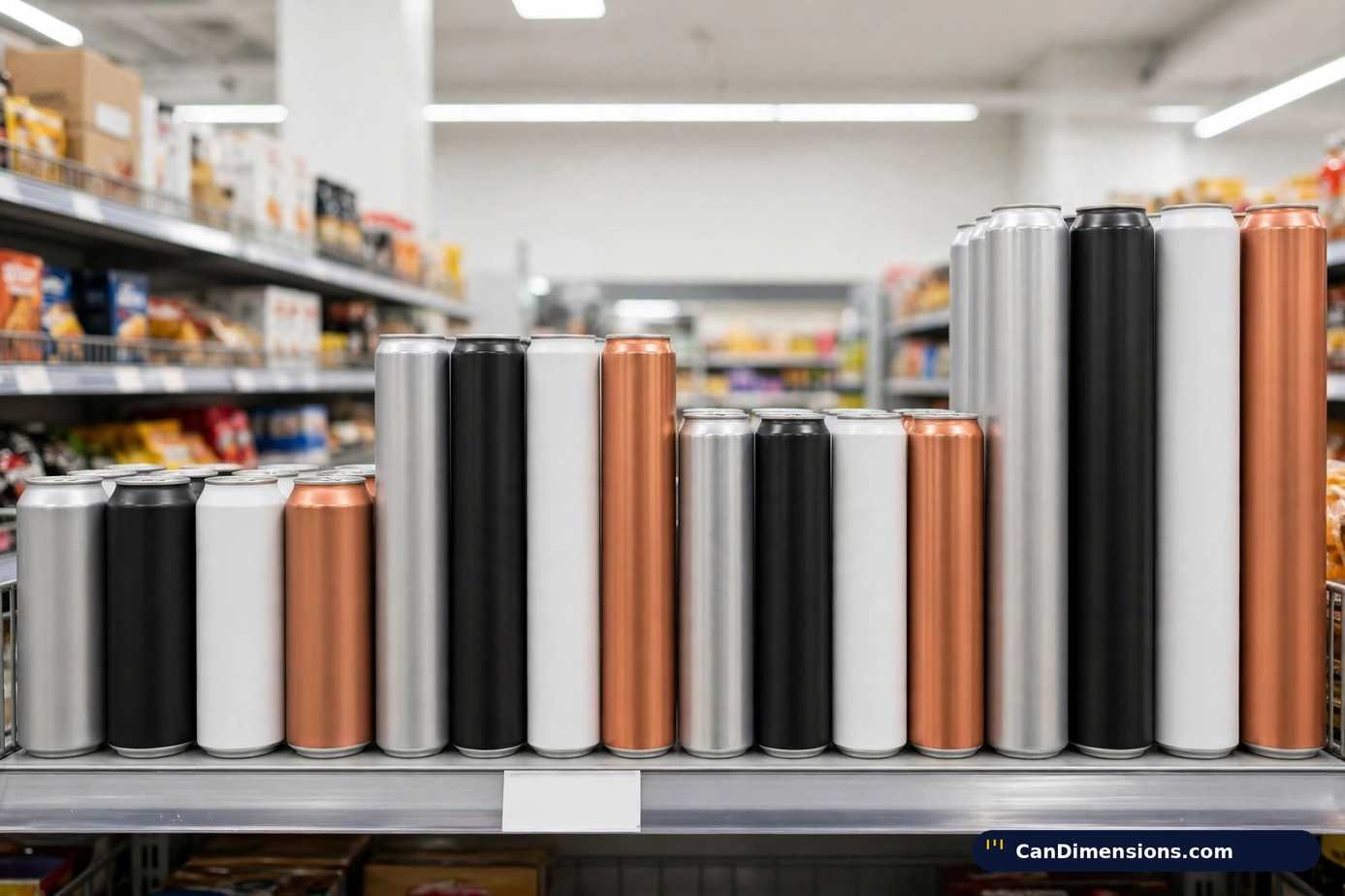
The ounce sizes above are American. Most of the world drinks from metric shells, and the two systems overlap more than they diverge, because the makers are the same companies.
Europe’s 330 ml standard is the world’s default soda can: 115.2 mm (4.54 inches) tall and 66.6 mm (2.62 inches) in outside diameter — Ardagh’s drawing for the 330 ml can gives a seamed height of 115.2 mm on a ø66 body, and IS 14407 tabulates the same shell. It is the US standard can’s close sibling: same body family, about a third of an inch shorter, 25 ml less inside.
The 500 ml can — 168.0 mm (6.61 inches) tall on the 66 mm body — is Europe’s tallboy, the standard single for beer and energy drinks across the continent, and the international shell behind many 16.9 oz imports. Japan and Brazil add their own staple: the 350 ml can, which is the 12 oz shell by another name — 355 ml and 350 ml fill the same standard body, which is why a Japanese soda can looks identical to an American one.
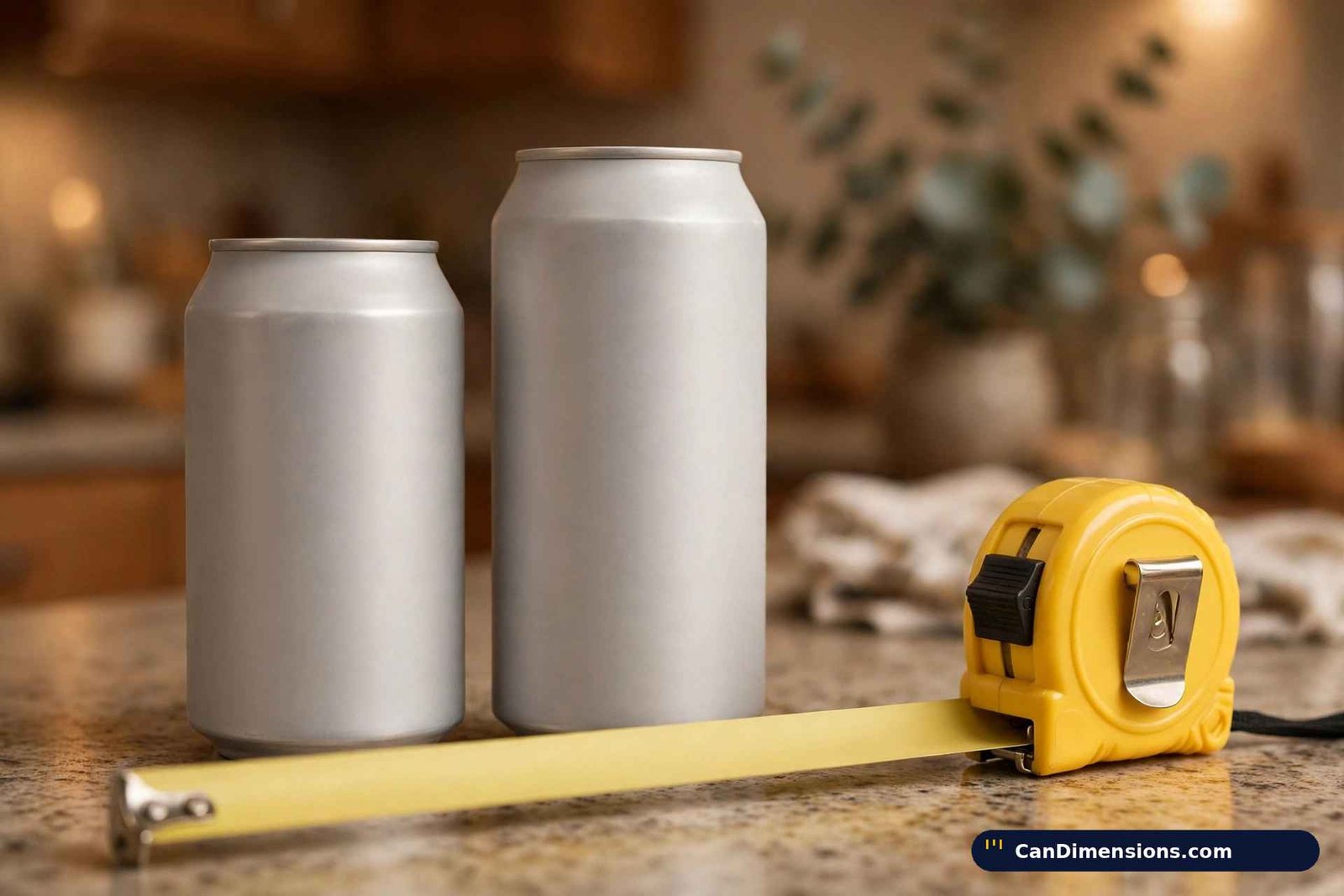
The lesson for anyone importing, exporting or designing wraps: convert volumes carefully, but measure bodies physically. A 330 and a 355 share a diameter and differ in height; a 250 slim and a 250 stubby share nothing but the number on the label.
How to Measure a Beverage Can Yourself
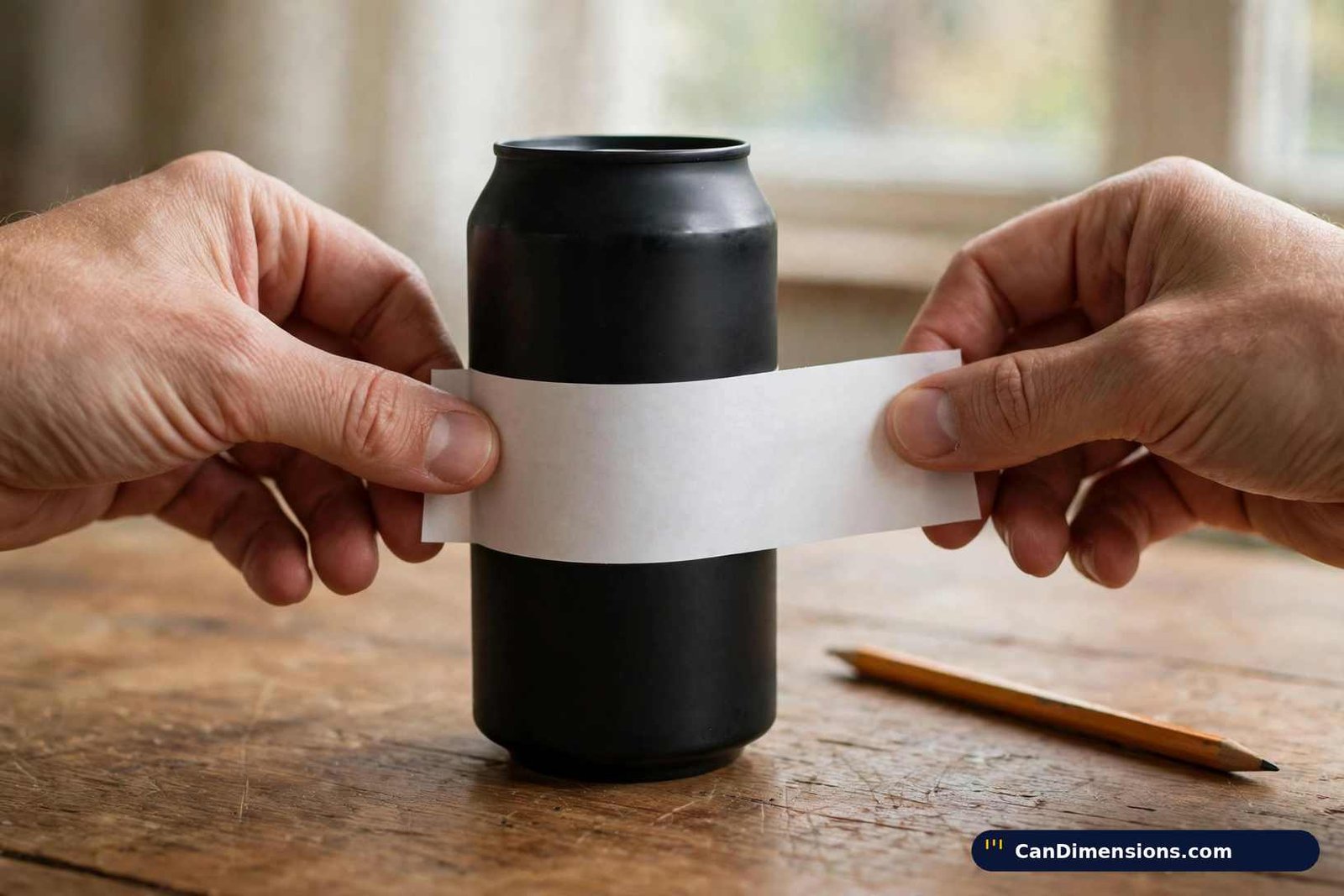
Stand the can on a flat surface, butt it against a wall, and lay a ruler flat across the top rim to read the height where it meets your measuring tape — measure the finished, sealed can, since an open empty can reads slightly differently at the flange. For the diameter, measure straight across the centre of the widest part of the body, never the lid: on a crowler especially, the base (2.86 inches) and the lid (a 300 end, 3 inches) are both narrower than the 3.29-inch body, and quoting either as “the diameter” is how the wrong numbers in circulation got there. Or wrap a strip of paper around the body, mark the overlap, measure the strip and divide by 3.14 to get the diameter from the circumference.
Koozie, cup holder and fridge fit. A standard foam koozie is cut for the 2.6-inch body, so the 330 ml, 12 oz, 16 oz and 19.2 oz cans all wear the same one. Sleek and slim cans rattle in it and want their own sleeves; the crowler fits no standard koozie at all. In a car cup holder, every standard-body can fits anywhere a soda can does, slim cans fit with room to spare, and the crowler’s 3.29-inch body is the one that will not go in. On a fridge door shelf, allow at least 5 inches of clear height for a 12 oz, 6.5 inches for a 16 oz and a full 8 inches for a stovepipe or crowler.

FAQ’s
What are the dimensions of a drink can?
A standard drink can in the USA measures 4.83 inches (122 mm) tall with a 2.6-inch (66 mm) diameter. This 12 oz format dominates the beverage market. Dimensions vary significantly by category, with energy drinks using taller slim formats at 5.28 inches by 2.1 inches, while mini cans measure about 4.11 inches by 2.28 inches.
What is the standard size of cans?
The standard can size is 12 oz (355 ml) with dimensions of 4.83 inches in height and 2.6 inches in diameter. This measurement became the industry norm through decades of market evolution. It balances serving size, production efficiency and distribution convenience across the beverage sector.
What size is a 250ml can?
A 250 ml can corresponds to 8.4 oz — but it is a volume, not a shape. The famous slim form measures 5.28 inches (134 mm) tall with a 2.1-inch (53.4 mm) diameter and dominates the energy drink category; the same 250 ml also comes as a 3.6-inch stubby on the standard-width body and a short sleek. The tall, slim proportions create distinctive shelf presence and fit easily in cup holders and bags.
What are the dimensions of a 24 pack of beer cans?
A 24-pack of standard 12 oz beer cans measures approximately 16 inches long, 10.5 inches wide and 5 inches tall — and this one checks out arithmetically: six cans by four at 2.6 inches each give a 15.6 by 10.4 inch footprint, and the 4.83-inch can plus its tray accounts for the height. Individual cans within the pack are 4.83 inches by 2.6 inches. Case dimensions vary slightly between cardboard carriers and shrink-wrapped formats, affecting pallet configurations used by distributors.
How much is a standard can size?
The standard can size is 12 oz (355 ml) in volume with physical dimensions of 4.83 inches height and 2.6 inches diameter. This became the default industry format for soft drinks, beer and most beverages. The measurement provides optimal balance between consumer preference and manufacturing efficiency.
How big is a 250ml coke can?
A 250 ml Coke can uses the slim shell: 5.28 inches (134 mm) tall and 2.1 inches (53.4 mm) in diameter — not the 5.75-inch height usually printed, which belongs to the taller 330 ml sleek. This format appears less commonly for Coke than the standard 12 oz size. The taller, slimmer profile differentiates it from traditional soda can dimensions and appeals to customers seeking portion control.
Conclusion
Beverage can dimensions reduce to a handful of shells: the standard 2.6-inch body carrying the 330 ml at 4.54 inches, the 12 oz at 4.83, the 16 oz at 6.19, the 500 ml at 6.61 and the 19.2 oz stovepipe at 7.41; the slim 250 ml at 5.28 × 2.1 inches and the sleek family at 2.26 inches wide; the mini at about 4.11 × 2.28; and the two wide cans, the 24 oz at about 7.7 × 2.9 and the crowler at 7.60 inches on its 3.29-inch body. Beyond them there is no standard can — the 64 oz is a glass jug wearing a can’s name.
Choose the shell before the label, and measure the can in front of you before you order the koozie, cut the shelf or trust any size chart — including the ones this guide corrected. Every format above began as an aluminium can drawn to a specification by a can maker, and the specification, not the chart that copies it, is the number that fits.