Magazine Dimensions: Standard Magazine Sizes in Inches, CM and MM
Magazine dimensions are the finished trim sizes of a magazine — the width and height of the closed publication after its pages are cut. They decide how an issue feels in the hand, what it costs to print and whether it fits a newsstand rack.
There is no single official standard. Letter size, 8.5 × 11 inches, is the figure quoted most often, yet most US consumer magazines actually trim a fraction smaller, at 8.375 × 10.875 inches — and famous titles such as Time, Vogue and National Geographic each use a smaller trim of their own.
Below you will find every standard format from pocket to oversized, a full conversion table, the sizes used outside the United States, and the binding and bleed allowances that change the size you actually send to a printer.

Standard Magazine Dimensions
Magazine sizes are always written as width × height, measured on the closed front cover — the trim size, meaning the size of the finished, cut publication. Three formats do most of the work in the United States — letter, digest and tabloid — but the size most consumer magazines really use is a fourth one that rarely gets listed. Here is the full standard set, with the examples corrected against the publishers’ own specifications:
| Format | Inches | Millimetres | Typical Uses |
|---|---|---|---|
| Letter | 8.5 × 11 in | 216 × 279 mm | Company magazines, catalogs, annual reports |
| Standard consumer magazine | 8.375 × 10.875 in | 213 × 276 mm | Most US newsstand monthlies |
| Digest | 5.5 × 8.5 in | 140 × 216 mm | Reader’s Digest and digest-format titles |
| Tabloid | 11 × 17 in | 279 × 432 mm | Community newspapers, supplements |
| 4 × 6 in | 102 × 152 mm | Pocket guides, mini editions | |
| Square | 8.5 × 8.5 in | 216 × 216 mm | Art, photography and music titles |
| Oversized | 9 × 12 in | 229 × 305 mm | Large-format fashion and art titles |
Letter Size Magazine (8.5 × 11 inches)
The letter size magazine, at 8.5 × 11 inches (216 × 279 mm), matches US letter paper, which makes it the easiest format to design, proof and print. It is the standard for company and independent magazines, catalogs, annual reports, newsletters and some academic journals — publications printed on ordinary office and commercial press stock.
One correction matters here, because letter size is usually illustrated with famous names it does not belong to. Time does not trim at 8.5 × 11 inches: Time Inc.’s own media kit gives its trim as 8 × 10.5 inches. National Geographic is smaller still, at about 7 × 10 inches, and Cosmopolitan’s publisher specifications put it at 7.875 × 10.875 inches. Letter is a real and common magazine size — just not the size of the newsstand titles most often used to picture it.
Digest Size Magazine (5.5 × 8.5 inches)
The digest size magazine measures 5.5 × 8.5 inches (140 × 216 mm) — exactly half of a letter page, which is why it prints so economically. Reader’s Digest gave the format its name, and the size still suits fiction digests, puzzle magazines, TV guides and condensed non-fiction: thick enough to feel substantial, small enough for a coat pocket or a handbag.
At 5.5 inches wide, a digest page is narrower than a dollar bill is long, so text columns stay short and type has to be set a little larger to remain comfortable. In exchange, digest titles are cheap to mail, cheap to shelve in quantity, and easy to read one-handed — the format’s whole appeal.
Tabloid Size Magazine (11 × 17 inches)
The tabloid size magazine measures 11 × 17 inches (279 × 432 mm) — two letter pages side by side. That is a newspaper’s economy, not a newsstand magazine’s: the format belongs to community weekly papers, free distribution papers, supplements and poster-style specials, where a big page carries big headlines and photographs at newsprint prices.
Tabloid is often illustrated with Entertainment Weekly, which is wrong twice over. Entertainment Weekly was a standard weekly magazine of about 8 × 10.5 inches, in the same class as Time — and its print edition ended in 2022, with the final print issue dated April 2022. A true 11 × 17 publication feels like a small newspaper in the hand, not like a weekly magazine.
Magazine Dimensions in CM and MM
Printers outside the United States — and many inside it — work in metric, so here is every format from this guide converted. The figures are exact conversions of the inch sizes (1 inch = 25.4 mm), rounded the way printers round them:
| Format | Inches | Centimetres | Millimetres |
|---|---|---|---|
| Letter | 8.5 × 11 in | 21.6 × 27.9 cm | 216 × 279 mm |
| Standard consumer magazine | 8.375 × 10.875 in | 21.3 × 27.6 cm | 213 × 276 mm |
| Digest | 5.5 × 8.5 in | 14 × 21.6 cm | 140 × 216 mm |
| Tabloid | 11 × 17 in | 27.9 × 43.2 cm | 279 × 432 mm |
| 4 × 6 in | 10.2 × 15.2 cm | 102 × 152 mm | |
| Square | 8.5 × 8.5 in | 21.6 × 21.6 cm | 216 × 216 mm |
| Oversized | 9 × 12 in | 22.9 × 30.5 cm | 229 × 305 mm |
| A4 | 8.27 × 11.69 in | 21 × 29.7 cm | 210 × 297 mm |
| A5 | 5.83 × 8.27 in | 14.8 × 21 cm | 148 × 210 mm |
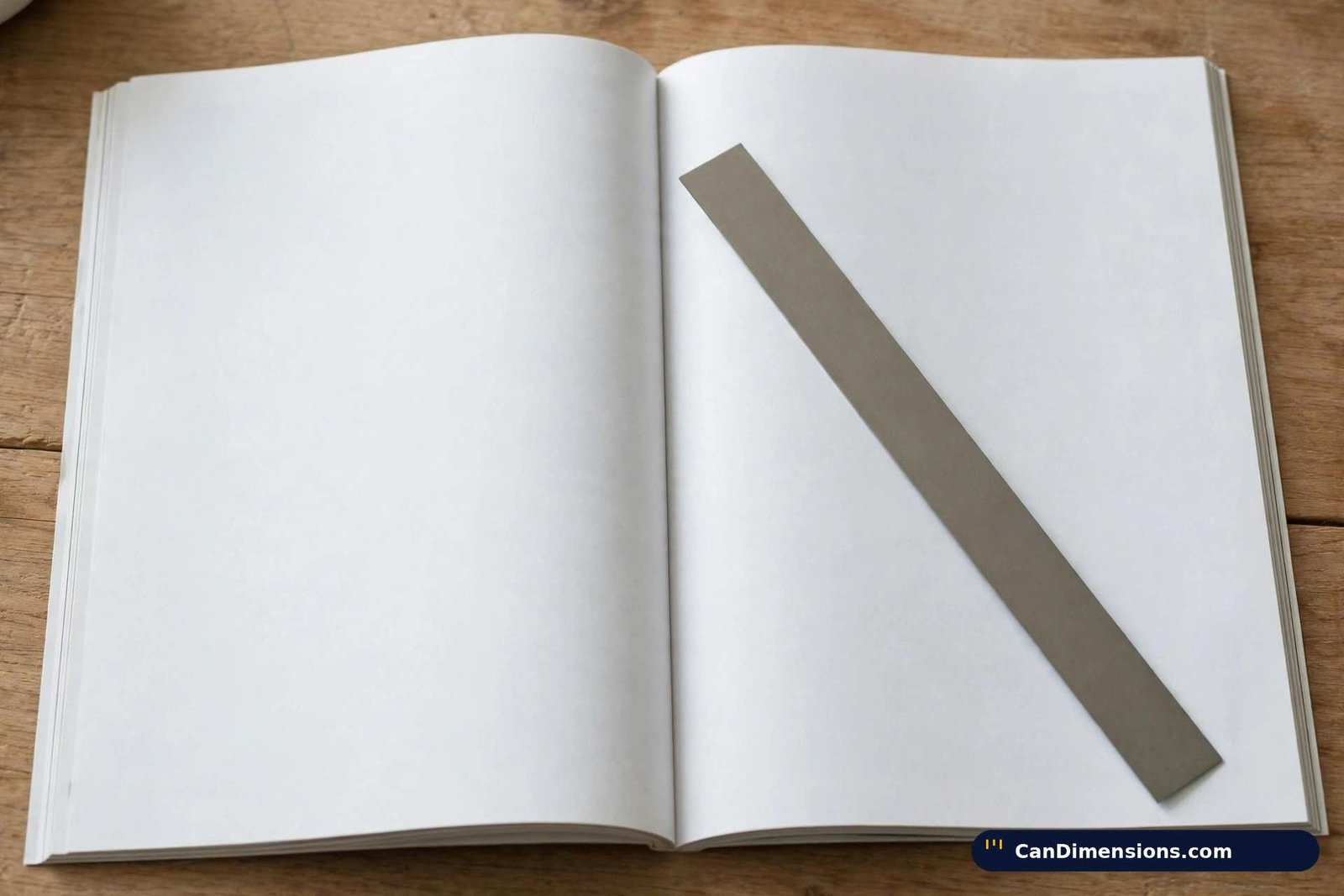
When you convert a size yourself, multiply inches by 2.54 for centimetres or by 25.4 for millimetres — and give your printer the figure in the unit their specification sheet uses, because a rounded conversion (216 mm for 8.5 inches, against the exact 215.9 mm) is the version their presses are set up for.
Magazine Sizes Around the World: A4 and A5
Most of the world does not start from letter size at all. Under the ISO 216 paper standard, the A-series rules: A4 measures 210 × 297 mm (8.27 × 11.69 inches) — slightly narrower and noticeably taller than US letter — and A5, at 148 × 210 mm (5.83 × 8.27 inches), is exactly half an A4 sheet and serves the role digest size plays in America.
In practice, European and British magazine titles start from A4 and then trim to their own size, much as US titles trim down from the consumer standard. British Vogue, for example, is specified by its publisher at 210 × 285 mm — A4’s width, but 12 mm shorter than a full A4 page. The lesson travels in both directions: on any market, the named paper size is the starting point, and the magazine’s real trim is whatever its publisher’s specification sheet says.
Magazine Binding Types and Their Impact on Dimensions
Binding does not change a magazine’s trim width or height, but it decides how thick the issue can be, how much of the page disappears into the spine, and which page counts are physically possible. The three bindings used for magazines each carry their own dimensional rules.
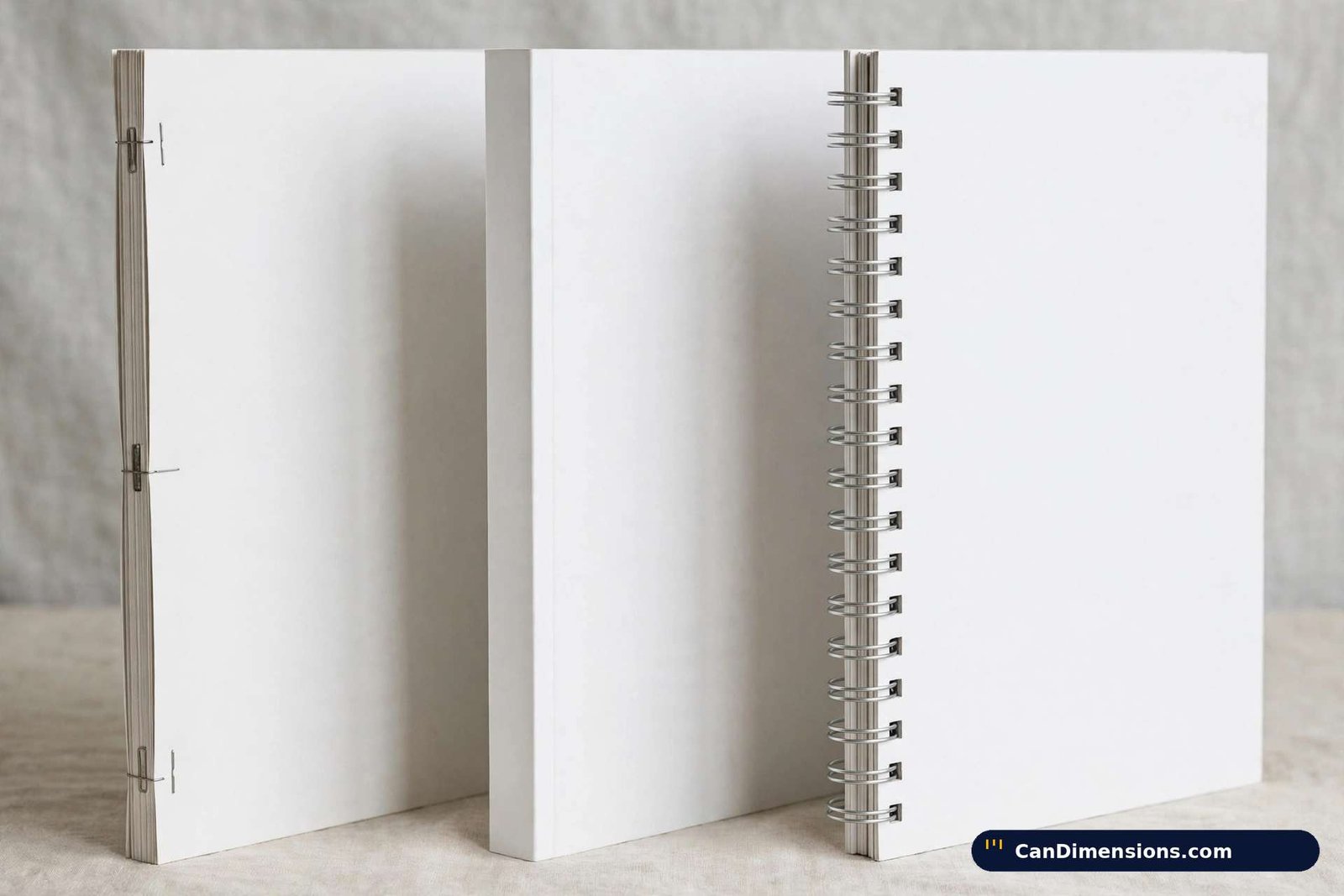
Saddle Stitch Binding
Saddle stitching folds printed sheets over a saddle and drives two or three wire staples through the fold. Because every sheet makes four pages, a saddle-stitched magazine’s page count must be a multiple of four, starting from a minimum of 8 pages. Printers cap the top end by thickness — one major US printer offers saddle stitching from 8 to 92 pages, while others stop earlier — because beyond a certain bulk the folded sheets creep and the issue will not lie flat. The binding adds nothing to the trim size, but the designer must allow for that creep on the outer pages of thick issues.
Perfect Binding
Perfect binding mills the folded edges flat and glues the pages into a wraparound cover, giving the magazine a square, printable spine. It needs enough pages to form that spine: printers set the minimum at roughly 28 pages, about a 1/8-inch spine, and the same printers will perfect-bind up to about 2 inches thick — several hundred pages. The dimensional cost is inside the page: text and images must be kept clear of the glue edge, and anything meant to cross a two-page spread will lose a strip down the middle.
Wire-O Binding
Wire-O binding punches the pages and threads them onto a double loop of wire. The magazine lies completely flat and folds back a full 360 degrees, which is why cookbooks, manuals, calendars and workshop magazines use it. Page count is flexible because single sheets — not folded signatures — are bound, but the punched holes eat a strip along the binding edge, so the live area of a Wire-O page is narrower than its trim suggests. Allow for the punch margin in the layout, or the holes will eat the text.
Magazine Trim, Bleed and Safe Area: How the Numbers Fit Together
Three different sizes hide inside every magazine dimension, and confusing them is the most expensive mistake in print design. The trim size is the finished page — the figure this whole guide lists. The bleed is the extra artwork that runs past the trim edge so no white sliver survives the cutter: the industry allowance is 0.125 inches (1/8 inch) on all four sides. The safe area (or live area) is the zone inside the trim where text and faces must stay — publishers’ specification sheets put it 0.25 inches (1/4 inch) inside the trim.
Worked through for a letter-size page, the stack looks like this: trim 8.5 × 11 inches; the file you send is 8.75 × 11.25 inches with bleed; and everything that matters stays inside 8 × 10.5 inches. Apply the same arithmetic to any format in this guide — add a quarter inch to each overall dimension for the file size, and subtract half an inch from each for the safe area. Perfect binding adds one more allowance: keep critical content further from the spine edge, because the glued fold swallows more of the page than a stapled one does.
Specialized Magazine Sizes and Formats
Beyond the standards sit the formats chosen for a purpose — portability, shelf impact or a subject that needs room. One more American specialty deserves a line before them: the standard US comic book trim, 6.625 × 10.25 inches, which sits between digest and standard and exists because comics were printed four-up on tabloid sheets.
Pocket Size Magazines (3.5 × 5 inches to 4 × 6 inches)
Pocket magazines run from 3.5 × 5 inches up to 4 × 6 inches (102 × 152 mm at the top of the range). The small end of that range, 3.5 inches, is exactly the height of a standard trading card, which gives a fair sense of scale: these are publications built for a jacket pocket, a glovebox or a travel bag — field guides, phrase books, mini editions and promotional booklets. Layouts run to one column, type stays large relative to the page, and images are chosen for impact at small size.
Square Format Magazines (8 × 8 inches or 8.5 × 8.5 inches)
Square magazines — 8 × 8 inches (203 × 203 mm) or 8.5 × 8.5 inches (216 × 216 mm) — borrow the proportions of a vinyl record sleeve, and the format belongs to art, photography, music and design titles. A square page treats landscape and portrait photographs equally, which no rectangular trim does, and the shape stands out on a shelf of standard spines. The trade-offs are real: square pages waste more of a rectangular press sheet, and the format mails at less favourable rates than standard sizes.
Oversized Magazines (9 × 12 inches and larger)
Oversized starts at 9 × 12 inches (229 × 305 mm) and runs upward. A page 9 inches wide gives photographs and fashion spreads room that no standard trim can match, and large-format art and fashion titles accept the format’s costs — heavier paper, higher postage, and an issue that fits neither a standard rack nor a standard shelf — because presence is the product. Handle an oversized magazine before you commit to the format: at this size, paper weight and binding strength decide whether the issue feels luxurious or simply fragile.
Digital vs. Print Magazine Dimensions
Print Magazine Specifications
A print magazine’s dimensions are fixed the day the specification sheet is written: one trim size, one bleed allowance, one paper stock, and every copy identical. The numbers in this guide — trim, bleed of 0.125 inches, safe area of 0.25 inches, 300 dpi images — are the whole contract between designer and printer, and they are why a print size can be stated in a single line.
Digital Magazine Dimensions
A digital magazine has no fixed size at all, because it is read on screens that range from a phone to a desktop monitor. Pixel figures quoted for digital editions are really device resolutions: 1536 × 2048 pixels is the Retina display of a 9.7-inch iPad, 1080 × 1920 is a common phone resolution, and a widely repeated figure like 1024 × 1366 is an iPad-class screen — not a desktop standard, because desktops have none. Designers therefore work in aspect ratios and responsive layouts rather than fixed pages; if you publish for phones, the pixel sizes in our guide to phone wallpaper dimensions show the screens your edition will actually meet. The print habit worth keeping is the safe area: whatever the screen, keep the important content away from the edges.
How to Choose the Right Magazine Size
Start from the reader’s hands, not the press. A publication read on trains and in waiting rooms earns its keep at digest or pocket size; a company magazine or catalog belongs at letter, where office printers and standard stock keep costs predictable; a title sold on photography needs the standard consumer trim at minimum, and oversized if the budget carries it. Then let the content vote: page counts above the saddle-stitch ceiling force perfect binding and its spine allowances, and any size outside the standards should be checked against postal rates and rack dimensions before the first issue, not after. When in doubt, the typical US consumer trim — 8.375 × 10.875 inches — is the safest default in publishing: it is the size the whole supply chain, from paper merchants to newsstand racks, is already built around.
FAQ’s
What Size is a Magazine?
Most US consumer magazines trim at 8.375 × 10.875 inches. Across all formats, magazine sizes run from pocket editions at 3.5 × 5 inches to oversized titles at 9 × 12 inches and larger.
What is the Standard Magazine Size in the United States?
The typical consumer-magazine trim is 8.375 × 10.875 inches, the size most newsstand monthlies cluster around. Letter size, 8.5 × 11 inches, is the standard for company magazines, catalogs and newsletters.
How does Magazine Size Affect the Design and Readability of a Publication?
Larger pages carry bigger images and more generous type; smaller formats force tighter columns and larger relative type sizes. Margins, bleed and safe areas all scale from the trim, so the size is chosen before the layout begins.
What are the Differences Between Pocket-Size, Digest-Size, and Standard Magazine Sizes?
Pocket magazines measure 3.5 × 5 to 4 × 6 inches and are built for carrying. Digest size is 5.5 × 8.5 inches — half a letter page. Standard consumer magazines trim at about 8.375 × 10.875 inches for shelf presence and advertising formats.
What Is the Standard Size of a Magazine?
As above: 8.375 × 10.875 inches for most US consumer magazines, with letter size (8.5 × 11 inches) standard for company publications and catalogs. There is no single legal standard — each publisher sets its own trim.
What Is the Size of a Magazine in Illustrator?
Set the document to the magazine’s trim — 8.375 × 10.875 inches for a typical consumer title, or 8.5 × 11 inches for letter — and add 0.125 inches of bleed on all sides. A letter document with bleed therefore measures 8.75 × 11.25 inches.
How to Change the Size of a Magazine in InDesign?
Open File → Document Setup, enter the new width and height, and set the bleed to 0.125 inches. Then check every page against the new trim, because existing layouts do not reflow automatically — margins, columns and placed images all need review.
What Is the Average Size of a Magazine Cover?
A magazine cover is the same size as the magazine’s trim, so the average US consumer cover measures about 8.375 × 10.875 inches. Covers are printed on heavier stock than the inside pages, but the dimensions match exactly.
How Do You Design a Perfect-Size Magazine in InDesign?
Start the document at the printer’s stated trim size, add 0.125 inches of bleed, and keep text at least 0.25 inches inside the trim. Build the layout on a baseline grid with consistent margins, and export to the printer’s PDF specification.
What Size is a Vogue Magazine?
US Vogue trims at 8 × 10.875 inches — narrower than letter size. British Vogue is specified by its publisher at 210 × 285 mm, close to but not exactly A4.
What Are the Dimensions of a Magazine?
Magazine dimensions span pocket size (3.5 × 5 inches) through digest (5.5 × 8.5), the standard consumer trim (8.375 × 10.875), letter (8.5 × 11) and tabloid (11 × 17), up to oversized formats of 9 × 12 inches and beyond.
What Is the Size of a Magazine Cover in Photoshop?
Set the canvas to the trim size at 300 dpi, the print standard. A letter-size cover is therefore 2550 × 3300 pixels, and a standard consumer cover (8.375 × 10.875 inches) is about 2513 × 3263 pixels — add bleed in the document setup if the printer requires it in the file.
How to Create a Professional Magazine Layout?
Fix the trim size first, then build a grid: consistent margins, a small set of typefaces at consistent sizes, and images placed to the grid rather than by eye. Keep every important element inside the safe area, and proof at 100% scale before the file goes to print.
How Do You Measure the Size of a Magazine?
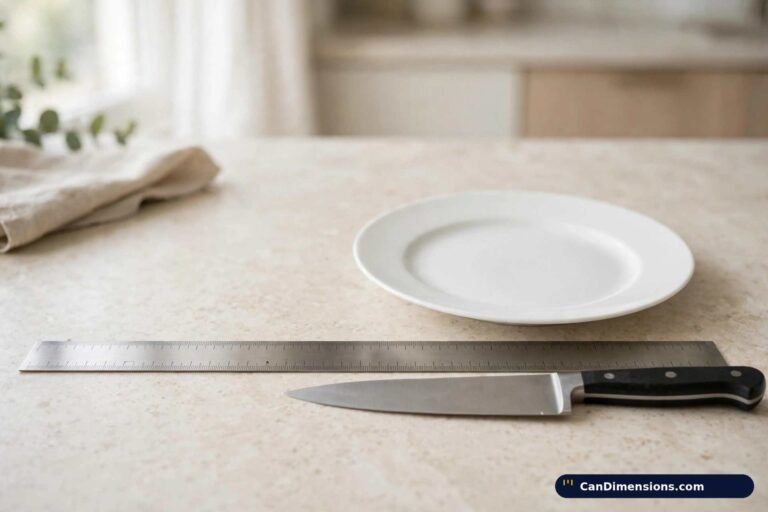
Close the magazine and measure the front cover with a ruler: width across, then height down the spine. Report it as width × height — that is the trim size, and it is the figure every source in this guide uses.
Conclusion
Magazine sizes look like a single standard and are really a family of them: letter at 8.5 × 11 inches for company publications and catalogs, the true consumer standard of 8.375 × 10.875 inches behind most famous titles — each of which, from Time at 8 × 10.5 to Vogue at 8 × 10.875, actually trims to its own figure — digest, pocket, square and oversized formats for special purposes, and A4-derived sizes across most of the world.
Whichever format you choose, the discipline is the same: confirm the trim from the publisher’s or printer’s specification, design with the 0.125-inch bleed and the 0.25-inch safe area, and let the binding’s page rules shape the issue from the start. From the first printing press runs to today’s responsive digital editions, that order of decisions — size first, everything else after — is what separates a magazine that prints cleanly from one that has to be rescued at the press.