What Does 30 Feet Look Like? 11 Things That Are 30 Feet in Daily Life
Ask what does 30 feet look like on a street, in a rink or out on the water, and the answers turn out to be hiding in catalogues and rule books: a farm bin sold by its 30-foot diameter, a fighting cage built 30 feet across, a circle painted on the ice with a 30-foot span.
The familiar street references still hold — the mid-size school bus, the 30-foot-class motorhome, the three-storey wall — provided each one is read the way its maker or its rule book actually states it. Several popular versions of those claims do not survive that reading, and the failures are kept below with the corrections attached.
This guide gives the conversions first, then tests 12 candidates against a specification, a standard or a published record. Eleven pass. One famous fish does not, and it stays on the page at its true size.

How Long Is 30 Feet?
In plain conversions, thirty feet comes to 360 inches, exactly 10 yards or 9.144 metres. No single room in an ordinary house runs that far, so useful comparisons have to come from larger things — vehicles, structures and playing surfaces rather than furniture.
| Unit | 30 Feet Equals |
|---|---|
| Inches | 360 in |
| Yards | 10 yd |
| Centimeters | 914.4 cm |
| Millimeters | 9,144 mm |
| Meters | 9.144 m |
Anyone who has paced out 25 feet along a driveway or across a garden can scale up from there: add a fifth of that span again and you have arrived. Three 10-foot lengths laid end to end give the same total — worth remembering, since 10 feet is both a stock trade length on building sites and the height of a basketball rim.
11 Common Things That Are 30 Feet Long or Tall
| # | Thing | Counted? | Basis |
|---|---|---|---|
| 1 | Standard Short School Bus | Yes | Class range — Blue Bird Vision Type C configurations run 25 ft 9 in to 41 ft 7 in; the 217-in-wheelbase bus measures about 29–31 ft |
| 2 | Large Motorhome or Class A RV | Yes | Labelled class — Winnebago Vista 29VE brochure length 30 ft 3 in; the current 29V is listed at exactly 30 ft |
| 3 | Giant Oarfish | No | Reliably measured record is about 7–8 m (23–26 ft); longer figures are unverified reports |
| 4 | 30-Foot Sailboat or Cabin Cruiser | Yes | Labelled class — Catalina 30 length overall 29 ft 11 in |
| 5 | Mature Suburban Shade Tree | Yes | Corrected species basis — eastern redbud matures at 20–30 ft; the species usually named grow 40–80 ft |
| 6 | 3-Story Residential Building | Yes | Rule of thumb — three residential floors at roughly 10 ft floor-to-floor |
| 7 | Airstream Flying Cloud 30 Travel Trailer | Yes | Labelled class — Airstream’s chart gives the Flying Cloud 30 an exterior length of 30 ft 10 in (30RB) / 30 ft 11 in (30FB) |
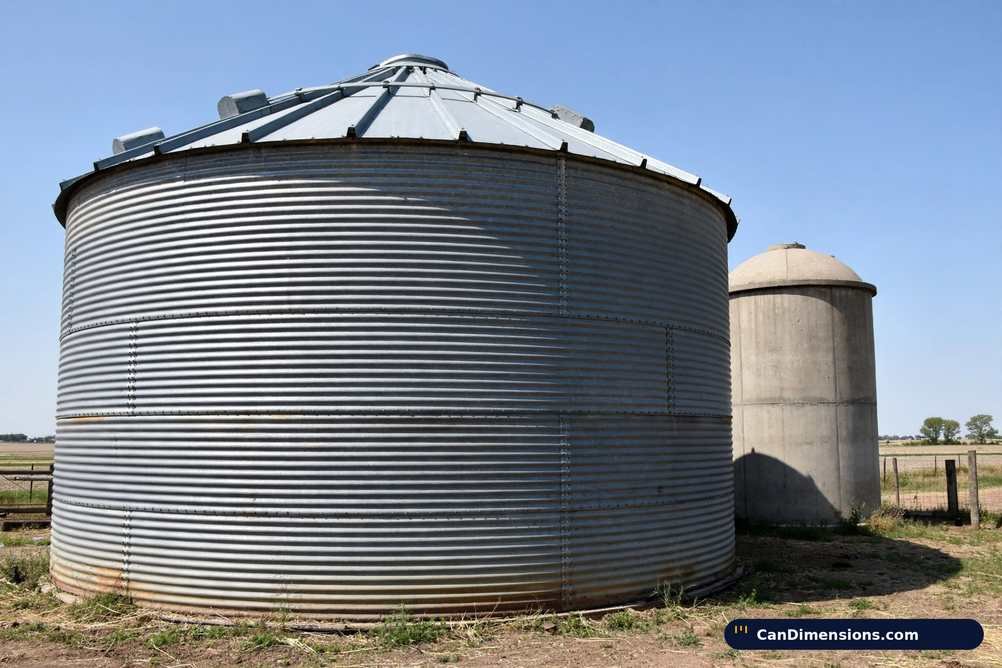
| 8 | A 30-Foot-Diameter Grain Bin | Yes | Standard size class — Sioux Steel publishes its commercial bin range for the “30 Ft Diameter” SCS30 series |
| 9 | An NHL Faceoff Circle | Yes | Exact by rule — the rule book marks each circle with a radius of 15 ft, a diameter of exactly 30 ft |
| 10 | The UFC Octagon | Yes | Official size — the standard Octagon measures 30 ft across; a smaller 25 ft version serves smaller venues |
| 11 | A Whale Shark | Yes | Range basis — average adults measure about 18–32 ft (5.5–9.8 m), so 30 ft sits inside the documented average band |
| 12 | Portuguese Man o’ War Tentacles | Yes | Typical figure — the tentacles typically run about 10 m (30 ft), though they can extend far beyond it |
1. Standard Short School Bus
Counted: On the class basis — the count rests on a configuration band within Blue Bird’s published range, stated openly here. For the Vision, its Type C conventional model, Blue Bird’s specification data spans 309 to 499 inches of overall length — 25 feet 9 inches to 41 feet 7 inches — across its wheelbase and body combinations. Within that span, buses on the 217-inch wheelbase come out at roughly 29 to 31 feet overall: a mid-size Type C of about 30 feet is a real, orderable configuration, and districts buy it for special-needs routes and small-group work.
The passenger figure attached to the claim, though, belongs to a shorter vehicle. Blue Bird’s wheelbase table pairs “up to 48 passengers” with the 189-inch wheelbase, while the 217-inch-wheelbase bus — the roughly 30-foot one — is rated at about 54 passengers. Corrected, the example stands in this form: not every short bus measures 30 feet, yet the mid-size Type C band passes directly through the mark.
2. Large Motorhome or Class A RV
Counted: On the labelled class basis, anchored to a named model. Class A motorhomes span the mid-20s up to 45 feet, and 30 feet marks the compact end of that family: Winnebago’s brochures give the Vista 29VE an overall length of 30 feet 3 inches, and the current Vista 29V is listed at exactly 30 feet. As the original list says, Winnebago, Coachmen and Forest River all centre their entry Class A lines on this class.
Its campsite claim, however, has to be softened rather than repeated. KOA and state-park campgrounds share no single standard pad length — pads differ from park to park and are reserved by maximum rig length. What can honestly be said is that 30-foot-class coaches are sized the way they are because they fit the mid-size pads that most parks provide. The class itself is real; the “standard pad” is a booking label, not a rule.
3. Giant Oarfish
Not counted: No checked measurement gets the giant oarfish — the longest bony fish alive — as far as 30 feet. Its verified record length stands at about 7 to 8 metres (23 to 26 feet) in the published record summary; the larger figures in circulation, up to 11 metres (36 feet), are reports rather than measurements, and the Florida Museum puts the size more commonly observed at around 10 feet. A genuine 30-foot specimen would clear the reliable record by roughly four feet.
So the claim that “several 30-foot specimens have washed ashore on American beaches” cannot stand. A stranding is precisely the occasion when a fish gets measured, and no measured stranding backs the claim up. At its true size the animal needs no help — a silver ribbon longer than a transit bus is wide — and it stays on this page, corrected, because inflating it to fit the headline is the rounding habit this page refuses to repeat.
4. 30-Foot Sailboat or Cabin Cruiser
Counted: On the labelled class basis. In American recreational boating, thirty feet is where the entry-level cruising class sits, and its defining boat proves the point neatly: the Catalina 30 — more than 6,500 hulls launched between 1974 and 2008 — carries a length overall of 29 feet 11 inches (9.12 m) in the International Catalina 30 Association’s figures. Catalina, Hunter and Beneteau all market flagship models in the class, as the source list notes, and marinas price their slips by the class length.
One disclosure covers every boat in this guide: the number in the class name is a nominal one. The hull’s measured length overall comes within an inch of it, one way or the other, and items like the pulpit, swim platform and outboard fall outside the figure altogether. A “30-foot sailboat” is a genuine class reference — towable in some layouts and slip-sized in every one — provided nobody promises a tape-exact 360 inches of fibreglass.
5. Mature Suburban Shade Tree
Counted: On a corrected species basis — the claim survives only after its trees are swapped. Red maple finishes at 40 to 60 feet, white oak at 50 to 80 feet and American elm at 60 to 80 feet, so none of the three species usually named here is a 30-foot tree at maturity, regardless of how a young street planting looks in its first decade. The supporting authority claim fails too: neither the Arbor Day Foundation nor the Forest Service publishes any classification making 30 feet “the standard mature height for suburban street trees”.
The tree that honestly fits is a small ornamental, the eastern redbud (Cercis canadensis) of eastern and central front yards, which the extension services — NC State’s Plant Toolbox and the University of Illinois among them — put at 20 to 30 feet tall at maturity. Thirty feet is the ceiling of that small-tree class: a mature redbud shading a sidewalk stands exactly that tall, blossom included.
6. 3-Story Residential Building
Counted: On the floor-height basis used throughout this family of guides. Residential floors are conventionally reckoned at ten feet apiece — an 8- or 9-foot ceiling plus the structure of the floor above — so the wall of a three-storey home tops out at about 30 feet, its top plate, where the roof takes over, sitting roughly five and a third adults above the pavement.
Two disclosures belong with it. First, the figure covers the three floors only, not the roof peak, which adds several feet more. Second, the code claim attached to this example is garbled: the International Residential Code’s scope extends to one- and two-family dwellings and townhouses up to three stories; it does not “reference 30-foot building heights consistently in stairwell, egress, and fire safety requirements”. The simpler truth is that the residential code’s world ends at three storeys — and three storeys is about 30 feet of wall.
7. Airstream Flying Cloud 30 Travel Trailer
Counted: On the labelled class basis, against the maker’s own chart. Airstream’s specification chart for the Flying Cloud 30 gives an exterior length of 30 feet 10 inches for the 30RB layout and 30 feet 11 inches for the 30FB — the “30” in the model name is the class, and the aluminium shell runs about ten inches past it. The trailer family is distinct from the motorhome counted above: this one is towed, not driven, and it is the size thousands of owners hitch up every weekend.
The disclosure matches the boat’s: a buyer ordering a “30-foot trailer” receives a trailer whose measured shell is a little under 31 feet, bumper to hitch. The class figure is what parks, storage yards and ferry lanes bill by, which is why the class — stated with its overage — is the honest way to count it.

8. A 30-Foot-Diameter Grain Bin
Counted: As a standard manufacturer diameter class. Farm grain bins are ordered by diameter from a fixed ladder of sizes, and 30 feet is one of its standard sizes: Sioux Steel publishes its commercial bin specification sheet for the “30 Ft Diameter” SCS30 series, and Sukup’s bin lines list 30 feet among their standard diameters. A working farm’s most recognisable structure is, across its middle, exactly this page’s length.
As with any round structure, the direction of the measurement needs stating: the 30 feet runs across the circle’s middle, as a width. It earns its place regardless, because diameter is the dimension a bin is ordered, sited and filled by — and standing in a 30-footer’s noon shadow gives a quick feel for the ground it commands, about 707 square feet of it.
9. An NHL Faceoff Circle
Counted: Exactly, by rule. The NHL’s Official Rules mark the centre-ice circle and each end-zone faceoff circle with a radius of fifteen feet (15′) from the centre of the faceoff spot — Hockey Canada’s rink technical guidelines state the same marking as a 30 ft diameter (9.14 m). Every rink in the league carries five of these circles, and every game restarts inside them.
That makes the faceoff circle the most-watched 30 feet in winter sport: a span viewers see a dozen times a night without ever hearing it named as a measurement. Stand at one side of the circle and the far edge is a full three-storey wall laid flat on the ice.

10. The UFC Octagon
Counted: Exactly, on the promotion’s published size. UFC events use two official Octagon sizes, and the standard one measures 30 feet in diameter, with about 750 square feet of fighting space inside a 6-foot fence; a smaller 25-foot version serves smaller venues such as the UFC APEX. The standard cage is the one on every major card.
For an eight-sided shape, “diameter” needs one clarification: the 30 feet spans the fighting area from one side to the opposite one, rather than measuring any single fence panel. Taken the way the promotion takes it, the cage encloses a fighting span equal to the length this whole page is about.
11. A Whale Shark
Counted: On a range basis, with the range stated up front. The whale shark is the largest fish in the sea, and published averages for adults put the species at about 18 to 32 feet (5.5 to 9.8 metres) — a band with 30 feet inside it, well short of the record individual accurately measured at 61.7 feet (18.8 m).
So the count needs no rounding in either direction: 30 feet is neither the species’ ceiling nor a juvenile’s promise, but a size healthy adults routinely reach. The oarfish above had to be inflated to get here; the whale shark qualifies on its documented average alone.

12. Portuguese Man o’ War Tentacles
Counted: On the typical figure, with the extremes disclosed. The Portuguese man o’ war drifts at the surface on a float only inches long, while its fishing tentacles hang below it — typically about 10 metres (30 feet) in length, on the published species accounts, and capable of extending past 30 metres (100 feet) in mature colonies. National Geographic’s profile gives the same pairing: tentacles up to 165 feet, with 30 feet the average.
So the most dangerous 30 feet on this page is also the least visible: a curtain of stinging threads the length of a three-storey building, trailing under a float the size of a dinner plate. The count rests on the typical figure, not the maximum — the honest end of the range to build on.
30 Feet Sideways: When the Measurement Is a Width
Four of the counted entries above — the grain bin, the faceoff circle, the Octagon and the round span of a whale shark’s world — measure this length across rather than along. That is not a loophole. Diameter is the dimension each of those objects is specified, sold and officiated by: bins are ordered by it, rinks are painted to it, cages are sanctioned at it.
Sideways spans are also the easiest form of the length to judge in person. A length along a street disappears into perspective; a width across a circle sits inside one field of view. If a claimed 30 feet ever feels abstract, picture the circle first — 30 feet across, about 94 feet around its edge — and the street-length examples fall into place behind it.
How to Visualize 30 Feet Without a Measuring Tape
Four field methods, each good enough to estimate 30 feet on the spot:
| Method | Accuracy | How To |
|---|---|---|
| 3-Story Building Height | ★★★★★ | Standard 10-foot floor × 3 |
| Short School Bus Length | ★★★★★ | A mid-size Type C bus in its roughly 30-ft configuration |
| First-Down Chain | ★★★★★ | The chain itself — exactly 10 yards, no multiplying |
| 2 Sedan Car Lengths | ★★★★☆ | Standard ~15-foot car × 2 |
One circulating shortcut has to be corrected in print: the football method is often written as “first down distance × 3”. But the first-down distance is itself 10 yards, and 10 yards is 30 feet — tripling it produces 90 feet. Pulled taut on the sideline, the chain crew’s chain is the entire measurement in one span. Indoors, an ordinary door is 30 inches wide, so twelve door-widths in a row give a hallway check that lands on the same total.
How Far Is 30 Feet on Foot? Steps, Seconds and Strides
Walk it and the distance resolves into a dozen ordinary steps, reckoning a comfortable stride at roughly 2.5 feet. Time it instead and a stroll at 3 miles per hour — 4.4 feet per second — crosses the span in about 7 seconds. Traffic erases it far faster: at 30 miles per hour a car eats 44 feet every second, so the whole span is gone in roughly 0.7 of a second — one reason driving instructors measure following gaps in seconds rather than feet.
A second check is built into the body. Stretched fingertip to fingertip, an adult’s arm span comes out close to their height, so spans of your own, five and a third of them in a row, cover the ground — the same five-and-a-third that the human comparison gives for this length wherever it appears.
Where Does 30 Feet Appear in Daily Life?
Transportation: Roads supply the two most familiar sightings — a mid-size school bus built on the 217-inch wheelbase in its roughly 30-foot Type C form, and a Class A motorhome from the named 30-foot class — vehicles Americans pass daily on residential streets, highways and campground loops.
Marine & Recreation: On the water, 30-foot sailboats and cabin cruisers form America’s most popular entry-level cruising segment, the hull class first-time owners and experienced coastal sailors alike choose at dealerships and marinas across the country, where slips are let by class length.
Nature & Wildlife: Nature’s honest entries are a whale shark inside its 18-to-32-foot average band, a man o’ war trailing typically 30 feet of tentacles, and a mature eastern redbud at the top of its 20-to-30-foot range — while the giant oarfish so often rounded up to this length has never been reliably measured past about 26 feet.
Construction & Architecture: In the built world the 3-story threshold gives 30 feet an outsized role in American residential real estate: three floors of 10-foot wall, at the upper limit of the residential code’s scope and echoed through zoning rules and neighborhood design standards in every U.S. state.
Why 30 Feet Keeps Appearing in Rule Books and Catalogues
Lengths that people must agree on get standardised, and 30 feet is one of the sizes the agreement landed on. Leagues froze it into paint and fence: a 15-foot radius in the hockey rule book, a 30-foot cage in the UFC’s published sizes. Manufacturers froze it into ladders of stock sizes: bin diameters stepping through 30 feet, trailer classes named for it, bus configurations built inside a range that runs straight through it.
That is also why the trustworthy references on this page share a shape — each one names its basis, whether that basis is a rule, a spec sheet, a class name or the middle of a published range. A 30 feet that nobody can point to a document for is usually a rounding wearing a costume.
Almost 30 Feet: The Near Misses Worth Knowing
Three famous spans crowd this length without touching it. A squash court measures 32 feet long (9.75 m) under the World Squash Federation’s specification — two feet over, close enough to fool anyone pacing it out. An Olympic diving platform stands 10 metres high, which converts to 32 feet 10 inches — nearly three feet past the mark, however often it is quoted as “about thirty”.
The third miss is a missing product: there is no standard 30-foot shipping container. The ISO fleet runs in 20-foot and 40-foot units, so a “30-foot container” in a listing is either a cut-down conversion or a mistake. Knowing the near misses — and the non-existent one — keeps the 11 counted references honest.
Question’s
How long is 30 feet compared to a human?
Against an average adult of 5 feet 8 inches, 30 feet works out at roughly 5.3 times that height — five and a third people head to toe. Six would overshoot, reaching about 34 feet.
How many car lengths is 30 feet?
About 2 standard car lengths: a typical American sedan runs roughly 15 feet from bumper to bumper, so a pair parked nose to tail covers it.
What is 30 length in feet?
In other units, 30 feet is 360 inches, 10 yards, or 9.144 meters exactly — picture the mid-size Type C bus, a 30-foot-class Class A motorhome, or a 30-foot sailboat sitting in its marina slip.
How tall is 30 feet in stories?
Roughly 3 stories in a standard American building, reckoning the typical 10-foot floor-to-floor height of U.S. residential construction and measuring to the top of the third floor’s wall, before the roof.
How many cars will fit in 30 feet?
2 standard cars, at approximately 15 feet apiece bumper to bumper, parked nose to tail with barely a gap between them.
Is 30 feet a common height for a tree?
For small trees, yes; for the classic shade trees, no. 30 feet tops the range of small ornamentals like the eastern redbud (20–30 feet), while red maple, white oak and American elm mature at 40 to 80 feet, well past the mark.
How far is 30 feet in a house?
Longer than any one room in a typical home: imagine a generous open-plan living area of about 20 feet with a hallway tacked on, or the whole frontage of a modest single-story house. The scale is a house’s main span, not one room inside it.
How far is 30 feet visually?
Summon any of three ground-level pictures: a mid-size Type C bus, bumper to bumper, the top of a 3-story building’s wall overhead, or the far edge of a faceoff circle from where you stand on the ice.
Final Thoughts
Stood next to, stood inside or measured across, thirty feet stops behaving like an abstraction. It shows up as the bus waiting at the kerb and the trailer settled on its pad, but equally as the bin in the farmyard, the circle painted on the ice and a common adult size for the largest fish in the sea — and behind every one of those references sits a document that can be checked.
That is the thread running through the list: each entry declares the basis it rests on. Where a famous example failed its claim — the oarfish above — the guide kept it visible and said so, rather than stretching a 26-foot fish to fit a headline.
Next time you need the length in a hurry, count five and a third adults, look for three storeys of wall, or walk it off in twelve ordinary steps. And if you are anywhere near a rink, find the painted circle: the rule book’s own octagon may belong to another sport, but the 30-foot span under the skaters is this page’s length, drawn to the inch and hiding in plain sight.