Coke Can Engineering: How Big Is a Coke Can, and Why Is It Shaped That Way?
Most people who ask how big is a coke can want two numbers, and the standard can supplies them: 4.83 inches tall, 2.6 inches across the body, holding 12 fl oz (355 ml). Those figures open this guide, and the full size chart follows with every correction applied.
What the two numbers hide is that neither was chosen freely. Height and width on a modern drinks can are the visible end of a chain of engineering decisions — how the top is narrowed, why the base curves inward, how a wall thinner than a credit card holds a pressurised drink — and each size in the range inherits those decisions.
So this page works in two passes. First comes the complete verified record: every Coke can format, in inches, centimetres and millimetres, with the widely copied errors named and replaced. Then comes the engineering reading of that record, explaining why the cans measure what they measure.
Coca-Cola Can Dimensions Comparison
One table holds the whole range. Figures are the can makers’ specifications for each format — measured shells, not rounded guesses — and two formats circulating in copied charts have been removed from it, for reasons their own sections give below.
| Can Format | Height | Diameter | Volume | Typical Use |
|---|---|---|---|---|
| Mini (7.5 oz) | 4.09 in (10.4 cm) | 2.26 in (5.7 cm) | 222 ml | Smaller servings, lunch boxes |
| Standard (12 oz) | 4.83 in (12.27 cm) | 2.6 in (6.6 cm) | 355 ml | The everyday serving |
| Slim / Sleek (12 oz) | 6.13 in (15.6 cm) | 2.25 in (5.7 cm) | 355 ml | Premium lines, slimmer grip |
| Tall Boy (16 oz) | 6.19 in (15.7 cm) | 2.6 in (6.6 cm) | 473 ml | A larger single serving |
| 330ml (Europe) | 4.54 in (11.52 cm) | 2.6 in (6.6 cm) | 330 ml | Standard across Europe |
| 330ml Sleek | 5.75 in (14.6 cm) | 2.26 in (5.7 cm) | 330 ml | Europe’s narrow format |
| 375ml (Australia) | 5.08 in (12.9 cm) | 2.6 in (6.6 cm) | 375 ml | Standard across Australia |
| 250ml Slim | 5.28 in (13.4 cm) | 2.1 in (5.3 cm) | 250 ml | Vending, airlines, mixers |
Read down the diameter column and the family’s organising fact appears. Only two body widths exist here: the 2.6-inch (66 mm) shell and the narrow shells at about 2.25 and 2.1 inches. Volume is adjusted almost entirely by altering height, which is why cans of very different capacities still drop into the same vending coils and pack into the same case grids.
Standard Coke Can Dimensions in USA
The Classic 12 oz Coke Can Size
North America’s default single serving stands 4.83 inches (12.27 cm) tall, and its body spans 2.6 inches (6.6 cm) at the widest point. Up top, the shell narrows to a lid measuring 2.13 inches (5.41 cm), producing the shouldered profile anyone can recognise by silhouette alone.
Can makers file this shell under a code, 211 × 413: the 211 names the body family (nominally 2 and 11/16 inches, 66 mm as manufactured), and the 413 records a height of 4 and 13/16 inches. The lid belongs to the 202 family, the same end fitted across most of the range, which is why opening any of these cans feels identical under the thumb.
Nor is the shell exclusive to one brand. Rival cola makers fill the identical 4.83 × 2.6 inch format, because the size long ago became the continent’s shared soda standard rather than one company’s property.
Anatomy of a Standard Coke Can
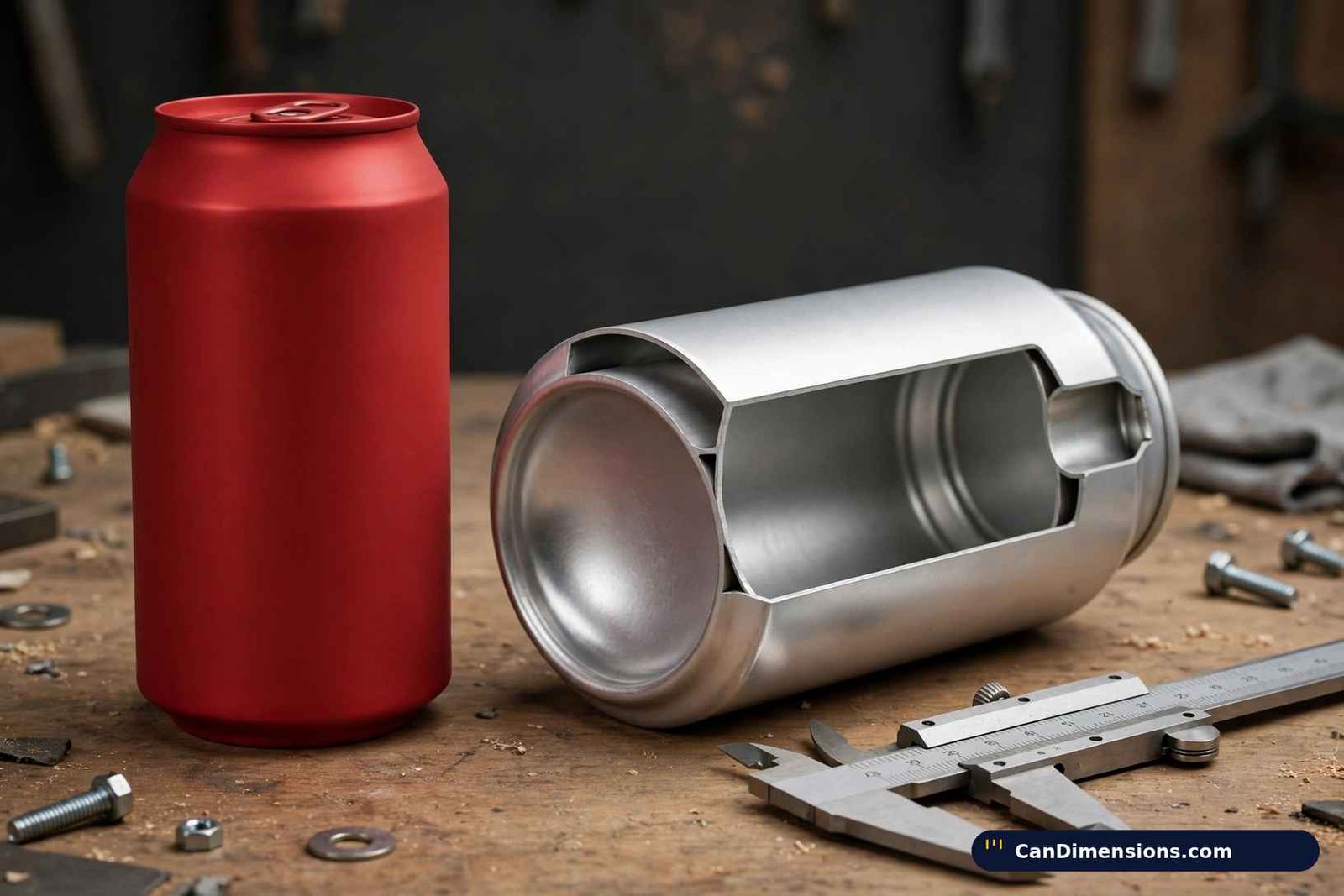
Three regions make up the finished can. The body is the straight-walled cylinder carrying the drink; its aluminium measures near 0.1 mm, yet a sealed can feels hard in the hand because the pressurised contents stiffen it from within. The neck is the sloping shoulder where the body draws inward toward the lid. The lid is where the stay-on tab sits, above the scored panel that folds inward as you drink.
Turn the can over and a fourth feature appears: the base curves upward into a dome. That inward dome is load-bearing design, not decoration — it helps the thin shell support the weight of filled cans stacked above it in cases and warehouses, and it resists the outward push of the carbonated drink sealed inside.
Why the Coke Can Is Necked, Domed and Thin-Walled
Every contour on the standard can answers a cost or a force. Take the neck first. Lid metal is the priciest aluminium in the package, and a lid spanning the full 2.6-inch body on every can would consume far more of it. Drawing the top inward to 2.13 inches shrinks each lid, and multiplied across the billions of cans filled yearly, that narrowing — called necking — is among the largest material savings in all of packaging.
The dome answers force instead of cost. A flat base of the same thin metal would bulge outward under carbonation pressure and rock on a shelf; the inward curve converts that push into tension the shell handles easily, while also letting one can’s base settle onto the lid below it in a stack. Strength here comes from geometry, not thickness.
Thin walls complete the logic. At roughly 0.1 mm, the body wall contributes almost nothing on its own; the sealed, pressurised system does the work. Open the can, drink it, and the same wall collapses in one hand — the clearest home demonstration that the drink’s pressure, not the metal’s bulk, supplied the rigidity.

Different Coke Can Sizes and Their Dimensions
Mini Coke Can Dimensions (7.5 oz)
The smallest American format holds 7.5 fl oz (222 ml) and belongs to the narrow family, not the standard one: 4.09 inches (10.4 cm) tall on a diameter of about 2.26 inches (5.7 cm). Its specification is a sleek shell, recorded by makers as a 402 height on a 204 body. Charts showing this can at the standard body’s width have confused it with its larger sibling.
Short and slim, it suits lunch boxes and low shelves, and with roughly 90 calories of Coca-Cola inside, it serves drinkers who want the original drink in a deliberately smaller serving.
Tall Boy Coke Can Size (16 oz)
Sixteen fluid ounces (473 ml) arrive by stretching the standard shell upward and changing nothing else: 6.19 inches (15.7 cm) tall, body still 2.6 inches (6.6 cm). Ardagh’s sheet gives the format a finished height of exactly 6.190 inches, on the familiar 211 body under a 202 end.
An unchanged footprint means the tall boy rides in the same holders, coils and carriers as the 12 oz can; only headroom grows. It is the identical shell the brewing trade uses for its pint cans, as the beer can dimensions chart shows size for size. Coca-Cola sells the format mainly as chilled singles in convenience outlets.
Large Format Coke Cans (20 oz and 24 oz)
This heading survives because the search is common, but its premise fails: Coca-Cola sells no 20 oz or 24 oz can in the US market. The documented American can range stops at 16 oz — 7.5, 12 and 16 fl oz — and the 20 oz Coke familiar from petrol stations is a plastic bottle. Any chart printing measurements for a 20 oz Coke can has invented them; no maker specification exists to copy.
Oversized cans genuinely exist one aisle over, where other brands fill 24 oz formats on stretched standard bodies — the monster can dimensions guide measures that class. For Coke itself in a can, plan around the 16 oz tall boy as the largest option.
One Body, Many Heights: How One Shell Becomes Five Cans
Lay the 66 mm family out by height and a production strategy becomes visible. The 330 ml can stands 4.54 inches; the American standard, 4.83; the Australian 375 ml, 5.08; the tall boy, 6.19. Four capacities, one diameter, one lid family — a filling plant changes a format largely by changing how tall the shell is drawn, while its seaming, packing and vending equipment carries on untouched.
The narrow family repeats the pattern at a smaller width. On the roughly 57 mm sleek body: the mini at 4.09 inches, the European 330 ml sleek at 5.75, the 12 oz sleek at 6.13. Height does all the volumetric work there too, which is why a mini and a sleek can feel related in the hand despite holding 222 ml and 355 ml respectively.
This is also why the wider beverage can dimensions family looks so orderly beside other packaging. Bottles multiply shapes freely; cans multiply heights within a couple of fixed bodies, and the whole distribution system — cases, pallets, coolers, dispensers — is engineered around that restraint.

Slim Coke Can Dimensions
What Makes Slim Cans Different
The slim format keeps the serving and redraws the silhouette: narrower around, taller overall. The trade name for the profile is the sleek can, and Coca-Cola reserves it largely for Diet Coke and premium or limited lines, where the elongated outline signals something more deliberate than the everyday standard.
It sits within a broader narrow-can family. The sleek body at about 2.25 inches is still wider than the true slim shell used by classic energy cans — the red bull can dimensions record that format at 2.1 inches — so “slim” on a cola shelf and “slim” on an energy shelf name two different shells.
Slim Can Size Specifications
The 12 oz sleek can stands 6.13 inches (15.6 cm), and its body spans about 2.25 inches (5.7 cm) — the maker’s specification for the format (a total height of 6.13 inches in Ball’s listing). The 202 lid is shared with the standard format, so the top face and the opening action feel familiar.
Europe’s sleek edition of its own standard, the 330 ml sleek, stands 5.75 inches (14.6 cm) on the same 2.26-inch (57 mm) body. A pocket rule separates the pair from the standard can at a glance: taller by about 1.25 inches, narrower by about 0.35 inches.
Advantages of Slim Coke Can Dimensions
Grip leads the list: a body near 2.25 inches closes securely in smaller hands and drops easily into holders and side pockets built for bottles, where a standard can wedges tight. Retailers gain a second benefit — more cans stand across a given shelf row — and the tall face gives artwork a vertical billboard no standard can matches, which is precisely why special editions favour the format. Any claim of an exact percentage gain in shelf capacity, though, is marketing arithmetic; none is printed here, because no maker publishes one.
Criticisms and Drawbacks
Height collects the complaints. A tall can on a narrow footprint carries its weight high, so it topples sooner on a car seat or an uneven picnic table. It also demands about 6.5 inches of clear shelf height, ruling out shallow fridge-door bins and some cooler lids. And since the sleek can holds exactly what the standard holds, sceptics read the format as styling rather than progress — a fair charge the sales of both formats leave permanently unsettled.
International Coke Can Dimensions
330ml Coke Can Size (Common Import)
Across Europe the standard pour is 330 ml, in a can measuring 4.54 inches (115.2 mm) tall by 2.6 inches (66 mm) — the American body, shortened slightly, holding 11.2 fl oz. Guides printing 4.75 inches for this format contradict the 115 mm figure every maker’s sheet agrees on; 115 mm converts to 4.54 inches, and that is the height used throughout this page.
Stateside, the size turns up in imported Coca-Cola, world-food aisles and European beer and soda sold under the same shell.
375ml Coke Can Dimensions (Australian Standard)
Australia pours larger: 5.08 inches (12.9 cm) tall on the 2.6-inch (66 mm) body, holding 375 ml (12.7 fl oz). The height comes from the Australian maker Orora’s listing of the classic can at 129 mm. Note the direction of the comparison — at 129 mm this can stands taller than the American standard’s 122.7 mm and holds 20 ml more, so the common description of it as a mid-sized can fails on height and on volume alike.
The size is a fossil of metric conversion, when Australia’s traditional can volume was rounded to 375 ml and stayed there. American importers stock it occasionally, chiefly for expatriate shoppers.
250ml Coke Can Size (Compact International)
The 250 ml format (about 8.5 fl oz) serves vending, airline and mixer markets across Asia and Europe. Coca-Cola’s common version wears the slim profile: 5.28 inches (13.4 cm) tall, 2.1 inches (5.3 cm) across — the makers’ 134 × 53 mm slim specification. A short, wide stubby sibling on the 66 mm body, about 3.62 inches (92 mm) tall, circulates in some markets, which explains a 250 ml can that looks unexpectedly squat.
One copied pairing deserves a direct refusal: 3.94 inches tall by 2.13 inches wide. A cylinder of those dimensions holds roughly 229 ml even before neck and dome remove their share, so it cannot contain 250 ml of anything — and no maker’s catalogue lists such a shell.
Weight in the Hand: What Half an Ounce of Aluminium Carries
Strip the standard can of its contents and the shell weighs about 13 to 15 grams — near half an ounce — the exact figure drifting slightly as makers shave the design year by year. Fill it and the drink does nearly all the work: 355 ml of soda weighs about 355 grams, bringing a sealed standard can to roughly 13 ounces (about 369 grams) in total.
The same arithmetic prices out the rest of the family, shell weight included and rounded honestly: a full mini lands near 236 grams, a full tall boy near 487 grams (about 17 ounces), a 330 ml can near 344 grams and a 375 ml can near 389 grams. None of these needs a laboratory — each is its volume in grams plus the shell’s roughly 14 grams.
Cases follow by multiplication. A dozen full standard cans contribute about 9.8 pounds of can and drink, so the cardboard 12-pack a shopper lifts weighs roughly 10 pounds — the figure worth remembering before a long carry or a cooler plan.
Why Coke Can Dimensions Matter
Storage and Space Planning
Clearance is the governing number at home. Budget about 5 inches of vertical room for standard cans once lifting space is counted, and about 6.5 inches for sleek and tall boy formats. Fridge shelves typically adjust in one-inch steps, so a single notch decides whether cans stand upright or recline — and reclining is no defeat, since a standard can on its side asks only for its 2.6-inch diameter in height, the trick door bins and rolling dispensers exploit.
Accessories obey the same two body widths. Sleeves and organisers are cut around either the 2.6-inch body or the sleek body, and the can koozie dimensions are the reference for matching a sleeve to the shell it must hug. Mixed-diameter layers pack badly; single-diameter layers stack in a clean grid, which is why coolers reward sorting by shell before sorting by flavour.
Transportation and Packaging
Multipacks are can dimensions multiplied by count. Twelve standard cans arrange four by three, so the case measures roughly 10.5 × 7.8 × 5 inches and weighs about 10 pounds full — both figures derivable from the chart at the top of this page, and both printed here instead of the inconsistent case sizes in copied guides.
Because the 66 mm body is shared across brands, that case geometry is shared too: a Coke case and a rival’s case occupy the same pallet footprint and stack interchangeably, a quiet standardisation the entire soda trade plans its trucks around.
Recycling and Sustainability
Aluminium cans are the most recycled drinks containers in circulation, and fixed dimensions are part of the machinery behind that record — sorting lines can be built and tuned for a short list of known shapes rather than an endless variety. Each returned standard can sends about 14 grams of aluminium back into the loop, and remelting recovered metal uses only a sliver of the energy that smelting new aluminium requires.
Format size nudges the balance further. A single 16 oz can wraps its drink in one shell with a single lid, where two smaller cans would spend two lids, two bases and twice the wall metal — so the larger format spends less aluminium per ounce.
How Coke Can Size Affects Your Experience
Carbonation and Freshness
Every format leaves the filler carbonated alike; the formats diverge after opening, because escaping gas works on whatever drink remains. A mini is gone within minutes, so its final mouthful fizzes nearly like its first. A tall boy nursed through a long evening gives its gas far longer to leave, and the closing third tastes the difference. Slow drinkers, in other words, already own a freshness strategy: buy smaller cans.
Drinking Experience
The drinking end never changes across the range. Standard, tall boy, 330 ml and 375 ml cans all close with the same 202 lid and the same scored opening, so the sip itself is a constant. What varies is everything around it — the 2.6-inch body filling an average adult grip, the 2.25-inch sleek body suiting smaller hands, and the taller cans pouring a shade faster at a given tilt because their liquid starts higher.
Value Analysis by Size
Shelf prices move too quickly to print honestly, but the ranking principle is stable: cost per ounce generally falls as the can grows. The multipack standard can is the everyday benchmark; the tall boy single charges a little more per ounce for convenience; the mini carries the steepest per-ounce price of the range, selling portion control rather than liquid. The shelf-edge test takes seconds — divide any pack’s price by its total ounces and the formats order themselves.
The Can After the Last Sip: Crushing, Sorting and Second Lives
An empty can’s afterlife begins with the parlour fact from the anatomy section: drained of pressure, the tenth-of-a-millimetre wall crumples in one fist. That fragility is a recycling feature. Crushed or whole, the can is a known quantity — about half an ounce of a single, valuable metal in one of a handful of standard shapes — and sorting equipment tuned to those shapes can pull cans from a mixed stream at line speed.
What comes back is unusually complete. Aluminium survives remelting without degrading, so the metal in a discarded can re-enters production as new can stock rather than cascading into lesser uses, and each pass repeats the energy saving described above. The standardisation that made the can cheap to fill and easy to vend makes it cheap to recover: one body, endlessly reissued.
Question’s
What are the dimensions of a can of Coke?
The standard American can: 4.83 inches (12.27 cm) tall, 2.6 inches (6.6 cm) across the body, 12 fl oz (355 ml) inside, narrowing to a 2.13-inch lid.
What are the dimensions of a 330ml Coke can?
4.54 inches (115 mm) tall by 2.6 inches (66 mm) across, holding 11.2 fl oz — Europe’s standard, a shortened version of the American body.
What are the dimensions of a 375mL coke can?
5.08 inches (129 mm) tall by 2.6 inches (66 mm) across, holding 12.7 fl oz — Australia’s standard, standing slightly taller than the American can.
What are the dimensions of a 12oz soda can?
4.83 inches tall by 2.6 inches across, whichever major brand is printed on it — the shell is an industry standard shared across North American soda.
How tall is a 250ml can of coke?
In its common slim format, 5.28 inches (134 mm), on a 2.1-inch (53 mm) body. Some markets also sell a short, wide stubby built on the 66 mm body.
Conclusion
Read as engineering, the Coke range reduces to a disciplined pattern: two working body widths, a shared lid, and height adjusted to set the volume — 4.83 × 2.6 inches for the standard can at the centre of it all. The neck, the dome and the hair-thin wall are not styling; each is a saving or a strength worked out once and repeated billions of times.
That discipline is why the numbers reward learning. Know the standard shell and its narrow sibling, and every format in this guide — plus the cases, coolers and shelves built around them — becomes predictable. Few objects prove the point better than this one: a flavoured soft drink sealed inside half an ounce of aluminium, engineered so precisely that its dimensions barely register until the day they are the only thing standing between a party and a fridge that will not close.