2 Inches: 12 Workshop and Garage Things That Are Exactly 2 Inches Long
Two inches is the size the workshop keeps reaching for without thinking. If you are asking how long is 2 inches, picture the jaw of the big binder clip on the parts bin, the ball on the trailer hitch, and the nail the trim carpenter calls a sixpenny — small hardware, standardised long ago.
The bench and the garage are the whole territory here. Nineteen objects get checked against a manufacturer’s specification, a standards table or the Mint’s published diameter; twelve come through at exactly two inches, while seven — among them a matchstick, a pair of quarters and a roll of tape — are kept on the page alongside the figures that exclude them.
After a short conversion table comes the dozen itself, then ways to judge the length with empty hands, then the questions people always ask about a size this small.
How Long Is 2 Inches?
Two inches makes one sixth of a foot. Metrically it comes to 50.8 millimetres (5.08 centimetres, 0.0508 metres); in yards it is 0.0556, a sliver that explains why hardware is never sold by the yard. For a feel of it: about as wide as two thumbs laid side by side, and one step up from the biggest paperclip in the drawer.
| Unit | 2 Inches Equals |
|---|---|
| Centimeters | 5.08 cm |
| Millimeters | 50.8 mm |
| Meters | 0.0508 m |
| Feet | 0.167 ft |
| Yards | 0.0556 yd |
12 Common Things That Are 2 Inches Long
| Thing | Verified size | Counted? |
|---|---|---|
| Large Binder Clip | 2 in jaw width (ACCO large) | Yes |
| Standard Matchstick | 2.5 in per retailer spec table; 2.25 in per Q&A | No |
| Wine Cork | 44 mm commonest (1.73 in); 49 mm = 1.93 in | No |
| Two U.S. Quarters Side by Side | 0.955 in each → 1.91 in | No |
| Top Joint of an Index Finger | No standard exists; varies by hand | No |
| Standard Key (House or Car) | No published overall length | No |
| 2-Inch Brad Nails (18-Gauge) | 2 in length (Metabo HPT) | Yes |
| A 2-Inch Trailer Hitch Ball | 2 in ball diameter (CURT) | Yes |
| A 2-Inch Hole Saw | 2 in hole diameter (Milwaukee) | Yes |
| A 2-Inch Roloc Sanding Disc | 2 in overall diameter (3M) | Yes |
| A 2-Inch Caster Wheel | 2 in wheel diameter (Shepherd) | Yes |
| 2-Inch Ratchet Strap Webbing | 2 in strap width (Keeper) | Yes |
| A #8 × 2-Inch Wood Screw | 2 in length (SPAX) | Yes |
| A 2-Inch Paint Brush | 2 in bristle width (Purdy) | Yes |
| A 2-Inch Foam Brush | 2 in width (Jen Manufacturing) | Yes |
| A 6d Common Nail | 2 in by the penny standard | Yes |
| A Size 3 Safety Pin | 2 in (Dritz size 3) | Yes |
| 2-Inch PVC Pipe | Nominal only — outside diameter 2.375 in | No |
| “2-Inch” Painter’s Tape | 1.88 in actual (3M ScotchBlue) | No |
Large Binder Clip
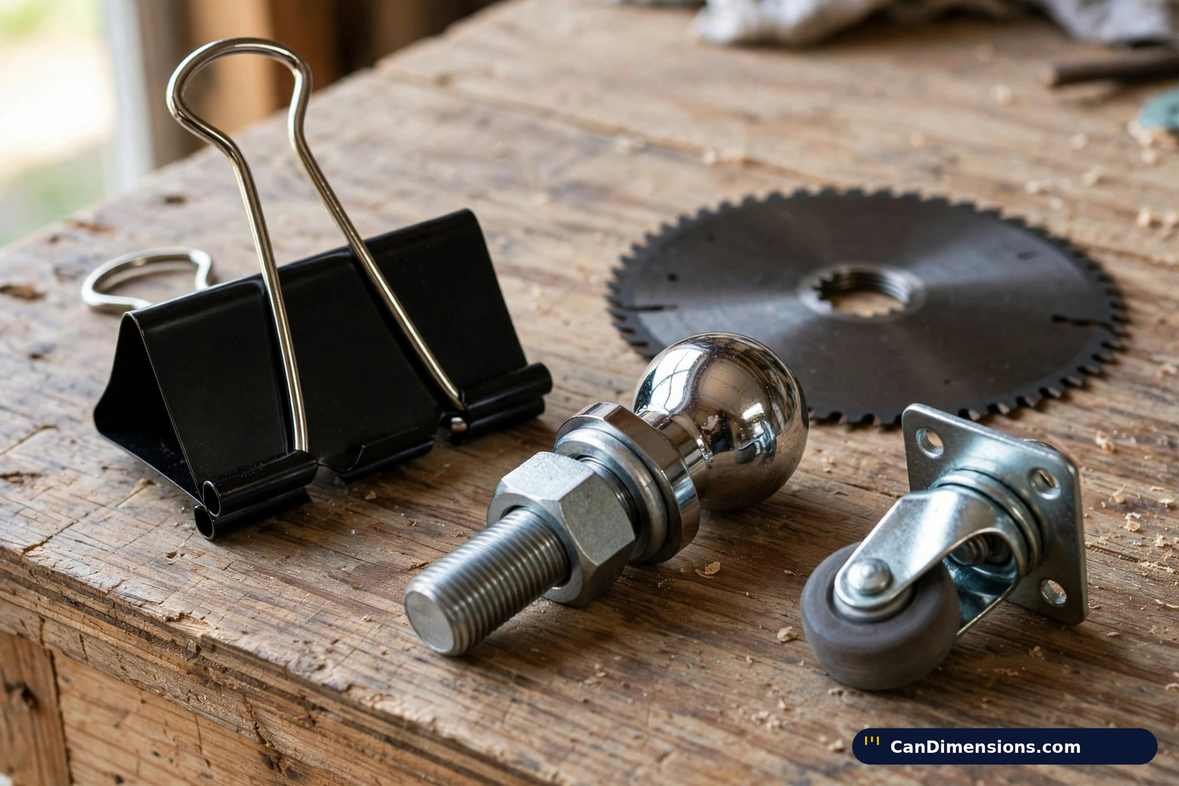
Counted: — the one office object on this bench page, and it earns its place on a spec sheet. ACCO’s large binder clip is specified at 2 inches of jaw width with about an inch of clamping capacity, and Staples’ own table for the same large size prints the width plainly as 2.
The jaw is the dimension that matters: clip one onto a board edge and the steel mouth spans this page’s length exactly. The smaller binder clips step down from here — medium and small are narrower tools wearing the same shape.
Standard Matchstick
Not counted: — longer than its reputation, and the sources cannot even agree on how much longer. The retailer spec table for Diamond’s strike-on-box kitchen matches prints a match length of 2.5 inches; an answered product question for the same box says two and a quarter. Both figures clear 2 inches comfortably.
The honest summary is that a kitchen match is a two-and-a-bit-inch object, and no maker’s figure supports calling it exactly two. It stays on the page as a warning: the most repeated example for this length is one of the wrongest.
Wine Cork
Not counted: — close at its longest common size, exact at none. Cork makers work in millimetres: the lengths run 38, 44, 49 and 54 mm, and the trade’s own guides name 44 mm as the most common — that is 1.73 inches. The long 49 mm cork converts to 1.93 inches, near this page’s figure and visibly short of it.
No standard cork is cut at 50.8 mm, so no cork is exactly 2 inches long. A pulled cork is a fine near-enough gauge in a kitchen drawer; on a verified list it belongs in the corrections.
Two U.S. Quarters Side by Side
Not counted: — the arithmetic is short by nine hundredths of an inch. The United States Mint specifies the quarter at 0.955 inches across. Two of them edge to edge make 1.91 inches, not 2.00, and no arrangement of two whole quarters changes that sum.
Coins remain useful precisely because their sizes are fixed by law — but the honest pair to remember is this one: two quarters get you to 1.91, and the last sliver has to come from somewhere else.
Top Joint of an Index Finger
Not counted: — for two reasons, either of which would be enough. First, no standard exists: that segment is a different length on every hand, and no maker, mint or standards body publishes its length. Second, this site’s already-published guide to this length counts a finger section among its own examples, measured on its own terms — a redo that repeated the same body gauge would be copying, not competing.
Body gauges are estimates, and this page’s rule is that estimates do not get counted. Use your own top joint as a rough field check by all means; just know it is calibrated to nobody’s specification.
Standard Key (House or Car)
Not counted: — unverifiable, which on this page is the same as untrue. The key catalogues for the two commonest house-key blanks publish bitting depths, pin spacing and blade tolerances — and no overall length anywhere. A figure repeated on a hundred listicles traces back to no manufacturer’s document at all.
What can be said from the trade’s own data is that a typical blank runs around two and a half inches overall, head included. That makes the familiar claim wrong in the likely direction as well as unproven — but “likely” is not a citation, so the key stays uncounted.
2-Inch Brad Nails (18-Gauge)
Counted: — the finish carpenter’s standard strip. Metabo HPT’s 18-gauge brad nails are sold by length and the 2-inch strip (manufacturer number 24108THPT) is specified at exactly that: 18 gauge, 2 inches long, a thousand to the box.
Brads are measured along the shank, and the 2-inch brad is the longest of the common trim sizes — the one that pins a casing through drywall and into the stud behind it. Open a trim nailer in any workshop and this is the reference riding inside it.
A 2-Inch Trailer Hitch Ball
Counted: — the towing standard, on the maker’s own sizing page. CURT Manufacturing states it directly: the standard trailer ball measures 2 inches in diameter, and the ball must match the coupler’s inside opening exactly — its named 2-inch ball (the 40003) is rated at 3,500 pounds.
A hitch ball is a reference you can verify with your hand around it at any trailer shop in the country. The smaller 1⅞-inch and larger 2⁵⁄₁₆-inch balls exist precisely because 2 inches is the size the industry settled on.
A 2-Inch Hole Saw
Counted: — a tool named for the hole it leaves. Milwaukee’s 2-inch hole saw (49-56-0444) carries a single operative specification, hole diameter: 2 inches. The saw’s own body is a touch wider than the hole, as any toothed cup must be, but the cut it makes — the thing it is bought for — is this length across.
Hole saws step in tidy fractions around this size, which makes the 2-inch the natural calibration point of the set: drill one test hole in scrap and you own a permanent gauge.
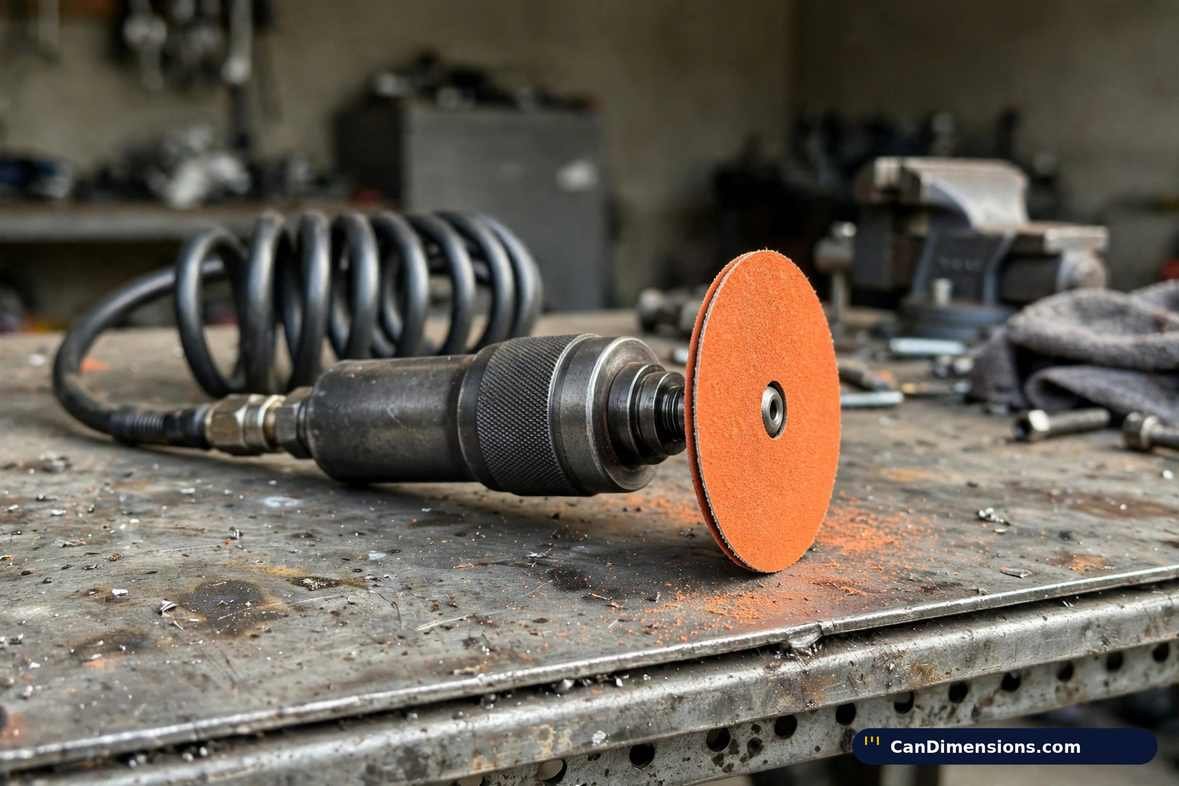
A 2-Inch Roloc Sanding Disc
Counted: — on 3M’s own specification table. The Cubitron II Roloc fibre disc (786C) lists its overall diameter in imperial as 2 inches, and 3M’s other Roloc lines print the same size as 2 in / 50.8 mm — the rare case of a maker stating both units and both agreeing exactly.
Abrasive discs live in die grinders on garage benches everywhere, and the 2-inch is the middle of the Roloc range. A worn disc in the toolbox drawer is a gauge that costs nothing.
A 2-Inch Caster Wheel
Counted: — the furniture mover’s small standard. Shepherd’s 2-inch caster (model 101440) is specified with a wheel diameter of 2 inches and a 125-pound capacity; the whole unit stands about two and a half inches tall once the plate and swivel are counted, but the wheel itself — the named dimension — is exact.
Casters are sold by wheel diameter, so the figure on the box is the figure on the part. Chairs, creepers and shop stands across the garage are rolling on this page’s length.
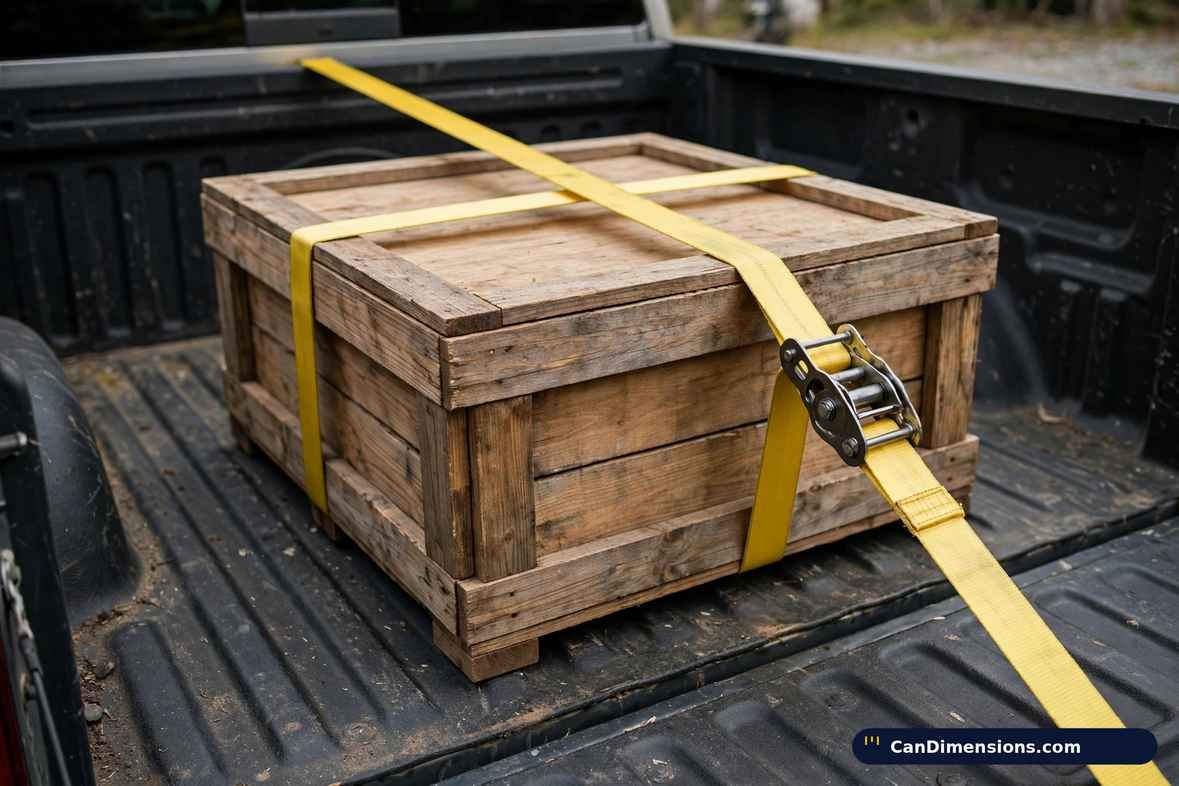
2-Inch Ratchet Strap Webbing
Counted: — width, this time, and width is the specification that sells the strap. Keeper’s ratchet tie-down (04622) is built on webbing whose spec table reads 2 inches wide, with a 10,000-pound breaking strength and a 3,333-pound working load to show for it.
The 2-inch webbing class is the heavy end of consumer tie-downs — the 1-inch straps are for kayaks and coolers. Measure across the yellow webbing on a loaded trailer and you are measuring this page’s title.
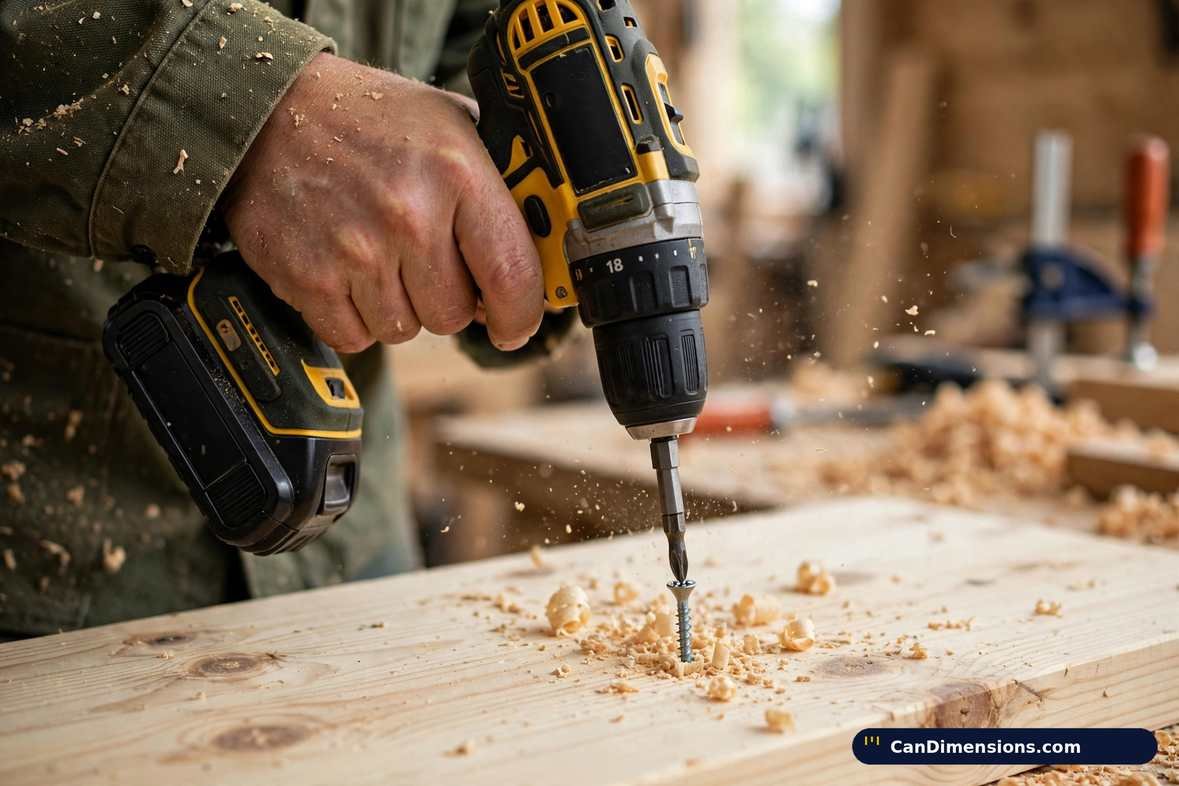
A #8 × 2-Inch Wood Screw
Counted: — the screw bin’s default. SPAX sells its interior construction screw as #8 × 2 in, and retailer spec tables state the pair plainly: screw width #8, screw length 2 inches, full thread. Screw length is measured from under the head to the tip, so the figure describes the whole fastener.
Two inches is where wood screws stop being trim hardware and start being structure — long enough to pull two nominal boards tight with thread to spare. A coffee can of them on the bench is a pocketful of gauges.
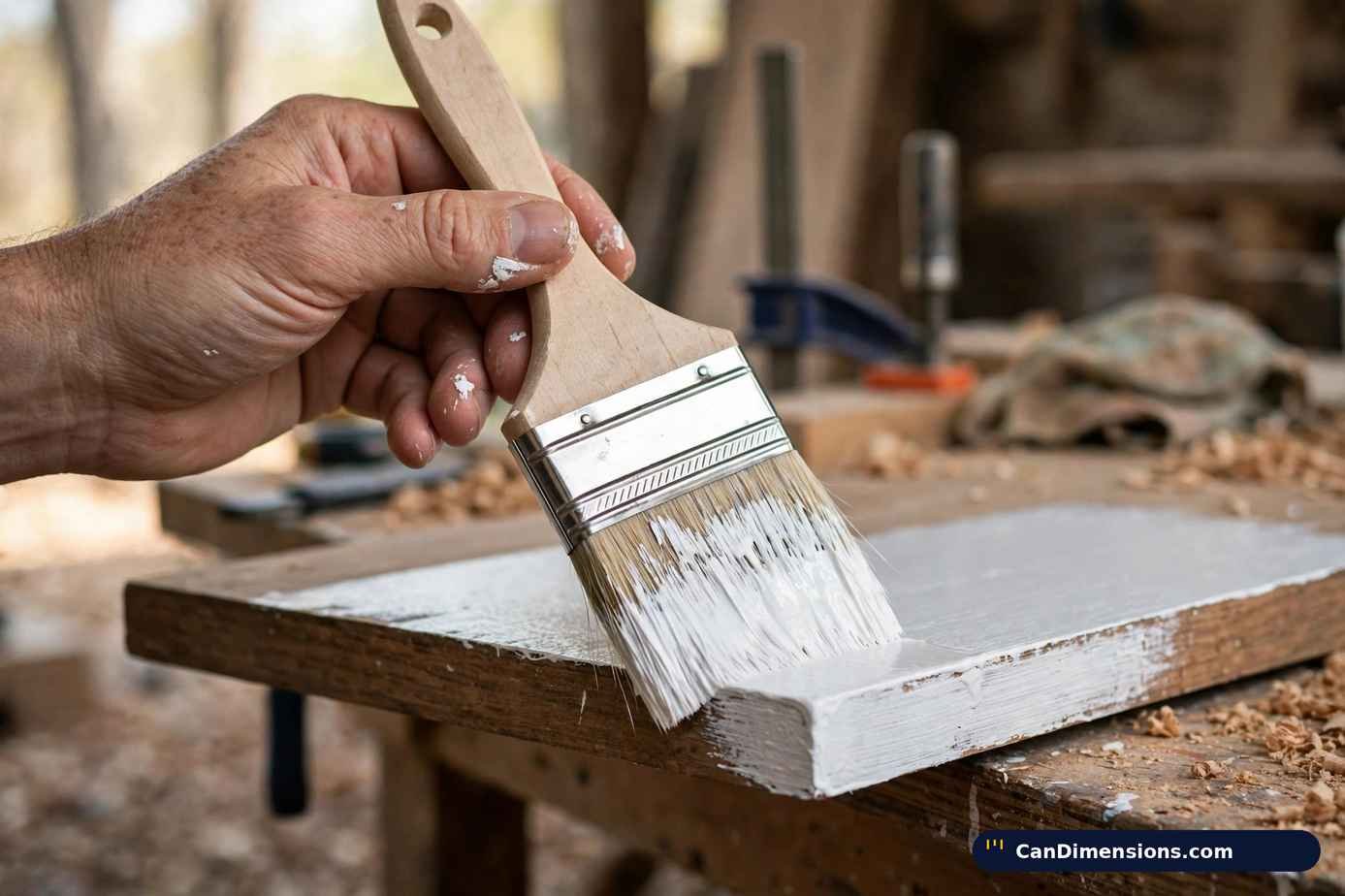
A 2-Inch Paint Brush
Counted: — on the brush maker’s sizing, which is bristle width. Purdy’s XL Dale angle brush is specified at a bristle width of 2 inches, and the same figure repeats across Purdy’s 2-inch lines — the width of the ferrule and the brush it holds.
Brushes step in half-inches around this size, and the 2-inch is the trim painter’s default for window sash and door edges. Hang one on the shop wall and its business end is a standing reference.
A 2-Inch Foam Brush
Counted: — the disposable cousin, same figure. Jen Manufacturing’s poly foam brush is sold in a 2-inch width and described by its maker in exactly those terms; the foam head spans 2 inches across its flat face.
Foam brushes are the workshop’s consumable — bought in multi-packs, used for varnish and glue, and thrown away. Their cheapness is the point: a 2-inch gauge you never have to clean.
A 6d Common Nail
Counted: — by the oldest sizing system on the bench. Nails sold by the penny carry their length in the number: the standard penny charts published by fastener makers (MISUMI’s and Maze Nails’ tables agree) fix the 6d nail at exactly 2 inches, 11½ gauge in common form.
The penny system predates the tape measure’s dominance by centuries, and it is still printed on every box of loose nails in the hardware aisle. A 6d nail is a 2-inch nail by definition of the trade — the definition is the verification.
A Size 3 Safety Pin
Counted: — the sewing kit’s contribution, on its maker’s numbering. Dritz sells its safety pins by size, and size 3 (product 1461) is the 2-inch pin; the trade size charts used by sewing suppliers print the same ladder — size 3 equals 2 inches.
Safety pins are measured closed, tip to coil, and the size-3 is the large household pin — the one that holds a curtain hem or a race number. It is also the only counted object on this page that most people own in a kitchen drawer rather than a toolbox.
2-Inch PVC Pipe
Not counted: — the page’s clearest lesson in nominal sizing. “2-inch” PVC is a name, not a measurement: Charlotte Pipe’s dimensional catalogue, following ASTM D1785, gives the pipe’s average outside diameter as 2.375 inches, with a Schedule 40 bore of about 2.067 inches. Neither surface of the pipe is 2 inches anywhere.
Nominal sizes exist so that fittings match across makers, and they do their job well. But a reader who cuts a length of “2-inch” pipe expecting a 2-inch object owns a 2⅜-inch one — which is why this entry is printed as a correction, not a reference.
“2-Inch” Painter’s Tape
Not counted: — the shelf label rounds up. 3M’s own page for ScotchBlue Original (2090-48NC) states the size as 1.88 in × 60 yd (48 mm), even while retailers title the same roll “2 Inch Wide”. The roll is short of this page’s length by 0.12 inches — an eighth of an inch surrendered to the label.
Tape widths are sold in classes, and the 48 mm class is a fine product; it simply is not 2.00 inches. Between the tape and the PVC, the workshop teaches the same lesson twice: the printed size is a category until a spec sheet says otherwise.
How to Visualize 2 Inches Without a Ruler
Small lengths get judged against whatever standard is lying on the bench, and few sizes are as well supplied as this one:
| Method | Accuracy | How To |
|---|---|---|
| Large Binder Clip Jaw | ★★★★★ | The large clip’s jaw is specified at 2 in wide |
| Trailer Hitch Ball | ★★★★★ | The standard ball is 2 in across — check any coupler |
| 6d Nail | ★★★★★ | The penny standard fixes 6d at exactly 2 in |
| Size 3 Safety Pin | ★★★★☆ | Dritz size 3 is the 2-inch pin |
| Two Quarters | ★★★☆☆ | 1.91 in together — a hair short, fine for judging |
Fasteners are the pocketable option: a 6d nail or a 2-inch brad is exact and travels in a shirt pocket. The matchstick and the key blank above were both reaching for the next size up, 2.5 inches, which keeps its own honest list on its own page.
Where Does 2 Inches Appear in Daily Life?
In the garage it appears as a standard, over and over: the ball the trailer couples to, the webbing that holds the load down, the wheel the creeper rolls on, the disc that cleans the part. In the workshop it is the fastener length that joins boards, the saw that cuts the lock hole, and the brush that finishes the edge.
Daily life outside the shop borrows the same figure quietly — the big clip on the paperwork, the large pin in the sewing kit. One size up changes the scale of everything: 3 inches is that next step, with the house key’s bigger cousins on its list.
From Inches to Centimetres: 2 Inches in Every Unit
| Unit | 2 inches equals |
|---|---|
| Centimetres | 5.08 cm |
| Millimetres | 50.8 mm |
| Metres | 0.0508 m |
| Feet | 0.167 ft |
| Yards | 0.0556 yd |
| Credit-card widths (2.125 in each) | 0.94 widths |
Memorise one line of that table: 50.8 mm, the exact metric twin, is the figure stamped across the engineering drawings of half the tools in this article. At the far end of the scale sits 2 mm — twenty-five times smaller than this page’s length.
Why the Workshop Runs on 2-Inch Standards
Two inches sits at a mechanical sweet spot. It is wide enough for a strap to hold a rated load, big enough for a ball-and-coupler to tow with, small enough for a caster to hide under furniture, and short enough for a fastener to stay cheap in bulk. Sizes that satisfy that many trades at once stop being choices and become defaults.
The defaults then defend themselves: couplers are bored for the 2-inch ball because the balls are everywhere, and the balls are everywhere because the couplers expect them. The same loop runs through the neighbouring size — see 3.5 inches for a length that never quite achieved the same standard status.
2 Inches vs 1, 3 and 6 Inches: Neighbouring Sizes Compared
Each neighbour owns a workshop landmark. One inch (2.54 cm) is the small caster and the bottle cap’s class. Three inches (7.62 cm) is the drywall screw’s long form and the Roloc range’s big disc. Six inches (15.24 cm) is the ruler’s half and the common combination square’s blade.
| Length | Centimetres | Workshop anchor |
|---|---|---|
| 1 inch | 2.54 cm | The small caster wheel |
| 2 inches | 5.08 cm | The hitch ball; the 6d nail |
| 3 inches | 7.62 cm | The long drywall screw |
| 6 inches | 15.24 cm | The combination square blade |
Between 2 and 6 the length triples — the single most useful ratio on this page. The 6 inches guide takes that neighbour apart in full.
Close to 2 Inches but Not 2: Workshop Near Misses
Four bench regulars miss the mark, and each misses it differently. Two quarters fall short at 1.91 inches — fixed by law, and still short. The painter’s tape falls short at 1.88 inches of actual width inside a 2-inch label. The long wine cork falls short at 1.93 inches (49 mm), the nearest of the three. And the “2-inch” PVC pipe overshoots on its outside at 2.375 inches while its bore, at about 2.067, overshoots too — the nominal name matches no surface of the object at all.
Everything from 1.85 to 2.4 inches gets called “about two” somewhere in print. These four mark the boundary — three fall short, by hundredths or by an eighth, and one overshoots on every surface it has.
Question’s
What does 2 inches long look like?
It looks like the jaw of the large binder clip, the ball on a trailer hitch, and the nail in the 6d box — small hardware you can close your fingers around. On paper it is a shade under the short edge of a credit card.
How can I measure 2 inches without a ruler?
Reach for a standard: a 6d nail, a 2-inch brad, a size 3 safety pin or the large binder clip’s jaw are all specified at the length. With only coins, two quarters give 1.91 inches — near enough for a rough call, and just short enough that you should know it.
How big is 2 inches?
Five point zero eight centimetres — about as wide as two thumbs laid side by side, a sixth of a foot, and the diameter of the standard trailer ball. It is about the biggest length that a closed fist can hide completely.
How many inches is 2 feet?
Twenty-four. A foot holds twelve inches by definition, so two feet hold twenty-four — twelve of this page’s lengths laid end to end, which is one way to feel how small 2 inches really is.
Final Thoughts
Look along one bench and the same measurement keeps surfacing: cast into the hitch ball, woven into the strap, rolling under the caster, cut along the brad and the sixpenny nail, and setting the width of the brush. The workshop did not choose 2 inches once — it chose it a hundred times, trade by trade, until the size became infrastructure.
Hold onto the hardware picture rather than the metric one. And for the clean round hole a lockset or a cable pass needs, the hole saw in the 2-inch size is the one the kit is built around.