How Big Is 10 Inches? 11 Workshop, Audio and Garden Things That Are 10 Inches Long
Woodworkers, hi-fi owners and gardeners rarely agree on anything, yet all three trades keep specifying the same circle. The question how big is 10 inches gets an identical answer at the bench, in the speaker cabinet and on the potting bench: 25.4 centimetres across — the width of a saw blade, the basket of a subwoofer, the mirror of a serious telescope and the rim of the pot a shrub arrives in.
The kitchen made this length famous, and the run of everyday examples — plates, pizzas, pans — is well covered elsewhere. This page deliberately goes somewhere else. It tests the size where work gets done: blades that cut, drivers that move air, wheels that carry toddlers and apertures that gather starlight.
Fifteen candidates are examined below against a maker’s specification, a retailer’s spec table or a format standard. Eleven pass cleanly. Four fail in instructive ways, and those four remain printed alongside the sums that rule them out — because a size label that lies teaches a buyer more than silence about it would.

How Long is 10 Inches?
Start with the conversions, because they are exact and they never change: this length is five-sixths of a foot, and it falls two inches short of the full twelve. It is also, not coincidentally, the size around which a surprising number of product standards were built, because it sits at the top of what one hand can span with a tool and the bottom of what two hands handle comfortably.
The wallet still gives the quickest picture. A United States banknote runs 6.14 inches along its long edge, so a note and two-thirds of a second note, laid in a line, cover the distance almost exactly. Three bank cards in a row overshoot it slightly, reaching 10.11 inches in total. For the note’s full official sizing, see our guide to dollar bill dimensions.
In the trades covered here, though, the honest reference objects are round. Ten inches is a diameter far more often than it is a length: a circle you measure straight across the middle, through the centre point, rim to rim.
11 Common Things That Are 10 Inches Long
Every entry below carries its evidence. Where the figure comes from a maker’s own specification table, the entry says so. Where a famous “10-inch” claim collapses under its own numbers, the entry says that instead, and the item is marked as not counted.
Standard Dinner Plate
Counted: — the one kitchen survivor on this page, kept because it is also the workshop’s lunch plate. Trade dinnerware guides give the dinner plate family a span running from this size up to 12 inches; the plate at the foot of that range is a standard stocked item, the one works canteens and small café tables are set with.
Measure through the centre, rim to rim. Salad and side plates, at 7 to 9 inches, fall short of qualifying; the full-size plate at this exact figure does not.
iPad or Tablet Screen (Diagonal)
Not counted: — a diagonal masquerading as a straight length. Search the current catalogues and no tablet’s screen lands precisely on this figure: Apple’s standard iPad reads 10.9 inches corner to corner, the model before it read 10.2, and the Fire HD 10 from Amazon — where the number is baked into the product name — reads 10.1.
“10-inch tablet” names a class, not a measurement. A sleeve sewn for a genuine 10.0 would fit nothing on sale, because every device in the class is built around its own real diagonal.
Large Submarine Sandwich
Counted: — a real named menu size, at the chain that actually sells it. Wawa builds its hoagie range as a ladder — Junior at 4 inches, Shorti at 6, then the Classic at the full figure — and the Classic is the full-size sandwich its menu and catering trays are organised around.
The better-known chain sells 6-inch and footlong sizes only, so a “10-inch sub” is never a Subway measurement. Where a catering order or calorie chart uses the term, Wawa’s Classic class is the sandwich being described.
Standard Paper Length (Letter Size)
Not counted: — one inch too long. US Letter stock is 8.5 inches wide and 11 tall, which puts its longer edge a full inch beyond this page’s length.
It survives here as a reference rather than an example: picture the sheet, picture an inch trimmed away, and what remains in your hand is the length this page is about.
Large Chef’s Knife Blade
Counted: — on the maker’s own spec sheet. For its Classic 10-inch chef’s knife, Wüsthof prints a blade length of precisely this figure, a handle of 4.5 inches behind it, and an overall length near 14.5 inches.
Only the blade carries the number, measured from bolster to tip. The line’s smaller standard is the 8-inch blade — so when a blade stretches from one rim of a dinner plate to the opposite rim, the larger tool is the one in your hand.
Adult Hand Span (Thumb to Pinky Stretched)
Not counted: — the average falls short. Published anthropometric norms centre a stretched adult span near 7.5 to 7.9 inches for women and 8.5 to 8.9 for men. This page’s figure shows up only at the extreme upper edge of the male distribution — in other words, attached to an exceptionally large hand.
A hand remains a fine personal gauge once its own number is known (see the measuring section below). What it is not, for almost anyone, is a 10-inch ruler.
10-Inch Miter Saw Blade
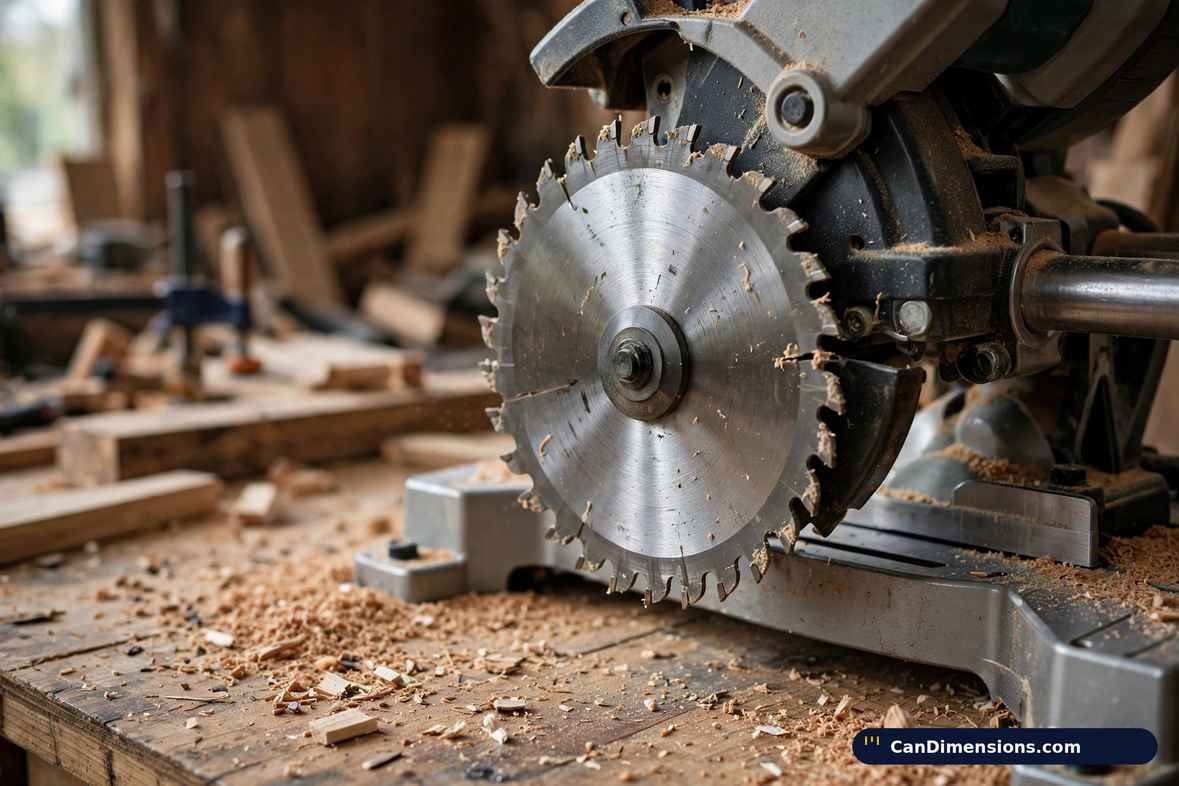
Counted: — the workshop’s defining circle. Blade makers’ tables for miter and slide-miter saws list the size plainly: Tenryu’s PT and Silencer series both carry a full row of 10-inch models — 10 in diameter on a 5/8 in arbor, in tooth counts from 32 up to 100 — and Diablo’s 10-inch general-purpose blade is specified the same way, blade diameter 10 in, arbor 5/8 in.
One honest note: the same physical blade family serves table saws too, which is why this page counts the blade once, under the miter saw where angled crosscuts define it. The diameter is the saw’s name — a “10-inch miter saw” is a machine built around this exact disc.
10-Inch Subwoofer
Counted: — on its nominal basket diameter, with the flange disclosed. Eminence specifies its Kappalite KL3010LF-8 low-frequency driver with a nominal basket diameter of 10 inches, 254 mm — and an overall diameter of 10.25 inches once the mounting flange is included. JBL’s W10GTi MkII is likewise sold as the 10-inch size while its external diameter reads 10-1/2 inches.
Speaker sizes are basket sizes. The 10 inches names the nominal basket the cabinet cut-out and the product class are built around; the flange that bolts it down reaches a quarter to a half inch further. Counted on the industry’s own definition, and printed with both figures so nobody is fooled.
10-Inch Vinyl Record (the EP Format)
Counted: — a format standard, and a different object from the shellac disc in older collections. The 10-inch vinyl record measures 10 inches, 25.4 cm, in diameter and survives today as the EP and short-album format, played at 33⅓ or 45 rpm and holding roughly 9 to 12 minutes of music per side.
The shellac 78 rpm disc shared the diameter but not the material, the speed or the era. Vinyl 10-inch pressings are still cut for EPs, limited editions and jazz reissues — a living format, not a museum piece.
10-Inch Embroidery Hoop
Counted: — a named maker’s size. Frank A. Edmunds’ beech wood embroidery hoop is sold at a size of 10 inches diameter (model FAE202-10), the large end of the hand-hoop range that starts at 3 inches.
A hoop this wide holds a full tapestry block or a large monogram without repositioning the fabric — and, for this page’s purposes, it puts an exact 10-inch ring on the craft-room wall.
10-Inch Nursery Pot
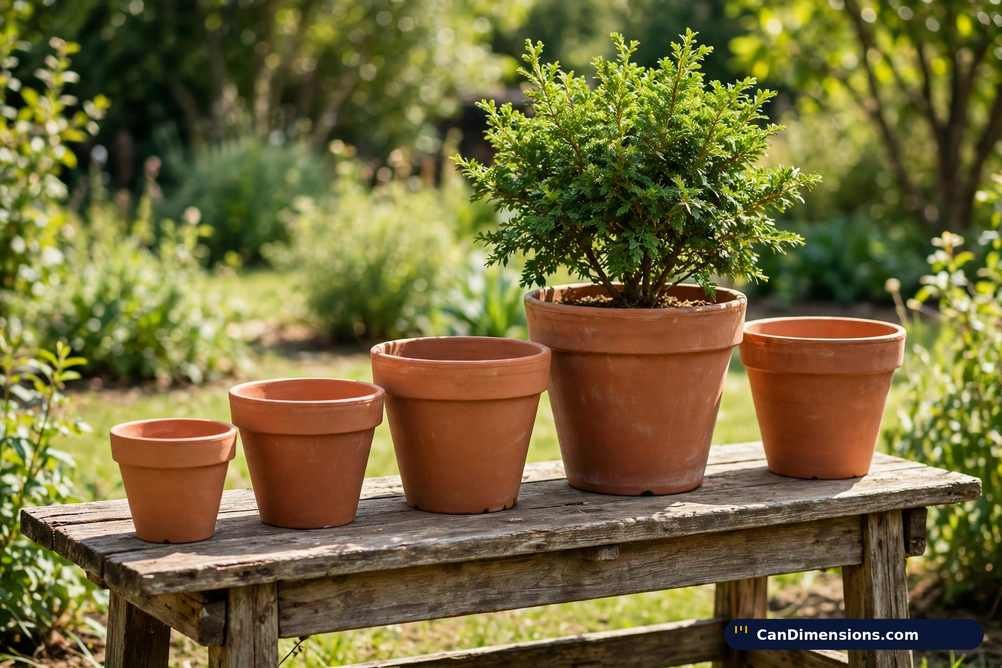
Counted: — the garden trade’s standard measure. Pot sizes name the diameter across the top rim, and the 10-inch pot is the chart standard for shrubs and larger perennials: planter guides list the 10″ pot at roughly 2.5 to 3 gallons of soil, about 0.40 cubic feet.
Pots taper, so the base is narrower than the rim — the 10 inches is the top measurement, the one a saucer, a cachepot or a planting hole must clear.
10-Inch Dobsonian Telescope Mirror
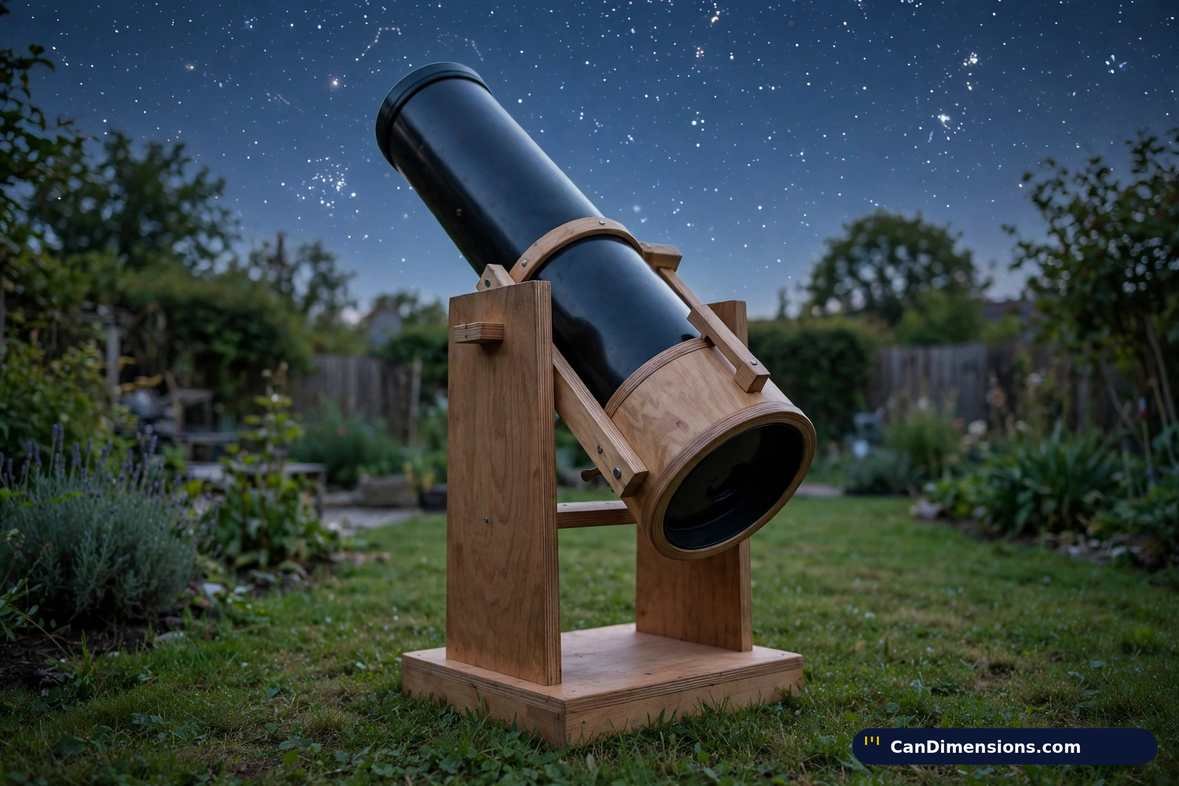
Counted: — as an aperture, which is a diameter by definition. A 10-inch Dobsonian is built around a primary mirror of 254 mm — 10 inches — across: Celestron’s StarSense Explorer 10, Sky-Watcher’s 10-inch Flextube and Explore Scientific’s 10-inch models all specify a 254 mm parabolic primary, at focal lengths around 1200 mm.
That mirror gathers roughly 1.6 times the light of an 8-inch, which is why the 10-inch class is where galaxies start showing structure. The telescope is far longer than 10 inches; its defining measurement, the one it is sold by, is this disc of glass.
10-Inch Balance Bike Wheel
Counted: — the smallest wheel in the bike shop. Children’s bikes are sized by wheel diameter, and balance bikes for the youngest riders — roughly 18 months to two and a half years, inseams around 10 to 14 inches — run on 10-inch wheels; makers such as Chillafish sell the size outright as a 10-inch-wheel toddler trainer.
The wheel’s diameter sets the whole machine: seat height, stand-over and the pace a toddler’s legs must keep. Twelve inches is the next step up, and the difference is visible across a showroom.
10-Inch Springform Pan
Counted: — the one baking entry the workshop angle earns honestly, because a springform is a tool with a latch. Wilton’s springform ranges include a 10-inch pan outright — the Excelle Elite 10-inch is specified at 10 in diameter by 2.75 in deep, and Wilton’s three-piece sets step 8, 9 and 10 inches.
The ring’s span with the latch closed is the measurement. It is also the largest cheesecake most home ovens are ever asked for, which is why the size tops out so many sets.
10-Inch Softball
Not counted: — the circumference trap, and the most misread size in sport. A “10-inch softball” measures 10 inches AROUND the ball, not across it. The diameter that follows from a 10-inch circumference is about 3.18 inches — a ball for players aged 8 and under, T-ball and coach-pitch, sized for small hands.
The ball genuinely is a 10-inch object if the measurement is a loop of string. As a length on this page, it misses by nearly seven inches, and it stays here as the standing warning: always ask which line a size describes.
Why Three Trades Settled on the Same 10 Inches
Workshop, studio and garden arrived at 10 inches by separate roads. A blade of this diameter cuts framing lumber in one pass while staying light enough for a portable saw. A driver of this basket moves enough air for real bass while fitting the boot wells and door cavities cars actually have. A pot of this rim holds enough soil — near three gallons — to carry a shrub through a dry week, while remaining liftable when wet.
Underneath the separate reasons sits a shared one: 10 inches is about the largest circle one person handles all day without thinking about it. Standards settle where hands, shelves and vehicle spaces agree, and on this size, three unrelated trades happened to agree completely. The same family of stand-ins people keep for small jobs — the cards, notes and gauges in our guide to items that measure 3 inches long — scales up to this length with nothing more than repetition.
How to Measure 10 Inches Without a Ruler
On a bench or a potting table, the references are already lying around. A blade off the saw, a spare hoop, a record sleeve: each is a certified 10 inches wearing work clothes. Away from those, fall back on the wallet. One banknote plus two-thirds of another covers the length; three bank cards overshoot it by a ninth of an inch, close enough to judge a shelf or a planting gap.
Hand Span Method
Stretch your span once against a real ruler and write the number down. Most adults land between 7.5 and 8.9 inches, so a span plus a known extra — a finger width measured the same day, roughly an inch — builds the target honestly. The method fails only when the span is assumed rather than measured.
Smartphone Measurement Apps
Every iPhone carries Apple’s Measure app, which reads lengths through the camera. Android owners must pick a third-party AR ruler instead: Google withdrew its own Measure app back in June 2021, deleting it from the Play Store. Whichever app you use, test its reading once against a known object — a blade, a hoop — before trusting it on a cut. A few percent of error is normal for these apps: fine for furniture, not for joinery.
When “10-Inch” Is a Label Rather Than a Measurement
Four entries on this page teach the same lesson from four directions. The tablet’s “10” is a class name stretched over diagonals of 10.1 to 10.9 inches. The subwoofer’s 10 is a basket size whose flange reaches 10.25 to 10.5. The softball’s 10 is a circumference whose diameter is barely 3.2. The Letter sheet’s long side is not a label at all — it is simply 11 inches, misremembered.
None of these products is dishonest; each industry measures the line that matters to it. The buyer’s job is narrower: before comparing two “10-inch” objects, or ordering a case, cut-out or frame for one, establish what the number is actually measuring — diameter, diagonal, basket or circumference — and check that dimension.
10 Inches in Different Units
Because one inch is fixed at precisely 2.54 centimetres by definition, each figure in this table is exact rather than rounded:
| Unit | This length equals |
|---|---|
| Centimetres | 25.4 cm |
| Millimetres | 254 mm |
| Metres | 0.254 m |
| Feet | 0.833 ft |
| Yards | 0.278 yd |
A product labelled 25 cm in a metric market is not this size — 25 cm converts back to about 9.84 inches, a sixth of an inch short, which is enough to bind a blade guard or gap a record sleeve.
10 Inches vs 1 Foot (12 Inches)
Two inches separate this length from a foot: 10 is 83.3% of 12. On the bench the gap is practical — a 10-inch blade will not do a 12-inch saw’s work, and a 10-inch pot leaves a hand’s width spare on a foot-deep shelf. In the other direction, a foot of board covers this page’s length with two finger-widths to spare.
Sellers round both ways, so “about a foot” on a listing can hide either figure. The specification never rounds: read it, and the two inches reappear.
Stepping Up and Down: The 8-Inch and 12-Inch Neighbours
Every trade on this page sells the same ladder. Blades step from 8 to 10 to 12 inches; drivers from 8 to 10 to 12; pots climb in two-inch increments through all three. Eight inches is the compact class — the jobsite blade that rides in a van, the bookshelf driver, the starter pot on the bottom shelf. Twelve is the full-size class — the LP record, the foot itself, the saw that never leaves the workshop.
Ten is the rung where portability and capacity cross, which is why it anchors so many ranges. For the far end of the same ladder, our guide to 24 inches covers the length these circles grow into as bars, brackets and shelves.
Fitting 10-Inch Gear: Clearances, Sleeves and Saucers
Owning the size means housing it. A 10-inch blade needs a guard and a storage case cut for a disc a fraction over 10 inches once the teeth are counted. A 10-inch record stores in a 10-by-10 sleeve and stands upright only on a shelf with more than 10 inches of clear height. A 10-inch pot needs a saucer wider than its base and a shelf or step that takes its rim with room to water.
Garages absorb most of this gear eventually, and the same clearance habit scales: the bays and doors measured in our guide to standard garage door dimensions are just this page’s question asked at vehicle size. Measure the opening, then the object, in that order — never the reverse.
Question’s
What object measures 10 inches?
Miter saw blades, subwoofer baskets, Dobsonian telescope mirrors, nursery pot rims and balance bike wheels all measure exactly 10 inches — as do a dinner plate and a large chef’s knife blade.
How long is 10 yards in inches?
Multiply a yard’s 36 inches by ten and the answer is 360 inches.
Is the female ureter 10 inches long?
Only at the lower end of its span. Anatomy sources give the adult ureter as 25–30 cm — roughly 10–12 inches — for women and men alike, so treat the figure as a range rather than a fixed length.
How big is 10 inches compared to an object?
Think of a saw blade or a flowerpot rim: a circle of 25.4 cm. Laid out straight, the same length is a banknote plus two-thirds of a second one.
How can I measure 10 inches without a ruler?
Line up three bank cards and you have 10.11 inches; use a banknote and two-thirds of another; add a known extra to your own pre-measured span; or use a phone app you have first checked against a known object.
How big is a 10-inch picture?
Usually the 8×10 print — its shorter edge runs 8 inches, its longer edge the full figure, and shop frames and mats are cut around those two numbers.
What size is a 10 inch?
In metric, 25.4 cm. In the catalogue it can also be a diameter, a diagonal, a basket size or a blade length, depending on the product — establish which before you buy.
Is 10 inches big for a pizza?
No — the chains file it under Small: six slices, intended for one or two eaters.
What is 10 inches in real life?
Look for the blade that cuts your trim, the driver behind the grille, the pot the shrub arrived in and the mirror gathering starlight in the garden after dark.
What size is 10 inches in shoes?
Shoe sizes are not lengths. Brannock-based charts put a foot of this exact length at roughly a US men’s 8 or a women’s 9; the men’s size 10, by contrast, is built for a foot nearer 10.56 inches.
Conclusion
Follow this length out of the kitchen and into the places where things are built, played and grown, and it turns out to be a tradesman’s standard: exactly 25.4 centimetres, specified to the tooth on a blade, to the millimetre on a mirror, and to the gallon on a pot. Eleven objects on this page carry the measurement on a maker’s own figures — and the four that fail, fail in ways that teach the only rule that matters: find out what the number is measuring before you trust it.
Keep a certified circle within reach — a blade, a hoop, a record — and the length never needs guessing again. And when the angled cuts come out clean at the end of a project, credit the machine that made them: the humble miter saw, whose whole design is organised around a disc of exactly this size.