Dollar Bill Dimensions: Height, Length, Thickness and Weight of Every U.S. Bill
If you are asking how tall is a dollar bill, the answer is 2.61 inches on its short edge — the height of the bill as it sits in your wallet or a cash drawer — and 6.14 inches along its long edge. Those two numbers are not just the $1 bill’s: every U.S. denomination in circulation, from the $2 to the $100, is printed to exactly the same size, and has been since 1929.
The figures are the Bureau of Engraving and Printing’s own specification, and they come with two more: a thickness of 0.0043 inches and a weight of about one gram per note. There is no larger size for large bills and no smaller size for small ones, and a note’s dimensions do not change with its design series — a 1990s $20 and a current $20 measure identically.
This guide gives the full specification in inches, centimetres and millimetres, denomination by denomination, works through the thickness and stack-height maths, looks at the oversized “horse blanket” notes the modern bill replaced, and compares the bill with the cards and cans it shares a kitchen counter with. Where widely copied guides get a figure wrong, the guide says so and prints the corrected value.

Dollar Bill Dimensions Comparison Chart
One chart really does cover American paper money, because there is only one size to chart. Every current denomination is below, with the pre-1929 large-size note added at the bottom for scale.
Every Denomination, One Size
| Denomination | Length | Height (short edge) | Thickness | Weight |
|---|---|---|---|---|
| $1 | 6.14 in | 2.61 in | 0.0043 in | ≈1 g |
| $2 | 6.14 in | 2.61 in | 0.0043 in | ≈1 g |
| $5 | 6.14 in | 2.61 in | 0.0043 in | ≈1 g |
| $10 | 6.14 in | 2.61 in | 0.0043 in | ≈1 g |
| $20 | 6.14 in | 2.61 in | 0.0043 in | ≈1 g |
| $50 | 6.14 in | 2.61 in | 0.0043 in | ≈1 g |
| $100 | 6.14 in | 2.61 in | 0.0043 in | ≈1 g |
| Large-size note (pre-1929) | 7.375 in | 3.125 in | — | — |
Reading the Two Numbers
A dollar bill is printed in landscape orientation, so its “height” in normal use is the short edge: 2.61 inches. Stand the same bill on its end, in portrait, and it is 6.14 inches tall with a 2.61-inch width. Guides swap the labels “width” and “height” freely — some call 2.61 inches the width — but the two measurements never change: a long edge of 6.14 inches and a short edge of 2.61 inches, whichever way up you hold the note. Wallets, cash drawers, bill validators and ATM cassettes are all built around that one rectangle.
Dollar Bill Dimensions in Different Units
The Bureau of Engraving and Printing specifies the note in inches: 6.14 long by 2.61 wide, 0.0043 thick. Converted, the length is 156 mm (15.6 cm) and the short edge is 66.3 mm (6.63 cm) — you will also see the width quoted as a rounded 66 mm, which is the same edge measured less precisely. Weight converts just as neatly: the roughly one-gram note is 0.035 ounces, so 454 bills — $454 in ones — weigh almost exactly a pound.
Quick Reference Table
| Feature | Imperial | Metric |
|---|---|---|
| Length | 6.14 inches | 156 mm |
| Width | 2.61 inches | 66.3 mm |
| Thickness | 0.0043 inches | 0.109 mm |
| Weight | 0.035 ounces | 1 gram |
The Bureau’s specification values for a standard U.S. note. A worn bill can measure a fraction under on any edge; the specification describes the note as printed.
Are All Dollar Bill Dimensions the Same?
One Size Fits All U.S. Currency
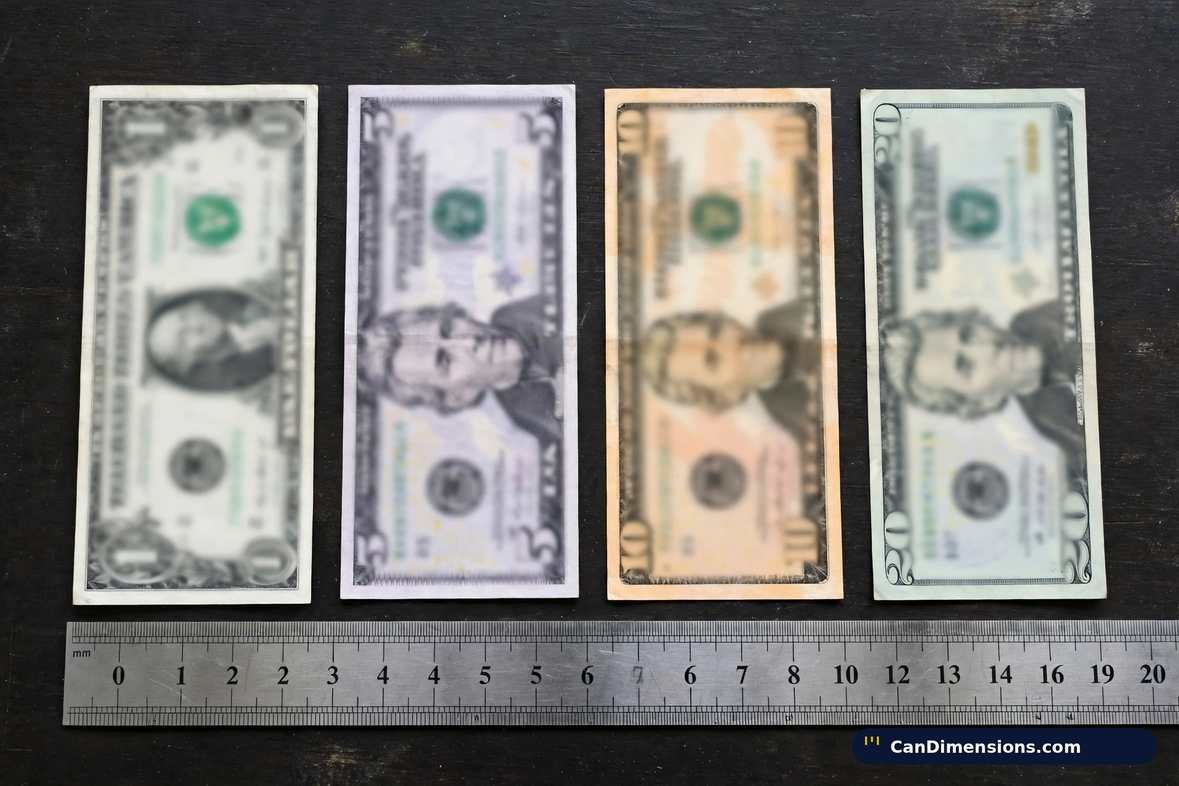
Yes. Every denomination of current U.S. currency shares identical dimensions: a $1 bill is the same size as a $5, $10, $20, $50 or $100 bill, and the $2 matches them too. The Federal Reserve and the Treasury keep the size uniform for practical reasons — ATMs, vending machines and bill counters never have to adjust for different sizes, wallets need no special compartments, and printing every denomination on one sheet size makes production cheaper and simpler.
One widely printed claim about that uniformity needs correcting, though: it is often called unique to the United States, and it is not. Canada does the same thing — every Bank of Canada note, $5 through $100, measures 152.4 × 69.85 mm (6.0 × 2.75 inches), so Canadian denominations are also told apart by colour and design rather than size. Uniform sizing is unusual among the world’s major currencies, most of which vary note size by denomination, but America is not its only user.
Historical Dollar Bill Sizes
Before 1929, American paper money was bigger. Large-size notes — issued from 1861 and nicknamed “horse blankets” by collectors for their size — measured 7.375 × 3.125 inches, a fixed standard size rather than a range (guides that print “up to 7.4 by 3.1 inches” are rounding that single figure). On July 10, 1929 the Treasury released the reduced small-size notes at today’s 6.14 × 2.61 inches, making the currency about 30 percent smaller, in the U.S. Currency Education Program’s own words. The reasons were the ones the Treasury gave at the time: smaller notes cost less to produce, handled and stored more easily, and let the Bureau print twelve notes to a sheet instead of eight. The large-size notes remained legal tender and were withdrawn gradually as they wore out.
Dollar Bill Dimensions by Denomination
Common Denominations
$1 Bill Dimensions: Measures 6.14 × 2.61 inches. George Washington’s portrait, taken from Gilbert Stuart’s Athenaeum Portrait, is on the front; the back carries both sides of the Great Seal of the United States — the eagle, and the unfinished pyramid with the all-seeing eye.
$5 Bill Size: Identical measurements, with Abraham Lincoln’s portrait and the Lincoln Memorial on the reverse. The redesigned $5 issued in 2008 added a large purple “5” on the back — printed that size and colour as an aid for people with low vision, per the U.S. Currency Education Program, rather than purely as a security feature as some guides describe it.
$10 Bill Measurements: Same standard dimensions. Alexander Hamilton is on the front and the U.S. Treasury building on the back. One correction to a claim repeated everywhere, including the guide this page replaces: the $10 is not the only bill without a president’s portrait. It is one of two — Benjamin Franklin, on the $100, was never president either.
$20 Bill Dimensions: No variation in physical size. Andrew Jackson’s portrait has fronted the $20 since the small-size redesign (Grover Cleveland had appeared on the earlier large-size $20). One more correction: the $20 is often called the most widely circulated denomination in America, but by the Federal Reserve’s own count it is not — at the end of 2025 there were about 19.9 billion $100 notes and 15.2 billion $1 notes in circulation, against roughly 11 billion $20s. The $20 is the everyday ATM note; it is not the most numerous note.
$50 Bill Size: Maintains the standard measurements, with Ulysses S. Grant’s portrait and the U.S. Capitol on the back.
$100 Bill Dimensions: Despite being the highest value in common circulation, it is still 6.14 × 2.61 inches. Benjamin Franklin’s portrait and Independence Hall make it instantly recognisable, and the current design protects it with a blue 3D security ribbon woven into the paper and colour-shifting ink. By note count it is the most common bill in the world — the Federal Reserve’s 19.9 billion $100s exceed every other denomination — because so much U.S. currency is held abroad as a store of value.
Rare and Discontinued Bills
The $2 bill still exists and is still printed, though it circulates rarely. It is exactly the same size as every other denomination, with Thomas Jefferson on the front and the signing of the Declaration of Independence on the back. Many people hoard them believing they are rare; they are not rare, just uncommon — about 1.8 billion were in circulation at the end of 2025.
The large denominations — $500 (William McKinley), $1,000 (Grover Cleveland), $5,000 (James Madison) and $10,000 (Salmon P. Chase) — were printed in the same small size after 1929, so even a $10,000 bill measures 6.14 × 2.61 inches. They were last printed in 1945 and officially discontinued in 1969. The reason given at the time was lack of use — the “pulled to fight organised crime” explanation attached to them in many guides is a later gloss; the denominations were retired because the public barely used them, and they remain legal tender today. Only a few hundred $10,000 bills are known to survive, most in museums and major collections, worth far more than face value.
The $100,000 gold certificate, Series of 1934, is the largest denomination the United States ever produced. It featured Woodrow Wilson’s portrait, was printed only in December 1934 and January 1935, and was used solely for gold transactions between Federal Reserve Banks — it never entered public circulation, and private ownership is illegal. Even so, it was printed at the same small size as regular currency: the Smithsonian’s example measures 15.7 × 6.6 cm, the standard note within normal tolerance.
Dollar Bill Dimensions in CM and MM
For metric listings, school projects and display work, here is the full specification in centimetres and millimetres, including the stack heights the thickness section works through.
| Measurement | Centimetres | Millimetres |
|---|---|---|
| Length | 15.6 cm | 156 mm |
| Height (short edge) | 6.63 cm | 66.3 mm |
| Thickness (1 bill) | 0.011 cm | 0.109 mm |
| Stack of 100 bills | 1.09 cm | 10.9 mm |
| Stack of 1,000 bills | 10.9 cm | 109 mm |
| Large-size note (pre-1929) | 18.73 × 7.94 cm | 187.3 × 79.4 mm |
Millimetre figures are the precise ones — the centimetre length and height are rounded to one decimal place. If you are cutting a display mount or a frame recess, work from the millimetre column and allow a millimetre of clearance around a circulated note.
Dollar Bill Thickness and Stack Height
How Thick Is a Dollar Bill?
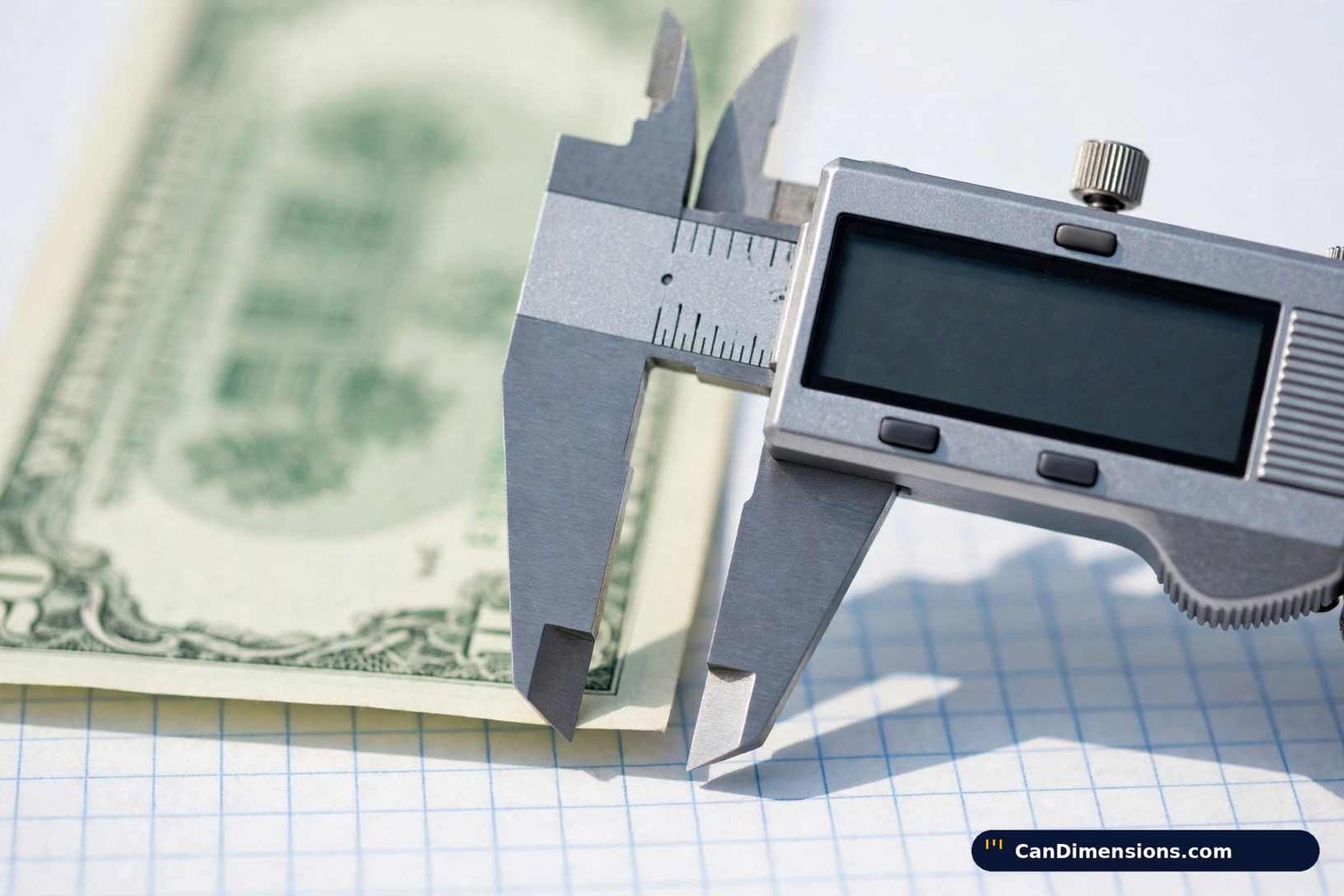
A single bill measures 0.0043 inches thick — 0.109 mm, which is about the thickness of one sheet of ordinary printer paper. It feels more substantial than paper because it is not wood-pulp paper at all: U.S. notes are printed on a woven blend of 75% cotton and 25% linen, the composition the Bureau of Engraving and Printing has used for generations. That fabric content is why the note survives the Bureau’s own benchmark of about 4,000 double folds — folded forward and back — before it tears.
Stack Calculations
Stack heights follow directly from the 0.0043-inch thickness, and this is the section where a widely copied error lives, so the figures are worth stating exactly. A stack of 10 bills is 0.043 inches — about 1.09 mm, roughly a millimetre — not the 0.43 mm some charts print; 0.43 is the figure for a hundred bills, in inches. The Bureau itself puts it at 233 new notes to the inch.
| Bills in the stack | Stack height (inches) | Stack height (metric) |
|---|---|---|
| 10 | 0.043 in | 1.09 mm |
| 100 | 0.43 in | 10.9 mm |
| 1,000 | 4.3 in | 10.9 cm |
| 10,000 | 43 in | 1.09 m |
| 1,000,000 | 4,300 in (358 ft) | 109 m |
Read the interesting rows off the table. A thousand dollars in $1 bills stands 4.3 inches high — about the height of a coffee mug. Ten thousand dollars reaches 43 inches, about 3.6 feet. A million dollars in $1 bills stacks to approximately 358 feet — taller than the Statue of Liberty, which stands 305 feet from the ground to the tip of the torch — and weighs about a tonne, since each of the million notes weighs a gram. The same million dollars in $100 bills is only 10,000 notes: a stack 43 inches (3.58 feet) high and about 10 kilograms in weight, which is why the briefcase version of a million is physically plausible even if it is rarely legal tender in a film.
How a Dollar Bill Compares to a Credit Card, a Playing Card and a Drinks Can
Everyday comparisons are where dollar-bill guides go wrong most often, so each one below is measured rather than remembered.
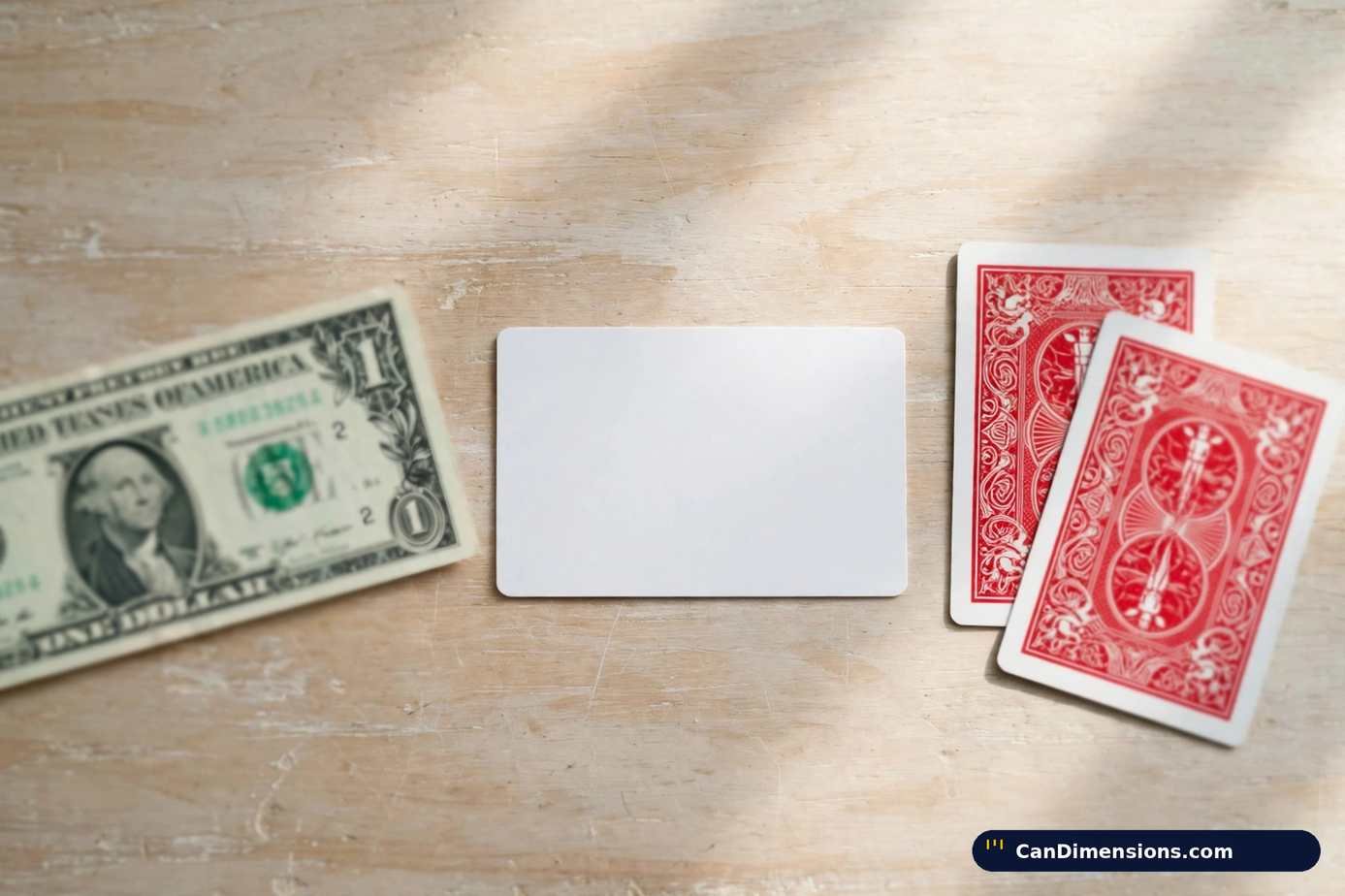
Against a credit card. A credit card follows the ISO/IEC 7810 ID-1 standard: 3.370 × 2.125 inches. A dollar bill is therefore not “slightly longer than a credit card and not quite as wide,” as it is often described — it is about 82 percent longer (6.14 against 3.37 inches) and about 23 percent wider (2.61 against 2.125 inches). The bill is the bigger object in both directions; the card wins only on thickness, at 0.76 mm against the bill’s 0.109 mm.
Against a playing card. A standard poker-size playing card measures 3.5 × 2.5 inches — the same footprint as the cards in our Pokémon card dimensions guide, 63 × 88 mm. A dollar bill is not “roughly the size of a playing card, shorter and narrower”: it is about 75 percent longer than the card (6.14 against 3.5 inches) and slightly wider (2.61 against 2.5 inches). Two playing cards end to end, at 7 inches, overshoot a bill by less than an inch — that is the honest version of the comparison.
Against a drinks can. A dollar bill, at 6.14 inches, is about 1.3 inches longer than a standard soda can in our coke can dimensions guide is tall (4.83 inches). Wrap one around a can and it falls short: the standard can’s 2.6-inch body has a circumference of about 8.2 inches, roughly 2 inches more than the bill’s length. The closest wrap in the drinks aisle is the classic slim can in our red bull can dimensions guide — 5.28 inches tall on a 2.1-inch body, a circumference of about 6.6 inches — and even there the bill falls about half an inch short of meeting its own end.
How to Measure a Dollar Bill Yourself
Lay the bill flat on a table and smooth it once with the side of your hand — circulated notes curl, and a curled edge reads short. Measure in millimetres, which are far easier to read precisely than fractions of an inch: the long edge should read 156 mm and the short edge 66.3 mm (a well-worn bill may read a fraction under on either). Work from corner to corner along the edge itself, not diagonally.
Thickness cannot be measured one bill at a time with household tools, so measure a stack instead: square up 100 bills, press them flat without compressing them hard, and measure the stack — about 0.43 inches (10.9 mm) — then divide by 100 to land on the single bill’s 0.0043 inches. A kitchen scale gives you the last specification: 100 bills should weigh about 100 grams. And if your ruler disagrees with this guide by a hair, believe the specification — rulers, like bills, are everyday objects with everyday tolerances.

Questions
What are the dimensions of a US dollar bill?
6.14 inches long by 2.61 inches wide (156 × 66.3 mm), 0.0043 inches thick, weighing about 1 gram. Every denomination uses these exact measurements.
What’s the size of a $100 bill?
Exactly the same as every other U.S. bill: 6.14 × 2.61 inches. Only the design, colours and security features differ — never the physical size.
What is the size of a $20 bill?
6.14 inches by 2.61 inches, identical to all other U.S. denominations. The dimensions have not changed since the Treasury standardised paper money in 1929.
What does a $10,000 bill look like?
It carries Salmon P. Chase’s portrait — Lincoln’s Treasury Secretary, later Chief Justice — at the standard 6.14 × 2.61 inches, with the green Treasury seal and serial numbers of its series. It looks like a large-value version of an ordinary bill, because physically it is one.
Conclusion
The U.S. dollar bill’s 6.14 × 2.61 inch dimensions, its 0.0043-inch thickness and its one-gram weight have stayed constant since the small-size notes replaced the horse blankets in 1929 — through every redesign, security upgrade and series change since. Seven denominations share the one rectangle, and the discontinued giants up to the $100,000 certificate were printed on it too.
That uniformity is the fact everything else hangs on: wallets, ATMs, vending machines, cash drawers and a century of collecting are all built around a single, unchanging size. Measure any bill in your pocket against the figures in this guide and it will match, because the humble banknote is one of the most tightly specified everyday objects in the world.