Pokémon Card Dimensions: Standard, Jumbo and Oversized Card Sizes Explained
The standard pokemon card dimensions are 2.5 inches wide by 3.5 inches tall — 63 × 88 mm — and that one size covers every regular card in the game, from a bulk common to a chase secret rare. It has not changed since the Pokémon Trading Card Game launched in 1996.
Around that standard sit a handful of oversized promotional formats — box toppers and two generations of jumbo cards — plus the sleeves, toploaders, binder pages and graded slabs that all have to be sized off the same 63 × 88 mm card. Buy protection for the wrong format and it simply will not fit, which is why the exact numbers matter.
This guide gives you every Pokémon card size in inches, centimetres and millimetres, a complete size chart, the protection sizes that fit each format, how Pokémon compares with other trading card games (including one comparison most guides get wrong), and how to measure a card yourself.
Standard Pokémon Card Sizes
Every card you can legally play — every card from a booster pack, theme deck or starter set — is printed to one standard size. Learn this one size and you know what almost every Pokémon card in the world measures.
Official Dimensions of Standard Pokémon Cards
The official size of a standard Pokémon card is 2.5 × 3.5 inches, which is 63 × 88 mm, or 6.3 × 8.8 cm. One honest note on the numbers: a strict conversion of 2.5 × 3.5 inches gives 63.5 × 88.9 mm, which is why some guides print those figures instead. Both describe the same card — the inch size is the defining one, and sleeve and holder makers all build to it.
Pokémon Card Height and Length Breakdown
Held upright, a Pokémon card is 3.5 inches (88 mm) tall — that is the long edge. Across the shorter edge it measures 2.5 inches (63 mm) wide. If you want a feel for that height before you measure one, picture it against everyday objects: our guide to items that measure 3 inches long shows how small that scale is — a Pokémon card stands just half an inch taller.
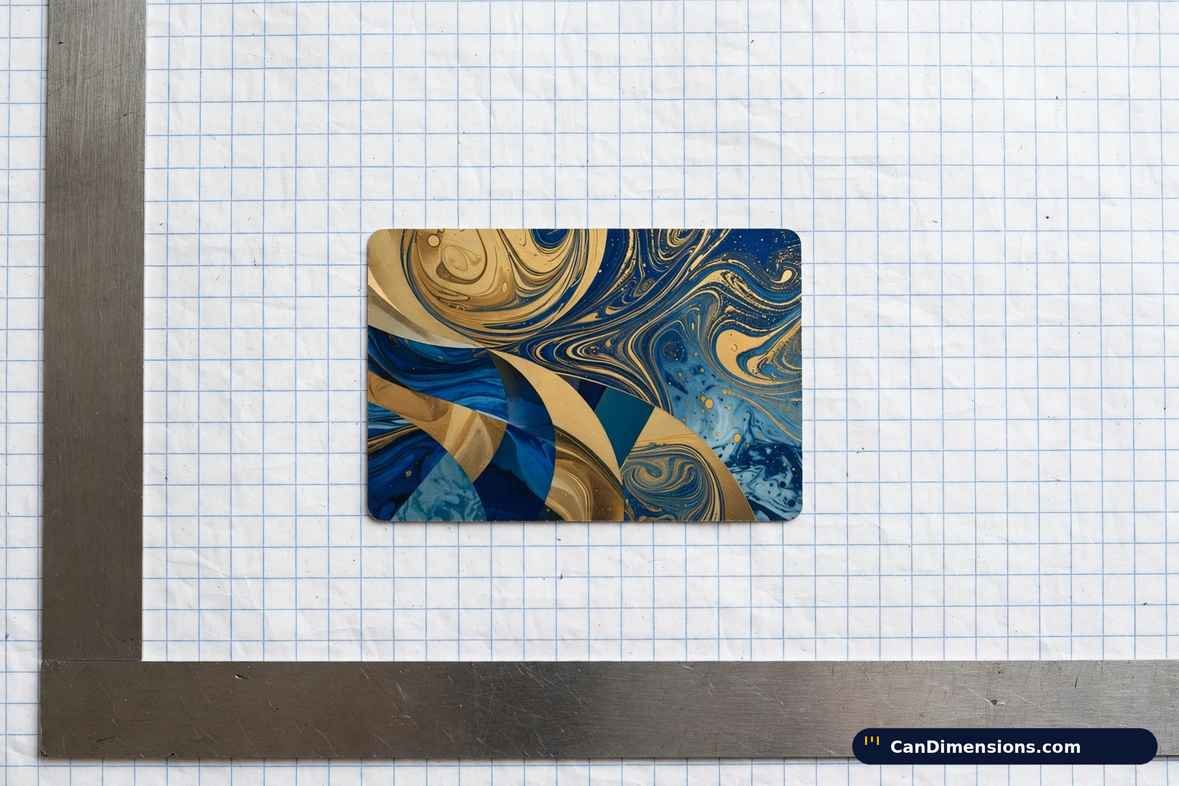
Those two numbers drive every accessory decision: sleeves, deck boxes, binder pages and grading holders are all designed around a 63 × 88 mm card, so a card that does not measure up to them is worth a second look (the measuring section below covers that check).
Pokémon Card Thickness: How Thick Is a Pokémon Card?
A standard Pokémon card is about 0.3 mm thick — roughly 0.012 inches, about the thickness of three sheets of printer paper stacked together. Foil and textured cards can feel a fraction stiffer, but the footprint never changes, which is why one card on its own feels flimsy and a 60-card deck feels like a solid brick: sleeved, that deck stands roughly 3.5 cm tall.
Thickness matters in one practical place — toploader sizing. Holders are sold in “point” sizes that describe how thick a card they accept, and a standard Pokémon card in a soft sleeve fits the regular 35-point size, as the protection section below explains.
Complete Pokémon Card Size Chart
Here is every Pokémon card format in one table — the standard card and the four oversized promotional sizes, with the protection each one needs:
| Card Type | Dimensions (inches) | Dimensions (mm) | Usage | Protection Notes |
|---|---|---|---|---|
| Standard | 2.5″ × 3.5″ | 63 × 88 mm | Tournament play, booster packs | Standard sleeves |
| Box Topper | ~3.5″ × 5″ | 90 × 126 mm | Promotional, display only | Oversized sleeves (3.5″ × 5″) |
| Jumbo L (2020+) | 5.2″ × 7.3″ | 133 × 185 mm | Premium collections, display | Jumbo sleeves or framing |
| Jumbo XL (Pre-2019) | 5.7″ × 7.9″ | 145 × 200 mm | Older premiums, display | Specific XL sleeves |
| CoroCoro XXL | 5.7″ × 8.1″ | 145 × 205 mm | Japanese exclusive, rare display | Custom XXL protection |
Standard Card Size
Standard cards measure 2.5″ × 3.5″ (63 × 88 mm) and make up the overwhelming majority of Pokémon cards in existence — everything in booster packs and starter decks, from basic commons to ultra-rare secret rares. These are the cards used in tournament play and ordinary games, and the size every accessory in the hobby is built around.
The uniformity is the point: because every playable card is identical in size, shuffling is smooth, decks stack evenly, and protection bought for a card printed this year fits a card printed in 1999.
Box Topper Card Size
Box topper cards measure approximately 90 × 126 mm — about 3.5″ × 5″, roughly twice the area of a standard card. They are promotional cards packed on top of certain collection boxes, and they are not legal for tournament play; they exist as display and novelty pieces.
Protection is the catch: box toppers need oversized sleeves in the 3.5″ × 5″ class, and many collectors skip sleeves altogether and frame them or use a display case instead.
Jumbo L Card Size (2020 and After)
Jumbo L cards measure 133 × 185 mm (approximately 5.2″ × 7.3″) and are the modern oversized format. From 2020, The Pokémon Company moved its premium collection boxes to this slightly smaller jumbo size, so most oversized cards you pull from a recent box will be Jumbo L.
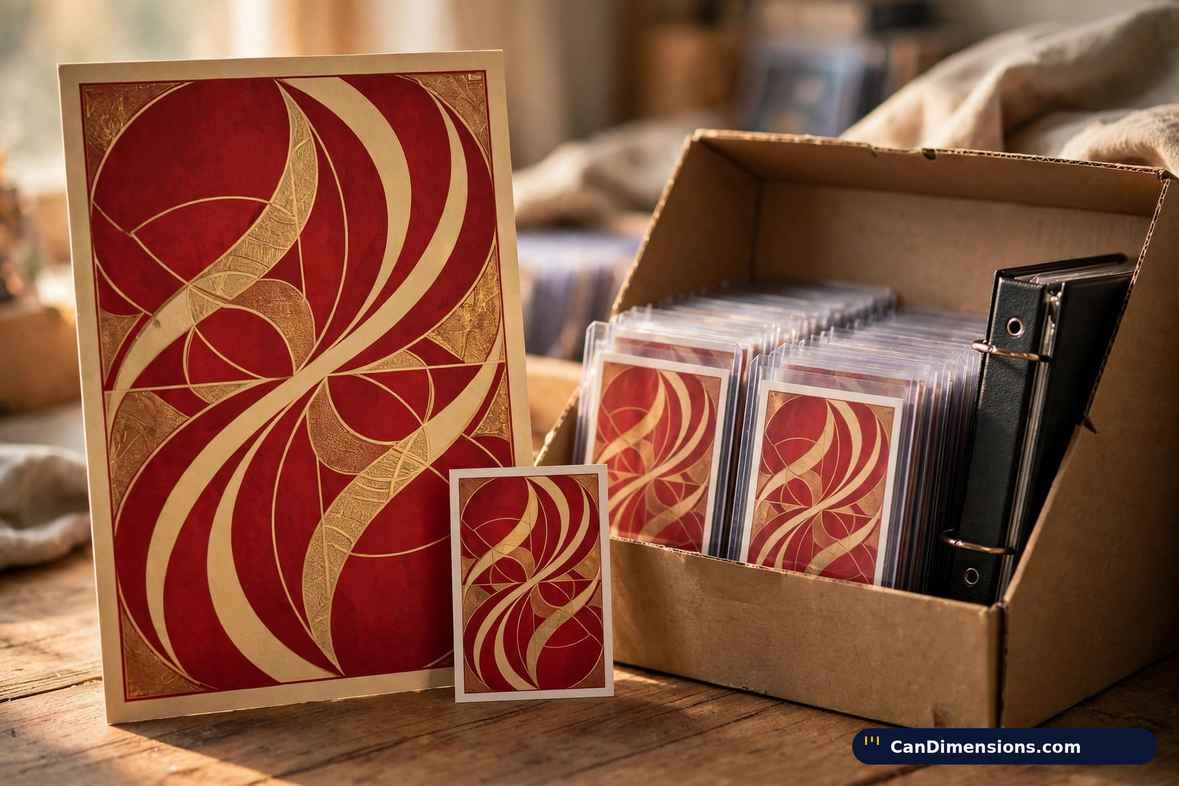
Regular sleeves cannot hold a card this size. Look for sleeves and binder pages sold specifically for jumbo cards, or frame the card — jumbo cards are display pieces, never playing cards, and they make excellent framed art for a collection room.
Jumbo XL Card Size (Pre-2019)
Jumbo XL cards, printed before 2019, measure 145 × 200 mm (approximately 5.7″ × 7.9″) — the original jumbo format, slightly larger than Jumbo L in both directions. If your oversized cards came from older premium boxes, they are most likely this size.
That small difference is exactly why you should measure before you order protection: a Jumbo XL card will not sit properly in a sleeve cut for Jumbo L. Vintage collectors feel this most, because their oversized promos predate the changeover.
CoroCoro XXL Card Size
CoroCoro XXL cards measure 145 × 205 mm (approximately 5.7″ × 8.1″) and are Japanese-exclusive promotional cards, distributed with CoroCoro Comic magazine. They are the largest official Pokémon card format and among the hardest to find outside Japan, which is why they command strong prices.
The extra 5 mm of length over Jumbo XL means even XL sleeves fall short; XXL cards need custom protection, and most owners frame them professionally.
Sleeve, Toploader and Binder Sizes for Pokémon Cards
Protection is sized off the card with a little clearance, so the numbers to buy are slightly bigger than 63 × 88 mm:
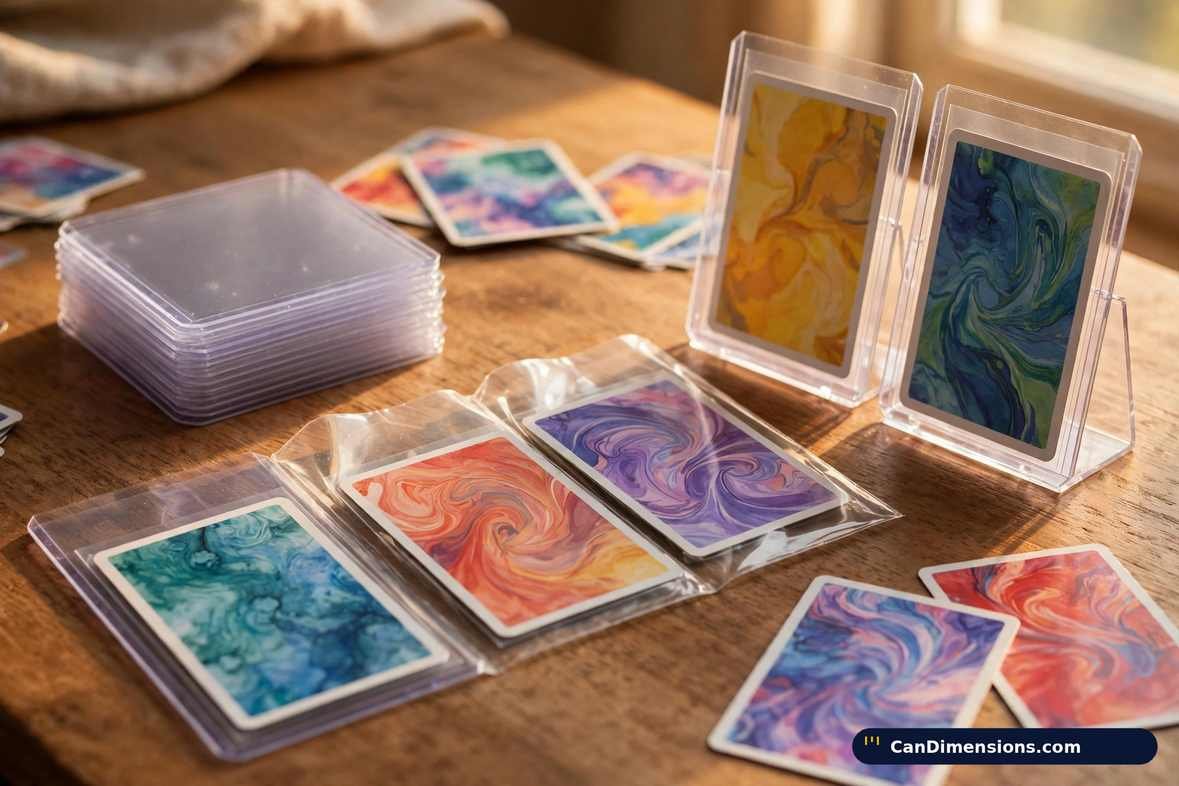
- Standard sleeves: 66 × 91 mm. That is the manufacturer specification for standard-size deck protector sleeves (Ultra Pro publishes exactly this size for Pokémon and Magic cards). It gives the card about 3 mm of clearance in each direction — easy to slide in, no sloppy movement.
- Perfect-fit inner sleeves: about 64 × 89 mm. These hug the card almost exactly and are worn underneath a standard sleeve for double protection.
- Toploaders: 3″ × 4″, regular 35-point. The rigid holder standard for a sleeved Pokémon card is the 3 × 4 inch toploader; the 35-point size takes a standard card in a soft sleeve. Thicker memorabilia cards need higher point sizes — a normal Pokémon card does not.
- Binder pages: standard 9-pocket pages. Pockets are cut for 2.5″ × 3.5″ cards, so any page sold for standard trading cards fits Pokémon cards — including a card in a perfect-fit sleeve.
Jumbo formats break all of these rules: each oversized size needs its own sleeve class, as the chart above notes, and none of them fit a standard binder page.
Graded Pokémon Card Slab Sizes
When a card is professionally graded, it is sealed inside a rigid plastic slab — and the slab is always bigger than the card. One caution before you measure anything: grading companies do not share one holder size. PSA, CGC and Beckett each use their own case dimensions, and cases have changed across generations, so there is no single “slab size” to quote honestly.
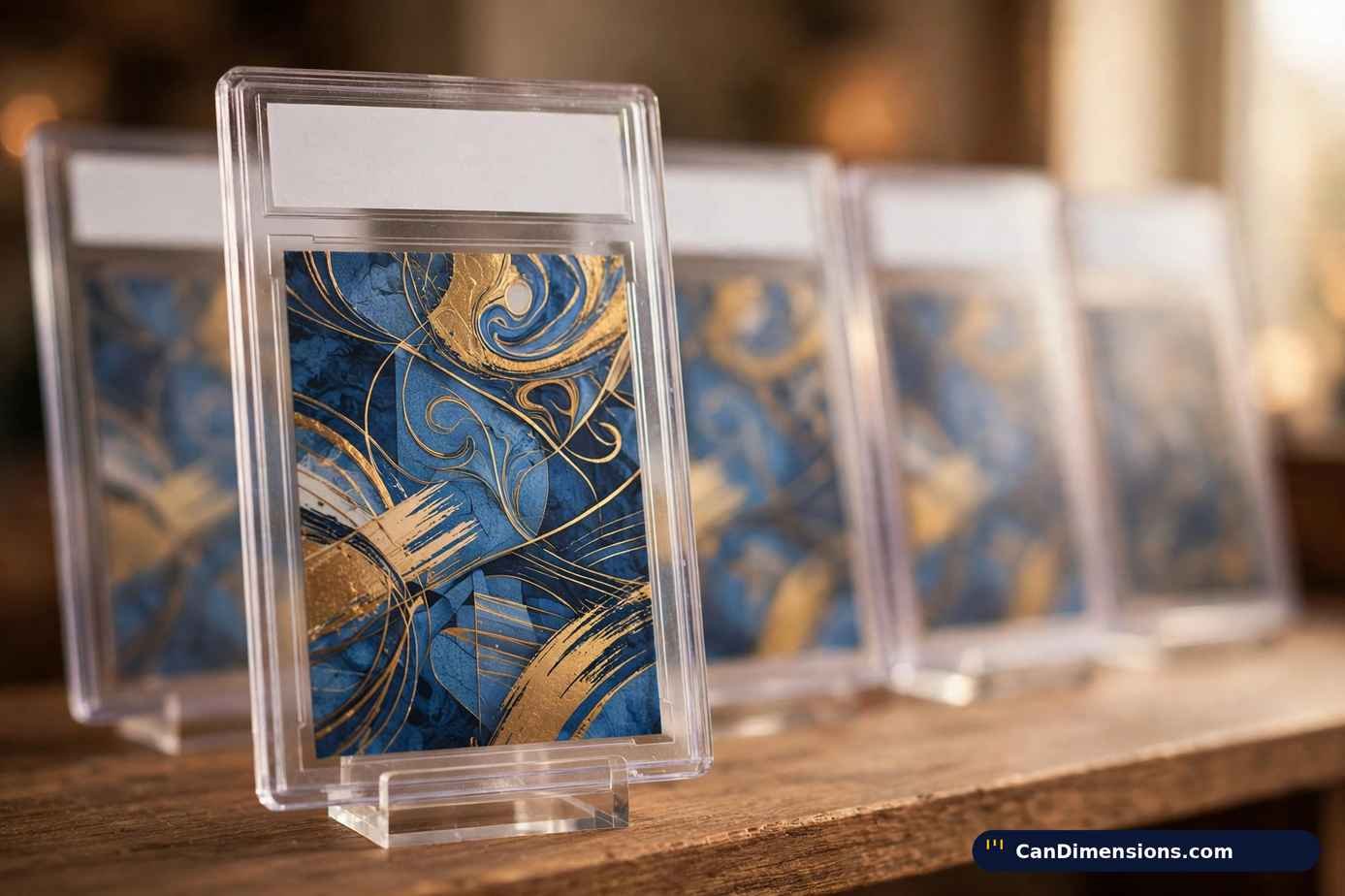
What stays constant is the card inside: a standard Pokémon card in a slab still measures 63 × 88 mm. If you are buying a display stand, frame or storage box for graded cards, measure your actual slab — or check the holder dimensions the grading company publishes for its current case — rather than trusting a generic number from a listing.
How Pokémon Card Sizes Compare to Other Trading Cards
Standard TCG Card Size Comparison
Pokémon cards share their 63 × 88 mm size with Magic: The Gathering cards exactly — sleeves, deck boxes and binders are fully interchangeable between the two games, and most sports cards follow the same 2.5″ × 3.5″ standard too.
One popular comparison is often stated wrongly, so here it is correctly: Yu-Gi-Oh! cards are smaller. A Yu-Gi-Oh! card measures 59 × 86 mm — about 4 mm narrower and 2 mm shorter — which is why Yu-Gi-Oh! uses its own “Japanese size” sleeves (about 62 × 89 mm). A Yu-Gi-Oh! card rattles around in a Pokémon sleeve, and a Pokémon card simply will not fit in a Yu-Gi-Oh! sleeve.
Japanese vs. International Pokémon Card Sizes
Another widely repeated claim needs correcting: Japanese Pokémon cards are the same size as international ones. Pokémon uses the standard 63 × 88 mm size in every language, Japan included — a Japanese card fits the same sleeves and binder pages as an English one.
The confusion comes from other Japanese card games, Yu-Gi-Oh! above all, which genuinely do use the smaller 59 × 86 mm Japanese size. That smaller size belongs to those games, not to Japanese Pokémon cards.
How to Measure a Pokémon Card (and Spot a Fake by Size)
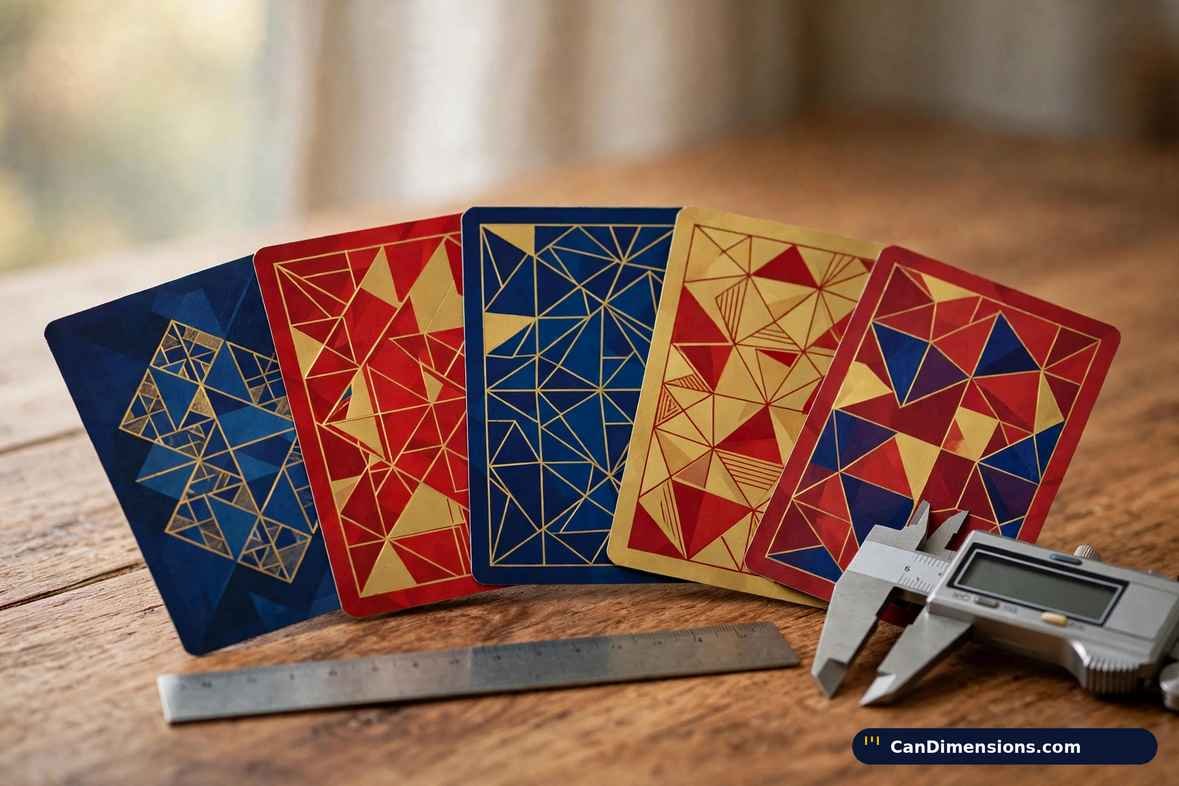
You only need a ruler or a basic caliper:
- Lay the card flat, out of its sleeve — sleeves add millimetres of their own.
- Measure the short edge (width) and the long edge (height) in millimetres; mm are easier to read precisely than fractions of an inch.
- Compare against the standard: 63 × 88 mm (2.5″ × 3.5″).
Genuine cards are cut to a tight, consistent size. A card that measures clearly off — a millimetre or more in either direction — or whose thickness feels obviously wrong against a known genuine card deserves a closer authenticity check before you pay collector money for it. Size alone does not prove a card fake (print runs have tiny tolerances), but it is the fastest first filter you have, and it costs nothing.
FAQ’s
What are the sizes of Pokemon cards?
Standard Pokémon cards measure 2.5 × 3.5 inches (63 × 88 mm). The promotional formats are larger: box toppers at about 90 × 126 mm, Jumbo L at 133 × 185 mm, Jumbo XL at 145 × 200 mm, and the Japanese CoroCoro XXL at 145 × 205 mm. Only the standard size is legal for play.
What size is a XL Pokémon card?
A Jumbo XL Pokémon card — the oversized format printed before 2019 — measures 145 × 200 mm (about 5.7″ × 7.9″). It is a display piece, not a playing card, and it needs XL-size sleeves because the newer Jumbo L format is slightly smaller.
What Pokémon card is worth $1,000,000?
The Pikachu Illustrator is the famous one: a copy sold for $5.275 million in 2021, the record price for a Pokémon card. Other seven-figure cards include rare Trophy Pikachu variants and top-graded 1999 First Edition Charizard cards — all of them printed at the same standard 63 × 88 mm size as a common card.
What size are Pokemon cards in CM?
A standard Pokémon card measures 6.3 × 8.8 cm. The oversized formats in centimetres: box topper about 9 × 12.6 cm, Jumbo L 13.3 × 18.5 cm, Jumbo XL 14.5 × 20 cm, and CoroCoro XXL 14.5 × 20.5 cm.
Are fake Pokemon cards different sizes?
Often, yes. Authentic cards are cut to a consistent 63 × 88 mm, while counterfeits are frequently a millimetre or two off in one or both directions and can feel thinner or flimsier. Size is a first check, not a verdict — combine it with print, texture and light tests before judging a valuable card.
Is Pokémon TCG 40 or 60 cards?
A constructed Pokémon TCG deck is exactly 60 cards. The 40-card figure belongs to limited formats — prerelease, sealed and draft events — where you build a smaller deck from the cards you open on the day. Either way, every card in the deck is the standard 63 × 88 mm size.
What is a normal card size in cm?
The normal trading card size is 6.3 × 8.8 cm (63 × 88 mm) — the size used by Pokémon, Magic: The Gathering and most sports cards. Ordinary poker-size playing cards are the same footprint in inches, 2.5 × 3.5.
What is the standard TCG card size?
The standard TCG card size is 2.5 × 3.5 inches (63 × 88 mm), shared by Pokémon and Magic: The Gathering. The main exception among major games is Yu-Gi-Oh!, which uses the smaller Japanese size, 59 × 86 mm — one reason its accessories are not interchangeable with Pokémon’s.
What size sleeves do Pokemon cards fit in?
Standard-size sleeves, 66 × 91 mm — the size every major sleeve brand sells for Pokémon and Magic cards. For double-sleeving, add a perfect-fit inner sleeve (about 64 × 89 mm) underneath. Jumbo cards need their own oversized sleeves; no standard sleeve will hold them.
Conclusion
Pokémon card dimensions come down to one number worth remembering — 63 × 88 mm — plus four oversized promotional formats for display pieces. Get the standard size right and every sleeve, toploader, binder page and deck box decision follows from it. And whatever game you collect, the trading card hobby runs on a small set of shared sizes — which is exactly why checking the millimetres before you buy protection is never wasted effort.