Dishwasher Dimensions: Standard Sizes, Cutouts and Capacities Explained
Measure for dishwasher dimensions in inches and one size does almost all of the work: the standard built-in fits a 24-inch-wide opening, stands in a space about 34½ to 36 inches tall, and needs 24 inches of depth, while the compact alternative drops to an 18-inch opening.
The trap is that the number on the box names the opening, not the appliance. A machine sold as 24 inches wide actually measures about 23½ to 23⅞ inches across on maker spec sheets, and that hidden margin is exactly what lets it slide in — or leaves a buyer confused when the tape disagrees with the label.
This page works from the makers’ own specification sheets: the standard breakdown first, then the verified size chart, the compact, drawer, portable and countertop formats, the measuring steps, the clearances around the door, and what capacity in place settings really counts.

Standard Dishwasher Dimensions
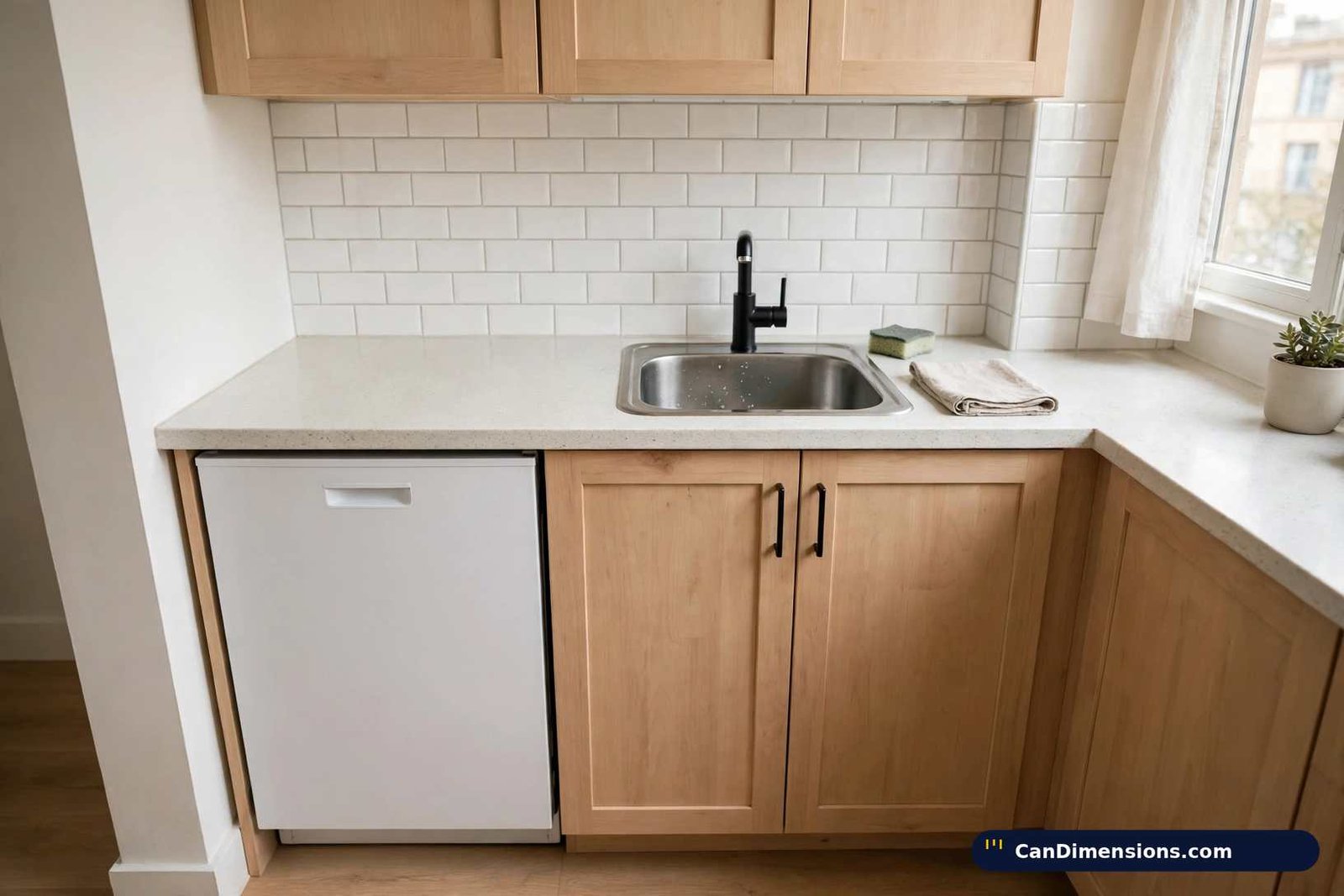
The standard American built-in is a 24-inch-class machine. Whirlpool’s own sizing guide puts the standard dishwasher at about 24 by 24 by 35 inches — width, depth, height — and describes those figures as the size of the cabinet opening the appliance is made to fit rather than the size of the box itself.
That single distinction explains most dishwasher confusion. The opening is the fixed quantity your kitchen provides; the appliance is built a fraction smaller on every side so it can be levelled, connected and slid home. Every figure in the breakdown that follows is therefore given twice where it matters: once for the hole, once for the machine that fills it.
Dishwasher Dimensions Chart
| Type | Opening width | Appliance width | Height | Depth | Capacity |
|---|---|---|---|---|---|
| Standard built-in (24-inch class) | 24 inches | About 23½ to 23⅞ inches | Opening 34½ to 36 inches; appliance from 33⅞ inches, adjustable | 24-inch cutout; appliance about 23 to 23¾ inches | About 12 to 16 place settings |
| Compact built-in (18-inch class) | 18 inches (17⅝ inches minimum on the checked spec) | 17½ inches | From 32½ inches, adjustable upward | 22½ inches on the checked spec | 8 place settings |
| ADA-height built-in | 24 inches | About 23⅝ inches class | About 32 to 32½ inches | About 24 inches class | Varies by model |
| Single DishDrawer | 24 inches | 23 9/16 inches | 17⅞ inches (tall single) | 22½ inches | 7 place settings per drawer |
| Double DishDrawer | 24 inches | 23 9/16 inches | About 32 5/16 to 34⅝ inches | 22½ inches | 7 place settings per drawer |
| Portable (freestanding) | None | About 24 inches | About 37 inches | About 27 inches | Varies by model |
| Countertop | None | 21.65 inches | 17.24 inches | 19.69 inches | 6 place settings |
Read the chart as a set of classes, not promises about any single model. Within the standard class alone, one leading maker’s sheet gives an appliance 23 9/16 inches wide and 23¾ inches deep, while another’s planning guide gives 23⅞ inches wide — both honest, both “24-inch dishwashers”, and different enough that the spec sheet for your exact model always outranks any chart, this one included.
Standard Built-In Dishwasher Size Breakdown
Width comes first because it is the dimension with no adjustment in it. The standard opening is 24 inches wide, and makers build to it with a small working margin: the Bosch 800 Series sheet lists the appliance at 23 9/16 inches wide against a required cutout of 23⅝ to 24 inches, and Whirlpool’s planning dimensions list a door width of 23⅞ inches. A standard machine is therefore about 23½ to 23⅞ inches wide in the metal, whatever the shelf label says.
Depth is the dimension buyers most often misread. The cutout depth on the same Bosch sheet is 24 inches, while the appliance itself measures 23¾ inches deep in bar-handle form and just 23 1/16 inches deep in the panel-ready version, before any handle or custom panel is added. Whirlpool’s planning guide works the same way: about 24½ inches deep with a pocket handle and 26½ inches with a protruding towel-bar handle, handles included.
Height carries the adjustment. The Bosch appliance starts at 33⅞ inches tall and levels upward to 35 inches on its feet; Whirlpool asks for a 34½ to 36-inch-tall opening in its measuring guide. So the honest standard height statement is a pair of ranges: an opening of roughly 34½ to 36 inches, filled by an appliance of roughly 33⅞ to 35 inches once levelled.
Standard Cabinet Sizes Behind the Opening
The opening exists because the cabinets around it are themselves standardised. Base cabinets are built so the finished countertop lands about 36 inches above the floor, and the dishwasher bay is simply one 24-inch-wide module in that run with the door and drawer fronts left off. That is why the opening height is measured to the underside of the counter rather than to its top, and why a thick countertop eats into appliance height instead of adding to it.
It is also why the neighbouring sizes come in whole modules. An 18-inch compact bay is the next standard module down, and the jump from an 18-inch bay to a 24-inch bay is a cabinet-maker’s decision, not an installer’s adjustment — no amount of levelling turns one module into the other.
Non-Standard Dishwasher Sizes Explained
The compact built-in is the 18-inch class, and its real figures are smaller in every direction than the standard story suggests. The GE Monogram 18-inch specification lists the appliance at 17½ inches wide, 22½ inches deep and 32½ inches tall, needs a cutout at least 17⅝ inches wide, and rates the machine at 8 place settings. So a compact is not a standard dishwasher squeezed in width alone: it is shallower and shorter as well, and it suits the lower openings of older and accessible kitchens for the same reason.
At the other end sit the oversized built-ins. Whirlpool’s sizing guide describes oversized dishwashers as roughly 30 to 42 inches across, with standard-class depth and height — the 30-to-42-inch band is real, but it belongs to a niche, custom-remodel class rather than to anything a mainstream retail line stocks in depth, and a kitchen taking one is being framed around the appliance, not the other way round. Between the two mainstream widths there is nothing: no major maker sells a 20-inch or 22-inch built-in, a point the questions at the end of this page return to twice.
European sizing explains most of the metric figures shoppers meet. A European full-size machine is a 60-centimetre-class appliance — 600 millimetres is 23.62 inches, a close cousin of the American 24-inch class rather than the same thing — and the 45-centimetre slimline class, at 17.72 inches, matches the American 18-inch compact. Depths vary by market and model, so a single “European depth” figure should never be trusted without the model’s own sheet.
Dishwasher Dimensions in Centimeters and Millimeters
Every metric figure below uses the exact factor of 2.54 centimetres per inch, with a single rounding at the end of each conversion. The standard opening converts to 60.96 centimetres wide (609.6 millimetres), 87.63 to 91.44 centimetres tall and 60.96 centimetres deep. The compact opening converts to 45.72 centimetres wide, and the checked compact appliance, at 17½ by 22½ by 32½ inches, converts to 44.45 by 57.15 by 82.55 centimetres.
Two conversions earn their keep. First, 600 millimetres is 23.62 inches — not 24 — which is why a European machine can feel a fraction loose in an American opening. Second, 55 centimetres is 21.65 inches: shallower than any American built-in class, which is why the 55-centimetre depth figure in the questions below belongs to specific European models rather than to dishwashers generally.
How to Measure Your Space for a Dishwasher
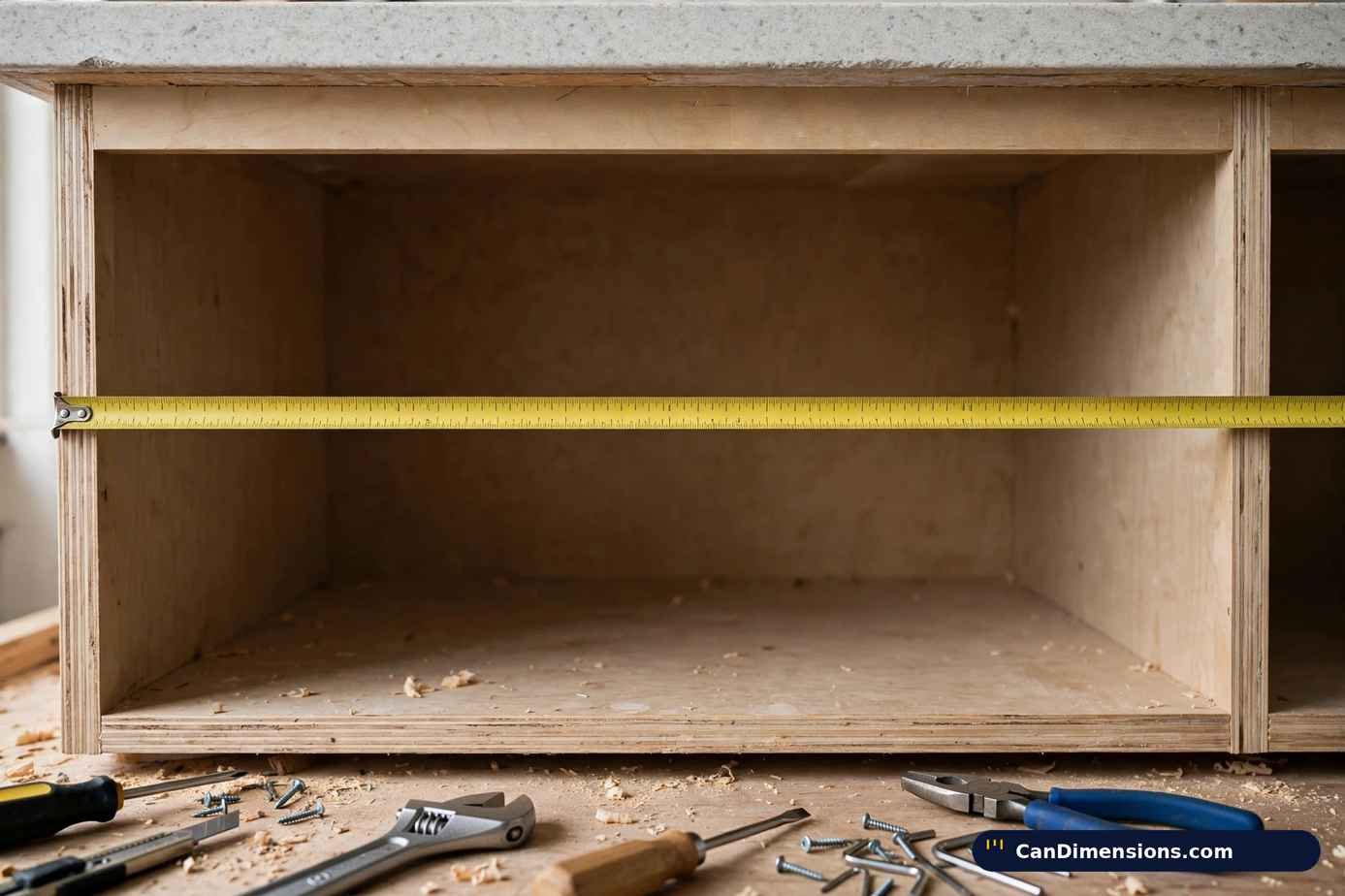
Measure the empty opening, never the appliance coming out of it. The old machine may sit on shims, behind filler strips or over flooring that stops at its feet, and every one of those tricks falsifies the three numbers you need. The same three numbers, taken the same way, decide which of the standard kitchen trash can dimensions and every other under-counter fit in the kitchen will work.
Step 1 – Measuring Dishwasher Opening Width
Measure between the inside faces of the cabinets on either side, at the front of the opening and again at the back, and at the top and the bottom. Openings are rarely perfectly square, and the smallest reading is the one the appliance has to pass through, so the smallest reading is the one to shop with. For a standard machine that smallest reading needs to be 24 inches, or within the 23⅝-to-24-inch cutout band the Bosch sheet allows; for a compact, at least 17⅝ inches on the checked GE specification.
Step 2 – Measuring Dishwasher Opening Height
Measure from the floor inside the opening to the lowest point of the countertop’s underside, at the front and at the back, and again shop with the smaller figure. Whirlpool’s guide puts most openings at 34½ to 36 inches. Flooring is the hidden variable: tile or boards laid after the cabinets raise the floor inside the kitchen but often stop short inside the opening, and a machine levelled for the lower floor inside can sit too tall at the front edge where the new floor begins.
Step 3 – Measuring Dishwasher Opening Depth
Measure from the back wall of the opening to the front face of the surrounding cabinets, not to the front of the countertop, which overhangs. The standard cutout depth is 24 inches. Then check what lives inside that depth: a protruding electrical box, a water line run along the back wall or a baseboard heater all spend depth the spec sheet assumes is empty, and each one is a reason a nominally deep-enough opening refuses a nominally shallow-enough machine.
Space Requirements Around Your Dishwasher
The opening is only half the space question. The other half is the room the machine needs in front of it and beside it once it is installed, and that half is where kitchens with islands and corner runs get caught.
Door Swing Clearance
A dishwasher door does not swing sideways; it folds down, and its footprint is a depth figure, not an arc. Whirlpool’s planning dimensions give a depth of 50 3/16 inches with the door fully open on the checked models — the machine’s own depth plus the dropped door and the lower rack rolled out onto it. Separately, Whirlpool’s measuring guide asks for a clear working zone of at least 27 inches ahead of the machine, enough to load and unload comfortably and to move between the open door and an island or counter opposite. The two numbers answer different questions: about 50 inches is what the open machine physically occupies from the back wall; 27 inches of free floor in front of the cabinets is the working room a person needs alongside it.
Side and Corner Clearances
Sideways, a built-in needs almost nothing. The GE installation guidance for its built-ins requires as little as 0.1 inch — about 2 millimetres — between the dishwasher and the cabinet sides, because the machine is fixed to the countertop or cabinetry and does not breathe through its sides. Corner kitchens are the exception that creates the confusion: where the dishwasher sits next to a perpendicular run or an appliance with a protruding handle, the dropped door’s edge and the neighbouring handle need checking against each other with the door open, and that check is about the layout in front of the machine, not about a fixed side gap inside the opening.
Top Clearance and Countertop Gap
Height is spent at the top. The appliance levels up toward the underside of the counter and is secured there or to the cabinet sides, so the working requirement is simply that the opening’s smallest height reading clears the model’s minimum height on its feet. A small shadow gap under a thick counter is normal and harmless; a machine forced against the counter by over-extended feet is not, because the door’s top edge and controls need their designed clearance to open without rubbing.
Utility Connection Considerations
Water, drain and power usually arrive through the neighbouring sink cabinet, and makers plan for it: Bosch’s installation material includes a cutout in the side wall of the adjacent cabinet for the hoses and cord to pass through. Two space consequences follow. The drain hose run is length-limited — GE’s guidance places the dishwasher within about 9.8 feet (3 metres) of the sink for the drain to work properly — and the connections themselves sit low at the back of the opening, which is why depth obstructions matter most in the bottom rear corner rather than at the top.
Dishwasher Size Variations and Capacity
Capacity is quoted in place settings, and the term has a standards meaning rather than a marketing one: under the ANSI/AHAM DW-1 test framework used in United States appliance rules, a standard dishwasher is one holding at least eight place settings plus six serving pieces, and a place setting is one person’s full set of plates, bowl, cup, glass and cutlery. Standard 24-inch machines rate at roughly 12 to 16 place settings on that basis; the checked 18-inch compact rates at 8.
How Interior Layout Affects Capacity
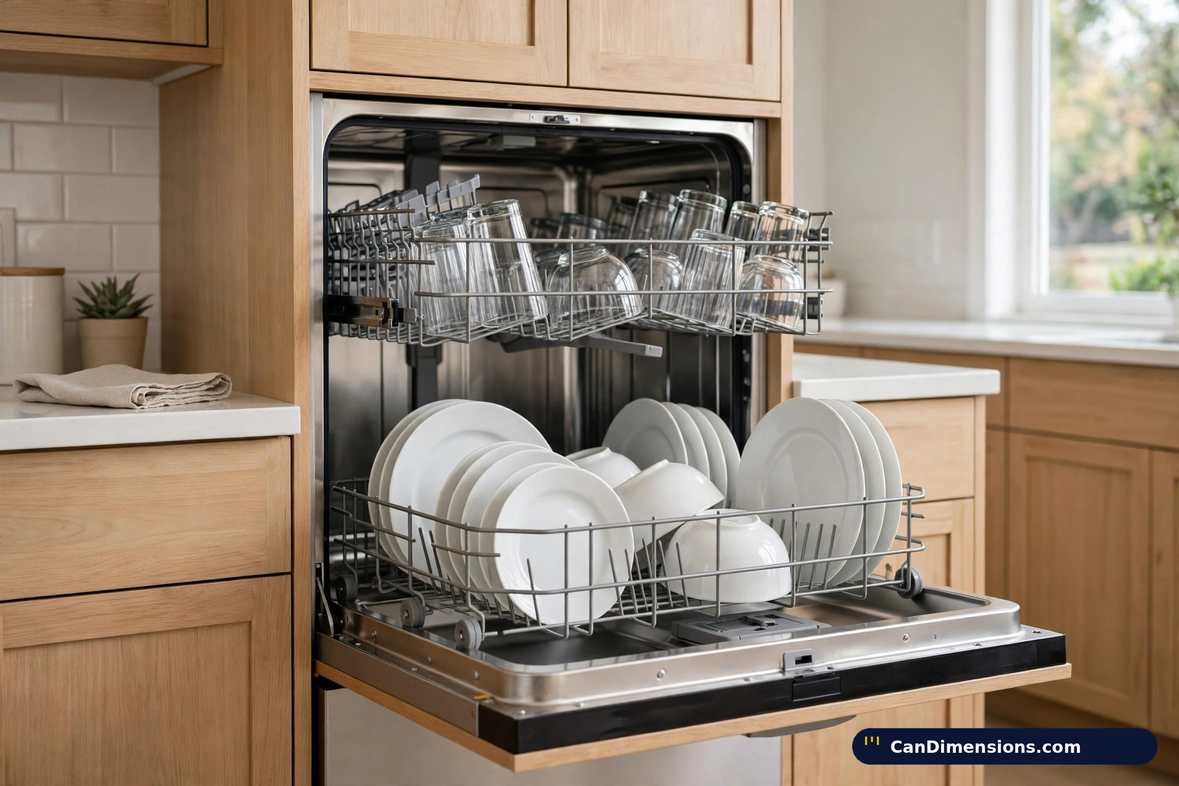
Two machines with identical outside dimensions can rate two place settings apart, because the rating counts what the racks hold, not what the tub measures. A third rack across the top trades a few inches of upper-tub height for a full extra layer of cutlery and small items; adjustable middle racks trade the other way, giving up a setting or two of count to swallow tall pans below. The place-setting number is therefore a comparison tool between models of the same class, not a promise about any particular load of your own dishes.
Tall Tub vs. Standard Tub Height
A tall tub spends the same opening differently. The exterior still fits the standard cutout class — the height adjustment on the feet and the thinner floor and top structures inside the cabinet buy the extra inches for the tub instead — so a tall-tub model can take oversized platters and stock pots that a standard tub of the same outside size cannot. The drawer format takes the idea furthest: a tall single DishDrawer stands 17⅞ inches high at the standard 23 9/16 inches wide on Fisher & Paykel’s sheet, holds 7 place settings, and can sit at counter height in a run of drawers rather than under the counter at all.
Panel-Ready Models and Depth Adjustments
A panel-ready machine is built to disappear, and the disguise costs depth. Bosch’s panel-ready sheet gives the appliance at 23 1/16 inches deep — shallower than its handled equivalent — precisely so the custom cabinet panel can go on the front: Whirlpool’s installation figures put that panel at ¾ inch (19 millimetres) thick, which brings the finished front back to roughly the standard depth and flush with the cabinet faces around it. Price the panel into the depth measurement from the start, and remember that a protruding bar handle on a standard model spends the same room less elegantly, at up to about 26½ inches of total depth on the checked Whirlpool figures.
Dishwasher Drawer, Portable and Countertop Sizes
Three formats need no standard opening at all, and each has a maker’s size of its own. The double DishDrawer stacks two 7-place-setting drawers into roughly the standard machine’s footprint — about 32 5/16 to 34⅝ inches tall and 22½ inches deep at the same 23 9/16-inch width on Fisher & Paykel’s planning figures — so a drawer kitchen keeps the 24-inch bay and changes only what happens inside it.
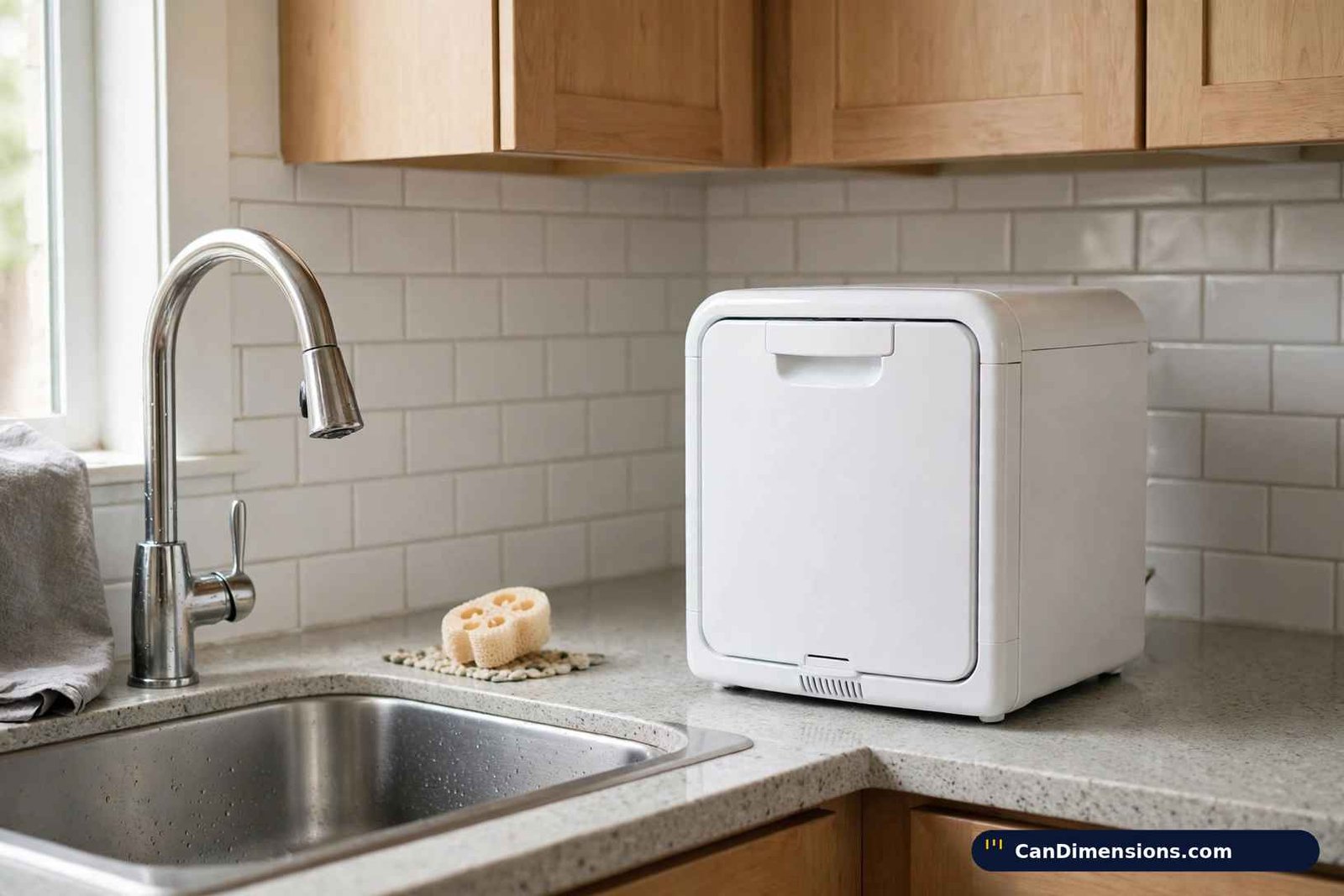
Portable freestanding machines roll to the sink and connect to the faucet. Whirlpool’s guide sizes a typical portable at about 24 inches wide, 27 inches deep and 37 inches high — deeper and taller than the built-in it substitutes for, because the case wraps the tub on all sides and the top doubles as workspace. Countertop machines shrink the idea onto the counter itself: the Danby countertop specification lists 21.65 inches wide, 19.69 inches deep and 17.24 inches tall, holding 6 place settings — small enough to fit under most wall cabinets, and the only format on this page whose height is measured against the gap above a counter rather than the space below one.
Questions and Installation Tips
Does My Dishwasher Need to Be Flush with Cabinets?
Flush is a depth question wearing a style question’s clothes. The tub must sit far enough back for the door to close against the opening and the front to read as one plane with the cabinet faces; a pocket-handle or panel-ready front can sit genuinely flush, while a bar handle stands proud by design. What must not happen is the opposite error in either direction — a machine pushed so far back that the door binds on the cabinet edges, or left so far forward that the dropped door’s hinge line moves into the walkway.
What If My Opening Doesn’t Match Standard Sizes?
Work with the size of the mismatch. An opening a fraction wide takes filler strips matched to the cabinet finish. An opening a fraction short on height may still take an ADA-height model at about 32 to 32½ inches tall, built for counters at a maximum of 34 inches under the accessibility standards. A full module out — a 22-inch opening, say — has no appliance answer at all: the honest choices are an 18-inch machine with fillers, a portable or countertop machine that ignores the opening, or reframing the bay to 24 inches as part of a larger remodel. The average living room dimensions problem is the same one at room scale: standard modules first, furniture second.
Important Installation Tips from Professionals
Measure twice, at the narrowest points, and write the smallest figures down. Check the floor inside the opening against the floor in front of it before choosing a height. Confirm the water, drain and electrical positions before ordering, not after delivery. And read the installation sheet for the exact model — every maker prints one, the cutout figures on it outrank every guide, and the difference between a smooth slide-in and a returned appliance is usually a quarter-inch somebody assumed instead of measuring.
Question’s
What is the standard size of a dishwasher?
A 24-inch-class built-in. The opening measures 24 inches across, 24 inches front to back and roughly 34½ to 36 inches from floor to counter underside; the machine inside it is a fraction smaller on every side, as the breakdown section sets out.
How much space is required for a dishwasher?
The opening above, plus working room in front of it: at least 27 inches of unobstructed floor ahead of the cabinets for comfortable loading, and roughly 50 inches measured from the back wall once the door is down and the lower rack is out.
Is a 24 inch dishwasher actually 24 inches wide?
No. Twenty-four inches names the opening. The checked spec sheets put the appliance at 23 9/16 inches (Bosch) and 23⅞ inches (Whirlpool) wide — the missing fraction is the installation margin.
How wide of an opening do I need for a dishwasher?
Twenty-four inches for a standard machine, with the checked Bosch cutout band running 23⅝ to 24 inches. A compact 18-inch machine needs a minimum opening width of 17⅝ inches, per the GE sheet quoted in Step 1.
Are all dishwashers 55cm deep?
No. Fifty-five centimetres is 21.65 inches — shallower than the American built-ins, whose appliances run about 23 to 23¾ inches deep into a 24-inch cutout, and shallower than many European machines too. A 55-centimetre depth belongs to particular models, mostly European; it is not a dishwasher standard.
Is there a 20 inch wide dishwasher?
No mainstream built-in. The built-in widths jump from the 18-inch compact class straight to the 24-inch standard class. A 20-inch opening takes an 18-inch machine with filler strips, or a countertop model that does not use the opening.
Are all dishwashers 600 wide?
No. Six hundred millimetres — 23.62 inches — is the European full-size class width, close to but not identical with the American 24-inch opening standard, and the compact classes on both sides of the Atlantic are far narrower at 450 millimetres and 18 inches.
What is the width of space required to install a dishwasher?
The same answer as the opening question, because it is the same measurement: 24 inches between the cabinet faces for a standard machine, taken at the narrowest point; the compact class needs a minimum of 17⅝ inches on the GE sheet quoted earlier.
Is there a 22 inch wide dishwasher?
No standard built-in at 22 inches exists from the major makers. The working options for a 22-inch opening are the 18-inch compact with fillers, a portable or countertop machine, or widening the bay to the 24-inch module.
Conclusion
Dishwasher sizes turn out to be a short list wearing a long set of labels. Underneath, there are two built-in widths that matter — the 24-inch standard and the 18-inch compact — a standard opening 34½ to 36 inches tall and 24 inches deep, an appliance always a fraction smaller than the hole it fills, and a fringe of drawers, portables and countertop machines with honest sizes of their own.
Hold on to the working figures — 24 inches of opening, about 23⅝ inches of actual machine, 27 inches of clear floor in front — and measure your own opening at its narrowest points before trusting any label. Get the fit right and the rest of the purchase, down to the last tablet of detergent, becomes the easy part.