40 Feet: 11 Things with Pictures That Are 40 Feet Long or Tall
Forty feet sounds abstract until you stand it next to a person. Put 40 feet compared to human height and the scale lands at once: about seven adults tall, or one city bus parked at the kerb.
This guide converts 40 feet into every unit that matters, then walks through 11 real things that measure 40 feet long or tall — each one checked against a manufacturer’s specification, an official standard or a museum record, with the basis stated wherever a figure is a class size or a recorded maximum rather than an exact tape measurement.

How Long Is 40 Feet?
Forty feet is 480 inches, 13.33 yards or 12.192 metres. It is long enough to need a wide street, a long tape or a practiced eye — which is why most people judge it against buses, buildings and containers instead of a ruler.
| Unit | 40 Feet Equals |
|---|---|
| Inches | 480 in |
| Yards | 13.333 yd |
| Centimeters | 1,219.2 cm |
| Millimeters | 12,192 mm |
| Meters | 12.192 m |
If you have already paced out 25 feet for a room or a garden, add a little more than half of it again and you are at 40 feet. It is also exactly twelve 40-inch lengths end to end — a handy check, because 40 inches is a standard counter and doorway-module size.
40 Feet Compared to a Human
The average adult stands about 5 feet 8 inches tall. Divide 40 by 5.67 and you get almost exactly seven — so 40 feet is roughly seven adults standing on each other’s shoulders, or seven adults lying head to toe along a pavement.
That one comparison unlocks most of this list. A four-story building is seven people tall. A city bus is seven people long. When a sperm whale passes under a boat at 40 feet, it is seven divers nose to tail. Keep the number seven in mind and every example below becomes easy to picture.
11 Common Things That Are 40 Feet Long or Tall
| # | Thing | Counted? | Basis |
|---|---|---|---|
| 1 | 40-Foot High-Cube Shipping Container | Yes | Exact — ISO standard length 12,192 mm |
| 2 | Full-Size City Transit Bus | Yes | The 40-foot class — 40 ft 2 in over the body |
| 3 | Full-Size School Bus | Yes | Maximum-length configuration, up to 40 ft |
| 4 | Large Female Sperm Whale | Yes | Recorded maximum — 12.3 m (40 ft) |
| 5 | Mid-Size Motor Yacht or Sailboat | Yes | The 40-foot class — hull 39 ft 4 in |
| 6 | 4-Story Residential or Commercial Building | Yes | About — four floors at roughly 10 ft each |
| 7 | Standard Wooden Utility Pole | Yes | Exact — standard manufactured length 40 ft |
| 8 | Large Whale Shark | Yes | Large adults — NOAA: may grow to about 40 ft |
| 9 | Classic 40-Foot Boxcar | Yes | The 40-foot class — inside length 40 ft 6 in |
| 10 | 40-Foot Gooseneck Equipment Trailer | Yes | Exact — maker floor length 480 in |
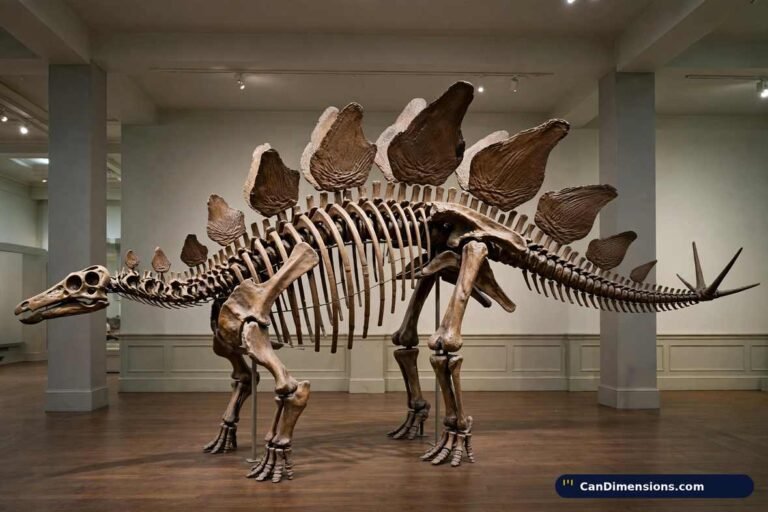
| 11 | SUE the T. rex | Yes | About — 40.5 ft, Field Museum record |
1. 40-Foot High-Cube Shipping Container
Counted: The 40-foot container is the backbone of world shipping, and its length is not approximate. The ISO 668 standard fixes the external length of a 40-foot container at 12,192 millimetres — exactly 40 feet 0 inches — with an internal length of 12,032 mm (about 39.5 feet) once the walls and door gear are allowed for.
The “high-cube” part of the name is about height, not length. A standard 40-foot container stands 2,591 mm (8 feet 6 inches) tall, while a high cube stands 2,896 mm (9 feet 6 inches) — exactly one foot taller, which is why high cubes carry cube-out cargo like furniture and boxed goods. Same 40-foot footprint, one extra foot of air inside.
2. Full-Size City Transit Bus

Counted: The standard North American city bus is sold, scheduled and sheltered as a 40-foot bus — it is the default size in almost every transit fleet. One honest disclosure: the class name is nominal. New Flyer’s own data for its 40-foot Xcelsior puts the bus at 40 feet 2 inches over the body and 41 feet over the bumpers, so a real 40-foot-class bus runs a couple of inches past the badge.
That is close enough that transit agencies, bus stops and road space are all planned around the 40-foot figure, and it seats around 40 passengers depending on the layout, with standing room on top. When one pulls up beside you, you are looking at 40 feet of vehicle.
3. Full-Size School Bus
Counted: The biggest school buses are built right up to the 40-foot mark. IC Bus rates its current CE Series at up to 40 feet overall, Blue Bird’s Vision range tops out in the same class, and several states cap school-bus length at 40 feet outright — so the longest floor plans, seating 70-plus students, sit exactly on this number.
One correction to the usual description: this size is often filed under “Type D” (the flat-nose transit style), but the two best-known models named for it — the Blue Bird Vision and the IC Bus CE Series — are actually Type C conventionals with a hood. Both types reach 40 feet at their longest; the count here rests on those maximum-length configurations, since shorter wheelbases in the same ranges run down to the mid-20s.
4. Large Female Sperm Whale

Counted: A large female sperm whale is one of the few animals that honestly reaches 40 feet — but read the basis carefully, because this is a recorded maximum, not the typical size. Most adult females run about 36 feet (11 metres), and NOAA notes that females reach physical maturity at around 35 feet. The largest females actually measured came in at 12.3 metres — 40 feet.
So the claim “a large female sperm whale is about 40 feet long” holds only for the biggest individuals ever recorded, and any source saying females routinely reach 40 feet is overstating it. Males are another matter: they grow far larger, past 50 feet, which is what makes the sperm whale the largest toothed predator alive.
5. Mid-Size Motor Yacht or Sailboat
Counted: The 40-foot class is the classic family cruising size, big enough for two cabins and a proper galley, small enough for a couple to handle. But “40-foot” on a yacht is a class name, not a tape measurement, and the Beneteau Oceanis 40.1 — one of the best-selling 40-footers — proves it: its hull measures 11.99 metres (39 feet 4 inches), while its length overall stretches to 12.87 metres (42 feet 3 inches) once the bowsprit is counted.
Descriptions that quote a flat “40 feet LOA” for boats like this are rounding twice at once. Counted here on the class basis the whole industry uses: when a broker says “forty-footer,” this is the size of boat that turns up.
6. 4-Story Residential or Commercial Building

Counted: The everyday rule of thumb is ten feet per residential floor — an 8- or 9-foot ceiling plus the floor structure above it — which puts a four-story apartment building at about 40 feet tall. Treat it as a range rather than a point: real four-story buildings land anywhere from the high 30s to the high 40s in feet, and commercial floors run taller (12 to 14 feet each), so a four-story office block can pass 50 feet.
One code claim needs correcting while we are here. Forty feet is sometimes described as an International Building Code “mid-rise threshold” where requirements suddenly escalate — it is not. The IBC’s high-rise line is an occupied floor more than 75 feet up. Forty feet does genuinely appear in the code, as the allowable building height for the least fire-resistant wood construction class (Type V-B, unsprinklered) in Table 504.3 — a limit, not a threshold where rules begin.
7. Standard Wooden Utility Pole

Counted: The pole marching past your window is probably this exact length. Wood utility poles are made to the ANSI O5.1 standard in 5-foot steps, and the standard distribution pole is 40 feet long — sold and stocked that way, for example as a 40-foot Class 5 southern yellow pine pole.
The trick is that you never see all of it. Roughly 6 feet goes into the ground, leaving about 34 feet in the air carrying the crossarms and wires. So the pole is a true 40 feet of timber; it just spends six of them underground.
8. Large Whale Shark
Counted: The whale shark is the largest fish in the sea, and NOAA’s own summary says it may grow to about 40 feet. That “about” matters: most adults people actually meet run 18 to 33 feet, so a 40-foot whale shark is a big, mature animal rather than an average one.
The verified record runs far beyond it — the largest whale shark reliably measured was 18.8 metres, or 61.7 feet. Forty feet is therefore a fair, documented size for a large adult of the species, counted here on that basis.
9. Classic 40-Foot Boxcar
Counted: For the middle of the twentieth century, the 40-foot boxcar was North America’s standard freight car — the vehicle that moved everything from grain to furniture. The landmark 1937 AAR design, built in the hundreds of thousands, had an inside length of 40 feet 6 inches, which is where the class gets its name.
Like the bus and the yacht, this is a class figure rather than an exact external measurement: coupler to coupler, a loaded-era boxcar ran a little over its name. But railroads ordered, routed and billed by the 40-foot class for decades, and preserved examples still sit in rail yards and museums at that size.
10. 40-Foot Gooseneck Equipment Trailer
Counted: Equipment trailers are sold by deck length, and 40 feet is a standard heavy-hauler size. Big Tex’s 14GN gooseneck, for example, is specified with a floor length of 480 inches — exactly 40 feet — made up of a 35-foot flat deck plus a 5-foot dovetail, rated at 15,900 pounds GVWR.
This is the length contractors use to move two machines at once, or one excavator with room to spare. Parked on a job site, it is one of the easiest honest 40-foot references to measure for yourself: pace the deck and you have paced 40 feet.
11. SUE the T. rex
Counted: The most famous dinosaur in the world is also a 40-foot reference. SUE, the Tyrannosaurus rex at Chicago’s Field Museum, measures 40.5 feet long and 13 feet tall at the hip, according to the museum — the largest and most complete T. rex ever found, about 90 percent of the skeleton recovered.
Counted as an “about 40 feet” entry on the museum’s own figure: half a foot over, across 67 million years. Stand in front of SUE and you are standing in front of the length this whole article is about, with teeth.
40 Feet Next to Other Lengths
| Length | How 40 Feet Compares |
|---|---|
| 10 feet | Four of them, end to end |
| 25 feet | 40 feet is 25 feet plus 15 more — 1.6 times as long |
| 30 feet | 40 feet is one-third longer |
| 50 feet | 40 feet is 80% of it |
| 60 feet | 40 feet is two-thirds of it |
The 25-foot line is the most useful anchor of the set, because so many rooms, driveways and garden plots are paced out at that size first.
How to Visualize 40 Feet Without a Measuring Tape
No tape? No problem. Use one of these mental shortcuts:
| Method | How It Works | Accuracy |
|---|---|---|
| 4-Story Building | Look at a four-story apartment block — its roofline is your mark | ★★★★★ |
| City Transit Bus | One full-size city bus, bumper to bumper, is the 40-foot class | ★★★★★ |
| School Bus | The longest school buses are built to the same 40 feet | ★★★★★ |
| Family Cars End to End | About 2.7 average sedans (at roughly 14.8 feet each) | ★★★★☆ |
A warning about a comparison that circulates with this topic: adding “2.5 car lengths plus a school bus” does not give you 40 feet — it gives you nearly 80. Cars alone do the job; you need just under three of them.
Measuring 40 Feet with Your Own Body
Your body carries two built-in measures. Your arm span — fingertip to fingertip with both arms stretched wide — is roughly equal to your height, so about seven of your own arm spans laid end to end cover 40 feet. And an ordinary interior door is 30 inches wide: sixteen of those widths in a row is also exactly 40 feet, a useful check in a hallway or showroom.
For a rougher pass, use your stride. A comfortable walking step is about 2.5 feet, so 16 steps at an easy pace lands you close to 40 feet — no counting past your fingers twice.
Where Does 40 Feet Appear in Daily Life?
Shipping & Commerce: Every 40-foot container on a truck, train or ship is this exact length, standardised worldwide under ISO 668 — the global economy literally moves in 40-foot units.
Urban Transportation: The standard city transit bus and the longest school buses are both 40-foot-class vehicles, which is why bus stops, turning circles and school loading zones are laid out the way they are.
Marine & Recreation: Forty feet is the classic cruising-yacht class at the marina and, out at sea, the size of a large whale shark or the biggest female sperm whales ever measured.
Construction & Architecture: Four-story apartment buildings, the standard 40-foot utility pole and 40-foot gooseneck site trailers all put this length into the built landscape around you.
What Is Not 40 Feet: Three Near Misses
Plenty of famous lengths get rounded to 40 feet in casual talk and are not. A bowling lane is 60 feet from the foul line to the head pin, so 40 feet only gets your ball two-thirds of the way there. A giraffe tops out around 18 feet tall — less than half of 40, however tall it feels at the fence. And a blue whale runs to roughly twice this length, commonly 70 to 80 feet or more. Knowing the near misses keeps the real 40-foot references honest.
Question’s
What’s equivalent to 40 feet?
480 inches, 13.33 yards or 12.192 metres — the length of a 40-foot shipping container or a full-size city bus.
What is the length of 40 in feet?
If you mean 40 feet, it is 480 inches (12.192 m). If you mean 40 inches, that is 3 feet 4 inches (3.33 feet).
What is something that is 40 feet long?
A 40-foot shipping container, a standard city bus, a standard wooden utility pole, or a 40-foot gooseneck trailer.
How much is 40 feet in inches?
Exactly 480 inches.
How far is 40 feet?
About seven adults lying head to toe, one city bus, or two-thirds of the way down a bowling lane.
How far is 40 feet to walk?
Roughly 16 to 17 normal walking steps — at a steady 3 mph you cover it in about 9 seconds.
How tall is a 40-foot building?
About four stories — roughly 10 feet per residential floor; commercial floors run taller, so four commercial stories often exceed 40 feet.
40 feet compared to a human?
About seven times the height of a 5-foot-8 adult — picture seven people standing on each other’s shoulders.
How long is 40 feet visually?
Picture a city bus at the kerb or a container on a truck: that full length, end to end, is 40 feet.
Final Thoughts
Forty feet stops being a number once you have stood next to it. It is the container on the truck, the bus at the stop, the biggest school bus on the route, and four floors of apartments stacked over a shop — all the same honest length, shared by a whale, a shark and a dinosaur.
The simplest reference is hiding in plain sight along almost every road: the standard utility pole is manufactured 40 feet long, so the next row of poles you pass is a ready-made ruler. Count seven adults, spot one bus, or pace sixteen steps — and you will never misjudge 40 feet again.