10 Feet: 11 Things with Pictures That Are 10 Feet Long or Tall
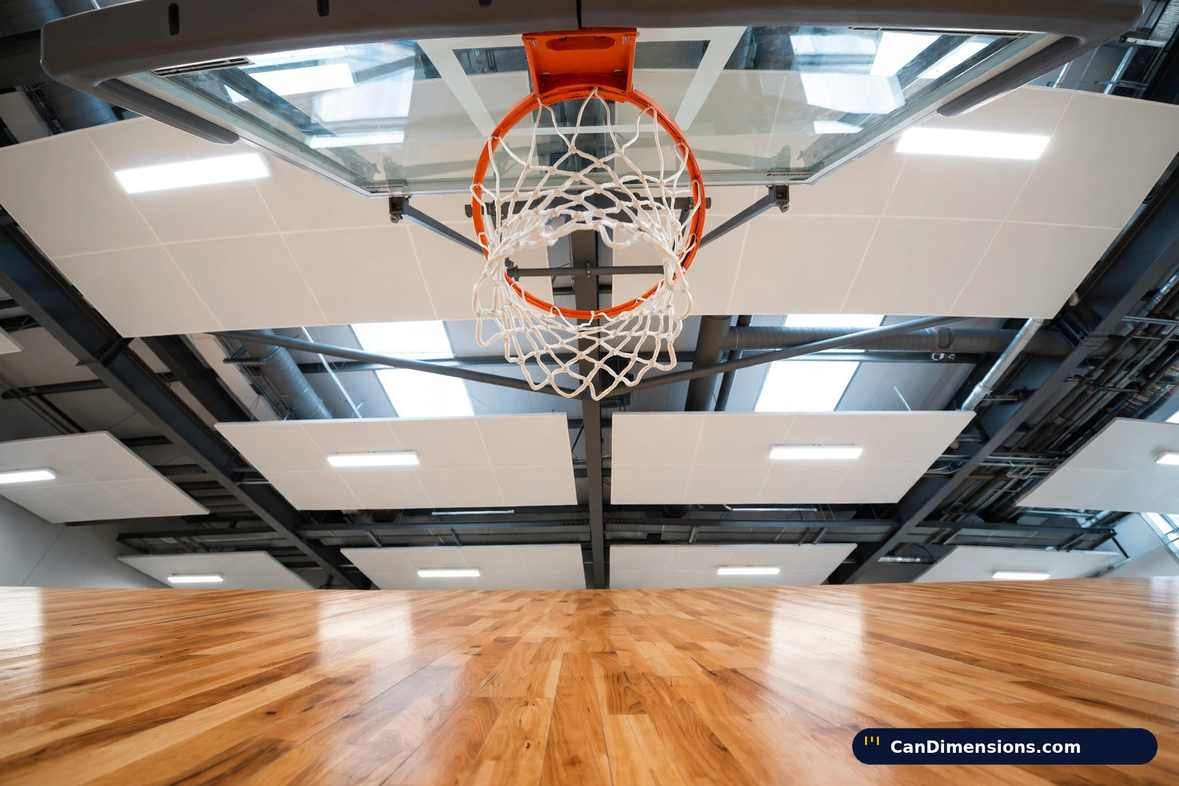
Ten feet is one of those lengths you have already measured a thousand times without knowing it. It is the height of every basketball hoop in America and the length of the kayak on the roof rack next door — and the handiest 10 feet example of all is a single story of an ordinary house, measured floor to floor.
It also sits in a useful gap: taller than the ceiling over your head, shorter than a school bus, and common enough that factories build ladders, drywall sheets and conduit sticks in exactly this length.
This guide converts 10 feet into every unit that matters, then walks through 11 real things that measure 10 feet long or tall — each one checked against a rulebook, a manufacturer’s specification or a published species record, with the basis stated wherever a figure is a class size or part of a range rather than an exact tape measurement.
How Long Is 10 Feet?
Ten feet is 120 inches, 3.333 yards or 3.048 metres. It is too tall for a door, too long for a bed and exactly the height of the rim every basketball player alive has shot at — which is why most people judge it against hoops, ladders and lumber instead of a ruler.
| Unit | 10 Feet Equals |
|---|---|
| Inches | 120 in |
| Yards | 3.333 yd |
| Centimeters | 304.8 cm |
| Millimeters | 3,048 mm |
| Meters | 3.048 m |
If you have already paced out 25 feet for a driveway or a garden, 10 feet is two-fifths of it. It is also exactly four standard door widths laid side by side — a handy check, because doors are everywhere and hoops are not.
10 Feet Compared to a Human
The average adult stands about 5 feet 8 inches tall. Divide 10 by 5.67 and you get about 1.76 — so 10 feet is roughly one and three-quarter adults standing on each other’s shoulders, noticeably short of two full adults head to toe.
That one comparison unlocks most of this list. A basketball rim is one-and-three-quarter people up. A big alligator is one-and-three-quarter people long. When an elephant’s shoulder passes at 10 feet, it is looking down from one-and-three-quarter people high. Keep the number 1.76 in mind — or just picture two adults and shave a head off — and every example below becomes easy to picture.
11 Common Things That Are 10 Feet Long or Tall
| # | Thing | Counted? | Basis |
|---|---|---|---|
| 1 | Standard Residential Ceiling Height | No | The standard first-floor ceiling is 9 ft — 10 ft is an upgrade |
| 2 | NBA Regulation Basketball Hoop | Yes | Exact — NBA Rule No. 1 puts the rim 10 ft above the floor |
| 3 | Standard 10-Foot Construction Lumber | Yes | Exact — a 2×4×10 measures a true 120 in long |
| 4 | Small Recreational Kayak | Yes | Exact — the Lifetime Tamarack 100 measures 120 in |
| 5 | Large American Alligator | Yes | Adult range — females reach 10 ft; males average 11.2 ft |
| 6 | 10×10 Self-Storage Unit | Yes | Industry size — both walls a nominal 10 ft |
| 7 | 10-Foot Step Ladder | Yes | Exact — Werner’s 6210 is a 120-in product |
| 8 | 4×10 Drywall Sheet | Yes | Exact — USG Sheetrock panels come 48 × 120 in |
| 9 | EMT Electrical Conduit | Yes | Exact — ANSI C80.3 standard length is 10 ft |
| 10 | 10-Foot Round Trampoline | Yes | Exact — the Skywalker frame is 120 in across |
| 11 | African Elephant at the Shoulder | Yes | Range — fully grown bulls average 10.0–11.0 ft at the shoulder |
| 12 | 10-Foot Artificial Christmas Tree | Yes | Exact — National Tree’s Dunhill Fir stands 120 in |
1. Standard Residential Ceiling Height
Not counted: This is the most repeated 10-foot claim in America, and it is a foot too tall. The National Association of Home Builders’ own data records the real shift: between 1995 and 2004, 9 feet replaced 8 feet as the most common ceiling height for single-story homes and the first floors of two-story ones. Eight feet remains the older standard and the usual second-floor height, and the building code’s floor is lower still — the IRC sets a 7-foot minimum for habitable rooms.
Ten-foot ceilings absolutely exist, in large numbers — but as an upgrade in custom and upscale homes, not as the standard a tape measure finds in a typical new house. Walk into an ordinary new-build living room and the ceiling above you is nine feet away, not ten. The example is kept here so the record is straight, and because the honest version of the claim still earns its place below: a whole story, floor to floor, really is about 10 feet once the structure between floors is counted.
2. NBA Regulation Basketball Hoop
Counted: The cleanest exact 10 feet in this list hangs in every gym in the country. NBA Rule No. 1, Section II fixes it in so many words: each basket ring “shall be securely attached to the backboard with its upper edge 10′ above and parallel to the floor”. College basketball plays to the same height, and FIBA’s international standard of 3.05 metres is the same mark in metric dress.
The height has survived since the game’s first peach baskets precisely because it works — just out of reach of a standing player, just within reach of a jumping one. Stand under any regulation rim, reach up, and the ring is this article’s length above the floorboards.
3. Standard 10-Foot Construction Lumber
Counted: Lumber plays a famous trick with its cross-section — a 2×4 really measures 1.5 by 3.5 inches — but its lengths are honest. A 2×4×10 measures a true 120 inches long, as do the 2×6 and 2×8 boards stacked beside it at every Home Depot and Lowe’s; 8, 10 and 12 feet are the standard shelf lengths, and 10 is the middle of the rack.
One framing claim needs correcting while we are here. A 10-foot stud does not “perfectly span a standard 9-foot wall”: the precut studs builders actually frame 9-foot walls with are 104⅝ inches long, sized for the plates above and below. A full 10-foot board is a general length you buy long and cut to fit — which is exactly why it is such a reliable thing to measure against.
4. Small Recreational Kayak

Counted: Ten feet is the standard beginner kayak size, and the best-sellers are built to it exactly. Lifetime’s Tamarack 100 — one of the most common recreational kayaks in America — is specified at 120 inches long and 31 inches wide, with a 275-pound capacity; Pelican, Perception and Sun Dolphin all anchor their entry ranges with 10-foot hulls of their own.
The size is a compromise that works: long enough to track straight across a lake, short enough to ride on a roof rack and store against a garage wall. If you have ever loaded one onto a car, you have handled this article’s length in plastic.
5. Large American Alligator

Counted: A 10-foot alligator is a genuinely large animal — but read the basis carefully, because the claim usually printed with it is wrong. UF/IFAS Extension, in a publication co-authored by Florida Fish and Wildlife Conservation Commission biologists, puts it precisely: females can grow to 10 feet but are typically 7 to 9 feet when full-grown, while males average about 11.2 feet and most do not grow beyond 11 to 12.
So a 10-footer is a top-end female or an ordinary adult male on his way to eleven-plus — not the “fully mature bull” of the usual description, since bulls average a full foot longer. Counted on that documented adult range: alligators of exactly this size are common in the Everglades, the Okefenokee and the Atchafalaya, and meeting one at a respectful distance is the most dramatic way to see 10 feet alive.
6. 10×10 Self-Storage Unit
Counted: The storage industry’s standard mid-size unit measures 10 feet by 10 feet — 100 square feet of floor, about half a one-car garage or a small bedroom — and SpareFoot’s size guide calls the 10×10 the most popular unit rented in America, the size that swallows a one-to-two-bedroom apartment’s furniture, appliances and boxes. Public Storage, Extra Space Storage and CubeSmart all build their inventories around it.
One honest disclosure: the 10×10 is a nominal industry size, and the clear interior of a real unit can run a few inches under once wall thickness and the roll-up door are allowed for. But the industry sells, prices and plans by the 10-foot wall, and that is the measurement this entry counts.
7. 10-Foot Step Ladder

Counted: Ladder sizes are true heights, and 10 feet is a standard catalogue size. Werner’s 6210 fiberglass stepladder — the yellow ladder on half the job sites in America — is specified at size 10 ft, product length 120 inches, rated Type IA for 300 pounds.
Read the fine print the right way round, because it is the part people get wrong: the ladder itself is exactly 10 feet tall, but your feet stand at about 7 feet 8 inches on its highest safe step, giving a working reach of around 14 feet. The ladder is this article’s length; the painter on it is not.
8. 4×10 Drywall Sheet
Counted: Drywall comes in a small family of standard sheets — 4×8, 4×10 and 4×12 feet — and the middle one is exactly this length. USG’s Sheetrock panels in the 4×10 size measure 48 by 120 inches and cover 40 square feet each.
The size exists for a precise reason: hung vertically, a 10-foot sheet covers a 10-foot wall in a single piece with no horizontal seam to tape and float, and it does the same floor-to-nearly-ceiling on a 9-foot wall. Every tall wall in a new house that finishes without a middle joint is quietly showing you 10 feet of gypsum.
9. EMT Electrical Conduit
Counted: The pipes that carry a building’s wiring are made to this length by standard. Electrical metallic tubing — the thin-wall steel conduit electricians call EMT — is produced under ANSI C80.3 and UL 797 in standard lengths of 10 feet (3.05 m), with a tolerance of a quarter inch; Nucor’s Republic Conduit furnishes every trade size, from ½ inch to 4 inch, in nominal 10-foot lengths, and Wheatland Tube’s specification sheet says the same.
That makes the humble conduit stick one of the most exact 10-foot objects in the built world: every length bundled on every electrical job in America is this article’s measurement, give or take a quarter inch.
10. 10-Foot Round Trampoline
Counted: Backyard trampolines are sold by frame diameter, and 10 feet is the standard mid-size. Skywalker’s 10-foot round trampoline — the blue or green ring in a million suburban yards — is specified with a 120-inch frame, 120 by 120 inches in its product dimensions.
One disclosure, in the spirit of the lumber above: the 10 feet is the frame, not the mat. The jumping surface inside the springs and padding is smaller, around 8 to 8.5 feet across. The product’s size, the hole it needs in your yard layout and the measurement on the box are all the 10-foot frame.
11. African Elephant at the Shoulder

Counted: The largest land animal on Earth meets this list standing still. The San Diego Zoo Wildlife Alliance’s fact sheet puts savanna elephant bulls at 2.9 to 3.7 metres (9.5 to 12 feet) at the shoulder, and fully grown bulls average 3.04 to 3.36 metres — 10.0 to 11.0 feet — with about 90 percent of fully grown males falling inside that band.
Read the basis the same way as the alligator’s: 10 feet is the lower edge of the fully-grown average, not a record. The biggest bull ever measured stood 13 feet at the shoulder. An ordinary big bull, though — the kind standing in every safari photograph — carries his shoulder right at this article’s mark.
12. 10-Foot Artificial Christmas Tree
Counted: Artificial Christmas trees are sold by height in exact steps, and 10 feet is the grand size for tall rooms. National Tree Company’s 10-foot Dunhill Fir is specified at 120 inches tall with a 74-inch base diameter and 5,090 branch tips — the manufacturer’s own dimension line reads 74 × 74 × 120 inches.
There is a pleasing catch that ties this list together: a 10-foot tree will not fit under the standard ceiling of the first entry. It needs a two-story foyer or a genuinely tall room — which is why the 10-foot tree, unlike the 10-foot ceiling, really is found mostly in upscale homes.
10 Feet Next to Other Lengths
| Length | How 10 Feet Compares |
|---|---|
| 5 feet | Exactly double |
| 9 feet | 10 feet is one foot longer — the real standard ceiling height |
| 20 feet | Exactly half |
| 25 feet | Two-fifths of it |
| 40 feet | Exactly a quarter |
| 50 feet | Exactly a fifth |
| 100 feet | Exactly a tenth |
The comparisons that do the most work day to day are the two big ones: the 40-foot container-and-bus length is four of these end to end, and the 50-foot court-width length is five — so once 10 feet is in your eye, the two longest lengths in ordinary life come with it.
How to Visualize 10 Feet Without a Measuring Tape
These real-world methods help you estimate 10 feet quickly and accurately:
| Method | How It Works | Accuracy |
|---|---|---|
| Basketball Hoop | Stand under any rim — it is 10 ft up by rule | ★★★★★ |
| 10-Foot Ladder or 2×4 | Hardware-store standards, exactly 120 in | ★★★★★ |
| Your Own Stride | About 4 average steps at roughly 2.5 ft each | ★★★★☆ |
| Two Adults Head to Toe | A real pair measures about 11 ft 4 in — overshoots | ★★★☆☆ |
A warning about the two shortcuts that circulate with this topic. The first is your own ceiling: the method only works if your ceiling is genuinely 10 feet, and the standard first-floor ceiling in a modern American home is 9 feet — judging by it under-measures every estimate by a full foot. The second is stacking two adults: it quietly assumes a 5-foot adult, and two average adults head to toe actually run about 11 feet 4 inches. The hoop and the ladder do not have these problems; use them.
Measuring 10 Feet with Your Own Body
Your body carries two built-in measures. Your arm span — fingertip to fingertip with both arms stretched wide — is roughly equal to your height, so 10 feet is a little under two of your own arm spans end to end. And an ordinary interior door is 30 inches wide: four of those widths in a row is exactly 10 feet, a useful check down a hallway.
For furniture and counters, three 40-inch counter runs end to end also make 120 inches — 10 feet on the nose. For a rougher pass, use your stride: a comfortable walking step is about 2.5 feet, so four steps at an easy pace lands you close to 10 feet.
Where Does 10 Feet Appear in Daily Life?
Home Construction: The 10-foot dimension is framed into American houses whether or not the ceilings reach it — 10-foot boards, 10-foot conduit sticks and 4×10 drywall sheets are the trade’s standard lengths, and a whole story, floor to floor, stands about 10 feet even where the ceiling inside it is nine.
Sports & Recreation: The basketball hoop at exactly 10 feet makes this measurement one of the most athletically familiar heights in American culture — a standard every player from kindergarten recreation leagues to professional arenas measures themselves against daily. The 10-foot kayak and the 10-foot trampoline carry the same length outdoors.
Outdoors & Wildlife: 10-foot alligators and a 10-foot elephant shoulder give Americans two dramatically different wildlife references for this scale — one met with respectful distance in a Southern swamp, the other across a savanna or a zoo railing.
Storage & Organization: The 10×10 self-storage unit makes 10 feet one of the most practically significant measurements in American residential life — the floor dimension that storage companies, moving planners, and apartment renters reference constantly when managing household transitions.
What Is Not 10 Feet: Three Near Misses
Plenty of famous heights get rounded to 10 feet in casual talk and are not. The 10-metre diving platform is the classic mix-up — it stands 32 feet 10 inches, more than three times this length, and it is metres doing the damage just as they do with the Olympic pool. A standard interior door feels taller than it is: it measures 6 feet 8 inches, so 10 feet leaves a full three feet and change above the frame. And a giraffe overshoots entirely, standing roughly 14 to 19 feet tall — half again this length at the low end. Knowing the near misses keeps the real 10-foot references honest.
Question’s
How long is 10 feet visually in inches?
Exactly 120 inches — and the picture to hold is a basketball rim: 120 inches of air between the floorboards and the ring.
What is 10 feet in feet?
Ten feet is 10 feet exactly — equivalent to 3.333 yards, 120 inches, or 3.048 meters in standard American and metric measurement conversions.
Is a story 10 feet tall?
Roughly, yes — measured floor to floor. A residential story with a 9-foot ceiling plus about a foot of floor structure lands at about 10 feet; measured floor to ceiling alone it is 8 to 9 feet, and a commercial story runs 12 to 14 feet.
How big is 10 ft by 10 ft?
A 10×10 foot space equals 100 square feet — roughly the size of a small bedroom, a standard self-storage unit, or a 10×10 trade show booth at any American convention center or expo hall.
How far is 10 feet to walk?
About four normal steps — and at a comfortable walking pace of 3 mph, covering 10 feet takes approximately 2.3 seconds.
How far is 10 feet visually?
Picture a basketball hoop from directly underneath, or a 10-foot ladder leaning against a house — both measure almost exactly 10 feet. Do not use your ceiling: in a standard home it is 9 feet, a full foot short.
Final Thoughts
10 feet is one of the most structurally important and practically useful measurements in everyday American life — from the hoop you shoot toward to the conduit in your walls to the kayak on your roof rack heading to the lake.
Whether you’re planning a home renovation, shopping for outdoor gear, renting storage space, or simply satisfying your curiosity, knowing what 10 feet looks like gives you a genuine practical edge every single day.
The wildest reference is the one with teeth: a ten-foot American alligator sliding off a bank in the Everglades is exactly as long as the rim is high, the ladder is tall and the elephant’s shoulder is broad — one honest length, told four ways. Next time you need it, count four steps, find a hoop, or pace out a story of your house, floor to floor — they are all telling the same story in the same length.