Water Bottle Dimensions: Standard Sizes, Heights and Diameters Explained
If you are asking how many inches is a 16.9 oz water bottle, the standard single-serve bottle stands 8 inches (20.3 cm) tall and measures 2.5 inches (6.35 cm) in diameter — the reference size recorded for the 500 mL bottle, and the size the rest of this chart is built around. One honesty note belongs at the top: the big bottlers publish no bottle dimensions at all, so every figure in this guide is labelled with its basis — a maker’s specification, a manufacturer’s chart, or a reference drawing — and none is dressed up as something it is not.
That 8-inch figure is a reference size, not a law. Bottled-water sellers working to the same 16.9 oz capacity ship bottles up to about 8.25 inches tall and as narrow as 2.25 inches across, because 16.9 oz is a capacity, not a size: two bottles holding identical water can differ by a quarter inch in height and diameter. Reusable bottles vary far more — the maker-specified litre bottle in this guide is shorter than the disposable litre bottle, and a full inch wider than the standard 16.9 oz bottle.
Below are the standard disposable sizes from a bottle manufacturer’s own chart, the 16.9 oz bottle taken measurement by measurement, the reusable bottles whose makers actually publish specifications, the same sizes in centimetres and millimetres, how to measure a bottle yourself, and the fit numbers for cup holders, bag pockets and fridge shelves.
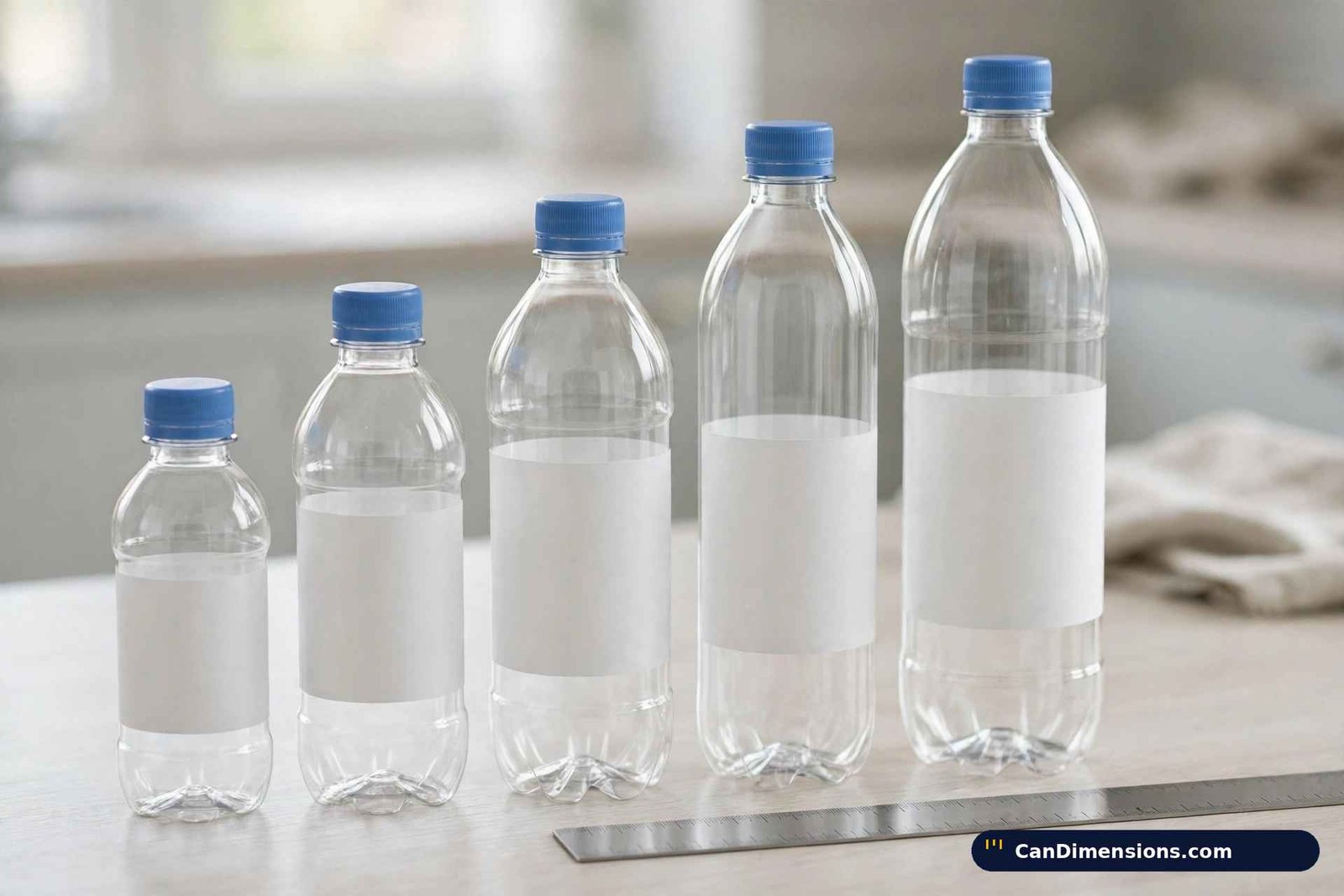
Standard Water Bottle Dimensions and Sizes
Single-serve PET bottles are the most standardised containers in the drinks aisle, because bottling lines, shrink-wrap trays and vending coils all reward the same few shapes. The chart below is a bottle manufacturer’s published size chart (Egrace Pack, a custom plastic bottle manufacturer), printed as the approximate ranges the manufacturer itself gives — these are production-typical figures, not a standard any body enforces, and the sections under the chart replace the headline sizes with their best-documented values.
| Capacity | Height (in) | Diameter (in) | Height (cm) | Diameter (cm) |
|---|---|---|---|---|
| 8 oz / 237 mL | 5–5.5 | 2.25–2.5 | 12.7–14 | 5.7–6.4 |
| 12 oz / 355 mL | 6.25–7 | 2.25 | 15.9–17.8 | 5.7 |
| 16.9 oz / 500 mL | 8–8.25 | 2.25–2.5 | 20.3–21 | 5.7–6.4 |
| 20 oz / 591 mL | 8.5–9.5 | 2.5–2.75 | 21.6–24.1 | 6.4–7.0 |
| 24 oz / 710 mL | 9–10.5 | 2.75–3 | 22.9–26.7 | 7.0–7.6 |
| 1 litre / 1,000 mL | 10–11.5 | 3–3.5 | 25.4–29.2 | 7.6–8.9 |
| 2 litre / 2,000 mL | 12–12.5 | 4–4.33 | 30.5–31.8 | 10.2–11.0 |
For scale against the containers that share the shelf: the standard can charted in our beverage can dimensions guide stands 4.83 inches tall, so even the smallest bottle on this chart is taller than a soda can, and the 16.9 oz bottle is roughly two-thirds taller again.
500ml (16.9 oz) Water Bottle Dimensions
The 16.9 oz water bottle is the standard single-serve size in the United States — 500 mL wearing an imperial label, which is where the odd 16.9 figure comes from. Its reference dimensions, recorded in the Dimensions.com reference database, are 8 inches tall × 2.5 inches diameter. Measured against a real seller’s bottle, the range is honest: BottleYourBrand, which sells custom-label bottled water, lists its own 16.9 oz bottle at 8.25 inches tall and 2.25 inches wide. Both figures are documented; they describe different bottles, and the quarter-inch spread between them is the true answer to the headline question.
The rest of the bottle, on the documented breakdowns: the base is narrower than the body, at about 2.1–2.3 inches across, and the mouth opening is about 0.85–1 inch under a 28 mm cap finish (the cap standard is covered in its own section below). The empty bottle weighs about 0.5–0.7 oz (14–20 g) depending on how light the maker blows the plastic; filled, it weighs about 17.6 oz — the 500 g of water plus the bottle. Around the body, the circumference at the full 2.5-inch diameter is π × 2.5 = 7.85 inches (19.9 cm) — the number a label or a sleeve is cut to. The full-height comparison: the standard can in our coke can dimensions guide is 4.83 inches tall, so a 16.9 oz bottle stands about 1.7 cans high.
What cannot be given is a per-brand table. Dasani, Aquafina and Poland Spring publish no bottle height or diameter in their product data — checked at draft time — so any chart that prints three different exact sizes for the three brands has invented at least two of them. The documented position is the one above: a reference 8 × 2.5 inches, a real-seller range of about 8–8.25 × 2.25–2.5 inches.
Small Water Bottle Height (8-12 oz)
The small formats are the half-pint 8 oz (237 mL) and the 12 oz (355 mL). On the manufacturer’s chart, the 8 oz bottle stands 5–5.5 inches tall with a diameter of 2.25–2.5 inches — BottleYourBrand’s own 8 oz listing sits inside that range at about 5 inches tall and 2.25 inches wide. The 12 oz bottle stands 6.25–7 inches tall at about 2.25 inches in diameter: the extra capacity over the 8 oz is taken almost entirely in height, not width, which is why both sizes run through the same cup holders and lunchbox pockets.
Standard Water Bottle Height (16.9-20 oz)
The 20 oz water bottle (591 mL) is the vending and sports-cap size. On the manufacturer’s chart it stands 8.5–9.5 inches tall with a diameter of 2.5–2.75 inches. The sports-cap versions sit at the tall end of that range: the cap and its tether add height above the shoulder that a flat cap does not, so a 20 oz sports-cap bottle can measure half an inch taller than the same body under a flat cap. No bottler publishes an exact 20 oz specification, so the range — not a single figure — is the documented answer.
24 oz Water Bottle Dimensions
The 24 oz water bottle (710 mL) in disposable PET stands 9–10.5 inches tall with a diameter of 2.75–3 inches on the manufacturer’s chart. This is also the capacity where reusable bottles take over the search results, and the two families must not be averaged together: the insulated steel 24 oz bottles in the next section stand 10.68 inches tall on a maker’s specification — inside the PET range for height, but on a wider, double-walled body. Same capacity, same rough height, different object.
1 Litre and 2 Litre Water Bottle Dimensions
The 1 litre water bottle (33.8 oz) in PET stands 10–11.5 inches tall with a diameter of 3–3.5 inches on the manufacturer’s chart. Treat any chart that prints a single exact litre height with suspicion: the reusable litre in the next section is maker-specified at 8.25 inches tall, shorter than every PET figure here, because its maker took the litre in width instead. The 2 litre bottle stands 12–12.5 inches tall at 4–4.33 inches in diameter — the largest size on the chart, and the one where the diameter, not the height, decides where it can live: at over 4 inches across it fits no cup holder and few fridge door shelves. For containers at the far end of the liquid scale — the 5 and 20 litre class — the jerry can dimensions guide covers the handled cans built for storage and transport.
Reusable Plastic Water Bottle Dimensions
Reusable bottles are where maker specifications actually exist. The three below are printed exactly as their makers publish them — no averaging, no rounding beyond the maker’s own — and they show why a single “reusable bottle size” cannot be charted: at near-identical capacities the heights run from 8.25 to 10.68 inches.
| Bottle | Capacity | Height | Diameter | Basis |
|---|---|---|---|---|
| Nalgene Wide Mouth | 32 oz / 1 L | 8.25 in / 21 cm | 3.5 in / 89 mm | Maker’s specification |
| Owala FreeSip (stainless) | 24 oz / 710 mL | 10.68 in / 27.1 cm | 3.12 in / 7.9 cm | Maker’s specification |
| Hydro Flask Standard Mouth | 21 oz / 621 mL | 9.4 in / 23.9 cm | 2.81 in / 7.1 cm | Maker’s specification data |
Nalgene 32 oz Wide Mouth Dimensions
Nalgene publishes a full specification for its 32 oz Wide Mouth bottle: height 8.25 inches (21 cm), diameter 3.5 inches (89 mm), cap diameter 2.5 inches (63 mm), empty weight 6.25 oz. It is the counterexample to most of the copied charts: a full litre carried at 8.25 inches tall — barely taller than the disposable 16.9 oz bottle that holds half as much — because the capacity is in the 3.5-inch width. That width is also its limit: at 3.5 inches it fits almost no car cup holder, a trade the maker documents in the same specification that gives the size.
Owala FreeSip 24 oz Dimensions
Owala’s product data for the stainless FreeSip gives the 24 oz at 10.68 inches tall × 3.12 inches diameter — the tallest maker-specified bottle in this guide, and a useful check on the “24 oz bottles are about 9 inches” claim the copied charts print: the insulated 24 oz runs nearly two inches taller than the bottom of the PET range. Owala’s own published size guide puts the 32 oz FreeSip at 10.66 inches — a fraction shorter than the 24 oz, because the bigger bottle takes its capacity in width. Capacity and height do not climb together, even inside one maker’s range.
Hydro Flask 21 oz Standard Mouth Dimensions
The Hydro Flask 21 oz Standard Mouth is specified at 9.4 inches tall × 2.81 inches diameter, with a mouth diameter of 1.91 inches (48.5 mm) — the slim profile the standard-mouth line is built around, sized to the cup-holder bore the way the sleek shell in our white claw can dimensions guide is. One caveat the maker’s own size chart documents and the copied charts ignore: the lid is part of the height. Hydro Flask’s chart lists the same 21 oz body about an inch taller under its sport cap than under the standard cap, so a height printed without naming the lid is a height with a piece missing.
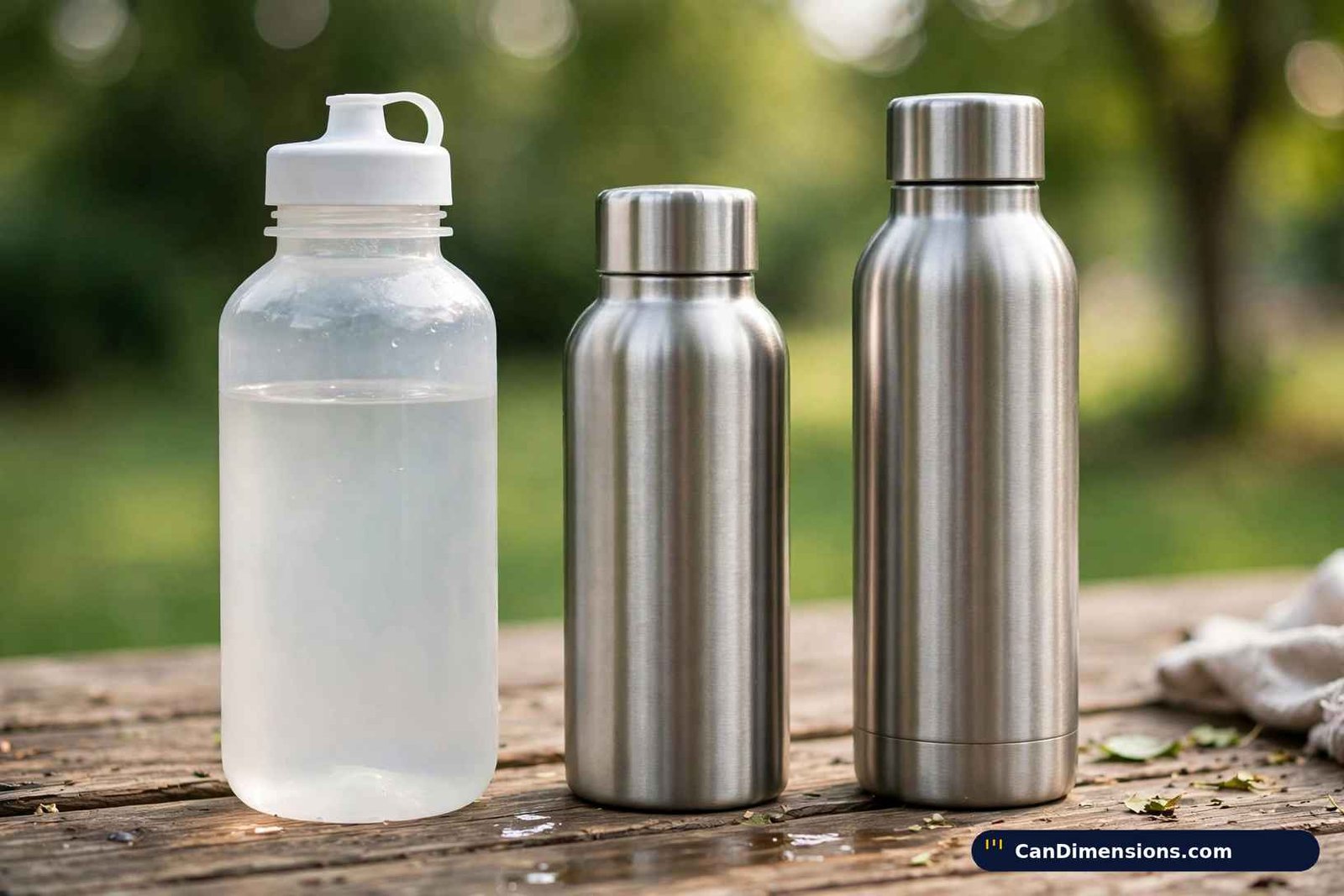
Water Bottle Dimensions in CM and MM
For metric listings, label work and accessory sizing, here are the documented sizes from the sections above in centimetres and millimetres. Disposable-bottle rows are the manufacturer’s chart ranges; reusable rows are the makers’ own specifications.
| Bottle | Height (cm) | Height (mm) | Diameter (cm) | Diameter (mm) |
|---|---|---|---|---|
| 8 oz PET | 12.7–14 | 127–140 | 5.7–6.4 | 57–64 |
| 12 oz PET | 15.9–17.8 | 159–178 | 5.7 | 57 |
| 16.9 oz PET (reference) | 20.3 | 203 | 6.35 | 63.5 |
| 20 oz PET | 21.6–24.1 | 216–241 | 6.4–7.0 | 64–70 |
| 24 oz PET | 22.9–26.7 | 229–267 | 7.0–7.6 | 70–76 |
| 1 litre PET | 25.4–29.2 | 254–292 | 7.6–8.9 | 76–89 |
| 2 litre PET | 30.5–31.8 | 305–318 | 10.2–11.0 | 102–110 |
| Nalgene 32 oz Wide Mouth | 21 | 210 | 8.9 | 89 |
| Owala FreeSip 24 oz | 27.1 | 271 | 7.9 | 79 |
| Hydro Flask 21 oz | 23.9 | 239 | 7.1 | 71 |
Centimetre figures are the exact conversions of the inch figures (1 inch = 2.54 cm), rounded to one decimal place; work from the millimetre column for a precise fit.
How to Measure a Water Bottle Yourself
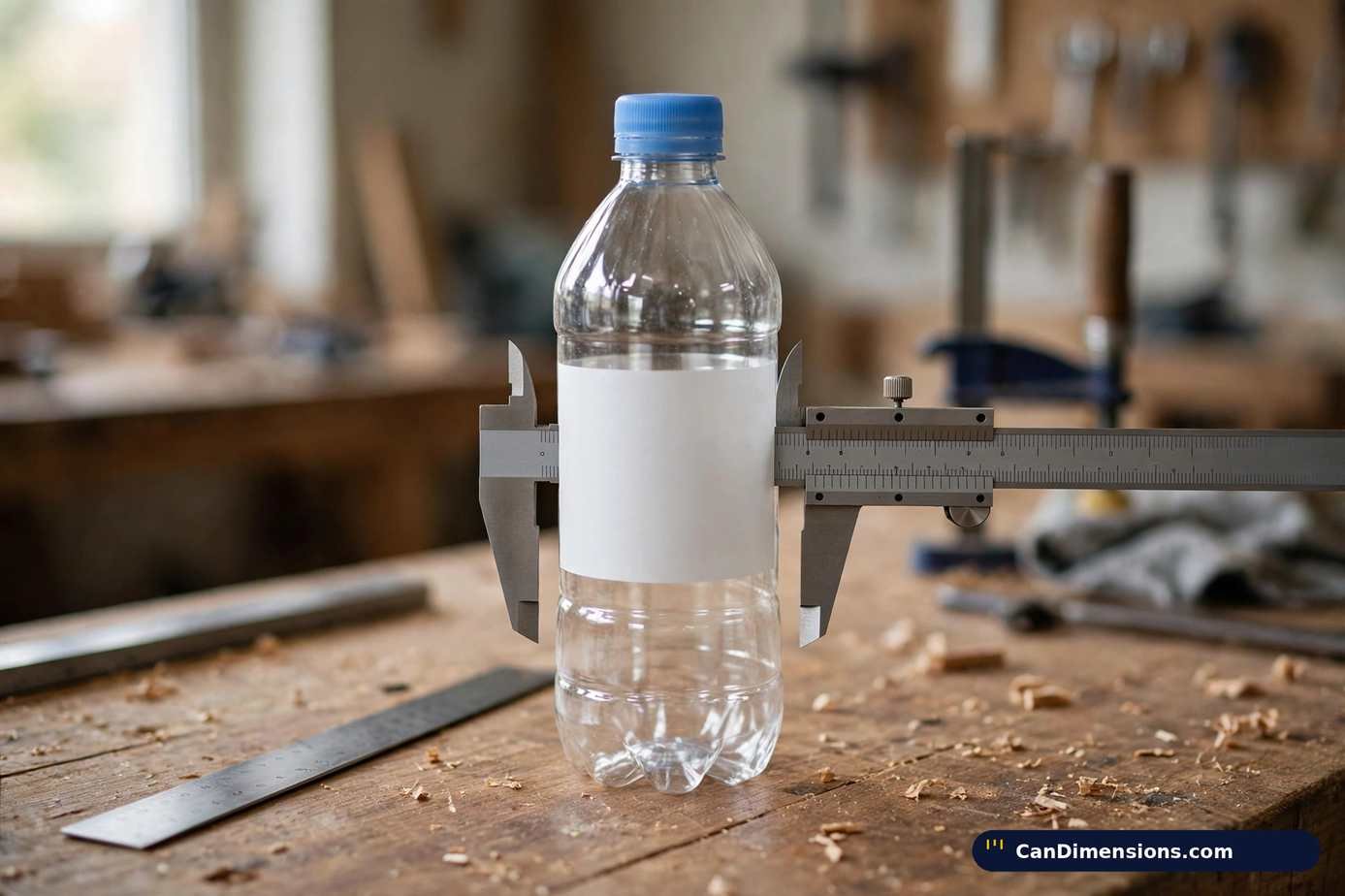
Measure height with the bottle standing on a flat surface, cap on, from the surface to the top of the cap — a sports cap or straw lid is part of the bottle’s working height, as the Hydro Flask chart shows. A standard 16.9 oz bottle should read about 8 inches (203 mm). Measure diameter at the widest point of the body, not at the base: on the 16.9 oz bottle the base is about 2.1–2.3 inches across while the body is 2.5, and it is the body figure that decides cup holders, pockets and sleeves.
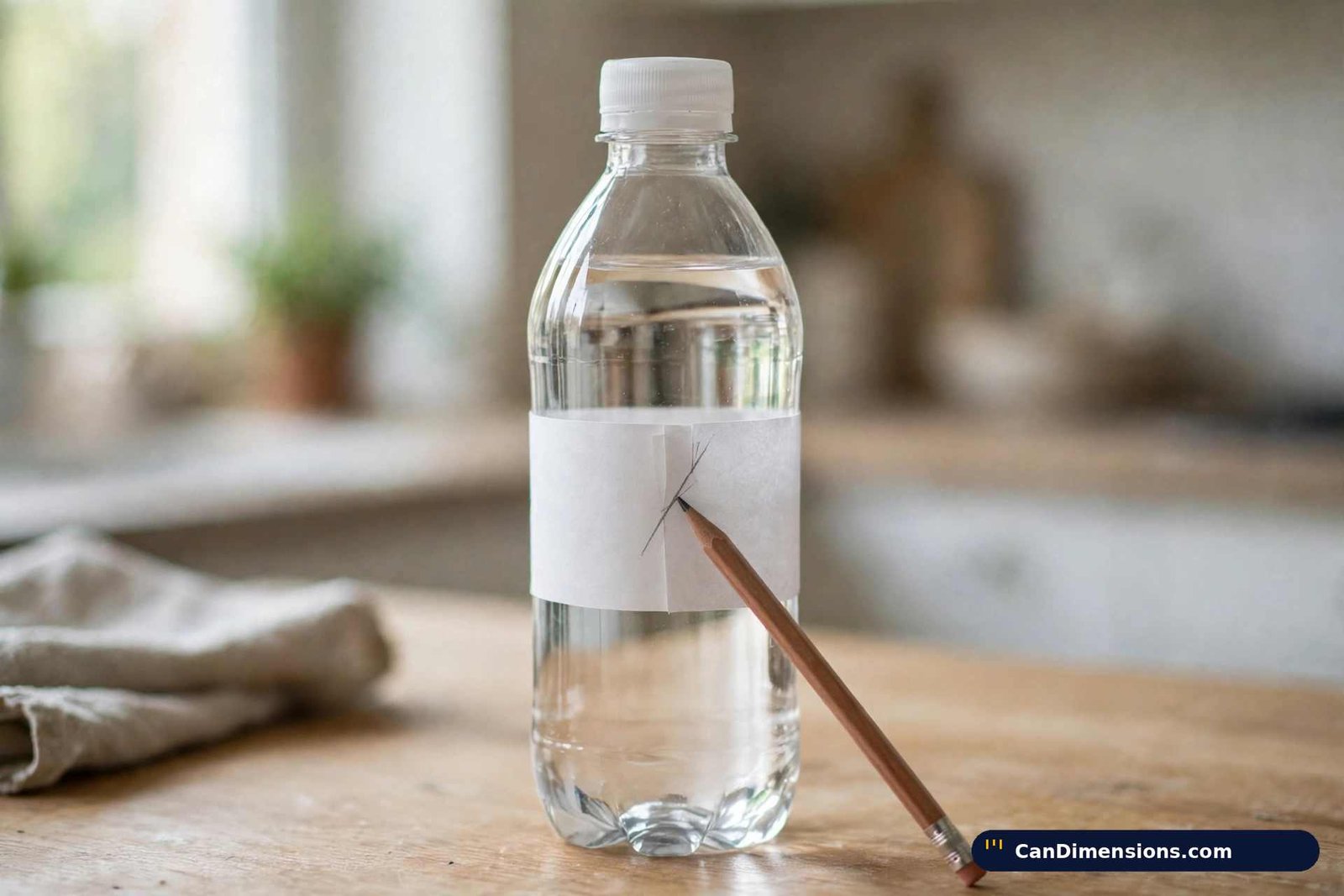
If calipers will not fit, wrap a strip of paper around the body at its widest point, mark the overlap, measure the strip and divide by π (3.1416): a standard 16.9 oz bottle’s wrap is about 199 mm, which returns the 63.5 mm diameter. Compare your result with the tables above allowing a millimetre either way — a thin PET wall flexes under calipers in a way a steel bottle does not, so squeeze gently and measure twice.
Will a Water Bottle Fit? Cup Holders, Bag Pockets and Fridge Shelves
Diameter decides the fit, and the first fact is that there is no standard cup holder to fit into: documented holder diameters run from about 2.5 to 3.5 inches across vehicles, with most front-seat holders clustering around 3 to 3.25 inches. Against that spread, the disposable range is safe — every PET bottle up to the 24 oz, at 3 inches or under, drops into almost any holder. The failures start with the wide reusables: the Owala FreeSip’s maker-specified 3.12-inch diameter already exceeds the tighter holders, and the Nalgene’s 3.5 inches fits almost none of them. “Fits most cup holders” printed without a diameter is a claim to check, not to trust — measure the holder, then read the diameter column.
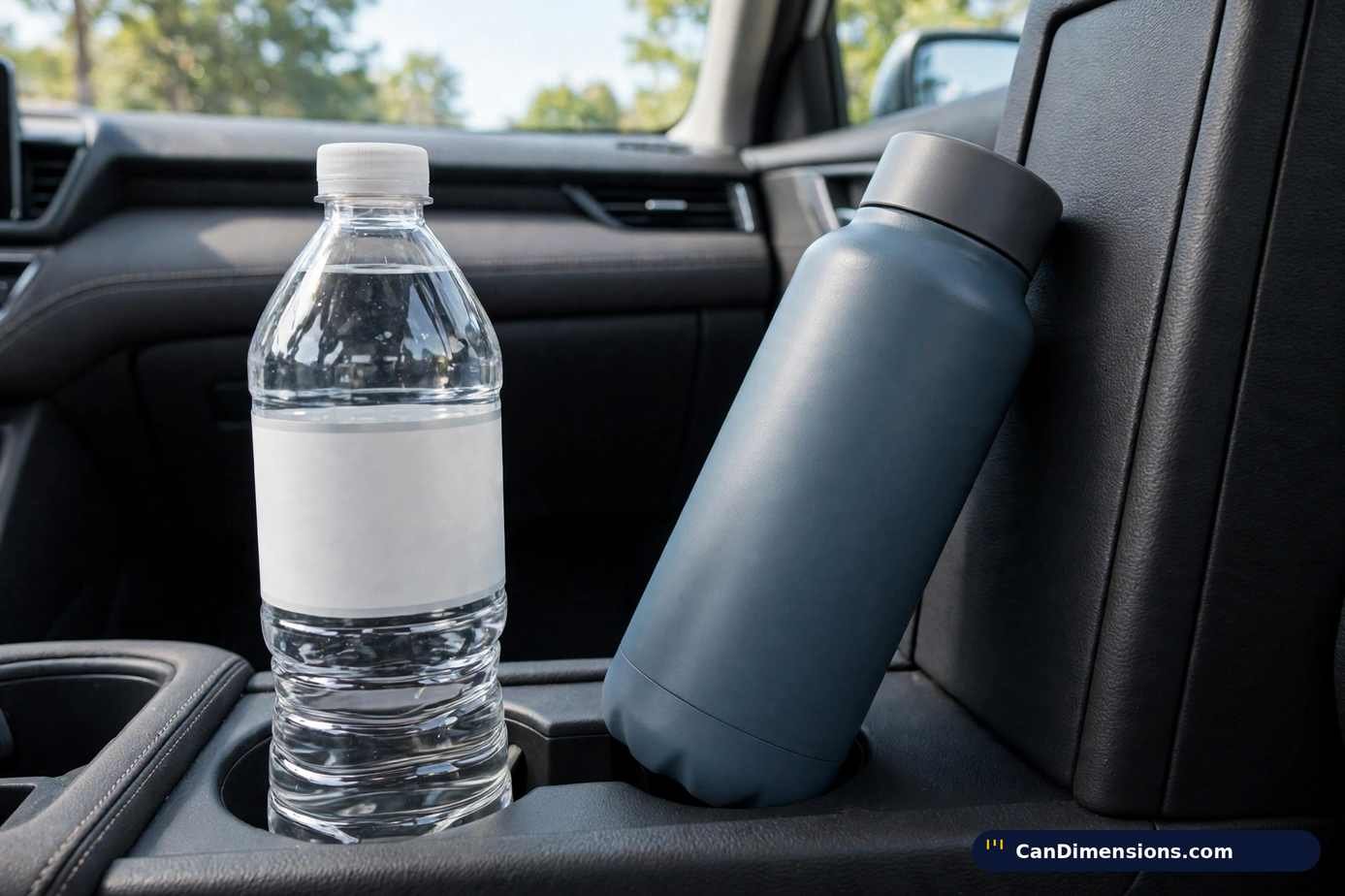
Bag side pockets are usually cut for the disposable bottle — a pocket that swallows a 2.5-inch PET body strains at a 3.12-inch insulated one. Fridge door shelves reverse the problem: height is rarely the issue, but the 2 litre’s 4-plus-inch diameter is wider than most door bins, which is why the big bottle ends up on the main shelf. Height only bites in one common place — under-cabinet and fridge-shelf clearances around 11 inches, where the 10.68-inch FreeSip just clears and a 1 litre PET bottle at the top of its range does not.
Water Bottle Cap and Mouth Sizes
The most standardised dimension on the whole bottle is the one nobody charts. Almost every PET beverage bottle in the world, from the 8 oz to the 2 litre, closes on the same neck finish: the 28 mm PCO 1881 finish, standardised for PET bottles — the “28 mm” names the neck finish the cap screws onto, not a size that grows with the bottle. Charts that print a different cap size for every capacity (28 mm, 30 mm, 33 mm and up the ladder) are inventing a progression that does not exist; the cap stays 28 mm while the bottle grows around it.
Mouth openings — the hole you actually drink and pour through — are a different measurement, and makers do publish them for reusables: the Nalgene Wide Mouth’s cap diameter is 2.5 inches (63 mm) per its specification, and the Hydro Flask Standard Mouth’s mouth is 1.91 inches (48.5 mm). On the disposable bottle the mouth is about 0.85–1 inch. Ice cubes are the practical test: a standard cube needs roughly an inch of clear opening, which the disposable mouth fails, the standard mouth passes, and the wide mouth passes with room to spare.
Questions
How many inches is a 16.9 oz water bottle?
A 16.9 oz water bottle is 8 inches tall and 2.5 inches in diameter on the reference size; real sellers’ bottles run 8–8.25 inches tall and 2.25–2.5 inches across.
What is the standard size of a water bottle?
The standard water bottle is the 16.9 oz (500 mL) single-serve: 8 inches (20.3 cm) tall × 2.5 inches (6.35 cm) in diameter.
How tall is a 20 oz water bottle?
A 20 oz water bottle stands about 8.5–9.5 inches tall in PET on the manufacturer’s chart, with a diameter of 2.5–2.75 inches; sports caps sit at the tall end.
How many inches is a 24 oz water bottle?
A 24 oz water bottle stands 9–10.5 inches tall in PET; the insulated Owala FreeSip 24 oz is maker-specified at 10.68 inches tall × 3.12 inches diameter.
How tall is a 1 litre water bottle?
A 1 litre water bottle stands 10–11.5 inches tall in PET — but the wide-mouth Nalgene litre is 8.25 inches tall and 3.5 inches wide. Shape, not capacity, sets the height.
What is the diameter of a water bottle?
Water bottle diameter runs from 2.25 inches on the small disposables to 2.5 inches at 16.9 oz, 3–3.5 inches at a litre, and 3.5 inches on the wide-mouth Nalgene.
Will a 32 oz water bottle fit in a car cup holder?
Usually not: the maker-specified 32 oz Nalgene is 3.5 inches wide, and most car holders cluster around 3–3.25 inches. Measure the holder before trusting any “cup-holder friendly” claim.
What cap size does a water bottle have?
Almost all PET water bottles share the same 28 mm PCO 1881 neck finish, from 8 oz to 2 litres — cap size does not grow with capacity.
Conclusion
Water bottle dimensions come down to one documented standard and one honest warning. The standard: the 16.9 oz (500 mL) bottle at 8 inches tall × 2.5 inches in diameter, with the disposable family running from 5 inches at 8 oz to about 12.5 inches at 2 litres on the manufacturer’s chart. The warning: capacity is not size. The same litre is 8.25 inches tall in a wide-mouth reusable and up to 11.5 in a PET bottle; the same 24 oz differs by two inches between a disposable and an insulated steel bottle — so the maker’s specification, where one exists, beats every averaged chart.
Measure height cap-on, diameter at the widest point of the body, and check the diameter against the holder or pocket before the height against the shelf — and the chart stops contradicting itself, whether the bottle in hand is a disposable polyethylene terephthalate single-serve or a steel reusable built to its maker’s own numbers.