Can Koozie Dimensions: Standard, Slim, Tall Boy and Bottle Koozie Sizes Explained
If you are looking up the standard koozie size before ordering, here is the number the whole trade works to: a standard can koozie measures 4 inches wide by 4 inches tall laid flat, and it is built around the regular 12 oz can, which stands 4.83 inches tall on a 2.6-inch body.
That one flat measurement hides a trap, because a koozie can be measured three ways: the flat panel, the formed sleeve on the can, and the can itself. Most wrong orders come from mixing the three up, so this guide keeps them separate for every size — standard, slim, tall boy, 500 ml, mini and bottle.
You will get the flat, formed and can dimensions for each koozie size, the design and print areas that real supplier templates actually allow, the working numbers for screen printing, sublimation, vinyl and DTF, and a short method for measuring a can and a koozie yourself before you spend anything.
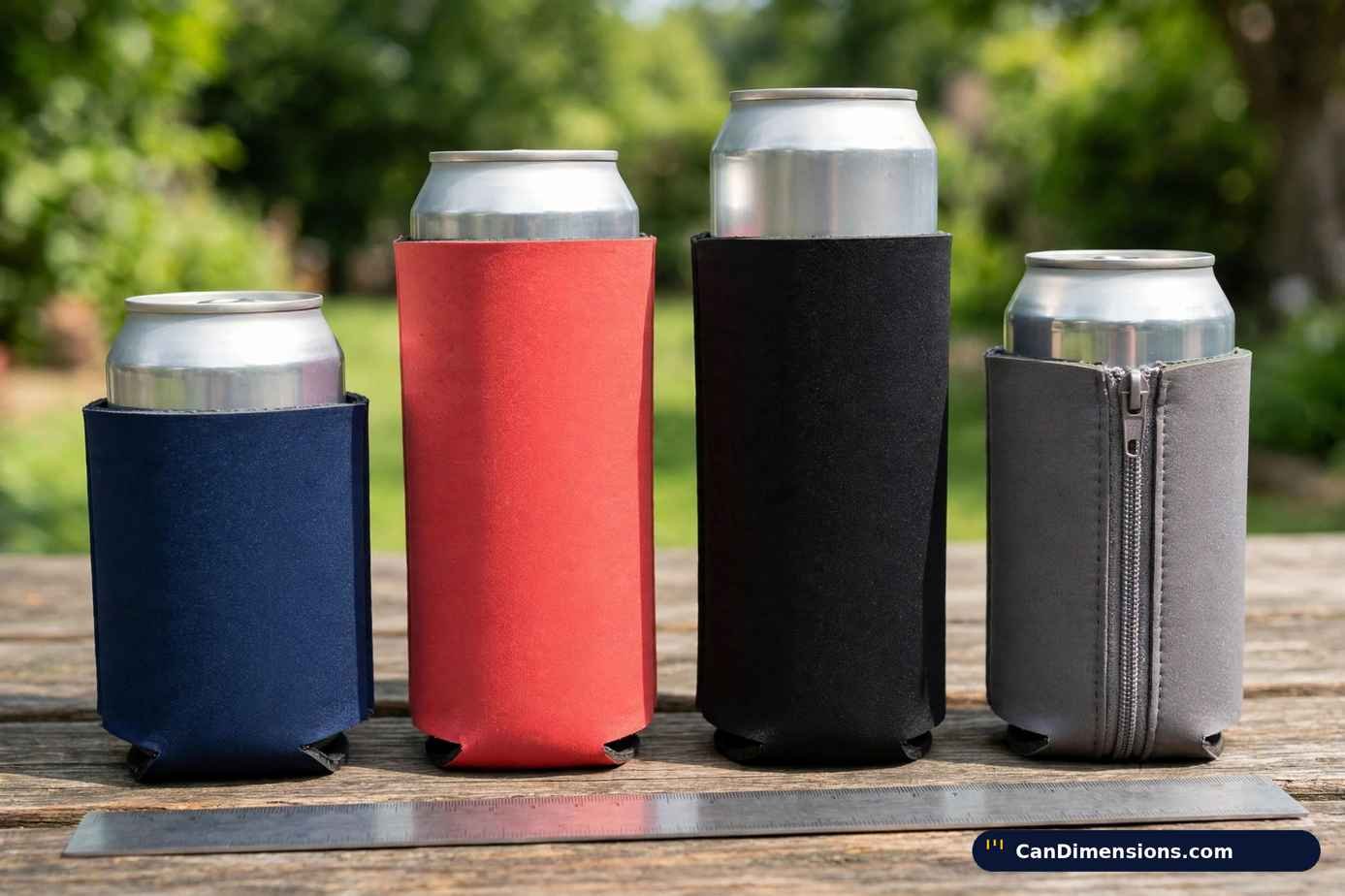
Can Koozie Dimensions Chart: Every Size at a Glance
Every koozie in this chart is sized to a can shell that a can maker publishes a specification for — the same shells verified across our beverage can dimensions guide — and to the flat patterns the big promotional suppliers cut for those shells. Heights and widths below are the finished sleeve laid flat unless the column says otherwise.
Quick Reference Table
| Koozie Size | Fits | Koozie Flat (W x H) | Formed Diameter | The Can (H x Diameter) |
|---|---|---|---|---|
| Standard 12 oz | Regular beer and soda cans | 4 x 4 in (foam); 3.75 x 5.13 in (neoprene sleeve) | About 2.75 in | 4.83 x 2.6 in |
| Slim | Sleek and slim cans | 3.375 x 4.875 in | 2.25 to 2.4 in | 6.13 x 2.26 in (sleek); 5.28 x 2.1 in (slim) |
| 16 oz tall boy | Tall boy cans | About 4 x 6 in | About 2.6 to 2.8 in | 6.19 x 2.6 in |
| 500 ml | International 500 ml cans | About 5 x 4 in | About 2.75 in | 6.61 x 2.6 in |
| Mini | 7.5 oz mini cans | About 3.5 x 3.5 in | About 2.4 in | About 4.11 x 2.28 in |
| Bottle (zipper) | 12 oz longneck bottles | About 7.25 in tall | Bottle body about 2.4 in | Bottle about 9 in tall |
Flat, Formed and Can Measurements Are Three Different Numbers
A flat dimension describes the sleeve before or after it is flattened — for a collapsible foam koozie, the 4-inch width is half the tube the can sits in, not the width of the can. A formed dimension describes the sleeve standing on the can: the same standard koozie forms a tube of roughly 2.75 inches in outside diameter. The can dimension is the shell specification — 4.83 by 2.6 inches for the standard can — and it is the only one of the three that never changes between suppliers. When a listing gives you one number with no basis, ask which of the three it is before you order.
Circumference: The Number That Decides the Fit
A koozie grips or slides according to one number: the can’s circumference, which is pi times its diameter. The standard can’s circumference is 8.17 inches, the sleek can’s is 7.10 inches and the true slim can’s is 6.60 inches. A standard sleeve, whose inside must stretch over 8.17 inches of can, will always swim on a slim can — no thickness of foam fixes a half-inch gap in circumference. Match the koozie to the circumference first and to the height second; a sleeve that is a little short still insulates your hand, while a sleeve that is loose insulates nothing.
Standard Can Koozie Dimensions
What Are the Dimensions of a 12 Oz Can Koozie?
A 12 oz can koozie in the classic collapsible foam pattern measures 4 inches tall by 4 inches wide when laid flat — the product dimension the largest stock suppliers publish for this item, on foam 4 mm thick. The taller neoprene sleeve pattern measures about 3.75 inches wide by 5.13 inches tall laid flat. Both wrap the same can; they are two cuts of the same size, not two sizes, and listing pages that quote one without naming the pattern are the main source of “wrong size” complaints.
Laid flat, the 4-inch width is half the sleeve’s tube. Formed around the can, the sleeve stands about 4 inches tall and roughly 2.75 inches across on the outside, foam included. One figure copied from chart to chart needs untangling: the often-quoted circumference of “about 8.6 inches” is the outside of the formed sleeve (pi times 2.75). The circumference that decides the fit is the can’s own — 8.17 inches — and the sleeve’s inside is cut to stretch over exactly that.
The 4-inch height is deliberately shorter than the 4.83-inch can. The exposed top leaves the rim and the drinking opening clear while the sleeve covers the part your hand actually holds. One material note is worth correcting from the usual charts: neoprene patterns are not one fixed 3.875 by 4 inches — supplier patterns for this size genuinely vary between the square foam cut and the taller neoprene cut above, because neoprene’s stretch lets a maker trade width for height.
The working design area on a standard koozie is about 3 inches by 3 inches per side — that is the imprint area the major stock templates specify, and it is detailed in the design sections below. It is smaller than the panel, and designs planned against the full 4 by 4 inches are the ones that come back clipped.
How Big Are Standard Cans?
Standard 12 oz cans measure 4.83 inches tall and 2.6 inches in diameter — the can makers’ specification for the 211 body, and the exact shell our coke can dimensions guide verifies across brands. Beer, soda and sparkling water all fill this same shell, which is why one koozie size serves all three.
The lid is smaller than the body, and the number usually printed for it needs its footnote. The can’s end is a “202” end: 2.13 inches is that code’s nominal value (2 and 2/16 inches), while the end itself measures about 52.4 mm — 2.06 inches — on the makers’ drawings. Either way, the neck is not what a koozie grips; the 2.6-inch body is.
This is also the most common can in America by a wide margin, and the standard koozie exists because of it: every major supplier’s standard template is drawn for this shell, and it is the first size every promotional range stocks. A claim repeated on many koozie pages — that a named institute puts the 12 oz at a precise 60% of all canned drinks — is published by no can-industry source we can find, and this guide does not repeat it as fact. The dominance is real; the decimal point is not.
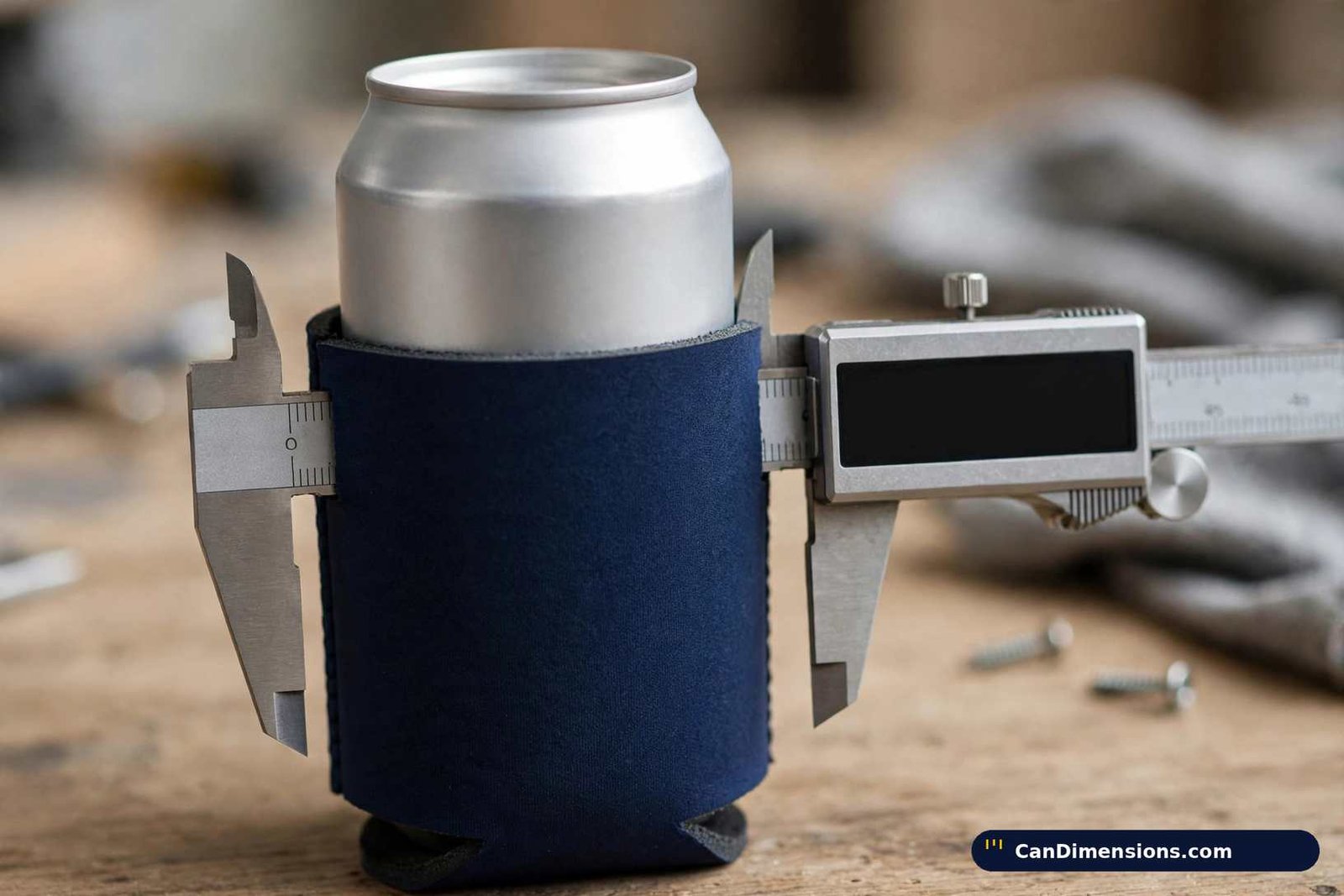
Slim Can Koozie Dimensions
How Wide Are Slim Koozies?
Slim can koozies measure about 4.875 inches tall by 3.375 inches wide when laid flat, and formed around the can they make a diameter of approximately 2.25 to 2.4 inches. The 3.375-inch width is 0.625 inches narrower than the standard koozie, matching the narrower cans — but “slim can” covers two different shells, and a careful size guide has to separate them.
The tall seltzer can — White Claw, Truly, High Noon — is the sleek shell: 6.13 inches tall and 2.26 inches in diameter, circumference 7.10 inches, exactly as verified in our white claw can dimensions guide. The true slim shell is narrower again: the 250 ml energy-drink format, 5.28 inches tall and 2.1 inches in diameter, circumference 6.60 inches — the shell in our red bull can dimensions guide. One neoprene slim koozie serves both because the material stretches across the half-inch of circumference between them.
That is also why the common claim that “slim cans typically measure 5.5 to 6 inches tall” is wrong at both ends: the sleek can stands 6.13 inches and the slim can 5.28. Neither is in the quoted range.
One brand list in wide circulation needs correcting outright. Red Bull’s 250 ml can is a true slim; White Claw and Truly are sleek. But Monster Ultra and Bang Energy are not slim or sleek cans at all — they are 16 oz drinks in the standard 2.6-inch body, 6.19 inches tall, as our monster can dimensions guide specifies. They take tall boy koozies, not slim ones, and ordering slim coolers for them is a guaranteed misfit.
Slim vs Standard: Size Comparison
| Measurement | Standard Koozie | Slim Koozie | Difference |
|---|---|---|---|
| Height | 4 inches | 4.875 inches | 0.875 in taller |
| Width | 4 inches | 3.375 inches | 0.625 in narrower |
| Diameter | About 2.75 inches | About 2.25 to 2.4 inches | Variable |
| Can it fits | 4.83 x 2.6 in, circumference 8.17 in | 6.13 x 2.26 in or 5.28 x 2.1 in, circumference 7.10 or 6.60 in | Different shells entirely |
The comparison that matters is the last row. Slim and standard koozies are not a size run of one product, like shoes; they are patterns for two different families of can, and neither substitutes for the other.

Specialty Can Koozie Sizes
500 mL Can Koozie Measurements
500 ml can koozies measure about 127 mm by 102 mm — approximately 5 inches by 4 inches — when laid flat. The size exists for the international 500 ml can: 6.61 inches tall on the same 2.6-inch (66 mm) body as the American standard can, which is why the koozie’s 4-inch width matches the standard koozie and only its height grows.
Do not confuse the 500 ml can with the American 16 oz tall boy. They are close in volume — 500 ml against 473 ml — but the 500 ml can stands 6.61 inches against the tall boy’s 6.19, so a tall boy koozie sits noticeably short on one. In the United States you will meet the 500 ml format in import beers and international energy drinks rather than in domestic soda.
Other Common Sizes
16 oz tall boy koozies measure about 4 inches wide by 6 inches tall laid flat — the size the major suppliers list for the format — fitting the 16 oz can at 6.19 inches tall on the standard 2.6-inch body. Some charts print this koozie at 4.5 inches wide; supplier templates put it at about 4 inches, a few at 4.25. The can’s circumference is the standard 8.17 inches, so the tall boy koozie is really a standard koozie grown taller, not wider.
Mini can koozies measure about 3.5 inches by 3.5 inches flat. They are usually described as fitting “8 oz mini cans”, but there is no 8 oz can in the makers’ ranges: the small soda can is the 7.5 oz mini, about 4.11 inches tall and 2.28 inches in diameter, and the 3.5-inch flat width is exactly half its 7.16-inch circumference. The other small can, the 8.4 oz energy format, is a tall slim shell (5.28 by 2.1 inches) and takes a tall, narrow cooler of its own — roughly 2.25 inches wide by 5.13 inches tall in supplier listings — not the little square mini koozie.
Bottle koozies are a different garment: about 7.25 inches tall, usually with a zipper down one side. The longneck bottle they dress stands about 9 inches tall with a body about 2.4 inches across, and the zipper exists because the sleeve has to close around the bottle’s shoulder rather than slide over it. The “4 inches wide” sometimes printed for this size matches no published product dimension — zip-up bottle jackets are listed at about 2.3 inches wide by 7.3 inches tall as a finished, on-bottle measurement. Stubby bottle koozies run shorter, roughly 5 inches tall, for short, wide craft bottles.
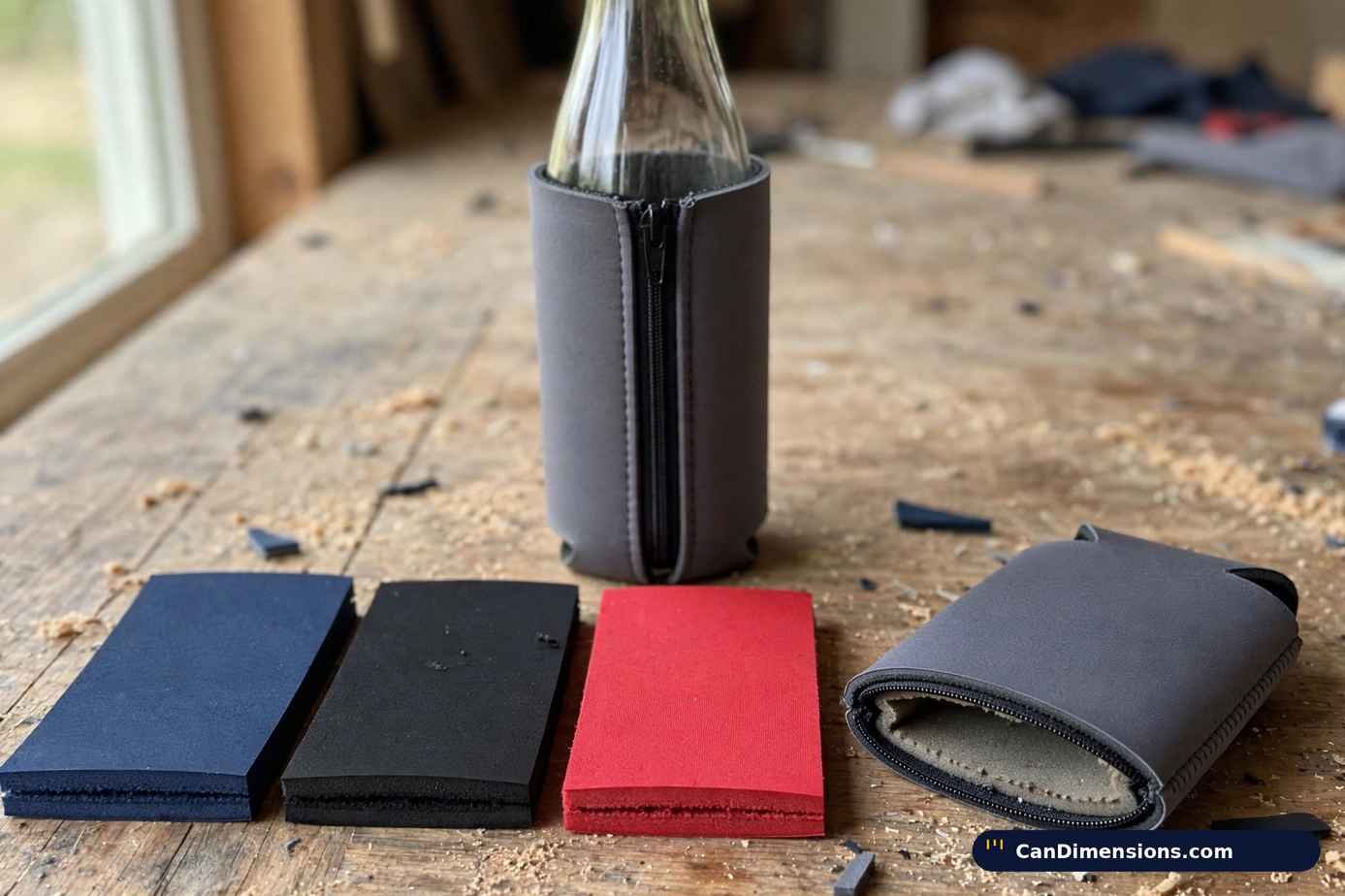
What Size Should a Koozie Design Be?
Start from the imprint area your printer actually guarantees, not from the panel size. On the standard stock templates that most custom koozies are printed on, the imprint area is about 3 inches by 3 inches on each side — one major supplier specifies 3 by 3 inches for full-colour work and 2.75 by 2.75 inches for screen print, and another’s collapsible template allows 3 inches wide by 2.5 inches high. Treat 3 by 3 inches as the safe design zone for a standard koozie and centre your logo inside it.
Figures of “3.75 inches wide by 4 inches high” circulate as a maximum printable area, but no major supplier template supports them — they describe nearly the whole panel, seams and curvature included, and art built to them will wrap its edges out of sight or into the stitching. Keep a full-wrap pattern, rather than a placed logo, for the whole-panel treatment, and build it to the full-wrap file size given in the sublimation section below.
Front and back can carry different designs; keep each within the same 3 by 3 inch zone. Some makers also offer a bottom print of about 2.5 inches in diameter, revealed when the drink is lifted — a novelty placement, not a substitute for the front.
Design Margins and Bleed
Safe margins of 0.25 to 0.5 inches from every edge protect the important elements of a design, and text should sit at least 0.375 inches from any edge. On a 4-inch panel those margins are what turn the nominal panel into the roughly 3-inch working zone above — the two sets of numbers describe the same reality from opposite directions.
Bleed for full-coverage work is 0.125 inches (1/8 inch) beyond the trim line on every side, so a design that must print to the edge of a standard panel is built oversize by a quarter inch in each dimension and the excess is trimmed away. Skipping bleed is what leaves the thin white edge on a finished koozie when the cut runs slightly off centre.
Text sizing follows from the curved surface: most print shops working on koozies recommend a minimum of about 12-point type for body copy and 18-point or larger for headlines, since small type fills in and breaks up on foam and neoprene. Treat those as shop guidance rather than a specification — if your printer sets a larger minimum, theirs governs.
What Size DTF for Can Koozie?
For DTF transfers on a standard koozie, the working guidance from transfer suppliers is a maximum of about 3.5 inches wide by 3.75 inches high, a recommended 3.25 by 3.5 inches, and a universal safe size of 3 by 3 inches — the same 3-inch square the imprint templates point to. On slim koozies the transfer can run taller and narrower: up to about 3 by 4.25 inches at most, with 2.75 by 4 inches the size most professionals settle on for durability.
These are vendor working figures, not an industry standard — no standards body publishes DTF sizes — so confirm against your transfer supplier’s own chart before a production run. Pressing settings and durability are covered in the printing-methods section and the questions below.
Koozie Materials and Thickness: Foam vs Neoprene
The two materials behind nearly every koozie measure differently because they behave differently. The classic collapsible is polyurethane foam — the biggest stock line specifies it at 4 mm thick — cut square at 4 by 4 inches and stitched at the sides and base so it folds flat. Foam barely stretches, so its flat pattern must already be the right size.
Neoprene — the wetsuit rubber — is the second material, and it is also sold laminated as scuba-knit fabric. Neoprene stretches, so its patterns can be cut closer and still pull over the can; that stretch is exactly why the neoprene version of the standard size is a taller, narrower sleeve (3.75 by 5.13 inches) rather than a square. Thickness is the other half of fit: 4 mm of foam on each side is why a sleeve formed around a 2.6-inch can measures about 2.75 inches across on the outside — the material itself accounts for the difference charts often blame on the can.
A third class is not a sleeve at all: rigid stainless-steel can insulators are machined to the can, typically for the standard and 16 oz shells, and are measured by the can they take rather than by any flat pattern. If a listing gives a “flat size” for a rigid insulator, it is not describing the product.
Can Koozie Dimensions for Printing Methods
Screen Printing Dimensions
Screen printing on koozies works inside the same imprint areas as everything else on a standard sleeve: about 3 inches by 3 inches per side on the major templates. Larger figures in circulation — up to 3.5 inches wide by 4 inches high — exceed what the stock templates guarantee, and a printer offering them is printing a different, larger blank or accepting wrap-around distortion; ask which before you approve art.
Fine detail has a floor. One major maker’s own template specifies a minimum line weight of 1.25 points for positive lines (about 0.45 mm) and 1.5 points for reversed lines — effectively the 0.5 mm minimum quoted in most koozie printing guides. Multi-colour work registers each colour to a tolerance of roughly plus or minus 0.5 mm, which is why bold, simple designs in the 2 by 2 to 3 by 3 inch range screen print sharpest. Screen printing suits volume: setup charges apply, and minimums commonly start around 50 to 100 pieces.
Sublimation Printing Dimensions
Sublimation is the full-coverage method, and it changes what “design size” means: the artwork is printed on the flat panel before the sleeve is sewn, so a wraparound design is one file spanning the whole blank — about 8.5 to 9.25 inches wide (the can’s 8.17-inch circumference plus seam and handling allowance) by about 4.25 inches tall including bleed. A figure of 4.125 by 4.125 inches, widely copied as the sublimation file size, covers one side of the panel only; a file built to it cannot wrap.
Sublimation needs polyester or a polyester-coated surface, and white or light colours give the most vibrant results. Files are built at 300 DPI minimum, and the colour mode is RGB — the heat process converts from the RGB file, unlike most print workflows. In exchange you get photo-quality, unlimited-colour work with no screen setup, which is why sublimation is the small-quantity method.
Vinyl and HTV Dimensions
Cut vinyl and heat transfer vinyl follow the placed-design rules: 3 by 3 inches for most applications, with a maximum of about 3.5 by 3.75 inches on a standard koozie. Keep every detail at least 0.25 inches in size — smaller pieces will not weed cleanly or will lift in the wash — and remember that each layered colour adds thickness and may need a pressure adjustment.
Application settings for common HTV run about 305 degrees F for 10 to 15 seconds at medium-firm pressure on neoprene and foam. Vinyl is the single-piece method: no minimums, low material cost, and sharp results for text, logos and solid graphics.
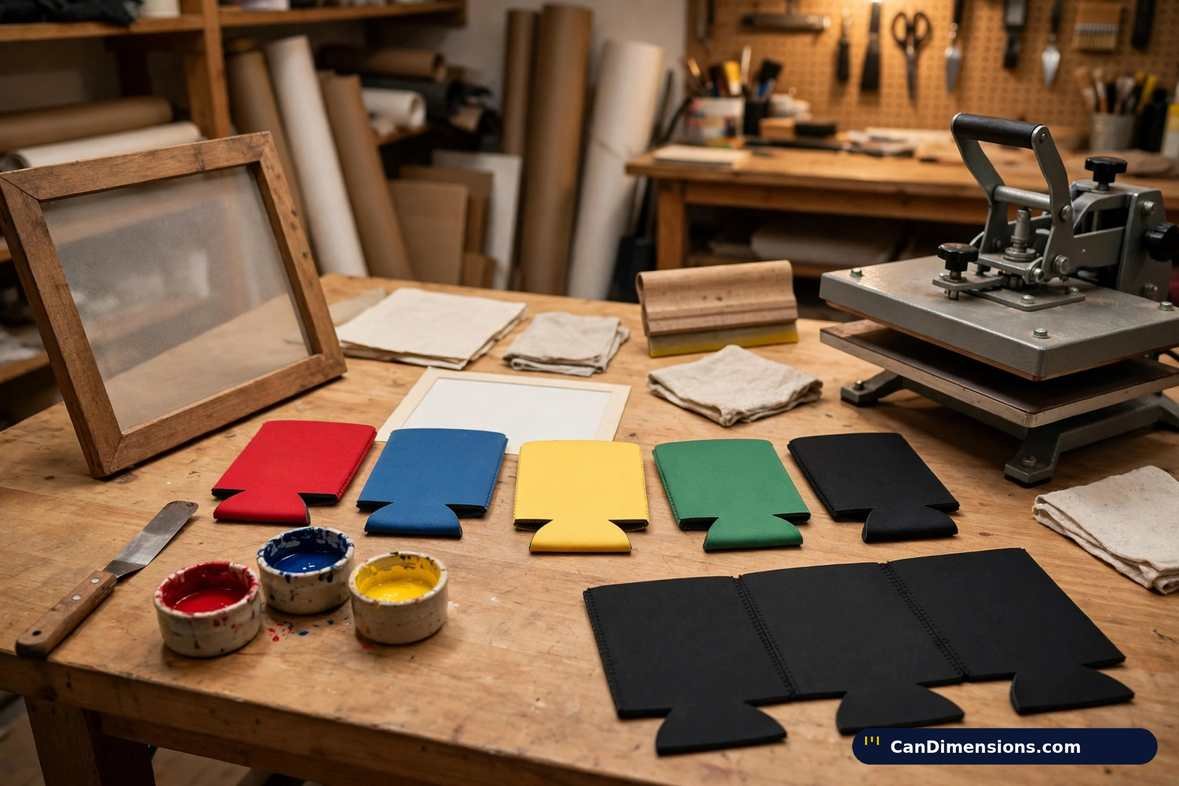
How to Measure a Can and a Koozie Yourself
Measure the can first, because it is the fixed quantity. Stand it on a flat surface and measure its full height to the top of the rim, then measure the body diameter at its widest point — or wrap a tape around the body and divide by 3.1416 to get the diameter from the circumference. A standard can should come out at 4.83 by 2.6 inches; if yours does not, identify the shell from the chart at the top before choosing a koozie.
Then measure the koozie the way the supplier does: lay the empty sleeve flat and measure its width and height, and note which pattern it is — square foam or tall neoprene — before comparing the numbers with any chart. Finally, test the formed fit: on the can, the sleeve should need a gentle stretch to seat, sit flat against the body with no gap you can slide a fingernail into, and leave the rim clear. A sleeve that drops on loosely will not insulate, however correct its flat numbers looked.
Question’s
What is the size of a can koozie?
The standard can koozie is 4 inches tall by 4 inches wide laid flat in the foam pattern (about 3.75 by 5.13 inches in the neoprene sleeve pattern), fitting the 12 oz can. Slim can koozies measure 4.875 inches tall by 3.375 inches wide for the taller, narrower sleek and slim cans.
What are the dimensions of a 12 oz can koozie?
A 12 oz can koozie is 4 inches in height and 4 inches in width laid flat, in the standard foam pattern. Formed around the can it stands about 4 inches tall and roughly 2.75 inches in outside diameter — the can inside it is 4.83 inches tall and 2.6 inches in diameter.
What size should a koozie design be?
Work to about 3 inches by 3 inches per side — the imprint area the major stock templates specify — and keep critical elements at least 0.375 inches from every edge. Larger “maximum printable” figures of 3.75 by 4 inches describe almost the whole panel and are not supported by supplier templates.
What size DTF for can koozie?
About 3.5 inches wide by 3.75 inches high at most on a standard koozie, 3.25 by 3.5 inches recommended, and 3 by 3 inches as the safe size that works on every koozie type. On slim koozies, up to about 3 by 4.25 inches, with 2.75 by 4 inches preferred.
What is a good size for DTF transfers?
Three inches by three inches. It matches the imprint area of the standard templates, keeps clear border space around the transfer for adhesion, and avoids the edge peeling that oversize transfers suffer on a curved surface.
Can you use DTF on koozies?
Yes — DTF works well on neoprene, polyester-blend and scuba foam koozies. Press at about 305 to 315 degrees F for 10 to 15 seconds at medium pressure, using a pressing pillow, and expect roughly 25 to 50 washes of durability with proper care. It is not recommended on plain foam or silicone.
How big are standard cans?
Standard 12 oz cans measure 4.83 inches tall and 2.6 inches in diameter, with a 202 end at the top — 2.13 inches by the code’s nominal value, about 52.4 mm (2.06 inches) as the end actually measures. The same shell carries most beer and soda sold in the United States.
How to make a DIY koozie?
Cut two neoprene panels about 4.25 inches square including seam allowance — or one strip about 8.5 inches wide, the can’s 8.17-inch circumference plus seam allowance — by the height of your pattern. Keep the design inside a centred 3 by 3 inch area, sew or glue a 0.25-inch seam, and if you want an open wrap instead of a sewn sleeve, attach 1 by 4 inch hook-and-loop strips at each end with a 0.5-inch overlap.
How wide are slim koozies?
Slim koozies are 3.375 inches wide laid flat — 0.625 inches narrower than standard koozies — and 4.875 inches tall, forming a diameter of about 2.25 to 2.4 inches around sleek and slim cans.
Conclusion
Koozie sizing is simple once the three measurements are kept apart. The standard koozie is a 4 by 4 inch flat panel (or the taller 3.75 by 5.13 inch neoprene cut) wrapped around a can of 4.83 by 2.6 inches; the slim koozie is 4.875 by 3.375 inches for cans of 6.13 by 2.26 or 5.28 by 2.1 inches; the tall boy, 500 ml, mini and bottle sizes each follow their own shell the same way.
For custom work, plan designs to the roughly 3 by 3 inch imprint area real templates guarantee, add 0.125 inches of bleed for full-coverage pieces, and choose the print method whose file geometry matches the job — placed art for screen print, vinyl and DTF, a full-wrap file for sublimation. Most koozie sleeves today are cut from neoprene or polyurethane foam, and knowing which material — and which can — you are sizing for is the whole of getting the dimensions right the first time.