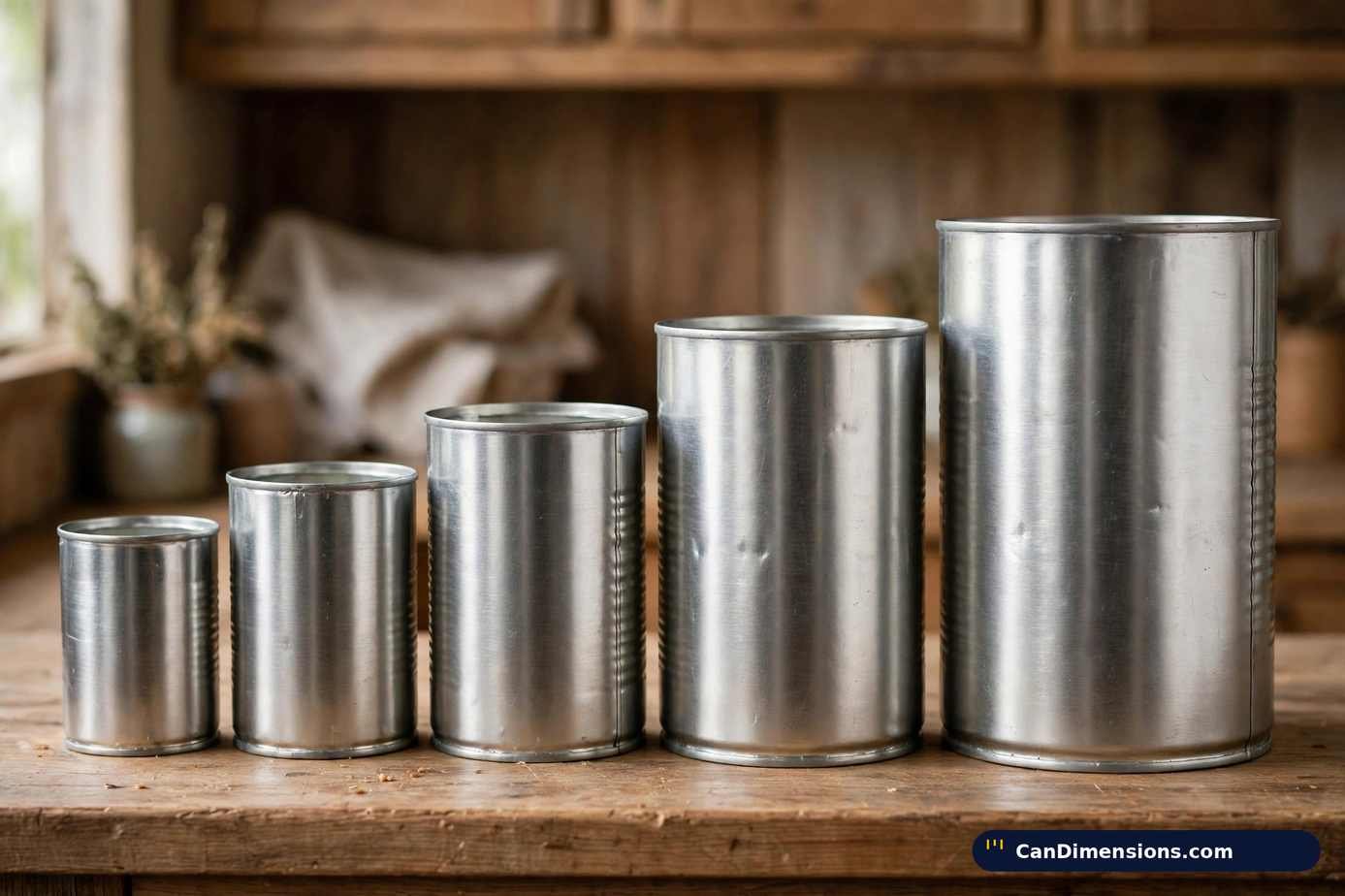
Food Can Dimensions: Size, Height and Standard Can Numbers Explained
Standard can dimensions look like alphabet soup at first glance — a #2 is not two of anything, a 303 is not a weight, and a #10 holds a hundred-odd ounces, not ten. Decoded properly, though, every one of those names resolves to an exact diameter and height.
The system underneath is reassuringly plain. American food cans are named twice over: once with a traditional trade label that grew up in the canneries, and once with a six-digit industry code that states the physical shell outright, in inches and sixteenths. Learn the code and the trade labels stop mattering — you can size any can on the shelf from its stamp alone.
This page rebuilds the full size ladder from the industry tables, shell by shell: the small retail cans, the big food-service formats, the metric visitors, and the construction differences that nudge a finished can a fraction inside its nominal code. All metric values below were converted from verified inch figures at exactly 25.4 millimetres per inch.
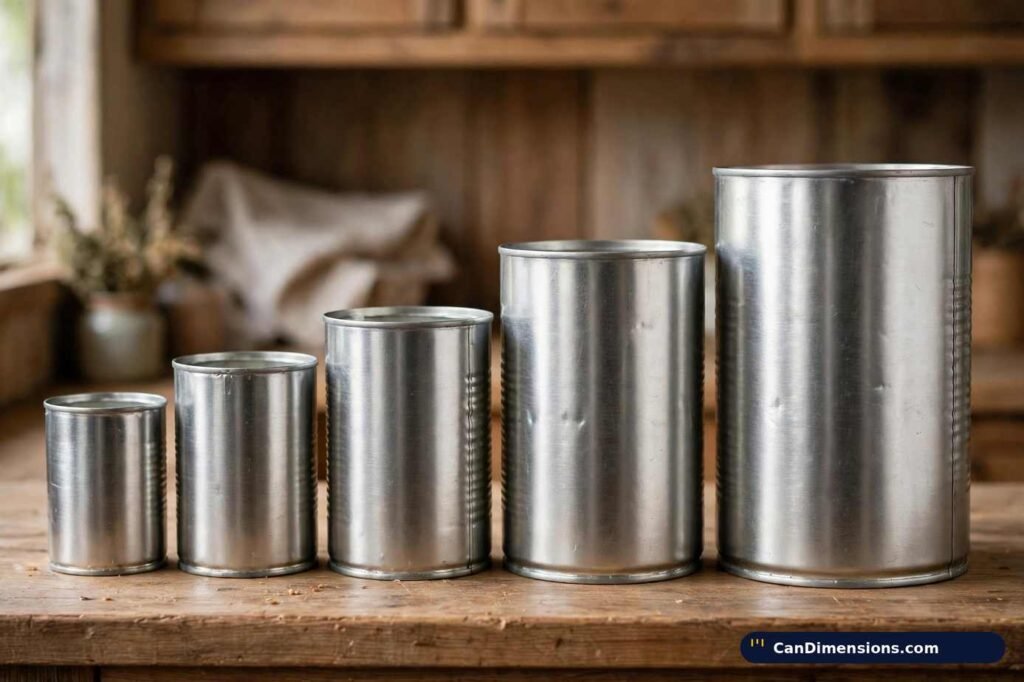
🥫 Complete Food Can Dimensions Chart
Each row in the ladder below was rebuilt from its industry code, not transcribed from older charts. Where a familiar guide pairs a name with the wrong shell — and two rows of the widely copied chart do exactly that — the row has been split or corrected, and the SEO notes at the foot of this page record each fix.
| Can Size Code | Diameter | Height | Capacity | Common Uses |
|---|---|---|---|---|
| 211×106 | 2 11/16 in (68.3 mm) | 1 3/8 in (34.9 mm) | About 3 oz | Tomato paste, concentrates |
| 211×400 (#1 Picnic) | 2 11/16 in (68.3 mm) | 4 in (101.6 mm) | About 10 to 12 oz | Fruit, condensed soup |
| 307×200 | 3 7/16 in (87.3 mm) | 2 in (50.8 mm) | About 8 oz | Tomato sauce, small portions |
| 307×306 (#2 Short) | 3 7/16 in (87.3 mm) | 3 3/8 in (85.7 mm) | About 14 oz | Beans, corn, vegetables |
| 300×407 (300) | 3 in (76.2 mm) | 4 7/16 in (112.7 mm) | About 14 to 16 oz | Beans, vegetables, some soups |
| 303×406 (303) | 3 3/16 in (81.0 mm) | 4 3/8 in (111.1 mm) | About 16 to 17 oz | Stewed tomatoes, fruit, beans |
| 307×409 (#2) | 3 7/16 in (87.3 mm) | 4 9/16 in (115.9 mm) | About 19 to 20 oz | Vegetables, fruit, ready-to-serve soup |
| 401×411 (#2.5) | 4 1/16 in (103.2 mm) | 4 11/16 in (119.1 mm) | About 26 to 29 oz | Sliced fruit, pie filling, tomatoes |
| 404×414 (#3) | 4 1/4 in (108.0 mm) | 4 7/8 in (123.8 mm) | About 32 oz | Tomatoes, large retail portions |
| 404×700 (#3 Cylinder) | 4 1/4 in (108.0 mm) | 7 in (177.8 mm) | About 46 oz | Fruit juice, tomato juice |
| 502×510 (#5) | 5 1/8 in (130.2 mm) | 5 5/8 in (142.9 mm) | About 56 oz | Institutional soup, chili |
| 603×700 (#10) | 6 3/16 in (157.2 mm) | 7 in (177.8 mm) | About 102 to 117 oz | Bulk vegetables, sauces, food service |
Two warnings belong beside any such chart. First, the capacity column describes what a shell typically holds when filled, and that shifts with the food: a dense paste packs differently from a light vegetable in identical metal, and labels state net weight rather than anything about the empty container. Second, a code names the nominal shell, while the seamed, labelled article on a shelf can measure slightly inside it — so code figures and shelf figures each have their place and should never be swapped.
How to Read a Food Can Size Code
Split the code at the multiplication sign. The group before it is always the diameter and the group after it is always the height, and each group is read the same way: the first digit counts whole inches, while the last two digits count sixteenths of an inch on top. Read 211, for instance, as two inches plus eleven sixteenths. Read 406 as four inches plus six sixteenths. A group ending in 00, such as 700, is a whole number of inches with nothing added: seven exactly.
Worked once, the system unlocks every row above. Put 303×406 through the rule and out comes a diameter of 3 3/16 inches on a height of 4 3/8 inches. Run 603×700 through it and the result is 6 3/16 inches of diameter on a height of exactly 7 inches. The beverage can dimensions page elsewhere on this site follows the same diameter-first order, and once the habit forms, a bare code on a case listing tells you the can’s footprint and clearance before you ever see the product.
📊 Visual Size Comparison
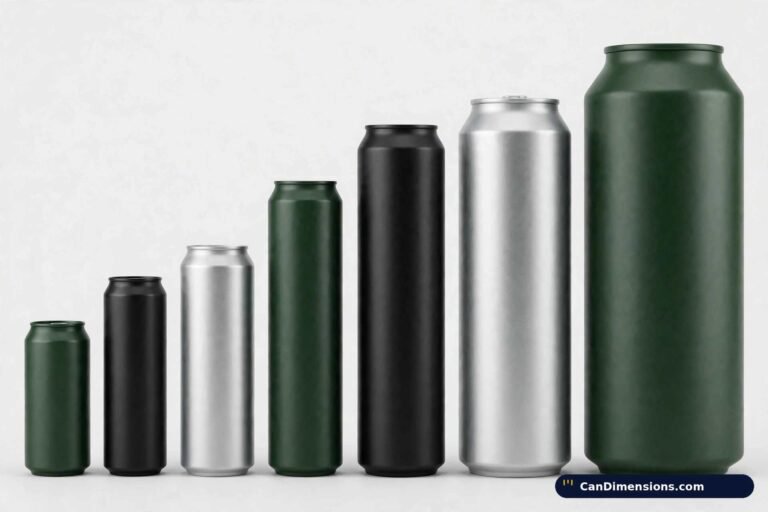
Grouped by the work they do, the ladder falls into four bands. The small band runs from the 3-ounce paste can up to the #1 Picnic at about 10 to 12 ounces. The standard grocery band covers the 300, the 303 and the true #2, at roughly 14 to 20 ounces. The large band holds the #2.5 and the two distinct #3 shells, from about 27 up to 46 ounces. The institutional band is the #5 and the #10, at about 56 ounces and a hundred-plus respectively.
Read as heights, the spread is just as tidy. The squattest shell on the chart stands 1 3/8 inches; the everyday retail cans cluster between about 4 and 4 11/16 inches; and two shells share the ladder’s ceiling of exactly 7 inches — the tall #3 Cylinder and the #10. Diameter spreads wider than height across the range, from 2 11/16 inches on the small cans to 6 3/16 inches on the #10, which is why diameter, not height, usually decides whether a can fits a holder, a case divider or a shelf row.
Small to Medium Food Can Dimensions
The smaller shells dominate grocery shelves because they match household appetites: a single meal, a single recipe, a single side dish. Their footprints also suit domestic cupboards, whose shelf spacing was effectively designed around cans in this band over the last century of packaged food.
Baby Food and Single-Serve Can Dimensions (211×106)
The 211×106 is the shortest shell in the chart: 2 11/16 inches across (68.3 mm) and only 1 3/8 inches tall. That height converts to 34.9 mm — a figure worth stating carefully, because a widely copied chart prints 41 mm beside it, which would belong to a can roughly a quarter-inch taller. At about 3 ounces, this is a single-portion shell, used for concentrated products such as tomato paste where a recipe calls for a spoonful or two rather than a cup.
Its width deserves a second look. The squat can shares the 211 diameter with the much taller #1 Picnic below, so the two stack and case together neatly despite holding very different quantities. Short shells of this family are about conserving vertical space, not footprint.
#1 Picnic Can Dimensions (211×400)
The #1 Picnic pairs that same 2 11/16-inch diameter with a full 4 inches of height (101.6 mm), and the extra column of metal takes the fill to roughly 10 to 12 ounces. This is the classic condensed-soup shell — the size this site’s soup can dimensions guide examines can by can — and it is just as common under fruit and small vegetable portions.
Because the diameter is narrow, the Picnic is the can that fits the gaps other cans leave: the ends of shelf rows, the door racks of older refrigerators, the corners of case boxes. Its 4-inch height is also a useful pantry benchmark, since a shelf that clears a Picnic clears almost every small can made.
8 oz Can Dimensions (307×200)
The 307×200 inverts the Picnic’s proportions. It is wide and low: 3 7/16 inches across (87.3 mm) but only 2 inches tall (50.8 mm), holding about 8 ounces. Tomato sauce is its signature fill, in the quantity a single pan of sauce or a small pizza actually consumes.
A squat shell offers two practical advantages. It sits stably, with a low centre of gravity that resists tipping in a crowded cupboard, and its broad mouth lets a spoon reach the bottom corners of a thick sauce without the scraping a narrow can demands.
#2 Can Dimensions (307×308 and variations)
This heading needs the page’s most important correction, because the #2 name is routinely attached to the wrong shell. The true #2 is the 307×409: 3 7/16 inches across by 4 9/16 inches tall, holding about 19 to 20 ounces — the tall, familiar vegetable-and-fruit can that anchors the middle of the American grocery aisle.
The shorter can often pictured under this name is a different shell. The industry’s Short #2 is the 307×306, at 3 3/8 inches tall and about 14 ounces, and a height of 3 1/2 inches paired with a 307×308 code matches neither standard: it sits between the short shell and the true #2, a hybrid that no industry table lists. When a listing says #2, the 307×409 dimensions are the ones to plan around; when it says short, expect the 306 height. Even the small round tins in the next aisle obey stricter naming — the zyn can dimensions on this site show a maker keeping one diameter across its whole range rather than borrowing a taller can’s name.
300 Series Can Dimensions
The 300 shell, coded in full as 300×407, measures exactly 3 inches across (76.2 mm) by 4 7/16 inches tall (112.7 mm) and holds about 14 to 16 ounces. It is the ladder’s plainest can: a round-number diameter, a mid-range height, and a fill that suits beans, vegetables and some soups.
Note the naming habit the 300 establishes. Some shells are known by their diameter group alone — 300, 303 — because the height that traditionally pairs with it is understood. The full code still exists, and the chart above prints it, because a diameter group can pair with more than one height across the wider industry catalogue.
303 Can Dimensions
The 303, coded 303×406, measures 3 3/16 inches across (81.0 mm) by 4 3/8 inches tall (111.1 mm) and holds about 16 to 17 ounces — almost exactly two cups, which is why recipe writers lean on it so heavily. Stewed tomatoes, beans and canned fruit fill most of the 303s on a shelf.
Set the 303 beside the 300 and the system’s granularity shows. The 303 is a mere 3/16 of an inch wider and 1/16 of an inch shorter, yet that small reshuffle buys roughly two extra ounces of fill. Can sizes evolved as packaging economics, not as a tidy ounce ladder, and neighbouring shells often differ by less than a ruler’s smallest mark.
Large and Commercial Food Can Dimensions
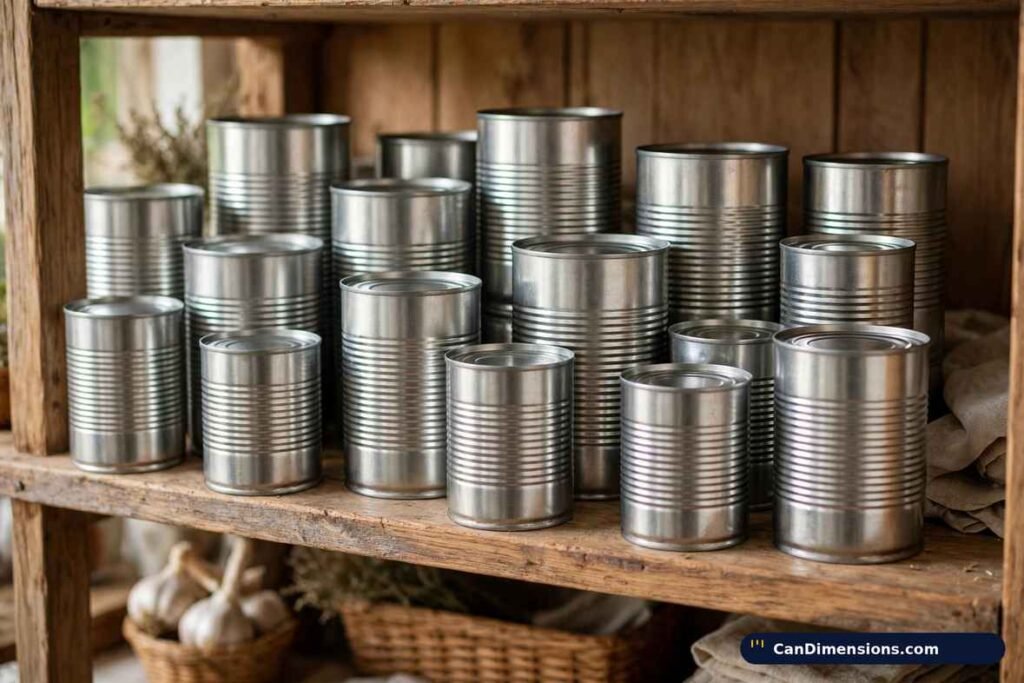
Above the grocery band, cans stop being portions and start being ingredients. Commercial kitchens buy in this range because opening one large can is faster than opening six small ones, and because the price per ounce falls as the shell grows. The trade-off is storage and turnover: a big can demands shelf depth today and a plan for its contents tomorrow.
#2.5 Can Dimensions (401×411)
Coded 401×411, the #2.5 stands 4 11/16 inches tall (119.1 mm) on a diameter of 4 1/16 inches (103.2 mm) and holds about 26 to 29 ounces — the 28-ounce can of crushed tomatoes and pie filling that family recipes treat as a unit in its own right. It was introduced historically as a compromise below the #3, and it remains the largest can most home pantries stock on purpose.
Cases of this size generally hold twelve cans rather than twenty-four, a packing rhythm set by simple weight: a dozen filled #2.5 cans already make a carton worth lifting with both hands.
#3 Cylinder Can Dimensions
Here the chart’s second conflation needs untangling, because two different cans share the #3 name. The ordinary #3 is the 404×414: 4 1/4 inches across by 4 7/8 inches tall, holding about 32 ounces. The #3 Cylinder is its tall sibling, the 404×700: the same 4 1/4-inch diameter stretched to a full 7 inches of height, holding about 46 ounces.
The dimensions 4 1/4 by 4 7/8 are often printed beside the 46-ounce capacity, as if one can owned both figures. It cannot: a shell under 5 inches tall does not hold the juice-can quantity, and a 46-ounce cylinder needs every one of its 7 inches. Fruit juice and tomato juice are the cylinder’s classic fills, sold in a format sized to fill a pitcher. Whenever a listing says #3, ask which height it means — the two cans share a diameter, a name, and nothing else.
#5 Can Dimensions
Its code is 502×510: a diameter of 5 1/8 inches (130.2 mm), a height of 5 5/8 inches (142.9 mm), and a typical fill of about 56 ounces — seven cups. The height is worth printing exactly, since some guides round this shell up to 5 7/8 inches — a quarter-inch of clearance that a tight shelf will not forgive.
Soup, chili and bulk sauces for institutions are its usual contents. The #5 lives in the gap between retail and full food service: too large for a household shelf, handy for a small restaurant, a food truck or a catering operation that cooks in daily batches.
#10 Can Dimensions (603×700) – The Foodservice Standard
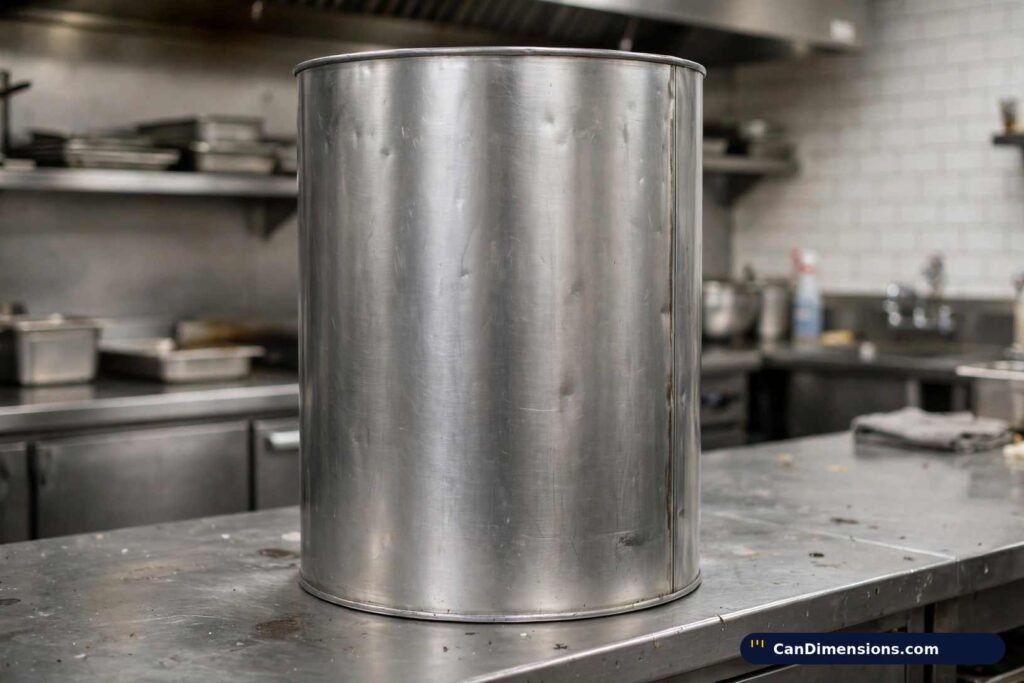
The #10, coded 603×700, is the can commercial kitchens are planned around: 6 3/16 inches across (157.2 mm) by exactly 7 inches tall (177.8 mm). What it holds depends on the food packed: roughly 102 ounces at the light end and up to about 117 for dense packs — twelve to thirteen cups, or around six pounds of a typical vegetable or sauce. The industry table’s nominal figure is 105 fluid ounces; the spread around it is density, not error.
Schools, hospitals, diners and commissaries buy this shell because it minimises opening labour and packaging waste per serving. The costs are real too: a filled #10 is a two-handed lift, it needs a sturdy opener rather than a kitchen-drawer model, and once opened its contents move to refrigerated storage with a short clock on them. Standard cases hold six cans.
#1 Tall Can Dimensions
The #1 Tall is the Picnic stretched, not supersized. In the industry table it is the 211×413: the Picnic’s 2 11/16-inch diameter carried up to 4 13/16 inches tall (122.2 mm), holding about 12 ounces. It keeps the narrow footprint that fits crowded shelving and adds a modest pour of extra capacity.
Claims that this can holds around 48 ounces belong to a different shell entirely — that quantity is the #3 Cylinder’s territory, in a can nearly twice as wide and half again as tall. A 12-ounce tall can and a 46-ounce juice cylinder are both legitimate formats; they are simply not the same can, and ordering one while expecting the other is a costly mix-up for any buyer.
Specialty and International Food Can Dimensions
Not every can on an American shelf was born in the American system. Beverage shells follow their own maker standards, and metric-market cans are sold by volume first and dimensions second. Both families sit beside the food ladder rather than on it, and borrowing figures across the fence is how bad charts happen.
Beverage Can Dimensions (for reference)
The standard 12-ounce beverage shell measures about 2.6 inches across by 4.83 inches tall — close to the food ladder in height, unrelated in construction. Beverage cans are drawn to hold pressure, necked at the top to a smaller end, and sized by fluid volume in a way food cans, sold largely by net weight, are not. This site’s beer can dimensions guide lays out the full family, from sleek and slim shells to the tall crowler.
Treat beverage figures as neighbours, not substitutes. A koozie, a vending column or a fridge door shelf tuned to a beverage shell will not automatically suit a food can of similar height, because the diameters and the neck profiles differ where it matters.
Metric Standard Cans (250ml, 330ml, 500ml)
The metric trio needs care, because the figures usually quoted for them describe beverage shells, and two of the three commonly printed pairs match no verified shell at all. The 330 ml beverage can is the clearest case: it is sometimes described as smaller than a 12-ounce can in both directions and then handed the 12-ounce can’s own dimensions, 2.6 by 4.8 inches. The maker-verified 330 ml shell is 66.6 mm across by 115.2 mm tall — about 2.62 by 4.54 inches — genuinely a little shorter than its 12-ounce cousin, on a near-identical diameter.
The 250 ml size exists in two distinct beverage formats rather than one: a slim shell at 53.4 mm across by 134.0 mm tall (about 2.1 by 5.28 inches), and a stubby shell at 66.6 mm across by 91.5 mm tall (about 2.62 by 3.6 inches). A printed pair of 2.5 by 4 inches matches neither. The 500 ml beverage can, meanwhile, is a tall shell at about 66 mm across by 168.0 mm tall (about 2.6 by 6.61 inches); the 3 by 4.5 inch pair sometimes quoted for it matches no standard shell, food or beverage. Its capacity, roughly 17 fluid ounces, does sit near the 303’s — but capacity kinship is not dimensional identity, and the two cans share almost no measurement.
For food packed in metric markets, the honest rule is to read the label’s net weight and measure the can. Metric food cans follow their makers’ drawings rather than a single public ladder, and a gram weight alone never determines a diameter.
Food Can Dimensions in Centimeters and Millimeters
Every metric figure on this page is a single conversion, each one worked at exactly 2.54 centimetres per inch from the nominal inch figure, with one rounding at the end. The table below gathers the shells readers convert most often.
| Can | Diameter (cm) | Height (cm) | Diameter (mm) | Height (mm) |
|---|---|---|---|---|
| 211×106 | 6.83 cm | 3.49 cm | 68.3 mm | 34.9 mm |
| #1 Picnic (211×400) | 6.83 cm | 10.16 cm | 68.3 mm | 101.6 mm |
| 300 (300×407) | 7.62 cm | 11.27 cm | 76.2 mm | 112.7 mm |
| 303 (303×406) | 8.10 cm | 11.11 cm | 81.0 mm | 111.1 mm |
| #2 (307×409) | 8.73 cm | 11.59 cm | 87.3 mm | 115.9 mm |
| #2.5 (401×411) | 10.32 cm | 11.91 cm | 103.2 mm | 119.1 mm |
| #3 Cylinder (404×700) | 10.80 cm | 17.78 cm | 108.0 mm | 177.8 mm |
| #5 (502×510) | 13.02 cm | 14.29 cm | 130.2 mm | 142.9 mm |
| #10 (603×700) | 15.72 cm | 17.78 cm | 157.2 mm | 177.8 mm |
The discipline that keeps these tables honest is ordering: convert the true figure, then round. Rounding an inch measurement first and converting afterwards compounds the error — a height rounded to 4.5 inches converts to 11.43 cm, nearly 3 mm away from the 303’s true 11.11 cm, from nothing more than premature rounding.
Two-Piece vs. Three-Piece Food Can Construction and How It Affects Dimensions
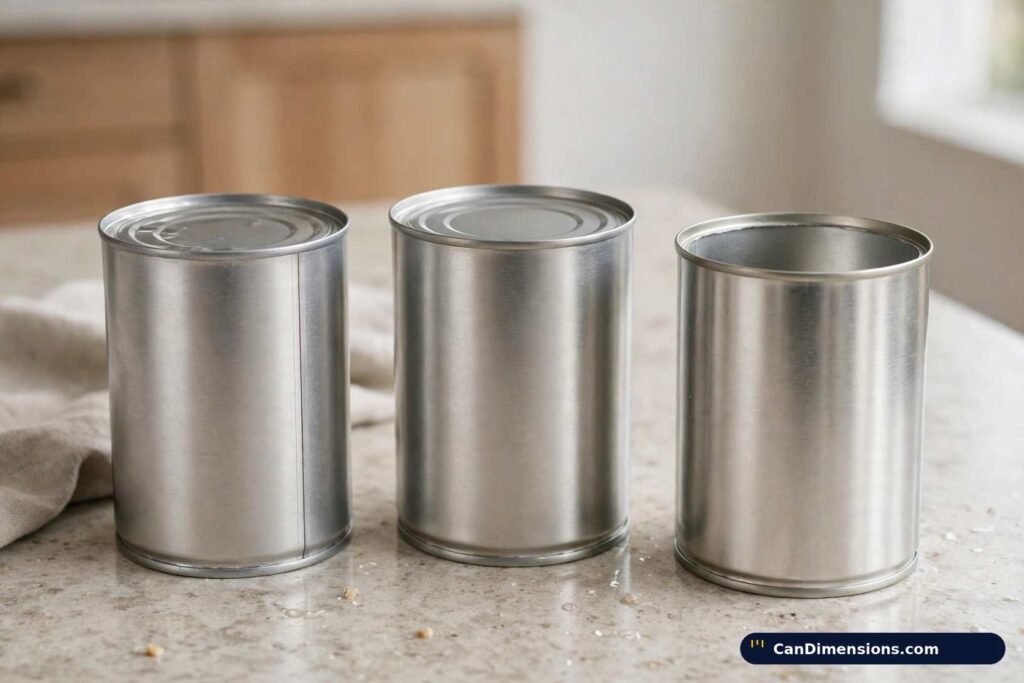
Two factories can build the same nominal shell by different routes, and the route leaves fingerprints on the finished can. The nominal code does not change — a 303 is a 303 either way — but seam placement, wall profile and the realistic tolerance band all follow the construction.
Two-Piece Can Design
A two-piece can starts as a flat disc of metal drawn upward into a cup, so the base and the wall are one continuous piece with no side seam and no bottom seam. Only the top end is seamed on after filling. Drawn cans suit beverages and an increasing share of foods, and their walls can be worked thinner in the middle and reinforced where the draw demands it.
Because the body is formed in one operation, its diameter is highly consistent from can to can. The dimension to watch is height: drawing and trimming set it precisely, but the profile near the base, where the cup’s corner radius curves inward, means the straight-walled portion is a little shorter than the overall height suggests.
Three-Piece Can Design
A three-piece can begins as a flat rectangular sheet, rolled into a tube and welded along a single vertical seam, with separate ends seamed onto the top and bottom. This is the traditional food-can route for vegetables, fruit and beans, and it accommodates the widest range of diameters and heights on the ladder above, including the largest shells.
The welded seam is its dimensional signature. The body measures true to code around most of its circumference, with a slight local thickening where the seam overlaps — one reason a holder or sleeve should be fitted to the can in hand rather than to the code alone. Not every food container even uses this metal route: the familiar snack canister covered by this site’s pringles can dimensions guide is a composite tube with metal ends, sized by its maker rather than by this code system.
How Construction Affects Actual Food Can Dimensions
Construction explains the small print on every chart, including this one. Maker tolerances on can bodies and ends run in fractions of a millimetre — the sheet metal itself is only tenths of a millimetre thick, so a claim that a wall or a seam can wander by a millimetre or two describes a can that could not be made, let alone filled. Real variation between a nominal code and a finished can comes from seams, coatings and retailer rounding, and it amounts to hundredths of an inch at most.
Height varies least between the two constructions, since the seamed ends define it. Diameter carries what little variation exists, concentrated at the seam of a three-piece can and at the neck of a drawn can. For storage planning, clearance of a small fraction over the nominal figure is enough for any standard shell; for equipment — seamers, fillers, labellers — the maker’s drawing, not the trade name, is the document that counts. The same caution governs metal containers far outside the kitchen, as this site’s ammo can dimensions guide shows: a trade name travels, a drawing does not.
How to Measure a Food Can Yourself
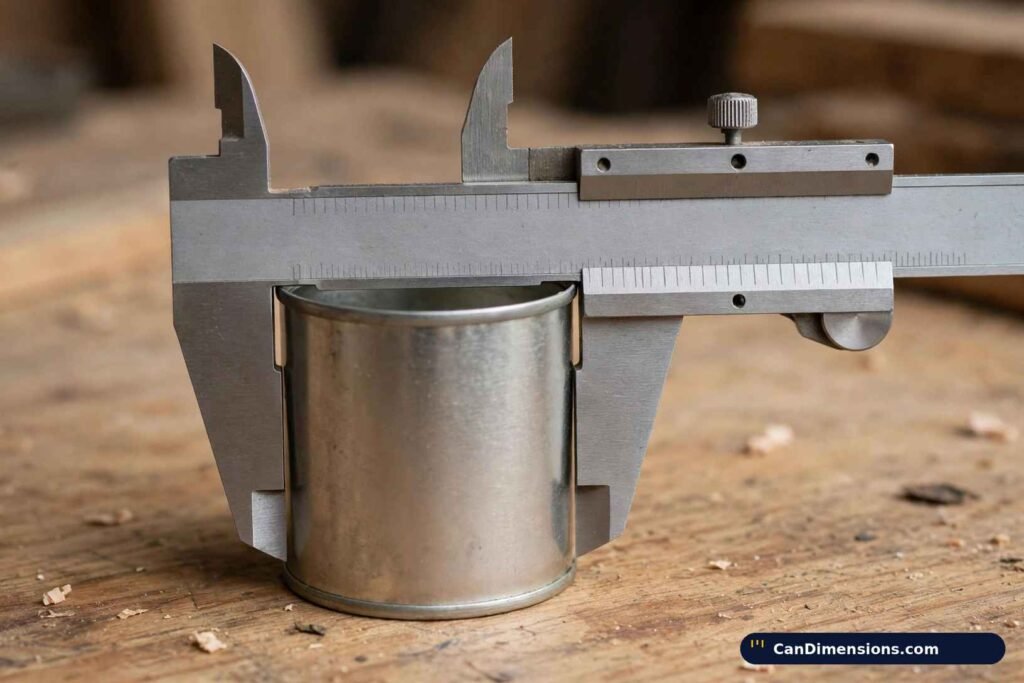
Set the can upright on a flat counter. Height comes first: run a ruler vertically alongside the body and read from the countertop up to the rim’s top edge. For diameter, span the body at its broadest point, then turn the can a quarter-turn and span it again, since a dent or a seam can bias a single reading. The aluminum can dimensions guide on this site was checked with the same pair of readings.
Circumference is diameter multiplied by pi, and it decides labels, sleeves and holders. On the nominal shells the #10 works out to about 19.44 inches around, the true #2 to about 10.80, the 303 to about 10.01, and the Picnic to about 8.44. Fit questions are circumference questions first, which is why the can koozie dimensions guide begins with the can’s outer measurement too. For any fit that matters, measure the actual can: misjudge the diameter by a tenth of an inch and the wrap-around reading moves by roughly three-tenths.
Question’s
What are the dimensions of a can of food?
Across the standard ladder, diameters run from 2 11/16 inches on the smallest shells to 6 3/16 inches on the #10, and heights from 1 3/8 inches to exactly 7 inches. Each size is fixed by its industry code, diameter first and height second, in inches and sixteenths.
What is the standard size of a can?
There is no single standard. The everyday retail shells are the 300, the 303 and the #2 — three distinct cans, despite the habit of writing “#2 (303)” as if they were one — while the #10 is the standard of food service. The can a recipe means is usually the 303, at about two cups.
What is the size of a 330mL can?
The verified 330 ml beverage shell measures about 2.62 inches across by 4.54 inches tall (66.6 by 115.2 mm) and holds about 11.2 fluid ounces. It sits a little below the 12-ounce can in height, on a near-identical diameter — not the same 2.6 by 4.8 inch pair the larger can owns.
What size is a 28oz can?
A 28-ounce can is the #2.5, coded 401×411: 4 11/16 inches tall by 4 1/16 inches across (119.1 by 103.2 mm). Tomatoes, sauces and pie fillings fill most of them, and cases generally hold twelve.
How big is a 250mL can?
It depends on the format. As a slim beverage shell, 250 ml measures about 2.1 inches across by 5.28 inches tall (53.4 by 134.0 mm); as a stubby shell, about 2.62 across by 3.6 tall (66.6 by 91.5 mm). Either holds about 8.5 fluid ounces. No single 2.5 by 4 inch can matches a verified shell.
How big is a 500mL food container?
As a beverage can, 500 ml is a tall shell about 2.6 inches across by 6.61 inches tall (66 by 168.0 mm), holding about 2.1 cups (17 fluid ounces). Its capacity neighbours the 303 food can’s, but its dimensions do not: the 303 is wider and far shorter, at 3 3/16 by 4 3/8 inches.
What size is a 24oz can?
No standard food-can code carries 24 ounces. The tall 24-ounce beverage format is a wide-body shell of about 2.9 inches across by about 7.7 inches tall, printed with “about” because makers publish no finished retail spec for it. A food product sold at 24 ounces by weight may sit in a #2.5-family shell; measure the can rather than inferring the shell from the weight.
Is 28 oz 796 ml?
Not exactly. Twenty-eight fluid ounces come to about 828 ml. The 796 ml figure, converted the other way, works out to about 26.9 fluid ounces. The figures sit close enough to be confused on bilingual labels, and far enough apart to matter in a scaled recipe.
How much is 32 oz in cans?
Thirty-two fluid ounces is about 946 ml — one quart, or four cups. In cans, that is roughly two 303 cans at about 16 ounces each, or a single #3 can, whose nominal fill is about 32 ounces in the 404×414 shell.
Conclusion
Food can dimensions reward the reader who separates three things that sloppy charts blend: the trade name, the industry code, and the finished can on the shelf. The name is history, the code is the nominal shell — diameter times height, in inches and sixteenths — and the finished can is that shell plus seams, coatings and a whisper of real-world variation on top. Keep those layers apart and the whole ladder, from the 1 3/8-inch paste can to the 7-inch #10, reads plainly.
Keep three figures in your head and most days are covered: the 303 at 3 3/16 by 4 3/8 for the everyday recipe can, the #2.5 at 4 1/16 by 4 11/16 for the 28-ounce staple, and the #10 at 6 3/16 by 7 for food service. Measure, rather than guess, whenever a can must fit a shelf, a case divider or a holder, because the two famous traps on this page — a short can wearing the #2 name, and a #3 wearing its tall cylinder sibling’s capacity — both survive by being repeated rather than checked. The entire standardised system exists because canning turned a sealed metal shell into the most reliable pantry package ever devised, and its sizes still repay anyone who bothers to decode them.