How Much Does an Aluminum Can Weigh? Weight, Wall Thickness and Recycling Numbers
An empty drinks can feels like nothing in the hand, and the scale agrees. The aluminum can diameter across the body is 66 mm and the sealed can stands 122 mm tall, yet body, base, neck and lid together add up to only about 14.9 grams — roughly half an ounce of metal doing the work of holding 355 mL.
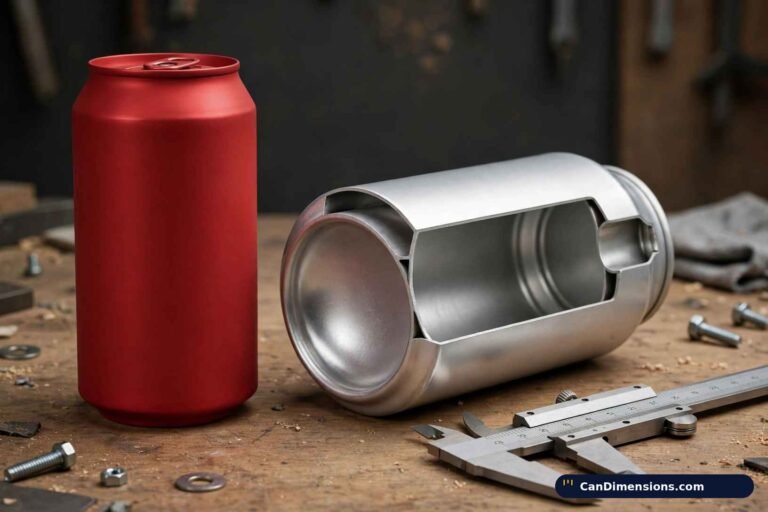
Nothing about that figure is luck. Makers iron the side wall down to around 0.097 mm, finer than a page in a paperback, and spend the saved metal where loads concentrate: the domed floor that resists pressure, the neck that takes the seam, the lid that has to open on cue and not before. Put a can on a scale and you are weighing a set of deliberate trade-offs.
The verified size chart is still here in full, since height and diameter are what most visitors come to settle. What this page adds is the story told by mass: the weight itself, the arithmetic that turns empties into pounds of scrap, and the compressed, baled form in which cans travel back to the mills.

How Much Does an Aluminum Can Weigh?
For the standard 12 oz can, the empty weight most often quoted across the industry is about 14.9 grams (0.53 oz). It is the tare figure attached to the modern two-piece 355 mL can, and the construction explains why it lands there: a body rolled from 3004 alloy and ironed to a mid-wall near 0.097 mm, closed by an end pressed from harder 5182 alloy, tab included.
Compare package with contents and the efficiency sharpens. Filled, the same can totals somewhere around 370 to 384 grams, so the metal contributes barely 4 percent of the weight a shopper carries home. The other 96 percent is drink. Hardly any rigid container gets near that split, which is one reason cans freight so cheaply long before anyone mentions recycling.
Bigger shells carry more metal, smaller ones less, roughly in step with how much wall each one needs. The 330 mL can, at 115.2 mm on a related body, sits a little under the standard; the 16 oz tallboy, at 157.2 mm, sits above it. Because makers publish no finished weight for each shell, this page states the single documented figure — 14.9 g for the standard can — and leaves the rest of the family described by proportion instead of dressing guesses up as data.
Treat 14.9 g as a production average rather than a guarantee for the can in your drawer. Ink, lacquer and small differences between makers nudge individual cans a few tenths of a gram either side of it, and any drink left inside weighs far more than the variation does. Rinse, dry, then weigh.
Aluminum Can Size Chart
Every common format on a single chart, at the values the makers themselves specify. The diameter column records finished bodies as a caliper reads them — not the industry codes, which name the shells and convert to larger numbers than any real can measures, as the diameter section below works through.
| Can Type | Volume | Diameter | Height | Common Use |
|---|---|---|---|---|
| Standard | 12 oz / 355 mL | 2.6 in / 66 mm | 4.83 in / 122 mm | Soda, Beer, Iced Tea |
| Sleek | 12 oz / 355 mL | 2.26 in / 57.4 mm | 6.13 in / 156 mm | Hard Seltzers, RTD Cocktails |
| Stubby | 250 mL / 8.45 oz | 2.62 in / 66.6 mm | 3.6 in / 91.5 mm | RTD Coffee, Specialty Drinks |
| Slim | 250 mL / 8.45 oz | 2.1 in / 53.4 mm | 5.28 in / 134 mm | Energy Drinks, Carbonated Water |
Linger on the standard row, because it is the one copied charts most often corrupt. Its body answers to the designation 211, written in inches and sixteenths and reading as 2 11/16 inches. Turned into millimetres honestly, that is 68.3 mm — wider than any finished drinks can on sale. The can in the fridge spans 66 mm. One number names the shell, the other measures it, and confusing the pair is the original error behind half the wrong charts online.
Standard Aluminum Can Dimensions
The Standard 12 oz Aluminum Can – America’s Most Common Size
Ask a room to picture a drinks can and this is the one they picture: 355 mL, the default serve for soda and beer across the United States, produced in greater numbers than every other format combined.
What are the dimensions of an aluminum can? Finished and sealed, the standard can spans 66 mm (2.6 in) across its body and rises 122 mm (4.83 in) from base to top seam. Construction is in two pieces — a cup drawn upward and ironed into a body with the base formed in, then a separate lid seamed on after filling. The pairing behind those figures, a 211 body closed by a 202 end, is the same shell checked dimension by dimension in our coke can dimensions guide, and both codes are unpacked in the questions near the end of this page.
Aluminum Can Height Variations Across Different Formats
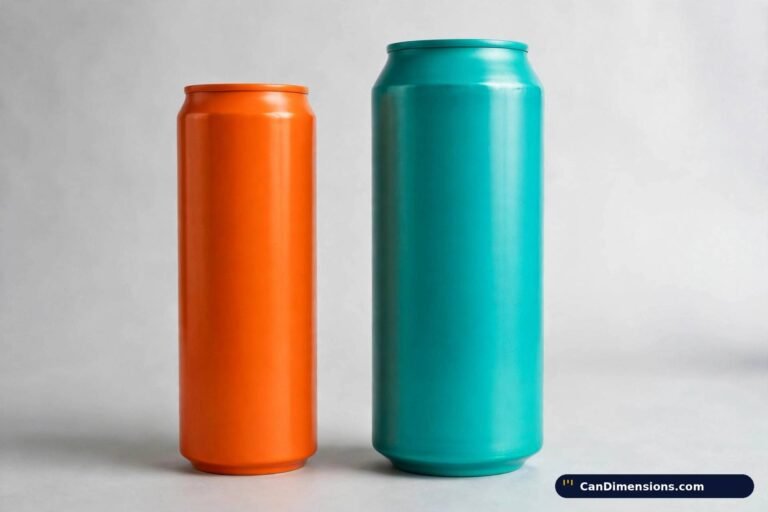
Formats diverge mainly upward. Give the drink a slimmer silhouette, a shorter retro stance or a longer pour, and in nearly every case it is the height that changes while the filling lines, cases and coolers carry on undisturbed.
At 155.7 mm (6.13 in), the sleek stands well clear of the standard’s 122 mm. The stubby travels the other way, stopping at just 91.5 mm (3.6 in) and looking broader for it. The slim reaches 134.0 mm (5.28 in) on its narrow body — the proportions energy drinks made familiar. Even within the standard 66 mm body, height alone sets the serve: 122 mm holds 12 oz, 157.2 mm holds 16 oz, 168.0 mm holds 500 mL and 188.1 mm holds 19.2 oz.
How Many Aluminum Cans Make a Pound?
Scrap changes hands by weight, so the useful question about a sack of empties is arithmetic. A pound contains 453.592 grams. Divide that by the documented weight of one empty standard can:
453.592 g ÷ 14.9 g per can = 30.4 cans
Round it to about 30 cans per pound. Thirty cans at 14.9 g apiece come to 447 g, a shade under the line; can number 31 tips the pile past it. Scale the same figure up and a tidy 100-can collection weighs about 1.49 kg (roughly 3.3 lb), while 1,000 cans reach about 14.9 kg (roughly 32.8 lb). All of that assumes clean metal: dregs, grit or a stray steel can in the bag inflate the reading without adding a gram of aluminum, which is why yards insist on cans sorted and drained.
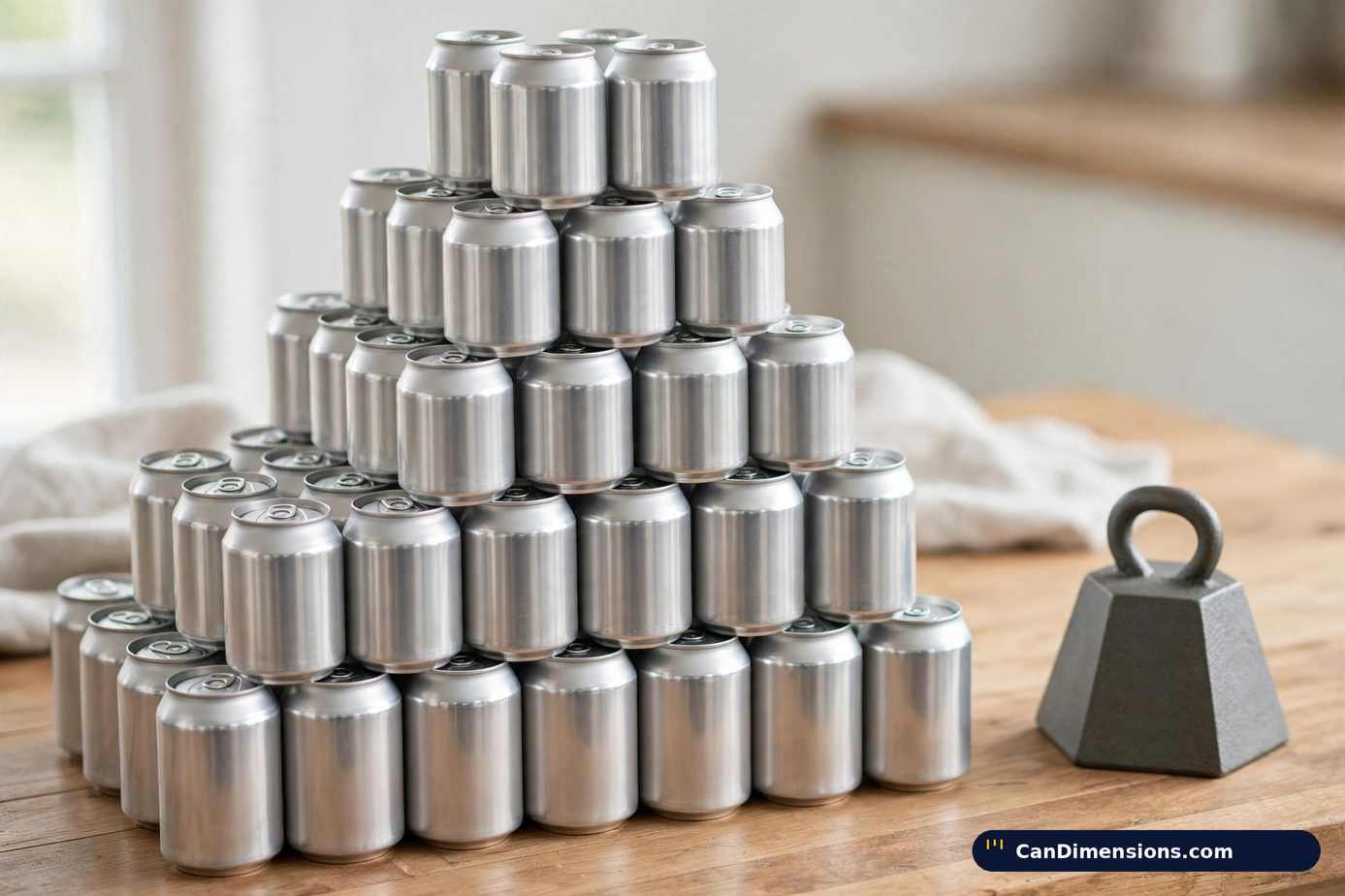
Anyone quoted a count in the mid-20s by an older collector is not being misled — they are remembering a heavier generation of can. Wall thinning, narrower necks and lighter ends have shaved the package steadily for decades, so a count learned years ago now understates how many current cans a pound requires. Trust the scale over the memory.
Aluminum Can Sizes in the US Market
Sleek Aluminum Cans – Modern and Sophisticated
A sleek can pours the identical 12 oz (355 mL) as a standard can from a reshaped shell: the body narrows to 57.4 mm (2.26 in) and the height stretches to 155.7 mm (6.13 inches), the finished value on Ball’s manufacturing specification for the format, coded 202/204 × 602.
Shelf presence is the whole point of the shape. Hard seltzers and ready-to-drink cocktails adopted it first and still define it: an identical pour to the standard can, presented in a taller, trimmer outline that reads as the lighter choice before a word of the label is read. Volumes across the category have grown quickly on the back of that signal.
Stubby Aluminum Can Dimensions
The stubby is the range’s squat outlier: 250 mL (8.45 oz) packed into a body of 66.6 mm (2.62 in) — full standard width, nothing trimmed away — under a height of just 91.5 mm (3.6 inches), the pairing tabulated for the shell in IS 14407:2023, India’s national standard for beverage cans.
Ready-to-drink coffee has claimed the format in recent years, trading on the same low, stable stance that once sold it as a retro shape. Nothing wobbles: the footprint matches the standard can exactly, so coolers, trays and cup holders accept it without adjustment, and only the missing inch and a half of height marks it out.
Slim Aluminum Can Measurements
The slim pairs the narrowest body in the family with a mid-range height: 250 mL inside a diameter of 53.4 mm (2.1 in) and a height of 134.0 mm (5.28 in), the dimensions of the 250 Slim shell in IS 14407:2023. Energy drinks built the format’s reputation, and the shell gets its own close examination in our red bull can dimensions guide.
A narrower grip is the everyday advantage: the can sits easily in one hand and drops into cup holders that a standard body fills completely. What began as an energy-drink signature has since spread into sparkling waters and coffee, anywhere a lighter hold suits the drink.
Aluminum Can Diameter Specifications
Standard Can Diameter Measurements
What is the diameter of a tin can? Tinplate food cans come in dozens of sizes, but drinks cans answer to one dominant body, designated 211 — a designation that needs decoding before a ruler can say anything useful. The system expresses sizes in inches plus sixteenths — first digit whole inches, last two digits sixteenths — so 211 reads as 2 11/16 inches. Read it as a name, though, not as a measurement: Ardagh’s specification for a 211 body caps outside diameter at 66.3 mm, and finished cans leave the line at 66 mm, or 2.6 inches.
Because every filler, seamer and packer in the trade is tooled around that one body, the 211 functions as a shared standard far beyond any single maker. Cases interlock, shelves plan around it, and wraps are cut to what follows from it: a circumference of π × 66 mm, about 207 mm (20.7 cm, roughly 8.17 in). The same treatment, format by format, fills our beverage can dimensions guide.
Diameter Variations in Specialty Aluminum Cans
Away from the standard body, diameter becomes a positioning choice. The sleek steps down to a 57.4 mm body and the slim further still, to 53.4 mm; the 7.5 oz mini borrows a 58 mm body from the sleek family; and the widest drinks shell of all, the crowler’s 307 body, spans 83.6 mm (3.29 in). Each width changes the grip, the stance and the shelf read of the can.
Each step away from 66 mm trades something. Broad bodies stand planted and pour generously but eat case space; narrow ones pack tightly and feel premium while asking more height of the shelf. Makers pick the point on that scale that matches the drink, the drinker and the route to market.
Aluminum Can Length and Height
How Aluminum Can Height Is Measured
Height, in the makers’ drawings, is taken seam to seam on the sealed can. Body, base and lid all count toward the published figure, so the number describes the object a shelf must clear rather than the open shell on the production line. Makers hold the line tightly while doing it: Crown’s drawing for the 440 mL can permits its 149.90 mm finished height a tolerance of only ±0.30 mm.
Seaming explains the small gap between shell and finished figures, since the double seam at each end folds metal over and adds its own fraction. Gauges on the line watch the result continuously. For the buyer of accessories the lesson is simpler: anything meant to wrap a can — sleeve, cosy, printed film — is sized off the body, never off the necked-down lid, the rule worked through in our can koozie dimensions guide.
The Relationship Between Can Height and Volume
Height, diameter and volume trade against one another inside a fixed pour: stretch a shell upward and narrow it, and the same 355 mL still fits. What changes is the impression — can size as judged by eye routinely parts company with capacity as measured.
Set the pair side by side and perception does the rest: a sleek 12 oz can looks the bigger of the two beside a standard can, although both hold exactly 355 mL — the sleek pours it into 155.7 mm of height on a 57.4 mm body instead of 122 mm on a 66 mm one. Nothing extra is being sold, yet the taller outline reliably supports a higher shelf price, a piece of packaging psychology no brand team ignores.
Popular Aluminum Can Sizes and Dimensions
16 oz Tall Boy Aluminum Can Dimensions
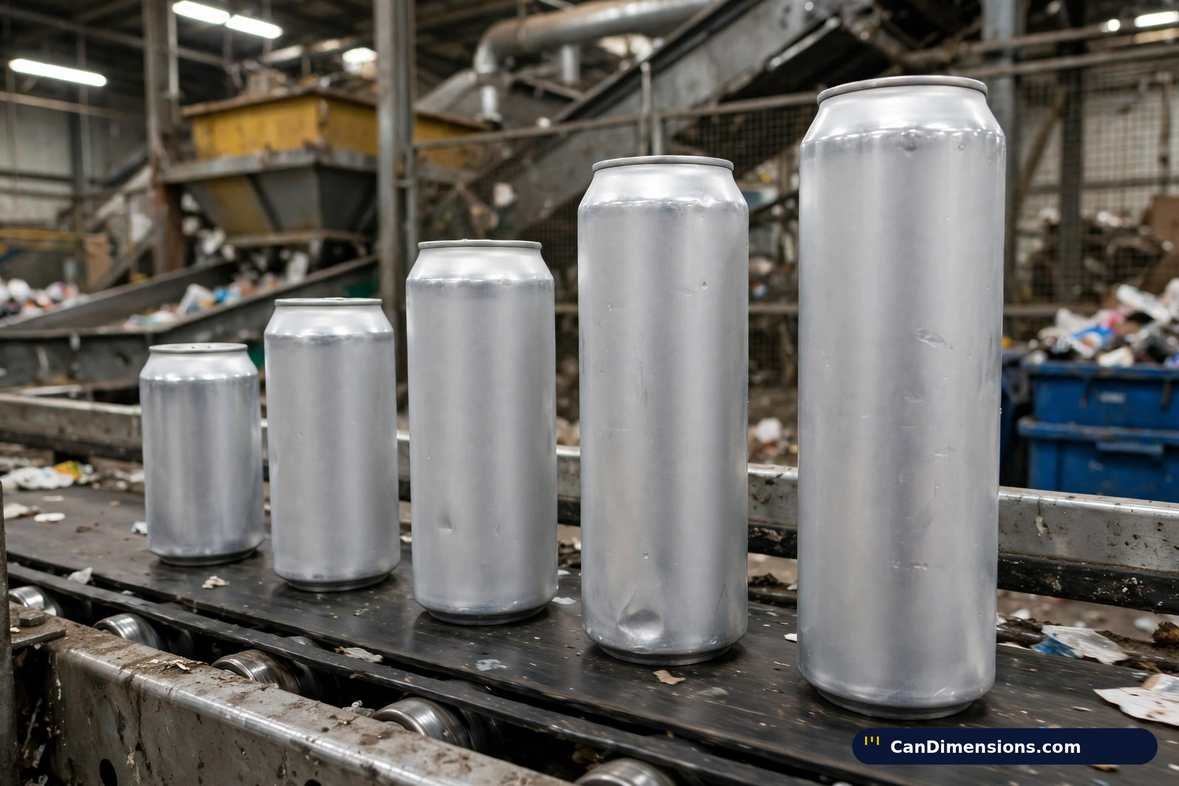
The tallboy is the standard shell pulled upward: the body stays at 66 mm while the height climbs to 6.19 inches (157.2 mm) on Ardagh’s manufacturing specification for the format. (Printed elsewhere as 158 mm — 6.22 in when converted — while the specification’s own figure is 157.2 mm.) The payoff is a third more drink: 16 oz against 12 oz is a ratio of 1.33, so the often-quoted “33% more” is plain arithmetic. Craft beer and energy drinks are its home shelves, where the extra third of a serve and the taller stance both earn their keep.
Mini Aluminum Can Sizes
The mini shrinks the serve rather than the concept: 7.5 oz (222 mL) in a sleek-family shell, its 58 mm body standing about 4.11 inches (104.4 mm) tall — a catalogue figure; Ball groups the format with its Sleek range. Copied charts fail most often on the mini, so the correction belongs here: the pairing printed for them in places, 53 mm across by about 94 mm tall, corresponds to no shell any maker sells. That 53 mm body belongs to the slim, which at 250 mL stands 134 mm tall; the genuine mini is broader and lower than the printed pairing on both axes.
The appeal is portioning: a mixer measure, a child’s serve, a taster beside a full-size can. Smaller shells also chill faster and empty before they warm, which suits the categories that stock them.
Large Format Aluminum Cans (19.2 oz, 24 oz, 25 oz)
At the top of the range the single serve becomes the whole point. The stovepipe, at 19.2 oz (568 mL), keeps the familiar 66 mm body and stretches to 7.41 inches (188.1 mm), Ardagh’s finished height for the format — the 7-inch (178 mm) figure in circulation undershoots it by 10 mm. The 24 oz label covers two distinct cans and they must not be merged: Ball’s wide-body shell, flanged at 7.60 inches with a 2.87-inch base diameter and finishing at about 7.7 by about 2.9 inches, is the one behind the resealable can measured in our monster can dimensions guide, while the roughly 8.46-inch figure on beer charts belongs to a separate 24 oz single raised on the standard 66 mm body. And the heading’s “25 oz” resolves, in the makers’ own catalogues, to 25.4 oz (750 mL) at the top of Ball’s King family, on that same wide-body format. No finished height for the King is published by Ball, so this page prints none in place of an estimate wearing a specification’s clothes.
Singles retail is where these cans live: one tall can, sold cold, priced as a complete serve. The engineering follows the format upward — longer walls need the standard body’s stiffness and careful handling to reach the shelf unbuckled.
Aluminum Can Recycling: The Can’s Second Life in Numbers
Every dimension so far describes a can before or during its one short job. The figures that outlast the drink concern what the can is made of, because aluminum is built to come back. Research commissioned by the Aluminum Association and the Can Manufacturers Institute, carried out by the consultancy RRS and reported in March 2025, timed the return directly: a used beverage can moves from recycling bin to newly formed can in less than 60 days on average in the United States.
The rest of the loop, in the same industry’s figures: nearly 97 percent of recycled aluminum beverage cans in the US become new cans again, against 30–60 percent for glass and 34 percent for plastic bottles. The average aluminum beverage can sold in the United States already contains 71 percent recycled content, compared with 23 percent for glass bottles and 3–10 percent for plastic bottles. And producing metal this way cuts energy use and emissions by 95 percent versus making new aluminum from ore — in practical terms the largest saving anywhere in the can’s specification.
One figure keeps the story honest. The same reporting puts the share of shipped cans actually recycled at 43 percent. For every can that enters the loop the system is fast and nearly closed; the loss happens earlier, at the bin. The second life of a can is therefore a collection problem attached to an engineering success — alloy, wall and dimensions were never what held it back.
Crushed and Baled: A Can’s Dimensions After Use
Crushing rewrites a can’s height and leaves its weight untouched, which is why the scrap trade stops specifying the can and starts specifying density and bale size. Ask for the standard height of one crushed can and there is none to give: a boot, a bench press and a depot compactor each leave a different puck, so this page prints no such figure. The bale is where standardisation resumes.
Novelis, the largest maker of can sheet, sets the receiving specification its suppliers ship to: bales of used beverage cans must run to at least 30 cubic feet, with dimensions in the ranges 24 to 41 inches by 30 to 52 inches by 41 to 72 inches. The industry’s ISRI specification for baled used beverage cans, its TALDON grade, prices the compaction itself — a density of 14 to 17 pounds per cubic foot for unflattened cans, rising to 22 pounds per cubic foot for flattened ones. Identical metal in both cases; the only dimension that changed is the air travelling with it.
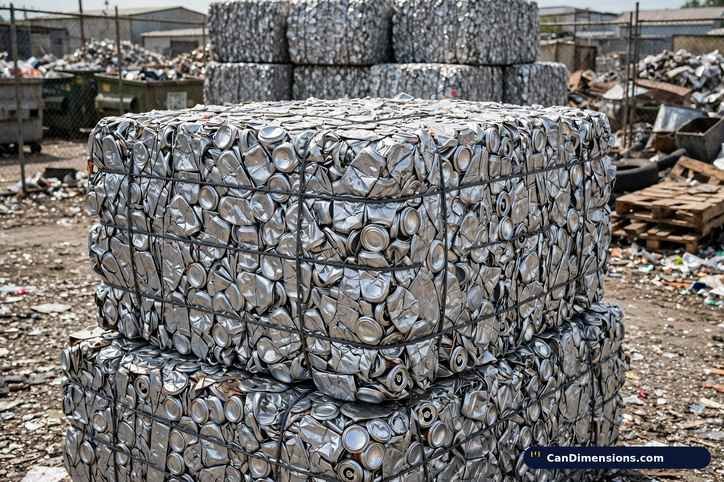
Translate a bale back into cans with the verified weight and the stream’s scale emerges. Even one cubic foot of flattened cans, at 22 lb, carries roughly 660 cans’ worth of metal (22 × 30.4, using the cans-per-pound figure derived above), and a full bale holds thousands. The metal arrives undiminished by the trip: can sheet remelts into can sheet, which is the mechanical reason the sub-60-day loop in the previous section can run at all.
Question’s
What are the dimensions of an aluminum can?
For a standard 12 oz can: a body 66 mm (2.6 in) wide, a finished height of 122 mm (4.83 in), 355 mL inside — and an empty weight of about 14.9 g.
What is the standard size of a can?
In the United States the standard is 12 oz (355 mL), at 4.83 in tall by 2.6 in across. Europe’s everyday equivalent is the 330 mL can, at 115.2 mm tall on a 66.6 mm body.
What is the diameter of a tin can?
There is no single answer: beverage cans are aluminum, not tin, and tinplate food cans are made in many sizes. For the drinks can itself, the standard body measures 66 mm (2.6 in).
What is the difference between a tin can and an aluminum can?
Despite the shared nickname, the materials differ outright. A tin can is tinplate: steel sheet carrying a thin coat of tin. A drinks can is aluminum alloy: 3004 or 3104 for the body (about 1% manganese and 1% magnesium in the mix), walls ironed to roughly 0.097 mm, and 5182 alloy for the ends. Density does the rest — about 2.7 g/cm³ for aluminum against 7.85 for steel — which is why one feels almost weightless and the other does not.
How tall is a 440mL can?
Crown’s catalogue puts the 440 mL can at 149.9 mm (5.90 in) finished height on the standard 66 mm body. Figures near 168 mm quoted for it describe the 500 mL can instead.
What size is a 202 can lid?
202 is a code before it is anything else: read in inches and sixteenths it gives 2 2/16 inches, a nominal 54.0 mm. The finished end itself measures smaller, about 52.3–52.5 mm across, with Ardagh’s neck plug diameter at 52.4 mm. The code names the part; the part measures less.
Conclusion
A scale explains a can faster than a ruler does. Fourteen point nine grams of alloy, walls near 0.097 mm, one 66 mm body under heights that run from the stubby’s 91.5 mm through the standard’s 122 mm to the stovepipe’s 188.1 mm — and a material worth enough that some 30 empties gather into a collectable pound and most collected cans reappear as new cans inside 60 days.
Take two habits away from this page: read every can code as a label, not a measurement, and weigh a package before trusting anything printed about it. Both lead back to the same starting point, the ground the metal came from — bauxite, the ore each of those 14.9 grams was refined out of.