How Big Is a Soup Can? Every Soup Can Size in Real Life
Stand in front of an open cupboard and the question how tall is a can of soup stops being abstract. The little condensed can at the front is about 4 inches tall, the chunky can behind it nearer 5, and the catering tin at the back stands a full 7 inches — three different answers, all of them correct, all of them sold as “a can of soup.”
This page answers the question the way a kitchen asks it: how the cans on a real shelf compare with the objects around them, how to name the can in your hand from its height alone, and what each size holds when a recipe just says “a can.” Every figure comes from the can industry’s own size codes and from shelf and case records — not from the rounded guesses that circulate online.
The full verified chart is here too, rebuilt from those codes. But the order is deliberate: real life first, then the numbers.

How Big Is a Soup Can in Real Life?
A soup can is smaller than it photographs. The condensed can most kitchens stock is 2 11/16 inches across and 4 inches tall — shorter than a dollar bill is long, and only about as tall as two credit cards stacked edge to edge. Work through the shelf with a wallet as the ruler and the whole family falls into place.
A US banknote measures 6.14 inches long by 2.61 wide (Bureau of Engraving and Printing). Lay one beside the cans and three comparisons land at once. The family-size #10 can, at exactly 7 inches tall, is the only common soup can that out-stands the bill’s length. The everyday #2 can is 3 7/16 inches across — a hair wider than a credit card is long, the card being 3.37 inches under the ISO/IEC 7810 standard. And the condensed can’s 4-inch height is, near enough, a credit card’s 2.125-inch width doubled (4.25 inches — the can stands a quarter-inch shy of the pair).
| Can | Height | Everyday yardstick |
|---|---|---|
| Small soup can | 3 in | About half a dollar bill’s length (half is 3.07 in) |
| Condensed can | 4 in | Two credit-card widths, less a quarter inch |
| Ready-to-serve can | 4 9/16 in | A credit card’s length plus its width, near enough (5.5 in is too tall — see below) |
| Chunky can (shelf) | 4.95 in | Just under a dollar bill’s length, by 1.2 in |
| #10 catering can | 7 in | Taller than a dollar bill is long, by 0.86 in |
Read the ready-to-serve row carefully, because it teaches the method: honest comparisons say how far off they are. A card’s length plus its width totals 5.5 inches, which overshoots the 4 9/16-inch can by nearly an inch — so that pairing is a bracket, not a match, and this page prints it as one. The matches above are the ones that survive subtraction.
Complete Soup Can Size Chart
The can industry names its cans with a three-digit code: the first digit is whole inches, the last two are sixteenths of an inch, diameter first and height second. Decoded, the standard soup shells are these — and for the two retail formats where the shelf can measures smaller than its shell, both figures are printed and labelled.
| Can | Industry code | Diameter | Height | Typical fill |
|---|---|---|---|---|
| Small can | 211×300 | 2 11/16 in | 3 in | About 7–8 oz |
| Condensed can (#1 Picnic) | 211×400 | 2 11/16 in | 4 in | 10.75 oz (net weight) |
| 300 can | 300×407 | 3 in | 4 7/16 in | 14–16 oz |
| Ready-to-serve can (#2) | 307×409 | 3 7/16 in | 4 9/16 in | 18–19 oz class |
| #2.5 can | 401×411 | 4 1/16 in | 4 11/16 in | Family size |
| #3 can | 404×414 | 4 1/4 in | 4 7/8 in | Large family |
| #5 can | 502×510 | 5 1/8 in | 5 5/8 in | About 56 oz |
| #10 can | 603×700 | 6 3/16 in | 7 in | About 102–117 oz |
Two cautions belong on the chart itself. The condensed can’s 10.75 oz is a net WEIGHT, not fluid ounces — soup is denser than water, and the label is honest about which one it means. And the #5’s capacity is about 56 oz: charts that print 51 oz beside it have usually misread its code as well.
Standard Soup Can Dimensions and Sizes
Condensed Soup Can Dimensions
The condensed can rides the #1 Picnic shell, 211×400: 2 11/16 inches in diameter and exactly 4 inches tall before seaming. On the shelf the finished can measures a touch less — leading brands shelf-list at 2.65 to 2.66 inches wide and 3.91 to 3.95 inches tall — because the chart figure describes the shell the maker starts with, and the shelf figure describes the seamed, labelled product.
Campbell’s own food-service case settles which shell the condensed can really is: twelve 10.75 oz cans ship in a case measuring 10.75 × 8.25 × 4.125 inches, which only works as four cans of about 2.7 inches standing about 4 inches tall. Any chart that gives the condensed can a 3-inch diameter and a 4.5-inch height is describing a different can — the 300 shell, two rows down.
Ready-to-Serve (Chunky) Soup Can Dimensions
Ready-to-serve soup splits into two shelf formats that charts habitually merge. The #2 shell, 307×409, decodes to 3 7/16 × 4 9/16 inches nominal, and the Progresso-class cans built on it shelf-list at 3.35 inches wide by 4.45 tall. Campbell’s Chunky line is its own shape: narrower and taller at 3.15 inches wide by 4.95 tall on the shelf, corroborated by the maker’s case of twelve at 12.875 × 9.5 × 5 inches.
So “ready-to-serve” is not one size. The broth-based cans follow the #2 shell; the chunky cans stand about half an inch taller on a narrower footprint, which is why they tower over the condensed row in the cupboard despite holding a similar dinner.
Small Soup Can Sizes
The small can is the 211×300 — the condensed can’s diameter with an inch of height removed: 2 11/16 inches across and 3 inches tall, for a fill of about 7 to 8 ounces. It is the single-serving and children’s-soup format, and the shortest true soup can in the standard set.
Figures in circulation that give the small can a 4-inch height have confused it with its condensed sibling, which shares the diameter. Height is the only thing that separates them, and it separates them by a full inch.
Which Soup Can Is in Your Cupboard?
Forget codes for a moment. Height alone names almost every can in a home cupboard, because the standard shells step in clear bands and no two home formats share one.
| If it stands… | It is almost certainly… | Clue on the label |
|---|---|---|
| About 3 in | The small single-serving can | 7–8 oz |
| About 4 in | A condensed can | “Condensed” — add water or milk |
| About 4 1/2 in | A ready-to-serve #2 can | 18–19 oz class |
| Just under 5 in, narrow | A chunky can | “Chunky” in the product name |
| About 7 in, very wide | A #10 catering can | 100 oz class — a catering tin |
The label clue confirms what the tape suggests. Condensed soup announces itself, because the directions must tell you to add liquid; a can that says “condensed” at 4 inches tall is the #1 Picnic shell whatever the brand. The chunky can is the one identification height alone can fumble — at just under 5 inches it can pass for a tall #2 until the narrower 3.15-inch width gives it away. Measure across, not just up, when a can stands between bands.
One can that will not appear in a home cupboard is worth naming so it is not misidentified in a store: the #3 and #5 shells belong to club stores and delis. If a can stands 4 7/8 or 5 5/8 inches tall and spans more than 4 inches across, it is a bulk format, not a large home can.
Popular Soup Can Dimensions by Brand
Campbell’s Soup Can Dimensions
Campbell’s condensed line — the red-and-white cans — is built on the #1 Picnic shell: a nominal 2 11/16 × 4 inches, shelf-measuring 2.65 to 2.66 inches wide by 3.91 to 3.95 tall, at 10.75 oz net weight. The maker’s case dimensions (10.75 × 8.25 × 4.125 inches for twelve) confirm the shelf figures from the shipping side.
Campbell’s Chunky is the taller sibling at 3.15 × 4.95 inches on the shelf. The two Campbell’s formats bracket the home market: the shortest full-size can and nearly the tallest, from the same maker — which is why “a Campbell’s can” is not a dimension until the line is named.
Other Major Brand Dimensions
Progresso’s ready-to-serve cans shelf-list at 3.35 inches wide by 4.45 tall — the #2 shell finished and labelled, a fraction under its nominal 3 7/16 × 4 9/16. Store brands buy the same shells from the same can makers, so an own-brand ready-to-serve can measures within a few hundredths of the Progresso figure, and an own-brand condensed can matches the Campbell’s footprint.
That is the quiet truth of this whole chart: brands differ, shells do not. A handful of can makers supply the industry, and the brand’s contribution is the soup and the label — the dimensions were settled by the shell long before the label was designed. For the bulk formats sold under food-service brands, see our guide to food can dimensions, where the #10 and its neighbours get their own chart.
Large Format Soup Can Dimensions
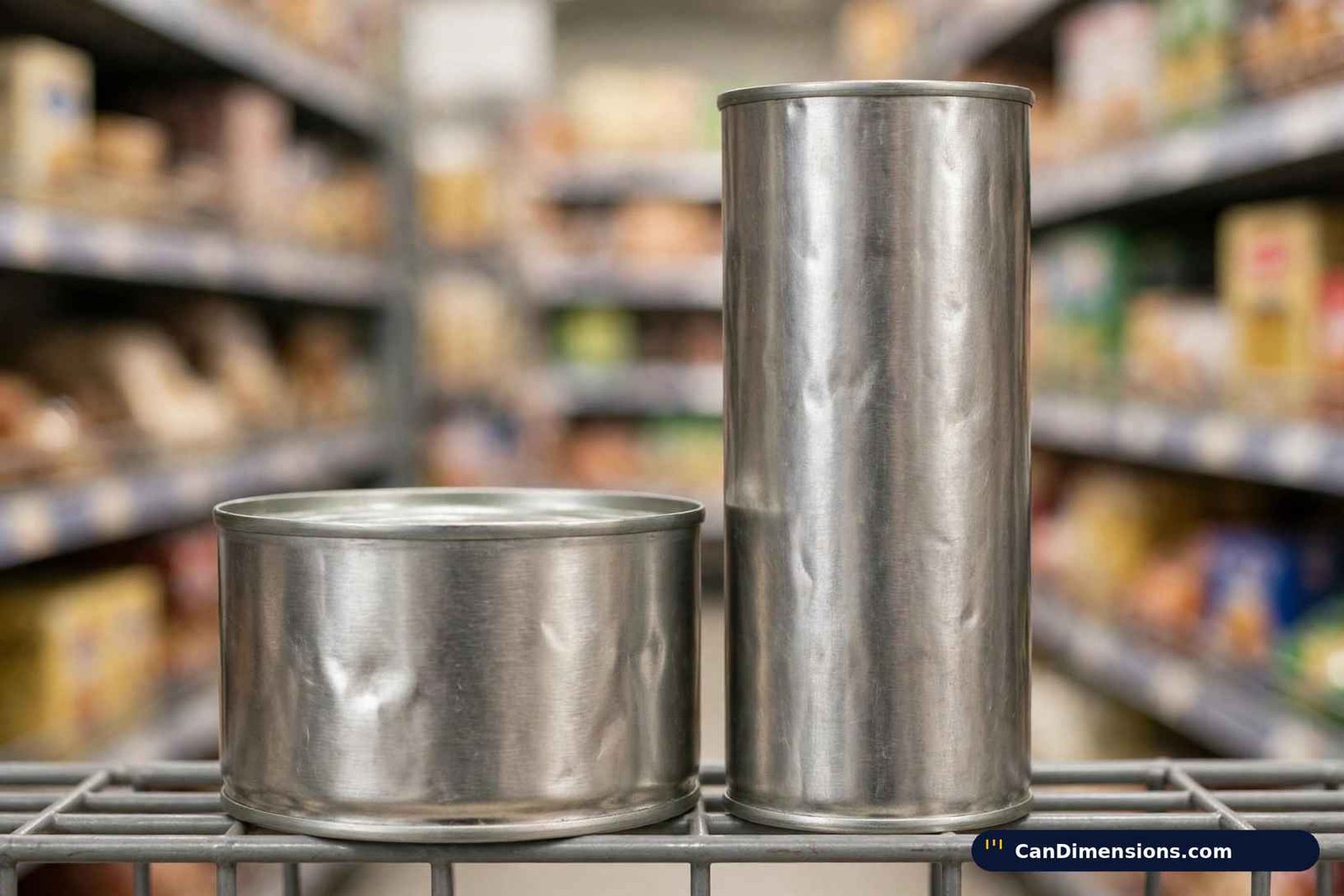
Above the home sizes, the shells stop pretending to be cupboard-friendly. The #2.5 (401×411) measures 4 1/16 × 4 11/16 inches; the #3 (404×414) measures 4 1/4 × 4 7/8; the #5 (502×510) measures 5 1/8 × 5 5/8 and holds about 56 ounces. The #10 (603×700) closes the range at 6 3/16 inches across and exactly 7 inches tall, with a capacity of roughly 102 to 117 ounces that shifts with what is packed in it.
Two errors follow these cans around the internet. The #5 is often printed with the code “512×562,” which cannot exist — the sixteenths field of a can code tops out at 15, so 62 is an impossible reading; the shell is 502×510. And the #10’s capacity is a range, not a point: dense products pack heavier than broths, and honest charts print the spread.
Soup Can Dimensions in Metric (Centimeters)
Converting Soup Can Measurements
Multiply inches by 2.54 for centimetres and by 25.4 for millimetres — both factors are exact by definition. Can codes convert cleanly too: read the code as inches first (211 = 2 11/16 in), then convert the decoded figure, never the digits.
Standard Sizes in Centimeters
| Can | Diameter | Height |
|---|---|---|
| Small (211×300) | 6.83 cm | 7.62 cm |
| Condensed (211×400) | 6.83 cm | 10.16 cm |
| 300 (300×407) | 7.62 cm | 11.27 cm |
| Ready-to-serve (307×409) | 8.73 cm | 11.59 cm |
| #2.5 (401×411) | 10.32 cm | 11.91 cm |
| #3 (404×414) | 10.80 cm | 12.38 cm |
| #5 (502×510) | 13.02 cm | 14.29 cm |
| #10 (603×700) | 15.72 cm | 17.78 cm |
The condensed can in metric is a tidy thing: 6.83 cm across and 10.16 cm tall — call it 7 by 10 cm in a European kitchen and nobody is misled. The #10 is the one to convert carefully, because 6 3/16 inches is 15.72 cm, not the 15.9 that a careless rounding of 6.25 inches produces.
Soup Can Capacity and Serving Sizes
Understanding Fluid Ounces vs Servings
A can carries two numbers that refuse to match: the net weight on the label and the servings in the nutrition panel. The label weight counts everything in the can, sauce and solids together, weighed — for condensed soup, 10.75 oz of product. The serving count comes from the regulator’s reference amount, and the two systems were never designed to agree.
Is One Can of Soup Equal to One Cup?
For ready-to-serve soup, close: the FDA’s reference amount customarily consumed for soup is 245 grams, roughly a cup, and one ready-to-serve can contains about two of those servings. For condensed soup the question splits — it holds roughly a cup and a third of concentrate, which becomes about 2.5 cups of soup once the added water or milk goes in. One can of condensed, prepared as directed, is a two-bowl proposition.
Standard Soup Serving Sizes
Work to 245 grams — the FDA reference amount at 21 CFR 101.12 — as one serving of soup. A small 7–8 oz can is a single serving wearing a can. A ready-to-serve can in the 18–19 oz class is two servings by the reference amount, however it is marketed. A condensed can, prepared, serves two to three depending on whether it is a starter or the meal.
Soup Can Sizes for Recipes: What “One Can” Really Means
Recipes are the worst dimension-keepers in the kitchen. When a casserole recipe says “a can of soup,” it means the condensed can — 10.75 oz, about 1.3 cups as it comes out of the tin — because the condensed can is the ingredient can, the one cooks have reached for since the format standardised. A recipe that wants ready-to-serve soup as an ingredient says so, or names a weight.
Substitutions follow from the sizes. One condensed can plus its added liquid equals roughly 2.5 cups of ready soup, so a recipe calling for 2.5 cups of ready-to-serve can be met with one condensed can prepared — and the reverse swap leaves a dish short and thick. When a recipe gives ounces instead of cans, trust the ounces: 10.75 oz is the condensed can, 14 to 16 oz is the 300 shell, and anything at 18 to 19 oz is the #2 ready-to-serve family. The weight on the label is the recipe’s real unit; the can is just its container.
Length and Circumference of Soup Cans
How Long is a Soup Can?
“Length” for a can is its height stood upright — the dimension this page has used throughout: 3 inches for the small can, 4 for the condensed, 4 9/16 for the ready-to-serve #2, and 7 for the #10. Laid on its side, a can’s length becomes its diameter plus nothing — a can rolls, which is the practical difference between its two dimensions.
Calculating Soup Can Circumference
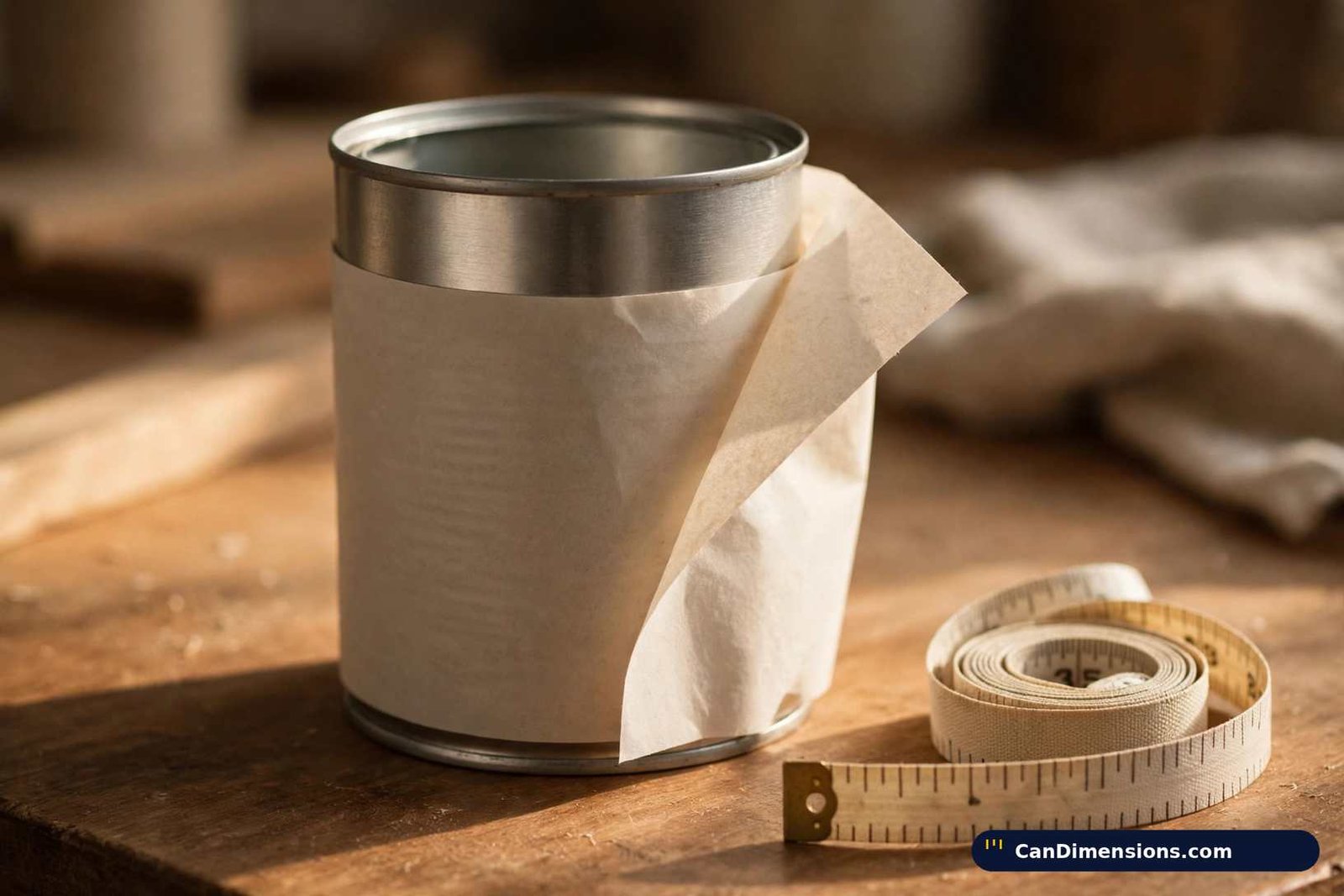
Circumference is π times diameter, and labels, sleeves and wraps are all cut to it. On the nominal shell diameters: the condensed can measures 8.44 inches around (2.6875 × π), the #2 measures 10.80 inches, the #2.5 measures 12.76 inches, and the #10 measures 19.44 inches around. Anyone printing a wrap or a cosy for a can should measure the actual can as well — the shelf diameter runs a few hundredths under the shell figure, and a wrap cut to the shell can hang loose. It is also why a soup can defeats a standard drink cosy: the can koozie dimensions are drawn for a 2.6-inch beverage body, and even the narrowest soup can is wider than that.
Soup Can Dimensions for Storage
Cabinet Space Planning
Plan a soup shelf by the tallest can you stock, not the average. A shelf that clears the 4-inch condensed can fails the 4.95-inch chunky can by a finger’s width, so measure the chunky format before fixing shelf heights: 5 inches of clear space is the working minimum for a mixed home stock, and the #10 needs a 7-inch shelf of its own — usually the floor of the cupboard or a pantry shelf.
Depth is the forgiving dimension. Even the #10, at 6 3/16 inches across, fits a standard cupboard’s depth twice over; two rows of condensed cans, at 2.69 inches each, occupy about 5.4 inches of depth and leave room for a third row behind.
Refrigerator Storage After Opening
USDA’s Food Safety and Inspection Service allows soup to be refrigerated in its opened can, while recommending transfer to a clean container for the best quality — the food-safety point is the clock, not the container: use refrigerated soup within 3 to 4 days, the low-acid leftovers rule. A transferred portion also frees the can’s footprint: a #2 can is 3.44 inches of fridge-door width, and a lidded pot of the same soup stacks where the open can cannot.
How to Measure a Soup Can With a Dollar Bill
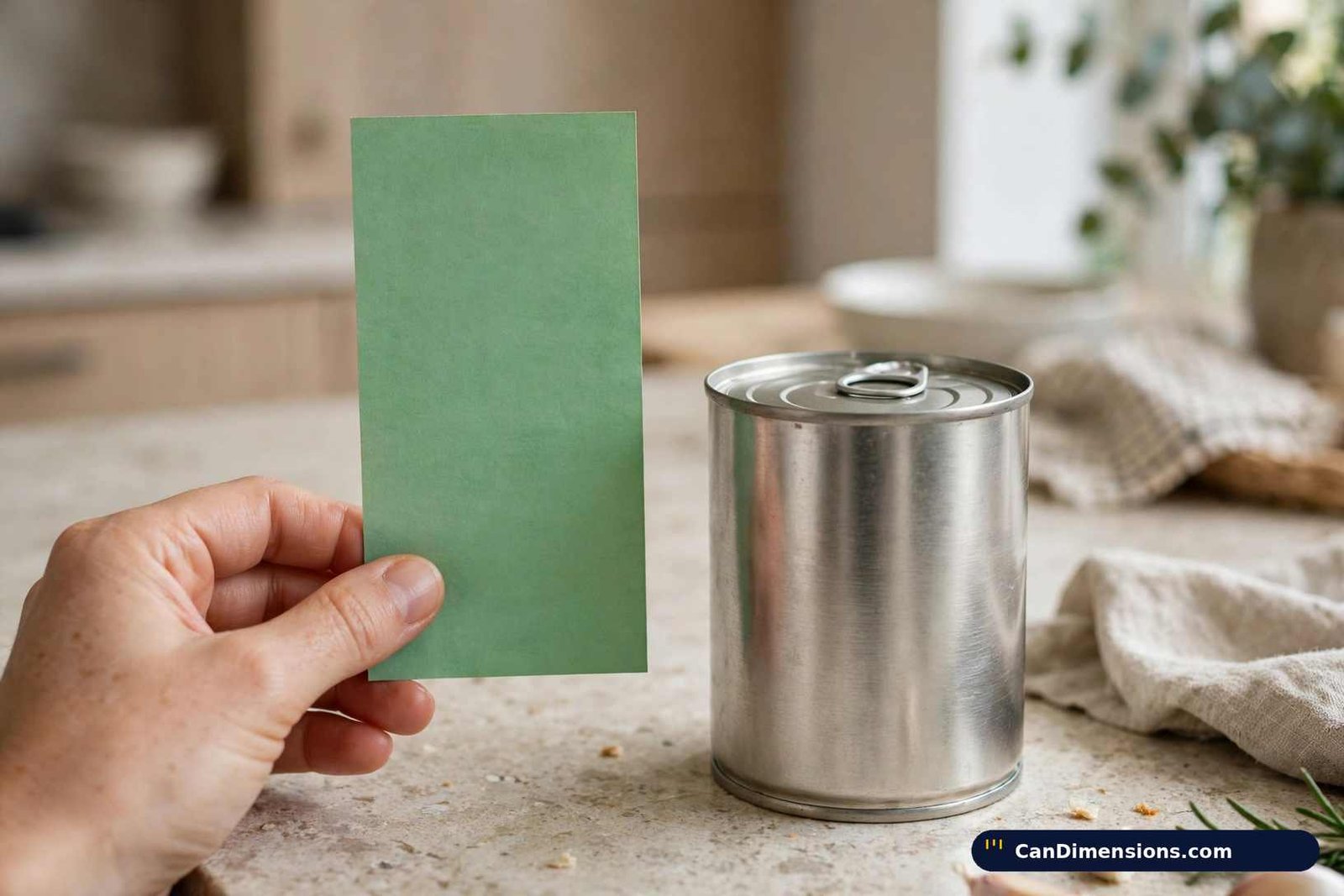
No tape, no ruler — a banknote is a gauge. The bill is 6.14 inches long and 2.61 wide (Bureau of Engraving and Printing), and those two edges test a soup can three ways.
For height, stand the bill beside the can. A can level with the bill’s length is in #10 territory at 6 to 7 inches; a can reaching two-thirds of the length is the condensed 4 inches (two-thirds of 6.14 is 4.09 — within a tenth); a can at three-quarters is a ready-to-serve (three-quarters is 4.6, against the #2’s 4.56 — within a twentieth). For diameter, lay the bill’s width across the top: 2.61 inches against the condensed can’s 2.69 — if the lid overhangs the bill’s edge by a fingernail on each side, the width is right. For circumference, wrap the bill around the can and mark where it meets itself: the condensed can’s 8.44 inches is one full length plus three-eighths of another (6.14 + 2.3), and the #2’s 10.80 is one length plus three-quarters of a second (6.14 + 4.6 = 10.74, within a sixteenth).
Treat the bill as a bracket, not a caliper — it names the shell family, which is all identification ever needs. The same trick gauges the drink cans in the fridge door; our aluminum can dimensions guide gives those shells their own verified chart.
Question’s
What are the dimensions of a soup can?
There is no single soup can. The condensed standard measures 2 11/16 × 4 inches. Ready-to-serve soup rides the #2 shell at 3 7/16 × 4 9/16 inches, chunky cans sit at 3.15 × 4.95 on the shelf, and the catering #10 measures 6 3/16 × 7 inches.
How many centimeters is a can of soup?
The condensed can is 6.83 cm across by 10.16 cm tall. The ready-to-serve #2 is 8.73 × 11.59 cm, and the #10 catering can is 15.72 × 17.78 cm.
How long is canned soup?
Stood upright, canned soup runs from 3 inches (the small can) through 4 inches (condensed) and 4 9/16 inches (ready-to-serve) to 7 inches for the #10. Height is the dimension “long” refers to for a can.
What is a standard serving size of soup?
245 grams — the FDA’s reference amount for soup, roughly one cup. A ready-to-serve can is about two servings; a condensed can, prepared, makes about 2.5 cups.
What size is a Campbell’s soup can?
The condensed red-and-white can uses the #1 Picnic shell: a nominal 2 11/16 × 4 inches, shelf-measuring about 2.66 × 3.95 inches at 10.75 oz. Campbell’s Chunky is taller and narrower at 3.15 × 4.95 inches.
Is 1 can of soup 1 cup?
No. One ready-to-serve can contains roughly two cups; a condensed can holds roughly a cup and a third of concentrate, becoming about 2.5 cups after preparation. One cup is one serving, not one can.
Conclusion
A soup can’s size is a code before it is a measurement: three digits that decode to the shell, a shelf figure a few hundredths smaller, and a height that names the format at a glance — 4 inches for condensed, 4 9/16 for ready-to-serve, and a full 7 for the catering tin. Learn the bands and the cupboard identifies itself.
And once the can is open, the size stops mattering and the soup takes over — simmered into a sauce, stretched into a casserole, or thickened into a chowder. The can was only ever the container; but it is a container with exact dimensions, and now you have them.