How Tall Is a Dollar Bill? Using It as a Ruler, in Straps and in Bulk
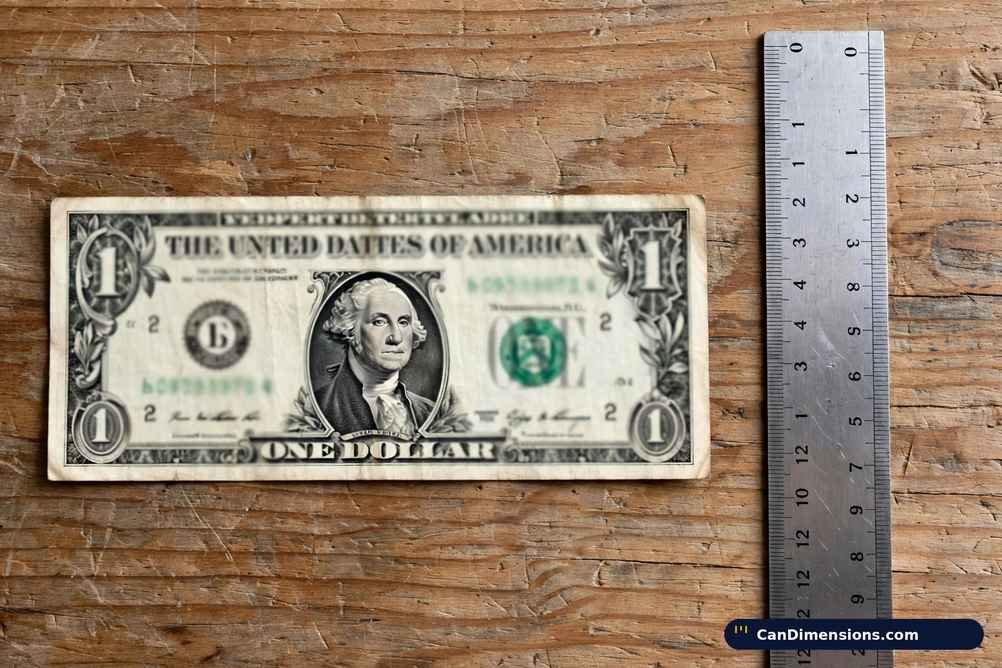
Most people carry a ruler without knowing it. Ask how tall is a dollar bill and the short edge answers first — 2.61 inches — yet the edge that earns its keep day to day is the long one: 6.14 inches of printed gauge, folded in wallets everywhere, ready to measure whatever a tape cannot reach.
This page puts that gauge to work. It shows which lengths a folded note can check honestly, how banks group loose bills into straps, bundles and bricks, and what serious money weighs once the count climbs into thousands and millions.
The complete official specification is still here, in fresh words and in full. It simply arrives in a working order: measure first, package second, weigh last.
A Dollar Bill as a Ruler: Folds, Fractions and Field Checks
Fold a note once, end to end, and the crease hands you a second gauge for free. The full long edge reads 6.14 inches — close enough to the lengths in our 6 inches guide that the difference, 0.14 inches, is about the width of two stacked credit cards’ edges — while the halved edge reads exactly 3.07 inches, a whisker over the 3-inch mark covered in our measuring 3 inches guide. Fold the halved note again and the quarter length is 1.535 inches, call it an inch and a half for field purposes.
| Gauge | Length | Honest use |
|---|---|---|
| Full long edge | 6.14 in | Checking lengths near 6 in |
| Half fold | 3.07 in | Checking lengths near 3 in |
| Quarter fold | 1.54 in | Checking lengths near 1.5 in |
| Three-quarter fold | 4.61 in | Checking lengths near 4.5 in |
| Short edge | 2.61 in | Checking widths near 2.5 in |
Set those gauges against objects whose sizes are fixed by a standard or a maker. A credit card, built to the ISO/IEC 7810 ID-1 pattern at 3.37 inches long, falls just past the note’s half fold — the card overshoots 3.07 inches by three-tenths. A poker-format playing card runs 3.5 inches long, so it sits between the half fold and the three-quarter fold, nearer the half. A drinks can tells the opposite story: at 4.83 inches tall, the standard can in our coke can dimensions guide stands a fifth of an inch beyond the three-quarter fold at 4.61 inches, so a note folded in fourths brackets it from below rather than matching it.
Hold the method to its proper standard. Paper flexes, worn notes shrink a hair, and a crease is never a machined edge, so treat every reading as a bracket — this object is a little over 3 inches, that one a little under 6 — and never as a measurement to the hundredth. For sorting, sizing a gap, or settling which of two boxes is longer, a bracket is all the job asks for. For cutting material to fit, fetch a real ruler.

Dollar Bill Dimensions in Different Units
The Bureau of Engraving and Printing publishes one rectangle for all current American notes: 6.14 inches along the long side, 2.61 inches along the short side. Turned into metric, the long side becomes 156 millimetres and the short side 66.3 millimetres. Thickness and mass complete the set: 0.0043 inches through, and roughly a single gram on the scales.
Quick Reference Table
| Feature | Imperial | Metric |
|---|---|---|
| Length | 6.14 inches | 156 mm |
| Width | 2.61 inches | 66.3 mm |
| Thickness | 0.0043 inches | 0.109 mm |
| Weight | 0.035 ounces | 1 gram |
Read the short side as the height whenever a note sits the way it sits in a wallet, upright in landscape view. Turn the note on its end and the labels trade places while the figures stay put — the rectangle itself never changes, only the way a person happens to hold it. A tired, softened note can read a fraction short on either side; the table gives the size as printed, which is the size every wallet slot and counting machine was built around.
Are All Dollar Bill Dimensions the Same?
One Size Fits All U.S. Currency
Within today’s American system, yes — one size serves every value. A single dollar and a hundred dollars occupy the same rectangle, and the two, five, ten, twenty and fifty fill it too. Cash machines, vending slots and drawer trays can therefore accept any value through the same opening, and a wallet needs only one shape of compartment.
Guides often present that sameness as an American-only habit. It is not. Canada runs the same policy: notes issued by the Bank of Canada, from five dollars to one hundred, each measure 152.4 by 69.85 millimetres. Plenty of other currency systems vary the size from one value to the next, which makes the shared-size approach uncommon — just not exclusive to a single country.
Historical Dollar Bill Sizes
Older American notes were cut larger. The large-size issues that ran from 1861 until the late 1920s measured 7.375 by 3.125 inches, one fixed pattern rather than a family of sizes, and collectors later nicknamed them horse blankets. On July 10, 1929 the Treasury put the reduced format into circulation at the modern 6.14 by 2.61 inches — a cut the U.S. Currency Education Program describes as roughly thirty percent smaller.
The Treasury’s reasoning at the time was practical. Smaller notes cost less to make, sat more neatly in storage and handling, and allowed twelve notes to a printed sheet where the old format had allowed eight. Large-size pieces stayed valid as money after the change and left circulation gradually, as individual notes wore out and were retired.
Dollar Bill Dimensions by Denomination
Common Denominations
$1 Bill Dimensions: 6.14 by 2.61 inches. George Washington faces outward, his likeness taken from Gilbert Stuart’s Athenaeum Portrait, while the reverse prints both faces of the Great Seal — the eagle on one side, the unfinished pyramid beneath the all-seeing eye on the other.
$5 Bill Size: The same rectangle, carrying Abraham Lincoln in front and the Lincoln Memorial behind. The 2008 redesign placed an oversized purple numeral 5 across the back; the U.S. Currency Education Program explains that feature as help for readers with low vision, not merely as a guard against copying.
$10 Bill Measurements: Unchanged again. Alexander Hamilton appears in front and the Treasury building behind. A claim repeated across the internet says this is the sole note picturing someone who never held the presidency — it is not, because Benjamin Franklin on the hundred was never president either, making two such notes, not one.
$20 Bill Dimensions: The standard size once more, with Andrew Jackson in front — he replaced Grover Cleveland, who had fronted the earlier large-size twenty. Another repeated claim calls the twenty the most numerous note in the country; the Federal Reserve’s own tally disagrees, counting about 19.9 billion hundreds and 15.2 billion ones in circulation at the close of 2025, against roughly 11 billion twenties.
$50 Bill Size: Standard measurements, Ulysses S. Grant in front, the United States Capitol behind.
$100 Bill Dimensions: Still 6.14 by 2.61 inches, despite sitting at the top of the values in everyday use. Benjamin Franklin faces outward, Independence Hall stands behind, and the current issue weaves a blue 3D security ribbon through the paper alongside ink that shifts colour as the note tilts. By sheer count it leads the world: those 19.9 billion hundreds outnumber every other American denomination, largely because so much of the stock is held outside the United States.
Rare and Discontinued Bills
The two-dollar note remains in production and remains legal, Jefferson in front and the Declaration signing behind, at the standard size. It turns up seldom in change — about 1.8 billion were circulating at the end of 2025 — which leads many holders to shelve it as a rarity, though uncommon and rare are different things.
The retired high values — five hundred with McKinley, one thousand with Cleveland, five thousand with Madison, ten thousand with Chase — were also printed at the small modern size after 1929. Printing stopped in 1945 and the values were formally ended in 1969, with low public use given as the reason at the time; the story that they were withdrawn chiefly to frustrate organised crime came later. They still count as legal money. Only a few hundred ten-thousand-dollar notes are known to survive, most held by museums and major collections.
Above them all sat the hundred-thousand-dollar gold certificate of the Series of 1934, bearing Woodrow Wilson. It was printed across December 1934 and January 1935, moved only between Federal Reserve Banks for gold settlements, never reached the public, and may not be owned privately. Even that exceptional piece used the standard small rectangle — the Smithsonian’s holding measures 15.7 by 6.6 centimetres, the ordinary note within normal tolerance.
Straps, Bundles and Bricks: How Banks Package Bills
Loose notes are awkward to count, carry or audit, so the cash trade groups them in fixed counts. The Federal Reserve’s Deposit Visual Reference Guide sets the first two levels plainly: a strap is a package of 100 notes, all of one denomination, held by a single paper band; a bundle consists of 1,000 notes of the same denomination, arranged as ten equal straps of 100 notes each. Deposits follow the same pattern — the Reserve Banks ask for ones through twenties in full bundles, while fifties and hundreds may arrive as full straps or full bundles.
The third level belongs to the Bureau of Engraving and Printing, which wraps newly printed notes for shipment. Its packaging specification describes a bundle as ten straps shrink-wrapped together — 1,000 notes — and a brick as four such bundles wrapped together, 4,000 notes in all. Older Bureau histories describe the same brick from the counting side: forty units of 100 notes each.
| Package | Notes | Stack height (arithmetic) | Weight (arithmetic) |
|---|---|---|---|
| Strap | 100 | 0.43 in | About 100 g |
| Bundle | 1,000 | 4.3 in | About 1 kg |
| Brick | 4,000 | 17.2 in as a single stack | About 4 kg |
Every height and weight in that table is arithmetic from the official single-note figures — 100 notes at 0.0043 inches apiece give the strap its 0.43 inches, and 4,000 notes at about a gram apiece give the brick its roughly 4 kilograms. A brick is not actually stored as one 17.2-inch tower; the figure is the stack equivalent, useful for picturing how much paper 4,000 notes contain. Value follows denomination alone: a brick of ones is $4,000, a brick of twenties $80,000, and a brick of hundreds $400,000, while the weight stays identical across all three.

Dollar Bill Thickness and Stack Height
How Thick Is a Dollar Bill?
One note measures 0.0043 inches through — 0.109 millimetres, close to a sheet of ordinary printer stock. It outlasts plain paper because it is not plain paper: the Bureau prints on a woven mix of 75 percent cotton and 25 percent linen, and its own benchmark credits the finished note with surviving about 4,000 double folds before it tears.
Stack Calculations
Multiply the single thickness by the count and the whole ladder follows. Ten notes make 0.043 inches, which is 1.09 millimetres. One hundred make 0.43 inches. One thousand make 4.3 inches, and ten thousand make 43 inches. The Bureau expresses the same point from the other direction, at 233 fresh notes to the inch before compression.
| Bills in the stack | Stack height (inches) | Stack height (metric) |
|---|---|---|
| 10 | 0.043 in | 1.09 mm |
| 100 | 0.43 in | 10.9 mm |
| 1,000 | 4.3 in | 10.9 cm |
| 10,000 | 43 in | 1.09 m |
| 1,000,000 | 4,300 in (358 ft) | 109 m |
One widely copied chart misplaces a decimal here, printing ten bills as 0.43 millimetres. Ten times 0.109 millimetres is 1.09 millimetres; the 0.43 figure belongs to a hundred bills, counted in inches. Getting that row right matters on this page more than most, because every packaging and bulk figure below builds on the same multiplication.
Cash in Bulk: Weight and Volume of a Million Dollars
A million dollars is a count of notes before it is a sum, and the denomination decides the count. In ones it takes a million notes. In hundreds it takes ten thousand. Everything else — mass, height, floor space — follows from those two counts and the single-note specification, and every figure in this section is labelled arithmetic for exactly that reason.
Weight first. A million ones, at about a gram per note, come to about 1,000 kilograms — a metric tonne of paper money. The same million in hundreds is ten thousand notes and about 10 kilograms, a load one person lifts without thinking twice. In packaging terms, the ones fill 1,000 bundles or 250 bricks; the hundreds fill just 10 bundles, a single brick plus change, or 100 straps.
Volume next. One note covers 6.14 by 2.61 inches, a footprint of about 16.03 square inches. Piled as one stack, a million ones would stand 4,300 inches — 358 feet, past the 305 feet the National Park Service records for the Statue of Liberty from ground to torch tip. Nobody stores money that way, so read the stack as a volume measure instead: footprint times height gives roughly 68,900 cubic inches, about 39.9 cubic feet, or about 1,127 litres of tightly packed notes. The hundreds shrink by the same factor of one hundred — about 0.4 cubic feet, a modest briefcase-class volume, standing 43 inches if piled in one column.
| A million dollars in… | Notes | Weight (arithmetic) | Single-stack height (arithmetic) |
|---|---|---|---|
| $1 bills | 1,000,000 | About 1,000 kg | 4,300 in (358 ft) |
| $100 bills | 10,000 | About 10 kg | 43 in (3.58 ft) |
That hundredfold gap explains a familiar film scene and its limits. A case of hundreds at a million dollars is physically believable — ten kilograms, well under half a cubic foot of notes. A case of ones at the same value is not a case at all; it is a tonne of paper needing forty cubic feet, closer to a small van load than to luggage.

Will It Fit? Bills in Wallets, Envelopes and Cash Drawers
Fit questions reduce to two comparisons: is the container longer than 6.14 inches, and is it taller than 2.61 inches? Pass both and a note lies flat; fail either and the note must fold, curl or ride at an angle.
The business envelope passes easily. A #10 envelope measures 4.125 by 9.5 inches — the size listed by office suppliers such as Quill for the standard commercial envelope — leaving about 3.36 inches of spare length and about 1.5 inches of spare height around a flat note. That is why cheques and folded letters share the envelope so comfortably, and why a note mailed inside one arrives uncreased along its length.
Wallets pass by design rather than by a single standard, because no governing standard fixes wallet size. The test to apply in a shop is the note itself: a bill slot that clears the full 6.14-inch length takes notes flat, while a shorter card-style pocket forces the familiar fold. The cards sharing that wallet follow their own fixed pattern — the trading-card footprint in our Pokémon card dimensions guide, 63 by 88 millimetres, shows how much smaller a card pocket can be than a bill slot and still do its job.
Cash drawers and cash machines pass for a structural reason: they were engineered around this one rectangle, which has not altered since 1929. A drawer divider sized for notes, like the slim drinks-can body in our red bull can dimensions guide, is built to a published figure and stays valid for decades. This page prints no cassette dimensions for cash machines, because no authoritative maker specification for a universal cassette size was found — machines differ by model, and an invented figure would help nobody. The safe claim is the uniform one: whatever the model, its note path was drawn for a 6.14 by 2.61 inch note.

Questions
What are the dimensions of a US dollar bill?
6.14 inches by 2.61 inches (156 by 66.3 mm), 0.0043 inches thick, about 1 gram. The size is shared by every denomination.
What’s the size of a $100 bill?
Identical to every other current note: 6.14 by 2.61 inches. Value changes the printing, never the rectangle.
What is the size of a $20 bill?
6.14 by 2.61 inches, the standard set in 1929. By count it is not the commonest note — hundreds and ones both outnumber it.
What does a $10,000 bill look like?
An ordinary-sized note at 6.14 by 2.61 inches, with Salmon P. Chase in front and its series’ green seal and numbering. Physically it matches the bills in any wallet.
Conclusion
One rectangle does every job on this page. At 6.14 by 2.61 inches, 0.0043 inches thick and about a gram apiece, the American note works as a pocket gauge in halves and quarters, stacks into straps of a hundred and bricks of four thousand, and scales from a ten-kilogram million in hundreds to a full tonne in ones — all without changing size since 1929.
Keep the note in your wallet for the small jobs and the arithmetic for the large ones. Folded, it brackets the lengths daily life actually asks about; counted, it explains how banks move money by the brick. Either way, the humble Federal Reserve Note remains one of the most exactly specified objects most people will ever carry.