Standard Garage Door Dimensions: Complete Sizes Chart for Single, Double and Specialty Doors
The garage door sizes chart most American homes are built around is a short one: single-car doors come 8, 9 or 10 feet wide by 7 feet tall, and the standard two-car door is a 16-foot-wide, 7-foot-tall door. Every size on that short list is a stock size at the big manufacturers, made in volume and sitting in distributor warehouses.
That stock status is the whole point of a standard size. A door built to one of the common dimensions costs less than a custom build, ships faster, and matches the tracks, springs and openers the industry designs around those same measurements. Step outside the standard sizes and every one of those advantages thins out.
Below is the full chart — single, double, three-car, RV, golf-cart and commercial sizes in feet, centimetres and millimetres — followed by the clearances an opening needs around the door itself, a step-by-step measuring method, and the metric conversions answered directly.
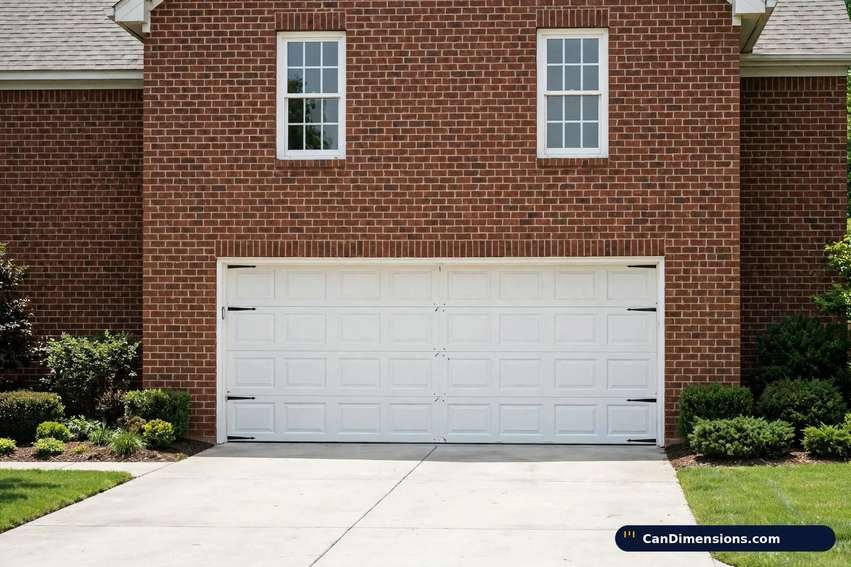
Standard Garage Door Dimensions
Garage door sizes are always written width first, then height: a 9×7 door is 9 feet wide and 7 feet tall. The size names the finished opening, and the door is ordered to match it — Clopay’s installation literature states the rule plainly: the rough opening should be the same size as the door.
The width ladder the major makers stock runs 8, 9, 10, 12, 14, 15, 16 and 18 feet (Clopay’s published stock widths). Seven feet is the standard height across that whole ladder, and 8-foot doors are stocked on the same models for taller openings. Heights are assembled from horizontal sections, and section heights of 18, 21 and 24 inches are the building blocks: a 7-foot door is typically four 21-inch sections, and an 8-foot door four 24-inch sections or a mix.
Standardisation matters for three practical reasons. First, stock sizes are produced in volume, so they undercut custom sizes on price and are usually available without a long lead time. Second, replacement is simple: a stock door swaps into an existing standard opening without reframing. Third, the hardware ecosystem — tracks, springs, weather seal and openers — is engineered and rated around these dimensions, so parts and installers are easy to find years later.
Garage Door Sizes Chart
The chart below collects every standard size in one place. Widths and heights are the door (and opening) sizes; the centimetre column is rounded to the nearest centimetre, with exact conversions in the metric section further down.
| Door type | Size (width × height) | Size in cm | Typically fits |
|---|---|---|---|
| Single-car | 8 × 7 ft | 244 × 213 cm | Compact cars, older and smaller garages |
| Single-car | 9 × 7 ft | 274 × 213 cm | Most sedans, SUVs and mid-size pickups |
| Single-car | 10 × 7 ft | 305 × 213 cm | Full-size trucks, wide mirrors, work vans |
| Single-car, tall | 9 × 8 ft | 274 × 244 cm | Tall SUVs, roof racks, lifted vehicles |
| Double-car | 12 × 7 ft | 366 × 213 cm | Older two-car garages; tight for two modern cars |
| Double-car | 14 × 7 ft | 427 × 213 cm | Two compact or mid-size cars |
| Double-car | 16 × 7 ft | 488 × 213 cm | The standard two-car door |
| Double-car | 18 × 7 ft | 549 × 213 cm | Two full-size trucks or SUVs with room to spare |
| Double-car, tall | 16 × 8 ft | 488 × 244 cm | Two tall vehicles, extra headroom |
| Three-car | 24 × 7 ft | 732 × 213 cm | Three bays behind one wide door |
| RV | 12 × 12 ft | 366 × 366 cm | Class C motorhomes, tall travel trailers |
| RV | 14 × 14 ft | 427 × 427 cm | Class A motorhomes, large fifth wheels |
| Golf cart | 5 × 7 ft | 152 × 213 cm | Golf carts and small utility vehicles |
| Golf cart | 6 × 7 ft | 183 × 213 cm | Carts with canopies, small tractors |
| Commercial | 10 × 10 ft | 305 × 305 cm | Service bays, single delivery vans |
| Commercial | 12 × 12 ft | 366 × 366 cm | Loading docks, box trucks |
Three-car garages often skip the single 24-foot door and pair a 16-foot double with an 8- or 9-foot single instead — the layout question is covered in its own section below.
Single-Car Garage Door Dimensions
For a single-car garage, the classic standard size is 8 feet by 7 feet (width by height). It is the size older homes were framed for, and it still serves compact cars and sedans well, though the margins beside a modern vehicle are modest once mirrors are counted.
Most newer homes are built with 9 feet wide by 7 feet tall single doors, and that extra foot is the size the industry now treats as the default single. It swallows full-size SUVs and pickups without the slow, mirror-folding creep an 8-foot opening can demand, and it leaves working room at the sides when the vehicle is in.
At the top of the single range, 10 feet wide by 7 feet tall gives the most manoeuvring room a one-car opening offers — the comfortable pick for full-size trucks, vans and anyone loading gear past the vehicle daily. It is still a stock width, so it keeps the standard-size price and availability advantages.
Height works the same way. Seven feet is the national standard and clears ordinary cars and SUVs; 8-foot tall doors suit higher ceilings, vehicles carrying roof racks or cargo boxes, and owners who simply want the taller opening. Anything beyond 8 feet leaves the residential single-car ladder and enters the specialty sizes below.

Two-Car Garage Door Dimensions
One wide sectional door is the standard answer for two cars: 16 feet wide, 7 feet tall, spanning the whole opening with room for two vehicles to sit next to each other and still swing their doors. It is the most common door in American residential construction.
In centimetres, that standard door works out to 487.68 cm across — round it to 488 — and 213.36 cm in height. The conversion is worth doing exactly when comparing against manufacturers or suppliers who spec in metric: 16 × 30.48 cm is 487.68, which rounds up to 488, not down to 487.
The stocked alternatives bracket the standard. A 14-foot width serves smaller vehicles or tighter frontages; a 12-foot double survives in older garages but is genuinely tight for two modern cars and is more often used today as an oversized single. An 18-foot door accommodates larger trucks or buys extra manoeuvring room at a higher price. Heights repeat the single-door pattern: 7 feet standard, 8 feet where taller vehicles or ceilings call for it.
Garage Door Dimensions in CM and MM
Every figure below is worked from the exact conversion, 1 foot = 30.48 cm = 304.8 mm. Charts that truncate instead of rounding shave nearly a centimetre off a 16-foot door, which is how the wrong 487 cm figure for a two-car door got into circulation.
| Size | Centimetres | Millimetres | Metres |
|---|---|---|---|
| 7 ft | 213.36 cm | 2,134 mm | 2.13 m |
| 8 ft | 243.84 cm | 2,438 mm | 2.44 m |
| 9 ft | 274.32 cm | 2,743 mm | 2.74 m |
| 10 ft | 304.8 cm | 3,048 mm | 3.05 m |
| 12 ft | 365.76 cm | 3,658 mm | 3.66 m |
| 14 ft | 426.72 cm | 4,267 mm | 4.27 m |
| 16 ft | 487.68 cm | 4,877 mm | 4.88 m |
| 18 ft | 548.64 cm | 5,486 mm | 5.49 m |
| 24 ft | 731.52 cm | 7,315 mm | 7.32 m |
Read across for the common pairings: the standard single at 9×7 ft is 274.32 × 213.36 cm, and the standard double at 16×7 ft is 487.68 × 213.36 cm. Clearances convert too — the 12 inches of headroom a standard track needs is 30.48 cm, and the 3¾-inch sideroom minimum is about 9.5 cm.
Specialty Garage Door Sizes
RV garage doors are sized by the rig, not by the house. The common band runs 10 to 14 feet wide with heights of 12 to 14 feet: 12×12 ft serves most Class C motorhomes and tall trailers, 12×14 ft adds margin, and 14×14 ft is the usual pick for Class A motorhomes and large fifth wheels. Measure the RV’s true height first — roof air conditioners and antennas ride above the body line, and it is that highest point the door has to clear. Doors wider than 14 feet exist for the largest coaches, but they are oversize orders, not the standard band.
Commercial sizes answer to fleets instead of family cars: a 10 feet square door is a common service-bay size, dock doors cluster at 12×12 ft and 12×14 ft with 14×14 ft above them, and warehouse buildings go wider again — doors of 20 feet and more are routine where forklifts and trailers work side by side.
Custom garage doors fill the gaps the ladder leaves. Boat storage is the classic case: a wide boat on its trailer may need something like a 14-foot wide by 10-foot tall opening that no stock pairing matches exactly. Classic car collectors often choose a simple 10-foot wide single door, wide enough to walk a valuable car in and out without holding their breath at the mirrors.
Golf cart garages sit at the other end of the scale. Their doors typically measure 5 to 6 feet wide by 6 to 7 feet tall — 5×7 ft and 6×7 ft are the common pairings — sized for a cart and its canopy rather than a car, and priced accordingly. An 8-foot door on a cart garage is just a small car door doing the job at car-door money.

Garage Door Sizes for Trucks and SUVs
The vehicle fleet has outgrown the 8-foot door. A full-size pickup is roughly six and a half feet wide across the body, and its mirrors push the true span well past seven — through an 8-foot opening that leaves a few inches of grace on each side, every entry becomes a slow-speed threading exercise. The 9-foot single exists precisely for this fleet, and for a truck that is parked daily, it is the sensible minimum; the 10-foot single is the relaxed one.
Height catches a different set of vehicles. Most SUVs and pickups stand under 6 feet 6 inches and clear a 7-foot door without drama — but the measurement that matters is the tallest point as equipped: roof racks, cargo boxes, light bars and lift kits all ride above the catalogue height. A vehicle that measures close to 7 feet as it actually drives deserves the 8-foot door.
The working rule is to measure the vehicle, not the brochure: width mirror to mirror, height at its highest fitted point, and then leave clearance on every side — a hand’s width at the mirrors and a few inches overhead at minimum. Doors are cheap to size up at build or replacement time and expensive to widen later.
One Wide Door or Two Single Doors?
A two-car garage can wear its width two ways: one 16-foot door, or a pair of single doors — two 8×7 or, better, two 9×7 — with a framed post between them. Two 9-foot doors, the post and the side framing together span roughly 20 feet of front wall, still five feet short of 25 feet, and the choice between the layouts is a real one.
The single wide door is cheaper to buy and to automate (one door, one opener), gives an unobstructed opening for awkward loads, and is the default on most new construction. The pair costs more and needs two openers, but each bay opens independently — one car can leave without exposing the whole garage — a failure strands one bay instead of both, and the centre post gives the front wall structure that very wide openings have to engineer around. Paired singles also let each bay be sized to its vehicle: a 9-foot door for the truck, an 8-foot door for the compact.
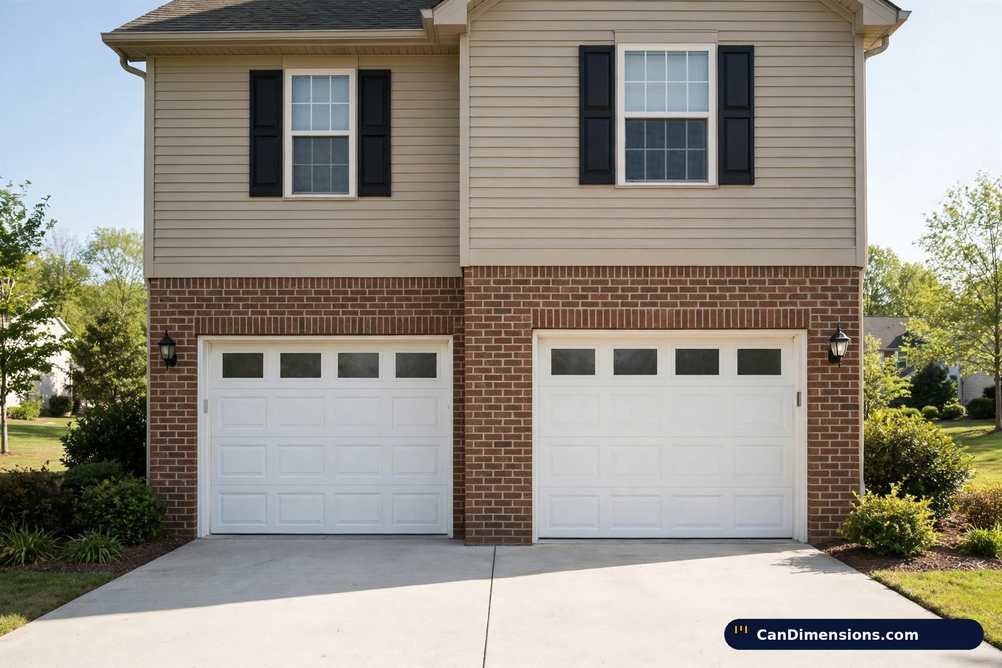
How to Measure Your Garage Door Opening
Accurate measurement prevents costly installation problems, and it takes five dimensions: width, height, headroom, sideroom and backroom. Use a steel tape measure for all of them — cloth tapes stretch and quietly invent fractions.
For width, stretch the tape across the opening so it touches the inner face of each side jamb; take the reading at floor level and again partway up, and let the smaller figure govern. Measure the height from the garage floor to the underside of the header at three points — left, centre and right — and use the smallest number, because garage floors commonly slope for drainage and the door seals against the high side. The opening you measure is the size you order: the rough opening should be the same size as the door.
Headroom is the clear space between the top of the opening and the ceiling or its lowest obstruction. Clopay’s published requirements put standard track at 12 inches of headroom with a torsion spring system and 10 inches with extension springs, and a trolley-style opener needs a further 2 to 3 inches on top of either figure. Where headroom runs short, low-headroom track systems work down to roughly 4½ inches; where the door is meant to hug a high ceiling, high-lift track needs the lift height plus about 9½ inches. There is no single headroom number — the spring and track system sets it.
Sideroom is the clear wall space on each side of the opening, where the vertical tracks mount. Clopay’s installation manual sets the minimum at 3¾ inches on each side (5½ inches for its EZ-Set extension spring hardware) — measure from the edge of the opening to the nearest wall, shelf or pipe, not to where the wall happens to end on the plan.
Backroom, the dimension checklists most often forget, is the clear depth from the opening straight back into the garage: the horizontal tracks and the raised door have to fit inside it. Clopay calculates residential backroom as the door height plus 18 inches — 8 feet 6 inches for a 7-foot door — with more needed once an opener’s rail and motor go in. Measure it to the first obstruction, not to the back wall on paper.

FAQ’s
What are standard garage door dimensions?
Single-car doors: 8×7, 9×7 and 10×7 ft. Double-car doors: 16×7 ft as the standard, with 14×7 and 18×7 ft stocked either side. Eight-foot heights are stocked alternatives at every width.
What is the size of a 2 car garage door?
16 feet wide by 7 feet tall is the standard. Wider 18-foot and narrower 14-foot versions are stock sizes too, and both 7- and 8-foot heights are offered.
How many centimeters is a 2 car garage door?
487.68 cm wide by 213.36 cm tall — about 488 × 213 cm. (16 ft × 30.48 = 487.68; the figure is often truncated to 487, which is a rounding error.)
What is the size of a 1.5 car garage in feet?
Usually a 12×7 ft door; the type spans 12 to 14 feet in width at a 7-foot height. Inside, the garage itself runs about 14 to 16 feet wide — one vehicle plus storage or a workbench.
What’s better, a 1¼ or ¾ garage door opener?
Neither, as a blanket rule — the springs counterbalance the door, so the opener moves only a fraction of its weight. By LiftMaster’s published guidance, ½ HP covers most single doors and doors up to roughly 300 lb, ¾ HP handles heavy doubles up to roughly 500 lb, and 1¼ HP is a top-tier rating for the heaviest carriage-house doors. There is no 200 lb rule.
How wide is a normal 2 car garage?
About 20 feet wide by 20 feet deep is the conventional two-car footprint, giving roughly 18 to 20 feet of interior width once walls are counted. Many newer garages run 22 to 24 feet in one or both directions for storage and door swing.
What is the most common garage size?
For the door, 16×7 ft. For the garage itself, the 20×20 ft two-car footprint — about the floor area of a large living room doubled — is the size American builders have repeated most.
Are most doors 32 or 36 inches?
That question belongs to entry doors, not garage doors: the standard residential entry door is 36 inches wide (32 inches is a common interior and secondary-door width). Garage doors are sized in feet — 8 to 18 of them.
What is the size of a standard garage door in meters?
A single-car door at 9×7 ft equals 2.74 metres wide by 2.13 metres tall. A double-car door at 16×7 ft measures 4.88 metres wide by 2.13 metres tall.
Conclusion
Standard garage door dimensions run from the 5-foot golf-cart door to the 24-foot three-car door, but the chart’s centre of gravity never moves: 9×7 ft for a single bay on a newer home, 8×7 ft on an older one, and 16×7 ft for two cars. Every one of those is a stock size at every major maker, which is why they anchor the chart — volume production keeps them cheaper, quicker to get and easier to service than any custom cut.
Measure the opening before anything is ordered — width, height at three points, headroom, sideroom and backroom — and size the door to the vehicle as it actually drives, mirrors and roof gear included. The last detail to get right is the hardware the size commits you to: the spring system above the door, most often a torsion spring counterbalancing the door’s weight, is specified from the door’s dimensions and weight, so a door ordered to the chart is a door whose springs, tracks and opener all match it.