Miles to Steps Calculator: How Many Steps in a Mile, by Height and Pace
A good miles to steps calculator should tell you where its numbers come from, so here is the short version first: one mile walked at an average pace takes about 2,252 steps — the average actually measured in the best-known treadmill study of the question — and your own figure moves up or down from there with your height and your pace.
That range is the honest part most calculators skip. A 5-foot walker can take around 2,550 steps to cover a mile while a 6-foot-4 walker takes about 2,010, and running the same mile can cut the count to roughly 1,670 or fewer. There is no single exact number, and any tool that prints one without its basis is hiding the interesting part.
This page shows the working. You will find the full conversion chart for common distances at every pace, the study the standard figures come from, a steps-per-mile table computed openly from your height, and the simple method for measuring your own step length so the conversion fits you instead of an average stranger.

Miles to Steps Conversion Chart: Common Distances at Every Pace
Every figure in this chart is built from one measured set of averages: the steps-per-mile counts recorded by Hoeger and colleagues in ACSM’s Health & Fitness Journal (2008), who put walkers and runners on a treadmill and counted a full mile at six set paces. The per-mile averages are 2,252 steps at an average walk, 1,935 at a brisk walk, 1,951 jogging, 1,672 running, 1,400 at a fast run and 1,080 at a very fast run — the study section below gives the source, the men-and-women splits, and one famous oddity in those numbers. The chart simply multiplies.
| Miles | Average Walk (3 mph) | Brisk Walk (4 mph) | Jog (5 mph) | Run (6 mph) | Fast Run (7.5 mph) | Very Fast Run (10 mph) |
|---|---|---|---|---|---|---|
| 0.5 | 1,126 | 968 | 976 | 836 | 700 | 540 |
| 1 | 2,252 | 1,935 | 1,951 | 1,672 | 1,400 | 1,080 |
| 2 | 4,504 | 3,870 | 3,902 | 3,344 | 2,800 | 2,160 |
| 3 | 6,756 | 5,805 | 5,853 | 5,016 | 4,200 | 3,240 |
| 5 | 11,260 | 9,675 | 9,755 | 8,360 | 7,000 | 5,400 |
| 10 | 22,520 | 19,350 | 19,510 | 16,720 | 14,000 | 10,800 |
Half-mile figures are the per-mile averages halved and rounded, which is why the brisk and jog columns read 968 and 976 rather than exact halves. Everything else is the per-mile figure times the distance — no hidden rounding, and the same arithmetic the calculator section below walks through for an individual height.
Going the other way — steps to miles — the same averages divide instead of multiply. At the average-walk figure of 2,252 steps per mile, 10,000 steps is 4.44 miles. At the textbook 2.5-foot step (2,112 steps per mile, the basis explained in the height section), it is 4.73 miles. Both are printed here because both circulate, and the gap between them is exactly the stride-length question this page keeps returning to:
| Steps | Miles at 2,252 steps/mile (study average walk) | Miles at 2,112 steps/mile (2.5 ft step) |
|---|---|---|
| 1,000 | 0.44 | 0.47 |
| 5,000 | 2.22 | 2.37 |
| 7,500 | 3.33 | 3.55 |
| 10,000 | 4.44 | 4.73 |
| 15,000 | 6.66 | 7.10 |
| 20,000 | 8.88 | 9.47 |
So the famous claim that 10,000 steps equals 5 miles is true only at a rounded 2,000 steps per mile — a step of 2.64 feet, longer than most people walk. For an average walker it is closer to four and a half miles, and the reverse chart is the honest version of that slogan.
🏃 Miles to Steps Calculator
The calculator this page is built around takes five inputs, and each one earns its place. Distance (Miles) is the number being converted. Height (inches) is what personalises the answer, because step length scales with height. Gender selects between two very close step-length factors. Pace adjusts the step length for speed, from an average walk to a very fast run. Weight (lbs) – for Calories feeds only the calorie estimate, never the step count.
Underneath, the arithmetic is one division. A mile is exactly 5,280 feet — 63,360 inches. Your step length is estimated from your height using the regression factors published for the American College of Sports Medicine method: height in inches times 0.413 for women, times 0.415 for men. Steps per mile is then 63,360 divided by that step length, lengthened by a pace factor at faster paces, and total steps is steps per mile times your distance.
Two worked examples show what the inputs actually do. A woman who is 5 feet 6 inches (66 inches) has an estimated step of 66 × 0.413 = 27.26 inches, so she takes 63,360 ÷ 27.26 = about 2,324 steps per walking mile — and a 3-mile walk comes out at about 6,973 steps. A man who is 5 feet 10 inches (70 inches) has a step of 70 × 0.415 = 29.05 inches, takes about 2,181 steps per mile, and covers the same 3 miles in about 6,543 steps. Same distance, same pace setting, 430 steps apart — that gap is height, and it is why a calculator asks for yours instead of printing one number for everyone.
Notice what those examples also show: the height-based result (2,324) is not the study average in the chart (2,252), and neither is wrong. The chart’s 2,252 is what a mixed group of real walkers averaged on a treadmill; the formula’s 2,324 is what the height regression predicts for one specific walker. Averages describe groups. The formula describes you, approximately — and measuring your own step, covered below, describes you best.
Your Results
The results panel returns four numbers. Total Steps is the headline: your distance times your personalised steps per mile, rounded to a whole step. Steps per Mile shows that personalised rate itself, so you can see the assumption your total rests on and compare it with the study averages in the chart — if your rate sits far outside the roughly 2,000-to-2,500 walking range, it is worth re-measuring rather than trusting. Estimated Time is distance divided by the pace’s speed — 20 minutes per mile at an average walk, 15 at a brisk walk, down to 6 minutes per mile at the fastest setting — with no allowance for hills, crossings or tired legs.
Calories Burned is the roughest of the four, and it should be read as an estimate with the widest error bars. The standard method multiplies a MET value (the energy cost of the pace, where 1 MET is resting) by your weight in kilograms by the hours spent: at 3.5 METs, a 150 lb (68 kg) walker out for one hour gets 3.5 × 68 × 1 = about 238 kcal. Change the MET table the tool draws from and the answer moves, which is why two calculators given the same walk can disagree on calories while agreeing exactly on steps.
Quick Reference Table (Average Walk)
For the single most common question — a plain walk, no height or pace adjustments — the reference table is the study average applied straight: 2,252 steps per mile, multiplied out. It is the fastest answer on this page and the right one for a rough plan.
| Miles | Steps |
|---|---|
| 1 | 2,252 |
| 2 | 4,504 |
| 3 | 6,756 |
| 5 | 11,260 |
| 10 | 22,520 |
Every row checks: 2,252 × 2 = 4,504, × 3 = 6,756, × 5 = 11,260 and × 10 = 22,520. If you need a distance that is not listed, the full chart at the top of this page extends the same multiplication to half miles and to all six paces, and the height table below adjusts it to your legs.

Steps per Mile by Pace: What the Treadmill Study Actually Measured
The pace figures used across this page — and, usually without credit, across most of the internet — come from one study: Hoeger, Bond, Ransdell, Shimon and Merugu, “One-Mile Step Count at Walking and Running Speeds,” published in ACSM’s Health & Fitness Journal in 2008. Forty-four participants walked a treadmill mile at two speeds and about thirty-four ran at four speeds while a pedometer counted. These are the averages it recorded, with the splits the summaries usually drop:
| Pace | Speed | All participants | Women | Men |
|---|---|---|---|---|
| Average walk | 20 min/mile (3 mph) | 2,252 | 2,310 | 2,176 |
| Brisk walk | 15 min/mile (4 mph) | 1,935 | 1,987 | 1,868 |
| Jog | 12 min/mile (5 mph) | 1,951 | 1,979 | 1,919 |
| Run | 10 min/mile (6 mph) | 1,672 | 1,709 | 1,635 |
| Fast run | 8 min/mile (7.5 mph) | 1,400 | 1,469 | 1,360 |
| Very fast run | 6 min/mile (10 mph) | 1,080 | 1,213 | 1,064 |
Two things in that table deserve attention. The first is the oddity in the middle: jogging a mile (1,951 steps) averages slightly more steps than brisk-walking one (1,935). Copied from site to site, that pair is often “corrected” by people who assume a typo, but it is what the study measured — at the walk-to-jog transition the gait changes before the step has lengthened much, so a slow jog and a fast walk land at about the same count. The safe reading is that the two paces are effectively tied, not that one precisely beats the other.
The second is the labels. The study’s paces are set in minutes per mile, and the fast run’s 1,400 steps belong to an 8-minute mile — 7.5 mph. Tools that copy the table sometimes relabel that row “8 mph,” which is a different, faster pace (a 7:30 mile) that would take fewer steps again. Every speed in the table above is printed in both units so the two cannot be welded together.
The limits of the study matter as much as its numbers. The participants were young (average age about 27) and of normal weight, the miles were walked and run on a treadmill — where steps tend to run a little shorter than over ground — and at the fastest pace only nine runners, including a single woman, contributed, which is why that row’s women’s figure rests on one person’s mile. Treat the table as the best-measured averages available, not as constants of nature.
Steps per Mile by Height: Taller Walkers Take Fewer, Longer Steps
Height is the strongest everyday predictor of steps per mile, because legs are levers: a taller walker’s step is longer, so fewer of them fit into 5,280 feet. The table below is computed, not copied — every row is the formula from the calculator section applied openly: step length = height × 0.413 (women) or × 0.415 (men), then steps per mile = 63,360 ÷ step length, rounded to a whole step. It assumes an ordinary walking pace; use the pace chart to adjust for speed.
| Height | Women’s step | Women’s steps/mile | Men’s step | Men’s steps/mile |
|---|---|---|---|---|
| 5’0″ (60 in) | 24.78 in | 2,557 | 24.90 in | 2,545 |
| 5’2″ (62 in) | 25.61 in | 2,474 | 25.73 in | 2,462 |
| 5’4″ (64 in) | 26.43 in | 2,397 | 26.56 in | 2,386 |
| 5’6″ (66 in) | 27.26 in | 2,324 | 27.39 in | 2,313 |
| 5’8″ (68 in) | 28.08 in | 2,256 | 28.22 in | 2,245 |
| 5’10” (70 in) | 28.91 in | 2,192 | 29.05 in | 2,181 |
| 6’0″ (72 in) | 29.74 in | 2,131 | 29.88 in | 2,120 |
| 6’2″ (74 in) | 30.56 in | 2,073 | 30.71 in | 2,063 |
| 6’4″ (76 in) | 31.39 in | 2,019 | 31.54 in | 2,009 |
Read it by differences. Each extra inch of height takes roughly 30 steps off a walking mile, so the spread from the shortest row to the tallest is more than 500 steps — a quarter of a mile’s worth of counting over a single mile. The women’s and men’s columns, by contrast, nearly touch: at the same height the two factors differ by only about 11 steps per mile, because the factors themselves differ by just 0.002. Height does the real work; the gender setting is a fine adjustment, which is why the study averages show a bigger men-versus-women gap (2,176 against 2,310 at a walk) — in the study, the men were on average taller.
This table is also where the familiar round numbers come from. The “about 2,000 steps a mile” rule assumes a step of 2.64 feet — the bottom rows of this table, a tall walker’s step. The “2.5-foot average step” behind the 2,112 figure is 30 inches, a step length nobody in the middle rows of the table actually has: at 5’6″ the formula gives about 27.3 inches. Neither rule is a lie; both are one row of this table pretending to be the whole of it.

How to Measure Your Own Step Length (and Why It Beats Any Calculator)
Every figure so far is an average or a regression. Your own step length is measurable in about two minutes, and once you have it, every conversion on this page becomes personal: steps per mile = 63,360 ÷ your step in inches, and miles = steps × your step ÷ 63,360.
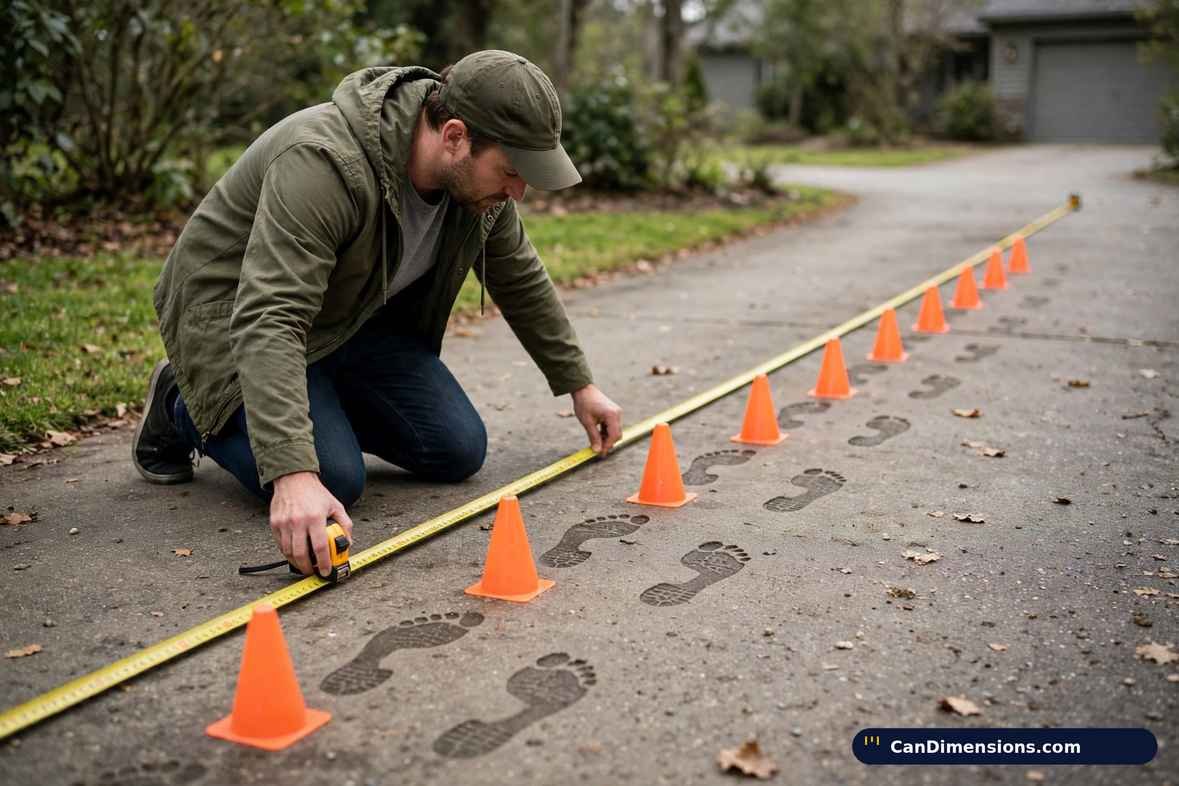
The reliable method uses a known distance. Mark out a straight, flat stretch — ten natural steps cover roughly 25 feet for most adults, so a driveway or a quiet stretch of sidewalk works. Walk it at your normal pace, counting ten steps, then measure from the toe of your first step to the toe of your tenth and divide by ten. Repeat it two or three times and average: a single ten-step sample wobbles, three samples settle. For a running step, do the same at a jog on a track or a measured block, and keep the two numbers separate — a running step is a different length, not a faster walking step.
Two cautions keep the measurement honest. Count steps the way a tracker counts them: one step is one footfall, heel of one foot to heel of the other. In careful biomechanics language that distance is a step length, while a stride is the full cycle of the same foot — two steps — but calculators and trackers almost universally work in the one-footfall unit, and so does every table on this page. Mixing the two definitions is the single easiest way to halve or double a conversion. And measure at the pace you actually walk: step length grows with speed, which is the entire reason the pace chart exists.
Once measured, your number also calibrates the device on your wrist. A phone or watch that knows your step length turns its step count into distance; one working from a default is quietly using somebody else’s legs. Good step counters count steps themselves accurately to within a few percent — the distance error enters almost entirely through the step-length assumption, which is the part you have just fixed.
FAQs
How many steps are in a mile?
About 2,252 walking at an average pace — the measured average from the ACSM treadmill study — with most adults falling between roughly 2,000 and 2,500 depending on height. Taller walkers sit at the low end, shorter walkers at the high end, and runners take far fewer: about 1,672 at a 6 mph run.
How many steps are in 3 miles, 5 miles and 10 miles?
At an average walk (2,252 steps per mile): 6,756 steps in 3 miles, 11,260 in 5 miles and 22,520 in 10 miles. At a brisk walk the same distances take 5,805, 9,675 and 19,350. The full chart at the top of this page covers every pace.
How many miles is 10,000 steps?
About 4.4 miles at the study’s average walking rate (2,252 steps per mile), about 4.7 miles at a 2.5-foot step, and exactly 5 miles only at a rounded 2,000 steps per mile — a 2.64-foot step, longer than most people walk. For most walkers, “10,000 steps is 5 miles” overstates the distance.
Is 2,000 steps really a mile?
Only if your step is 2.64 feet (about 31.7 inches) long — roughly the step of a walker over six feet tall. At the measured average step it takes about 2,252 steps to make a mile, so 2,000 steps is about 0.89 of a mile for an average walker.
Why do shorter people take more steps per mile?
Because step length scales with height: the standard estimate is height × 0.413 for women and × 0.415 for men, so a shorter walker covers less ground per step and needs more of them to reach 5,280 feet — roughly 30 more steps per mile for every inch shorter.
Do you take fewer steps when you run a mile?
Yes. Running lengthens the step, so the count falls as speed rises: the study averages drop from 2,252 steps walking to 1,951 jogging, 1,672 at a 6 mph run and 1,080 at a 10 mph run. The one wrinkle is the walk-to-jog transition, where a slow jog (1,951) counts about the same as a brisk walk (1,935).
How accurate is a miles to steps calculator?
It is an estimate built on averages: the pace figures are group averages from one treadmill study, and the height formula is a regression, so an individual result can sit 5–15% away from your true count. Measuring your own step length over a known distance, as described above, removes most of that error; what remains is your tracker’s own counting error.
Conclusion
A mile is a fixed 5,280 feet; everything else about converting it to steps is a statement about your legs and your pace. The measured anchors are solid — 2,252 steps at an average walk, 1,935 brisk, 1,672 at a 6 mph run, all counted on a treadmill in the 2008 ACSM study — and the height formula (step = height × 0.413 or 0.415; steps per mile = 63,360 ÷ step) adjusts those anchors to you with its arithmetic in the open. What no honest calculator can do is print one exact number for everybody: the spread between a short walker and a tall runner is more than two to one.
Use the chart for planning, the formula for a personal estimate, and a two-minute measurement for the real thing. Set your tracker with your measured step, and the humble pedometer on your wrist stops reporting somebody else’s mile and starts reporting yours.