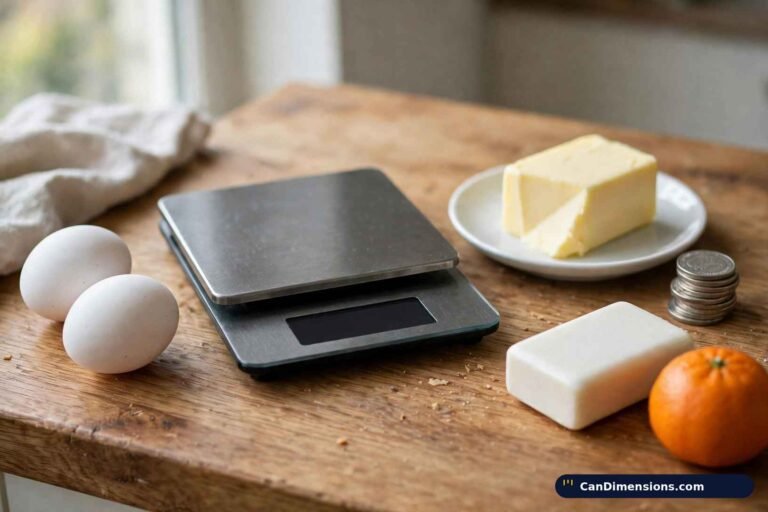
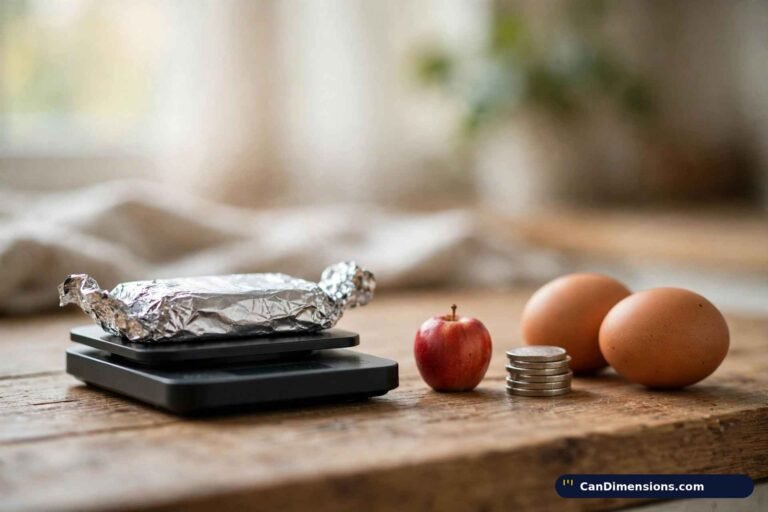
2mm: 15 Most Common Things That Are 2mm in Size
So, how big is 2mm? It is a very small measurement — exactly 0.2 centimetres, or 0.0787 inches. The easiest way to picture it is the edge of a coin: a US nickel is 1.95mm thick, so 2mm is a hair more than the thickness of the nickel in your pocket.
A measurement this small turns up in surprising places. It is the grout gap between bathroom tiles, the lead inside a drafting pencil, the neoprene of a summer wetsuit and the sparkle of a tiny gemstone. People usually meet 2mm when a product spec, a craft project or a coin leaves them guessing at the real size.
This guide pins the size down properly. You will find the exact conversions, 15 real things that measure 2mm with every size checked against a maker, a standard or an official specification, the near-misses that only look like 2mm, and the simple ways to measure it with tools you already own.
How Big Is 2mm? Exact Measurement
Two millimetres is exactly two one-thousandths of a metre. In the units most people switch between, it is 0.2 centimetres, 0.002 metres and 2,000 micrometres. In imperial terms it is 0.07874 inches. There is no exact inch fraction for it: the nearest sixty-fourth is 5/64 of an inch, which works out to 1.984mm — just under 2mm, and close enough for woodwork but not for engineering.
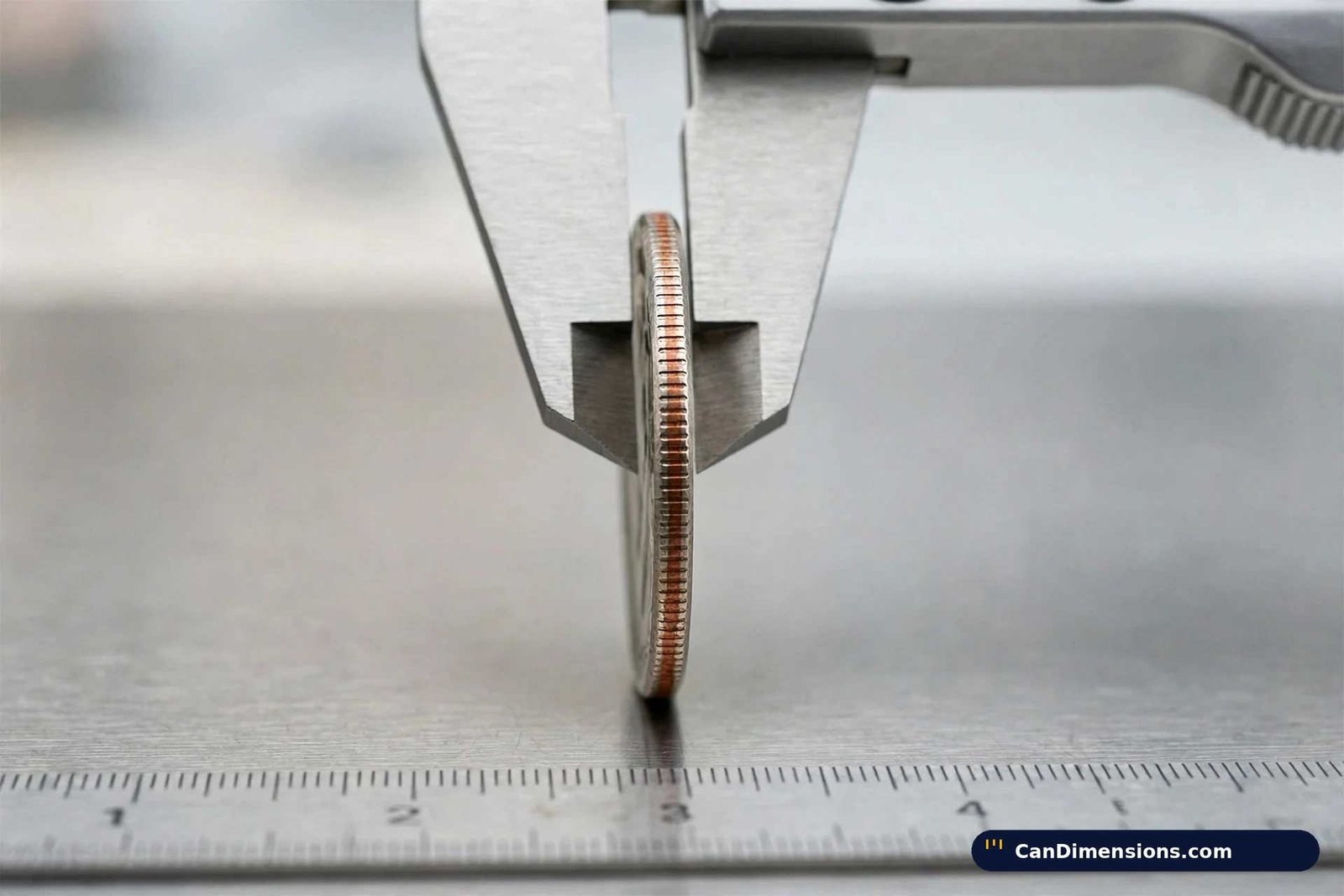
The fastest honest reference is a coin. A US nickel measures 1.95mm thick on the US Mint’s specification, so its edge is 2mm to within a twentieth of a millimetre. A US dollar coin is even better: the Mint lists its thickness at exactly 2.00mm.
Cards give a second bracket. A credit card is 0.76mm thick under the ISO/IEC 7810 standard, so two stacked cards make 1.52mm and three make 2.28mm. Two millimetres sits between the two stacks, at about two and two-thirds cards.

How long is 2mm?
| Unit | 2mm equals |
|---|---|
| Millimetres | 2 mm |
| Centimetres | 0.2 cm |
| Metres | 0.002 m |
| Micrometers | 2,000 µm |
| Inches | 0.0787 in |
| Feet | 0.00656 ft |
| Yards | 0.00219 yd |
15 Most Common Things That Are 2mm In Size
Each item below was checked against a real source — a mint specification, an international standard, a manufacturer’s size or a retailer’s labelled product. Items sold or made to a 2mm size are exact. Natural items and coins a fraction under the mark are counted honestly as “about 2mm”, with their true figure printed.
| Thing | Its 2mm dimension | Exact or about |
|---|---|---|
| 2mm lead-holder lead | 2mm diameter | Exact |
| US nickel | 1.95mm thick | About |
| Yellow mustard seed | Up to 2mm across | About |
| 2mm tile spacer | 2mm grout gap | Exact |
| Little black ant worker | 1.5–2mm long | About |
| Matchstick | 1.9–2mm thick | About |
| US dollar coin | 2.00mm thick | Exact |
| 2.0mm guitar pick | 2.0mm gauge | Exact |
| 2mm hex key | 2.00mm across flats | Exact |
| 2.0mm drill bit | 2.0mm diameter | Exact |
| 2mm wetsuit | 2mm neoprene | Exact (labelled) |
| 2mm craft foam sheet | 2mm thick | Exact (labelled) |
| Picture-frame glass | 2mm nominal thickness | About |
| 2.0mm knitting needle | 2.0mm diameter | Exact |
| 2mm calibrated gemstone | 2.0mm across | Exact |
A Pencil Lead — The Artist’s Most Familiar 2mm Reference
The 2mm pencil lead is real, but it needs one honest correction. The fat 2mm lead belongs to a lead holder — the metal clutch pencil that drafters and sketchers use — and makers such as Staedtler sell the refills at exactly 2mm (their Mars carbon 200 box). The click pencil in a school bag is different: its leads are 0.5mm or 0.7mm, a quarter of the size.
So the counted item is the lead-holder lead itself: a graphite rod exactly 2mm across, about as thick as the lead inside a traditional wooden pencil, which is why artists like it. It can be sharpened to a needle point for detail or used on its side for broad shading — something no 0.5mm lead can do.

A U.S. Nickel Coin — 2mm You Can Pull From Your Pocket
The US Mint’s specification gives the nickel a thickness of 1.95mm, a diameter of 21.21mm and a weight of exactly 5.000 grams, in 75% copper and 25% nickel. That makes its edge the closest everyday object to 2mm that most people own — five hundredths of a millimetre under the mark.
The nickel earns its keep twice over. Stand it on its edge and you have the 2mm reference; put two nickels on a kitchen scale and you also know how much is 10 grams, because the pair weighs exactly 10.000 grams by the same Mint specification.
A Mustard Seed — Nature’s Tiny 2mm Powerhouse
Mustard seed is the natural world’s favourite small-size comparison, and the honest figure is a range: mustard seeds run from about 1mm to 2mm across, depending on the type. Brown and black seeds sit at the small end, around 1 to 1.5mm. The pale yellow seed is the biggest, commonly 1.5 to 2mm, so the largest yellow seeds genuinely reach 2mm.
One comparison often printed with the seed needs correcting. A single grain of sand is not “typically 2mm”: sand grades run from very fine grains of a fraction of a millimetre up to 2mm at the very top of the scale, and anything larger is classed as granules. The seed reaches 2mm; a typical sand grain does not.
A Ceramic Tile Spacer — The 2mm Tool Behind Flawless Floors
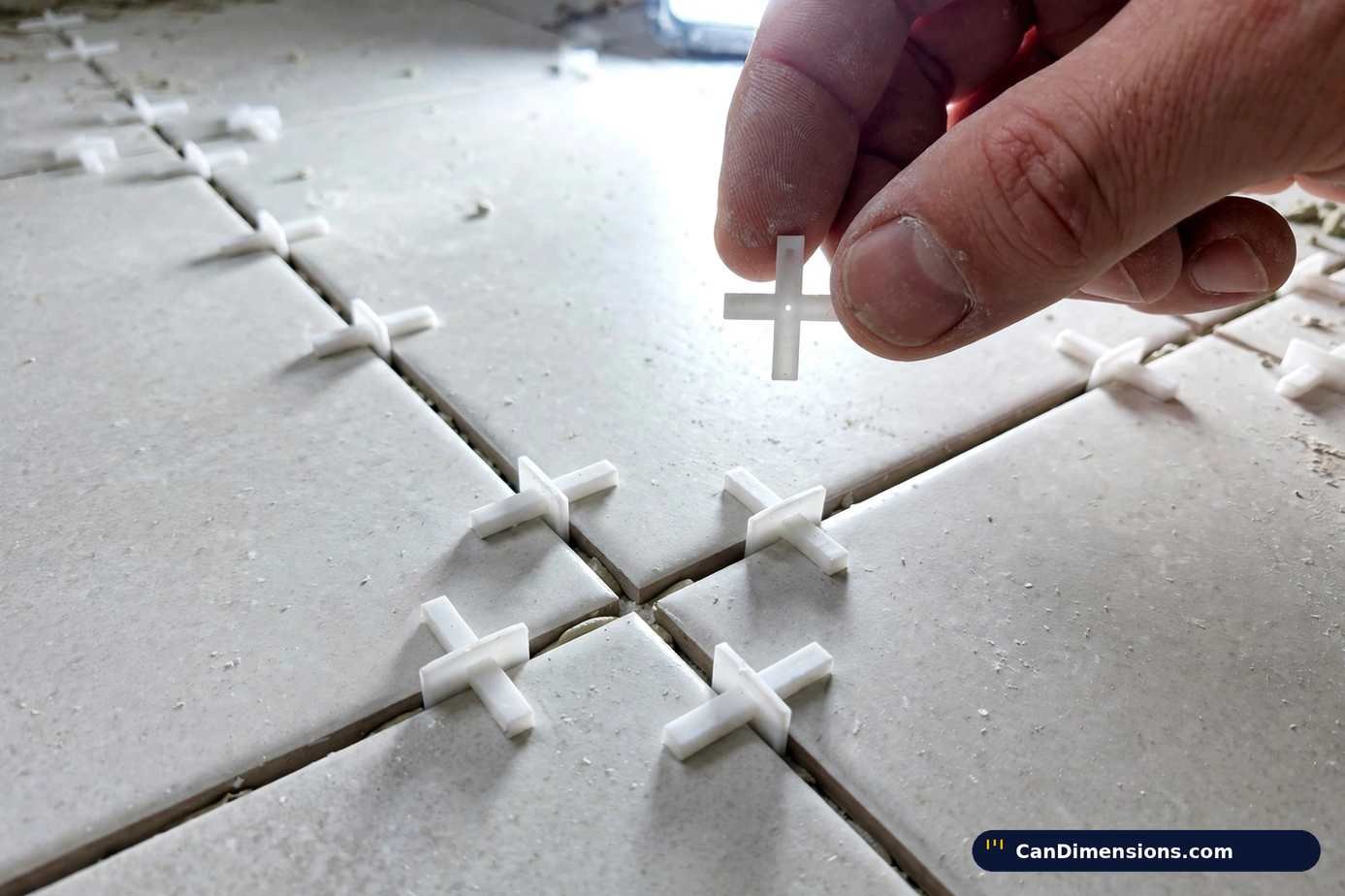
A tile spacer is the rare household object whose 2mm is its entire job. The little plastic crosses and T-pieces are moulded to a labelled size — 2mm spacers from makers such as RUBI are a standard shelf item — and the width of the cross sets the grout gap between the tiles at exactly that figure.
That is why tilers trust them more than eyeballing: a 2mm spacer cannot drift. If you want to see what 2mm looks like as a gap rather than a thickness, the space a 2mm spacer leaves between two tiles is the clearest example in the home.
A Small Ant — A Living, Moving 2mm Measurement
The small ant that fits this page is a named species: the little black ant. Its workers measure about 1.5 to 2mm long, which is why pest-control and university extension guides use the species to teach identification — a shiny black ant at the very top of that range is a full 2mm of insect.
Treat the label with care, because “small ant” covers hundreds of species of different sizes. The verified claim is narrower and stronger: a large little-black-ant worker, head to tail, is about 2mm long. The queens of the same species, at 4 to 5mm, are more than double the mark.
A Matchstick — 2mm of Potential in Every Strike
A matchstick’s thickness is set by standards, not guesswork. The safety-match specifications used internationally (the CARICOM and East African standards among them) set the wooden splint’s width and thickness at a minimum of 1.9mm, with a tenth of a millimetre tolerance — which puts a standard matchstick at 1.9 to 2mm thick, with the familiar square cross-section of roughly 2mm by 2mm.
The same standards set the splint’s length at 40mm or more, which is why box matches feel uniform. So a matchstick gives you 2mm in two directions at once: pick one up and its thickness and width are both the size this page is about.
A U.S. Dollar Coin — Exactly 2.00 mm Thick
Here is the exact one. The US Mint’s specification for the dollar coin — the golden-coloured coin of the Sacagawea and Presidential series — lists its thickness at exactly 2.00mm, with a diameter of 26.5mm and a weight of 8.1 grams. No “about” is needed: of all the coins in American pockets, the dollar is the one that is precisely 2mm thick.
It is less common in change than the nickel, which is why the nickel stays the everyday reference. But for a true 2.00mm edge, the dollar coin is the verified champion of this list.
A 2.0mm Guitar Pick — The Thick Pick Players Reach For
Guitar picks are sold by gauge, and 2.0mm is a standard heavy gauge. Dunlop’s Gator Grip range, one of the most widely stocked pick lines in the world, tops out at a 2.0mm pick (model 417P200), and its Big Stubby line is also sold at 2.0mm.
A 2mm pick is a serious piece of plastic: it barely flexes, which is why bass players and heavy strummers favour it. If a guitarist hands you their thickest pick, you are very likely holding 2mm between your fingers.
A 2mm Hex Key — The Small Allen Wrench in Every Set
A hex key is sized by the distance across the flats of its hexagonal bar, and 2mm is one of the standard metric sizes defined by ISO 2936. The standard holds a 2mm key to 2.00mm across the flats, within two hundredths of a millimetre. It is the key that fits M3 socket screws, and it appears in nearly every metric Allen key set sold — Bondhus and Würth both list it as a stock size.
There is a neat coincidence here: the nearest inch key, 5/64, measures 1.984mm — the same nearest-fraction figure as 2mm itself in inches. The two systems meet at this size.
A 2.0mm Drill Bit — A Standard Workshop Diameter
Drill bits are made to exact diameters, and 2.0mm is a standard size in the DIN 338 jobber range. Bosch sells its HSS-G bit at a cutting diameter of 2 millimetres, Milwaukee lists a 2mm hex-shank bit, and Dormer’s A002 bit is specified at a 2.00mm tip diameter.
Unlike most things on this page, the bit’s 2mm is the working dimension itself: the hole it drills is 2mm wide. A bit this fine is used for pilot holes, model work and electronics, and it is one of the easiest 2mm objects to find in a toolbox.
A 2mm Wetsuit — Warm-Water Neoprene
Wetsuits are sold by neoprene thickness, and 2mm is the standard warm-water rating. BARE’s REVEL shorty springsuit is specified at 2mm, O’Neill’s Reactor-2 spring suit lists an item thickness of 2 millimetres, and the brand’s 2mm Hyperfreak line is a staple of surf shops.
The number is the thickness of the rubber that keeps the swimmer warm, so a 2mm suit is literally a wearable sheet of this page’s measurement. In water of about 22°C (72°F) and above, that thin layer is all most swimmers need.
A 2mm Craft Foam Sheet — The Cosplay and Classroom Staple
EVA craft foam is sold in labelled thicknesses, and 2mm is the most common sheet of all — the foam paper of school craft packs and the base layer of cosplay armour builds. Retailers stock it by the roll and by the sheet at exactly 2mm, in dozens of colours.
Foam is soft, so treat the figure as the maker’s labelled thickness rather than a machined dimension. But as a sheet you can hold, cut and bend, it is the most touchable 2mm on this list.
Picture-Frame Glass — Standard 2mm Float Glass
The glass in an ordinary picture frame is a standard product: 2mm float glass, one of the stock thicknesses the glass industry manufactures and the usual choice for frames and light display work. One honest footnote — float glass is made to a nominal thickness, and a sheet sold as 2mm typically measures about 1.9mm within its manufacturing tolerance.
That makes frame glass an “about 2mm” that you probably already own. It is also a useful reminder that at this size, a tenth of a millimetre is the difference between a nominal label and a measured one.
A 2.0mm Knitting Needle — US Size 0
Knitting needles are sized by the diameter of the shaft, and the standard conversion charts — the Craft Yarn Council’s reference among them — set US size 0 at exactly 2.0mm (old UK size 14). Makers such as KnitPro print the same pairing.
A 2.0mm needle is a fine one, used for lace and sock work, and its diameter is the stitch size itself. Any knitter’s needle gauge will confirm it: the 2.0mm hole is the one the needle just slips through.
A 2mm Gemstone — A Calibrated Melee Stone
Jewellers cut small round stones to calibrated millimetre sizes, and 2.0mm is a standard one. Diamond size charts put a 2.0mm round brilliant at about 0.03 carats, and the trade’s sieve plates sort 2mm rounds as a recognised grade — the tiny accent stones, called melee, that ring a larger centre stone in a halo setting.
So the smallest-looking item on this page is also one of the most precise: a calibrated 2mm stone is cut to that diameter on purpose, and priced by it.
Is 2mm Big? The Size in Context
No — and the numbers show why. Two millimetres is one fifth of a centimetre, so five 2mm thicknesses stacked make a single centimetre, and five hundred of them make a metre. Against the body it is small but visible: roughly twenty human hairs laid side by side, or the thickness of the coin edge you can feel with a fingertip but struggle to read on a ruler.
Its importance is out of proportion to its size. At 2mm, grout lines look crisp, a wetsuit stays flexible, a gemstone catches light, and a drill bit makes a hole that a screw thread can bite into. Small is not the same as trivial.
How to Visualize 2mm Without a Ruler
| Trick | What to use | How close it is |
|---|---|---|
| The nickel edge | Any US nickel | 1.95mm — within 0.05mm |
| The card bracket | Two, then three stacked credit cards | 1.52mm and 2.28mm — 2mm sits between |
| The grout gap | A 2mm tile spacer or an existing grout line | Exactly 2mm by design |
| The pick test | A heavy 2.0mm guitar pick | Exactly 2.0mm by gauge |
| Count the marks | Any metric ruler’s smallest divisions | Each mark is 1mm — count two |
Start with the nickel. If no coin is handy, the card bracket is the next best thing: two cards are clearly less than 2mm, three are clearly more, and the truth sits between them.
How to Measure 2mm Accurately
On a metric ruler, 2mm is simply two of the smallest divisions — every millimetre mark is 1mm, so count two. Read at eye level to avoid parallax, and measure the item against the marks rather than the ruler’s worn end.
For anything that must be right, use a digital caliper, which reads to a hundredth of a millimetre and settles in seconds what a ruler leaves to eyesight. A drill-bit gauge or the shank of a known 2.0mm bit works as a workshop stand-in, and a stack of coins gives a rough check: a nickel is 1.95mm, a dollar coin exactly 2.00mm.
Once the small end of the scale feels familiar, the larger sizes fall into place — our guide to 3 inches shows what the next order of size looks like in everyday objects.

2mm vs 1mm and 3mm: The Sizes Either Side
Doubling and halving puts 2mm in its place. One millimetre is 0.0394 inches — thinner than any US coin — while 3mm is 0.1181 inches, half as thick again as 2mm. The Mint’s coin thicknesses make the ladder visible:
| US coin | Thickness | Against 2mm |
|---|---|---|
| Dime | 1.35 mm | Well under |
| Penny | 1.52 mm | Under |
| Quarter | 1.75 mm | Just under |
| Nickel | 1.95 mm | About 2mm |
| Dollar coin | 2.00 mm | Exactly 2mm |
| Half dollar | 2.15 mm | Just over |
Everyday anchors follow the same steps. A credit card at 0.76mm is under even 1mm; a 2mm wetsuit is the warm-water suit, while 3mm is where cool-water suits begin.
Almost 2mm: Look-Alikes That Miss the Mark
Plenty of familiar thicknesses get casually called 2mm and are not. These are the usual suspects, with their true figures — close enough to fool the eye, far enough to matter in a spec.
| Look-alike | True size | The miss |
|---|---|---|
| Half dollar coin | 2.15 mm thick | 0.15mm over |
| Quarter coin | 1.75 mm thick | 0.25mm under |
| Penny coin | 1.52 mm thick | About three quarters of 2mm |
| Dime coin | 1.35 mm thick | The thinnest US coin |
| Credit card | 0.76 mm thick | Barely a third of 2mm |
| Click-pencil lead | 0.5–0.7 mm | A quarter to a third of 2mm |
The click-pencil lead is the trap behind the most common 2mm mistake online: only the lead-holder lead is 2mm, and the leads in ordinary mechanical pencils are 0.5 or 0.7mm.
Question’s
What is the actual size of 2mm?
Exactly 0.2 centimetres, 0.002 metres or 0.07874 inches. It is two one-thousandths of a metre, and the nearest inch fraction, 5/64, is 1.984mm — just under it.
How big is 2mm visually?
Picture the edge of a US nickel, which is 1.95mm thick. Or the gap a tile spacer leaves between bathroom tiles: that clean, narrow grout line is designed to be 2mm.
What is the same size as 2mm?
A US dollar coin is exactly 2.00mm thick. Also the same size: a 2.0mm drill bit’s diameter, a 2mm hex key across its flats, a heavy guitar pick, and the neoprene of a 2mm wetsuit.
What does 2mm look like compared to other sizes?
It is twice 1mm and two thirds of 3mm. In coin terms it sits between the quarter (1.75mm) and the half dollar (2.15mm), almost exactly on the nickel (1.95mm).
What object is 2mm?
Manufactured objects are the reliable ones: a 2.0mm drill bit, a 2mm tile spacer, a calibrated 2mm gemstone, a 2.0mm knitting needle and the 2mm lead in a drafting lead holder are all made to that size.
Is 2mm tiny?
Yes. It is a fifth of a centimetre — about twenty human hairs side by side. But it is far from invisible: it is a coin’s edge, a grout line and a gemstone’s width, all easy to see.
Is 2mm large?
No. On any ruler it is two of the smallest marks. It only feels large next to the things measured in fractions of a millimetre, such as a 0.5mm pencil lead or a human hair.
How do I measure 2mm on a ruler?
Use the metric edge and count two of the smallest divisions; each one is 1mm. One myth to drop: a credit card is not 1mm thick — the standard card is 0.76mm, so 2mm is about two and two-thirds cards.
Is 2mm equal to 1cm?
No. One centimetre is 10mm, so 2mm is one fifth of a centimetre. Five 2mm thicknesses stacked together make exactly 1cm.
Is 1mm or 2mm thicker?
2mm, by exactly double. One millimetre is 0.0394 inches; 2mm is 0.0787 inches. The dime, at 1.35mm, sits between the two.
How thick is 2mm in standard measurements?
In decimal inches it is 0.0787. In fractions the nearest is 5/64 of an inch, which is actually 1.984mm — an approximation, not an equality, so engineers always work in the decimal or the millimetre.
What does 2mm mean in scale?
In model railways, 2mm scale means 2mm on the model for every foot of the real thing — a ratio of 1:152. It does not mean 1:500; that figure, sometimes printed, mixes the scale up with a different conversion.
How can I visualize 2mm?
Hold a nickel on its edge: 1.95mm. Or stack credit cards — two are thinner than 2mm (1.52mm), three are thicker (2.28mm), and 2mm is the size in between.
How wide is 2mm on a ruler?
Two of the smallest divisions on the metric scale. Note that a basic inch-only American tape measure has no millimetre marks at all; you need the metric edge of a ruler or a dual-scale tape.
How does 2mm look compared to other measurements?
Against a centimetre it is one fifth. Against an inch it is under a twelfth. The everyday comparison that lands best is a coin edge — thinner than a half dollar’s, thicker than a quarter’s.
Is 2mm smaller than 1cm?
Yes, five times smaller. One centimetre holds five 2mm lengths end to end, which is why 2mm is written as 0.2cm.
What is a 2mm gem?
A stone cut to a calibrated diameter of 2.0mm. In a round brilliant that is about 0.03 carats — a melee stone, the kind set in rows or halos around a larger centre gem.
What does a pea look like in millimeters?
A pea is no use as a 2mm reference: it is several times wider than 2mm in every direction. If 2mm is a coin’s edge, a pea is closer to a small marble — keep the two in different size worlds.
Final Thoughts
Two millimetres is exactly 0.0787 inches, and it hides in plain sight: the edge of a dollar coin, the gap between tiles, the lead in a drafter’s holder, the pick in a guitarist’s pocket. Fifteen verified objects on this page measure it exactly or within a hair, and the near-misses — the quarter at 1.75mm, the half dollar at 2.15mm — are now easy to spot.
Keep a nickel in your pocket and you will never misjudge the size again. And when a measurement has to be exact rather than eyeballed, a decent caliper is the tool that settles it — jaws closed on the edge, the reading leaves nothing to guesswork.