10 Tons: 11 Things with Pictures That Weigh 10 Tons
Ask what does 10 tons look like and the first trap is the word itself, because this page works in the American short ton of 2,000 pounds. Ten of them make 20,000 pounds — the weight of a fighter jet with empty tanks, a mid-size excavator in its heaviest working trim, and a pallet of concrete bags stacked higher than the person standing next to it.
The familiar shortcuts mostly fail their paperwork. Two elephants overshoot the mark by three tons, a loaded garbage truck overshoots it by fifteen, and the little school bus never gets within five tons of it — each failure is dealt with below, in its original position and under its original heading, with the true figure stated.
What survives is a stricter eleven: machines whose makers publish the pounds, loads that reach the number by labelled weight or by a standard density, and two animals — one swimming, one fossilised — whose documented extremes land within a few percent of it.
How Heavy Is 10 Tons?
Every figure on this page uses the US short ton unless a section says otherwise:
| Unit | 10 Tons Equals |
|---|---|
| Pounds | 20,000 lb |
| Kilograms | 9,071.85 kg |
| Grams | 9,071,847 g |
| Ounces | 320,000 oz |
| Stone | 1,428.6 stone |
| Metric Tonnes | 9.07 metric tonnes |
Every row above is the same mass in different units, because the pound is fixed by definition at 0.45359237 kilograms. Readers arriving from this site’s small end, where 500 g in pounds settles a question forty thousand times lighter, should note that the ton family has three members — and confusing them is the single most common error in this weight class.
Short Ton, Long Ton or Metric Tonne?
The short ton of this page is 2,000 pounds. The British long ton is 2,240 pounds, so ten long tons weigh 22,400 pounds (10,160.47 kg). The metric tonne is 1,000 kilograms, so ten metric tonnes weigh 10,000 kg — which converts to 22,046.2 pounds, or 11.0231 short tons. A metric figure quoted as “tons” therefore overshoots an American reading by a little over ten percent, and several of the claims audited below turn on exactly that gap.
Keep the three apart and the rest of the page is simple arithmetic. Mix them up and a forklift gains a phantom ton while a whale loses one.
11 Common Things That Weigh 10 Tons
Each entry below was checked against a document a reader could in principle demand: a manufacturer’s specification sheet, an official fact sheet or technical manual, an international shipping code, a standards-based unit weight, or a peer-reviewed estimate. Where the evidence is a range top, a documented maximum or a labelled weight rather than a single weighing, the section says so in the open. Eleven entries pass. Three inherited names fail, stay in place under their original headings, and carry their real figures with them.
| # | Thing | Verified weight | Counted? |
|---|---|---|---|
| 1 | Two to Three Adult Male African Elephants | Average bull ≈13,000 lb; two ≈26,000 lb = 13 tons | No |
| 2 | Large Commercial Garbage Truck | Rear loaders ≈20,000–35,000 lb empty; 50,000–60,000 lb loaded | No |
| 3 | Large Industrial Forklift | Toyota 8FD70U total weight 20,110 lb | Yes — flagged, maker spec |
| 4 | Small School Bus | Type A GVWR ceiling 21,500 lb (a rating, not a weight) | No |
| 5 | Large Luxury Motor Yacht (Displacement) | Cruisers 390 Express Coupe dry weight 20,000 lb (gas) | Yes — maker spec |
| 6 | Partial Shipping Container Load of Iron Ore or Rock | 10 short tons of ore by mass; ≈3–7 m³ by volume | Yes — exact by mass |
| 7 | A Komatsu PC88MR-11 Excavator | Operating weight 18,739–20,128 lb by configuration | Yes — flagged, range basis |
| 8 | An F-16 Fighting Falcon, Tanks Empty | 19,700 lb without fuel (USAF fact sheet) | Yes — flagged, official spec |
| 9 | An M1083 Army Cargo Truck | Curb weight 20,896 lb on the Army TM basis | Yes — flagged, manual basis |
| 10 | 250 Bags of Concrete Mix | 250 × 80 lb labelled = 20,000 lb | Yes — exact by label |
| 11 | Five Cubic Yards of Reinforced Concrete | 5 × 4,050 lb per yd³ (ACI design unit weight) | Yes — flagged, standard basis |
| 12 | About 2,400 Gallons of Water | 2,400 gal × 8.34 lb/gal ≈ 20,016 lb | Yes — standard density |
| 13 | A Large Minke Whale | Fully grown animals up to 20,000 lb | Yes — flagged, documented maximum |
| 14 | Scotty, the Largest Known T. rex | Estimated 8,870 kg ≈ 19,555 lb | Yes — flagged, peer-reviewed estimate |
Two to Three Adult Male African Elephants
Not counted: The arithmetic defeats this heading before the zoology does. Figures published by the San Diego Zoo Wildlife Alliance give the average adult male savanna elephant a weight of 6,000 kilograms — about 13,000 pounds. Two average bulls therefore weigh roughly 26,000 pounds, which is thirteen short tons, and three average bulls reach nineteen and a half tons. The pairing promised here overshoots the page’s weight by at least three tons.
The individual figures usually quoted for this example are roughly right; it is the sum that was never checked. A single bull is a six-and-a-half-ton animal, the zoo notes that the very largest males approach seven and a half tons, and the record bull on its books weighed about 24,000 pounds — twelve tons in one animal, and an exception famous precisely because it was one. No combination of two or three real elephants lands on ten.
Large Commercial Garbage Truck
Not counted: The truck in this heading is heavier than the claim in both of its states. Industry weight guides for the American fleet put a residential rear loader — the standard neighbourhood collection truck — at roughly 20,000 to 35,000 pounds empty, and at 50,000 to 60,000 pounds once the body is packed with a route’s worth of compacted refuse. Front loaders run heavier still.
So the quoted figure of a loaded truck at 18,000 to 22,000 pounds sits below the empty weight of most of the fleet it describes. Ten tons appears in this vehicle’s life only at the very bottom of the empty range, before a single bin is lifted — and a heading promising a large, loaded truck cannot be rescued by the lightest empty one. The honest numbers are fifteen tons empty on a good day and twenty-five to thirty tons loaded.
Large Industrial Forklift
Counted: Flagged, and the flag is small — 110 pounds over, on Toyota’s own specification sheet. For the 8FD70U, its large diesel pneumatic forklift, Toyota lists a total weight of 20,110 pounds (9,120 kg): a ten-ton machine by the maker’s paperwork, standing unloaded on a warehouse floor.
The same sheet teaches the distinction this example usually gets wrong. The 8FD70U is rated to lift 15,500 pounds — capacity and weight are separate numbers, rarely equal. A Toyota actually rated to lift ten tons weighs far more than ten tons itself: the maker’s high-capacity line lists operating weights from about 25,400 pounds upward, because a counterbalance truck must outweigh its load’s tipping moment. Ten tons is what a mid-large forklift weighs, not what the biggest ones lift.
Small School Bus
Not counted: The small bus fails on a definition as much as on a figure. American school buses are classified by the National School Transportation Specifications, and the small Type A class — the van-based buses this heading describes — splits into A-1, with a gross vehicle weight rating of 14,500 pounds or less, and A-2, rated above 14,500 and at most 21,500 pounds.
Two problems follow. First, a GVWR is a legal ceiling the loaded vehicle must not exceed, not a measurement of what any bus actually weighs; a typical Type A runs far below its rating. Second, even the ceiling only brushes the claim: the largest A-2 at its absolute maximum would gross ten and three-quarter tons, while the common A-1 tops out at seven and a quarter. The ten-ton school bus exists, but it is the full-size Type C or D — a different vehicle from the small bus in this heading.
Large Luxury Motor Yacht (Displacement)
Counted: Exactly, on the maker’s published dry weight. The Cruisers Yachts 390 Express Coupe — a 39-foot luxury express cruiser — lists a dry weight of 20,000 pounds (9,071 kg) in its gasoline-engined form, with a tested weight of 21,365 pounds once crew, fuel and gear come aboard. A large luxury motor yacht at ten tons is real; it simply arrives at about forty feet, not at the fifty to sixty feet usually quoted for this example.
At the quoted length the claim collapses by a factor of nearly four. Take the Viking 54 Convertible, a 54-foot-6-inch sportfishing yacht from one of the builders usually named here: its published displacement is 75,026 pounds — thirty-seven and a half tons. Hull volume grows faster than length, so ten tons of motor yacht is a forty-footer; a fifty-five-footer is a small ship.

Partial Shipping Container Load of Iron Ore or Rock
Counted: Exactly, by mass — this entry is a quantity of cargo rather than an object, and ten short tons of ore weighs ten short tons by definition. What needs checking is the container claim attached to it, and there the honest answer splits in two. By payload, the claim holds: a standard 20-foot container carries a maximum payload of roughly 28,000 kilograms, and 9,072 kilograms is about a third of it.
By volume it does not. The IMO’s bulk-cargo code gives iron ore a stowage factor between 0.29 and 0.80 cubic metres per tonne, so this page’s weight of ore occupies only about three to seven cubic metres — a heap in one corner of a box with roughly thirty-three cubic metres inside it. Dense cargo runs out of weight long before it runs out of room, which is the whole reason partial loads of ore are a standard booking at all.
A Komatsu PC88MR-11 Excavator
Counted: Flagged, because the evidence is a range and the count uses its top. Komatsu’s brochure for the PC88MR-11, its short-tail-swing midi excavator, gives an operating weight spanning 8,500 to 9,130 kilograms depending on track and boom configuration — 18,739 to 20,128 pounds. The heaviest standard configuration stands 128 pounds over this page’s mark; the lightest sits about six percent under it.
That spread is normal for excavators, whose weight is a configuration rather than a constant: steel tracks against rubber, a two-piece boom against a single arm, a blade fitted or omitted. The range still establishes the point that matters — the ten-ton excavator is a real, named class of machine, the largest of the midi excavators.

An F-16 Fighting Falcon, Tanks Empty
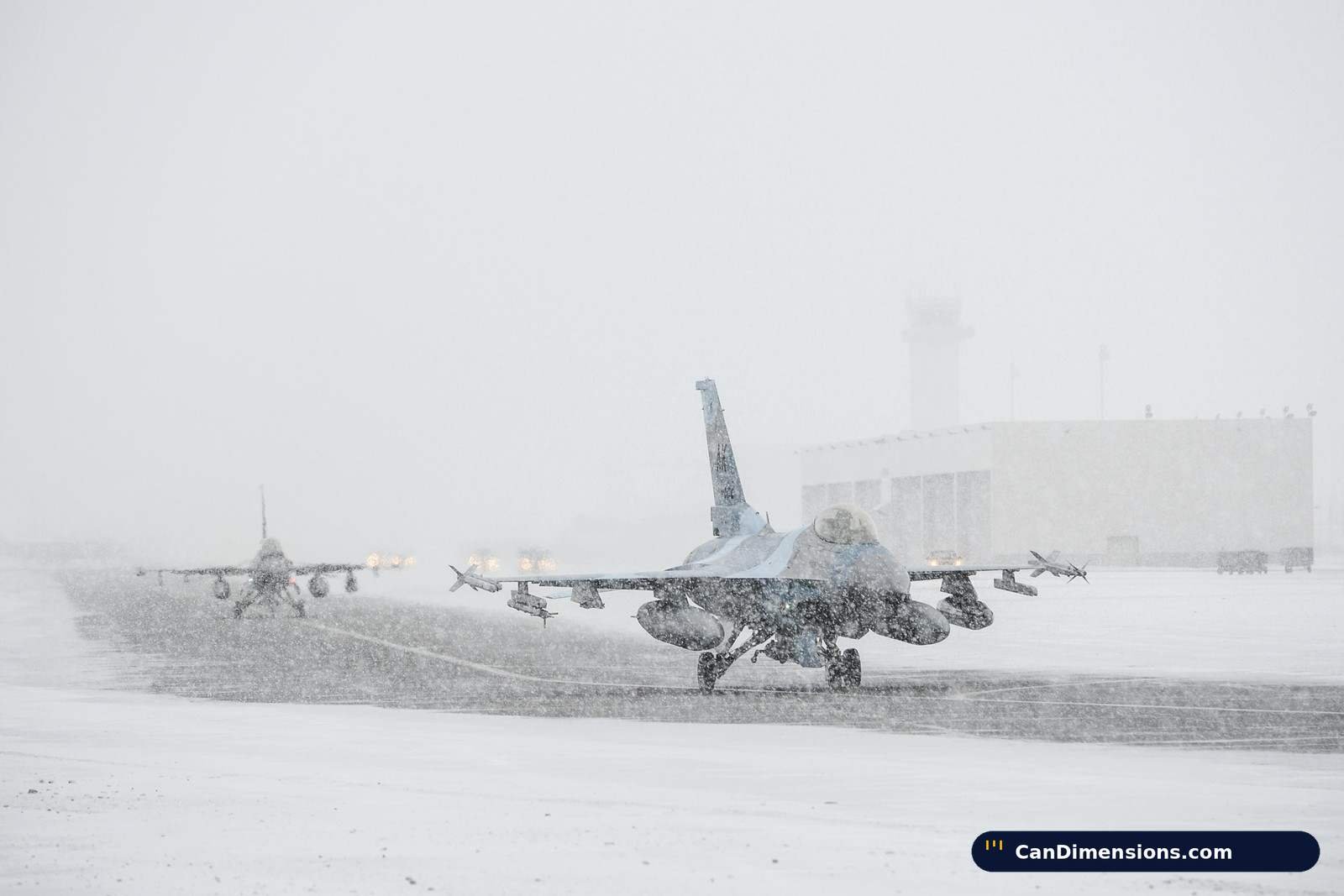
Counted: On the flagged official-spec basis, disclosed here — 300 pounds under. The US Air Force fact sheet for the F-16 Fighting Falcon lists the aircraft at 19,700 pounds without fuel (8,936 kg). Fill the internal tanks and the same jet leaves ten tons behind; at its maximum takeoff weight of 37,500 pounds it is nearly double this page’s figure.
It remains the most surprising entry on the list, because a supersonic fighter reads as a heavy object and is, by the standards of this page, a light one — an aluminium airframe, a single engine, and a design brief that punished every spare pound. The snowbound jets in the photograph at the head of this page are this section’s aircraft.
An M1083 Army Cargo Truck
Counted: On the flagged manual basis, disclosed here. The M1083 is the US Army’s standard 5-ton 6×6 cargo truck, and its technical manual tables a curb weight of 20,896 pounds — the truck complete, with fuel and the manual’s crew allowance aboard. Stripped of kits, crew and fuel, the Army’s own summary figure is 19,597 pounds, so the truck straddles this page’s mark depending on which official definition of its weight is used; both figures are printed here rather than averaged into a fiction.
The naming invites a confusion worth clearing up. The “5-ton” in this truck’s class name is its payload — the cargo it is rated to carry across country — not its weight. The vehicle that carries five tons weighs ten.
250 Bags of Concrete Mix
Counted: Exactly, on the labelled weight. Home-centre concrete mix comes in a big sack that the makers print and sell as 80 pounds. Two hundred and fifty of them are 20,000 pounds by multiplication alone: 250 × 80 = 20,000, with no range, density or estimate anywhere in the chain.
Picture it as freight rather than as shopping. Two hundred and fifty bags make five full pallets of fifty, a load that fills a flatbed’s middle section and arrives by forklift or not at all. Our earlier page on 300 pounds counted the same product six bags at a time; this page needs forty-two of those six-bag loads, which is a fair measure of how far apart the two weight classes sit.

Five Cubic Yards of Reinforced Concrete
Counted: On the flagged standard basis, disclosed here — 250 pounds over. Structural engineers do not weigh concrete pour by pour; they use the design unit weight the American Concrete Institute sets for normal-weight reinforced concrete, 150 pounds per cubic foot, which works out to 4,050 pounds per cubic yard. Five cubic yards at that standard figure weigh 20,250 pounds.
Plain unreinforced concrete uses 145 pounds per cubic foot and would put the same five yards at 19,575 pounds, just under the mark — the steel in a reinforced pour is worth roughly a person and a half of extra weight across five yards. Either way, a single standard mixer drum, which typically carries eight to ten yards, holds close to twenty tons of this page’s weight when full.
About 2,400 Gallons of Water
Counted: On the standard-density basis. Water is the reference liquid of the imperial system, and the US Geological Survey’s working figure puts a US gallon of it at 8.34 pounds. Multiply and 2,400 gallons weigh 20,016 pounds — sixteen pounds over the mark, a rounding error wearing a number.
The volume is easier to picture than the weight: 2,400 gallons is a small water-tender tank, or a large backyard spa several times over. It is also the hidden weight in other entries — the yacht floats by pushing aside ten tons of this same water.
A Large Minke Whale
Counted: On the flagged documented-maximum basis, disclosed here. The National Marine Sanctuary Foundation’s species account gives the minke whale — the smallest of the great whales — at up to 20,000 pounds (10 tons) and about 35 feet when fully grown. Ten tons is therefore the ceiling of the species rather than its middle: typical adults weigh far less, in the four-to-five-tonne band on the standard references.
It is the only single animal on this page that reaches the figure on a documented basis, and it does so at sea, where buoyancy carries what legs cannot. On land, no living animal’s typical weight reaches ten tons; only record-class individuals pass it.

Scotty, the Largest Known T. rex
Counted: On the flagged peer-reviewed estimate basis, disclosed here — about 445 pounds under. When Persons, Currie and Erickson described the Saskatchewan specimen nicknamed Scotty in The Anatomical Record, their limb-bone scaling put its living mass at 8,870 kilograms, roughly 19,555 pounds, making it the heaviest Tyrannosaurus rex yet published. A fossil cannot be weighed, so the figure is a modelled estimate with honest error bars — but it is a modelled estimate from the specimen’s own bones, in a peer-reviewed journal.
Set it beside the minke and a strange symmetry appears: the largest land predator known to science and the smallest great whale alive today meet at much the same weight.
How to Visualize 10 Tons
Divide the figure into loads and objects a reader already has a feel for. Three of the comparison rows that usually illustrate this weight did not survive the same audit as the list above; the note under the table records what happened to them.
| Common Reference | Accuracy | Comparison |
|---|---|---|
| 250 Labelled 80-Pound Concrete Bags | ★★★★★ | Exactly 20,000 lb by labelled weight |
| About 2,400 Gallons of Water | ★★★★★ | 8.34 lb per gallon adds up to the mark |
| Large Industrial Forklift | ★★★★☆ | Rated on Toyota’s published 20,110 lb total weight |
| An F-16 with Empty Tanks | ★★★★☆ | 19,700 lb on the Air Force fact sheet |
| 9,072 One-Kilogram Bags of Sugar | ★★★★☆ | The short-ton count of kilogram bags |
Three corrections ride with this table. The elephant row is removed, not repaired: two average bulls weigh thirteen tons, so no star rating makes them a ten-ton reference. The loaded-garbage-truck row is removed for the opposite reason — a packed residential truck runs to twenty-five tons and beyond. And the sugar row is recounted: 10,000 one-kilogram bags make ten metric tonnes, which is 22,046 pounds — eleven short tons, not ten; the count that matches this page’s ton is 9,072 bags.
Feeling 10 Tons in Loads
Nobody handles the whole figure at once, so split it the way freight actually moves. A pallet of fifty 80-pound bags is two tons; this page’s weight is five such pallets. A pickup rated for a 1,600-pound payload would need thirteen trips, bed filled to its legal limit every time, to move what one flatbed carries in a single journey.
The splitting works downward too. Ten tons is sixty-seven loads of 300 pounds — a weight a two-person crew can shift with a dolly — and two hundred loads at the hundred-pound line where solo lifting stops being sensible. Heavy weights become understandable once they are expressed as a count of familiar ones.
Where Does 10 Tons Appear in Daily Life?
Waste & Infrastructure: The kerbside truck is the closest most households come to this weight class, though not in the way it is usually described: the truck itself passes at fifteen tons and upward, while ten tons shows up as the payload class of the roll-off containers swapped at building sites, booked and billed by the load.
Industrial & Construction: This is the weight’s home ground. The ten-ton-class excavator digs the foundations, the forklift that weighs ten tons unloads the steel, the mixer drum carries close to twice it in wet concrete, and the Army-pattern cargo truck hauls the site supplies.
Wildlife & Conservation: At the zoo the figure works as a corrective rather than a label: the elephant house holds six-and-a-half-ton bulls, not ten-ton ones, and the keepers’ actual ten-ton problem is the record-class animal or the pair in the same paddock. At sea the number needs no correction at all — a large minke whale carries it through every dive.
Marine & Recreation: Marina engineering runs on this figure. Travel lifts are rated in it, haul-out cradles are built to it, and the forty-foot cruiser whose dry weight matches it to the pound is the largest boat most private owners will ever winch out of the water — beyond this weight, boats stop visiting land on trailers and start living in it full-time.
10 Tons Next to Other Weights
Against the small weights this site covers, ten tons is less a bigger number than a different regime. The 300 grams page deals with a weight this one exceeds thirty thousand times over; 100 grams needs two hundred thousand repetitions to build a single ten tons. The ladder between is pure multiplication: ten pounds a thousand times, a hundred pounds two hundred times, 300 pounds sixty-seven times.
Read in the other direction, the figure is a building block: five of this page make a hundred tons, the blue-whale class covered in the questions below. And for readers thinking in lengths rather than weights, the companion question of 3 feet covers a numeral from the other dimension entirely.
Is 10 Tons Heavy?
By every practical test, yes — and the tests are institutional rather than impressionistic. Ten tons exceeds the payload of every pickup and most box trucks, the capacity of every standard warehouse forklift below the heavy class, and the rating of most residential driveways, which is why delivery drivers refuse loads in this band and why building codes treat ten-ton point loads as a design case for floors and dock plates.
It is also the weight where lifting stops being a question of strength and becomes a question of paperwork. Cranes that work at ten tons operate under written lift plans, certified rigging and exclusion zones; the load’s weight must be known, not guessed, before the hook takes it. Nothing at 20,000 pounds is casual.
Question’s
What does 10 tons look like?
Picture the forklift first: a large warehouse forklift, empty, is ten tons of steel and counterweight. Add the forty-foot cruiser hanging in a marina lift, the fighter jet waiting with dry tanks, or five pallets of concrete bags on a flatbed — each is the same 20,000 pounds wearing a different shape, and any one of them gives the weight a fair face.
How much is 10 tons in kg?
9,071.85 kilograms, on this page’s short ton. If the tons in front of you are metric tonnes instead, the answer is exactly 10,000 kilograms — the two units share a name and differ by about ten percent, which is why every conversion on this page names its ton before it converts it.
What animal weighs 10 tons?
At sea, one does on a documented basis: a fully grown minke whale reaches up to 20,000 pounds at the top of its range. On land, none does typically — the average bull African elephant is a six-and-a-half-ton animal, the largest males approach seven and a half, and only the record bull on the zoo books, at about 24,000 pounds, clearly passed the mark. The largest known T. rex, Scotty, was estimated just under it.
Is 10 tons heavy to lift?
Extremely. Ten tons is beyond every human-powered device and every ordinary forklift in the building; it belongs to mobile cranes, heavy forklifts and gantries working under formal lift plans. Any load whose weight gets asked about in tons is a load that gets a rigger, not a volunteer.
What weighs 100 tons?
Ten of this page. In the world, the standard reference is the blue whale: NOAA Fisheries puts northern-hemisphere adults above 100,000 pounds and Antarctic animals up to about 330,000 pounds, so a large adult sits squarely in the hundred-ton class. A loaded railway freight wagon and a small work vessel live in the same band — all of them an order of magnitude past anything in the list above.
10 tons to pounds?
Exactly 20,000 pounds in the American short ton this page uses: ten multiplied by the 2,000 pounds in a ton. In long tons the same ten would be 22,400 pounds, and in metric tonnes 22,046.2 pounds — three answers, one for each ton, which is why the question is worth asking carefully.
How much is 10 tons in grams?
9,071,847 grams — about nine point one million. In metric tonnes the same count of tons gives a rounder 10,000,000 grams exactly. The imperial figure looks untidy for a structural reason: the gram belongs to the metric ladder, and the short ton reaches it only through the defined pound of 0.45359237 kilograms.
Final Thoughts
Ten tons survives its audit as a weight with a split personality. It is exactly reachable — by labelled bags, by a cruiser’s dry-weight line, by a partial container of ore — and it is honestly approached by machines and animals whose published figures land within a few percent of it. Just as honestly, it refuses the famous shortcuts: the elephant pair, the loaded refuse truck and the little school bus each weigh something quite different, as the sections above show.
The transferable habit is to ask which ton, and then ask for the document. A spec sheet, a fact sheet, a shipping code or a journal estimate will support a weight; a confident sentence with no source behind it usually supports a different, wronger one. Check the paperwork and most bad numbers confess at the first question.
If one idea from this page is worth keeping, it is the yacht’s. A floating boat’s weight is never read off a scale at all — it is inferred from the water the hull pushes aside, a quantity naval architects call displacement, and the reason a vessel’s paperwork can state its weight to the pound without the vessel ever having been weighed.