Pringles Can Storage & Reuse: How Big Is a Pringles Can, and What Fits Inside?
Anyone asking how big is a pringles can usually needs the answer for a shelf, a drawer or a project, and the standard tube gives it quickly: about 10 inches tall (25.4 cm) and about 3 inches across (7.6 cm), with the snap-on lid widening the top to 3.13 inches.
One caution before those figures go to work. Many US shelves now stock the Original at a 5.2 oz (147 g) fill, and retailers record that can at 9.19 inches tall under the same 3.13-inch lid — a shorter fill inside a familiar tube. Wherever height decides a fit, this guide states which fill a figure belongs to.
What follows is the full verified record first — every size, every core measurement, with the copied errors corrected — and then a second reading of the same numbers as a storage specification: what passes through the opening, what stands inside, what wraps around the outside, and where each size earns its place once the crisps are gone.
How Big Is A Pringles Can?
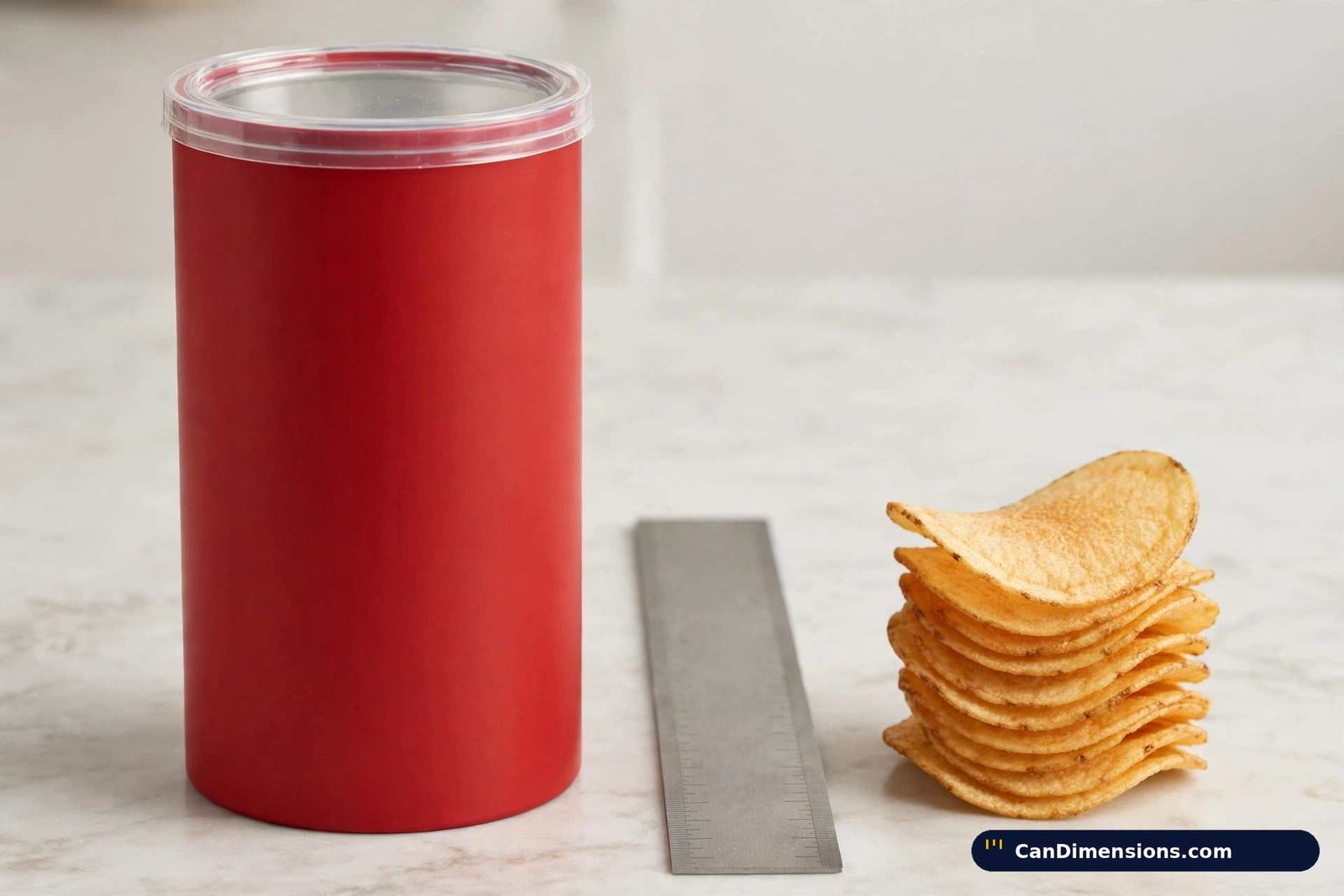
In one line: about 10 inches (25.4 cm) of height on about 3 inches (7.6 cm) of width. The proportions are the point — a tube standing taller than two stacked soda cans, yet narrow enough to grip in one hand and to file into a 3-inch slot of shelf. For storage and craft purposes that footprint matters more than any single figure: a fixed circle of counter or cupboard, claimed on the day the can is opened and still claimed, identically, months later in its second career.
Standard Pringles Can
The flagship fill at a glance. Each figure returns later in the specifications with its basis, so this table can be used on its own for quick fit checks.
| Measurement | Imperial | Metric |
|---|---|---|
| Height (classic 5.5 oz / 156 g) | about 10 in | 25.4 cm / 254 mm |
| Height (current 5.2 oz / 147 g) | 9.19 in | 23.3 cm / 233 mm |
| Diameter across the lid | 3.13 in | 7.94 cm / 79.4 mm |
| Body (outer) diameter | about 3.0 in | 7.6 cm / 76 mm |
| Inner diameter (opening) | about 2.9 in | 7.4 cm / 74 mm |
| Circumference | about 9.4 in | 23.9 cm / 239 mm |
| Net weight | 5.5 oz (156 g) | — |
| Crisp count | about 90 | — |
Pringles Can Specifications
Eight specifications describe the standard can completely. Where a widely repeated figure fails verification, the replacement is printed here and the failure is named, so the wrong number can be retired rather than repeated.
Height/Length
For the classic 5.5 oz (156 g) can, print about 10 inches (25.4 cm). Individual cans measure anywhere from 9.96 to 10.1 inches; the spread comes from the lid’s crown, so a rounded figure with “about” is the defensible form. The current 5.2 oz (147 g) Original stands at 9.19 inches (23.3 cm) in retailer listings. A range of “9 to 10.1 inches” printed for a single can blurs two separate fills into one vague span — each fill owns its figure.
Outer Diameter
The body spans about 3.0 inches (7.6 cm / 76 mm); the snap-on lid, the package’s widest point, spans about 3.13 inches (79.4 mm). One range in circulation opens at 2.6 inches, which cannot describe this can: a tube’s outside cannot be narrower than the 2.9-inch mouth inside it. That figure’s home is a soda can, and it has been copied into the wrong guides.
Inner Diameter (Lid)
With the seal removed, the mouth measures about 2.9 inches (7.4 cm / 74 mm). The crisp sets the size: at roughly 2.5 to 2.8 inches long, each saddle needs a mouth just under 3 inches to descend flat and stacked. Do not merge this figure with the lid’s — the lid, at about 3.13 inches, is measured outside, over the body it caps.
Circumference
Measured with a paper strip — wrapped, marked, laid flat — the body gives about 9.4 inches (23.9 cm / 239 mm), and the calculation backs the strip: 3.1416 × 3.0 inches = 9.42 inches. Wraps for labels, gifts and crafts all start from this figure; unusually for this topic, the copied guides have this one right.
Volume
Copied guides put the can’s capacity near 25 fl oz (750 ml), and the arithmetic disagrees. Start from the mouth: a 1.45-inch radius yields about 6.6 square inches in cross-section, and roughly 9.6 inches of depth below the rim turns that into about 63 cubic inches — about 1,040 ml, or roughly 35 fl oz, at the brim. The 750 ml figure sits closer to the space the crisps occupy than to the space the tube offers.
Weight (Net Content)
The 5.5 oz (156 g) printed on the classic can is the crisps’ weight — the net content — not the package’s. Today’s US Original fill is 5.2 oz (147 g) and the Party Stack’s is 7.1 oz (201 g); the “200 g” seen in some guides belongs to bigger cans sold abroad, not to the American standard.
Average Chip Count
Label arithmetic settles the count. The US Original label sets a serving at about 15 crisps (28 g); multiplying that serving across the 156 g fill lands in the high 80s to about 90 crisps, with breakage deciding where an individual can falls. A “90 to 100” range overstates the top. The Party Stack label lists 7 servings of about 14 crisps — a total near 98.
Quick Can Overview
| Dimension | Standard Pringles can |
|---|---|
| Height | about 10 in (25.4 cm) — 9.19 in for the current 5.2 oz can |
| Outer diameter | about 3.0 in body; 3.13 in across the lid |
| Inner diameter | about 2.9 in (7.4 cm) |
| Circumference | about 9.4 in (23.9 cm) |
| Brim capacity | about 1,040 ml (35 fl oz), calculated |
| Net weight | 5.5 oz (156 g) |
| Crisps | about 90 |
The Empty Can as a Storage Tube: Three Numbers That Decide Everything
An empty Pringles can is one of the most reused packages in the kitchen and the craft room, and its second career is governed by three of the figures above. The opening, about 2.9 inches, decides what can enter. The usable depth, roughly 9.6 inches beneath the lid, decides how long an item may be. The brim capacity, about 1,040 ml, decides how much loose material the tube will swallow. Judge any proposed reuse against those three numbers and most disappointments disappear before they happen.
Through the opening go the everyday successes: pencils, pens, paintbrushes, chopsticks, knitting needles, cables coiled loosely, and dry goods poured from a bag. Trading cards pass with room to spare — a standard card is 2.5 × 3.5 inches (see pokemon card dimensions), comfortably inside the 2.9-inch gate — so a deck slides in flat and stays flat, protected by walls that cannot fold.
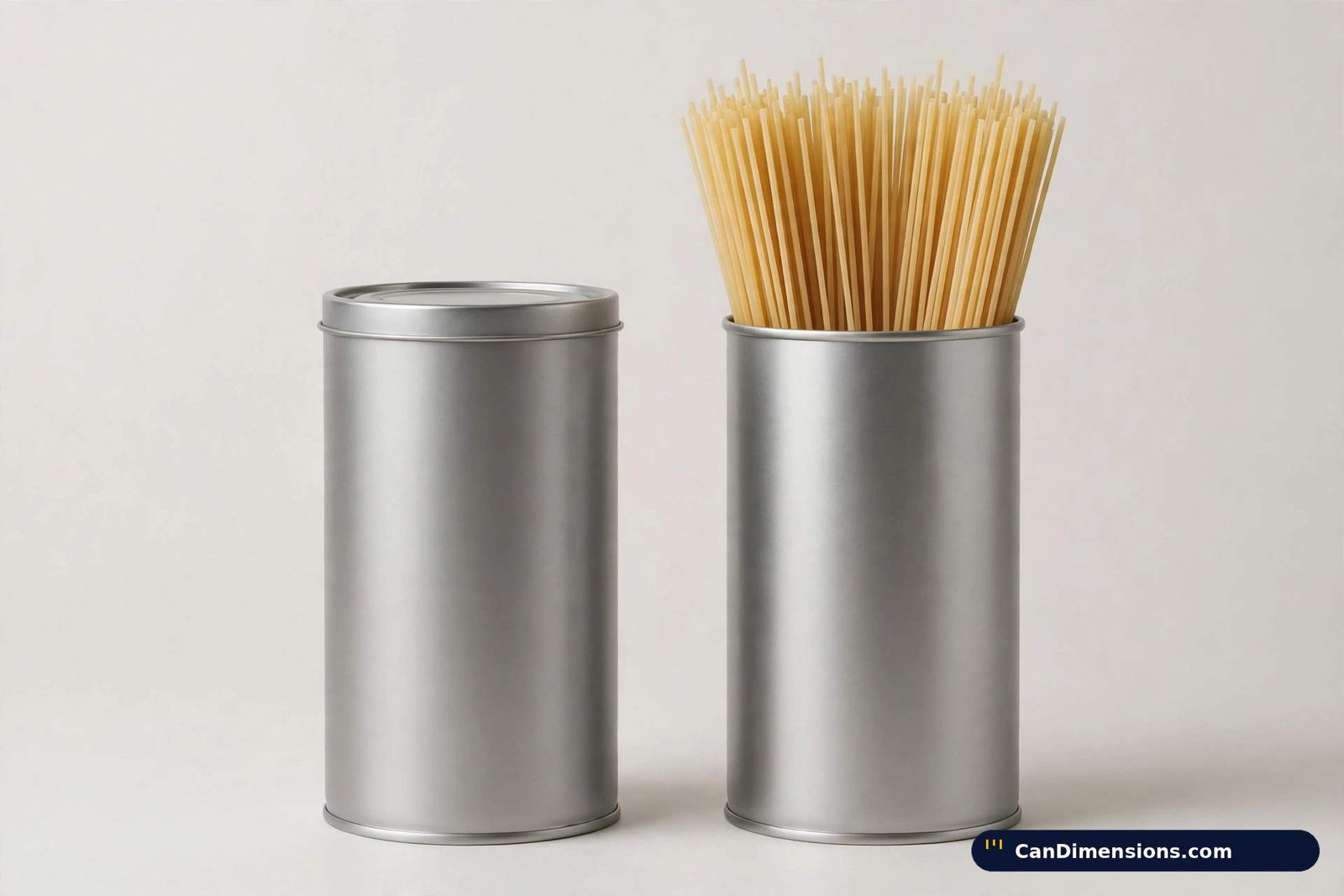
One popular reuse deserves an honest warning. Dried spaghetti is commonly sold in lengths of about 10 to 12 inches, which is longer than the standard can’s roughly 9.6 inches of usable depth, so full-length strands stand proud of the rim and the lid will not close over them. Snap the strands, accept an open top, or promote the job to a Party Stack, whose usable depth of roughly 11.6 inches closes over most packs. The tube is a fine pasta store only when the size pairing is chosen with the depth figure in mind.

Pringles Can Height and Length Explained
Listings use “length” for this tube as often as “height”, which suggests two measurements where only one exists. Upright on a shelf, the long edge is the height; quoted sideways in a catalogue, the same edge becomes the length. One edge, two names.
No Confusion Here!
The listing format gives the game away: the current Original is listed at 3.13 × 3.13 × 9.19 inches — width × depth × height. A circle is equally wide in every direction, hence the diameter appearing twice, and the final figure is the tall edge. A quoted “length” of 9 or 10 inches is that edge renamed, not a dimension hiding elsewhere on the can.
How Tall Is A Pringles Can?
By size, lid on: Grab N’ Go, 4.3 inches. The 5.2 oz Original, 9.19 inches. The classic 5.5 oz, about 10 inches. The Party Stack, about 12 inches. Plan shelving on those figures — allow a clear 10 inches for a standard can and a full foot for a Party Stack. For scale, the tallest entry in the monster can dimensions roundup, a resealable 24 oz Mega near 7.7 inches, still falls over two inches short of the standard tube.
Pringles Can Length
Tipped sideways in a drawer or a suitcase, the standard can presents the same edge horizontally: 10 inches (25.4 cm) of length. Inside the tube, length means something else — the roughly 9.6 inches of clear depth under the lid, which is the ceiling for anything stored upright and the space the ninety-crisp stack occupies from base to seal.
Pringles Can Diameter Dimensions
One can, three diameters — and most published errors begin by swapping one for another. Body, lid and mouth each measure something different, each answers a different question, and a fit problem is only solved by the right one of the three.
Outer Diameter Measurements
Calipers on the body return about 3.0 inches (76 mm); moved to the closed lid they return about 3.13 inches (79.4 mm), the lid being an overcap that adds its own wall to the span. Any fit — holder, divider, storage box, shipping carton — should be tested against the lid figure, the widest the can ever gets.
Inner Diameter and Lid Size
Inside the rim, the mouth spans about 2.9 inches (74 mm). Reuse lives or dies by this figure: an item wider than the mouth cannot enter, whatever the depth promises. The dimension also explains the body from the maker’s side — with each crisp running roughly 2.5 to 2.8 inches long, the tube’s outside could hardly be narrower than about 3 inches.
Circumference of a Pringles Can
Around the body the tape reads about 9.4 inches (23.9 cm) — π × 3.0 inches, as geometry requires — and around the lid about 9.8 inches. Cut wraps to the body figure plus whatever overlap the material needs, and check the lid figure whenever the finished wrap must pass over the top.
Wraps, Sleeves and Labels: Putting the Circumference to Work
Decorating the tube is where the circumference stops being a specification and becomes a cutting instruction. A paper, fabric or vinyl wrap for the body needs 9.4 inches of width plus an overlap allowance — half an inch is a comfortable working margin — and a height just short of the can’s own, so the wrap tucks under the lid rim at the top and meets the base cleanly at the bottom. Measure a new material once with the paper-strip method from the specifications — wrap, mark, measure flat — rather than trusting a printed figure against a can from a different market.
Sleeve fit obeys the same logic wherever it appears: a sleeve is a circumference with a tolerance, cut too tight and it splits, cut too loose and it slides. Drinks sleeves are sized exactly this way — the can koozie dimensions exist to match a sleeve to its shell — and the discipline transfers directly: measure the object, add the material’s own thickness, then cut. A finished Pringles wrap that passes over the 3.13-inch lid needs the lid’s roughly 9.8-inch circumference, not the body’s, a distinction that decides whether a decorated tube can still be opened without tearing its new skin.

Different Pringles Can Sizes
Four sizes carry most of the worldwide trade. Two of them attract more wrong descriptions than the rest, so each entry below carries its correction with it, inside the heading the copied guides use.
Standard Size (5.5 oz)
The reference can: 5.5 oz (156 g) of crisps, about 10 inches (25.4 cm) tall, about 3 inches (76 mm) across the body and 3.13 inches across the lid; the fill is about 90 crisps. Do not confuse it with its modern shelf-mate: the 5.2 oz (147 g) Original now widespread in US stores is an identical tube with a shorter fill, at 9.19 inches — so check the fill weight on the front before trusting which height is in hand.
Large/Family Size (13.5 oz)
This heading preserves a figure that no longer describes a real can, and honesty requires saying so inside it. No single can in the maker’s present range carries 13.5 oz; the number comes from variety-pack cases, whose combined weight was mistaken for one can’s fill as guides copied each other. The companion claim of up to 300 crisps fails against the labels, since the largest genuine can holds roughly a third of that. The genuine large American can is the 7.1 oz (201 g) Party Stack: about 12 inches (30.5 cm) tall on the same 3-inch body, with about 98 crisps by its own label. That is the family can — close to double the standard fill, nowhere near triple.
Mini/Snack Size (2.4 oz)
Start with the correction: the can sold today as Grab N’ Go in the US holds 1.41 oz (40 g). The 2.4 oz in this heading approximates an older 2.36–2.5 oz format that has since been discontinued. Width, however, never shrank: the mini keeps the full roughly 3-inch body — the crisps demand it — and sheds height instead, down to about 4.3 inches (11 cm). Count on roughly 24 crisps inside. A pairing of 4.1 inches tall with a 2.8-inch diameter blends two markets’ cans; no US mini sold today has a 2.8-inch body.
International Variations
Beyond the US the fills change while the tube holds its shape. The UK and European standard holds 165 g, stands about 24 cm (9.4 in) tall and spans about 8 cm (3.1 in). A larger 200 g edition sold in several markets reaches about 26 cm (about 10.2 in) on a body of the same width. Flavour ranges are local — Britain’s Prawn Cocktail is the best-known example — and narrower mini tubes sold in parts of Asia explain the sub-3-inch diameter figures that surface in some guides.
Relative Size Comparison
Side by side, corrected:
| Can | Height | vs standard |
|---|---|---|
| Grab N’ Go (1.41 oz) | about 4.3 in | under half |
| International 165 g | about 9.4 in | a touch shorter |
| Standard (5.5 oz) | about 10 in | — |
| Party Stack (7.1 oz) | about 12 in | about 2 in taller |
One caution travels with every comparison graphic for this topic: the most-copied version shows the standard can at 9.5 inches while its own page’s text offers 9 to 10.1 inches. Where a page contradicts itself, trust retailer listings and pack labels — the basis used throughout this guide.
Pringles Can Materials and Construction
Despite its name, the package is no drinks can. It is a canister wound in a spiral from paperboard, closed at the bottom by a metal disc and at the top by a snap-on plastic lid over a foil membrane. The format dates to the 1960s, when Fredric J. Baur, an engineer at Procter & Gamble, devised it so identical crisps could be stacked and shipped without breaking. Ownership has since moved on from the older guides’ account: P&G sold the brand to Kellogg in 2012, Kellogg’s snacking business became Kellanova in 2023, and Mars closed its purchase of Kellanova in December 2025 — today’s can is a Mars product.
What Are Pringles Cans Made Of?
Count the materials: paperboard for the spiral-wound body; a foil-and-film layer lining it against moisture and air; a peelable aluminium-foil seal under the lid; the lid itself in LDPE plastic; and a thin metal disc forming the base. Calling the package a “foil-lined cardboard tube” names only the first two. Because the layers are bonded together, most curbside schemes cannot separate them and will not accept the can — one more reason the reuse sections of this guide matter: service, not recycling, is this package’s second act.
Design Benefits
The design pays for its dimensions four ways. Freshness first: seal and lid keep air off the stack between servings. Protection next: rigid walls do what a bag cannot, arriving with the crisps intact rather than shattered. Packing follows: a 3-inch footprint tiles shelves and cases with little waste. And manufacturing last: one fixed diameter means one crisp shape, produced identically and stacked ninety-plus deep. A bag is cheaper, certainly — and capable of none of it.
Pantry, Desk and Drawer: Where Each Size Earns Its Place
Reuse succeeds or fails on placement, and placement is arithmetic. A standard can needs a clear 10 inches of vertical room and a Party Stack a full 12, so both belong on main pantry shelves rather than in shallow door racks; the 3-inch footprint, though, slips into narrow gaps and door shelves that defeat a chip bag, and a row of tubes files as neatly as books. The Grab N’ Go, at about 4.3 inches, is the drawer specialist — short enough for kitchen drawers, desk drawers and glove boxes where its taller siblings cannot stand.
On the desk the standard tube is the natural organiser: 9.6 inches of usable depth swallows pens and brushes whole, the 2.9-inch mouth keeps them upright and visible, and the lid turns the whole arrangement into a closed, portable kit. Laid on its side, the can asks a drawer for 10 inches of length and only its 3-inch diameter in height. In the fridge, reserve the tube for dry storage overflow rather than chilled food — the paperboard body is a pantry material, happiest dry, cool and upright.
Comparing Pringles Can Dimensions
Pringles vs. Traditional Chip Bags
A family-size chip bag takes the reverse approach: a wide, pillow-shaped sack that is mostly air by volume, its crisps sunk to the bottom, unguarded, breaking further every time the bag is handled. Set against it, the can’s offer is a fixed footprint — a circle just 3 inches wide on shelf or counter, the same on opening day as at the final crisp, its contents still stacked nearly to the top.
Pringles vs. Standard Beverage Cans
Set the tube beside a drinks can and the proportions jump out. A standard 12 fl oz beverage can — the subject of the coke can dimensions page — measures 4.83 inches tall by 2.6 inches wide, so the Pringles tube more than doubles that height and adds roughly half an inch of width; the rest of the drinks family is charted in the beverage can dimensions tables. And note where 2.6 inches truly belongs: on the drinks can, not in any Pringles diameter range, however often it is copied there.
Keeping a Reused Can Useful: Cleaning, Limits and Retirement
A reused tube lasts when its materials are respected. Clean it dry or nearly dry — a wipe with a barely damp cloth, then air-drying fully before the lid goes back on — because the paperboard body swells and softens if soaked, and a sealed damp tube grows stale smells quickly. Keep the contents dry as well: loose dry goods travel best inside a thin food bag lining the tube, which keeps oils and crumbs off the foil lining and makes the next change of contents a lift-out job rather than a scrub.
Know the limits plainly. The tube is not a vessel for liquids, hot items or the microwave, and it was not built for long-term storage of unwrapped food once opened — treat it as an organiser and a short-term dry store, not as a food container in its own right. Retire a can when the lining peels or flakes, when the body softens or dents deeply, or when the base shows rust: at that point the tube has given its service, first as packaging and then as storage, which is more than most packages ever manage.
Question’s
How many inches is a Pringles can?
The classic 5.5 oz can stands about 10 inches tall. Today’s 5.2 oz US Original is listed at 9.19 inches by retailers.
How many Pringles are in a standard can?
Around 90 — the label’s serving of roughly 15 crisps, multiplied across the 156 g fill, lands in the high 80s to about 90.
What is the diameter of a Pringles can?
Roughly 3 inches over the body, 3.13 inches over the lid, and about 2.9 inches through the mouth.
How tall is a 5.5 oz Pringles can?
About 10 inches (25.4 cm), lid included; individual cans measure between 9.96 and 10.1 inches.
Can Pringles cans fit in cup holders?
In wide holders only — allow roughly 3.2 inches of clearance for the lid, and check yours before a trip.
What is the volume capacity of a Pringles can?
Roughly 1,040 ml (35 fl oz) brim-full, calculated from the inside measurements; the crisps take up less than the tube offers.
Are Pringles can dimensions the same worldwide?
No — fills and heights vary by market: 165 g at about 24 cm in the UK/EU, 200 g near 26 cm elsewhere. The near-3-inch body is the constant.
Why are Pringles cans designed this way?
So a uniform crisp can be stacked instead of bagged: rigid walls stop crushing, the seal keeps the stack fresh, and the fixed footprint packs tightly.
Conclusion
The standard tube, then: about 10 inches tall — 9.19 inches in its current 5.2 oz fill — and about 3 inches across, with 3.13 inches over the lid, a 2.9-inch mouth, 9.4 inches around, about 90 crisps and roughly a litre to the brim. Across the family only height and fill move, from the little 4.3-inch Grab N’ Go up to the 12-inch Party Stack; the width never does.
Memorise five figures — height, lid width, mouth, wrap and count — and any can in the family can be judged in seconds: errors in copied charts stand out, and storage or craft plans can be passed or rejected before anything is cut. The second life is written into the first: a rigid paperboard canister, designed around one repeated saddle shape, turns out to guard almost anything of a similar size just as faithfully.