White Claw Can Party Guide: Cooler, Ice and Fridge Storage by Size
Hosting turns how tall is a white claw can into a practical question. At 6.13 inches tall and 2.26 inches across, the standard 12 oz can decides whether drinks stand in a fridge door and which shelf a variety box can occupy.
Every size in the range behaves differently at a party. The tall singles swap width for height or add both, variety boxes stand taller than soda boxes, and shoppers hunting for a mini version will not find one in this brand’s range at all.
So this guide plans the event first — quantities, ice, cooler loading and fridge space — and carries the full verified size reference inside that plan, so each decision traces back to a measured can.
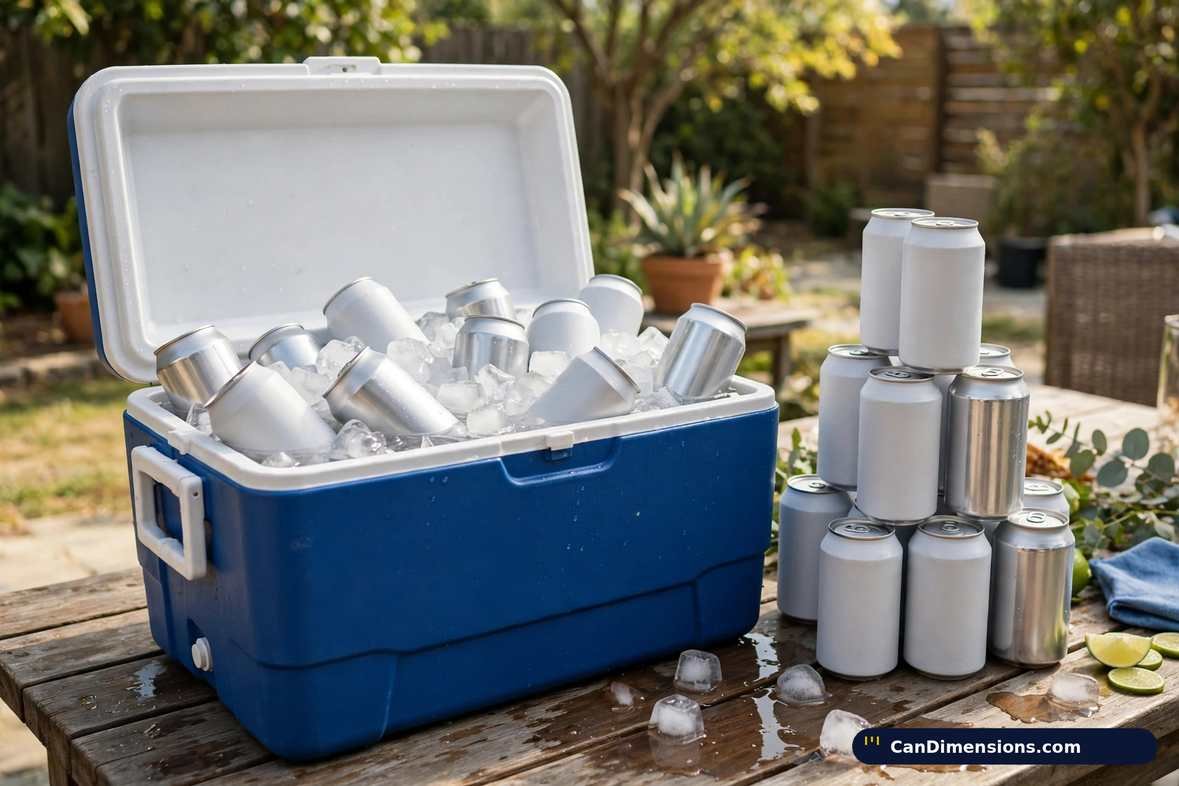
Party Maths: How Many Cans to Buy and How Much Ice to Allow
Catering planners work from a rough convention, offered here as guidance rather than observed data: budget about two drinks a head for the opening hour, then roughly one an hour after that. Turned into seltzer shopping, the sums run like this.
| Gathering | Drinks per guest (guidance) | Total drinks | If half are seltzer | Seltzer to buy |
|---|---|---|---|---|
| 12 guests, 3 hours | 2 + 1 + 1 = 4 | 48 | 24 cans | Two 12-packs |
| 20 guests, 4 hours | 2 + 1 + 1 + 1 = 5 | 100 | 50 cans | Four 12-packs + a 6-pack (56) |
| 30 guests, 4 hours | 5 | 150 | 75 cans | Six 12-packs + a 6-pack (78) |
Halving the total before buying is deliberate: some guests stay on water, and seltzer rarely carries an event alone. Always round up to complete packs — a spare box keeps, whereas an empty cooler in the third hour cannot be fixed.
Ice gets its own allowance. Party calculators broadly agree on near a pound per guest indoors, climbing toward one and a half to two pounds outside in summer heat. Twenty guests therefore want 20 to 40 pounds, split between the serving cooler and one sealed reserve bag.
Everything in that table is built from the 12 oz sleek can; the wider family of shells is charted in our beverage can dimensions reference, and the sections below take each size in turn.
Standard White Claw Can Dimensions (12 fl oz)
Exact Dimensions
Height: 6.13 inches (155.7 mm). Diameter: 2.26 inches (57.4 mm). Volume: 355 ml (12 oz). Can makers publish those figures for the sleek shell, and they are the ones worth trusting. Charts pairing a 4.83-inch height with a width near 2.25 inches have stitched together two unrelated cans, because 4.83 inches belongs to the ordinary soda body. Hosting plans live or die by the taller number: 6.13 inches is the clearance the fridge door, the cooler and the shelf all have to offer.
Weight Details
A filled can comes to roughly 13 ounces: 355 grams of drink riding in a shell that, empty, weighs under 0.5 ounces — around 13 grams of aluminium. Twelve cans plus their box land near ten pounds, a handy carrying guide when the shopping makes several trips from the car. The brand dates to a 2016 launch, and this sleek shell has carried its standard can ever since.
Visual Comparisons
Apple lists the iPhone 12 at 5.78 inches tall, so the can stands visibly taller than a familiar phone — near it, never equal to it, despite frequent claims otherwise. In the hand, most adults can close their fingers right around the slim body, keeping hold secure once condensation slicks the metal — a grip that matters over a long party.
Market Dominance
Packs are where this size rules. Every multi-can pack on the maker’s own site — variety or single-flavour — holds 12 oz cans; bigger White Claws arrive only as loose singles. Guides often bolt a market-share figure onto that observation, crediting this format with 68% of national beverage can sales, yet no can-industry publication supports the number, so it appears here only to be set aside. Hosts need just the verifiable part: buying packs means buying this can.
Portion Control
A single can lines up with one US standard drink — 355 ml at 5% ABV, 100 calories per the maker’s nutrition panel — and drinkers typically finish one in 15 to 20 minutes, roughly the pace the opening-hour guidance assumes. The larger singles further down break that one-can-one-serving pattern.
Ergonomic Design
Comfort here comes from narrowness, not width: at 2.26 inches the body lets smaller hands wrap it completely, and the extended wall offers plenty of gripping length. Stability pays the price — perched on a slim base, a tall can topples far more readily than a squat soda can, so party sleek cans belong in gripping holders, not balanced along garden walls.
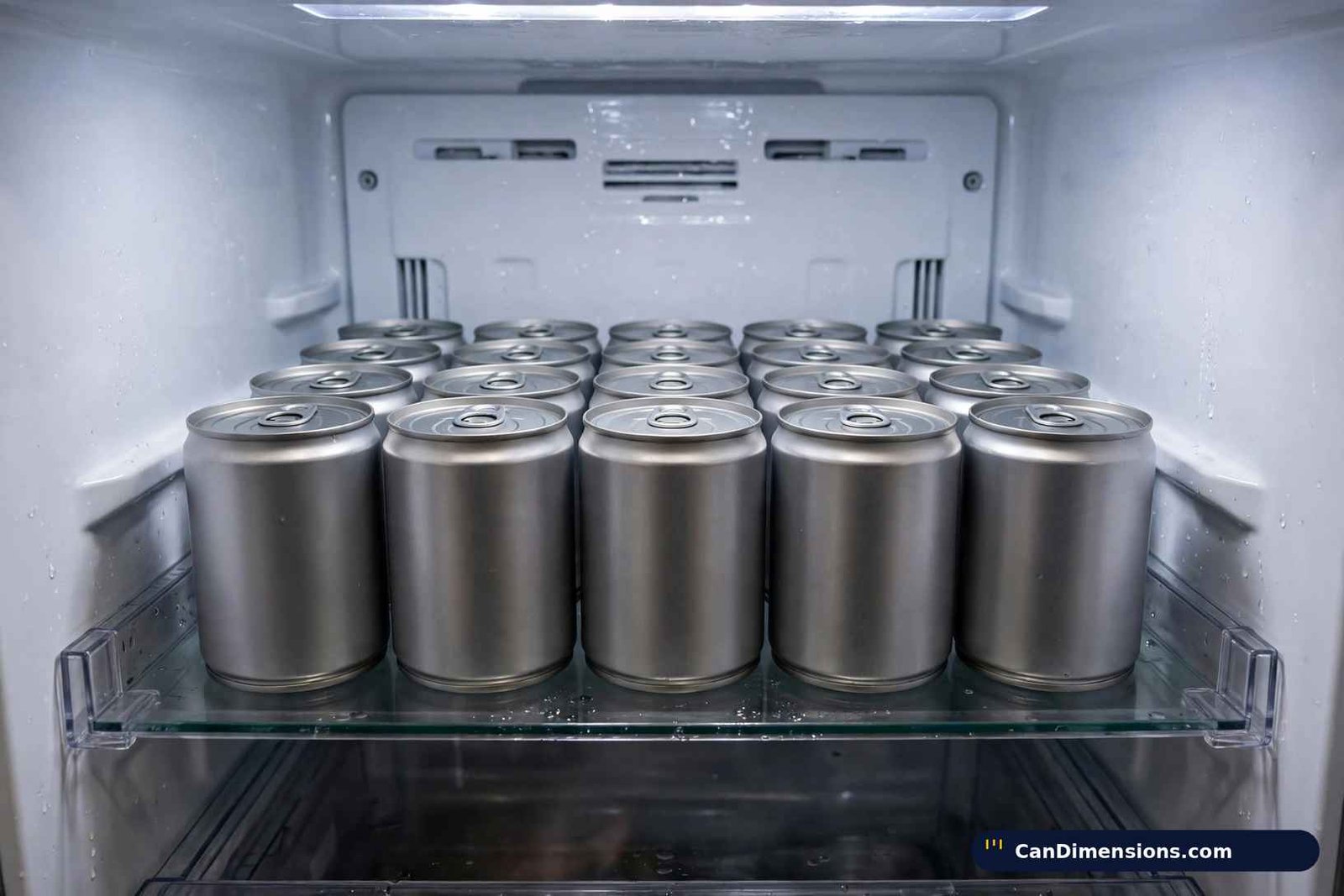
Visual Comparisons for Standard Size
Put both 12 oz cans on a counter and the category’s design shows itself. Soda: 4.83 inches of height on a 2.6-inch body. White Claw: 6.13 inches on 2.26 inches. Identical volume, no shared measurement — the seltzer gains roughly 1.3 inches of height while giving up a narrow slice of width, landing nearer the tallboy’s height than the soda can’s. Fridges arranged around soda packs feel that swap immediately, as the storage section explains.
What Makes This Size the Industry Standard?
Visibility helped first: rising above a door full of shorter cans, a white 6.13-inch can advertises itself in any shop cooler. Tooling helped second — makers already catalogued the sleek shell before seltzer arrived, so launching needed no new format. The deeper history belongs to aluminium itself: Coors introduced the first aluminium beverage can in 1959, loaded with the 12 oz volume this guide still builds from.
White Claw 16 oz Can Dimensions
The maker’s product pages offer this size beside the 12 oz and 19.2 oz, sold loose as a single-serve tallboy. Inside is the trade’s standard 16 oz shell: 6.19 inches (157.2 mm) tall and 2.6 inches (66 mm) wide, holding 473 ml — a third more drink — and weighing about 17 ounces filled. Treat it as a top-up purchase for guests who prefer one long drink, not as pack stock, and note that its beer-can body changes where it can sit.
How the 16 oz Dimensions Compare
The subtle trap in copied charts sits here. They print this can at 6.13 inches and call it roughly 1.3 inches taller than standard, when 6.13 inches actually belongs to the sleek 12 oz, and 1.3 inches measures that can against soda. Beside a genuine 12 oz White Claw, the tallboy adds a mere 0.06 inches of height; the growth went into width instead, 2.6 inches versus 2.26. Coolers treat it accordingly — beer-can slots and sleeves fit — and chilling takes slightly longer, around 20 to 22 minutes in ice water.
Best Uses for 16 oz Dimensions
Festivals and outdoor concerts flatter the format: one purchase lasts, and nobody queues repeatedly. Singles can also work out cheaper per ounce than multipack cans. Hosts should still count carefully, since each tallboy holds more than a standard serving. And anyone planning a stronger tallboy should stop — the maker’s Surge range skips this size, appearing only at 12 oz and 19.2 oz.
White Claw 19.2 oz Can Dimensions (Jumbo Size)
Heading the maker’s own range is this single-serve stovepipe: 7.41 inches (188.1 mm) tall on a 2.6-inch (66 mm) body, holding 568 ml and weighing about 21 ounces filled. Charts giving it 6.19 inches have borrowed the tallboy’s height, and the volume exposes the error — a body of that width at that height contains 473 ml, never 568 ml. The missing 1.22 inches are exactly what its label requires, and they cause every clearance headache mentioned later.
The 19.2 oz Dimension Advantage
Think of the volume as a US pint with 3.2 bonus ounces. Because 568 ml already served canned beer as an established single-serve format, the brand could adopt a proven shell instead of tooling a new one. Divide height by width and the ratio reaches 2.85:1 — lofty, yet anchored by a full-width base, so the cans seldom fall, even on beach blankets or a boat deck. Ignore one repeated boast: no maker publishes the claim that this size saves 12% of its aluminium per ounce.
Storage Considerations for Jumbo Cans
Width cooperates — holders everywhere are shaped around the 2.6-inch body — while height does not. Riding tall in a shallow vehicle holder, the can can feel loose when the road turns. Door shelves in fridges cause the bigger failure: plenty cap their clearance near 6.5 inches, a space this can simply cannot enter, whatever guides written around the wrong height promise. Give stovepipes a main shelf offering 7.5 inches or more, and a cooler at least 8 inches deep when they must bed down in ice.
White Claw 24 oz Can Dimensions
One size lives outside the maker’s catalogue. Flavour pages stop at 19.2 oz, yet big retailers and delivery services stock this single in core flavours, making it a genuine purchase even if packs never carry it. The can uses a wide-body format, measuring approximately 7.7 inches (about 196 mm) tall and about 2.9 inches (about 73 mm) across. Print claiming 7.41 inches repeats the stovepipe’s figure; with 710 ml to house — double the standard can — growth had to come from width as well, because a regular body stretched to fit would stand near 8.5 inches and wobble. Filled weight lands around 26 ounces, stock varies by region, and flavours usually stick to best sellers. Both sizes therefore rest on measured figures rather than a maker’s drawing; the resealable Mega shares this wide shell class and is detailed under monster can dimensions.
When the 24 oz Dimensions Make Sense
Slow outdoor days justify the giant: fishing trips, hikes and long afternoons afloat, where one can refreshes for hours and the empties carried home stay few. Per-ounce pricing often favours it too, spreading the single-serve premium across twice the liquid. Two conditions apply. The drinker must finish while the contents stay cold, and the roughly 2.9-inch body refuses standard sleeves and holders shaped for 2.6-inch cans — serve it plain, or find a holder built wide.
White Claw Mini Can Dimensions (8 oz)
Keep this heading, change its message: the brand sells no 8 oz mini. Its own pages, its packs and the big retailer listings checked for this guide run from 12 oz upward, and nothing smaller carries the name. The invented mini also betrays itself dimensionally — 4.2 inches by 2.13 inches corresponds to no shell in production, since 2.13 inches approximates the slim energy-can body, whose shortest common fill stands 5.28 inches tall. Genuine small cans belong to other drinks: soda’s 7.5 oz mini, a short sleek-family shell at roughly 4.11 × 2.28 inches; the 250 ml slim at 5.28 × 2.1 inches; and the 250 ml stubby at 3.6 × 2.62 inches. Shoppers after a petite White Claw should accept the 12 oz sleek as the smallest option going.
Comparing White Claw Can Dimensions to Other Seltzers
White Claw vs. Truly Can Dimensions
Order Truly’s standard can and the tape tells an identical story, for an unglamorous reason: rival brands purchase the same shell. Each stands 6.13 inches tall on a 2.26-inch body. Reports placing both at 4.83 inches recycle the soda mistake, a body neither fills at this volume. Party logistics benefit from the sameness — mixed packs share footprints, sit happily together in one cooler and accept identical sleeves. Truly’s larger loose singles include a 24 oz in the same wide-body class already described.
White Claw vs. Bud Light Seltzer Dimensions
That rival played the identical hand. Its 12 oz can also rode the sleek shell at 6.13 × 2.26 inches, rather than standing at standard height alongside some narrower variant. The 2.13-inch diameter printed for its supposed sleek version belongs to the slim shell, a format it never adopted. Stacking behaviour tracks the body, not the badge: sleek cans nest rim over rim like others, although a high stack on the slim base plants less surely than one built from cans like those in our beer can dimensions guide — keep party stacks of sleek cans low.
Hard Seltzer Can Dimensions vs. Regular Soda
At 12 oz the two categories share nothing dimensionally. Soda occupies the standard body at 4.83 inches tall and 2.6 inches wide; charts merging soda’s height with a 2.25-inch width have fused halves of separate cans, and production lines set up for one shell cannot casually run the other. Readers wanting the soda side measured brand by brand will find it in our coke can dimensions guide. Even the minis diverge from the copied story: a 7.5 oz soda mini stands about 4.11 inches tall on a 2.28-inch body, a shortened sleek shell, and neither liquid density nor carbonation pressure explains any of it — the shell chosen for the volume explains everything.
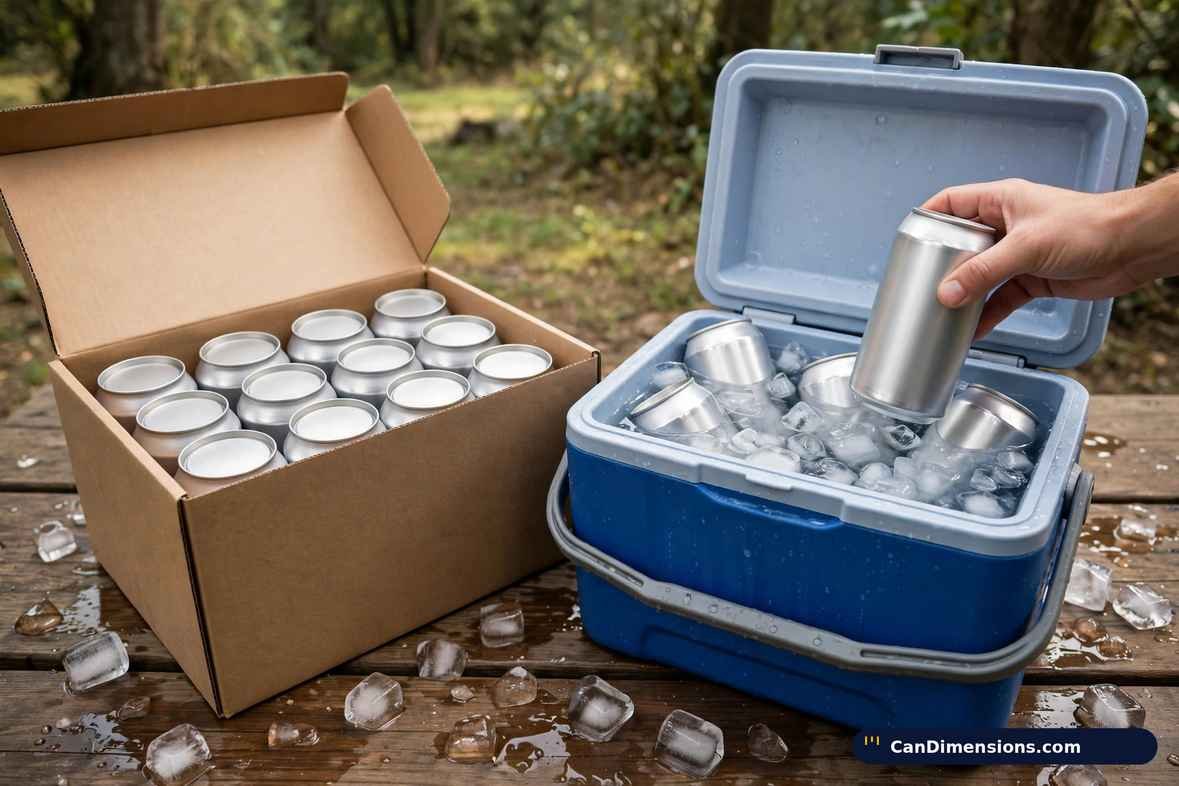
Loading the Cooler: Ice, Layers and the Tall-Can Problem
Begin with depth. Bury a sleek can in ice under a closing lid and the interior needs the can’s 6.13 inches plus room for ice below and clearance above — roughly 8.5 inches of usable depth as a working floor, a sum derived from the can plus a sensible ice allowance rather than any cooler maker’s rating. Stovepipes and the 24 oz push that requirement toward 10 inches; inside a shallow box, lay those on their sides in the ice instead of propping the lid open.
Sequence the load next. Ice goes down first, cans follow, then a thinner ice layer caps the tops — cold air sinks, so a can surrounded to its rim chills sooner than one parked on the surface. Bury the last-served drinks deepest, keep the opening round within reach, and leave backup ice bagged until the working layer runs thin.
Sleeves fix the sleek can’s single cooler flaw, its tendency to tip in meltwater: a slim sleeve hugs the narrow body and holds it steady, and the sleeve sizes for every shell named here are set out at can koozie dimensions. On sand and decking, keep sleek cans in sleeves rather than loose on a blanket, keep the cooler in shade, and give the firmly planted tall singles to guests settled furthest away.
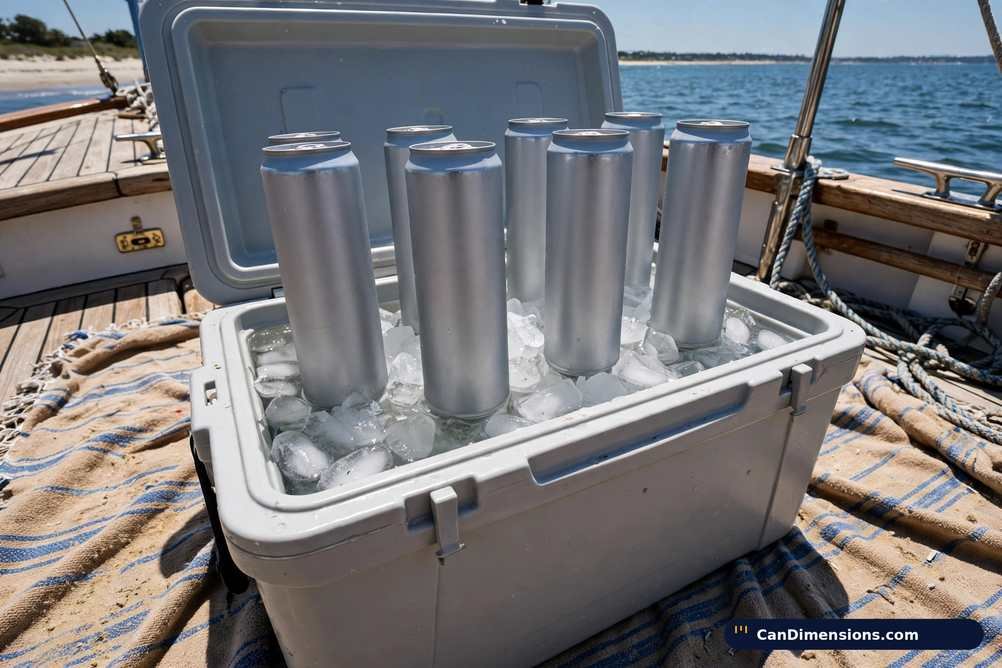
White Claw Can Dimensions for Different Pack Sizes
Pack dimensions expose the sleek correction at its most useful, since the figures in circulation were all taken around standard-body cans. What follows is derived from the confirmed can sizes — counts multiplied across the body, with a small allowance for carrier board — and presented honestly as approximation.
Single Can Dimensions and Display
Alone, a White Claw asks for just 2.26 inches of shelf width. Laid on a grid, five sleek cans span a foot, putting roughly 25 inside a square foot; standard cans manage four across and 16 per square foot, the count so often misassigned to this brand. Retail coolers commonly budget around 2.5 inches per can so shoppers can pull one free. Standardisation pays the shops back, letting seltzer brands rotate through one display layout unchanged.
6-Pack Configuration Dimensions
Six sleek cans ride three long by two deep, giving a carrier of approximately 6.8 inches long × 4.5 inches deep × 6.1 inches tall. Compare the standard-can pack usually quoted, near 8 × 5 × 5 inches: the sleek footprint shrinks, yet the height climbs by over an inch, because those extra inches of can have nowhere else to live. Board adds barely anything beyond the cans themselves. Filled, the pack weighs about 5 pounds — six servings at roughly 13 ounces apiece.
12-Pack Variety Pack Dimensions
Twelve cans pack four by three inside the variety box, which measures roughly 9 inches wide × 6.8 inches deep × 6.4 inches tall once its board counts. Copied listings land near the right footprint, around 10 × 7 inches, then spoil it with a 5-inch height lifted from standard cans; sleek boxes clear 6 inches comfortably. Loaded weight approaches 10 pounds. Ordinary fridge shelves run 10 to 12 inches deep, swallowing the box easily, and the flat top invites stacking.
Case Dimensions (24-count)
Twenty-four sleek cans arrange six by four on a case tray spanning approximately 13.6 inches long × 9 inches wide × 6.1 inches tall, before the tray’s lip. The familiar 16 × 10.5 × 5 inch case quoted online describes standard cans — precisely what six by four of those bodies produce. Drink alone brings the case to about 20 pounds, tray excluded. Pallet counts depend on the stacking pattern chosen, not on the can, so this guide offers none.
Fridge and Shelf Storage: Footprints for Every Pack Format
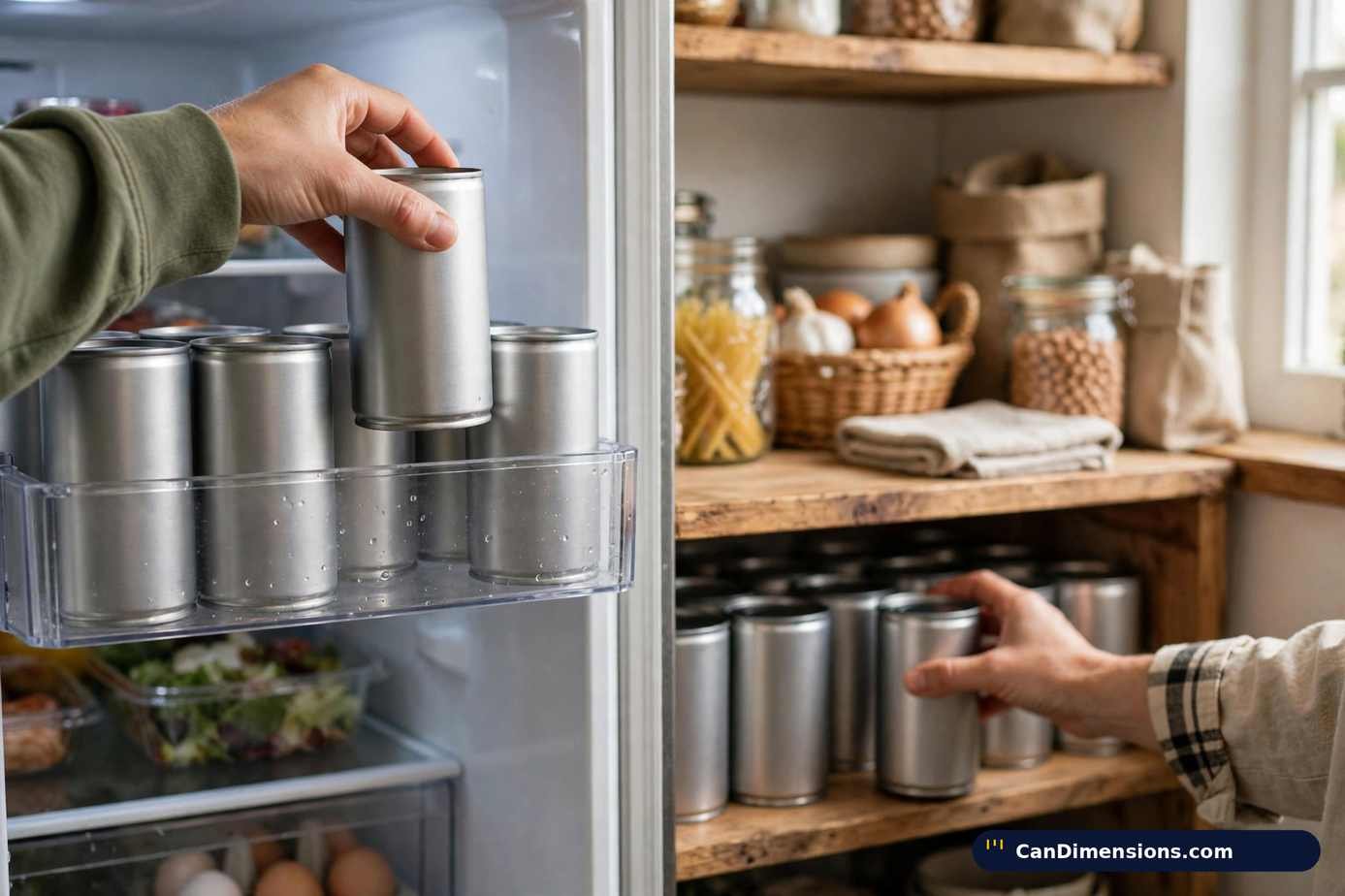
Home storage sorts the range by height. Door shelves commonly run out of room near 6.5 inches: the 6.13-inch sleek can slips under that ceiling, while the 7.41-inch stovepipe and the roughly 7.7-inch 24 oz single cannot enter at all, and graduate to a main shelf.
| Format | Footprint / clearance needed | Where it stores best |
|---|---|---|
| Single sleek 12 oz | 2.26 in across, 6.13 in tall | Fridge door or main shelf |
| 6-pack | About 6.8 × 4.5 in, 6.1 in tall | Door-adjacent shelf, small coolers |
| 12-pack variety box | About 9 × 6.8 in, 6.4 in tall | Main shelf, boxes stack flat |
| Case of 24 | About 13.6 × 9 in, 6.1 in tall plus tray lip | Bottom shelf, garage or pantry until chilling |
| 19.2 oz single | 2.6 in across, 7.41 in tall | Main shelf only, 7.5 in clear minimum |
| 24 oz single | About 2.9 in across, about 7.7 in tall | Main shelf only, about 8 in clear |
Inside the variety box, cans sit four by three with flavours grouped in rows, turning the chilled box into its own serving tray. A workable rhythm follows: one whole box chilling, one 6-pack broken into the door for early arrivals, the case waiting cold in reserve. Cases rest two trays high on a pantry shelf; loose sleek cans should never pile more than a few deep, since a tall pile on slim bases is easy to send crashing.
Measuring White Claw Cans at Home
Tools You’ll Need
Height needs nothing fancier than a ruler or tape. Calipers sharpen diameter work to within 0.01 inches, a kitchen scale confirms filled weight, and phone measuring apps serve for a rough check. Shelf carpentry and cooler purchases deserve the real ruler, though — an app drifting a few percent misreads by a rim’s height.
Step-by-Step Measurement Guide
Stand the can on something flat and read its height up to the rim’s highest edge, which is the top of the rim. Finished height means seamed height, lid counted in; the lid’s domed middle is not the summit, its rim is, and each specification quoted here follows that convention. Keep the ruler dead vertical. Diameter gets read across the body’s fattest point, midway up rather than at the pinched neck or base — or circle the body with string, mark one complete loop, lay the string flat, measure it and divide by 3.14.
Why Measurements Might Vary Slightly
Far less than folklore allows. Drawings from the makers hold finished height within fractions of a millimetre, mere thousandths of an inch, so home readings of 6.08 or 6.18 inches point to a dent, a neck measurement or a crooked ruler — never to loose tolerance. Heat moves aluminium by only around a hundredth of a percent across 10 °F, a movement too small to read on this can between fridge and beach. Crushed panels remain the lone real culprit, and they can throw a reading off noticeably.
White Claw Can Dimension Specifications Table
| Can Size | Height | Diameter | Volume | Filled Weight | Calories | ABV |
|---|---|---|---|---|---|---|
| 12 oz Sleek (Standard) | 6.13″ (15.6 cm) | 2.26″ (5.7 cm) | 355 ml | ~13 oz | 100 | 5% |
| 16 oz Tallboy | 6.19″ (15.7 cm) | 2.6″ (6.6 cm) | 473 ml | ~17 oz | 133 | 5% |
| 19.2 oz Jumbo | 7.41″ (18.8 cm) | 2.6″ (6.6 cm) | 568 ml | ~21 oz | 160 | 5% |
| 24 oz Giant (retail single) | ≈7.7″ (≈19.6 cm) | ≈2.9″ (≈7.3 cm) | 710 ml | ~26 oz | 200 | 5% |
Calorie figures come from the maker’s published 5% line — 100 in the 12 oz, rising in proportion with volume — while the 8% Surge range runs higher in identical shells, at 160 calories for 12 oz and 260 for 19.2 oz according to its pages. No 8 oz row appears, because no such can is sold. Production runs may shift a measurement by thousandths of an inch, never by the wide margins corrected throughout this guide.
Misconceptions About Seltzer Can Dimensions
“All 12 oz Cans Are Identical”
Far from it — American shelves hold three distinct 12 oz bodies: standard at 4.83 × 2.6 inches, sleek at 6.13 × 2.26 inches, and a slim-bodied version reaching 6.61 × 2.1 inches. The garbled version of this claim, contrasting sleek designs at 2.13 inches against a standard 2.25, misplaces each value: 2.25 to 2.26 inches defines the sleek body, 2.6 defines standard, and 2.13 roughly describes slim. Printed cans measure as their shells measure; a shrink sleeve elsewhere might pad perceived width by hundredths, but this brand prints directly.
“Bigger Cans Always Mean Better Value”
Per-ounce pricing flatters the largest can only while every drop gets drunk cold. Abandon the final 4 ounces of a warming 24 oz and the bargain quietly shrinks into a 20 oz purchase at a 24 oz price. Matching can size to drinking pace beats chasing the cheapest ounce — the logic behind building the party maths on single servings and treating giant cans as a chosen extra.
“Can Dimensions Don’t Affect Taste”
Temperature plainly shapes flavour: a chilled seltzer tastes sharper than one left standing to warm, something no laboratory is needed to confirm, and the exact percentage drops quoted in copied guides trace to no sensory study this guide could locate, so they go unrepeated. Fizz, meanwhile, escapes an opened can according to warmth and elapsed time, whatever the can’s proportions. Shape enters the story through the clock — a large can simply takes longer to finish, leaving its final third the warmest.
Question’s
What size can is a White Claw?
Three sizes make the maker’s list — the 12 oz sleek at 6.13″, the 16 oz tallboy at 6.19″ and the 19.2 oz jumbo at 7.41″ — joined by a retailer-sold 24 oz single near 7.7″. The 12 oz outsells the rest by a wide margin. No 8 oz version exists.
What are the dimensions of a seltzer can?
Category standard is the 12 oz sleek can: 6.13 inches of height over a 2.26-inch body, shared by this brand, its closest rival and most of the shelf. Soda’s 4.83 × 2.6 inch can matches it on neither axis.
How tall is a Truly can in inches?
Count on 6.13 inches for the standard 12 oz — the same sleek shell, filled by a different brand. Any 16 oz can riding the standard body, whatever its label, measures 6.19 inches.
What size cans are seltzers?
The 12 oz sleek at 6.13″ leads the category. Tallboy 16 oz cans, stovepipe 19.2 oz cans and occasional 24 oz singles fill out the range, with availability shifting by brand and by shop.
What are the dimensions of a 16 oz can?
Expect 6.19 inches of height and a 2.6-inch body — the standard shell, stretched one step beyond soda. The rule covers this brand, beer and most rivals at the volume, and a filled can weighs about 17 ounces.
How tall is a 19.2 oz can in inches?
The stovepipe reaches 7.41 inches, standing on a 2.6-inch body. Sold as a convenience-store single, it stays steady despite its height thanks to that full-width base.
How tall is a 24 oz can in inches?
Around 7.7 inches, with a body near 2.9 inches wide — a broad format rather than a stretched standard can. It tops this brand’s heights, though stock varies from market to market.
What are the dimensions of a 7.5 oz soda can?
Allow about 4.11 inches of height and 2.28 inches of width for the mini soda can, a shortened member of the sleek family. It is the genuine American mini; the 8 oz White Claw of copied charts was never made.
Is a can 8 or 12 oz?
The wider market holds both numbers, this brand does not. Ordinary cans carry 12 oz, minis usually carry 7.5 oz of soda or 250 ml — 8.4 oz — of energy drink. Here, 12 oz in the sleek shell is as small as the range goes.
Conclusion
Every hosting decision in this guide hangs on a single height: 6.13 inches. Clear that number and the fridge door accepts the cans, the cooler swallows them under ice, the variety box finds its shelf, and the reason seltzer packs tower over soda packs stops being a mystery. The singles then file themselves — a tallboy that behaves like beer, a stovepipe demanding main-shelf headroom and deep ice, a broad giant wanting width as well as height before anyone pays for it.
So shop by the opening-hour guidance, ice by the pound-per-guest rule, load in the order guests will drink, and run a tape over the shelf before the trip to the store. Handled that way, one ordinary refrigerator and a single properly packed cooler hold everything counted here — cold from the first arrival to the last goodbye.