What Weighs 300 Grams? 13 Common Things That Weigh 300 Grams
If you are asking what weighs 300 grams, the exact answer is 10.582 ounces — 0.66139 pounds, or just under a third of a kilogram. It is the weight of sixty American nickels in a stack, a games console with its controllers detached, or 300 millilitres of water poured into a jug.
Three hundred grams is the metric weight that sits in the gap between the imperial anchors Americans actually use. It is more than half a pound and less than three-quarters of one, close to the weight of the bigger phones-and-cases and the smaller tablets, and it is a size food packages, coin stacks and sports rulebooks all land on — which is why so many near-misses get rounded into it.
So below are 13 everyday things that weigh about 300 grams, each one checked against a real source — US Mint and Royal Mint specifications, MLB’s rulebook, USDA food data, or a manufacturer’s published weight. You also get the exact conversions and the honest corrections: five familiar examples from lists like this one, including the three sticks of butter and the two medium apples, do not actually weigh 300 grams, and this guide says so where they appear.

What Weighs 300 Grams? The Exact Conversions
Three hundred grams is just under a third of a kilogram, and the rest of its conversions follow from the fixed definitions of each unit. The pound row is the one worth memorising, because 300 grams is not two-thirds of a pound: two-thirds of a pound is 302.4 grams, so 300 grams falls about 2 grams short of the fraction it is usually rounded to — close enough for a kitchen estimate, wrong enough to matter on a postage scale.
| Unit | 300 Grams Equals | Notes |
|---|---|---|
| Kilograms | 0.3 kg | Just under a third of a kilogram |
| Milligrams | 300,000 mg | 1 g = 1,000 mg |
| Pounds | 0.66139 lb | 1 lb = 453.592 g |
| Ounces | 10.582 oz | 1 oz = 28.3495 g |
| Stones | 0.0472 st | 1 st = 14 lb |
| Carats | 1,500 ct | 1 ct = 0.2 g |
| Grains | 4,630 gr | 1 gr ≈ 0.0648 g |
| Volume of water | 300 ml | Water weighs 1 g per ml |
Read the carat and grain rows as the jeweller’s and the reloader’s versions of the same weight: 300 grams is 1,500 carats of gemstone or about 4,630 grains of powder measure. And the last row is the one the kitchen runs on — because water weighs almost exactly one gram per millilitre, 300 grams and 300 millilitres of water are the same thing wearing two labels.
How Heavy is 300 Grams?
Three hundred grams sits right between half a pound (227 grams) and three-quarters of a pound (340 grams): lighter than anything you would call heavy, but very noticeable in one hand — roughly the heft of a small tablet or a can of soup’s contents. One comparison that circulates with this weight needs correcting: 300 grams is not slightly heavier than a standard 12-ounce can of soda, as it is sometimes described. A full soda can carries about 355 ml of drink — roughly 365 grams of soda alone, before the can — so a full can outweighs 300 grams by a wide margin. Three hundred grams is closer to the soda can with a good swallow taken out of it. In the hand it is a one-handed, pocketable weight — about what you register when you pick up three 100-gram chocolate bars at once.
Common Things That Weigh 300 Grams
Here is the whole verified list at a glance. Every row is one of the counted examples detailed below; the five popular examples that failed the check — the butter, the apples, the ground beef portion, the paperback and the cased phone — keep their headings further down, clearly marked as misses.
| Example | Weight | Checked Against |
|---|---|---|
| Two standard baseballs | About 284–298 g | MLB Rule 3.01 (5–5.25 oz each) |
| A can of soup (condensed) | About 300 g | Labelled net weight (305 g / 298 g cans) |
| A standard tablet device (iPad mini) | About 293–297 g | Apple technical specifications |
| 60 US nickels | Exactly 300 g | US Mint (5.000 g each) |
| 120 US pennies (post-1982) | Exactly 300 g | US Mint (2.500 g each) |
| 60 British 20p coins | Exactly 300.0 g | The Royal Mint (5.0 g each) |
| 300 millilitres of water | Exactly 300 g | Density of water, 1 g per ml |
| 300 US dollar bills | About 300 g | Bureau of Engraving and Printing (~1 g each) |
| A 300 g calibration weight | Exactly 300 g | Certified test weight (ASTM/OIML) |
| 60 sheets of A4 paper (80 gsm) | About 299 g | ISO 216 size × rated grammage |
| A Nintendo Switch console | About 297 g | Nintendo official specifications |
| 13 AA alkaline batteries | About 299 g | Energizer E91 datasheet (23.0 g each) |
| Three 100 g chocolate bars | Exactly 300 g | Labelled net weight (100 g bars) |
Each example below was checked against a mint specification, an official standard, a labelled weight or a manufacturer’s published figure before it earned its place. Five famous names from lists like this one keep their headings but are clearly marked as misses, because they do not weigh 300 grams and pretending otherwise would make this list useless for calibrating anything.
Two Standard Baseballs
Counted, as an “about” — with the range disclosed, because this is the rare case where the rulebook itself sets the ceiling. Major League Baseball’s Rule 3.01 requires every official ball to weigh between 5 and 5.25 ounces, which is 141.7 to 148.8 grams. Two balls therefore weigh between about 284 and 298 grams: two balls at the very top of the legal range come to 297.7 grams, a couple of grams short of 300, and no legal pair can pass it.
That makes two baseballs an honest “just under 300 grams” reference rather than an exact one — the heaviest handful the rulebook allows. If you have held two game balls, you have held within a few grams of this weight, and the small shortfall is printed here rather than rounded away.
A Can of Soup
Counted, on the labelled contents — and with a correction to the way this example is usually told. Campbell’s classic condensed cans are labelled by net weight: the traditional 10.75-ounce can carries 305 grams of soup, and the 10.5-ounce cans now common on the shelf are labelled 298 grams. Either way, the soup itself sits within a few grams of 300, which is what makes the can such a natural pantry reference.
What the label does not say is that those grams are the contents alone. The figure printed on a can is a net weight, so the sealed can standing on your scale reads more — the steel adds its own weight on top. Lists that describe the 10.75-ounce can “including the soup and metal container” as weighing 305 to 310 grams have folded the can into a number that was only ever the soup. Counted here as what it verifiably is: about 300 grams of soup, in a can that weighs extra.
Three Sticks of Butter
This one is a clear miss, and the arithmetic is not close. One US stick of butter weighs 113 grams — exactly a quarter of a pound — so three sticks total about 340 grams, which is 40 grams over: nearly an eighth again as much as the target. Three sticks of butter are a three-quarter-pound reference, not a 300-gram one.
To hit 300 grams of butter you need about 2.65 sticks — two full sticks plus two-thirds of a third. Butter is a fine baking reference at 113 grams a stick. As a triple, it is not 300 grams, so it is not counted here.
Two Medium-Sized Apples
A miss by the same margin as the butter, in the same direction. USDA FoodData Central puts a medium apple — 3 inches across — at 182 grams, so two medium apples weigh about 364 grams, more than a fifth over the target. The claim behind this heading needs each apple to weigh about 150 grams, and while the USDA’s small apple, at 149 grams, is close to that, a small apple is not a medium one.
To reach 300 grams of apples you need about one and two-thirds medium apples. A single medium apple is a good 180-gram reference. As a pair, they are not 300 grams, so they are not counted here.
A Standard Tablet Device
Counted, as an “about” — on a named model, because “a standard tablet” as a class does not exist. The compact end of the market is where 300 grams lives: Apple’s technical specifications put the iPad mini (6th generation) at 293 grams for the Wi-Fi model and 297 grams for the Wi-Fi + Cellular model, and the original iPad mini of 2012 weighed 308 grams in Wi-Fi form. Across a decade of the same product line, the small tablet has stayed within about ten grams of this weight.
The caution is the word “standard”. Full-size tablets are nowhere near it — the 10-inch class runs roughly half again as heavy — so the reference only holds for the mini format. If your tablet is a small one, check its specification page: there is a good chance it is a 300-gram reference you already own.
300 Grams of Ground Beef
Not counted — not because the figure is wrong, but because it is not a reference. Three hundred grams of ground beef weighs 300 grams by definition: it is a portion you create on a scale, not an object you can pick out of a fridge and recognise. A reference you cannot identify without weighing it first cannot teach your hand anything, which is the same reason the paperback book below fails.
The portion is still worth picturing: 300 grams of ground beef is 10.58 ounces of meat — three 100-gram patties or two generous ones, and a substantial single serving by any guideline. But it earns its place in the kitchen sections below, not in the counted list.
A Standard Paperback Book
This one fails for the same quiet reason the hardcover failed at 500 grams: there is no such thing as a standard book weight to check it against. No publisher, printer or standards body fixes what a “standard paperback” weighs, and real novels of similar page counts scatter widely — trim size, paper stock and cover weight move the same story from well under 250 grams to well over 350.
Some individual paperbacks certainly land near 300 grams, the way some individual apples land near 150. But a reference you cannot identify without a scale is not a reference. Not counted.
A Large Smartphone with Case
Not counted, because the object itself is undefined. The phone half of the claim checks out — Apple lists the iPhone 15 Pro Max at 221 grams, and the largest mainstream phones cluster between about 220 and 240 grams — but “with case” adds a second object whose weight is whatever its maker chose: slim cases run near 20 grams, rugged armour cases several times that, and no standard case weight exists to add to the phone.
A big phone in a heavy case can certainly pass 300 grams; a big phone in a slim case lands nearer 245. Because the total depends entirely on a case nobody specified, there is no verifiable “large smartphone with case” weight to count. Not counted.
Sixty US Nickels
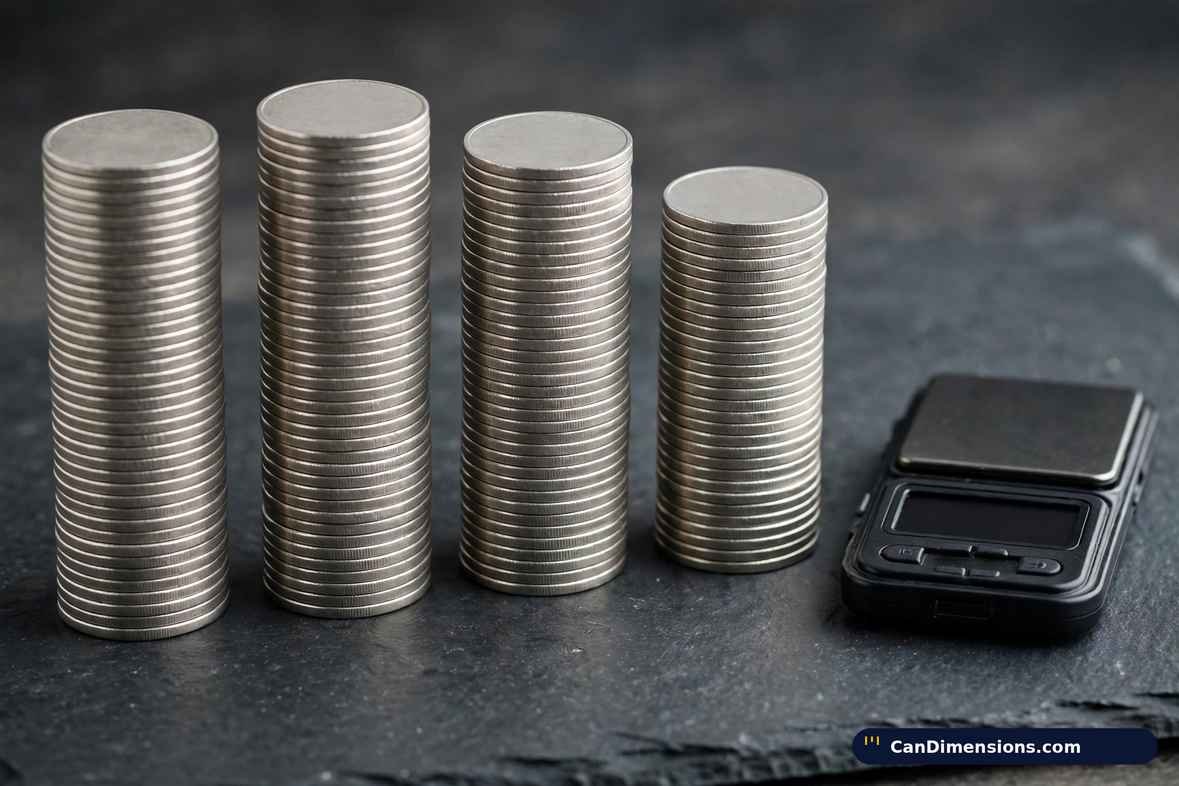
The most precise answer on this page costs three dollars. The United States Mint strikes every nickel to a specification weight of 5.000 grams, so 60 of them weigh exactly 300 grams — the same coin maths as 100 nickels making 500 grams, scaled down. The coins are 75% copper and 25% nickel, and the weight has been standard since the nickel was introduced in 1866.
Mint specifications are manufacturing tolerances, not estimates, which is why coin stacks are the classic home calibration check. If you own sixty nickels, you own a pocket 300-gram weight.
One Hundred Twenty US Pennies (Post-1982)
One hundred twenty pennies work too, with the same date condition as the other coin references in this series. Every cent minted since 1982 is copper-plated zinc at a Mint specification of 2.500 grams, so 120 of them weigh exactly 300 grams. Cents from before 1982 are mostly copper and weigh 3.11 grams each, so 120 vintage pennies would total about 373 grams — check the dates before you trust the pile.
Sixty British 20p Coins
Britain’s seven-sided 20p coin is the nickel’s exact transatlantic twin. The Royal Mint’s specification gives the coin a weight of 5.0 grams — cupro-nickel, 21.4 mm across, in circulation since 1982 — so any sixty 20p coins weigh exactly 300.0 grams. Between the nickel sixty and the 20p sixty, most pockets on either side of the Atlantic can assemble a precise 300 grams for twelve pounds or three dollars.
300 Millilitres of Water
The cleanest reference on this page, and the one every kitchen already owns. Water’s density is 1 gram per millilitre, so 300 ml of water is 300 grams by definition — no manufacturer, no tolerance, no range. Measure it with any measuring jug, pour it into a tared container, and you are holding exactly 300 grams.
As with the bigger bottle at 500 grams, the caution is the container: it is the water that weighs 300 grams, not the water plus its bottle. A full 300 ml bottle reads over, because the plastic counts too. For calibrating a scale, weigh the measured water, not the sealed bottle.

Three Hundred US Dollar Bills
Every US banknote, from a $1 bill to a $100 bill, is printed on the same cotton-linen stock — 75% cotton, 25% linen — and weighs approximately 1 gram, a figure that comes from the Bureau of Engraving and Printing itself. So a stack of 300 bills of any denomination weighs about 300 grams. Note the “about”: the Bureau says approximately, so this is a very good reference rather than a specification-grade one.
A 300 g Calibration Weight
The most literal answer on the list: a certified 300 g test weight, made by firms such as Mettler Toledo and Ohaus to an exact nominal 300 grams under ASTM or OIML classes, exists precisely so you never have to guess at this weight. Test weights are manufactured in a standard ladder of denominations — 100 g, 200 g, 300 g, 500 g — so the 300 g size is a catalogue item, not a special order. If you weigh coffee, parcels or portions regularly, one of these costs little, lasts forever, and settles every argument with your scale in seconds.

Sixty Sheets of A4 Paper (80 gsm)
Printer paper is sold by weight, and the maths is built into the name. Standard 80 gsm paper weighs 80 grams per square metre; an A4 sheet measures 210 × 297 mm, which is 0.0624 square metres, so one sheet weighs about 4.99 grams. Sixty sheets therefore weigh about 299 grams — 300 grams for any practical purpose, worked out straight from the paper’s own rating. A full ream is 500 sheets, so the reference is simply sixty sheets counted off the top of one.
A Nintendo Switch Console
Gaming’s contribution to the list, and a manufacturer’s figure rather than an estimate. Nintendo’s official specifications give the Switch console — the tablet unit on its own — a weight of approximately 297 grams. That is the number that matters here: the console you hold is a 297-gram object, within three grams of the target.

The disclosure is the controllers. Click the two Joy-Con controllers on and Nintendo’s figure rises to approximately 398 grams, a full third heavier — so the reference is the console with its controllers detached, exactly as it sits in many players’ hands on a train. Counted as an “about” on Nintendo’s own published specification.
Thirteen AA Alkaline Batteries
Counted as an “about”, on a datasheet figure. Energizer’s product datasheet for the E91 — the standard AA alkaline cell — gives a typical weight of 23.0 grams, so thirteen cells weigh about 299 grams: a drawerful of remote-control batteries is a 300-gram reference to within a gram.
The chemistry is the caution. The 23-gram figure belongs to alkaline cells; lithium AAs weigh only about 15 grams each, and rechargeable NiMH AAs are noticeably heavier, so a mixed drawer will not average out to this total. Thirteen alkaline AAs, of any major brand, are the reference.
Three 100 g Chocolate Bars
The sweetest arithmetic on the page. The standard European chocolate tablet is sold at a labelled net weight of 100 grams — the size on the shelf from Lindt, Ghirardelli and most other makers — and a labelled net weight is a legal claim, not a rough guide. Three such bars therefore weigh exactly 300 grams of chocolate, wrappers adding only a gram or two on top.
It is also the easiest reference to test a scale with and then eat. If the bars in your shop are the 100 g size — check the label, because American bars are often smaller — three of them are a precise, delicious 300 grams.
300 Grams for Quick Reference
Household Items Between 250 and 350 Grams
The band around the target is as useful as the target itself, and every figure in it can be checked. Just under 300 grams: 50 US nickels weigh exactly 250 grams by Mint specification, and 250 ml of water weighs exactly 250 grams — the quarter-kilo pair. Just over it: the three sticks of butter from the example list above total about 340 grams (three 113-gram sticks), which is where the three-quarter-pound line sits. And the comparison to retire: a full 12 fl oz can of soda, contents and can together, weighs roughly 380 grams — noticeably more than anything in this band, which is why describing 300 grams as “heavier than a soda can” gets the direction wrong.
How to Measure 300 Grams Without a Scale
Start with muscle memory. Hold 300 ml of water measured into a jug — the exact weight — then hold a full 300 ml bottle, remembering it actually reads over because the bottle counts too. Close your eyes and fix the sensation of the jug; that physical memory is what you will estimate against later, and it is genuinely how cooks and packers learn this weight.
For something checkable, use the coin method: 60 nickels, 60 British 20p coins or 120 post-1982 pennies each make exactly 300 grams by mint specification. Put the coins in one bag and your item in another, hang them from the ends of a ruler balanced on a pencil, and adjust the item until the ruler sits level — at balance, your item weighs 300 grams. And when precision matters, tare a container on any inexpensive digital scale and pour in water to 300 ml: you have manufactured an exact 300 grams out of a tap.
300 Grams in Different Contexts
300 Grams of Food Portions
In the kitchen, 300 grams is a generous single portion or a modest two-person one. It is one large chicken breast, about three servings of raw meat by the standard 3-to-4-ounce portion guidance, or a family-of-two amount of mince for a sauce. Measured dry, it is roughly five standard servings of pasta — the USDA’s dry-pasta serving is 2 ounces (56 grams) — and about 1.6 cups of uncooked long-grain rice, which expands to roughly 4.5 to 5 cups cooked and serves four to six as a side.
300 Grams in Shipping and Postage
At 10.582 ounces, a 300-gram parcel sits comfortably in the lightest band of domestic parcel pricing — well under the one-pound step where rates start to climb. Note that the service names have changed: USPS retired its First-Class Package Service in July 2023 and folded lightweight parcels into Ground Advantage, but the weight logic survived the rename. Internationally, carriers commonly step their rates at 250 grams, 500 grams and 1 kilogram, so a 300-gram package typically lands in the second pricing tier — the practical lesson being that shaving 50 grams off a 300-gram parcel can drop it a full band.
300 Grams in Fitness and Nutrition
For anyone tracking macros, 300 grams is where eyeballing stops working: it is large enough that a guess can be out by a hundred calories. Weighing the portion fixes it — a 300-gram raw chicken breast, for example, carries about 68 grams of protein by USDA figures (22.5 grams per 100 g raw), a number worth knowing precisely if it is the centrepiece of a training diet. A protein portion cut at 300 grams raw is a deliberate, athlete-sized serving, not an accident of the pan.
Comparing 300 Grams to Other Common Weights
300 Grams vs. Half a Pound
This is the comparison that frames the whole weight. Half a pound is 226.8 grams, so 300 grams overshoots it by about 73 grams — it is a half-pound plus roughly fifteen nickels. Against the full pound the gap runs the other way: one pound is 453.59 grams, so 300 grams is about two-thirds of the way there (0.66139 lb, to be exact — and not exactly two-thirds, which would be 302.4 grams). If a scale, label or recipe treats 300 grams and a neat imperial fraction as interchangeable, it is wrong by a small but real amount in both directions.
How 300 Grams Relates to Other Metric Weights
100 grams is one-third of 300 g. That is 20 nickels, 100 ml of water, or a standard bar of soap — and the weight nutrition labels use as their reference serving, which is why our guide to what weighs 100g gives that smaller weight the same verified treatment, example by example.
500 grams is 300 g plus another 200 g. That is two standard pasta packs’ heavier sibling at 1.10231 pounds — our how many pounds is 500 g guide runs the same coin-and-label checks at that weight.
1 kilogram is a little more than three times 300 g. That is 2.20462 pounds, 200 nickels, or three 300 ml measures of water plus a splash. Many household staples come in 1 kg packages because it is the metric system’s clean base number.
10 grams is one-thirtieth of 300 g. Thirty of the references in our how much is 10 grams guide — two nickels apiece among them — rebuild this exact weight, and three hundred of the paperclip-class items in our things that weigh 1 gram guide add up to it from the other direction.
Common 300-Gram Myths, Checked
Because this weight is asked about so often, the myths have had time to harden. These are the ones checked and corrected in this guide:
- “300 grams equals two-thirds of a pound.” It equals 0.66139 pounds; two-thirds of a pound is 302.4 grams. Close, but about 2 grams apart.
- “Two baseballs weigh exactly 300 grams.” The MLB rulebook caps one ball at 148.8 grams, so the heaviest legal pair is 297.7 grams — just under, never over.
- “Three sticks of butter weigh 300 grams.” A stick is 113 grams, so three sticks are about 340 grams — a three-quarter-pound weight, not this one.
- “Two medium apples weigh 300 grams.” USDA puts a medium apple at 182 grams; two weigh about 364 grams.
- “300 grams is slightly heavier than a full can of soda.” The direction is backwards: a full 12 fl oz can, drink and metal together, weighs roughly 380 grams.
- “A standard paperback book is a reliable 300-gram reference.” No standard paperback weight exists; page count alone does not fix a book’s weight, and real paperbacks scatter from under 250 to over 350 grams.
- “A full 300 ml water bottle weighs exactly 300 grams.” The water does; the bottle adds its own grams on top, so the sealed bottle reads over.
Question’s
What weighs 300 grams?
Sixty US nickels (exactly, by Mint specification), 300 ml of water, three 100 g chocolate bars, or about thirteen AA alkaline batteries. A Nintendo Switch console weighs 297 g, and two baseballs at the top of their legal range reach about 298 g. The full verified list of 13 is in this guide.
Which animal weighs 300kg?
Three hundred kilograms is 661 pounds — a thousand times this article’s weight, so no kitchen reference crosses over. A large male grizzly bear or a big Siberian tiger can reach about 300 kg, and a pony sits in the same neighbourhood.
What household items weigh 200 grams?
Forty US nickels weigh exactly 200 grams by Mint specification, and 200 ml of water does too. Two hundred grams is 7.05 ounces — about a third lighter than 300 grams, a difference you can feel the moment you pick both up.
How much is 300 grams of food?
It depends on the food, because cups measure volume: about 2.5 cups of all-purpose flour (roughly 120 g a cup), 1.5 cups of granulated sugar (about 200 g a cup), or about 1.6 cups of uncooked rice. As meat, it is one large chicken breast or three standard portions.
Is 300 grams of chicken a lot?
Yes, for one serving: it is 10.58 ounces against the standard 3-to-4-ounce portion, and a raw skinless breast of that weight carries about 68 grams of protein (USDA: 22.5 g per 100 g raw). It is a large single portion or a modest two-person amount.
What do 300 grams of sugar look like?
About 1.5 cups — a cup of granulated sugar weighs roughly 200 grams, so 300 grams fills a standard measuring cup once and then half again. In a bowl it is a modest heap, not a mound.
What is an example of a 300 GSM?
GSM stands for grams per square metre — it measures the weight of paper or fabric per unit area, not the weight of an object. A 300 gsm stock is thick card: business cards, wedding invitations and premium postcards are typically printed on it.
What household item weighs exactly 500 grams?
One hundred US nickels, exactly 500 grams by Mint specification — or 500 ml of water poured into a tared container. A full 500 ml bottle is close but reads about 10 grams over, because the bottle itself counts.
Is 300g of meat a lot?
Yes — 10.58 ounces, against the 6-to-8-ounce steaks most restaurants serve. It is a large single serving for one person, or a reasonable amount split between two.
Conclusion
Three hundred grams stops being abstract the moment it has anchors: 60 nickels, 300 ml of water measured into a tared jug, three labelled chocolate bars, a calibration weight made for exactly this number. Those are the examples worth remembering, because each one was checked against the people who actually make or measure the thing — the mints, the USDA, the manufacturers and the rulebooks.
Just as useful is knowing which famous examples to retire: the 340 grams of three butter sticks, the 364 grams of two medium apples, the case-dependent phone and the standardless paperback. Keep one verified reference where you weigh things — the certified weight if you are serious, the coin stack if you are not — and when someone tells you the weight of one baseball, doubled, must be 300 grams, you will know the rulebook’s own arithmetic stops it a couple of grams short: 297.7, honestly counted.