3 Feet: 11 Things with Pictures That Are 3 Feet Long or Tall
A reliable 3 feet example is hiding in plain sight in most houses: the work surface in a standard kitchen stands exactly this high, and the widest door in the hallway measures this much across. Three feet is also one yard, which makes it the easiest big conversion in the imperial system.
Four of the six objects usually named for this span do not survive a tape measure, and each failure is printed below with its real size attached. What replaces them is a stronger set — a road cone built to a federal size ladder, a grab bar whose length a building standard fixes, and a roller that physio clinics buy by this exact length.
First the conversions, then eleven checked references, the body tricks that genuinely work, and the spots where this span turns up during an ordinary week.
How Long Is 3 Feet?
The span, translated into the units readers ask for most often:
| Unit | 3 Feet Equals |
|---|---|
| Inches | 36 in |
| Yards | 1 yd exactly |
| Centimeters | 91.44 cm |
| Millimeters | 914.4 mm |
| Meters | 0.9144 m |
All five rows describe one and the same distance, because a foot is defined as 30.48 centimetres exactly. Two look-alikes deserve a warning before the list begins. Three inches — covered in 3 inches, our separate guide to that much smaller size — is only a twelfth of what is under discussion here, while the 25 feet that readers measure out for driveways belongs to another world of spans altogether.
For a first picture, use the kitchen. The top of a standard counter sits precisely this far above the floor, a height the cabinet industry settled generations ago; its example section further down shows the arithmetic behind it.
3 Feet Compared to a Human
The CDC puts the measured average height of an American man at 68.9 inches. Dividing this span by that figure gives 0.52: three feet equals a little more than half an adult’s height, landing at about hip level — the very reason a work surface built to it suits a standing cook.
Children reverse the picture. Median stature at age three, from the CDC growth tables, is roughly 37.4 inches for boys and 37 inches for girls, both just past the mark. A youngster measuring precisely three feet is therefore a perfectly ordinary toddler, somewhere on the near side of a third birthday — a handy image when the span must be judged against a person instead of a wall.
11 Common Things That Are 3 Feet Long or Tall
Every entry in the list that follows had to produce evidence: a manufacturer’s published dimension, a size fixed by a standard, or a figure set by a rulebook. Where the evidence amounts to a size class, a labelled size or an approximation, the section itself carries that disclosure. Eleven entries qualify. Four inherited names fail, and those four stay in their original places below, clearly marked, each with its true measurement printed.
| # | Thing | Verified size | Counted? |
|---|---|---|---|
| 1 | Standard Yardstick | Exactly 36 in by definition | Yes |
| 2 | Standard Household Broom | Full-size models ≈57 in overall; handles ≈48 in | No |
| 3 | Standard Traffic Cone | 36 in is a standard MUTCD/FHWA size class | Yes |
| 4 | Guitar Case | Dreadnought cases ≈42.5 in inside, ≈45 in outside | No |
| 5 | Fireplace Poker | Tool-set pokers cluster ≈26–33 in; no 36 in standard | No |
| 6 | Standard Baseball Bat | Adult sizes centre on 32–34 in per maker charts | No |
| 7 | A 36-Inch Door | The 3/0 slab is 36 in wide by trade notation | Yes |
| 8 | A Standard Kitchen Counter | Finished height 36 in (34.5 in cabinet + top) | Yes |
| 9 | A 36-Inch Dog Crate | MidWest iCrate 1536 listed at 36 in long | Yes — flagged, labelled-size basis |
| 10 | A 36-Inch Grab Bar | Moen R8736 is 36 in; ADA rear-wall minimum is 36 in | Yes |
| 11 | A Full-Length Foam Roller | OPTP PRO-ROLLER specified at 36 × 6 in | Yes |
| 12 | A 36-Inch Refrigerator | Frigidaire French-door models listed 36 in wide | Yes — flagged, labelled-width basis |
| 13 | A 36-Inch Level | Johnson 1300-3600 specified at 36 in long | Yes |
| 14 | A 36-Inch Ceiling Fan | Hunter Aker blade span 36 in per the maker | Yes |
| 15 | A 3-Foot Artificial Christmas Tree | National Tree Co. models measure 36 in tall | Yes |
Standard Yardstick
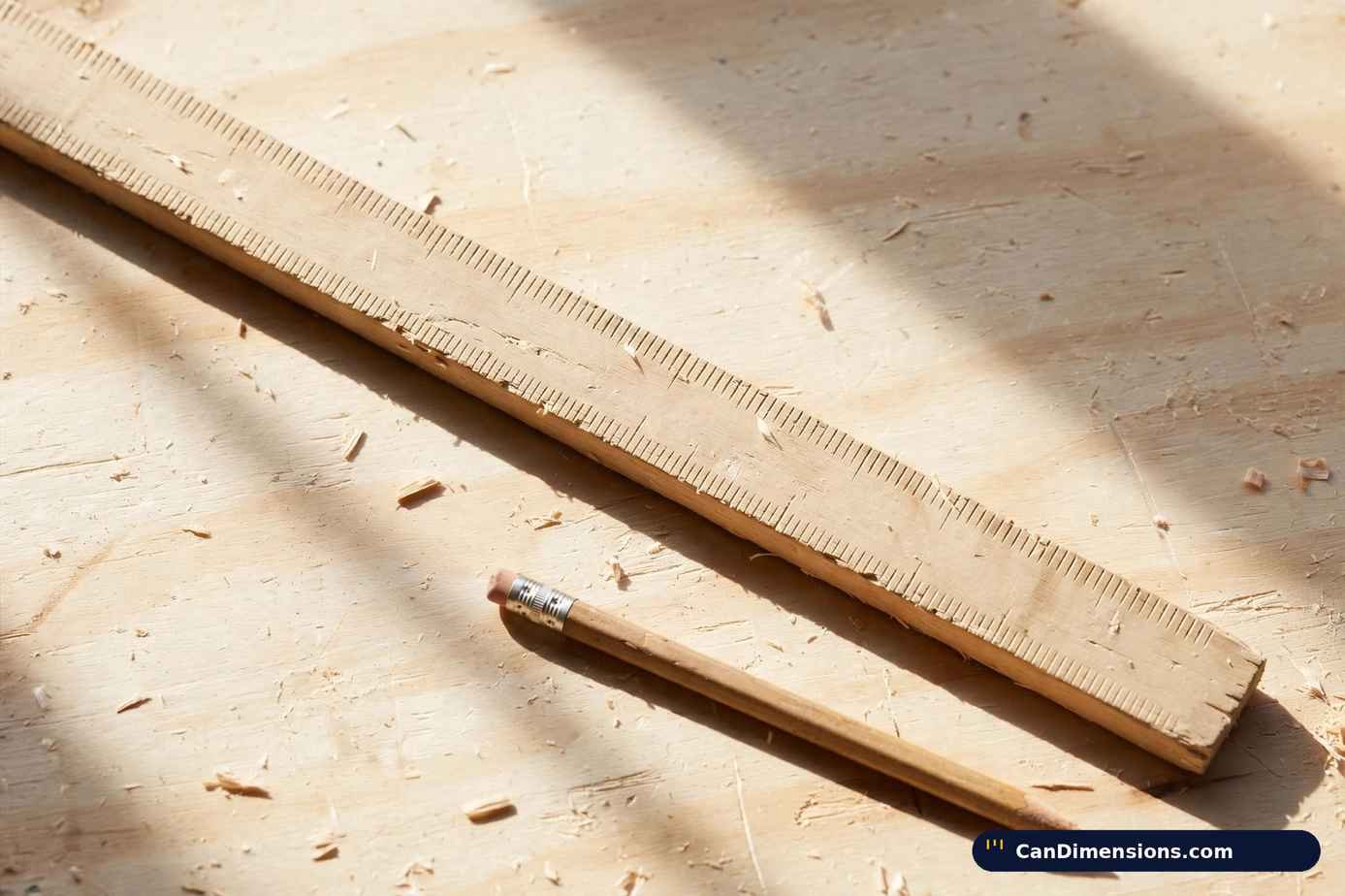
Counted: Exactly — by definition, and the tidiest reference in this list. A yardstick is the yard made physical: a rigid rule cut to 36 inches, one full yard end to end, sold for classrooms, sewing tables and workshop benches. No maker tolerance argument applies, because the object’s name and its length are the same statement.
That definitional neatness is also its limit as a visual aid. A yardstick tells you the span perfectly when one is in your hand, and does nothing for you at a kerb or in a showroom. Keep it as the calibration standard, then borrow the wider, taller references further down this list for estimating at a distance.
Standard Household Broom
Not counted: The broom named here overshoots the claim by nearly two feet. Full-size angle brooms from the big household brands run about 57 inches overall — O-Cedar’s full-size flagged and unflagged models both list 57 inches long on a 48-inch handle — and size guides for the category put ordinary household brooms at roughly 52 to 57 inches from bristle tip to handle top.
The likely source of the error is a lobby broom: one Libman lobby set lists a 36-inch handle, and a short lobby or whisk tool is a different implement from the kitchen broom most readers own. A claim that fits a niche variant cannot carry a heading that promises the standard article, so the broom leaves the count, and its star row leaves the methods table below with it.
Standard Traffic Cone
Counted: On the standard-size basis, disclosed here, with the regulation stated correctly. Cone heights in the federal Manual on Uniform Traffic Control Devices ladder run 18, 28 and 36 inches; 36 inches is the largest standard size, the one state highway departments reach for on freeways, expressways and night work at speed, where the federal minimum itself is 28 inches and the taller cone is the preferred practice.
So the honest claim is narrower and stronger than the usual version. Not every road cone stands three feet — parking-lot cones are commonly 18 or 28 inches — but the 36-inch cone is a real, regulated member of the family, manufactured in quantity and instantly recognisable. When the cone in front of a lane closure looks waist-high, this page’s span is what you are seeing.

Guitar Case
Not counted: The case in this heading overshoots by roughly a foot, and its own text gives the game away — a case built around an instrument about 39 inches long cannot itself measure 36. SKB’s dreadnought cases, the volume sellers in this class, list interior lengths of about 41 to 42.5 inches and exterior lengths of about 45 inches; its jumbo case runs longer still.
Smaller cases exist for smaller instruments, and a case for a short-scale or travel guitar can land nearer this span, but no standard full-size guitar case measures three feet. The heading stays because readers search for it; the count moves on without it.
Fireplace Poker
Not counted: No standard poker length exists, and the sets that dominate the market land short of this span. Standalone fire-pit pokers are commonly sold at about 30 inches, fireplace tool sets carry pokers in roughly the 26-to-33-inch band, and the products explicitly marketed as extra-long start at 36 inches and run upward — a category that only makes sense because the ordinary tool is shorter.
A 36-inch poker can certainly be bought; it is the long option, not the standard one. Since this list counts standards and named sizes rather than available options, the poker is corrected here and left out of the eleven.
Standard Baseball Bat
Not counted: Adult bats centre a full two to four inches below this mark. Louisville Slugger’s own sizing guidance puts the most popular length for players seventeen and older at 33 to 34 inches, retailer bat guides put the college game’s most popular size at 33 inches, and the most commonly used adult baseball length overall at 32 inches.
Thirty-six-inch bats exist at the extremes of slow-pitch and fungo lines, but the standard adult bat — the object this heading promises — is a 32-to-34-inch tool. The correction matters because the bat is the comparison readers reach for first; picturing one gives you a span about three inches short of the real thing, every time.
A 36-Inch Door
Counted: Exactly, on the trade’s own notation. American doors are scheduled in feet-and-inches shorthand, and the widest common single door is written 3/0 — three feet, zero inches — a slab 36 inches wide by 80 inches tall. It is the standard front-door width and the width used wherever furniture, appliances or a wheelchair need the extra clearance.
Stand in a doorway and spread a hand across the frame’s inner faces and you are spanning close to this page’s length, minus the stops. Of all the references here, this is the one built into the walls of the reader’s own home, already measured by the carpenter who hung it.
A Standard Kitchen Counter
Counted: Exactly, on the cabinet trade’s standard build. The NKBA’s kitchen planning material builds the finished work surface from a base cabinet 34.5 inches high plus a countertop about 1.5 inches thick, arriving at a finished height of 36 inches from the floor — the figure appliance makers then design their ranges and dishwashers to sit beside.
This is the reference the introduction promised, and it earns the spot two ways: it is exact, and it is vertical in a list dominated by lengths. Any standard kitchen gives you a three-foot altitude line running around the room at hip height, no tape required.

A 36-Inch Dog Crate
Counted: On the flagged labelled-size basis, disclosed here. Wire crates are sold by their length in a standard ladder, and the intermediate rung is the 36-inch crate: MidWest’s iCrate in that size, model family 1536, is listed at 36 inches long by 23 wide by 25 high, rated for dogs of about 40 to 70 pounds.
One disclosure rides along, borrowed from the crate family’s own listings: individual listings for nominally identical crates scatter by half an inch or so in each direction, because the printed size is the class name rather than a machined dimension. Counted as what it is — a manufactured size class every pet shop stocks — the figure holds.
A 36-Inch Grab Bar
Counted: Exactly, on both a maker’s sheet and a building standard. Moen’s Home Care line includes a grab bar, model R8736W, specified at 36 inches long with a 500-pound rating when fixed into studs or approved anchors — and the accessibility standards independently fix 36 inches as the minimum length for the rear-wall grab bar at a water closet, positioned twelve inches one side of the centreline and twenty-four the other.
Few household objects carry their length in a code book. The next time a hotel bathroom offers a long horizontal bar behind the toilet, the chances are good that its three feet were set by that paragraph of the standard rather than by anyone’s taste.
A Full-Length Foam Roller
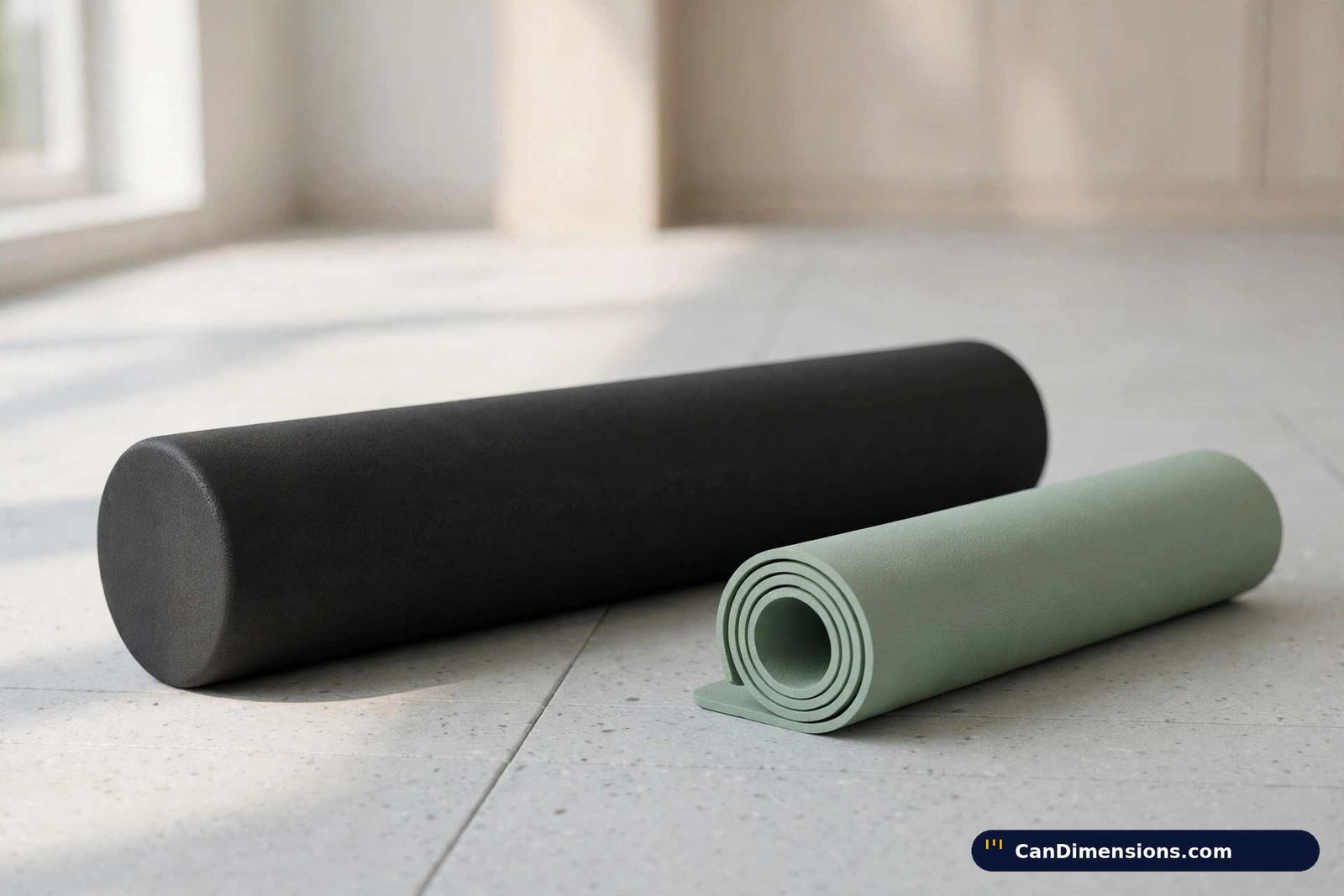
Counted: Exactly, on the maker’s specification. Foam rollers are sold in a four-length ladder — 12, 18, 24 and 36 inches — and the longest rung is the full-length roller used for back work and Pilates. OPTP’s PRO-ROLLER in that class is specified at 36 inches long by 6 inches in diameter, long enough to support head, spine and pelvis in a single line.
The size is worth fixing in memory because gym equipment is otherwise hard to gauge from a photograph. A roller that reaches across both shoulder blades in one pass is the 36-inch one; anything that makes you work down your back in sections is one of the shorter rungs.
A 36-Inch Refrigerator
Counted: On the flagged labelled-width basis, disclosed here. Full-size French-door refrigerators are built for a 36-inch cabinet opening, and the makers list the volume models at that width: Frigidaire’s 36-inch-wide French-door line is specified at a product width of 36 inches, even though the bare cabinet beneath the doors can measure a fraction under, at about 35⅝ inches on some models.
The distinction is printed rather than hidden because it decides what the count means: three feet is the width the kitchen is planned around, the number on the spec sheet’s headline line, and the gap the installer measures before the truck arrives. On that labelled basis — the same basis as the crate above — it counts.
A 36-Inch Level
Counted: Exactly, on the maker’s catalogue entry. Levels follow the same ladder logic as the yardstick they assist, and 36 inches is a standard rung: Johnson’s aluminium I-beam level, model 1300-3600, is specified at 36 inches long with three vials, sitting between the 24-inch and 48-inch sizes in the same line.
A level has one advantage over most references here — it is a measuring tool, so its printed length is its working length, checked by the people who stake their work on it. A three-foot level laid along a wall plate is this span with a bubble on top.
A 36-Inch Ceiling Fan
Counted: Exactly, on the maker’s product page. Small ceiling fans are sized by blade span — the diameter of the circle the blades sweep — and 36 inches is the standard small-room size, the top of the ENERGY STAR guidance band for rooms up to about 75 square feet. Hunter’s Aker model is built and sold at exactly that span for offices, hallways and laundry rooms.
Measured across a ceiling, three feet stops being a humble span: a circle this wide, turning overhead, is the working heart of a small room’s airflow. It is also the easiest reference here to verify from below, since the span is printed on the box the fan arrived in.
A 3-Foot Artificial Christmas Tree
Counted: Exactly, on the maker’s dimensions. Tabletop and entrance trees are sold by height, and three feet is a stocked size across the biggest maker’s range: National Tree Company’s Nordic Spruce in this class is listed at 36 inches tall with a 22-inch diameter, burlap base included in the height as sold.
Real cut trees are almost never this small outside a charity lot’s offcuts, which is why the artificial version carries the count. Order the three-foot size from a maker who lists one and the parcel that arrives stands, once fluffed, at this page’s height.

How to Visualize 3 Feet Without a Measuring Tape
Four methods survive checking. One inherited row does not, and its removal is flagged under the table rather than buried.
| Method | Accuracy | How To |
|---|---|---|
| Standard Yardstick | ★★★★★ | The yard itself, 36 inches by definition |
| Kitchen Counter Height | ★★★★★ | The standard finished surface, floor to top |
| 36-Inch Traffic Cone | ★★★★★ | The freeway size in the federal cone ladder |
| Fingertip to Opposite Shoulder | ★★★☆☆ | Arm across the chest; varies by build |
The removed row deserves its sentence. The household broom was rated five stars as a method in the older version of this page, on the strength of the three-foot figure corrected in its section above: a real full-size broom stands about 57 inches, so anyone who calibrated against one overshot this span by more than half again. The fingertip method is also demoted — a shoulder-to-fingertip arm averages roughly 25 to 29 inches, so the reach across the chest lands near three feet for many adults without landing on it for any particular one.
Measuring 3 Feet with Your Own Body
Your kitchen is the reliable instrument here. Stand at the counter and note where the surface meets your body — on most adults, at about hip level. That contact point is now a personal three-foot gauge: a fence panel, a dog at the shoulder, or a child who reaches the same line on you is in this span’s territory.
Calibrate the second method once and it sharpens: lay your arm across your chest in front of a door you know is a 3/0, and compare fingertip reach against the slab’s width. Whatever your arm covers of that known 36 inches tells you your personal error, and from then on the arm method carries a correction you chose yourself.
Where Does 3 Feet Appear in Daily Life?
Home & Kitchen: The counter surface at 36 inches, the refrigerator planned around a 36-inch opening and the 3/0 door between rooms make this the most handled vertical and horizontal pair in the house — a span you lean on, walk through and stock groceries behind every day.
Roads & Safety: The 36-inch cone at a lane closure and the 36-inch grab bar fixed by the accessibility standards put this length on both ends of a journey — the biggest standard cone guiding the car, the code-length bar steadying the traveller at the destination.
Sports & Music: Honesty requires a rewrite here: the famous bat and the guitar case both miss this span, as their sections above show. Where the length genuinely lives in recreation is the training room — the full-length foam roller at 36 inches — and the practice space measured out in yards rather than feet.
Education & Measurement: The yardstick remains the classroom form of this length, and its workshop cousins keep the size honest — the 36-inch level on the bench and the three-foot slab in the door schedule are the same span wearing work clothes.
3 Feet Next to Other Lengths
| Length | How 3 Feet Compares |
|---|---|
| 10 feet | 3 feet is three-tenths of it |
| 15 feet | 3 feet is a fifth of it |
| 20 feet | 3 feet is a little under a sixth of it |
| 25 feet | 3 feet is about an eighth of it |
| 40 feet | 3 feet is a little over a thirteenth of it |
| 50 feet | 3 feet is three-fiftieths of it |
| 24 inches | 3 feet is one and a half of them |
| 30 feet | 3 feet is a tenth of it |
| 80 feet | 3 feet is a little under a twenty-seventh of it |
Read the ladder as a set of fractions worth memorising. This span makes up three-tenths of ten feet — the subject both of a held guide in this run, the 10-foot article, and of the live 10 feet measurement guide elsewhere on the site. It is a fifth of the 15-foot truck-box span, roughly a sixth of the 20-foot container class, about an eighth of the 25-foot driveway span, and one and a half times 24 inches. No other rung in the feet family can be covered by a single human gesture, and that fact explains most of this length’s usefulness.
Is 3 Feet Big?
Against a person, it is exactly the dividing size: half an adult, a whole toddler. It reaches the hip, carries the countertop, and decides whether a doorway feels generous. Nothing three feet tall blocks a view; almost everything three feet wide decides whether furniture fits through a gap.
Against the built world it is small, and deliberately so. It is a tenth of a bus, a thirteenth of a shipping container’s shorter class, and a rounding error on a football field. Three feet is the largest length the hand and the hip still govern — the span of work surfaces, doorways and tools — before measuring becomes a matter of pacing, ladders and other people’s paperwork.
Question’s
What is 3 feet long?
The verified comparisons from this page: a yardstick, a 36-inch traffic cone, a 3/0 door, a kitchen counter’s height, a 36-inch grab bar, a full-length foam roller and a 36-inch level. The broom, guitar case, fireplace poker and baseball bat often named here are not — each measures something else, as its section shows.
What is 3 feet known as?
One yard — the unit the imperial system builds its longer measures from, and the reason fabric, fencing and football fields are still counted in this span’s multiples.
What measures are equivalent to 3 feet?
36 inches, 1 yard, 91.44 centimetres, 914.4 millimetres, or 0.9144 metres — each one exact, because the foot itself is defined as exactly 30.48 centimetres.
What household item is 3 inches?
A different, smaller question with its own guide on this site: the 3 inches of a Post-it note’s edge, a hockey puck’s diameter and a 3×5 card’s short side. Three inches is a twelfth of this page’s span.
How tall is 3 feet in inches?
Exactly 36 inches — three multiplied by the twelve inches in every foot, the first conversion most people learn and the one this whole page is built on.
How tall is 3 feet compared to a human?
About half an average adult — hip height on a man of 68.9 inches — and a little under a median three-year-old, whose CDC table height runs about 37 inches. Picture a toddler standing at a kitchen counter and both comparisons meet in one scene.
Final Thoughts
Three feet survives its audit with its reputation rearranged. The yardstick and the cone keep their places, the counter, door and grab bar turn out to be the span’s real stronghold, and four famous names — broom, guitar case, poker and bat — turn out to have been borrowing a length that belongs to other objects.
Trust the entries that arrive with documentation; drop the ones that never had any. For a fast estimate rather than an exact one, fetch the nearest full-length foam roller — thirty-six inches of clinic foam that doubles, between workouts, as the most honest ruler in the house.