How Big Is 3 Inches? 11 Common Things That Are 3 Inches Long
If you are asking how big is 3 inches, the exact answer is 7.62 centimetres — 76.2 millimetres, or precisely one quarter of a foot. It is the width of a classic sticky note, the diameter of a hockey puck and the length of a framer’s 10d nail.
Three inches is a small measurement with a long reach. It turns up in your pocket, on your desk and in the kitchen drawer, and it is the size a tape measure gets asked about more than almost any other — small enough to cover with three fingers, big enough to build and cook by. That popularity is also why it collects sloppy examples: plenty of objects get called “3 inches” that have never measured it.
So below are 11 everyday things that are 3 inches long, each one checked against a real source — 3M’s own catalogue, the NHL’s standard, Apple’s published specifications, a building code’s nail table or a glassmaker’s technical drawing. You also get the honest corrections: three famous “3 inch” examples, including the house key and the jumbo paperclip, do not actually measure 3 inches, and this guide says so where they appear.
How Long Is 3 Inches?
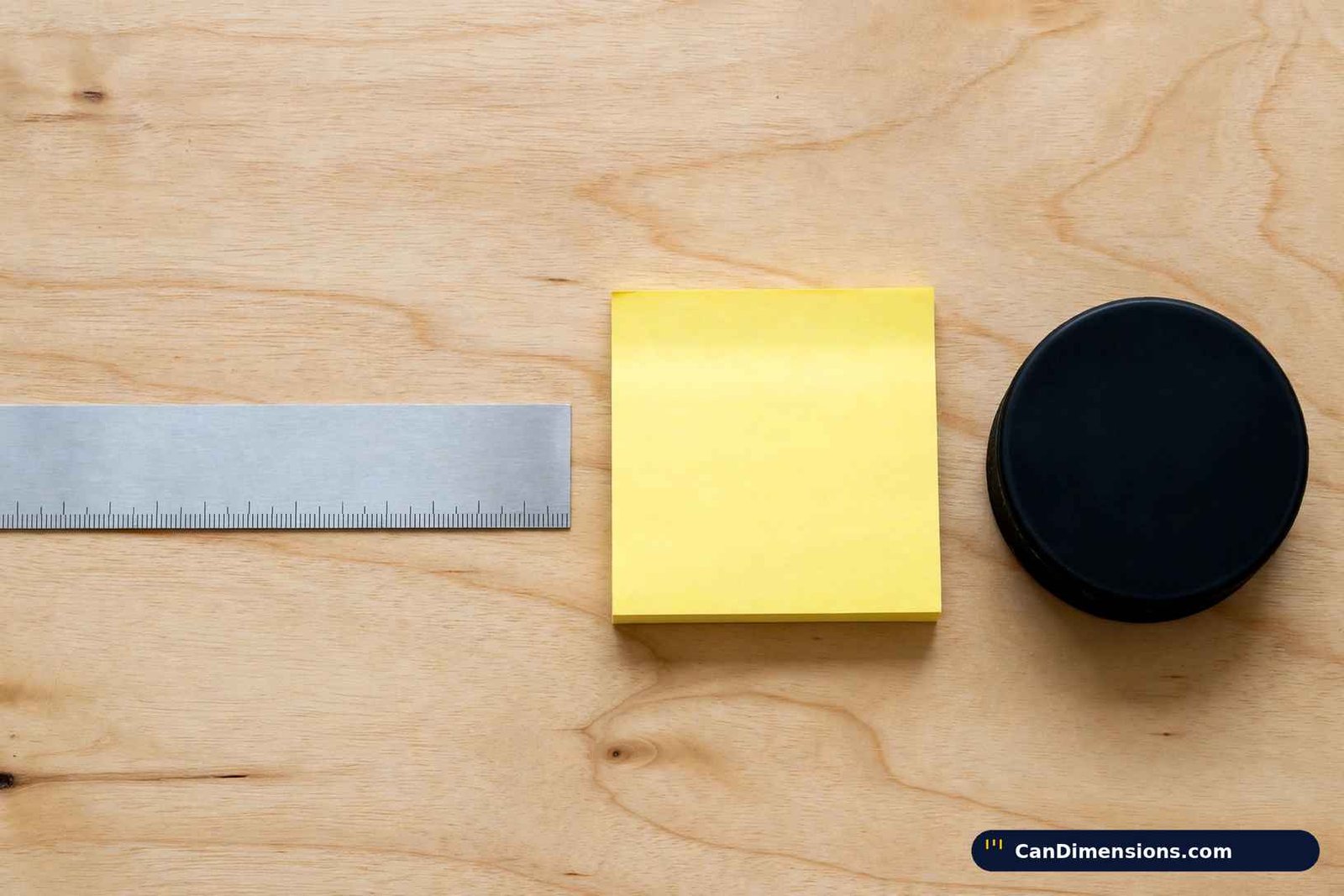
Three inches is exactly a quarter of a foot, which is the easiest way to hold it in your head: four of them, end to end, make the 12-inch foot on every ruler. Its metric conversions are fixed numbers, not estimates:
| Unit | 3 Inches Equals |
|---|---|
| Feet | 0.25 feet |
| Yards | 0.0833 yards |
| Centimeters | 7.62 cm |
| Millimeters | 76.2 mm |
| Meters | 0.0762 m |
The comparison usually offered next is your own hand — three inches is “roughly the width of your first three fingers held together”. That one needs a small correction: finger width is not standardised, and three fingers side by side measure anywhere from about 2.4 to 3 inches across depending on the hand. For larger hands the saying is exact; for smaller ones it overshoots. Measure your own three fingers against a ruler once, and from then on you carry a calibrated reference everywhere.
Is 3 Inches Big? The Size in Context
Against a foot, 3 inches is a quarter — no bigger than the first segment of any school ruler. Against the objects in your pocket it is more substantial: two 3-inch lengths laid end to end come to 6 inches, a hair under a US dollar bill’s 6.14-inch length, so half a banknote is a fair mental picture of one. Against a phone, 3 inches is roughly the width of the largest handsets and about half the height of any of them.
It also helps to know where 3 inches sits in the sizes around it. It is half of 6 inches, a third of 9, and three times the 1-inch world of paperclips and postage stamps. In metric terms it falls between the 7 and 8 centimetre marks on a ruler, closer to 8. Small, then — but not trivial: it is the difference between a photo that fits a frame and one that does not, and between a nail that holds a header together and one that splits it.
11 Common Things That Are 3 Inches Long
Here is the whole verified list at a glance. Every row is one of the counted examples detailed below; the three popular examples that failed the check — the house key, the USB flash drive and the jumbo paperclip — keep their headings further down, clearly marked as misses.
| Example | 3 Inches As | Checked Against |
|---|---|---|
| A standard Post-it sticky note | Exactly 3 in on every side | 3M’s catalogue (3 in × 3 in) |
| A standard lipstick tube | About 3 in tall | Packaging-industry dimension tables (72–82 mm) |
| A hockey puck | Exactly 3 in in diameter | NHL standard (3 in × 1 in) |
| A 3×5 index card | Exactly 3 in on the short side | The defining product size (3 in × 5 in) |
| A 10d common nail | Exactly 3 in long | 2021 IRC nail table; penny-size charts |
| An iPhone 15 Pro Max | 3.02 in wide | Apple’s published tech specs (76.7 mm) |
| A Bordeaux wine bottle | About 3 in in diameter | Glassmakers’ drawings (about 76 mm) |
| A 3-inch binder | 3 in ring size | The defining product size |
| 3-inch chlorine tablets | About 3 in in diameter | The defining product size |
| A 3-inch pillar candle | 3 in in diameter | The defining product size |
| A 3-inch hole saw | Exactly 3 in cutting diameter | Toolmakers’ specifications |
Each example below was checked against a manufacturer’s specification, an official standard or reference data before it earned its place. Three famous names from lists like this one keep their headings but are clearly marked as misses, because they do not measure 3 inches and pretending otherwise would make this list useless for estimating anything.
Standard Post-It Sticky Note
Counted, and exact. The classic Post-it note is a 3×3 inch square: 3M’s own catalogue lists the original note — the 654, the canary-yellow pad on desks across America — at 3 in × 3 in (76 mm × 76 mm), and the size has not changed since the product launched. Every side of the square is a true 3-inch reference, which makes it the most useful item on this page: peel one off, lay it along anything, and you are measuring.
It is worth being specific about which note you hold. 3M also sells 4×4, 4×6 and smaller 1.5×2 inch notes, and the generic pads on the shelf are not always honest copies. The reference is the classic 3×3 — if the pad is that size, each edge is exactly 3 inches.
Standard House Key
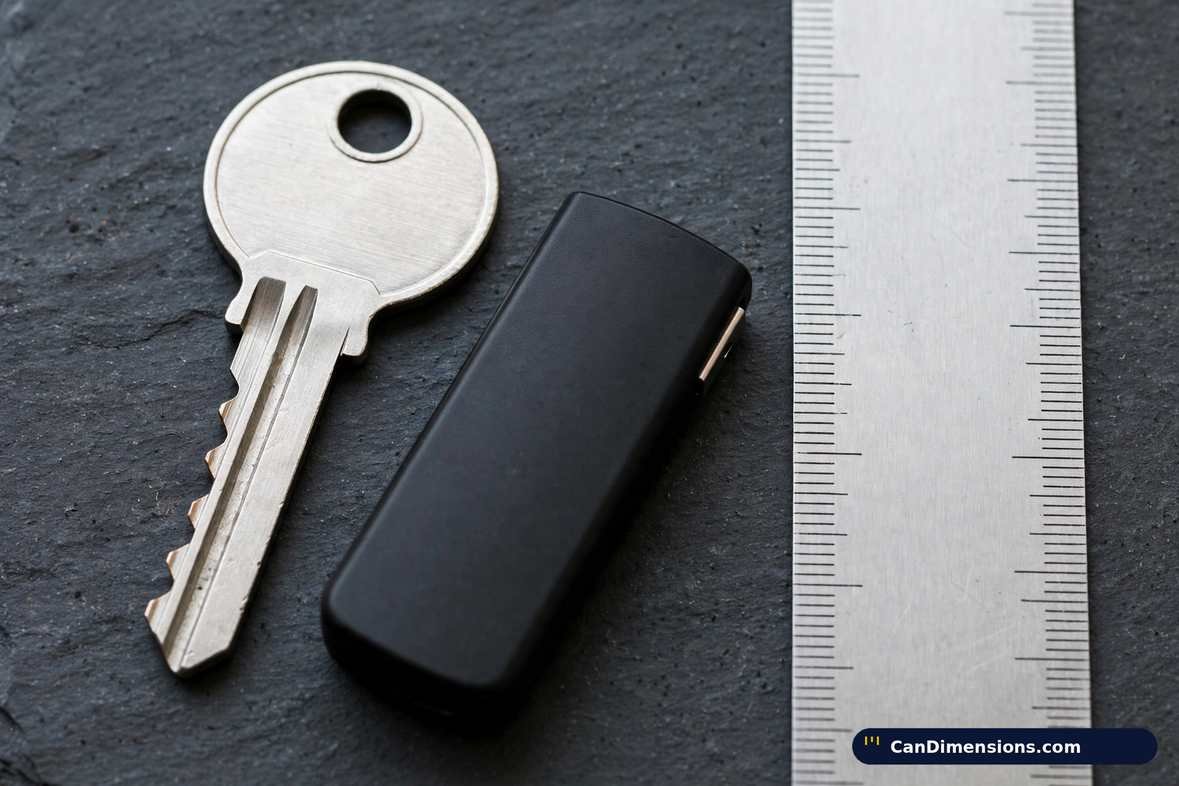
This one is a miss, and the miss is built into the phrase “standard house key”: no lock maker publishes an overall length for a key, because keys are specified by their cut pattern, not their size. What can be checked is the common North American blanks — the Kwikset KW1 and Schlage SC1 patterns in most front doors — and those measure roughly 2.5 inches from bow to tip, half an inch short of this page’s number. The 2.9-to-3.1 inch range quoted for house keys describes only the largest decorative-bow blanks, not the key in your pocket.
So keep the key as a reference, but for the right number: a house key is a two-and-a-half-inch object. Two of them end to end are 5 inches, which is its own useful estimate — just not this one, and it is not counted here.
USB Flash Drive
This one fails for the opposite reason: flash drives are specified precisely, and the specifications say they are smaller. SanDisk’s datasheet for the Ultra Flair — one of the best-selling flash drives in the world — gives its length as 42.93 mm, which is 1.69 inches. Full-size swivel drives from the big makers run longer, roughly 2.3 to 2.7 inches, but no major maker maintains a 3-inch standard across its range, and micro drives are barely an inch. A “USB flash drive” can be almost any length under 3 inches; it cannot be used as a 3-inch reference, so it is not counted here.
Lipstick Tube
Counted, as an “about” — with the range disclosed. There is no single lipstick standard, but the classic swivel tube is built around one shared part, the 12.1 mm bullet cup, and the packaging industry’s dimension tables put the finished tube at 72 to 82 mm tall: 2.83 to 3.23 inches, a range that brackets 3 inches with its middle almost exactly on it. Standard catalogue tubes sit right at the mark — 76 mm tall, which is 2.99 inches — and packaging references give the plain-language version of the same answer: a standard lipstick tube measures approximately 2.75 to 3 inches in height.
So the drugstore lipstick in a purse or bathroom cabinet is a genuine 3-inch-class object: not a specification-grade reference like the puck, but an honest “about 3 inches”, and by far the most carried one on this list.
Jumbo Paperclip
This one is a miss by a full inch. The jumbo paperclip is a 2-inch clip: ACCO, the biggest name in the category, lists its jumbo paper clips at 2 inches in length, and Staples’ jumbo clips are sold at the same 2-inch size. The standard No. 1 clip below it measures about 1.25 to 1.375 inches. There is no mainstream 3-inch paperclip — the oversized novelty clips sold for decoration are the only ones that reach it, and they are not office supplies.
The paperclip’s famous measurement claim on this site is its weight, not its length: a single standard clip is the reference object in our guide to things that weigh 1 gram. Its length belongs to a different list — and as the companion checks behind our how much is 10 grams guide show, ten of them do not weigh 10 grams either. A fine 2-inch reference; not counted here.
Hockey Puck
Counted, and exact — the most precisely standardised object on this page. The NHL’s puck specification fixes the puck at exactly 3 inches in diameter and 1 inch thick, weighing between 5.5 and 6 ounces, and the same dimensions hold from high school rinks to the Olympics. Every regulation puck made, by every approved manufacturer, is a 3-inch disc.
That makes the puck the sports world’s pocket ruler: if you have ever held one, you have held exactly 3 inches across. It is also the rare example whose size is a rule rather than a habit — the diameter is checked, not estimated, which is why it anchors this list.
A 3×5 Index Card
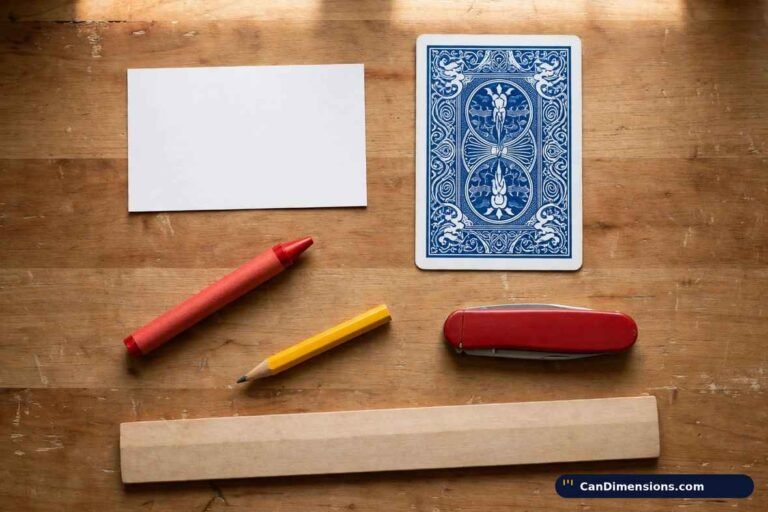
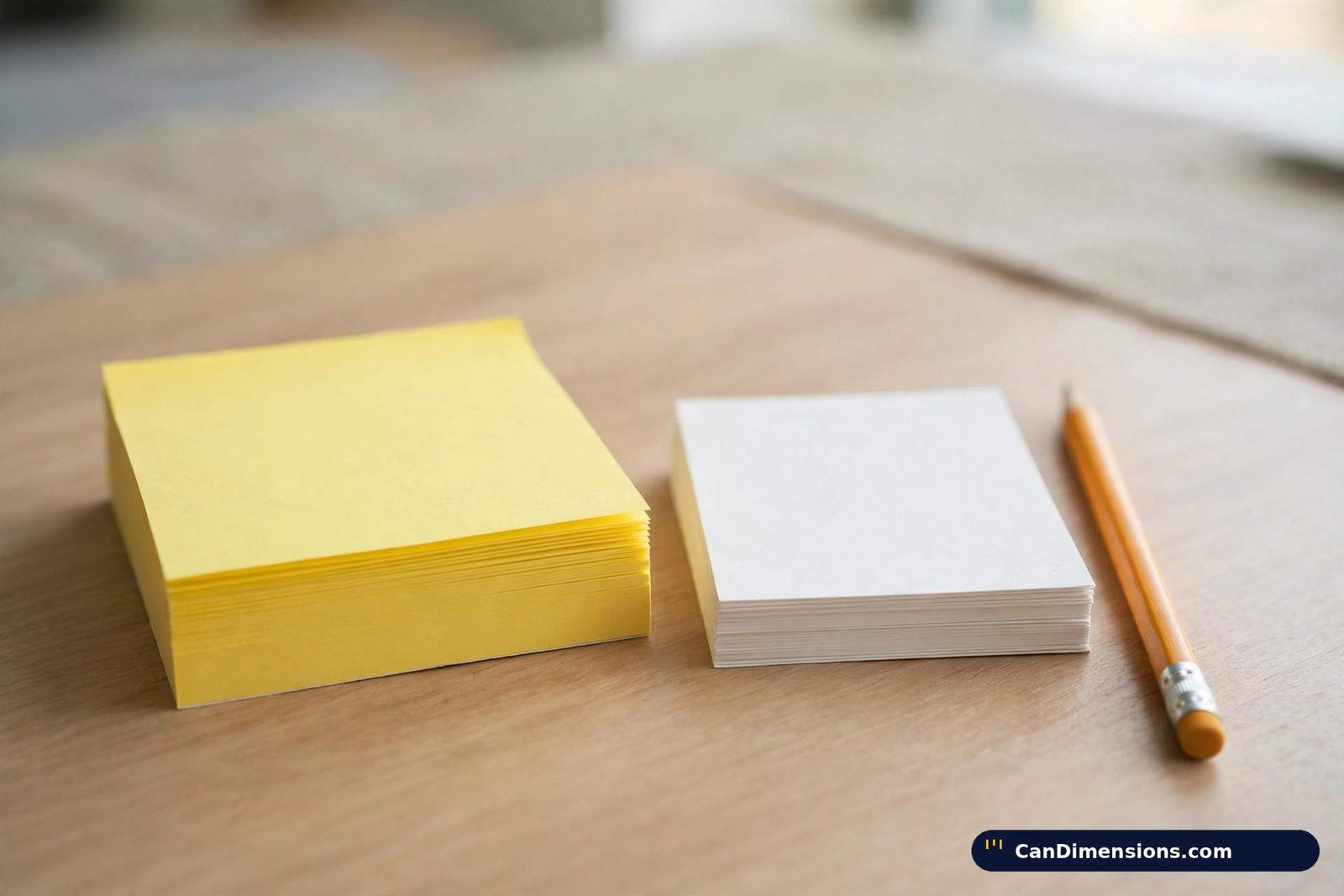
Counted, on the product’s defining dimensions. The standard index card is sold as 3×5 — three inches by five inches — by every office supplier, so its short side is exactly 3 inches by definition. Ruled or blank, Oxford or store brand, the small card in the recipe box and the library drawer is the same 3-inch width.
It pairs naturally with the sticky note above it: the note gives you a 3-inch square, the card gives you 3 inches with a 5-inch long side for the next measurement up. Between the two of them, a desk drawer holds a small measuring kit.
A 10d Common Nail
Counted, and exact — this one is written into building codes. Nails are sized by the old penny system, and the 10d (“ten-penny”) nail is the 3-inch size: the 2021 International Residential Code’s fastening table, Table R602.3(1), prints the 10d common nail at 3 inches long with a 0.148-inch shank, and every penny-size chart agrees (8d is 2.5 inches, 10d is 3, 16d is 3.5). It is the standard nail for framing headers and toenailing studs, so hardware stores sell it by the pound and by the box.
If you do any DIY, this is the 3-inch reference you already own: a loose 10d nail in the toolbox is exactly 3 inches from the underside of its head to its point.

An iPhone 15 Pro Max
Counted, on a named model — and the model has to be named, because most phones fall short. Apple’s published tech specs for the iPhone 15 Pro Max give its width as 3.02 inches (76.7 mm), two hundredths over the mark, disclosed here rather than rounded away. The smaller iPhones and most rival flagships are narrower; the biggest Pro Max is the phone that reaches 3 inches across.
So the reference is specific but genuinely useful, because it is the phone in millions of pockets: hold a Pro Max across its width and you are holding 3.02 inches — for any estimate that matters, 3 inches. Check the model before you trust it; a standard-size phone is a near-miss, and it appears in the look-alikes below in spirit if not in name.
A Bordeaux Wine Bottle
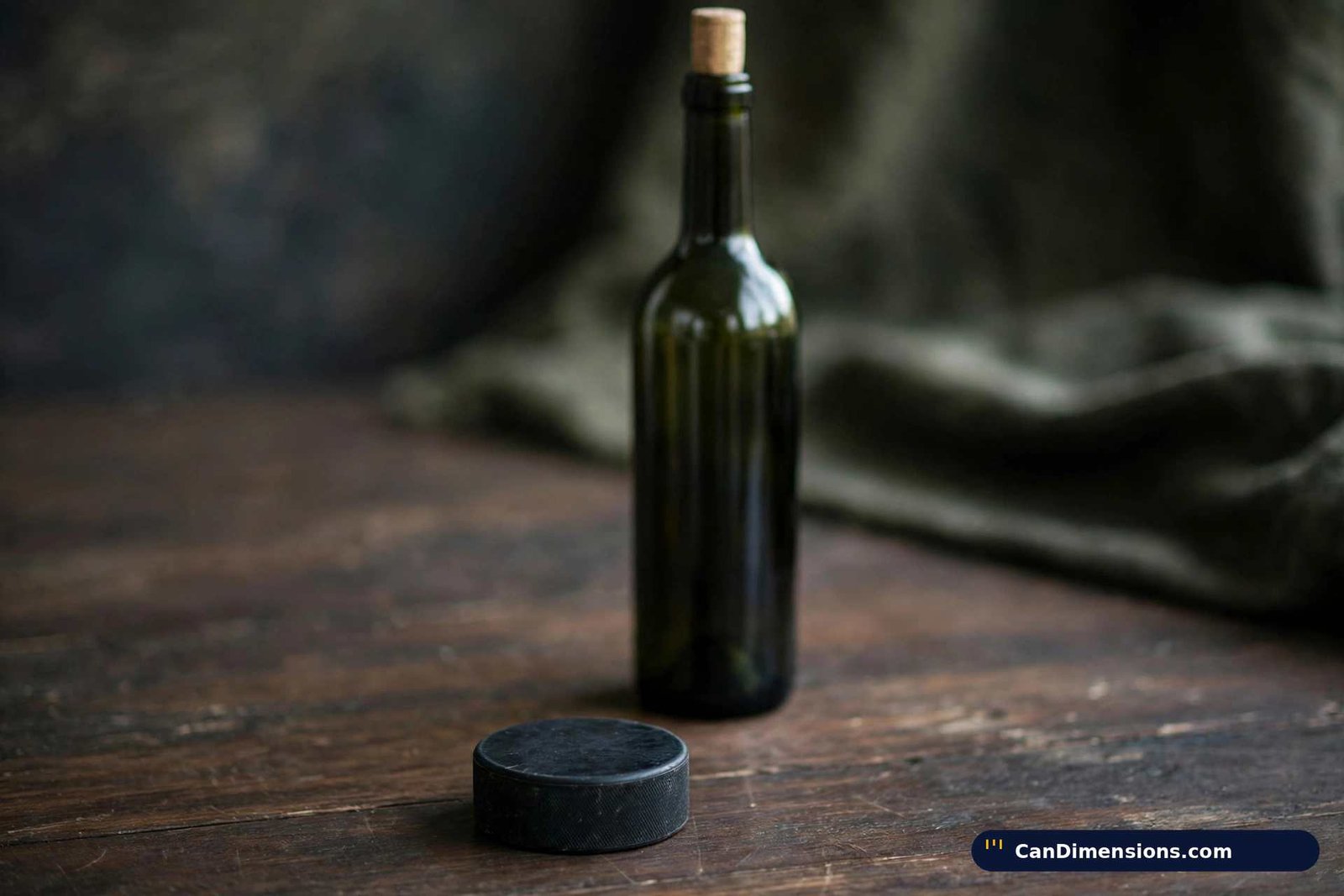
Counted, as an “about” — checked against the drawings of the people who blow the glass. The classic 750 ml Bordeaux bottle, the high-shouldered shape used for most reds, is drawn by its glassmakers at about 76 mm across the body: Saverglass’s Bordelaise Tradition drawing gives 76.6 mm and O-I’s standard Bordeaux 76.61 mm, both of which convert to 3.02 inches. Individual makers’ bottles scatter a little either side of that — roughly 74 to 78 mm — which is why this is an “about”, not an exact.
The shape matters more than the maker: reach for a Bordeaux bottle, not a Burgundy one. The sloping-shouldered Burgundy bottle is drawn wider, around 3.2 inches and up, and a Champagne bottle wider still. The straight-sided red-wine bottle on the rack is the 3-inch one.
A 3-Inch Binder
Counted, on the labelled size — because with binders, the size in the name is a real dimension. Binders are sold by the diameter of their rings, and the 3-inch binder is the largest standard office size: its rings measure 3 inches across, which is what lets it swallow a ream-sized stack of paper. The size is nominal in the way all ring sizes are — measured across the ring itself — but it is the dimension the whole category is specified by, from school binders to archive files.
Standing on a shelf, a 3-inch binder also gives you the size in its spine: the case is built around those rings, so the binder’s spine width is a working picture of 3 inches wherever binders are filed.
3-Inch Chlorine Tablets
Counted, on the labelled size. The standard large pool tablet is sold explicitly as a “3-inch tablet” — HTH, Clorox Pool&Spa and the other big pool-care brands all use the name — a slow-dissolving puck about 3 inches in diameter, made to fit the feeders and floating dispensers that are themselves sized around it. The smaller 1-inch tablets are the other standard size, so the category is literally organised around this diameter.
A tablet is a puck in the hockey sense as well as the pool sense: a manufactured disc whose whole job depends on being a consistent size. If you keep a pool or a hot tub, the tub of tablets in the utility cupboard is a stack of 3-inch references.
A 3-Inch Pillar Candle
Counted, on the labelled size. Pillar candles are sold by diameter and height, and 3 inches is the standard pillar diameter: the shelf sizes are written 3×4, 3×6 and 3×9 — three inches across, and four, six or nine inches tall. Candle holders, lanterns and hurricane glasses are sized to that diameter in turn, so the 3-inch pillar is a small standard of its own.
It is the softest reference on this list — wax is cast, not machined — but the diameter is the product’s defining size, and a pillar candle on the table is a fair picture of 3 inches across its base.
A 3-Inch Hole Saw
Counted, on a toolmaker’s specification — the most literal answer on this page. A hole saw exists to cut a hole of one exact diameter, and a 3-inch bi-metal hole saw, of the kind Milwaukee and Lenox sell for door locks, recessed lights and pipe pass-throughs, is manufactured to a 3-inch cutting diameter. The size is not a nickname or a shelf label; it is the tool’s function, ground into its teeth.
If a certified reference is what you want, this is the hardware-store equivalent of a gauge block: the circle a 3-inch hole saw cuts is 3 inches, by manufacture.
What ‘3 Inches’ Measures: Diameter, Width or Length
Read the list again and you will see the same number doing three different jobs. For the puck, the wine bottle, the chlorine tablet, the candle and the hole saw, 3 inches is a diameter — the distance across a circle. For the sticky note, the index card and the iPhone, it is a width or a side — one edge of a rectangle. For the nail and the lipstick, it is a length or a height — the longest straight line on the object. Knowing which job the number is doing matters, because a 3-inch diameter and a 3-inch length look nothing alike in the hand.
It is also where nominal sizes try to sneak in. A “3-inch” PVC pipe is not 3 inches anywhere you can measure it: pipe is sized by a nominal name, and the pipe sold as 3-inch has an outside diameter of 3.5 inches. A “2×4” board is not 2 by 4 either — it is 1.5 by 3.5 inches as sold. The examples counted in this guide were chosen to avoid that trap: every one of them is the size it claims on the dimension named, which is the same measure-first discipline behind our Pokémon card dimensions guide, where a card’s size is its printed 63 × 88 mm and nothing else.
How to Visualize 3 Inches Without a Ruler
These object-based methods help you estimate 3 inches quickly — with the two body-based rows from most lists corrected, because hands vary:
| Method | Accuracy | How To |
|---|---|---|
| Post-It Note Side | ★★★★★ | Any edge of a 3×3 sticky note |
| Hockey Puck Diameter | ★★★★★ | Across the face of a regulation puck |
| Index Card Short Side | ★★★★★ | The 3-inch edge of a 3×5 card |
| Three Fingers Together | ★★★☆☆ | Index, middle, ring side by side — measure yours once first |
The most reliable methods are the exact objects: a sticky note’s edge, a puck’s face, an index card’s short side. The famous body methods need their asterisks. Three fingers together lands anywhere from about 2.4 to 3 inches depending on the hand — excellent once you have measured your own, misleading before. And the “thumb to pinky” trick is often quoted as a quarter of a stretched hand span, but a full span averages about 8.5 inches, so a quarter of it is only about 2.1 inches; 3 inches is closer to a third of your span. Use the span in thirds, or better, use the note.
3 Inches vs 2 Inches and 4 Inches
The sizes either side of 3 inches have their own exact anchors, and one of them is an old friend from this page. Two inches is the jumbo paperclip — the clip that failed as a 3-inch example is a perfect 2-inch one, which is how most mislabelled sizes work: the object is standardised, just at a different number. A credit card’s short side, at 2.125 inches, sits just over 2. Four inches is the larger sticky note: 3M’s range steps from the 3×3 up to a 4×4 pad, each side exactly 4 inches.
Between the anchors, 3 inches is three-quarters of 4 and one-and-a-half times 2 — and it is worth seeing how much taller everyday things stand than all three: the can in our Coke can dimensions guide is 4.83 inches tall, clearing the 4-inch mark by most of an inch. Picturing the ladder — clip, note, big note, can — is the fastest way to make all four sizes stick.
Where Does 3 Inches Appear in Daily Life?
Office & Desk: The desk is the richest 3-inch environment in the building: 3×3 Post-it notes, 3×5 index cards and 3-inch binders all measure right at 3 inches — with one correction to the usual lists, since the jumbo paperclips in the same drawer are 2 inches, not 3.
Pocket & Purse: Lipstick tubes stand right at this height when capped. The other famous pocket claims cluster just underneath it — house keys at about 2.5 inches and USB flash drives shorter still — so most people are carrying several near-3-inch objects without carrying many exact ones.
Sports & Recreation: The NHL hockey puck’s standardised 3-inch diameter puts this measurement on every rink in North America, and the baseball in the next section misses it by less than a tenth of an inch — this is a size sport keeps almost hitting exactly.
Kitchen & Household: A Bordeaux wine bottle is about 3 inches across and a pillar candle is made at exactly that diameter. The kitchen claims in most lists do not survive measuring — the small limes and standard matchbooks quoted at 3 inches measure well short of it.
Almost 3 Inches: Look-Alikes That Miss the Mark
A baseball — just under. Major League Baseball’s Rule 3.01 fixes the ball at 9 to 9.25 inches in circumference, which works out to a diameter of 2.86 to 2.94 inches. It is the closest miss on this page: a hair under 3, by rule.
A credit card’s long side — over. Bank cards follow the ISO/IEC 7810 standard at 3.37 inches long and 2.125 inches wide. Neither side is 3 inches, though the card still earns its keep as a measuring stand-in: its long side minus a thumbnail’s width is a workable field estimate.
A soda can’s diameter — under. The standard 12-ounce can is 2.6 inches across (and 4.83 tall). It feels chunkier than 3 inches in the hand because of its height; across, it is 0.4 short.
A “3-inch” PVC pipe — nominal, not real. As covered above, the pipe sold under the 3-inch name measures 3.5 inches across the outside. The name is a category, not a measurement, and it is the one “3-inch” object in the hardware store that should never be used as a reference.
Questions
What can 3 inches be compared to?
A 3×3 sticky note along any edge, the diameter of an official hockey puck, or the short side of a 3×5 index card — all three are exactly 3 inches.
What can I use to measure 3 inches?
Without a ruler, use a standard Post-it note — each side is exactly 3 inches. A 10d nail or a regulation hockey puck does the same job.
How many fingers is 3 inches?
For most adults, three fingers held together — index, middle and ring pressed flat side by side — but hands vary: the span measures about 2.4 to 3 inches across adults, so check yours against a ruler once before trusting it.
How to tell 3 inches without a ruler?
The quickest exact method is a sticky note’s edge. Without one, use three fingers you have pre-measured, or picture a third of your stretched thumb-to-pinky span.
Final Thoughts
3 inches is one of those measurements that quietly shapes everyday American life — from the sticky note on your monitor to the puck sliding across an NHL ice surface to the nail holding a wall header together.
Whether you are crafting, measuring, shopping, or simply satisfying your curiosity, knowing what 3 inches looks like gives you a practical edge — as long as the picture in your head is a verified one. The house key, the flash drive and the jumbo paperclip that headline most lists measure 2.5, under 2.7 and exactly 2 inches respectively; the sticky note, the index card, the 10d nail and the hockey puck are the references that actually earn the number.
Next time you need a quick reference, picture the note, the card or the puck — three objects, three different dimensions, all telling the same story at exactly the same length.