What Weighs 100g? 17 Portable Things That Weigh 100 Grams
Most people meet this weight away from home: at an airport counter, in a hotel bathroom, or digging through a bag for change. The honest answer to what weighs 100g is whatever you are already carrying — a pocketful of small coins, a tube from the wash bag, a mouse from the laptop sleeve — provided each claim survives a check against the people who set the weight.
That travelling lens is how this page is built. Every example below earned its place from a mint specification, a rulebook, a food database or a maker’s printed label, and the references were chosen because they turn up in pockets, rucksacks and sports bags rather than only in one kitchen.
Seventeen pass the test. Three famous names fail it — the butter stick, the four AA cells and the hundred paperclips — and their sections stay, corrected where they stand, because a traveller who calibrates a luggage scale with a myth packs the error into every trip that follows.

100 Grams in Different Units
The fixed conversions never change, wherever you are standing when you need them. The weight is 0.1 kilograms, 3.527 ounces, 0.2205 pounds and 100,000 milligrams. The cup and spoon rows further down the table are a different species of figure: they describe volume, so they hold only for the ingredient named beside them.
| Unit | 100 Grams Equals |
|---|---|
| Kilograms | 0.1 kg |
| Ounces | 3.527 oz |
| Pounds | 0.2205 lb |
| Milligrams | 100,000 mg |
| Water | 100 ml (about 6.7 tablespoons) |
| Granulated sugar | About 1/2 cup |
| All-purpose flour | About 0.8 cup |
| Table salt | About 1/3 cup |
Two cautions travel well. First, a spoon measures space, not mass: flour packs loosely and salt packs tightly, which is why their cup rows disagree so sharply. Second, anyone converting a whole set of weights rather than this one should work from the full grams to ounces ladder, and the neighbouring anchor on that ladder is how many pounds is 500 grams — five times this page’s weight, checked the same way.
100 Grams at the Airport: The Carry-On Number
Airports have quietly made this the most regulated small weight in ordinary life. Under the liquids rule enforced at United States checkpoints, every container of liquid, gel, cream or paste in a carry-on bag is capped at 3.4 fluid ounces, which the rule itself states as 100 millilitres, with all containers riding together inside a single quart-size bag, one bag per passenger.
Millilitres are volume, and grams are mass, so the two hundreds coincide only for watery products. A travel tube sold for the cabin is therefore labelled two ways at once — and the toothpaste tube counted further down this page is a genuine cabin artefact: a product manufactured at this weight precisely because the checkpoint allows it.
The rule also judges the container, never the contents left inside it. A half-finished family-size bottle still fails, while a small tube filled to the brim passes. Pack by the printed size, and this weight stops being trivia and becomes the difference between a wash bag that flies and one that gets binned at security.
📊 Quick 100-Gram Reference Table
The seventeen verified references, gathered before the detail. The basis column matters as much as the weight column: exact rows are backed by a maker’s specification or a label declaration, and about rows carry their range or their size class openly.
| Example | Weight | Basis |
|---|---|---|
| A small apple (extra small class) | 101 g | USDA FoodData Central |
| A standard 100 g bar of soap | Exactly 100 g | Labelled net weight |
| 20 US nickels | Exactly 100 g | US Mint (5.000 g each) |
| A standard 100 g chocolate bar | Exactly 100 g | Labelled net weight |
| A deck of playing cards | About 90–100 g | Deck weights, ~1.8 g per card |
| Two medium-sized eggs | About 99 g | USDA egg weight classes |
| A computer mouse (Logitech G305) | 99 g | Logitech published specification |
| A small banana (6–7 inches) | 101 g | USDA FoodData Central |
| Half a cup of granulated sugar | 99–100 g | King Arthur / USDA ingredient weights |
| Forty-four US dimes | About 99.8 g | US Mint (2.268 g each) |
| Nine US half dollars | About 102 g | US Mint (11.340 g each) |
| Thirty-seven table tennis balls | About 99.9 g | ITTF Laws (2.7 g per ball) |
| A small orange | About 96 g | USDA size classes |
| A 100 g tube of toothpaste | Exactly 100 g | Labelled net weight |
| A 100 g ball of yarn | Exactly 100 g | Maker’s ball-band label |
| A pocket multi-tool (Victorinox Huntsman) | About 97 g | Maker model specification |
| A 100 g silver bar | Exactly 100 g | PAMP Suisse minted specification |
17 Common Things That Weigh 100 Grams
Each section below names its evidence before it asks for your trust. Where a heading inherited from the list this page rebuilds turned out to be wrong, the heading stays and the correction is printed inside it, marked plainly, so the error stops travelling.
A Medium-Sized Apple
Counted: — on the corrected size class printed here. The fruit that truly sits at this weight is the small one: USDA records put the extra small apple, roughly two and a half inches across, at 101 grams. The heading’s medium apple is a different object entirely, listed at 182 grams by the same database.
Travellers meet the honest version in airport cafés and lunchboxes, where the small fruit is the standard offering anyway. Buy the little apple and the claim holds; reach for the big glossy one and you are carrying nearly double.
A Standard Bar of Soap
Counted: — where the wrapper declares this size. Bars manufactured at 100 g are a long-standing standard across much of the world, and the figure on the carton is one the maker must legally stand behind. Hotel and travel bars are often cut smaller, and American drugstore bars commonly run to 90 grams or to four ounces, so the wrapper check is the whole method.
A sealed bar whose carton reads 100 g is one of the easiest references to pack: flat, dry, unbreakable, and still exactly itself at the end of the trip.
A Stick of Butter
Not counted: — the stick overshoots by an eighth. An American stick is a quarter of a pound, which is 113 grams, and no amount of rounding turns that into this page’s figure. Seven tablespoons cut from the stick come to roughly 99 grams, which is the useful form of the fact for a cook.
Butter also makes a poor travelling reference for a simpler reason: it softens, leaks and gets confiscated moods at checkpoints. It stays on this page as a correction, not as a standard.
20 US Nickels (or 40 US Pennies)
Counted: — exactly, twice over, on the United States Mint’s own figures. A nickel is struck to 5.000 grams, so twenty of them total precisely this weight and cost one dollar in face value. The cent struck since 1982 is specified at 2.500 grams, so forty modern cents arrive at the same total by a second route.
Date discipline is the only skill involved. Cents from before the 1982 changeover are mostly copper at 3.11 grams apiece, and a handful scooped blindly from an old jar mixes two different standards. Sort first, count second, trust third.
A Standard Chocolate Bar
Counted: — exactly, on the wrapper’s declaration. The 100 g tablet is the classic European bar format, sold by makers such as Lindt across a whole range, with the net weight printed on the foil. American standard bars run far smaller, near 43 grams for a regular bar, so nationality matters: read the wrapper before the bar becomes your reference.
It is also the only calibration weight on this page that improves morale. Test the scale first, then eat the evidence.
Four AA Batteries
Not counted: — the set falls short by eight grams. Energizer’s datasheet for its E91 alkaline AA gives a typical weight of 23 grams per cell, which makes four of them about 92 grams and five of them about 115. No whole number of AA cells lands on the target.
The near miss explains the myth’s durability: four cells feel substantial in a palm, and hands are generous judges. A remote-control drawer is a fine source of many things, but a 100-gram standard is not among them.
A Deck of Playing Cards
Counted: — as an about, with its spread disclosed. A poker-size deck of 52 cards plus jokers, carried in its tuck box, lands somewhere between roughly 90 and 100 grams; a Bicycle deck sits near 94 to 96 grams, each card contributing a little under two grams.
Card stock and finish shift the total slightly between brands, so treat the deck as a handful-grade reference: good enough to judge a parcel or a portion, never good enough to certify a scale.
Two Medium-Sized Eggs
Counted: — about 99 grams, on the grading system itself. American eggs are sorted into classes by weight, and the medium class begins at 21 ounces for a dozen eggs, putting each egg in its shell near 49.6 grams. A pair therefore stops one gram short of the mark.
Class discipline matters as much as it did for the apple. Two large eggs run to about 113 grams, and two small ones to only about 85, so the word medium on the carton is doing real work in this entry.
100 Paperclips
Not counted: — the claim cannot be verified at all. No manufacturer states what one clip weighs, and the estimates in circulation run from about half a gram to about 1.4 grams depending on the clip’s size and wire. Multiplied by a hundred, that uncertainty becomes a pile weighing anywhere from roughly 50 to roughly 140 grams.
A slogan repeated on a thousand websites is still a slogan. Until a manufacturer stamps a figure on the box, a jar of clips is desk clutter, not a measuring instrument.
A Small Smartphone or Computer Mouse
Counted: — for the mouse half of the heading, on a named model’s published figure. Logitech’s specification for its G305 LIGHTSPEED wireless mouse lists the weight at 99 grams with its battery fitted — one gram short of perfect, from the maker’s own sheet. The heading’s phone half fails outright: current smartphones start near 135 grams even in their lightest forms and most run well past 150.
That split is why this page names models instead of categories. “A mouse” can weigh almost anything; this mouse weighs 99 grams, in writing, from the firm that builds it.
A Medium-Sized Banana
Counted: — on the corrected size class, like the apple above. The banana at this weight is the small one: Department of Agriculture classes put a small fruit, six to seven inches long, at 101 grams of edible portion. The official medium, seven to eight inches, weighs 118 grams, and a large one reaches 136.
Picture the runt of the bunch, peeled, and the figure holds. The banana also demonstrates why produce can only ever be an about: ripeness moves water, and water is most of what a banana is.
Half a Cup of Sugar or Salt
Counted: — for the sugar half of the heading only. Standard ingredient charts put granulated sugar near 198 to 200 grams per cup, so the half-cup measure lands at 99 to 100 grams — squarely on the target, and handy in a rented kitchen with no scale.
The salt half collapses under the same arithmetic. Table salt packs far more densely, around 288 grams per cup, making its half-cup roughly 144 grams. Two white powders, one scoop, wildly different weights — the single best advertisement for weighing ingredients instead of scooping them.
Forty-Four US Dimes
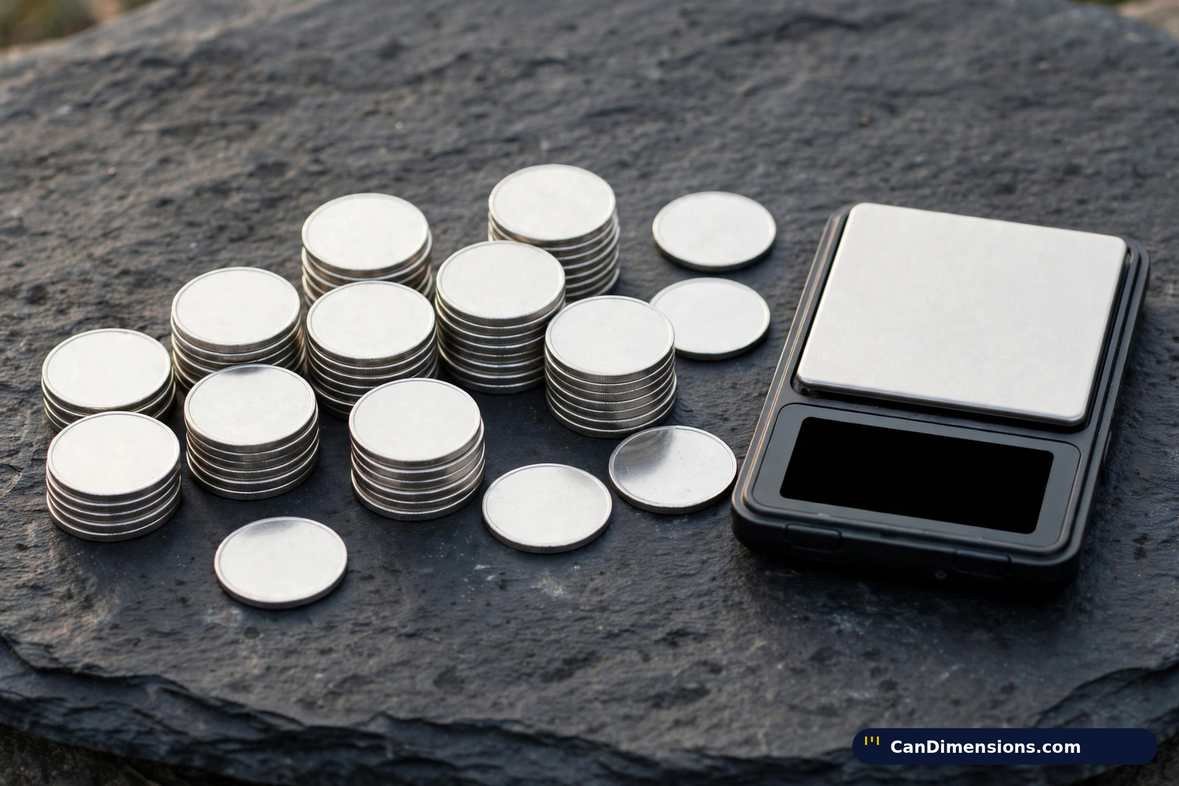
Counted: — about 99.8 grams, the new coin route this page adds. The Mint specifies the modern dime at 2.268 grams — the smallest, thinnest coin in American circulation — and forty-four of them multiply out to a fifth of a gram under the target.
Dimes suit travellers because they accumulate unnoticed: the bottom of a purse or a jacket pocket often holds half this stack already. Pre-1965 silver dimes weigh 2.50 grams apiece, so check dates on older coins before trusting the sum.
Nine US Half Dollars
Counted: — about 102 grams, on the same authority. The Kennedy half dollar is specified by the Mint at 11.340 grams, and nine of them total just over 102 grams — two grams heavy, close enough to judge a parcel or a portion by, and printed here as an about rather than rounded down into a false exact.
Half dollars rarely circulate, which cuts both ways: they are useless if your change jar holds none, and excellent if it does, because nine coins are quicker to count than forty-four.
Thirty-Seven Table Tennis Balls
Counted: — about 99.9 grams, on the sport’s own law book. The International Table Tennis Federation’s Laws fix the ball’s mass at 2.7 grams, and thirty-seven regulation balls therefore come to a tenth of a gram under the target.
No other entry on this page fills so much space with so little substance: thirty-seven hollow balls overflow two hands while weighing less than the orange beside them. Air is the volume; the plastic skin is the weight.

A Small Orange
Counted: — about 96 grams, on the Department of Agriculture’s size classes. A small orange is listed at 96 grams, four grams light of the mark, while the medium fruit runs to 131 grams. As with the apple and the banana, the small class is the honest one and the medium class is the myth.
An orange earns its travelling place by surviving a rucksack better than softer fruit. Treat it as a handful-grade reference and eat it before the peel dries out and lightens it further.
A 100 g Tube of Toothpaste
Counted: — exactly, on the label’s declared contents. Tubes manufactured at 100 g are a standard size across many brands — the size the cabin liquids rule made famous — and the number stamped on the crimp describes the paste alone. The empty tube adds a few grams of its own on a scale, exactly as a chocolate wrapper does, so the counted item is the labelled contents.
Of every reference here, this is the one most likely to be within arm’s reach in a hotel room. Read the crimp before you trust it: travel minis run far smaller, and family tubes far larger.
A 100 g Ball of Yarn

Counted: — exactly, on the ball band. Yarn is sold by weight as much as by length, and the 100 g ball is the craft world’s standard unit: Red Heart’s ball band, for example, lists its solid colours at 100 g per ball, with the yardage varying by fibre while the mass stays fixed.
Knitters have quietly owned a pocket reference all along. One fresh ball, band intact, is a labelled weight that also happens to become a hat.
A Pocket Multi-Tool (Victorinox Huntsman)
Counted: — about 97 grams, on the model’s specification. The Huntsman, Victorinox’s four-layer 91 mm pocket tool with fifteen functions, is listed at 97 grams — three grams light, and printed here as an about. Its smaller two-layer relatives weigh far less, so the model name matters as much as it did for the mouse.
A word of travelling sense: a pocket tool is a reference at home and in a checked bag, never in a cabin bag. Weigh it before the trip, not at the checkpoint.
A 100 g Silver Bar
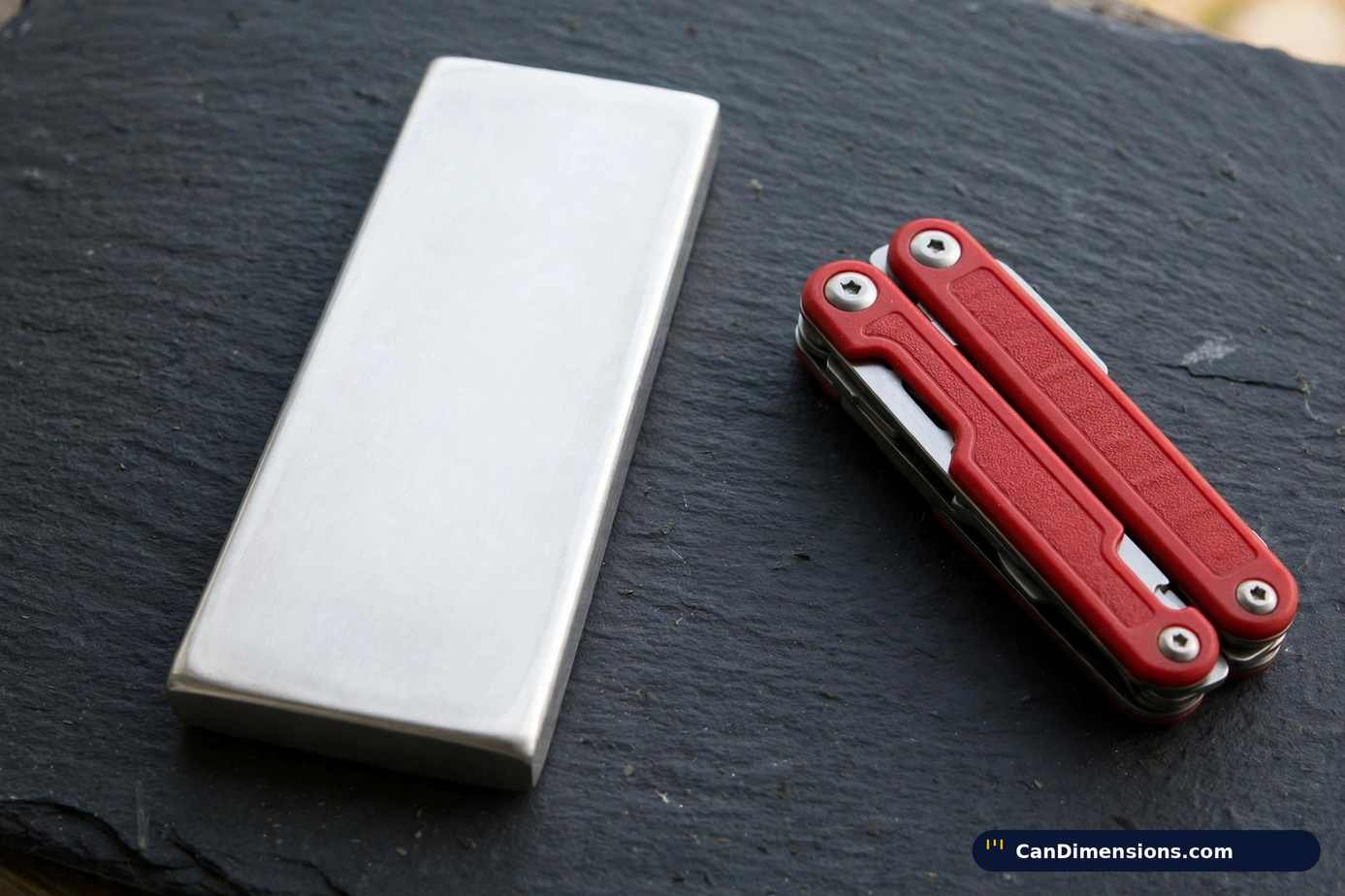
Counted: — exactly, minted to the figure. A bar at exactly this size is minted in .999 fine silver by PAMP Suisse, sealed in an assay card that certifies the weight, measuring about 60 by 35 millimetres in its Fortuna format. Silver’s modest density spreads the mass across a palm-sized slab — the opposite extreme from the same refiner’s compact gold bar at this weight.
Nobody packs one as a scale check, and that is the point of closing the list with it: at one end of this page a standard is something you count out of a change jar, and at the other it is something a refinery guarantees in writing.
How to Measure 100 Grams Without a Scale
Hotel rooms, campsites and holiday rentals share one feature: no kitchen scale. These are the methods that survive that absence, in descending order of trustworthiness.
Using Coins for Measurement
Coins remain the traveller’s first resort because mints publish their weights and hold them tightly. Twenty nickels or forty modern cents make the weight exactly; forty-four dimes stop a fifth of a gram short; nine half dollars overshoot by two grams. Any of those stacks can sit on one side of an improvised balance, or simply be held against the unknown object, palm against palm.
Mixed change works too, provided each coin is added at its specification rather than its face value: ten nickels contribute 50 grams, and twenty dimes contribute about 45.4, so a pocket rarely needs a single denomination to reach the neighbourhood.
Using Measuring Cups and Spoons
A measuring jug rescues one ingredient completely: water, at one gram per millilitre, so the 100 ml line is this weight poured. Everything else must be converted ingredient by ingredient — half a cup for sugar, roughly four-fifths of a cup for flour — and the conversions die the moment the ingredient changes.
Spoons shrink the same problem rather than solving it. About 6.7 tablespoons of water make the weight; a tablespoon of salt or flour makes something else entirely, which is why the jug’s water line outranks every spoon in the drawer.
Using Known Food Items
Labelled food is luggage-grade evidence. A bar of chocolate or soap stamped 100 g, a tube whose crimp reads 100 g, or a fresh ball of yarn with its band on can each stand in for the missing scale, because the figure on a packet is a claim its maker must legally stand behind, not a guess.
Loose produce sits a tier below: the small apple, small banana and small orange on this page are honest abouts, useful for portions and useless for certifying anything. Packaged first, produce second, folklore never.
Estimating with Your Hand
A hand learns this weight quickly if it is taught with verified objects: hold twenty nickels, then the chocolate bar, then the mouse, until the three memories merge into one sensation. For length-minded readers, our guide to measuring 10 inches builds the same kind of body-based reference for size.
Keep the hand in its place. It judges portions and packing — whether a gift will tip a suitcase into the next airline band — and it should never be asked to certify a scale or win an argument about a recipe.
100 Grams in Sport: Rulebook Weights
Sport is the one world that publishes its weights before it sells its equipment, which makes rulebooks a traveller-grade source. The table tennis ball counted above is the cleanest case: a federation fixes the mass at 2.7 grams, every approved ball obeys, and simple multiplication builds this page’s weight out of thirty-seven of them.
Other rulebooks frame the neighbourhood without landing on it. A golf ball may weigh at most 45.93 grams under the rules of golf, so even the two heaviest legal balls stop near 92 grams — a pair of golf balls is a near miss, not a reference. A baseball, confined by its rulebook to a band well above this weight, belongs to a heavier conversation entirely.
The habit worth copying is the sports world’s own: when a weight matters, somebody writes it into a rule, and everybody else can check it. That is the standard every section of this page was held to.
Checking a Luggage Scale at 100 Grams
A luggage scale that lies quietly is worse than none, because it lies at the airport, in public, at the worst moment. Stage the check at home with three unrelated routes and let them vote. First, water: fill a jug to the 100 ml line, set it in a tared container, and read. Second, change: count out twenty nickels, then swap them for forty-four dimes, and read again. Third, labels: the chocolate bar or the toothpaste tube, read a third time.
Agreement among three unrelated witnesses is hard to argue with. Disagreement has a housekeeping order — re-zero the empty scale, move it to a hard level surface away from a running appliance, and run the water pour again, since it is the stage you can reproduce most faithfully.
The same staging shrinks and grows. Two nickels alone stage the smaller rung covered by how much is 10 grams, while things that weigh 1 gram opens the ladder at a single banknote — three hundred of this page’s gram, reached one rung at a time.
Travel Myths About 100 Grams, Checked
- “A stick of butter is 100 grams.” A stick is a quarter-pound: 113 grams, an eighth too heavy.
- “Four AA batteries make it.” Energizer’s typical AA weighs 23 grams; four make about 92.
- “A hundred paperclips, obviously.” Clips are built with no weight standard at all; a hundred of them could total roughly 50 to 140 grams.
- “A small phone weighs about that.” No current smartphone comes close; the lightest recent models sit near 135 grams and most run far heavier.
- “A medium apple or banana is the picture.” The Department of Agriculture’s medium apple weighs 182 grams and its medium banana 118; the small sizes are the ones at this weight.
- “Half a cup of salt matches half a cup of sugar.” Sugar’s half-cup is 99 to 100 grams; salt’s is about 144.
- “Two golf balls, near enough.” The rules cap a ball at 45.93 grams, so the heaviest legal pair stops near 92 grams.
Question’s
How Much is 100 Grams in Ounces?
Exactly 3.527 ounces — about three and a half, by the fixed conversion.
How Much is 100 Grams in Pounds?
0.2205 pounds — a little over a fifth of a pound, and 13 grams short of a quarter-pound.
Is 100 Grams a Lot?
No. It is a small orange, a tube from a wash bag, or twenty nickels resting in one palm.
How to Visualize 100 Grams?
Picture a deck of cards in one hand and a computer mouse in the other — both sit within a gram or two of it.
What common object weighs 100 grams?
Soap and chocolate bars sold at a declared 100 g, or a fresh ball of yarn with its band still on.
How many pennies weigh 100 grams?
Forty, provided every cent is a post-1982 zinc issue at the Mint’s 2.500 grams.
What is an example of 100 grams?
Forty-four dimes at about 99.8 grams, thirty-seven table tennis balls at about 99.9, or a small banana at 101.
What can 100 grams be compared to?
A pocket multi-tool at about 97 grams, a small orange at about 96, or nine half dollars at about 102.
What weighs 100 grams so I can calibrate my scale?
A certified test weight is best; twenty nickels match it exactly, and 100 ml of water measured into a container you tared beforehand runs it close.
What coins can be used in combination to weigh 100 grams?
Any stack that sums on Mint figures: twenty nickels, forty modern cents, forty-four dimes, or ten nickels plus twenty cents.
How to weigh 100 grams without a scale?
Balance the unknown against a verified stack of coins, a labelled 100 g product, or a measured 100 ml of water.
How big is 100 grams of meat?
Roughly a deck-of-cards-sized portion, or your palm without the fingers — a serving visual, not a measurement.
How many almonds are in 100 grams?
About 80 whole almonds. The familiar 20-to-25 figure belongs to one ounce, not to this weight.
Conclusion
Away from home, this weight stops being a quiz answer and becomes a working tool: the cabin limit in a wash bag, the check that exposes a lying luggage scale, the stack of change that settles a parcel argument in a hotel lobby. The references worth trusting share one trait — a mint, a federation, a database or a manufacturer published the figure, and anyone can look it up.
Leave the failures behind when you pack: the 113-gram butter stick, the 92 grams of AA cells, the paperclips nobody has ever certified. And when the bag is zipped and the scale reads honest, the humblest item in it may be the toothpaste tube — a labelled hundred grams that flew through security precisely because somebody, years ago, wrote this weight into a rule.