What Weighs 1 Gram? 17 Common Things That Weigh 1 Gram
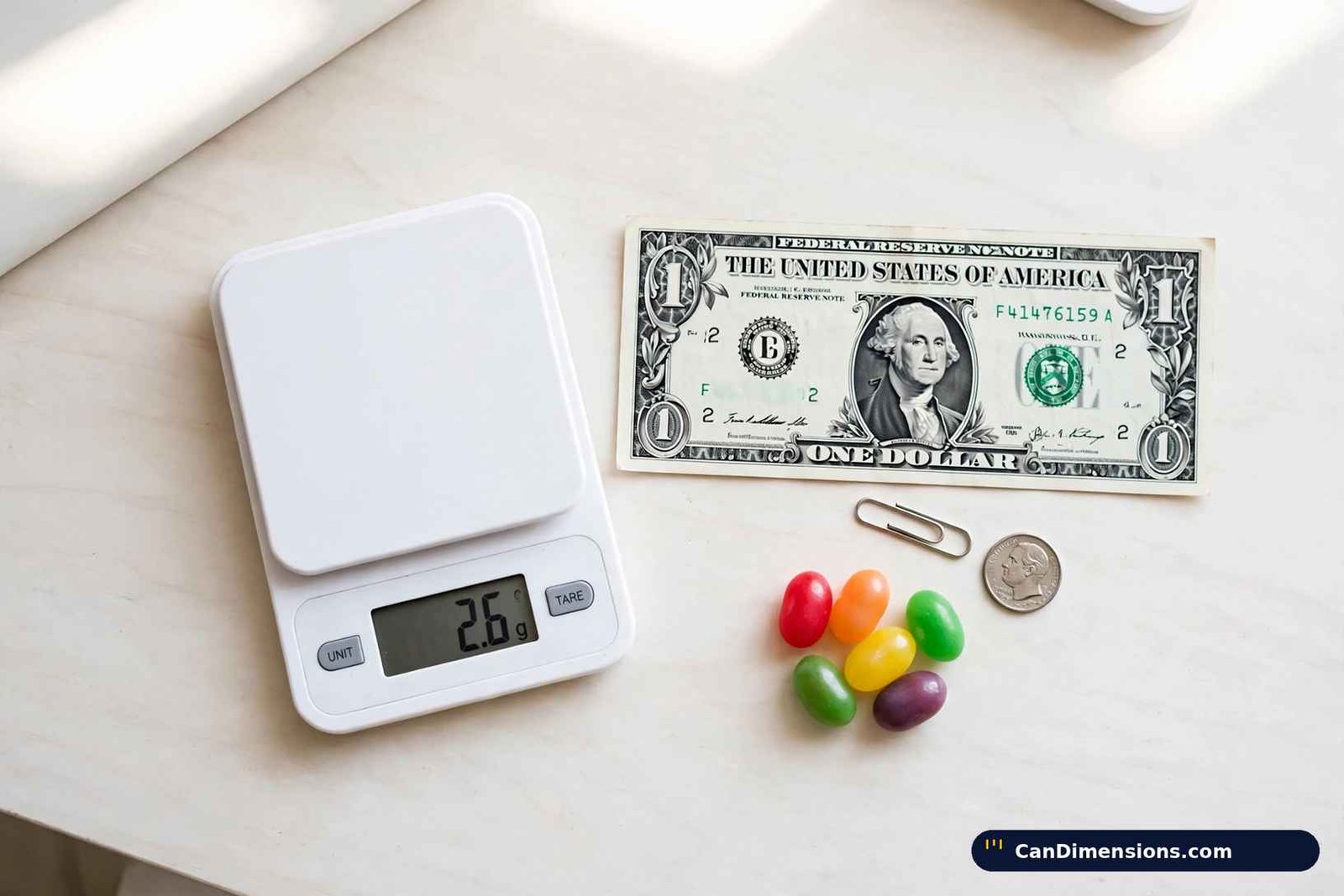
Plenty of things that weigh 1 gram are already in your wallet, your pockets and your kitchen drawers — a US dollar bill, a Japanese 1 yen coin and a standard paperclip all sit right at one gram, the smallest weight most of us ever need to picture.
A gram is one-thousandth of a kilogram, or 0.0353 ounces. That is too light for your hand to judge on its own — almost nobody can feel the difference between one gram and two — which is exactly why a list of familiar reference objects helps.
So here are 17 everyday things that weigh 1 gram, every one checked against a real source: mint and manufacturer specifications, USDA food data and product labels. You also get the conversions, three ways to estimate a gram without a scale, and the honest corrections — a few famous “1 gram” items, including a grape and a pinch of salt, do not weigh 1 gram at all.
How Heavy is 1 Gram?
One gram is barely there. Rest a paperclip on your palm and you will feel pressure more than weight — that faint presence is 1 gram. In imperial terms it equals 0.0353 ounces or 0.0022 pounds, roughly 1/28 of an ounce, so it takes about 28 gram-weight objects to make a single ounce and about 454 to make a pound.
The gram is a weight, not a size, so a gram of feathers and a gram of gold feel identical on a scale while looking completely different. If you think in inches rather than grams, our guide to measuring 3 inches gives you the same kind of everyday anchors on the length side.
1 Gram is Equal to:
- 1 gram = 1,000 milligrams (the unit medication doses are measured in)
- 1 gram = 0.0353 ounces (food and cooking)
- 1 gram = 0.0022 pounds (general weight)
- 1 gram = 1 millilitre of water (volume-to-weight, exact for water)
- 1 gram = 5 carats (jewellery and gemstones)
Gram vs Grain vs Carat: Three Tiny Units Compared
Three similar-sounding units cause endless confusion, and only one of them is the gram. The grain is the old imperial unit still used for bullets, arrows and some medicines: one grain is exactly 64.79891 milligrams, so a gram holds about 15.43 grains. The carat is the gemstone unit: one metric carat is exactly 0.2 grams, which is why the conversion above works out to a neat 5 carats per gram.
In short: a carat is one-fifth of a gram, a grain is about one-fifteenth of a gram, and neither is a rounding of the other. Jewellers price by the carat, reloaders measure powder by the grain, and everyone else is safest sticking with grams and milligrams.
Common Items That Weigh 1 Gram
Here is the full list at a glance. Every row is one of the 17 verified examples detailed below; nine items from the usual lists failed the check — a grape, a raisin, a pinch of salt and six more — and each of those is covered honestly in its own section further down.
| Example | Weight | Checked Against |
|---|---|---|
| A US dollar bill | About 1 g | Bureau of Engraving and Printing |
| A standard paperclip | About 1 g | Wikipedia reference value (no maker spec exists) |
| A Japanese 1 yen coin | Exactly 1.0 g | Japan Mint official specifications |
| A sweetener packet | Exactly 1 g | USDA SR 19868 / Splenda spec sheet |
| 1 millilitre of water | Exactly 1 g | Density of water, 1 g per ml |
| A 1 gram gold bar | Exactly 1 g | PAMP Suisse minted bar specification |
| A 1 gram calibration weight | Exactly 1 g | Certified test weight (ASTM/OIML classes) |
| One-fifth of a sheet of A4 paper (80 gsm) | 0.998 g | ISO 216 size × rated grammage |
| A quarter-teaspoon of granulated sugar | About 1.05 g | USDA: 1 tsp sugar = 4.2 g |
| A single shelled peanut | About 1 g | USDA FoodData Central portion data |
| A single jelly bean (Jelly Belly) | About 1.1 g | Label: 27 pieces = 30 g |
| A single M&M’s candy | About 0.9 g | Label: 32 pieces = 28 g |
| Two Tic Tac mints | 0.98 g | Ferrero label: 1 mint = 0.49 g |
| A single Skittle | About 1.03 g | Label: 29 pieces = 30 g |
| A single Cheez-It cracker | About 1.1 g | Label: 27 crackers = 30 g |
| Two Goldfish crackers | About 1.09 g | Pepperidge Farm label: 55 pieces = 30 g |
| An incense stick | About 1–1.25 g | Satya 15 g pack holds ~12–15 sticks |
A US Dollar Bill
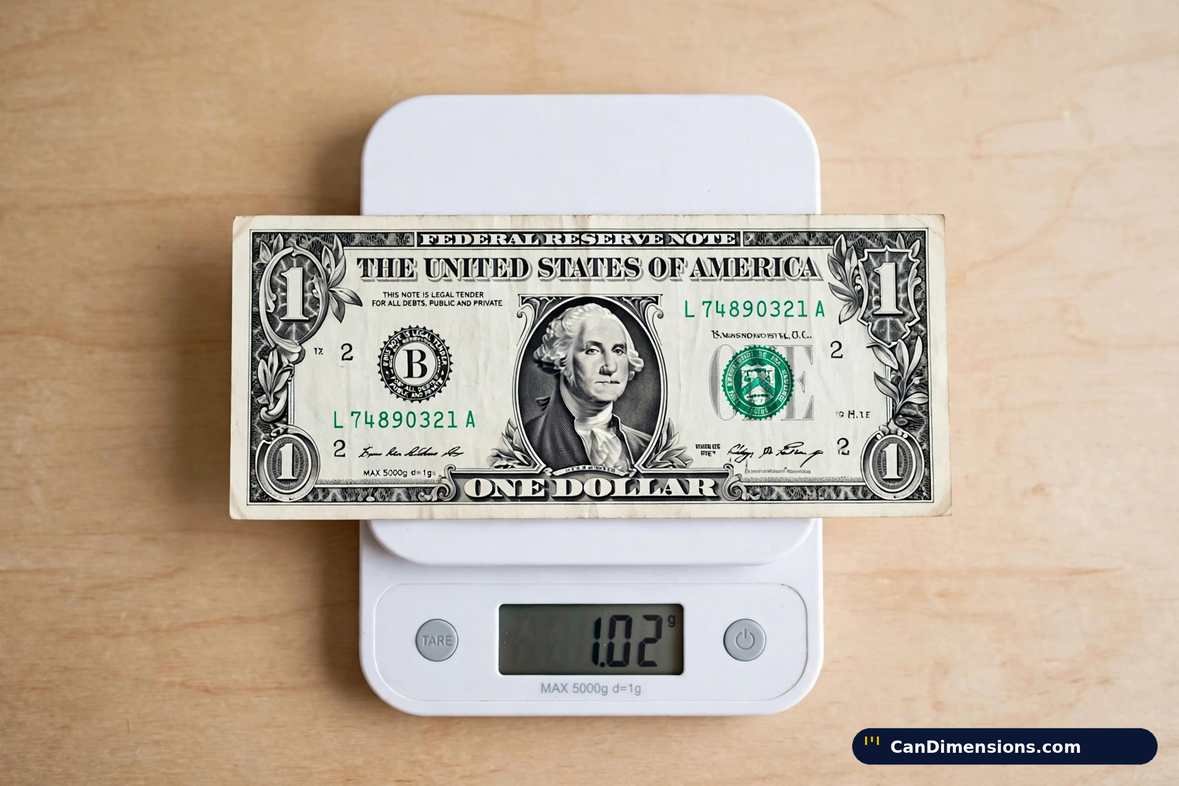
Every US banknote — $1, $5, $20 or $100 — weighs about 1 gram. The Bureau of Engraving and Printing gives the weight as approximately one gram, not exactly one: the notes are printed on a blend of 75% cotton and 25% linen, and a worn, humid bill can drift a fraction either way. Treat the dollar bill as a near-perfect pocket reference rather than a laboratory standard.
The note itself measures 6.14 inches long by 2.61 inches wide, whatever the denomination. That consistency is deliberate — counting and sorting machines handle every bill as the same physical object.
A Standard Paperclip
The standard Gem-style paperclip is the world’s favourite gram reference, and the honest version of the claim is “about a gram”: no paperclip manufacturer publishes a per-clip weight, but reference sources put the regular metal clip at roughly 1 gram, and it is the example textbooks reach for.
Size is everything here. Jumbo clips run about 1.5–2 grams and mini clips about 0.5–0.7 grams, so check which clip you are holding before you trust it as a reference — the standard office size, about 1⅜ inches long, is the ~1 gram one.
A Single Raisin
This one fails. USDA portion data puts a single raisin at about 0.5 grams — raisins vary, but a typical raisin is roughly half a gram, not a whole one. It takes two average raisins to make a gram.
Raisins get quoted as a gram because a one-ounce serving (28 g) contains roughly 28–30 of the larger golden variety in some packers’ counts. Weigh individual raisins and the average drops well below the claim.
A Thumbtack or Push Pin
Also lighter than claimed. No manufacturer publishes a thumbtack weight, and the one careful published measurement — 40 metal drawing pins weighed together at 17.55 grams in a school science text — works out to about 0.44 grams per pin. Plastic-headed push pins vary more, but none is a reliable gram.
Keep the thumbtack as a “half a gram, give or take” reference at best, and do not calibrate anything against it.
A Piece of Chewing Gum
A stick of gum is not a gram either. Wrigley’s own label for Extra gives a stick at 2.7 grams — nearly three times the claim — and the smaller pellet gums run about 1.4 grams each. The “one stick, one gram” line is a myth that survives because gum feels weightless.
If you want a mint that genuinely lands on a gram, skip to the two Tic Tacs further down this list.
A Pen Cap from a Ball Pen
This claim cannot be verified, so it does not count. No pen maker publishes the weight of the cap alone, and measured caps vary by model. The famous detail about pen caps is true — the hole in the top of a Bic-style cap is a safety vent, required so air can pass if a cap is swallowed — but a true story is not a weight.
A whole disposable ballpoint weighs only a few grams, so the cap is certainly light; light is not the same as a verified 1 gram.
A Pinch of Salt
A pinch is one of cooking’s defined measures — 1/16 of a teaspoon — and for table salt that works out to about 0.36 grams. A single pinch is barely a third of a gram; you would need almost three pinches to reach one gram.
The pinch survives in recipes because seasoning is forgiving. For gram accuracy it is useless, which is why the salt figure worth remembering is the level teaspoon: about 5.7–6 grams.
A Small Birthday Candle
The slim 2–2½ inch birthday candle is the closest miss on this list. Wilton’s standard 24-pack of 2.5-inch candles lists a total item weight of 1.12 ounces (about 32 grams) including the packaging — so the candles alone come to roughly 1–1.3 grams each, near a gram but impossible to certify at exactly one.
Count a birthday candle as “about a gram, probably a touch over,” and do not use it as a reference standard.
A Single Grape
This is the biggest error on the usual lists. USDA FoodData Central (FDC 174683) gives ten seedless grapes at 49 grams — about 4.9 grams per grape, five times the claimed weight. Even a small grape runs 3 grams or more; no table grape comes near 1 gram.
The claim seems to confuse grapes with their dried miniature cousins. As the raisin section above shows, even raisins only reach half a gram.
A Japanese 1 Yen Coin
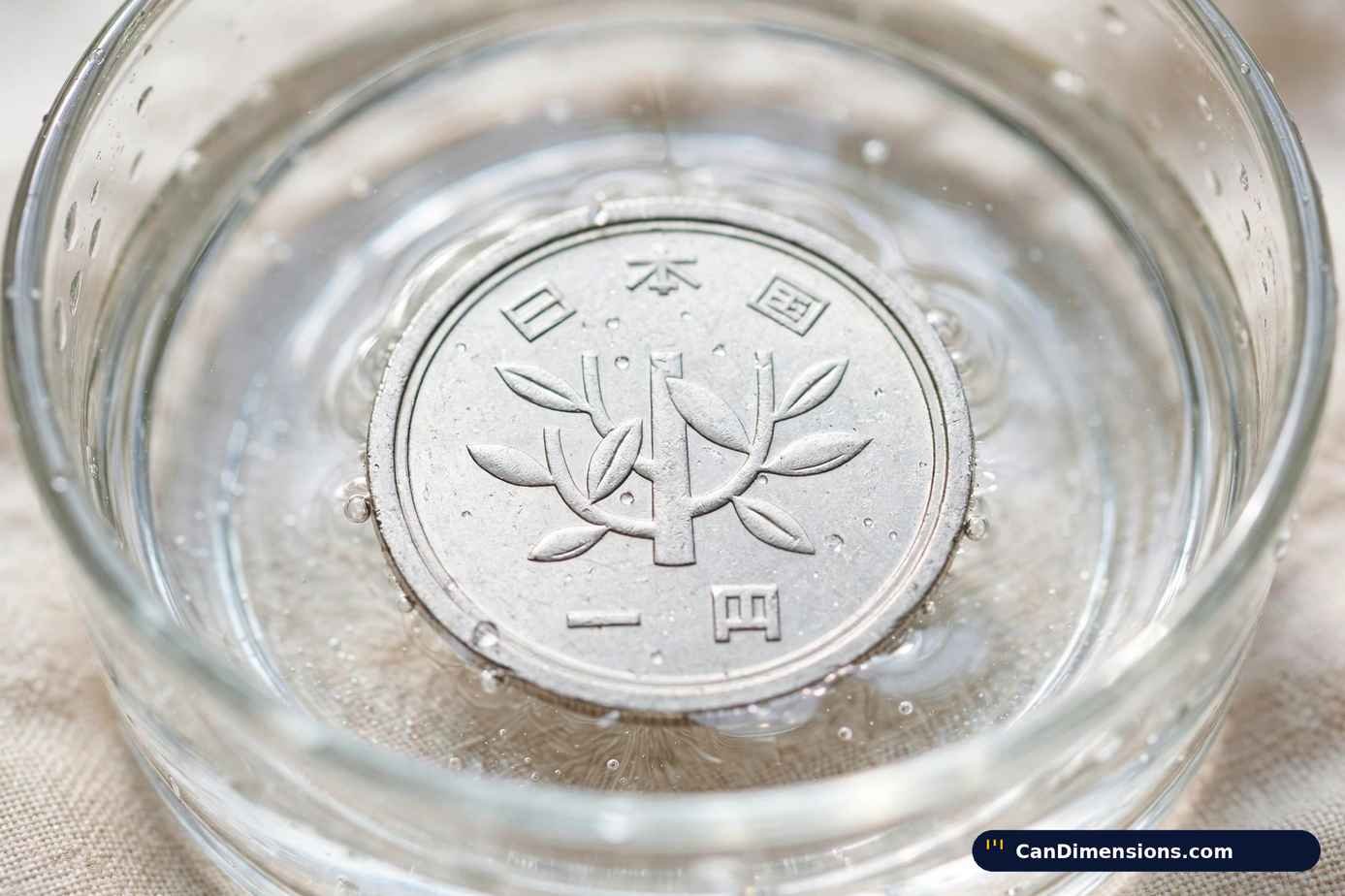
Here is a genuine exact gram. The Japan Mint’s official specifications give the 1 yen coin at exactly 1.0 gram — pure aluminium, 20 mm across, first minted in 1955 and deliberately the lightest circulating coin in the world.
Set one gently on still water and it can rest on the surface tension without sinking, something no heavier coin can do. If you ever handle one, you are holding the most precise everyday gram reference in existence.
A Sugar Packet
The restaurant sugar packet is not the 4-gram, quarter-equals-a-gram reference it is described as. Domino’s foodservice specification puts its packet at 2.83 grams, and Domino’s retail packets hold 3.5 grams — so a quarter of a real packet is 0.7–0.9 grams, close to a gram but not the tidy figure usually quoted.
The packet that is exactly a gram is the sweetener packet, next on this list.
A Plastic Bottle Cap
Standard plastic bottle caps are roughly twice the claimed weight. Manufacturer and packaging-industry figures put a normal 28 mm water or soda cap at about 1.75–2.45 grams: the lightest mainstream design, a Coca-Cola bottler’s lightweight cap developed with SCGC, is 1.75 grams, and Closure Systems International advertises its ultra-light 28 mm closure as merely “less than two grams.”
Caps feel weightless because they are hollow — but hollow and one gram are different things. The can beside the bottle is just as standardised, by the way: our Coke can dimensions guide gives its exact measurements.
A Sweetener Packet
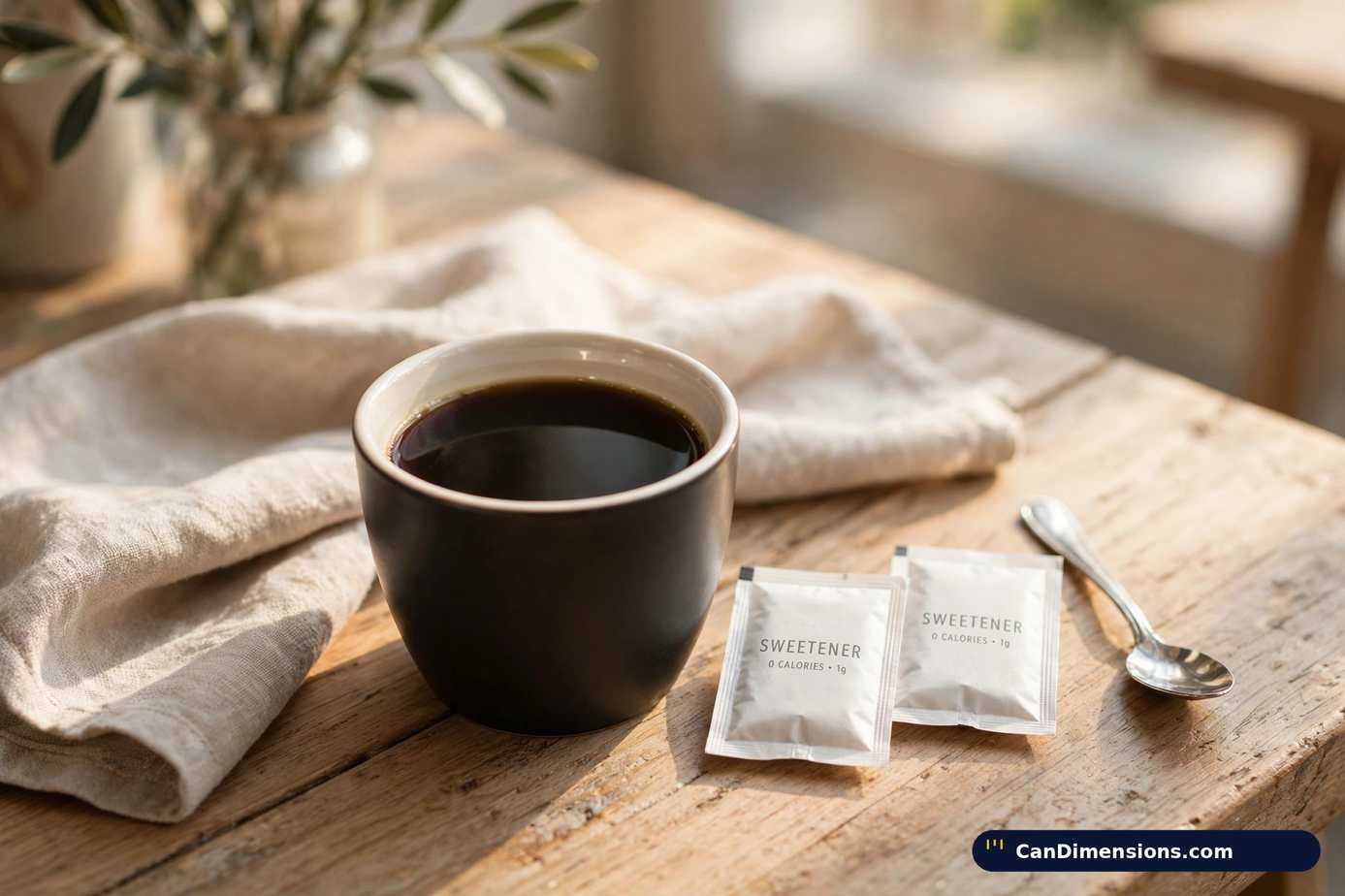
The true one-gram packet. USDA data (SR 19868) lists a packet of saccharin-based sweetener at exactly 1 gram, and Splenda’s own foodservice specification sheet gives its packets at 1.0 gram each. Sweet’N Low packets are likewise 1 gram.
So the coffee-station reference works — you just need the pink, blue or yellow packet, not the white sugar one.
One Millilitre of Water
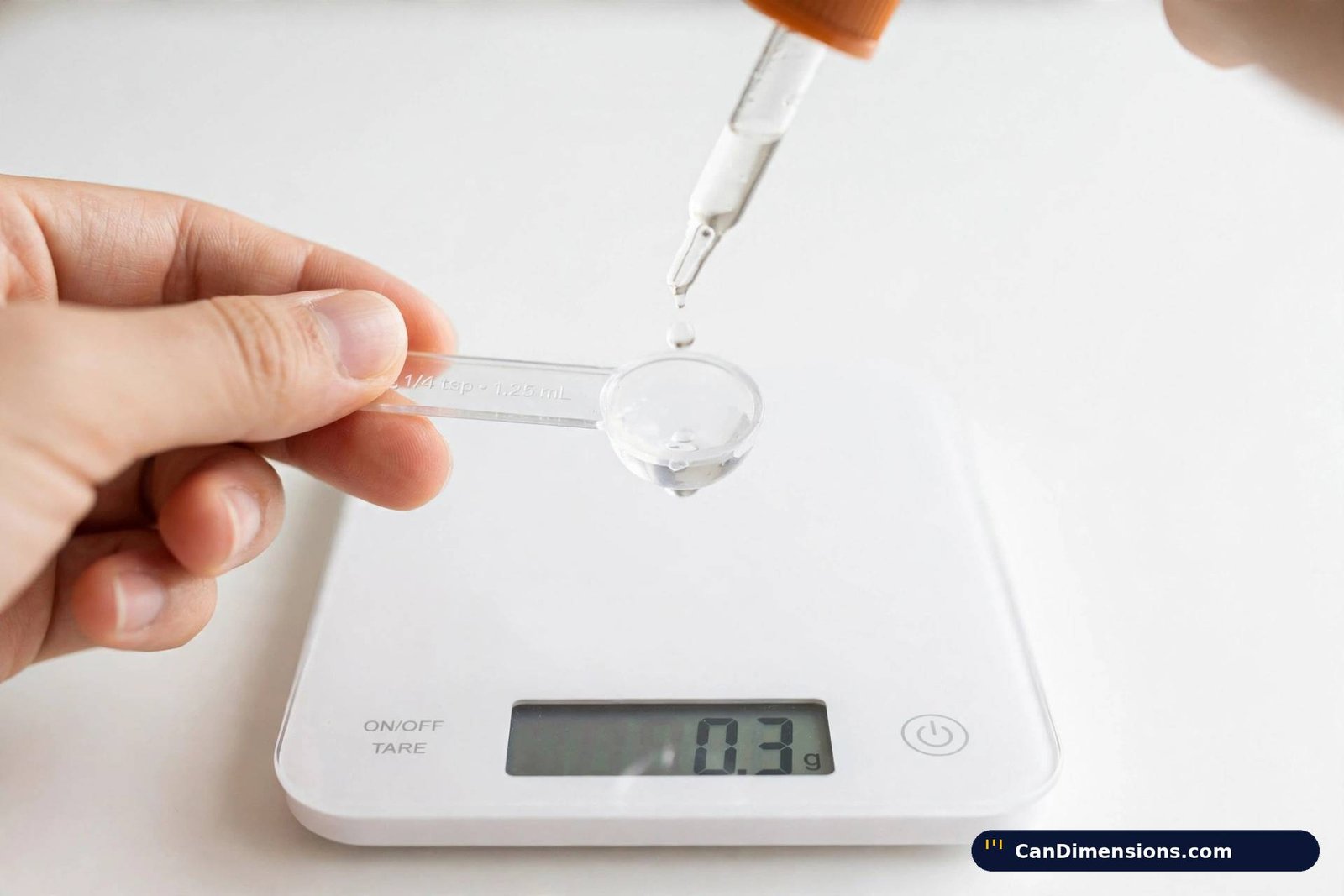
The metric system was built on this: one millilitre of water weighs exactly one gram (at water’s densest, just above freezing; at room temperature it is 0.998 g, a difference no kitchen will ever detect). It is the only example on this list that is true by definition rather than by manufacturing.
A medicine dropper or oral syringe marked in millilitres is therefore a gram scale in disguise — 1 ml in the barrel is 1 gram of water.
A 1 Gram Gold Bar
Gold refiners mint a bar at exactly this weight: the PAMP Suisse 1 gram Lady Fortuna bar contains exactly 1.0 gram of .9999 fine gold and measures just 22.1 × 13.5 mm — smaller than a postage stamp, because gold is nearly twenty times denser than water.
It is the most valuable gram on this list by a wide margin, and the clearest proof that weight and size are not the same thing.
A 1 Gram Calibration Weight
The professional’s gram. Certified calibration weights are manufactured and sold at exactly 1 gram nominal — the small stainless-steel piece used to check that a jeweller’s or laboratory scale reads true, graded under ASTM and OIML classes.
If a 1 g test weight and your scale disagree, it is the scale that moves. This is the item every other example on the list is implicitly compared against.
One-Fifth of a Sheet of A4 Paper
A full sheet of standard 80 gsm A4 weighs almost exactly 5 grams: A4 is 0.06237 m² (ISO 216), and 0.06237 × 80 g/m² = 4.99 grams. One-fifth of the sheet is therefore 0.998 grams — a gram of paper, for the price of a tear.
US Letter paper at the common 20 lb bond weight works out nearly the same (about 4.5 grams a sheet). Standardisation is what makes tricks like this possible — the same idea gives trading cards their fixed size, as our Pokémon card dimensions guide shows.
A Quarter-Teaspoon of Granulated Sugar
USDA ingredient data puts a level teaspoon of granulated sugar at 4.2 grams, so a quarter-teaspoon is about 1.05 grams — the handiest gram in the kitchen. (This is the honest version of the sugar-packet claim above: the spoon measure works, the packet arithmetic does not.)
Use a level quarter-teaspoon, not a heaped one; a heaped spoon can double the weight.
A Single Shelled Peanut
USDA FoodData Central’s portion data for shelled peanuts works out to about 1 gram per peanut, which makes a small handful a surprisingly reliable scale-check: ten shelled peanuts ≈ 10 grams, give or take the natural size variation.
In-shell peanuts weigh more — the shell roughly doubles it — so this reference only works with the peanut out of its shell.
A Single Jelly Bean
Jelly Belly’s own label gives a serving of 27 jelly beans at 30 grams, which works out to about 1.1 grams per bean. Flavours differ slightly in size, but any single gourmet jelly bean is a fair gram-and-a-bit reference.
Generic jelly beans from other makers run larger, so this one is brand-specific: it is the Jelly Belly figure that checks out.
A Single M&M’s Candy
Mars’s label for milk-chocolate M&M’s gives 32 pieces per 28-gram serving — about 0.9 grams per candy, a whisker under a gram. Two M&M’s are a little under 2 grams; one is the closest single candy to a gram in the bag.
Peanut M&M’s are a different story (each is over 2 grams), so keep this reference to the plain milk-chocolate original.
Two Tic Tac Mints
Ferrero’s label counts one Tic Tac as a 0.49-gram serving, so two mints = 0.98 grams — as close to a gram as makes no difference. A single mint is a half-gram reference, and the pair is the gram.
It is also the most portable reference on this list: the whole flip-top box lives in a pocket and every pair of mints in it is the same.
A Single Skittle
Wrigley’s label for original Skittles gives 29 pieces per 30-gram serving — about 1.03 grams per piece. One Skittle is, to all practical purposes, one gram of candy shell and chew.
Like the jelly bean, the figure comes from dividing the labelled serving, so expect a few hundredths of a gram of variation between pieces.
A Single Cheez-It Cracker
Kellogg’s label gives 27 Cheez-It crackers per 30-gram serving, or about 1.1 grams per cracker. The little square is mostly baked cheese and flour, and its uniformity from an industrial line is what makes the arithmetic trustworthy.
Broken crackers obviously break the rule — use a whole one from the middle of the box.
Two Goldfish Crackers
Pepperidge Farm’s label gives 55 Goldfish crackers per 30-gram serving, which is 0.55 grams per fish — so two Goldfish = about 1.09 grams. One fish is a half-gram; the pair is your gram.
Of all the snack references, this is the one children can be trusted to count out accurately — and to eat the evidence afterwards.
An Incense Stick
A standard hand-rolled incense stick weighs about 1 gram — the arithmetic is built into how it is sold. Satya, the best-known maker, sells its incense by weight in 15-gram packs that hold roughly 12–15 sticks, which puts each stick at 1.0–1.25 grams depending on how thickly the masala paste was rolled.
Machine-made sticks vary less than hand-rolled ones, but either way a single stick is a fair gram reference for anything except laboratory work.
What 1 Gram Looks Like in the Kitchen
Spoons measure volume, so a gram of each ingredient looks different. Using standard ingredient weights: granulated sugar is about 4.2 grams per level teaspoon, so 1 gram is a quarter-teaspoon. Table salt is denser — about 5.7–6 grams per teaspoon — so 1 gram is roughly a sixth of a teaspoon, a small mound on the spoon’s tip. All-purpose flour is lighter still: at about 120 grams per cup, a gram is roughly 0.4 of a teaspoon, barely a dusting.
Water is the exception that proves the rule: 1 gram is exactly 1 millilitre, about 20 drops from a standard dropper. When a recipe is written in grams, these spoon estimates will get you close — but for baking, where a gram of salt or yeast changes the result, the scale is the honest tool.
How to Estimate 1 Gram Without a Scale
The Paperclip Method
Keep a standard paperclip with your scale — or instead of one. Hold the clip in one hand and the item you are judging in the other; the clip’s ~1 gram gives your hand a reference it can learn. Avoid jumbo and mini clips, which run 1.5–2 grams and 0.5–0.7 grams respectively.
With practice the method is good to within about half a gram, which is close enough for portions, postage estimates and most kitchen work.
Currency Comparison
For Americans, the dollar bill is the perfect reference: every denomination weighs about a gram, so the measuring tool is already in your wallet. Coins do not help at this scale — a nickel is exactly 5 grams and a post-1982 penny 2.5 grams — but abroad, the Japanese 1 yen coin is an exact gram.
Bills work best for flat, light objects; for dense items like jewellery, compare against a coin multiple instead (two pennies = 5 grams).
The Water Volume Method
The most accurate method needs no scale at all: 1 millilitre of water is 1 gram. Draw 1 ml into a medicine dropper or oral syringe and you are holding a gram; match an unknown item’s heft against a sealed 1 ml of water in a small vial or spoon.
The method doubles as a scale check — weigh 10 ml of water and a correct scale must read 10 grams (within a fraction).
Things People Think Weigh 1 Gram (That Don’t)
Beyond the corrected list items above, four everyday references are widely misquoted. A US nickel weighs exactly 5.000 grams by US Mint specification — five grams, not one. A US quarter is 5.670 grams. A level teaspoon of sugar is 4.2 grams, four times the gram people imagine when they call a spoonful “about a gram.” And a single playing card runs about 1.8 grams — nearly two paperclips.
None of these ruins the items as references; it just means using them at their real weights: five nickels to check 25 grams, two pennies for 5 grams, a quarter-teaspoon of sugar for one.
When Does 1 Gram Actually Matter?
In medicine, constantly: doses are prescribed in milligrams, and 1 gram is 1,000 of them — the difference between a gram and a tenth of a gram is the difference between a dose and an overdose for potent drugs. In jewellery, gold is priced by the gram, so 1 gram is real money and scales are certified for it. In coffee, brew ratios such as 1:15 are weighed in grams because a gram of coffee in a 250 ml cup is a tasteable difference.
And in baking, the small ingredients — salt, yeast, baking soda — live in the 1–5 gram range where a spoon’s error is proportionally huge. Everywhere else in daily life, a gram is below the threshold of consequence, which is precisely why it makes such a good unit to learn by feel.
Question’s
What weighs exactly 1 gram?
By specification: the Japanese 1 yen coin (exactly 1.0 g, Japan Mint) and a certified 1 g calibration weight. A sweetener packet is exactly 1 g by label, and a dollar bill sits at about 1 g.
What is an example of a gram?
The standard paperclip is the classic example — about 1 gram, and in every desk drawer. A dollar bill, a single jelly bean and 1 ml of water are equally good examples.
How much does 1 gram look like?
It has no single look — density decides. One gram is a whole sheet’s fifth of paper, a tiny 22 mm gold bar, or a quarter-teaspoon of sugar: barely-there weight, many shapes.
Does a paperclip weigh 1 gram?
About, yes — a standard Gem-style clip is roughly 1 gram. Jumbo clips weigh 1.5–2 grams and mini clips 0.5–0.7 grams, so the standard size is the only one to trust.
How many grams is a normal paper?
A full sheet of A4 or Letter paper weighs about 4.5–5 grams, not 1 gram. For one gram of paper, tear off about one-fifth of the sheet.
Can a metal detector detect a paper clip?
Yes, easily. Detectors respond to the clip’s steel, not its weight — a 1-gram steel object gives a clear signal.
Can I use my phone as a gram scale?
No. Phone screens cannot measure a gram accurately. A small digital pocket scale that reads to 0.01 g costs little and is the right tool.
Does a dollar bill weigh 1 gram?
About, yes. The Bureau of Engraving and Printing puts every denomination at approximately 1 gram — close enough as a reference, though not an exact standard.
Is 1 gram equal to 1 spoon?
No — grams are weight, spoons are volume. A quarter-teaspoon of sugar is about 1 gram, but a teaspoon of water is 5 grams; the ingredient decides.
Conclusion
One gram stops being abstract the moment it has a shape: a yen coin, a paperclip, a pair of Tic Tacs. Hold two or three of the verified examples above and your hand learns the unit faster than any definition can teach it. Just as useful is knowing which famous examples to retire — the 4.9-gram grape, the third-of-a-gram pinch of salt and the two-gram bottle cap.
Keep one reliable reference where you work. A standard paper clip in the desk drawer is the traditional choice: check it against a 1 g calibration weight once, and every estimate after that — in the kitchen, at the post office, at the jeweller’s counter — gets easier.