How Much Is 10 Grams? 17 Things Checked Worldwide
Ask the question in Ohio, Osaka or Oxford and the answer changes currency. how much is 10 grams is two American nickels in one town, three small British coins in the next, and a pair of Japanese coins in a third — the same mass, rebuilt from whatever a country’s mint happens to strike.
That is the route this page takes. Instead of one nation’s drawer, it collects the weight from three mints, an international paper standard that works in almost every country on earth, and a handful of pantry staples whose labels travel just as well.
Seventeen references pass the checks below, each traced to a mint specification, a food database, a maker’s label or a standards body. Six famous candidates fail; their sections are kept, with the true figure printed where the claim stood — a traveller deserves to know which pocket references to retire.
What Is 10 Grams?
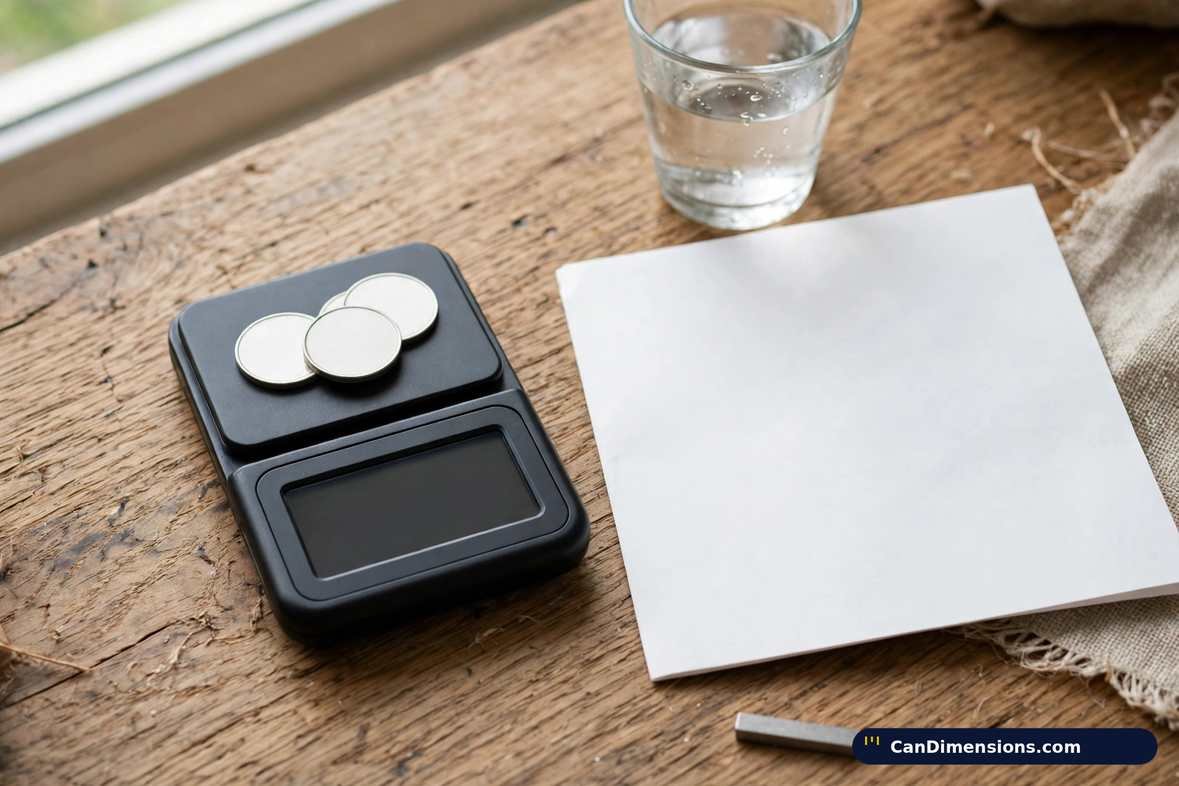
In metric terms the weight is a tidy decimal citizen: a hundredth of a kilogram, a tenth of a hundred grams, ten thousand milligrams. Rest it on a fingertip and it barely announces itself, yet it is heavy enough to price gold, dose yeast and step a postal tariff.
What makes this weight unusually friendly is how many nations manufacture it by accident. Coin systems were designed long before pocket scales, but their specification sheets read like a catalogue of small exact masses, and several denominations land within a whisker of this one.
How Much is 10 Grams in Other Units?
The fixed conversions never change, whichever country you ask in. Spoon rows are a different species: a spoon holds volume, so each row names the ingredient it was weighed with.
| Unit | 10 Grams Equals | Notes |
|---|---|---|
| Kilograms | 0.01 kg | Decimal form |
| Milligrams | 10,000 mg | 1 g = 1,000 mg |
| Pounds | 0.022 lb | 1 lb ≈ 453.6 g |
| Ounces | 0.353 oz | 1 oz ≈ 28.35 g |
| Carats | 50 ct | 1 ct = 0.2 g |
| Grains | 154.3 gr | 1 gr ≈ 0.0648 g |
| Teaspoons of water | About 2 tsp | 1 tsp of water ≈ 4.93 g |
| Teaspoons of granulated sugar | About 2.4 tsp | USDA: 1 tsp ≈ 4.2 g |
| Teaspoons of table salt | About 1.6 tsp | USDA: 1 tsp ≈ 6.1 g |
| Tablespoon of water | About ⅔ tbsp | 1 tbsp of water ≈ 14.8 g |
Anyone converting a whole recipe rather than a single weight can follow the complete grams to ounces ladder. Keep the salt row in sight as a warning: a single generic spoon figure would misstate two of the three rows above.
Ten Grams in Your Pocket, Country by Country
Start with the pattern, because the detail sections follow it. The United States builds the weight exactly, twice over: two nickels, or four modern cents. Britain builds it exactly with two 20p pieces and nearly with three 5p pieces, which total 9.75 grams. Japan builds it nearly with two 100 yen coins, which total 9.6 grams.
Three mints, three alloys, one mass. The reason this works is that national mints publish their figures and then hold them for decades, so a traveller’s loose change doubles as a set of certified masses — the single-gram end of that idea is set out in our guide to things that weigh 1 gram.
Paper money joins in more loosely. American notes are printed on one stock for every denomination and valued by their issuing bureau at roughly a gram apiece, so a fold of ten notes approximates the target on either side of any border where dollars circulate.
Everyday Things That Weigh 10 Grams
The table gathers all seventeen counted references before their sections. Read the basis column first: exact rows rest on a mint or minted specification, about rows on a database portion, a maker’s label or arithmetic printed openly in the section.
| Example | Weight | Basis |
|---|---|---|
| Two US nickels | Exactly 10 g | US Mint (5.000 g each) |
| Four US pennies (post-1982) | Exactly 10 g | US Mint (2.500 g each) |
| Two sheets of A4 paper (80 gsm) | About 9.98 g | ISO 216 area × rated grammage |
| Ten US dollar bills | About 10 g | Bureau of Engraving and Printing (~1 g each) |
| Two credit or debit cards | About 10 g | Chase: a plastic card weighs about 5 g |
| About eight almonds | About 9.6 g | USDA FoodData Central (1.2 g each) |
| Two British 20p coins | Exactly 10.0 g | The Royal Mint (5.0 g each) |
| Three British 5p coins | 9.75 g | The Royal Mint (3.25 g each) |
| Two Japanese 100 yen coins | 9.6 g | Japan Mint (4.8 g each) |
| 10 millilitres of water | Exactly 10 g | Density of water, 1 g per ml |
| One sheet of A3 paper (80 gsm) | About 9.98 g | ISO 216 area × rated grammage |
| One pitted prune | About 9.5 g | USDA portion data |
| One tablespoon of whole flaxseed | About 10.3 g | USDA tablespoon weight |
| Two tablespoons of cocoa powder | About 10.8 g | USDA: 1 tbsp = 5.4 g |
| Nine jelly beans | About 10 g | Jelly Belly label: 27 pieces = 30 g |
| A 10 g silver bar | Exactly 10 g | PAMP Suisse minted bar specification |
| A 10 g calibration weight | Exactly 10 g | Certified test weight (ASTM/OIML) |
Six familiar names keep their headings below without joining the count: the clips, the pencil, two spoon claims, the thumbtacks and the ping-pong balls. Each section prints the figure that disqualifies it.
Ten Standard Paper Clips
Not counted: — the pile inherits a guess and multiplies it. Nobody who makes clips publishes a weight for one, so the opening claim of a gram apiece has no specification underneath it. Weighed estimates for ordinary clips scatter from roughly half a gram to about 1.4 grams depending on size.
Ten clips drawn from one box could therefore settle anywhere between about five and about fourteen grams. As a shrug the handful is harmless; as a reference it is unusable on any continent, which is why it opens this list as a warning rather than an entry.
Two US Nickels
Counted: — exactly, on the US Mint’s specification of 5.000 grams per coin. Two nickels are the full weight with nothing left over, and the specification has held since the denomination arrived in 1866.
The coin’s recipe adds a footnote travellers enjoy: despite the name, a nickel is three-quarters copper and only one-quarter nickel metal. Carry two and you carry a pocket calibration weight that cost you ten cents.
Four US Pennies
Counted: — exactly, with a date check attached. Cents struck since 1982 carry a Mint specification of 2.500 grams and a copper-plated zinc build, and four of them total the target precisely.
Earlier cents break the sum. The mostly copper issues from before 1982 weigh 3.11 grams apiece, and four of those reach about 12.4 grams instead. Read the year on each coin before the set goes anywhere near a scale.
Two Sheets of A4 Paper
Counted: — about 9.98 grams, worked out from the sheet’s own rating. Paper graded 80 gsm carries eighty grams per square metre, and the ISO 216 standard fixes an A4 sheet at 210 by 297 millimetres, an area of 0.06237 square metres. One sheet therefore comes to ≈4.99 grams, and a pair to ≈9.98.
This is the reference that ignores borders altogether. A4 is the everyday sheet in most of the world, so the arithmetic is waiting in almost every office and hotel business centre on the planet.
Ten US Dollar Bills
Counted: — about, resting on the deliberately cautious wording of the Bureau of Engraving and Printing, which puts every denomination at approximately one gram, printed on identical cotton-linen stock — three parts cotton to one part linen — so ten notes of any value approximate the full weight.
Hold the word “approximately” in place. Circulated notes gather dirt and shed fibres as they age, which makes a well-travelled fold a good estimate, never a specification. The same note anchors the size side of the family in our dollar bill dimensions guide.
Two Credit or Debit Cards
Counted: — about, on a bank’s published typical figure. Chase values an ordinary plastic payment card at roughly five grams, so the pair in most wallets lands near the target.
Two caveats travel with this one. A card’s footprint and thickness are fixed by the ISO/IEC 7810 standard, which says nothing about weight, so five grams is an established typical value, not a rule. And premium metal cards run from about thirteen grams upward apiece — leave those in the wallet.
One Standard Graphite Pencil
Not counted: — a popular claim that lands short. Repeated weighings and pencil references put an unsharpened No. 2 at roughly six to seven grams, and no maker or standard fixes the class at the target figure.
At the very top of the pencil range a heavy wooden model nears the mark, which is likely where the story began. A range whose top edge touches ten is not a typical ten, so the pencil stays a “somewhat under” illustration and earns no count.
Two Teaspoons of Granulated Sugar
Not counted: — short by a fifth once the database’s figure is applied. The USDA’s data puts granulated sugar at 4.2 grams for a level teaspoon, making the pair 8.4 grams. Reaching the full weight takes about 2.4 level teaspoons.
The claim was built on a rounded five grams per spoon that hardened into fact through repetition. Spoon the sugar two and a half times, level each spoon, and the estimate becomes honest — but two spoons are not this weight.
One Tablespoon of Flour
Not counted: — the heading argues against itself. Reference ingredient charts put all-purpose flour near 120 grams a cup, which puts a spooned, levelled tablespoon near 7.5 grams. Guides listing this example often concede roughly eight grams inside their own section.
Digging the spoon into the bag packs the flour tighter and lifts the figure by an amount no chart can standardise. Three-quarters of the way there is a useful thing to know; it is not a reference, and it is not counted.
Seven to Ten Almonds
Counted: — on the corrected serving printed here. USDA FoodData Central values one whole almond at 1.2 grams, with about twenty-three making an ounce, so the serving that matches this weight is eight nuts at roughly 9.6 grams.
The heading’s full span is too loose to trust on its own: seven nuts come to roughly 8.4 grams, ten to roughly twelve. Count eight at the snack bowl and the handful means something.
Four Standard Ping-Pong Balls
Not counted: — the neatest miss in the list, settled by a rulebook. The ITTF’s Laws fix a table tennis ball at 2.7 grams, so four balls total 10.8 grams and three total 8.1. No whole number of balls reaches the target.
Precision is not the same as fit. This is the most exactly specified object in the competitor’s list, and it still cannot be counted, because the specification points somewhere else.
Ten Thumbtacks
Not counted: — barely two-fifths of the claim survives the only published measurement behind it. A school science text’s weighing put forty metal drawing pins at 17.55 grams altogether — about 0.44 grams a pin, so ten pins reach only ≈4.4 grams.
Plastic-headed push pins scatter wider still, and no manufacturer publishes a figure for either kind. Ten thumbtacks are a desk ornament, not a mass, wherever in the world the desk happens to be.
Two British 20p Coins
Counted: — exactly 10.0 grams, on The Royal Mint’s specification of 5.0 grams for the seven-sided 20p piece: cupro-nickel, 21.4 millimetres across, in circulation since 1982.
Set the pair beside the American nickels and the symmetry is pleasing — two unrelated mints chose the same coin mass, so pockets on both sides of the Atlantic hold an exact build of this weight.
Three British 5p Coins
Counted: — 9.75 grams, the new British build this page adds. The Royal Mint specifies the small 5p piece, the eighteen-millimetre coin introduced in 1990, at 3.25 grams. Three of them stop a quarter-gram below the mark.
A quarter-gram shortfall sits inside the tolerance of any pocket reference, and the trio has a practical virtue: 5p coins are the small change most likely to be sitting unspent at the bottom of a bag after a British trip.
Two Japanese 100 Yen Coins
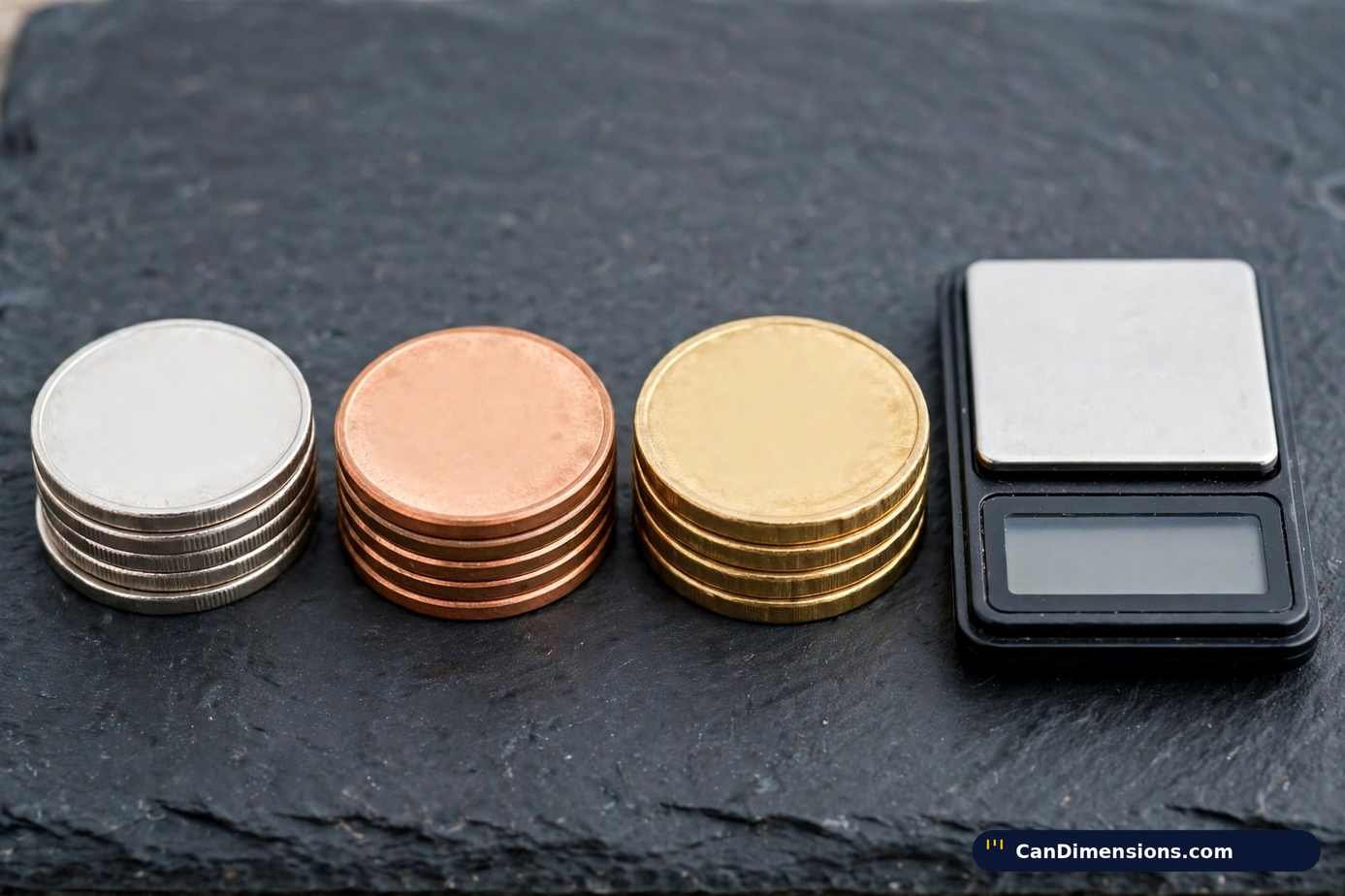
Counted: — 9.6 grams, the new Japanese build. The Japan Mint’s 100 yen coin is specified at 4.8 grams: cupro-nickel, three parts copper to one part nickel, 22.6 millimetres across, carrying the cherry-blossom design used since 1967.
Two coins therefore land four-tenths of a gram under the mark — near enough for portion judgement and for exposing a drifting scale, and a reminder that the specification habit is not a Western one. Every serious mint publishes its masses.
Ten Millilitres of Water
Counted: — exactly, by design of the metric system itself. A millilitre of water weighs a gram at room temperature to within any kitchen’s ability to notice, so ten millilitres measured into a tared container give the full weight outright.
For a traveller this is the universal fallback: a medicine syringe or a marked dosing cup exists in every pharmacy on earth, and none of them cares which currency is in your pocket.
One Sheet of A3 Paper (80 gsm)
Counted: — about 9.98 grams, the A-series trick played one size up. ISO 216 fixes A3 at 297 by 420 millimetres, exactly double an A4 sheet’s area at 0.12474 square metres. At the usual 80 gsm rating, that area works out near 9.98 grams for the single sheet.
One sheet instead of two halves the counting and doubles the surface — the poster, menu and placemat size in much of the world is quietly a pocket reference in its own right.

One Pitted Prune
Counted: — about 9.5 grams, on USDA portion data, which lists a single pitted prune at roughly that figure. Dried fruit varies with variety and drying, so read the entry as a database average rather than a promise about one particular bag.
Its virtue is portability. A prune is the reference that survives a journey in a coat pocket without bending, leaking or expiring, which is more than can be said for most of the fresh-fruit candidates on lists like this one.
One Tablespoon of Whole Flaxseed
Counted: — about 10.3 grams, on the USDA’s tablespoon weight for whole flaxseed. The seed is a standard smoothie and breakfast ingredient across several countries, and its whole form packs a spoon densely enough to reach this weight in a single scoop.
Form is the whole caveat. Ground flaxseed spoons up far lighter, at about seven grams per tablespoon on the same USDA basis, because grinding fluffs the seed apart. Whole seeds make this entry; the meal does not.
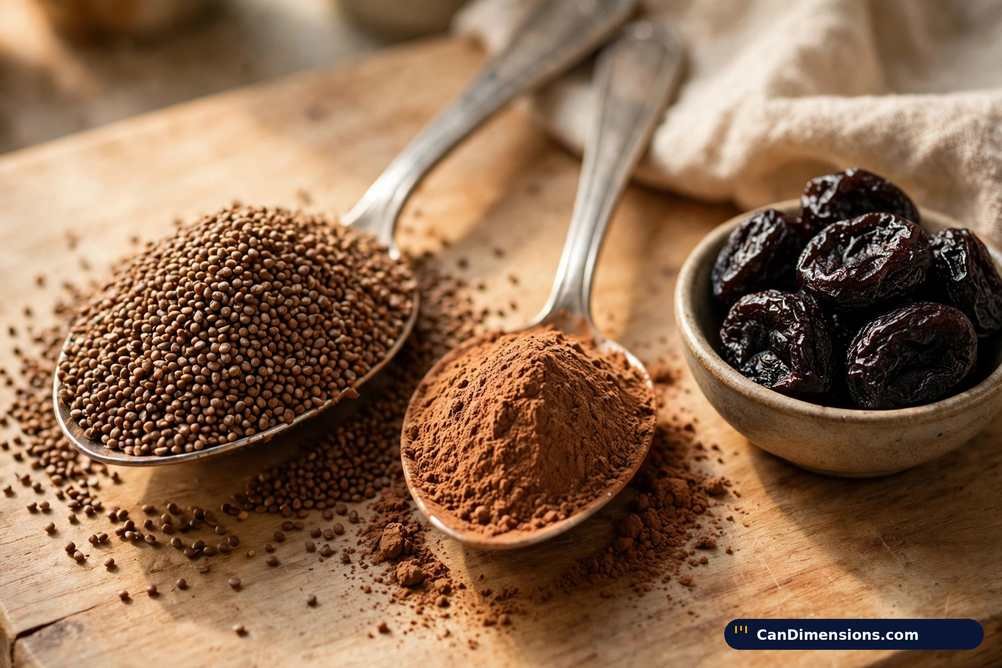
Two Tablespoons of Cocoa Powder
Counted: — about 10.8 grams, built from the USDA’s value of 5.4 grams for one level tablespoon of unsweetened cocoa powder. Two level spoons overshoot the target by eight-tenths of a gram, a margin printed here rather than rounded away.
Cocoa earns its place as the spoon measure that behaves. Unlike flour it does not pack unpredictably under a scoop, and unlike sugar its spoon weight was never inflated by a rounded myth — the database figure and the counted figure agree.
Nine Jelly Beans
Counted: — about ten grams, from arithmetic on the maker’s printed label. Jelly Belly prints a serving of twenty-seven pieces at thirty grams, which divides to roughly 1.1 grams per bean. Nine beans therefore carry the full weight between them.
Candy arithmetic only works when it starts from the packet. Assumed at a gram apiece, the beans would have been filed as ten and the count would have been wrong by a bean — the label, consulted first, fixes the handful at nine.
A 10 g Silver Bar
Counted: — exactly, as a minted specification. PAMP Suisse and its rival refiners strike a silver bar at this denomination in .999 fine metal, measuring 31 by 18 millimetres in the Lady Fortuna design and sealed inside its assay card, which certifies the mass.
Because silver is the less dense metal, the same ten grams spreads into a visibly larger wafer than gold would. One weight, two metals, two sizes — the density lesson a traveller can hold in one hand at any bullion counter.
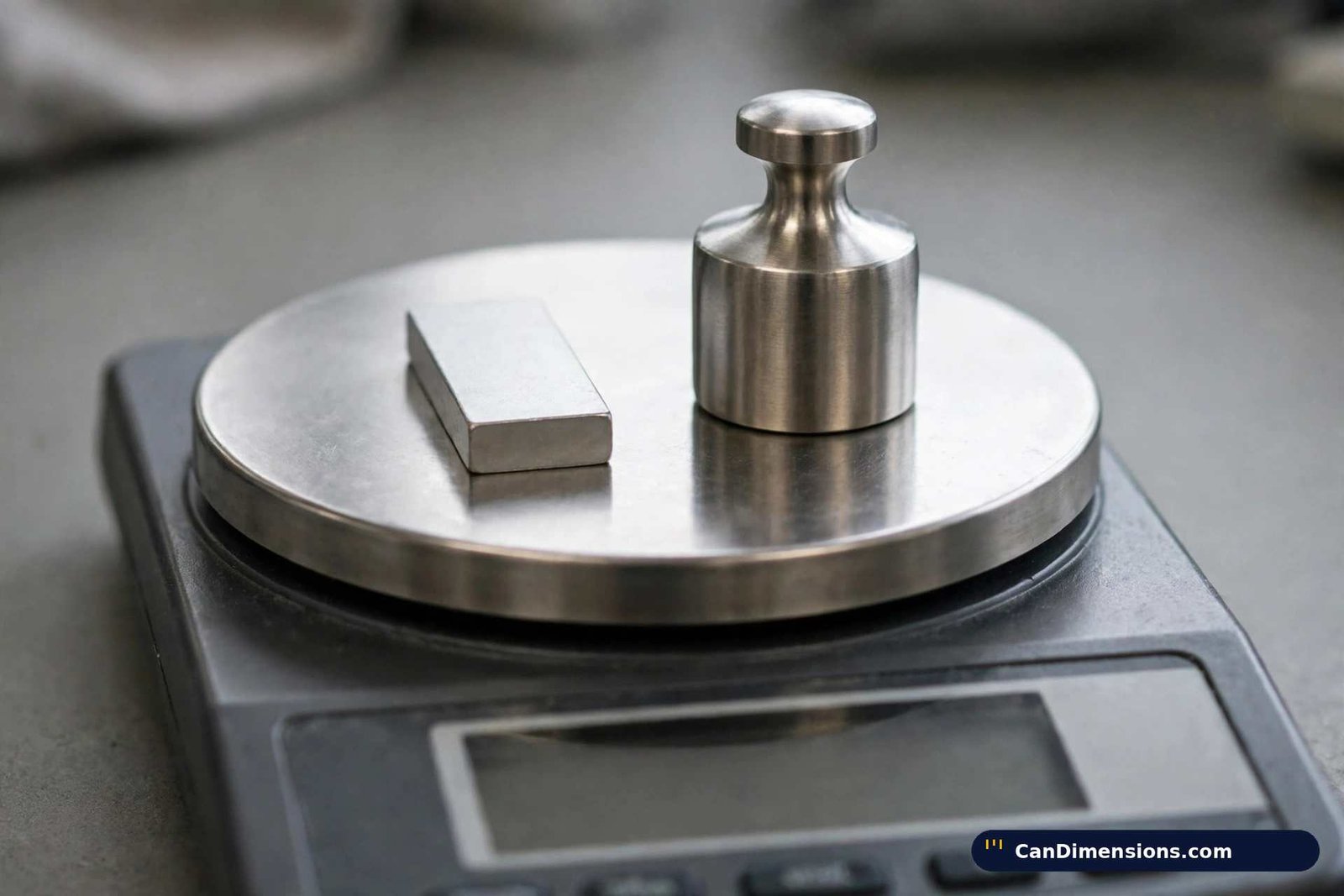
A 10 g Calibration Weight
Counted: — exactly, by manufacture. Certified test weights are produced at a nominal ten grams and graded under the ASTM and OIML class systems by firms such as Ohaus and Mettler Toledo, for the single purpose of proving that a small scale is telling the truth.
Every approximate entry on this page is a substitute for this object. Coins and sheets are what you use when the certified weight is at home; the certified weight is what settles the argument when you get back.
How to Measure 10 Grams Without a Scale
Using Kitchen Measuring Spoons
Spoons become honest the moment each one is married to its ingredient. Water needs about two level teaspoons, or two-thirds of a tablespoon. Granulated sugar needs about 2½ level teaspoons (2.4 on the USDA figure). Spooned all-purpose flour needs roughly four teaspoons, since its tablespoon runs near 7.5 grams.
Level every spoon with a straight edge. A heaped spoon is not a bigger measurement, it is an unknown one, and at this weight the heap can be a third of the answer.
Using Common Household Items
Reach first for the references backed by a specification: the coin builds from the sections above, the A-series sheets, the measured water. A ruler balanced on a pencil makes a serviceable beam — references on one end, the unknown on the other, and level means equal.
Keep the retired names out of the kit. Clips, pencils and thumbtacks feel scientific and are not, and a balance built on them balances beautifully at the wrong weight.
Using a Digital Kitchen Scale (Most Accurate)
A small digital scale reads in tenths of a gram and settles the question, and the routine is the same in every kitchen. Flat surface, scale on, empty container on the pan, tare pressed so the container vanishes, then the ingredient added slowly until the display reaches the target.
Most home errors are container errors, which is why the tare step matters more than the price of the instrument. Zero the vessel and the cheapest scale in the shop outperforms a guess made on the finest one.
Checking a Pocket Scale Before You Travel
Scales drift in suitcases. Temperature swings, knocks in transit and tired batteries all nudge a pocket instrument, and the check costs two minutes at the hotel desk. Begin with coins, because their specifications crossed the border with you: the display should agree with the mint builds from your change, denomination by denomination.
Follow with water. Ten millilitres from a pharmacy syringe, weighed in a tared cup, tests the same point by an unrelated route. Two unrelated methods agreeing is what trust looks like; two readings from the same method merely agree with themselves.
The habit scales upward. A scale honest at this weight is usually honest at the weights a kitchen actually uses, and how many pounds is 500 grams is the far anchor a full calibration set is finally proved against.
10 Grams vs. Other Common Weights
How Does 10 Grams Compare?
Against its neighbours the weight sits at a useful crossroads. It is a hundredth of a kilogram and a tenth of a hundred grams. Against imperial measures it is 0.353 ounces — call it a third of an ounce, since the full ounce holds 28.35 grams — and just over two percent of a pound, so forty-five such weights and a little change rebuild the pound.
Doubling and halving give the mental staircase: five grams is one nickel, twenty grams is four, and this page’s weight is the step where pocket change and kitchen measures first meet.
Paper Without Borders: Why the A-Series Makes This Weight Easy
The A-series is the closest thing measurement has to a world language. ISO 216 defines each size as a fraction of a square metre, so the weight of any sheet follows from one multiplication once its grammage is known. A0 at a square metre, halved to A1, halved again through A3 and A4 — every step is exact, and every printer on earth stocks the result.
That is why the paper entries on this page outrank the famous envelope claim. An empty business envelope is quoted at everything from about 6.75 grams to ten grams depending on the source, with no standard underneath any of the figures — stock, windows and adhesive all move the total. A rated sheet, by contrast, publishes the two numbers its weight is built from.
Carry the method, not the memorised sheet. Any rated paper, in any country, at any size, gives up its weight to the same area-times-grammage sum, and a stack of sheets turns that sum into a scale check of any size you need.
Provisions That Weigh Ten Grams: The Pantry End of the Trip
The pantry entries above share a traveller’s virtue: each one is sold, labelled or databased the same way in many countries at once. Flaxseed spoons up at the USDA’s figure wherever the seed is sold whole. Cocoa powder’s tablespoon is a database constant. The prune and the jelly beans carry their portions on data and labels that cross borders with the goods.
Scale the thought up and the provisions become a provisions list: the guide to what weighs 100g applies the same mint-label-and-database checking at ten times the size, for the weights a full recipe or a parcel actually reaches.
What the pantry cannot do is certify. Portions vary, labels round, and a spoon is a volume wearing a weight’s clothes. Use these entries to judge and to picture — and use coins, water or a certified weight when the number has to be right.
Question’s
How many teaspoons is 10 grams?
For water, about two. For granulated sugar, about 2.4 on USDA data. The ingredient decides, because a teaspoon holds volume rather than weight.
Is 10 grams equal to 1 tablespoon?
No. A tablespoon of water weighs about 14.8 grams, so this weight is roughly two-thirds of one; a tablespoon of flour weighs only about 7.5 grams.
How to measure 10 grams?
A digital scale is direct: container on the pan, tare pressed, ingredient added until the display shows the target. Two nickels check the result.
How can I measure 10 grams without a scale?
Build it from change: two US nickels, four post-1982 cents, two British 20p coins. Ten millilitres of water in a tared cup does the same job.
Is 10 grams half an ounce?
No — 0.353 ounces, about a third of one. Half an ounce would be 14.17 grams.
Does 1 gram equal 1 tablespoon?
No. A tablespoon is a volume measure: filled with water it weighs about 14.8 grams, filled with flour about 7.5 grams.
How to measure 1 gram of powder?
A scale is the accurate route. Spoon estimates near a gram: roughly ¼ teaspoon of granulated sugar or ⅙ teaspoon of table salt — approximations only.
Can I use my phone as a gram scale?
Not reliably. Phones carry no weighing sensor; the apps guess from tilt or screen pressure, and the guesses wander. Coins or an inexpensive scale beat them easily.
Conclusion
Gathered from three mints, one paper standard and a shelf of labelled staples, this weight turns out to be one of the most portable in the whole metric family: two nickels, three 5p pieces, a single A3 sheet, a spoon of whole flaxseed. Every one of them stands on something printed — a mint specification, an international standard, a label — that any reader can check.
Keep the failures beside them in memory — the clips that could weigh anything, the pencil that stops short, the balls a rulebook fixes at the wrong total. And when the last spoon has been levelled, remember that the darkest powder on this page, cocoa powder, reached its count the same way the coins did: not by reputation, but by a figure somebody published and stood behind.