How Big Is a Magazine? Magazine Sizes in Real Life
Most magazine dimensions charts answer a printer’s question. The question at the newsstand, the bookshelf and the post-office counter is different: how big is this thing in my hand, will it fit the shelf I own, and what envelope swallows it? The standard American consumer magazine is 8.375 × 10.875 inches — a fraction smaller than the sheet of paper in your printer, and that fraction decides half the answers.
This page keeps the complete verified size chart — every standard format, with the famous titles measured against their publishers’ own specification sheets — and then takes the sizes out of the chart: onto shelves, into boxes and envelopes, and through the post office’s own size classes.
Every figure is a trim size from a publisher’s media kit, a printer’s specification or an international standard. Where a famous title’s size is folklore rather than a published spec, the page says so.
How Big Is a Magazine in Real Life?
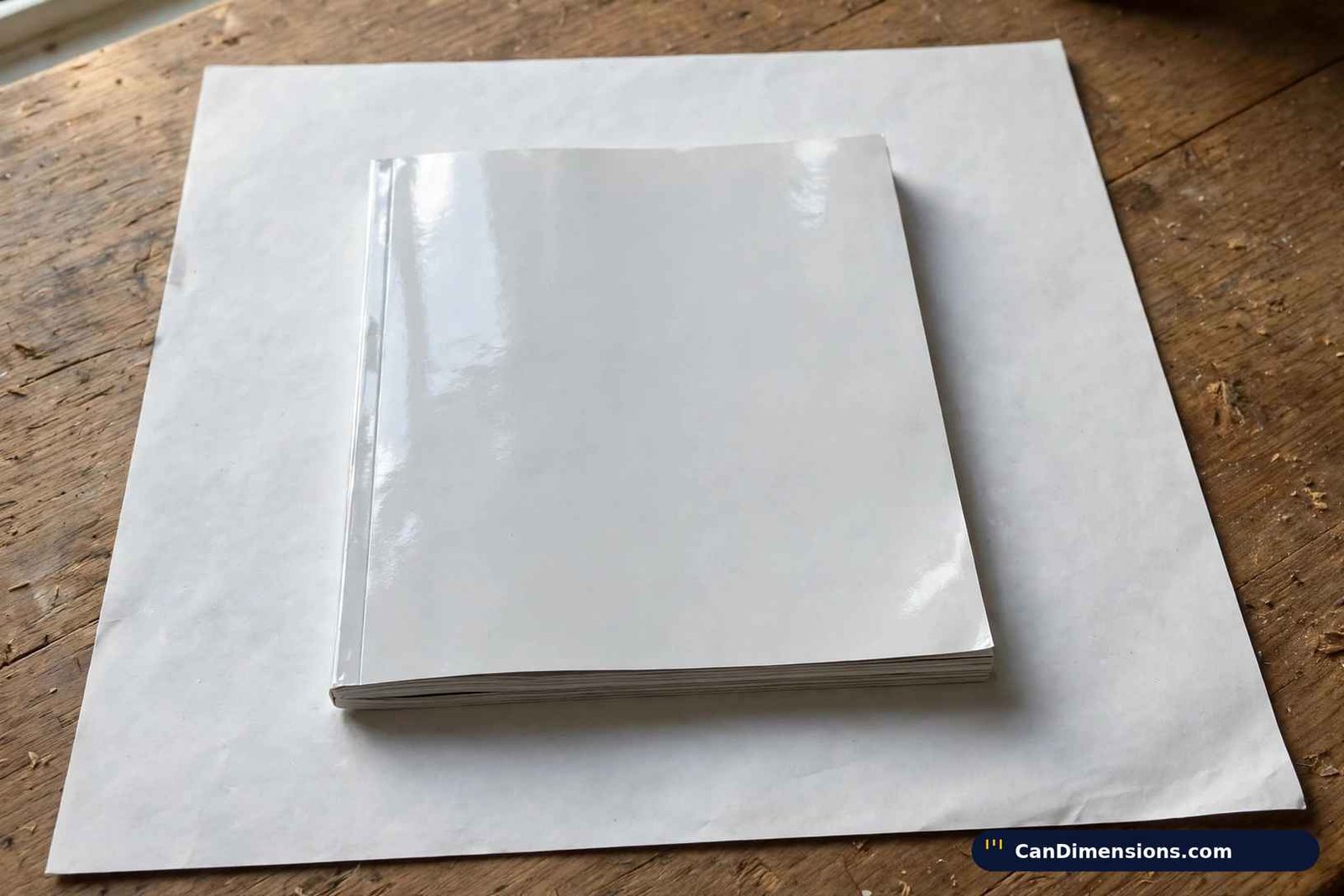
Hold a consumer magazine against a sheet of letter paper and the relationship is immediate: the magazine is the sheet, trimmed by an eighth of an inch on two sides. Letter paper is 8.5 × 11 inches; the standard consumer trim is 8.375 × 10.875 — exactly 0.125 inches narrower and 0.125 shorter. The magazine in a rack is a page that lost its margins to the cutter.
The other gauges agree. A consumer magazine stands 10.875 inches tall — taller than 9 inches by nearly two inches, shorter than 13 inches by a little over two — and its height is 1.77 times the length of a dollar bill (10.875 ÷ 6.14), the bill being 6.14 inches long by the Bureau of Engraving and Printing’s own figure; our dollar bill dimensions guide has the note’s full sizing. Two consumer magazines side by side span 16.75 inches (2 × 8.375), which is why a row of them fills a short shelf so completely.
The digest is the family’s neatest trick: fold a letter sheet in half along its long edge and the fold gives you 5.5 × 8.5 inches — the digest format exactly (11 ÷ 2 = 5.5). A digest magazine is half a sheet of paper, which is why it fits the hand and the handbag the way it does. And the tabloid, at 11 × 17, is two letter sheets side by side — the format doubles as neatly as the digest halves.
Standard Magazine Dimensions
| Format | Inches | Millimetres | Where you meet it |
|---|---|---|---|
| Standard consumer trim | 8.375 × 10.875 | 213 × 276 | Most US consumer titles |
| Letter | 8.5 × 11 | 216 × 279 | Company and independent magazines |
| Digest | 5.5 × 8.5 | 140 × 216 | Digest and TV-guide class |
| Tabloid | 11 × 17 | 279 × 432 | Newsprint and community papers |
| 3.5 × 5 to 4 × 6 | 89 × 127 to 102 × 152 | Pocket guides and minis | |
| Square | 8 × 8 or 8.5 × 8.5 | 203 × 203 or 216 × 216 | Art and design titles |
| Oversized | 9 × 12 and larger | 229 × 305 and up | Fashion and portfolio formats |
| A4 | 8.27 × 11.69 | 210 × 297 | The international standard |
The first row is the one most charts omit. The typical US consumer magazine is not letter size — it is the 8.375 × 10.875 trim that publisher specification sheets (Alabama Media Group’s advertiser sheet among them) list as the standard consumer size, and it is the size the famous titles cluster around: Time at 8 × 10.5 per its media kit, Cosmopolitan at 7.875 × 10.875 per Hearst’s specs, Vogue’s US edition at 8 × 10.875. Letter is the business format, not the newsstand one.
Letter Size Magazine (8.5 × 11 inches)
Letter — 8.5 × 11 inches, 216 × 279 mm — is the format of company magazines, independent titles, catalogues, annual reports and newsletters: publications produced where letter paper is the house stock. It is a real magazine size with the wrong reputation; charts that call it the American standard are describing the office, not the newsstand. Claims that a fixed percentage of magazines use it circulate without a source and are not repeated here.
Digest Size Magazine (5.5 × 8.5 inches)
The digest — 5.5 × 8.5 inches, 140 × 216 mm — is the half-letter format, named for the title that made it famous. It is the biggest format that still handles like a paperback: one hand, a coat pocket at a stretch, a handbag easily. Its page is exactly half the letter sheet, which kept it cheap to print on the same presses.
Tabloid Size Magazine (11 × 17 inches)
The tabloid — 11 × 17 inches, 279 × 432 mm — is the newsprint format: two letter pages on one sheet. It belongs to community papers and newsprint magazines rather than glossy titles. One famous name is routinely misfiled here: Entertainment Weekly was a consumer-trim title of about 8 × 10.5 inches, with its final print issue dated April 2022 in any case — it was never a tabloid in size, only in spirit.
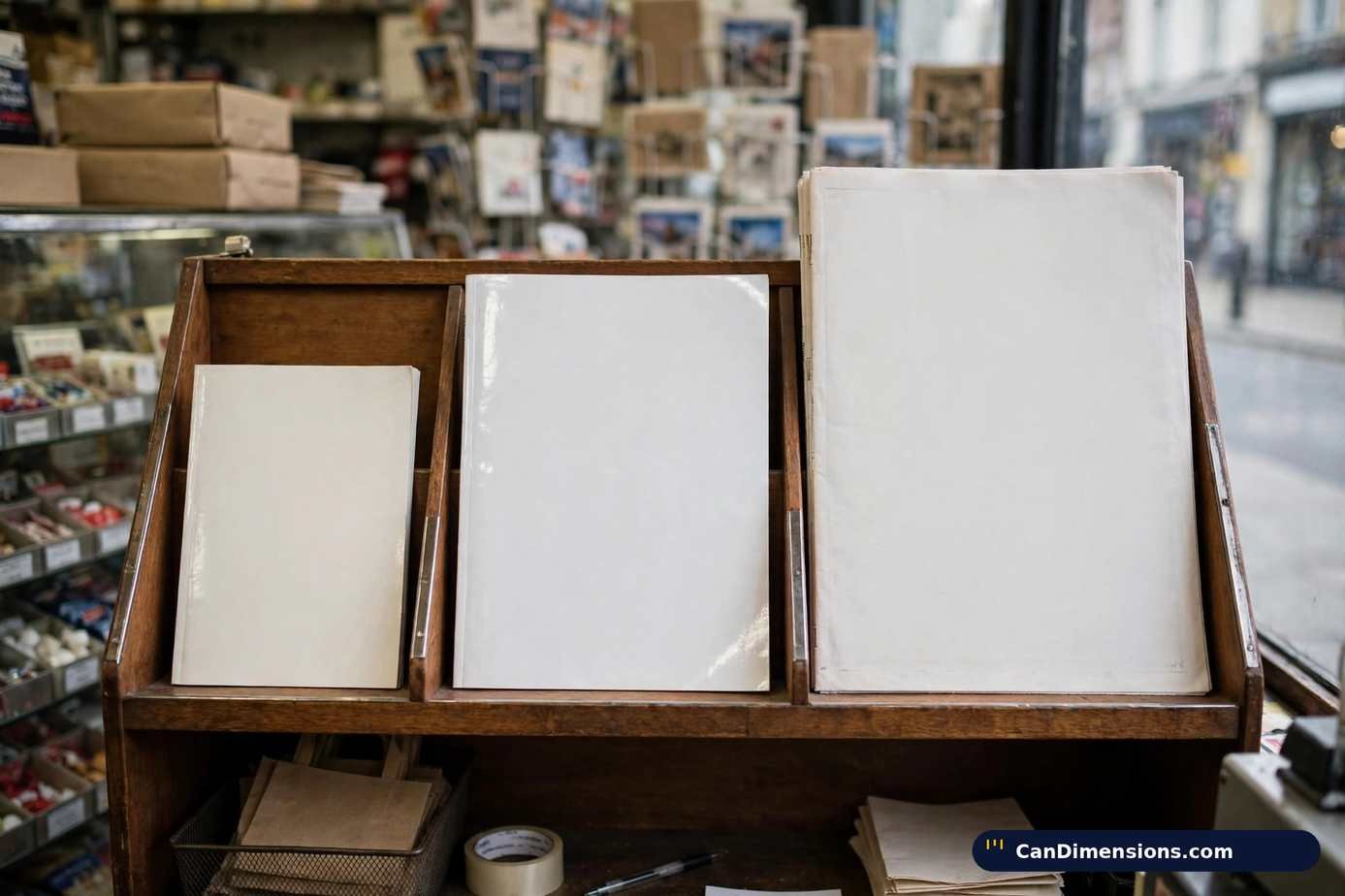
Magazine Binding Types and Their Impact on Dimensions
Bindings leave the trim size untouched. What they govern is bulk — how thick an issue may grow, and how flat it opens in the hand.
Saddle Stitch Binding
Saddle stitching folds sheets and staples them through the spine fold, so pages must come in fours, eight at the fewest. Bulk caps it from above: one major US printer, PrintingCenterUSA, sells the binding for runs of 8 to 92 pages, and the ceiling moves with paper weight — it is honest about being the thin magazine’s method. A saddle-stitched issue lies flat and adds nothing to the trim.
Perfect Binding
Perfect binding glues a stack of pages into a printed spine. It needs a spine worth printing on, which takes pages — about 28 of them, or roughly an eighth of an inch of thickness, is the working minimum in printer guidance (PrintNinja’s binding guide) — and it can reach about 2 inches at the thick end. The spine is why perfect-bound titles can print the magazine’s name along the edge, and why thick fashion issues stand on a shelf like books.
Wire-O Binding
Wire-O threads a double wire through punched holes, letting the magazine open a full 360 degrees and lie perfectly flat at any page. It adds a small working margin at the binding edge — artwork must keep clear of the punches — and it belongs to cookbooks, manuals and reference magazines that are used open rather than read straight through.
Specialized Magazine Sizes and Formats
Pocket Size Magazines (3.5 × 5 inches to 4 × 6 inches)
The pocket range runs from 3.5 × 5 inches up to 4 × 6 (89 × 127 to 102 × 152 mm): TV guides of the old school, pocket references and mini formats. At these sizes the magazine is an object first and a publication second — bought to be carried, not shelved.
Square Format Magazines (8 × 8 inches or 8.5 × 8.5 inches)
Square titles at 8 × 8 or 8.5 × 8.5 inches (203 or 216 mm square) are the art-and-design statement: the page shape itself is the branding. They shelve awkwardly — a square 8.5-inch magazine is shorter than a consumer title but wider across the spine row — and they are produced for the table, not the rack.
Oversized Magazines (9 × 12 inches and larger)
Oversized starts at 9 × 12 inches (229 × 305 mm) and goes up from there: portfolio fashion formats and large-format art titles. One caution from the spec sheets: People magazine, often filed here, is not oversized — its publisher lists trims of 7⅞ × 10½ inches for saddle-stitched titles and 8¼ × 10⅞ for perfect-bound ones, squarely in the consumer class. And National Geographic’s famous small format is about 7 × 10 inches — printed hedged, because no public trim spec is posted by the publisher and the honest figure is an approximation.
Storing Magazines: Shelves, Boxes and Magazine Files
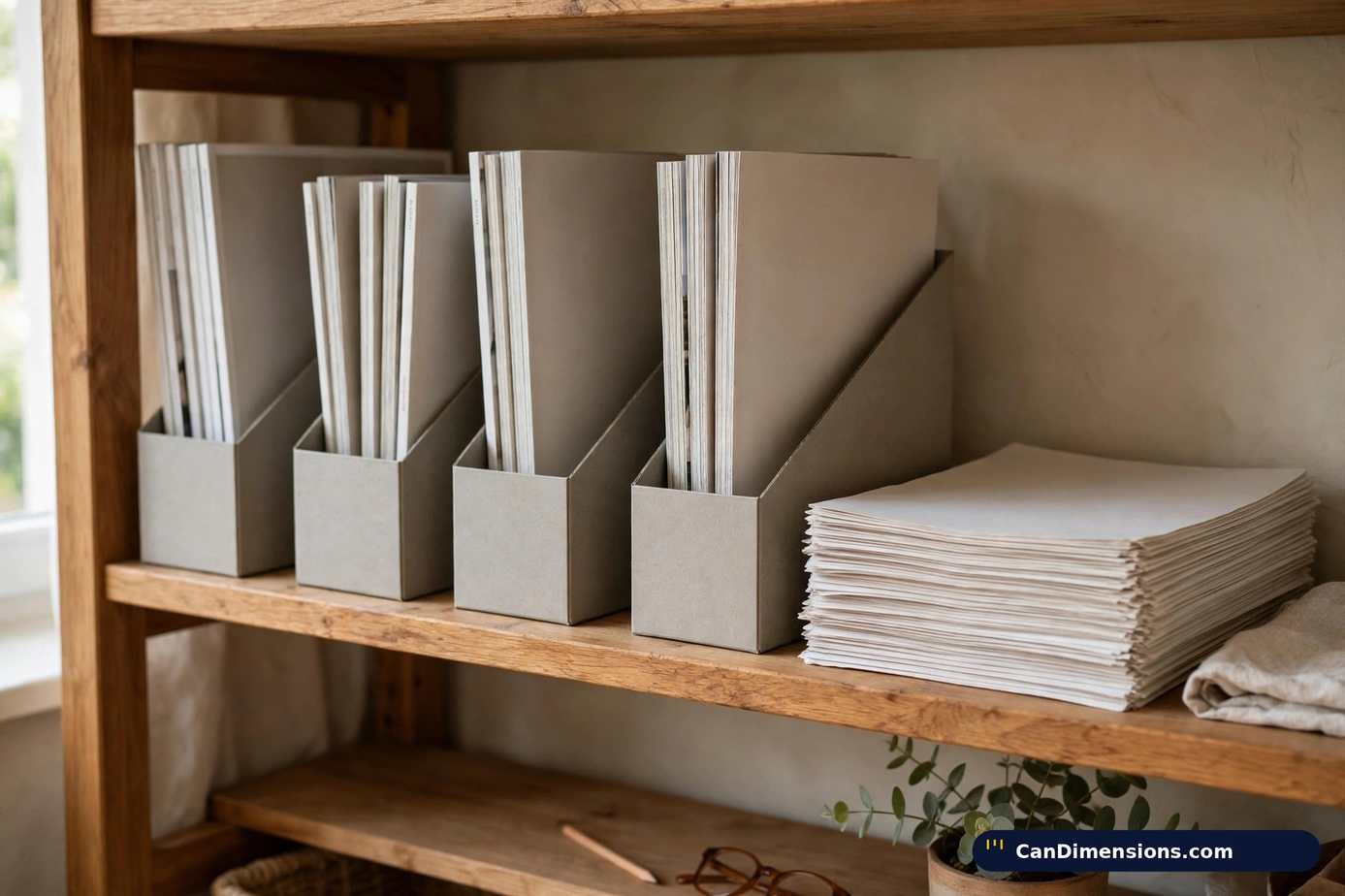
Storage is where dimensions stop being trivia. A shelf stores a magazine by its height, so plan by the tallest format you keep: allow the trim height plus an inch of finger room. A consumer title at 10.875 inches wants a shelf clear of about 12 inches; letter, at 11, the same shelf swallows it; the tabloid’s 17 inches wants about 18 — a clearance most bookcases do not have, which is why tabloids end up stored flat in piles, where their 11 × 17 footprint still fits a 24 inches shelf board with 7 inches to spare (24 − 17 = 7).
Magazine files and holders are built to the same classes as the magazines: a holder sized for letter swallows consumer trim with a whisper of slack (0.125 inches on each dimension), and digest holders are their own smaller family. Boxes follow the formats too — a storage box that takes letter upright takes every consumer title, and the oversized 9 × 12 class is the first one that demands its own box. The rule of the whole section: measure the tallest and widest thing you keep, and buy storage for that, not for the average.
Mailing a Magazine: Envelopes and USPS Flats
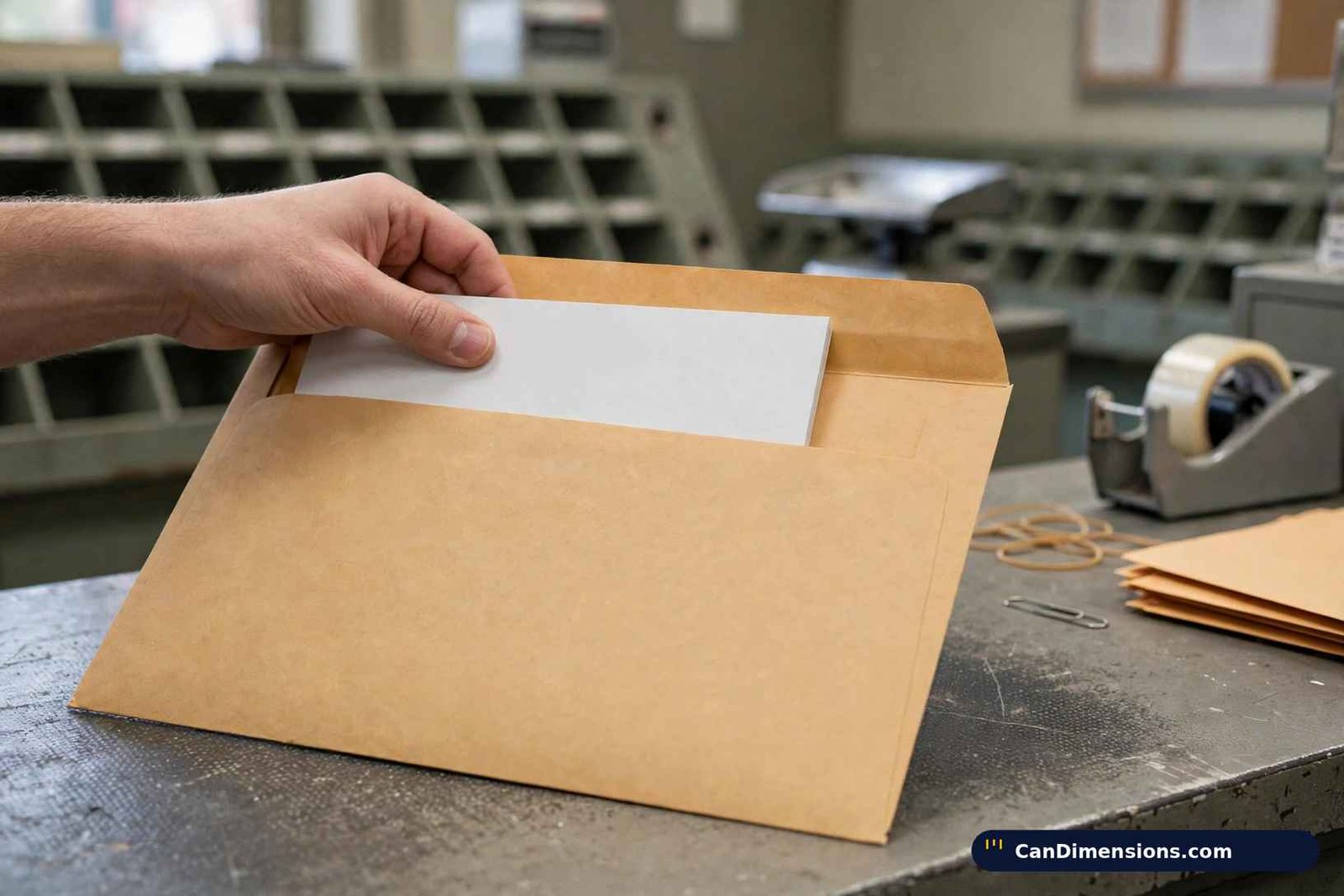
The post office has its own opinion about magazine size, and it is written in the Domestic Mail Manual (DMM 101). A piece is letter-size only up to 11.5 inches long, 6.125 inches high and a quarter inch thick. Exceed any one of those and it is a “flat” — the class magazines mail in — provided it stays within 15 inches long, 12 inches high and three-quarters of an inch thick.
Run the formats through the rule. A consumer magazine is 10.875 inches long and 8.375 high: the height alone puts it in flat territory, comfortably inside the maximums. A digest at 5.5 × 8.5 is also a flat once it is more than a quarter inch thick — thin digests can still mail as letters, since 8.5 long and 5.5 high both fit the letter limits. And the tabloid fails the flat test outright: at 17 inches long it exceeds the 15-inch flat maximum, so a tabloid mails as a parcel, not a flat. Size is postage.
Envelopes follow the same ladder. The #10 business envelope (4.125 × 9.5 inches) fits no magazine at all — even a digest stands 5.5 inches tall. A 6 × 9 catalog envelope takes the digest (5.5 × 8.5) flat. The 9 × 12 catalog envelope is the magazine envelope: its maximum enclosure is about 8.75 × 11.75 inches, which swallows letter and the consumer trim whole. The oversized 9 × 12 magazine itself steps up to a 10 × 13 envelope, whose enclosure limit of about 9.75 × 12.5 inches clears it. Every step is one envelope per format class — the chart and the mail agree.
Digital vs. Print Magazine Dimensions
Print Magazine Specifications
Print is specified in inches and points: a trim size, a bleed of 0.125 inches added on every side for artwork that runs off the page, and a safe area held about 0.25 inches inside the trim for anything that must not be cut. Publisher spec sheets state all three — Hearst’s Cosmopolitan specs, for instance, set bleed at 0.125 from trim and safety at 0.25 from trim — and images are prepared at 300 dpi, so a letter cover is a 2550 × 3300 pixel file and a consumer-trim cover about 2513 × 3263.
Digital Magazine Dimensions
Digital editions have no trim size; they inherit the screens they are read on. The figures quoted for “digital magazine dimensions” are device resolutions — 1536 × 2048 pixels is the 9.7-inch iPad’s Retina display, and 1024 × 1366, sometimes quoted as a desktop size, is an iPad-class panel too. A digital magazine is designed responsively to the reader’s screen, which is why the print numbers above remain the only true dimensions the format has.
Magazine Sizes vs Comics, Books and Paper
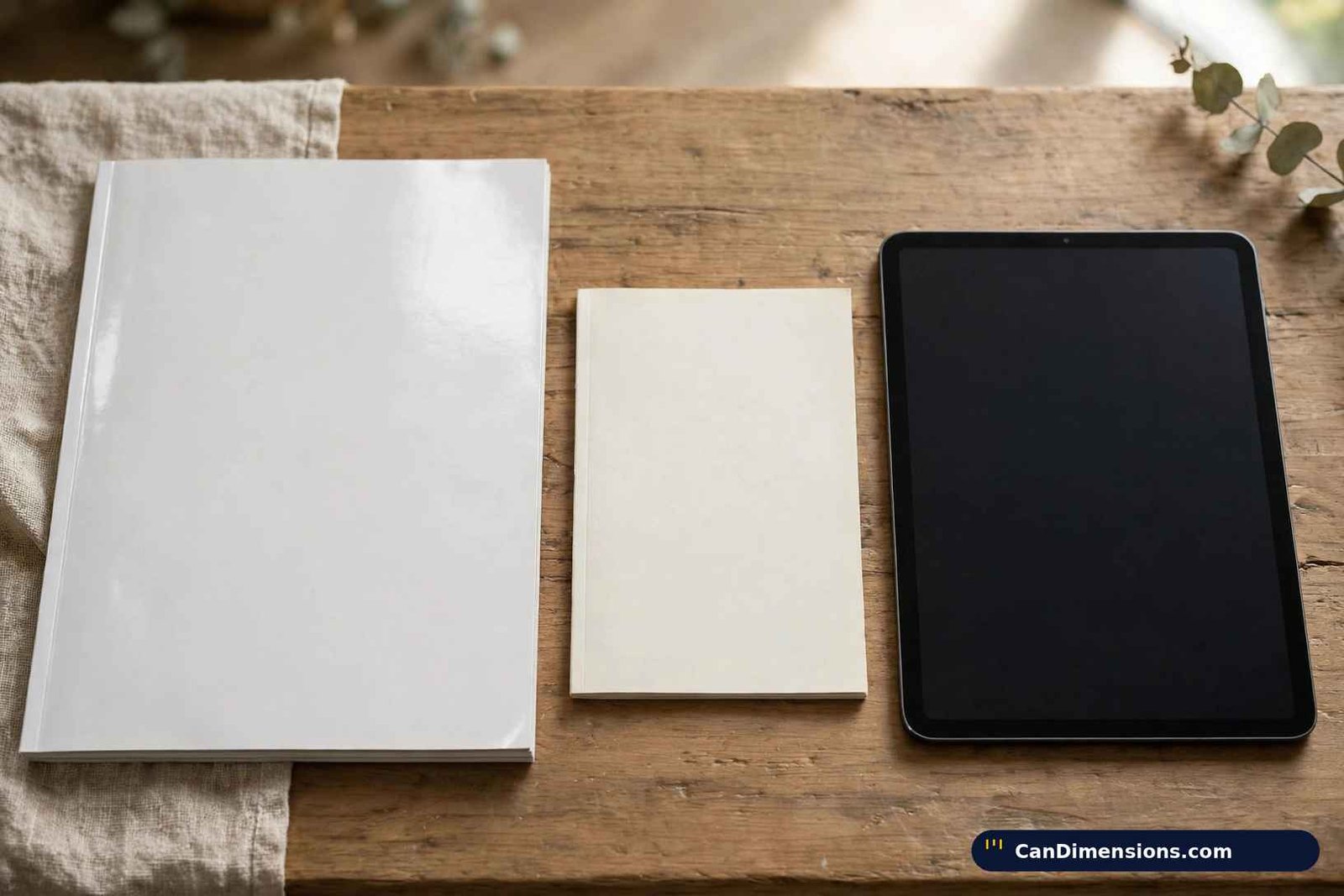
The comparisons that settle arguments. A US comic book trims at 6.625 × 10.25 inches — narrower than a consumer magazine by 1.75 inches and shorter by 0.625, which is why comics slide into a magazine rack with room to rattle. A4, the international standard at 210 × 297 mm (8.27 × 11.69 inches), is the mirror image of the US consumer trim: a tenth of an inch narrower and eight-tenths taller (11.69 − 10.875 = 0.815), so an A4 magazine overhangs an American shelf row at the top while fitting its width.
And the tablet that was supposed to replace the magazine is smaller than it: the classic iPad’s body measures 9.4 × 6.6 inches by Apple’s specifications — the famous 9.7 figure is a screen diagonal, not a body dimension — against the consumer magazine’s 8.375 × 10.875 of actual page. In both directions, the paper object is bigger. The magazine’s dimensions were settled by paper mills and presses over a century; the screen’s were settled by pockets. Each is exactly the size its material wanted.
FAQ’s
What Size is a Magazine?
The typical US consumer magazine trims at 8.375 × 10.875 inches. The full range runs from pocket formats at 3.5 × 5 inches up to oversized titles of 9 × 12 and beyond.
What is the Standard Magazine Size in the United States?
The standard consumer trim is 8.375 × 10.875 inches (213 × 276 mm), per publisher specification sheets. Letter, 8.5 × 11, is the business and independent format.
How does Magazine Size Affect the Design and Readability of a Publication?
Larger pages carry larger images and more columns; smaller formats force larger type relative to the page and shorter lines. Size also decides binding, shelf presence and postage class — design begins at the trim.
What are the Differences Between Pocket-Size, Digest-Size, and Standard Magazine Sizes?
Pocket runs 3.5 × 5 to 4 × 6 inches, digest is 5.5 × 8.5 (half a letter sheet), and standard consumer trim is 8.375 × 10.875. Each step roughly doubles the page area of the last.
What Is the Standard Size of a Magazine?
8.375 × 10.875 inches for US consumer titles — the size Time, Cosmopolitan and Vogue cluster around at 8 × 10.5 to 8 × 10.875.
What Is the Size of a Sports Magazine in Illustrator?
Set the document to the title’s trim — 8.375 × 10.875 inches for a standard consumer title — with a 0.125-inch bleed allowance on all sides. There is no separate “sports” size; sports titles use the consumer trim.
How to Change the Size of a Magazine in InDesign?
Use File > Document Setup to change the page size, and Layout > Margins and Columns for the safe area. Change size before layout begins — resizing a finished document reflows nothing automatically.
What Is the Average Size of a Magazine Cover?
The average cover is the average trim: about 8.375 × 10.875 inches for consumer titles, 8.5 × 11 for letter-format publications.
How Do You Design a Perfect-Size Magazine in InDesign?
Start from the trim the printer confirms, add 0.125 inches of bleed, hold live matter 0.25 inches inside the trim, and prepare images at 300 dpi. “Perfect size” is the size the whole production chain agrees on.
What Size is a Vogue Magazine?
The US edition trims at 8 × 10.875 inches. British Vogue is metric: 210 × 285 mm per Condé Nast UK’s media specifications.
What Are the Dimensions of a Magazine?
By class: pocket 3.5 × 5 to 4 × 6 inches, digest 5.5 × 8.5, standard consumer 8.375 × 10.875, letter 8.5 × 11, tabloid 11 × 17, oversized 9 × 12 and up.
What Is the Size of a Magazine Cover in Photoshop?
At the print standard of 300 dpi: 2550 × 3300 pixels for a letter cover, about 2513 × 3263 for the consumer trim — trim inches multiplied by 300, before bleed.
How to Create a Professional Magazine Layout?
Fix the trim, bleed and safe area first; build a grid on the safe area; keep type sizes consistent across the issue; and proof at 100% scale. Craft follows the dimensions, not the reverse.
How Do You Measure the Size of a Magazine?
Measure the trimmed page, width first, then height, with the magazine closed — width × height, in that order, is the industry convention. Measure a single leaf, not the spine bulk.
Conclusion
A magazine’s dimensions are a chain of agreements: the paper mill’s sheet, the press’s fold, the publisher’s trim, the shelf’s clearance and the post office’s size classes all pulling on the same two numbers. The consumer standard that falls out of that chain — 8.375 × 10.875 inches — is smaller than a sheet of office paper and larger than the tablet built to replace it.
Set it against the biggest print format of all and the scale settles: a broadsheet newspaper page runs about 22.75 inches long, more than two magazine heights end to end. The magazine is the handy format precisely because it refused to be that — a page sized for hands, shelves and envelopes, and exact about all three.