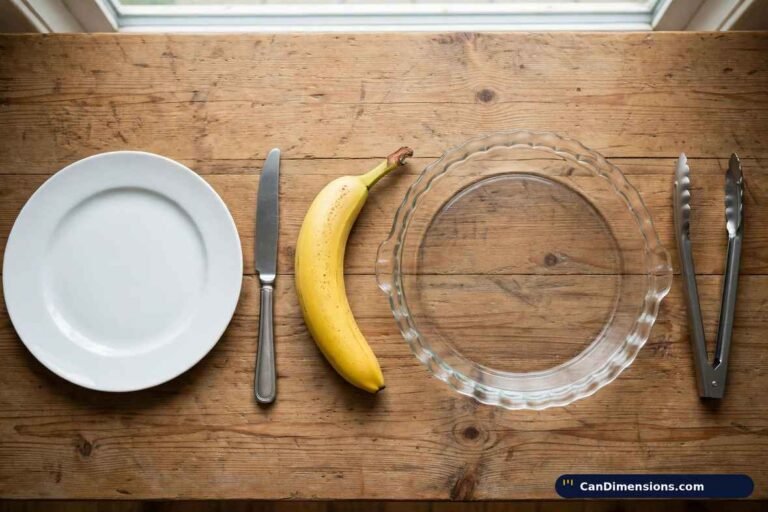
24 Inches: 12 Things with Pictures That Are 24 Inches Long
Hold a tape at 24 inches and you have stopped at exactly two feet — 60.96 centimetres, with no rounding anywhere. It is one of the easiest lengths in the imperial system to state, and one of the easiest to get wrong by example, because screens, boxes and pairs of smaller objects all borrow the number without ever measuring it.
Every object below was checked against a maker specification, an official size chart or a recognised standard before it was counted. Twelve pass — some exactly, on a maker’s stated dimension, and some as standard size classes where the basis is stated in the section. Two of the internet’s favourite 24-inch examples fail that check, and they stay on the page under their original headings, corrected, so nobody repeats them.
You will get the exact conversions first, then the 12 verified things that are 24 inches long, the honest ways to measure the length at home, a comparison against the neighbouring sizes, and short answers to the questions people actually ask about two feet.
How Long is 24 Inches ?
Twenty-four inches is exactly 2 feet — 24 divided by 12 is 2, with nothing left over. In metric it is exactly 60.96 centimetres (609.6 millimetres, 0.6096 metres), because the inch is defined as exactly 2.54 centimetres. In yards it is 0.6667 — exactly two-thirds of a yard.
That roundness is why 24 inches turns up as a manufactured size so often. A length that is exactly two feet is easy to spec, easy to cut and easy to check, so towel bars, levels, door slabs and bike wheels are all built to it by name. The sections below separate the products that genuinely measure 24 inches from the famous claims that only borrow the number.
12 Common Things That Are 24 Inches Long
Every example under this heading was checked before it was counted. Twelve pass — some exactly, on a maker’s specification or an official size class, and some as honest standard-size matches where the basis is stated in the section. Two of the original examples fail, and they stay below as corrected warning sections, clearly marked, so nobody repeats them.
| Thing | Verified size | Counted? |
|---|---|---|
| Standard kitchen cutting board | 24 in long (maker’s large size, 24 × 18) | Yes — corrected basis |
| Two rulers placed end-to-end | 12 + 12 = 24 in exactly | Yes |
| Medium pizza box | The 24-inch box class (party/catering) | Yes — corrected basis |
| Small to medium computer monitor (24-inch screen) | 24 in is the screen diagonal; panel 20.9 in wide | No |
| Two standard laptops lined up | 2 × 11.97 = 23.94 in | No |
| Baseball bat (youth size) | 24 in is the standard tee-ball size | Yes — corrected basis |
| A 24-inch towel bar | Bar length 24.00 in (maker’s spec) | Yes |
| A 24-inch level | 24 in (610 mm) on makers’ specs | Yes |
| A 24-inch carpenter’s square | Body 24 × 2 in (maker’s spec) | Yes |
| A 24-inch necklace | 24 in is a standard chain length | Yes |
| A 24-inch kids’ bike wheel | The 24-inch wheel class | Yes |
| A 24-inch interior door slab | The 2-0 standard width | Yes |
| A 24-inch dog crate | Maker’s stated size 24 in long | Yes — disclosed basis |
| A 24-inch floating shelf | The standard 24 in sold size | Yes — disclosed basis |
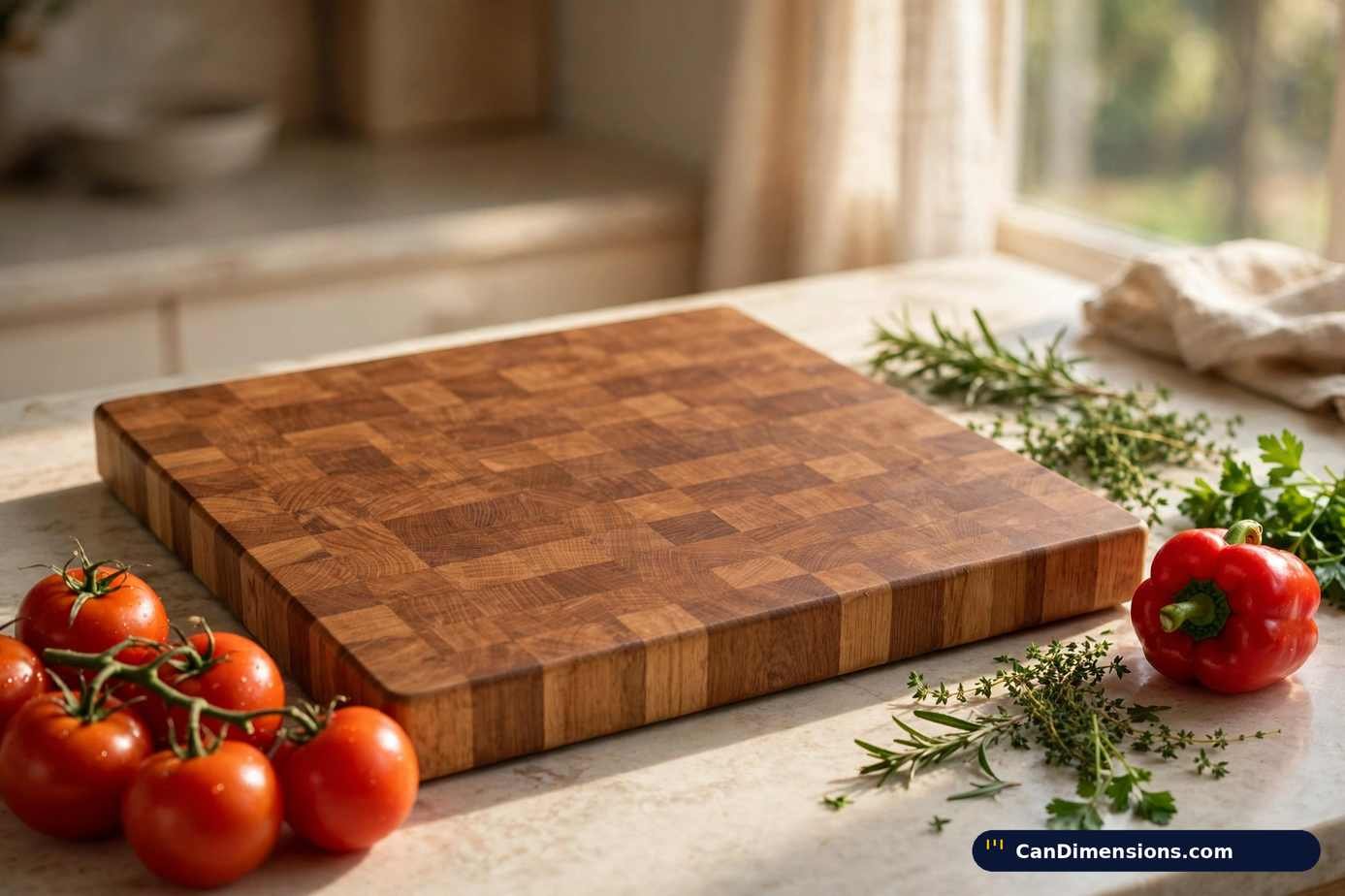
Standard Kitchen Cutting Board
Counted: on a corrected basis. Genuine 24-inch cutting boards exist and are sold by name — John Boos, the professional board maker, lists a whole family of 24 × 18 inch boards in its specification sheets (the RA03, for example, is 24″ × 18″ × 2¼″). If a board is sold as a 24 × 18, its long side is a true 24-inch reference.
The correction is the heading’s word “standard.” The everyday home cutting board is much smaller — the common sizes run from about 12 × 8 up to 18 × 12 inches. Twenty-four inches is the large, professional end of the range: the carving and butcher-block size, not the board in most kitchen drawers. The competitor’s page also credits the USDA with saying larger boards reduce cross-contamination; the USDA’s actual guidance is to use separate boards for raw meat and for produce, and it says nothing about size. Keep the board, name the size class, drop the borrowed authority.
Two Rulers Placed End-to-End
Counted: exactly. A standard ruler is 12 inches long by definition of the product, so two of them laid end to end make 24 inches — one foot plus one foot. It is the simplest honest reference on this page, and the one every other example can be checked against.
It is also a construction rather than an object, which is worth saying out loud: the pair works because each half is exact. The laptop pair further down this list tries the same trick and fails it by six hundredths of an inch, which is why constructions have to be measured, not assumed.
Medium Pizza Box
Counted: on a corrected basis — the 24-inch pizza box is real, but it is not a medium. Pizza boxes are sold in a ladder of sizes named for the pizza they hold, and the ladder’s stock sizes run 8, 10, 12, 14, 16 and 18 inches, then 20 and 24 for catering and party orders. Suppliers stock a box sold as the 24-inch size, roughly 24 × 24 inches folded, and that box is a true 24-inch-wide object.
Two parts of the usual claim need correcting. A medium pizza is a 12-inch pizza, in a box of about 12 to 14 inches — the heading’s “medium” is four size classes too small. And the big chains do not use the 24-inch box at all: Domino’s and Pizza Hut top out at a 16-inch pizza. The 24-inch box belongs to independent and catering kitchens serving party-size pies, and a box runs about half an inch to an inch larger than the pizza inside it, so the 24-inch box serves a pie of roughly 23 to 24 inches.
Small to Medium Computer Monitor (24-Inch Screen)
Not counted: the 24 inches is a diagonal, and a diagonal is not a length you can lay against anything. A 24-inch monitor’s screen measures 24 inches corner to corner; the viewable picture is about 20.9 inches wide and 11.8 inches high on a standard 16:9 display, and even the whole case, bezel included, is only around 21.5 to 22 inches wide. No horizontal or vertical measurement on the product reaches 24 inches.
The competitor’s own text admits the width is “approximately 20-21 inches” and then counts the monitor anyway — the same trap as the tablet in our 9-inch guide. A 24-inch monitor is a fine picture and a useless ruler: if you need 24 inches, the screen gives you about 21. His supporting claim that 24-inch monitors are nearly 30% of US desktop sales is printed without a checkable source and is not repeated here.
Two Standard Laptops Lined Up
Not counted: this is the closest miss on the page, and it still misses. Apple’s own technical specifications give the current 13-inch MacBook Air a width of 11.97 inches. Two of them side by side make 2 × 11.97 = 23.94 inches — six hundredths of an inch short of 24. Close enough to fool the eye, short enough to fail the measurement this page is about.
The wider claim fails further. “Most laptops range from 11 to 13 inches in width” leaves out the 15- and 16-inch models most people now buy, which run about 13.6 to 14.7 inches wide; two of those overshoot to 27 inches and more. There is no pair of standard laptops that lands on exactly 24 inches — the famous pair lands just under it, permanently.
Baseball Bat (Youth Size)
Counted: on a corrected basis — 24 inches is a standard bat size, but it is the starting size, not the 7-to-8-year-old size. Every major maker sells a 24-inch tee ball bat: Easton’s MOXIE is made at 24 inches with a −13 drop, Rawlings’ Remix and Raptor come at 24 inches, and Franklin’s Venom is a 24-inch bat — all approved for USA Baseball tee ball, the game for the youngest players.
Bat sizing charts start the smallest children — roughly age 4 to 6, and under about 4 feet 2 inches tall — on a 24-inch bat, and makers market the size for players aged 7 and under. By age 7 to 8 most players have moved up to 25 to 27 inches, so the competitor’s “players aged 7-8 commonly use 24-inch bats” points at the wrong end of childhood. The bat itself is exactly 24 inches long; that part of the claim was always true.

A 24-Inch Towel Bar
Counted: exactly, on the maker’s specification. Moen’s technical specification for its Danbury 24-inch towel bar (DN6724) gives the bar’s length — dimension A, post to post — as 24.00 inches. The 18-inch and 24-inch bars are the two standard bathroom sizes, and the 24 is the one that takes a full bath towel folded once.
One honest disclosure, printed because this page prints them: the 24 inches is the bar itself, the length a towel hangs on. The whole fitting, mounting posts included, spans about 26.4 inches on Moen’s drawing. Measured the way the product is named and used, the towel bar is a 24-inch object with its working length stated to the hundredth.
A 24-Inch Level
Counted: exactly, on makers’ specifications. The two-foot level is the carpenter’s standard size: Stanley’s catalogue lists its FatMax box beam levels (43-524, 43-625) at 24 in (610 mm), and Channellock’s 5100-0024 professional I-beam level specifies an overall length of exactly 24.0 in (609.6 mm). Levels are machined to their stated length because the length is the tool’s working edge.
Levels run 9 inches (the torpedo in our 9-inch guide) through 24, 48 and 78 inches, and the 24 is the size that lives in most toolboxes — long enough to span a door frame’s width check or a pair of studs, short enough to carry. If you own one tool that is exactly 24 inches long, it is probably this one or the square below.

A 24-Inch Carpenter’s Square
Counted: exactly, on the maker’s specification. Stanley’s 24-inch carpenter’s square (45-300) is specified with a body 24 inches long by 2 inches wide and a tongue of 16 by 1½ inches. The tool is an L of steel or aluminium whose long arm is the 24 inches — made to mark and check the framing that the rest of this page keeps meeting.
The square earns its place for the same reason the level does: it is a measuring tool, manufactured to the dimension it is named for. A carpenter’s square that was not 24 inches long would fail at its only job, so the stated size and the real size are the same thing.
A 24-Inch Necklace (Matinee Length)
Counted: as a standard trade length. Necklace chains are made and sold in a ladder of standard lengths — 16, 18, 20, 22, 24 inches and on to 30 and 36 — and 24 inches is one of the named steps, the long end of the matinee class (20 to 24 inches) in the jewellery trade’s standard length charts. A chain sold as 24 inches is measured at 24 inches, clasp included.
Where it sits is why the length is popular: on an average woman a 24-inch chain falls at the bust line, and on a man it rests at mid-chest or the top of the sternum, which makes it the standard length for a pendant worn over a shirt. Unlike the objects above it cannot be laid flat in a drawer and forgotten — it is a 24 inches you can wear.

A 24-Inch Kids’ Bike Wheel
Counted: as a standard sizing class. Children’s bikes are sized by wheel diameter, and 24 inches is one of the named classes in makers’ size guides — Schwinn’s guide puts its 24-inch bikes with riders around 8 years old and up, roughly 56 to 66 inches tall, the step between the 20-inch kids’ bike and a full-size adult machine.
The honest basis, stated the way this page states them: the 24 is the wheel’s diameter class — the tyre’s nominal outside diameter — not the frame. Two 24-inch bikes can carry different frames, but both roll on the 24-inch wheel class, and a tape across the wheel, tyre included, reads about 24 inches.

A 24-Inch Interior Door (the 2-0 Slab)
Counted: as a standard manufactured size. Interior door slabs are stocked in a ladder of widths — 24, 28, 30, 32 and 36 inches — and 24 inches, written “2-0” in the trade’s feet-and-inches notation, is the narrowest standard width, the size used for closets, small bathrooms and utility rooms. JELD-WEN and the other big door makers sell 24-inch slabs off the shelf, and the nominal width of a slab is its actual width.
This is the counted example the competitor’s page walks straight past: its measuring section says doors run 30 to 36 inches, so 24 must be estimated as a fraction of one. In fact the standard door range starts at 24 — a good share of homes have a door that is itself exactly the length this page is about, hung on its hinges.
A 24-Inch Dog Crate
Counted: on the maker’s stated size, with the measurement quirk disclosed. MidWest, the largest American crate maker, lists its 24-inch iCrate (model 1524) at 24 long × 18 wide × 19 high inches — the small-breed size, for dogs of roughly 12 to 25 pounds. The crate class is named 24, and the maker’s stated length is 24 inches.
The disclosure: measured over the assembled wire, latches and pan included, retailer measurements of the same crate come out around 24.8 inches long. The 24 inches is the maker’s size for the crate body, the figure the whole product line is organised by — counted on that basis, with the outside measurement printed here rather than hidden.
A 24-Inch Floating Shelf
Counted: as a standard sold size, with the same kind of disclosure. Floating shelves are stocked in a ladder of lengths — 16, 24, 36, 48 inches — and 24 inches is one of the standard steps, sold by name across makers. Lines that list their board dimensions give a full 24-inch length (one walnut line’s board size is printed as 24″L × 6.7″W).
The caution that keeps this honest: a few brands’ “24-inch” shelves measure a little under — one well-known line’s board is approximately 23.75 inches long. The size class is real and standard; the individual board is worth one look at the specification line before it is trusted as a measuring reference.
How to Measure 24 Inches at Home
A measuring tape is the accurate way: extend it to the 24-inch mark, which is the same point as the 2-foot mark. A yardstick does it in one move too — 24 inches is exactly two-thirds of its 36 inches, the second foot-line on the stick.
Without a tape, the competitor’s paper method works once its arithmetic is stated honestly. Two sheets of letter paper end to end give 2 × 11 = 22 inches, not 24 — the method needs its gap, and the gap is a full 2 inches, not a small one. Bridge it with the household’s standard 2-inch object, an AA battery (50.5 mm long, a hair under 2 inches), and the line of paper-plus-battery reads 24 inches to everyday accuracy.
The door method needs the correction from the examples list. Door widths in the United States do run to 30 and 36 inches, but the standard range starts at 24: the narrow closet or bathroom door in many homes is a 24-inch slab, so instead of estimating two-thirds of a door, find the narrowest door in the house and measure the opening against it directly.
24 Inches Conversion Chart (CM, MM, Feet and Yards)
The conversions in the first section give the method; this chart is the same 24 inches stated in every unit a reader is likely to need, so it can be read off directly.
| Unit | 24 inches equals |
|---|---|
| Centimetres | 60.96 cm |
| Millimetres | 609.6 mm |
| Metres | 0.6096 m |
| Feet | 2 ft |
| Yards | 0.6667 yd (exactly two-thirds) |
The millimetre figure is the one people stumble on, because 609.6 mm is hard to picture on its own. It helps to anchor the small end of the scale separately — our guide to 2 mm shows what a single small metric unit looks like against coins and card, and 24 inches is simply 304.8 of those stacked end to end.
Is 24 Inches Big?
It depends on what it is the size of, and the honest answer is: substantial but handy. Twenty-four inches is two full feet — too big for a desk drawer, small for a room. It is roughly the size of the things one person carries in two hands or hangs on a wall: a big cutting board, a towel bar, a level, a child’s bike wheel.
Two comparisons fix it in most people’s minds. A standard interior door is 80 inches tall, so 24 inches is not quite a third of a door’s height — but it is the full width of the narrowest standard door, which makes it a bigger length than it first sounds. And against the yardstick on the wall, 24 inches is two of its three feet: if you can picture a yardstick, you can picture two-thirds of it.
24 Inches vs 12, 18 and 36 Inches: Neighbouring Sizes Compared
Twenty-four inches makes most sense next to its neighbours. Twelve inches (30.48 cm) is the foot itself — the desk ruler, and the subject of our guide to measuring 12 inches long. Eighteen inches (45.72 cm) is the smaller towel bar and the large pizza. Thirty-six inches (91.44 cm) is the yard — the full stick, the standard exterior door’s width.
| Length | Centimetres | Everyday anchor |
|---|---|---|
| 12 inches | 30.48 cm | A full foot — the standard ruler |
| 18 inches | 45.72 cm | The smaller towel bar, a large pizza |
| 24 inches | 60.96 cm | Towel bar, level, 2-0 door slab |
| 36 inches | 91.44 cm | A full yard — the yardstick itself |
The step worth memorising runs downward: 24 inches is exactly eight lengths of 3 inches end to end — eight of those short measures, stacked, land on two feet precisely.
Almost 24 Inches: Look-Alikes That Miss the Mark
Some famous objects get quoted as 24 inches and are not — close enough to fool an estimate, wrong enough to matter. The laptop pair from the examples list is the champion: two 13-inch MacBook Airs measure 23.94 inches together, six hundredths of an inch short, and no arrangement of whole laptops closes that last gap.
The “24-inch” label itself sometimes rounds down. At least one well-known floating shelf sold as 24 inches measures about 23.75 inches board-length, and a “24-inch” monitor’s case is only about 21.5 to 22 inches wide — the 24 lives in the screen’s diagonal, a line that exists only corner to corner. Near 24 inches is a crowded neighbourhood; the counted list above is the part of it that is exactly 24.
Question’s
What is 24 inches long?
Any object that measures exactly two feet. Verified references from this page: a 24-inch towel bar, a 24-inch level or carpenter’s square, a youth tee ball bat, a 24-inch necklace chain, and the narrowest standard interior door — the 2-0 slab, which is 24 inches wide.
Is 24 inches 2 feet tall?
Yes. Twenty-four inches is exactly 2 feet — 24 ÷ 12 = 2 — whether the length stands tall, runs long or spreads wide. Height, length and width are the same measurement turned in different directions.
What is 24 cm long in inches?
24 centimetres is 9.45 inches (24 ÷ 2.54 = 9.4488). That is much shorter than 24 inches — less than ten inches — and the two figures are confused constantly, which is why the unit always needs checking.
How big is a 24 inch picture?
One of its sides is 24 inches. The standard prints and frames at this size are 24 × 36 inches (the common poster) and 24 × 18 inches; the frame size is the inside dimension the picture must fit, so a “24-inch picture” is 24 inches on its long or short side depending on the format.
How big is 24 inches on a ruler?
It runs past the end of a standard 12-inch ruler — you measure 12 inches twice, consecutively, or read the 24-inch mark on a tape or the two-foot line on a yardstick, where 24 inches is two-thirds of the stick.
How big is 24 inches on a TV?
A 24-inch TV is 24 inches measured diagonally across the screen. The picture itself is about 20.9 inches wide and 11.8 inches high on a widescreen (16:9) set, and the case is a little wider. No straight side of the TV measures 24 inches.
What size is 24 in feet?
Two feet exactly. Divide inches by 12 to get feet: 24 ÷ 12 = 2. It is one of the clean conversions — no remainder, no rounding.
What do 2 inches look like?
About the length of an AA battery, which is 50.5 mm long — a hair under 2 inches. A golf ball is a little less across, at 1.68 inches in diameter. One popular comparison needs correcting: a tennis ball is not 2 inches — its official diameter is 2.57 to 2.70 inches.
What cm is 4’11?
4 feet 11 inches is 149.86 centimetres. Convert to inches first — 4 × 12 + 11 = 59 inches — then multiply by 2.54: 59 × 2.54 = 149.86 cm.
How big is a 24 inch screen?
The 24 inches is the diagonal, corner to corner. The viewable area of a standard 16:9 screen is about 20.9 inches wide by 11.8 inches high; the monitor or TV around it adds a bezel, so the whole unit is roughly 21.5 to 22 inches wide.
What is 24 inch in cm?
60.96 centimetres, exactly. Multiply inches by 2.54 to convert: 24 × 2.54 = 60.96 cm (609.6 mm, 0.6096 m).
Conclusion
Twenty-four inches is the friendliest length in the imperial system: exactly two feet, exactly 60.96 centimetres, and a manufactured standard across the house — the towel bar, the level, the door slab and the bike wheel are all built to it by name. Twelve verified examples are listed above, each with the source or size class that backs it.
The length is just as defined by the claims that fail it — a monitor whose 24 exists only on the diagonal, a pair of laptops six hundredths of an inch short. Measure by specification and by tape, and two feet stops being a guess. Keep the honest gauges where you can reach them: two rulers end to end, or two-thirds of a yardstick — each one is exactly 24 inches in its working dimension, verified against the people who make them.