2.5 Inches: 11 Things with Pictures That Are 2.5 Inches Long
The handiest 2.5 inches example in the house is not in a toolbox at all: it is the short side of an ordinary poker-size playing card, a manufactured rectangle whose width is this exact span. Two and a half inches also equals 6.35 centimetres precisely.
Of the six objects usually offered for this span, four collapse under scrutiny, and every failure stays printed below with its true measurement attached. A casino chip, a keychain knife, a flash drive and a credit card each measure something quite different.
What survives is a better bench of references — a framing nail whose length a building code prints, a game ball whose diameter a rulebook brackets, and a set of workshop tools sold at this size by name.
How Long Is 2.5 Inches?
The span, restated in the units readers request most often:
| Unit | 2.5 Inches Equals |
|---|---|
| Feet | 0.2083 feet |
| Yards | 0.0694 yards |
| Centimeters | 6.35 cm |
| Millimeters | 63.5 mm |
| Meters | 0.0635 m |
All five rows state one identical distance, since the inch itself is a defined unit fixed at 2.54 centimetres. Two neighbouring sizes need flagging before the list begins. The 2 mm sliver covered in our millimetre guide is less than a twelfth of this span, while 3 inches overshoots it by a fifth — close enough to confuse an estimate, far enough to ruin a cut.
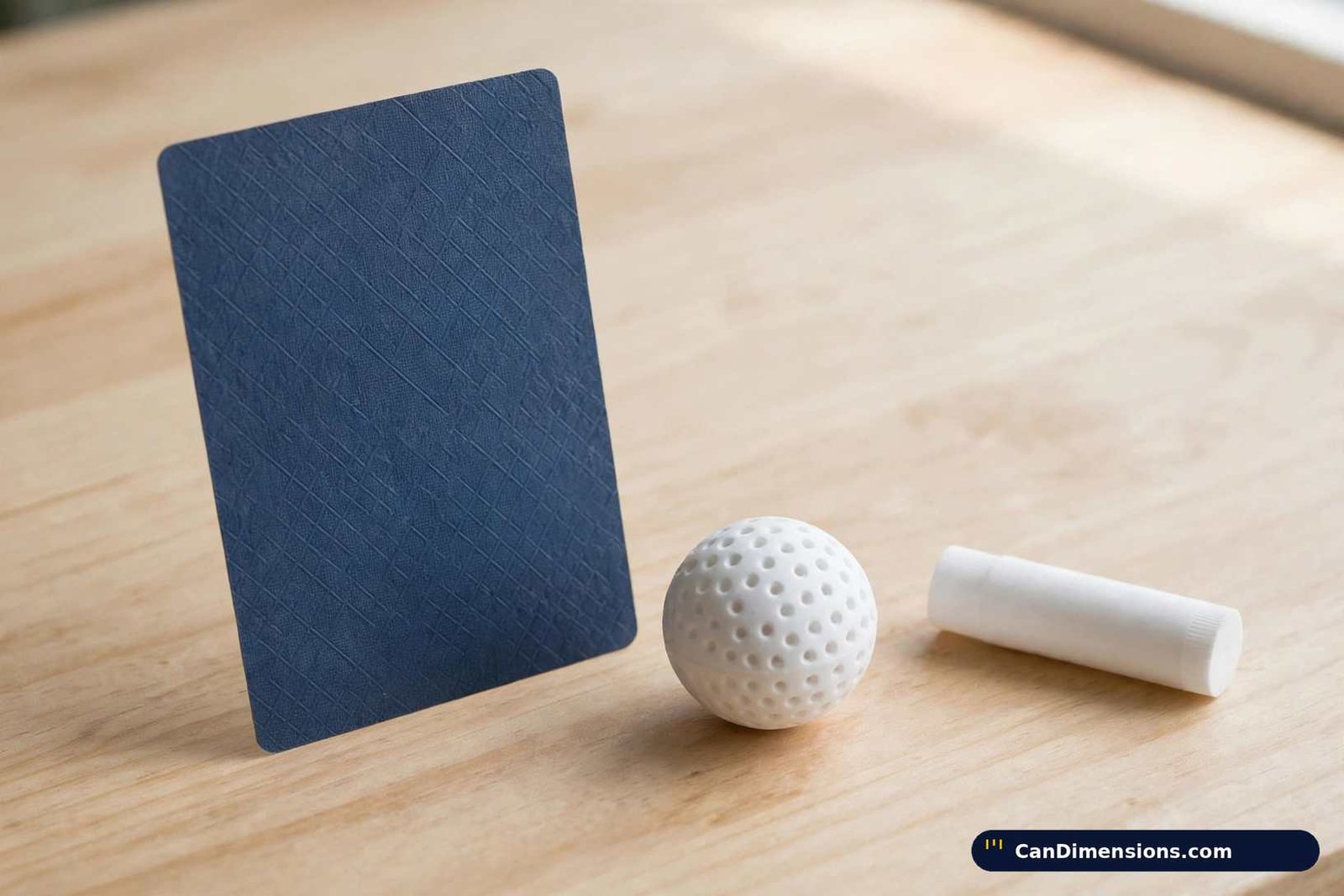
For a first mental picture, reach for a deck of cards. One poker-size card, measured across, is the whole span — neither rounded nor approximate — and its section below explains why that rectangle can be trusted.
11 Common Things That Are 2.5 Inches Long
Nothing was admitted to the count on reputation alone. Every candidate needed a document behind it — a manufacturer’s dimension sheet, a standard’s fixed size, or a rulebook figure — and any candidate resting on a label, a range or an approximation carries that admission within its own section. Eleven candidates pass. Four inherited from the original page do not, and they keep their places below with a Not counted marker and their true sizes stated.
| # | Thing | Verified size | Counted? |
|---|---|---|---|
| 1 | US Dollar Bill Width | 2.61 in wide (Bureau of Engraving and Printing) | Yes — about, gap disclosed |
| 2 | Standard Lip Balm Stick | Standard 0.15 oz tube 2.65 in tall with cap (tube supplier spec) | Yes — about, flagged |
| 3 | Standard Poker Chip | 39 mm diameter = 1.54 in (casino chip standard) | No |
| 4 | Small Pocket Knife or Keychain Tool | Victorinox Classic 58 mm = 2.28 in; Gerber Mini closed ≈3.1 in measured | No |
| 5 | Standard USB Flash Drive | No standard exists; SanDisk Ultra Flair datasheet = 1.69 in | No |
| 6 | Credit Card Width | 2.125 in (ISO/IEC 7810 ID-1 height 53.98 mm) | No |
| 7 | A Poker-Size Playing Card | Width exactly 2.5 in (63.5 mm) | Yes |
| 8 | An 8d Nail | Exactly 2.5 in long (2021 IRC Table R602.3(1)) | Yes |
| 9 | A Lacrosse Ball | Diameter 2.47–2.55 in (World Lacrosse / NCAA / NFHS) | Yes — range basis |
| 10 | A Tennis Ball | Diameter 2.57–2.70 in (ITF Rules of Tennis) | Yes — about, flagged |
| 11 | A 2.5-Inch Paint Brush | Bristle width 2.5 in (Wooster / Purdy brush size) | Yes |
| 12 | A 2.5-Inch Hole Saw | Diameter 2.5 in (Milwaukee Hole Dozer spec) | Yes |
| 13 | A 2.5-Inch Caster Wheel | Wheel diameter 2.5 in (Shepherd Caster spec) | Yes |
| 14 | A Libbey Prism Shot Glass | Height 2.5 in (Libbey 5277, 2 oz square) | Yes — named model |
| 15 | A Standard Muffin Pan Cup | About 2.5 in diameter (Land O’Lakes guidance) | Yes — about, flagged |
US Dollar Bill Width
Counted: as an honest “about,” with the gap printed rather than hidden. Every American note, whatever its denomination, is printed by the federal note bureau to a single fixed size: 6.14 inches in length and 2.61 inches across. The short side therefore overshoots this page’s span by 0.11 of an inch, roughly the thickness of a credit card’s edge stacked twice.
Counted anyway, on that disclosed basis, because no other pocket object is both government-made and guaranteed uniform. A bill worn soft with use still holds its printed dimensions, which is more than can be said for most wallet contents. The note’s full official measurements, including its weight of about a gram, are set out in our dollar bill dimensions guide.
Standard Lip Balm Stick
Counted: on a flagged container basis, as an honest “about,” disclosed here. The familiar 0.15-ounce balm tube is a packaging standard before it is a brand: tube suppliers who sell the empty standard tube to the trade specify its height with the cap on at 2.65 inches. That is 0.15 of an inch taller than this span, and the overage is stated plainly so nobody treats the tube as exact.
What the tube genuinely offers is availability. ChapStick, Burt’s Bees and their rivals all fill this same standard format, so the capped tube in a coat pocket is a repeatable near-reference rather than a guess. Reach for the playing card when precision matters; reach for the balm tube in a bare pocket.
Standard Poker Chip
Not counted: the casino chip misses this span by almost a full inch. The standard chip diameter across casino and quality home sets is 39 millimetres, which converts to 1.54 inches. Larger 43-millimetre chips exist for novelty and ceramic lines, yet even those reach only about 1.69 inches.
The original claim — premium chips swelling to a full 2.5 inches for a weightier feel — describes no chip any major maker sells; heft in this world comes from weight, ten to fourteen grams, never from a doubled diameter. A chip is a fine reference for an inch and a half. Presented as two and a half, it will shrink every measurement taken against it.
Small Pocket Knife or Keychain Tool
Not counted: the two models named on the original page bracket this span without touching it. Victorinox specifies its Classic SD, the archetypal keychain knife, at 58 millimetres long — 2.28 inches. At the other end, independent measured reviews put the Gerber Paraframe Mini’s closed length at 3.1 inches. One is short, the other long, and neither is two and a half.
There is no standard closed length for small knives at all; each maker cuts its own frame. The accompanying claim that this size slips through workplace security screening is also dropped, because blade rules belong to employers and venues, not to a measurement guide. A keychain tool can be a useful companion, but its length must be read off its own spec sheet.
Standard USB Flash Drive
Not counted: no governing standard fixes the length of a flash drive, and the best-selling metal model is nowhere near this span. SanDisk’s own datasheet for the Ultra Flair, a drive sold by the million, gives its product dimensions as 1.69 by 0.51 by 0.28 inches. Other drives scatter from barely an inch to well past three.
Capacity grew a thousandfold while bodies wandered freely, because only the connector is standardised — the shell behind it is styling. The original page’s picture of a consistent two-and-a-half-inch form factor surviving decades of development is therefore backwards: the one drive dimension that never changed is the plug, and it measures millimetres. Keep drives for data, not for measuring.
Credit Card Width
Not counted: the payment card is a superbly standardised object at the wrong size. ISO/IEC 7810 fixes the ID-1 format used by credit, debit and identity cards worldwide at 85.60 by 53.98 millimetres, so the short side — the dimension this heading reaches for — is 2.125 inches, falling three-eighths of an inch below the span.
The card still earns a role in the methods table below, where the missing margin is quantified and added deliberately. As a bare claim of two and a half inches, though, it fails by the widest margin on this page, and repeating it would understate everything measured against a wallet card by fifteen percent.
A Poker-Size Playing Card
Counted: exactly — the width is this span by the card trade’s own definition. Poker size, the format Bicycle and Bee decks are cut to, measures 2.5 by 3.5 inches, or 63.5 by 88.9 millimetres. The narrower bridge format, at 2.25 inches wide, is a different product and should not be substituted.
A card recommends itself three ways: it is rigid, its corners are true right angles, and the same rectangle is printed by every serious maker on earth. A single card laid across a gap gives the span outright; two cards overlapped can step it out along a shelf edge.

An 8d Nail
Counted: exactly, on a code-book basis. American nails are still sold by the old penny designations, and the 2021 International Residential Code prints the dimensions behind them in Table R602.3(1): an 8d common nail is 2-1/2 inches long by 0.131 inches in diameter, and an 8d box nail shares the length on a slimmer shank.
Few everyday objects carry their size in a building code. A handful of 8d nails in a workshop coffee tin is therefore a pocketful of certified references — each one this span, head to point, ready to be laid against a hinge, a shim or a picture hook.
A Lacrosse Ball
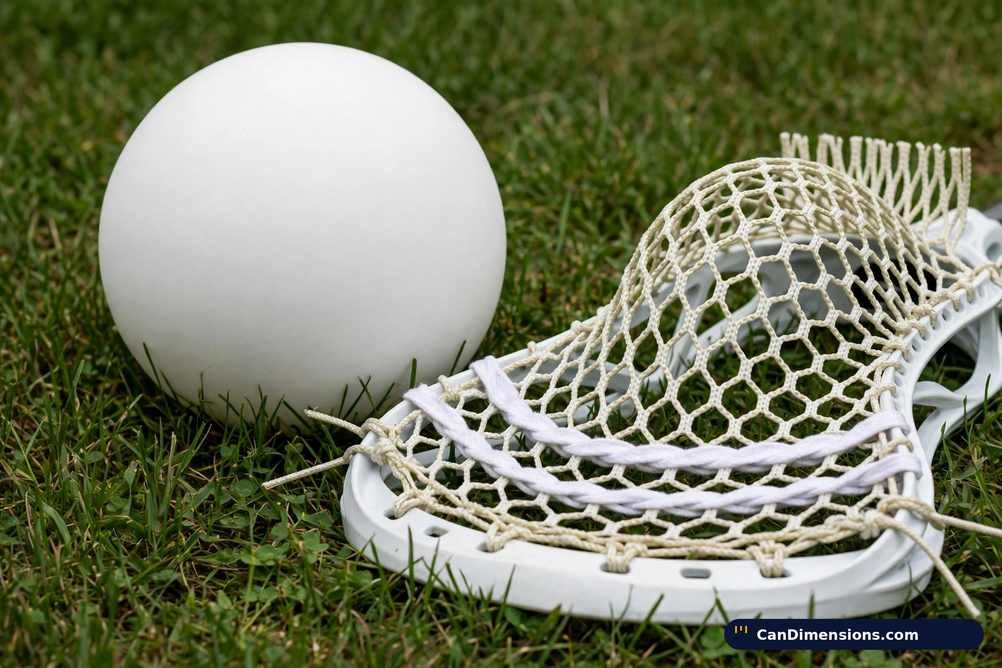
Counted: on a rulebook range that straddles the span, disclosed here. The approved specifications shared by World Lacrosse, the NCAA and the NFHS put a legal ball’s diameter between 2.47 and 2.55 inches, derived from the certified circumference band of 7.75 to 8 inches that every game ball must meet under the NOCSAE standard.
Solid rubber and weighing five to five and a half ounces, the ball sits in the hand like a denser tennis ball. Because the legal band is centred almost exactly on two and a half inches, any certified ball is a sound field estimate — and a ball outside the band is, by definition, not legal for play.
A Tennis Ball
Counted: with the whole legal range printed, flagged here as an honest “about.” The ITF Rules of Tennis require an approved ball to measure between 6.54 and 6.86 centimetres across — 2.57 to 2.70 inches. Even the smallest legal ball therefore stands about seven-hundredths of an inch proud of this span, and a fresh ball near the range’s upper end stands a fifth of an inch proud.
Counted, with that disclosure, because the range is tight, universal and enforced by laboratory approval testing: no other ball in sport is so uniformly near the mark. Use it as a quick visual, then confirm anything that matters against the card or the nail above.
A 2.5-Inch Paint Brush
Counted: exactly, on the maker’s brush size. Paint brushes are sold by bristle width, and the 2.5-inch size is the professional trim width in both big ranges: Wooster lists its angle sash models at a bristle width of 2-1/2 inches, and Purdy’s Dale and XL Glide lines are built at the same size.
The width is a working dimension, not packaging copy — it decides how much wall a single stroke covers beside a door frame. A brush resting in a painter’s kit is consequently a rigid, straight-edged reference that most households already own, provided the bristles are clean enough to lay flat.

A 2.5-Inch Hole Saw
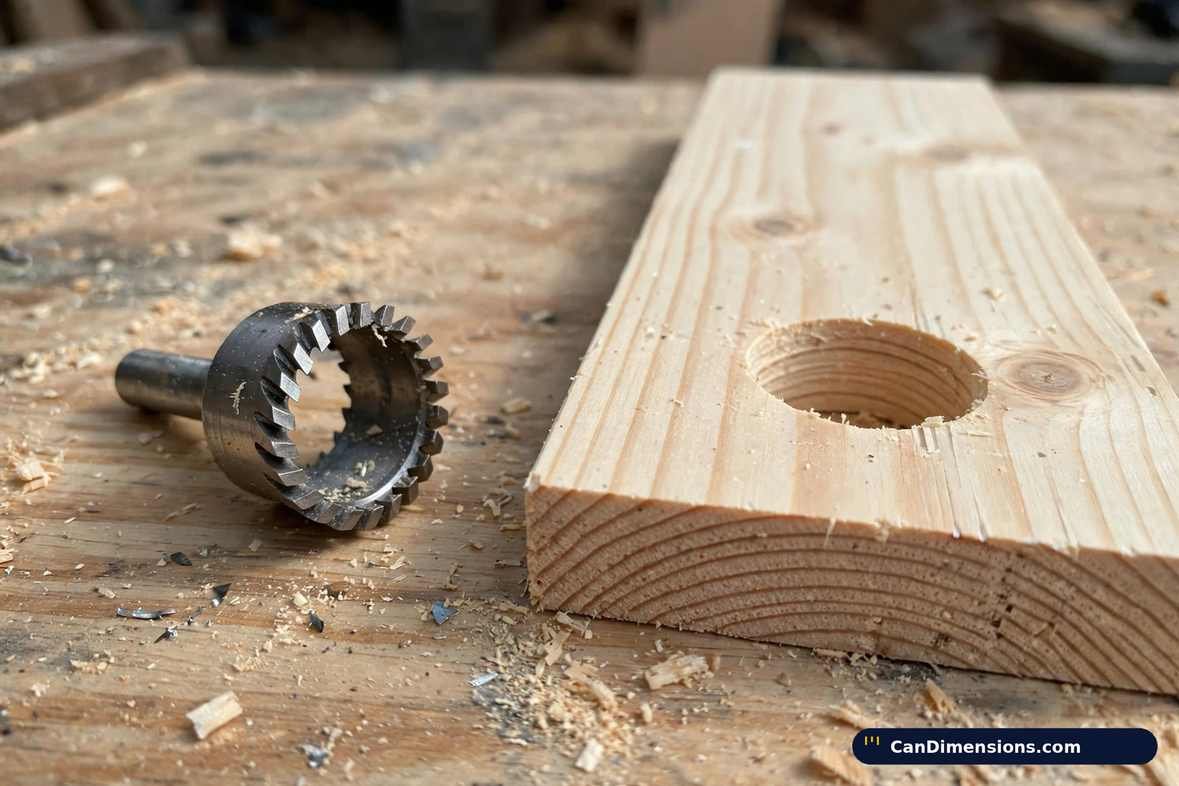
Counted: exactly, on the toolmaker’s specification. Milwaukee’s Hole Dozer range includes a bi-metal saw whose listed hole saw diameter is 2-1/2 inches, and rival makers cut the same rung in their ladders because door hardware, conduit fittings and plumbing pass-throughs keep demanding it.
A hole saw has one virtue no other reference here can match: it does not merely show the span, it reproduces it, leaving a hole of this diameter in whatever it cuts. The empty circle in a pine offcut is the span preserved in negative.
A 2.5-Inch Caster Wheel
Counted: exactly, on the manufacturer’s specification sheet. Shepherd, the furniture-caster maker, lists plate-mount swivel casters whose wheels measure 2-1/2 inches across, each rated at 175 pounds — the size fitted under carts, cabinets and shop stands.
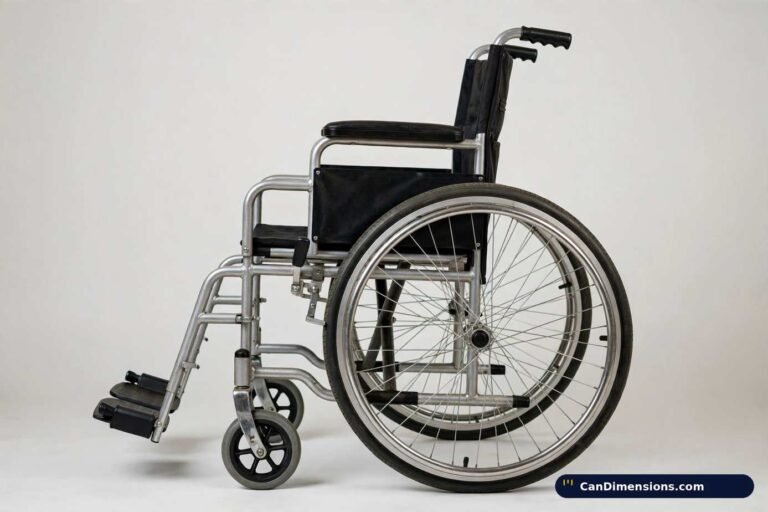
Four such wheels working together carry loads in the class of our 300 pounds guide, which is why the small wheel deserves respect: its diameter is modest, its workload is not. The same small-caster class also turns up at the front of many a chair covered by our wheelchair dimensions guide, where every inch of wheel and width is specified just as tightly.
A Libbey Prism Shot Glass
Counted: exactly, on a named model’s published dimensions. Libbey’s 5277 Prism, a square two-ounce shot glass sold to bars and restaurants, is listed at 2.5 inches tall, with a top diameter of 1-7/8 inches. Shot glasses as a class vary freely — no authority fixes their height — so the count rests on this named glass rather than on the category.
That distinction is the lesson of the example. Barware rewards anyone who checks a model number: one named glass can be a certified reference while the anonymous glass beside it on the shelf is a quarter-inch taller and useful only for its contents.
A Standard Muffin Pan Cup
Counted: on a flagged “about” basis, resting on a named authority’s guidance with its own caveat attached. Land O’Lakes’ baking guidance describes a standard muffin pan cup as about 2.5 inches in diameter, holding roughly a quarter to a third of a cupful of batter — and warns in the same breath that pan sizes vary within the category, some cups slightly larger or smaller.
Counted on that basis because the guidance is the closest thing the category has to a standard, and because the disclosure travels with it. A pan from a major maker will land near the mark; treat the cup as a kitchen estimate, and let the card and the nail settle arguments.
How to Visualize 2.5 Inches Without a Ruler
Five ways to judge this span without a ruler are rated below — four carried over from the original page and one added, with two of the inherited ratings corrected in the open underneath the table:
| Method | Accuracy | How To |
|---|---|---|
| Poker-Size Playing Card Width | ★★★★★ | The short side of any poker deck card |
| US Dollar Bill Width | ★★★★★ | 2.61 in — nearest pocket reference, a hair over |
| Standard Lip Balm Tube | ★★★★☆ | Cap-on standard tube, 2.65 in, slightly over |
| Credit Card Width Plus Slight Add | ★★★☆☆ | 2.125 in card plus a 0.375 in margin |
| Two Adult Thumb Widths | ★★★☆☆ | Side by side; varies with the hand |
The method that never misses is the playing card width — pull a poker-size card from any deck and its short side is the span outright, with no margin to remember. The bill’s short side follows it closely at 2.61 inches. Two inherited ratings are corrected in the open: the credit-card method drops two stars, because the card alone is 2.125 inches and only works once a deliberate three-eighths-inch margin is added, and the thumb method drops one, because thumb breadth differs enough between hands that two thumbs can land a quarter-inch either side of the mark.
Where Does 2.5 Inches Appear in Daily Life?
Wallet & Pocket: The wallet holds this span’s best and worst references side by side. The dollar bill’s short side, at 2.61 inches, is a genuine near-reference carried by millions; the credit card sharing the same wallet measures 2.125 inches along the short edge and belongs on the corrected list, not the counted one. The pocket’s other resident, the standard balm tube at 2.65 inches capped, rounds out a trio of almosts around one exact neighbour — the playing card in the jacket pocket.
Beauty & Personal Care: The bathroom cabinet’s contribution is the standard lip balm format, shared across brands because the filling machinery is shared. Lipstick, often quoted beside it, is a larger object — classic tubes run 72 to 82 millimetres tall, nearer three inches — and is deliberately not claimed here.
Tech & Everyday Carry: Honesty requires a rewrite of the usual claims for this drawer. Flash drives have no standard length — a flagship model measures 1.69 inches — and the famous keychain knives measure 2.28 and about 3.1 inches at the two ends of the category. Where this span genuinely lives in the drawer is hardware rather than electronics: the small caster wheels, brushes and fasteners counted on this page are its honest representatives.
Gaming & Entertainment: The card table supplies both this page’s exact reference and its most repeated error. A poker-size card is 2.5 inches wide by definition, while the poker chip beside it is a 39-millimetre disc of 1.54 inches — the game gives with one hand and takes with the other. Off the table, the lacrosse and tennis balls carry the span onto the field, one bracketed by its rulebook and the other standing just proud of it.
2.5 Inches Conversion Chart (CM, MM, Feet and Meters)
One multiplication produces every figure here — inches times 2.54 gives centimetres — and the chart collects the results for each unit readers commonly ask about.
| Unit | 2.5 inches equals |
|---|---|
| Centimetres | 6.35 cm |
| Millimetres | 63.5 mm |
| Metres | 0.0635 m |
| Feet | 0.2083 ft |
| Yards | 0.0694 yd |
Millimetres defeat most people’s intuition, since 63.5 of them refuses to form a picture. Build the figure up instead from a unit already visualised: our guide to 2 mm sets that tiny unit against coins and card stock, and 31.75 of them end to end reproduce this span. The same division run upward shows 3 feet holding 14.4 of these spans, exactly.
Is 2.5 Inches Big?
Against the hand, it is a two-finger span: wider than a thumb is long, narrower than a palm is wide. Against the ruler, it is five twenty-fourths of a foot — a little over a fifth. Against the objects people actually buy, it is the width of the card that starts a card game and the diameter of the wheel that starts a cart rolling.
Its real character is threshold size. Below it, objects are pocket litter — coins, clips, caps. At it, objects become tools: a brush wide enough to paint trim in one pass, a saw that bores a hardware hole, a nail long enough to fasten sheathing. Two and a half inches is where small things start doing structural work.
2.5 Inches vs 2, 3 and 6 Inches: Neighbouring Sizes Compared
Neighbours give this span its meaning. At two inches (5.08 cm) sit the jumbo paperclip and the mini muffin cup; at three inches (7.62 cm) sit the sticky note and the hockey puck measured across; at six inches (15.24 cm) sit the photograph print and the small cake pan.
| Length | Centimetres | Everyday anchor |
|---|---|---|
| 2 inches | 5.08 cm | A jumbo paperclip, a mini muffin cup |
| 2.5 inches | 6.35 cm | A poker card’s width, an 8d nail |
| 3 inches | 7.62 cm | A sticky note, a hockey puck across |
| 6 inches | 15.24 cm | A 4 × 6 photo print’s long edge |
The steps are worth memorising: 3 inches exceeds this span by exactly half an inch, 6 inches works out at 2.4 of these spans, and two spans laid end to end make five inches exactly, the pocket-comb size. Half an inch in either direction changes the object class entirely, which is why this crowded neighbourhood rewards exact references.
Almost 2.5 Inches: Look-Alikes That Miss the Mark
Some famous objects get quoted at this span without belonging to it — close enough to pass a casual glance, too far off to guide a cut or a fit. The wallet pair splits both ways: the dollar bill overshoots by 0.11 of an inch and is counted, openly, as the page’s nearest approximation, while the credit card undershoots by 0.375 and is not.
The technology shelf contributes the purest look-alike in computing. A “2.5-inch” hard drive or SSD carries this span in its name, yet the SFF-8201 form-factor specification fixes the case at 69.85 millimetres wide — 2.75 inches — and about 100 millimetres long. The name descends from the platter era and describes no external edge of the drive at all. Beside it, the tennis ball stands 0.07 to 0.20 of an inch proud and the balm tube 0.15 proud, both disclosed on the counted list rather than hidden here. The neighbourhood around this span is crowded; only the counted entries above can prove their address in it.
Question’s
What is 2.5 equal to?
2.5 inches equals 6.35 centimetres, 63.5 millimetres, 0.0635 metres or 0.2083 feet. In objects, the span equals a poker-size playing card measured across, and an 8d nail measured in length. It is not the diameter of a poker chip, which is 39 millimetres.
What thing is 2.5 inches long?
The references that survived checking on this page: a poker-size playing card’s width, an 8d nail, a lacrosse ball’s diameter within its legal band, a 2.5-inch paint brush’s bristles, a 2.5-inch hole saw’s cut, and a 2.5-inch caster wheel. A dollar bill’s width, at 2.61 inches, is the nearest approximation a pocket offers.
How many inches is 2.5 feet?
Thirty inches — two and a half dozen, since every foot holds twelve inches. The figure is exact and is one of the few numbers on the original page that survives checking unchanged.
How big is 2.5 inches in feet?
0.2083 feet — a shade over one-fifth of a foot. The original page prints 0.208, a truncation; carried to four decimal places, the exact quotient of 2.5 divided by 12 is 0.2083 recurring.
How much does 2.5 inches look like visually?
Lay a poker deck’s card across the gap you are judging — its short side is the span. A wallet bill’s short side gives 2.61 inches and a capped balm tube 2.65, both close and both disclosed as over rather than exact.
Final Thoughts
Two and a half inches survives its audit with a shorter, stronger cast than it started with. The card and the nail turn out to be exact, the balls and the bill turn out to be honest near-misses with their margins printed, and four famous names — chip, knife, drive and payment card — were borrowing a span that belongs to other objects.
Keep a poker-size card in the drawer where the tape measure never is, and the span is settled for life. And when a ball rolls off the field toward your bench, remember that a legal lacrosse ball is bracketed by its rulebook at 2.47 to 2.55 inches across — the rare sports object whose size is guaranteed by the people who govern the game.