6 Inches: 14 Things with Pictures That Are 6 Inches Long
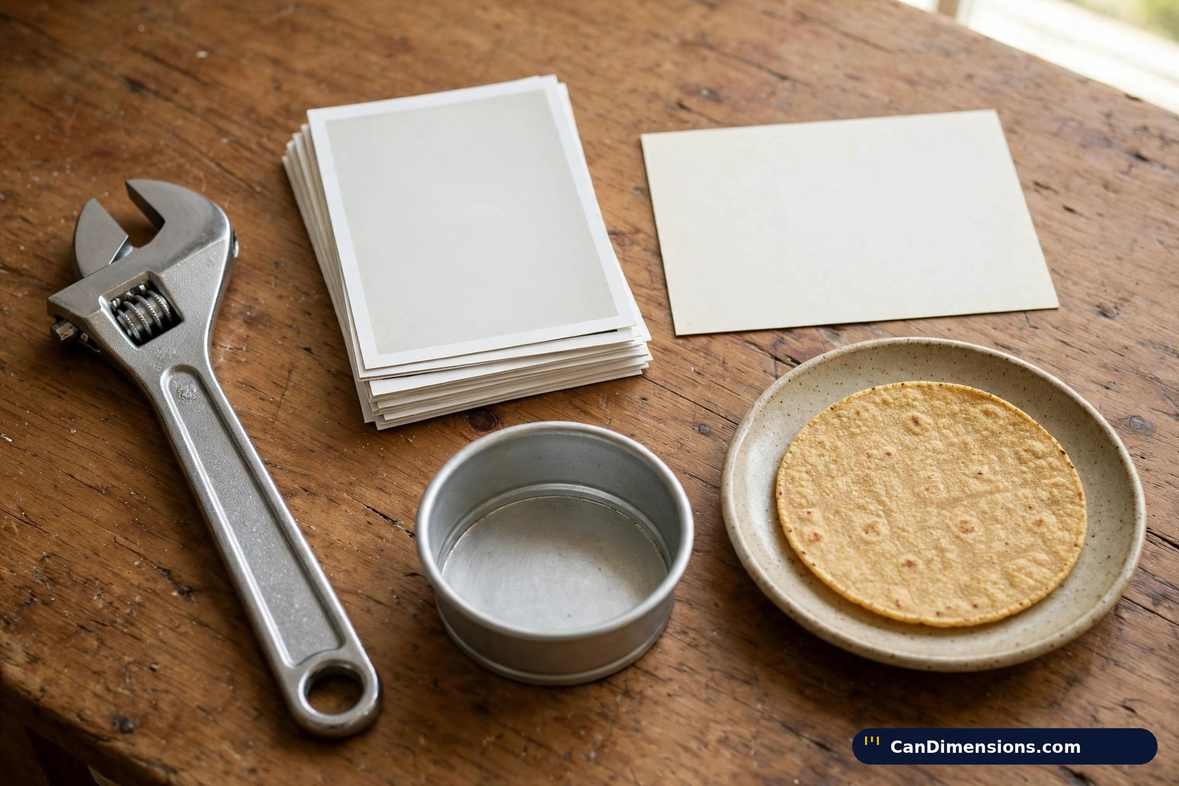
Half a foot sounds simple until someone asks you to show it. If you are wondering how long is 6 inches compared to an object, picture the wrench in a kitchen drawer: a standard 6-inch adjustable wrench runs exactly this long from end to end, and so — less obviously — does the tortilla folded in the fridge.
Nothing on this page earned its place by reputation. Each entry was measured against the maker’s own published size, a governing standard’s rule, or a reference database, and four of the internet’s favourite answers failed: the pocket comb, the eyeglasses case, the named sandwich and the new pencil all measure something else. They are still here, under their familiar headings, with the record corrected.
First the conversions. Then fourteen objects that honestly measure 6 inches, ways to estimate the length with no ruler nearby, a look at where it turns up during an ordinary day, and the answers to the questions people keep asking about it, kept short.
How Long Is 6 Inches?
Start with the ruler on any desk: 6 inches is where its halfway mark falls, exactly half of the 12-inch foot. Its metric equivalents are fixed by definition, not estimated:
| Unit | 6 Inches Equals |
|---|---|
| Feet | 0.5 feet |
| Yards | 0.1667 yards |
| Centimeters | 15.24 cm |
| Millimeters | 152.4 mm |
| Meters | 0.1524 m |
Hands get suggested as a built-in ruler for this length, and the suggestion survives because it sounds plausible. The numbers say otherwise. In the Army’s ANSUR II survey of soldiers’ measurements, the median hand, measured from the wrist crease to the middle fingertip, came out at 7.6 inches across men and 7.1 across women — and only the very smallest women’s hands, the bottom five percent, come down to 6.5 inches. Your hand is built to a 7-inch pattern, give or take. The drawer and pocket references below are the honest ones.
14 Common Things That Are 6 Inches Long
Fourteen of the objects below check out — the majority to the exact fraction, on a printed specification, and the rest as declared approximations with the true figure given in their own section. Four do not check out, and they are labelled as plainly as the rest.
| Thing | Verified size | Counted? |
|---|---|---|
| US dollar bill | 6.14 in long (Bureau of Engraving and Printing) | Yes — about, corrected basis |
| Standard new pencil | 7.5 in unsharpened (19 cm) | No |
| Subway six-inch sandwich | A menu name, not a specification | No |
| Modern smartphone | Pixel 9 body 6.02 in tall (152.8 mm) | Yes — corrected basis |
| Standard eyeglasses case | About 6.4–6.5 in (maker specs) | No |
| Pocket comb | 5 in (the standard Ace/Goody model) | No |
| The 6-inch round cake pan | 6 in diameter (Wilton maker’s size) | Yes |
| A 4 × 6 photo print | Long edge exactly 6 in | Yes |
| A 4 × 6 index card | Long edge exactly 6 in | Yes |
| A maximum-size USPS postcard | Long edge exactly 6 in (postal standard) | Yes |
| A 6-inch terracotta plant pot | 6 in across the rim (trade size) | Yes |
| A 6-inch embroidery hoop | 6 in diameter | Yes |
| A small banana | USDA small class starts at exactly 6 in | Yes — corrected basis |
| A 6-inch adjustable wrench | 6 in long (Crescent AC16 spec) | Yes |
| A 6-inch caliper | Jaws open exactly 6 in (Mitutoyo 500-196-30) | Yes |
| A 6-inch utility knife | Blade exactly 6.0 in (Wüsthof Classic) | Yes |
| A 6 × 6 inch tile | The nominal 6-in module size | Yes — nominal basis |
| A 6-inch corn tortilla | 6.000 in spec diameter (Mission Foods) | Yes |
US Dollar Bill
Counted: — the closest thing in your wallet, with a small confession attached. Every denomination of US paper money leaves the federal Bureau of Engraving and Printing at one size: 6.14 inches in length, 2.61 in width. Strictly, then, a bill is not 6 inches but six and a seventh — close enough to estimate with, too far off to call exact, which is how the original page wrongly called it. This page counts it as an approximation and prints the difference.
A bonus rides along: one note weighs roughly a gram. Our dollar bill dimensions guide carries the full official sizing.
Standard New Pencil
Not counted: — too long by roughly an inch and a half before it is ever sharpened. Leave a Dixon Ticonderoga in its box, eraser untouched, and it measures 19 centimetres: 7.48 inches, or 7.5 as usually rounded. That is the factory length of the classic American #2. Sharpening shortens it gradually toward 7 inches across its working life; at no point does an honest pencil read 6.
The claim that the industry standardised the new pencil at “approximately 6 inches” undershoots the truth by about a quarter of the pencil. Keep a new pencil as your 7.5-inch reference instead — it is an excellent one — and never as a 6-inch one.
Subway Six-Inch Sandwich
Not counted: — a brand name wearing a measurement’s clothes. The sandwich takes its name from the chain’s footlong loaf, cut in half. Bread, however, does not bake to a certified length. That became a matter of legal record in the Subway Footlong litigation: the dough portions start uniform, the baked rolls vary naturally, and some finish short of twelve inches. The Seventh Circuit closed the case in 2017.
Halve a loaf that is only roughly twelve inches and the result is only roughly six — no test the company ran, on the court’s record, guarantees 6.00 inches. Eat it by all means; measure with something else.
Modern Smartphone
Counted: — on one named handset, not on a range. Quoted heights for “modern smartphones” usually span 5.8 to 6.1 inches, and as a description of phone bodies the top of that span is fiction: the mainstream flagships cluster just below 5.9 inches — iPhone 16 at 5.81, Galaxy S24 at 5.79 — while 6.1-inch figures describe screens measured diagonally, or the taller Plus and Max variants.
One mainstream model does land on this page’s length. Google lists the Pixel 9 at 152.8 millimetres in height; converted, that is 6.02 inches, two hundredths over. A Pixel 9 in your pocket is a 6-inch reference. Almost any other standard phone is a 5.8-inch one, and the fifth of an inch matters when the thing being measured is a shelf.
Standard Eyeglasses Case
Not counted: — too long by nearly half an inch, across brand after brand. Look up the specifications of ordinary clamshell glasses cases and a pattern emerges: between 6.4 and 6.5 inches, again and again. Pyramex’s CA500B, a representative zippered hard case, is listed at 6½ by 3½ by 2 inches; typical hard sunglasses cases measure 163 to 165 millimetres, the same neighbourhood. None of the standard specifications lands on 6.0.
“Almost exactly 6 inches” therefore misses by nearly half an inch — at this size, the whole game. Let the case protect your glasses; do not let it measure your shelves.
Pocket Comb
Not counted: — the standard model is a 5-inch product, and says so on the packet. The pocket comb in the original example is easy to identify: the classic Ace design, now sold as Goody Ace, whose retail listings put the size right in the product name — a “Fine Tooth Pocket Comb” in the 5-inch size. Five inches is the category’s chosen size, small enough to disappear into a shirt pocket.
Other combs live at other lengths — dressing combs at 7.5 inches, the odd pocket model at 5.25 — but the standard pocket comb was never a 6-inch object. It is corrected here because the claim has the tidy sound of a fact, and tidy is what let it travel.
The 6-Inch Round Cake Pan
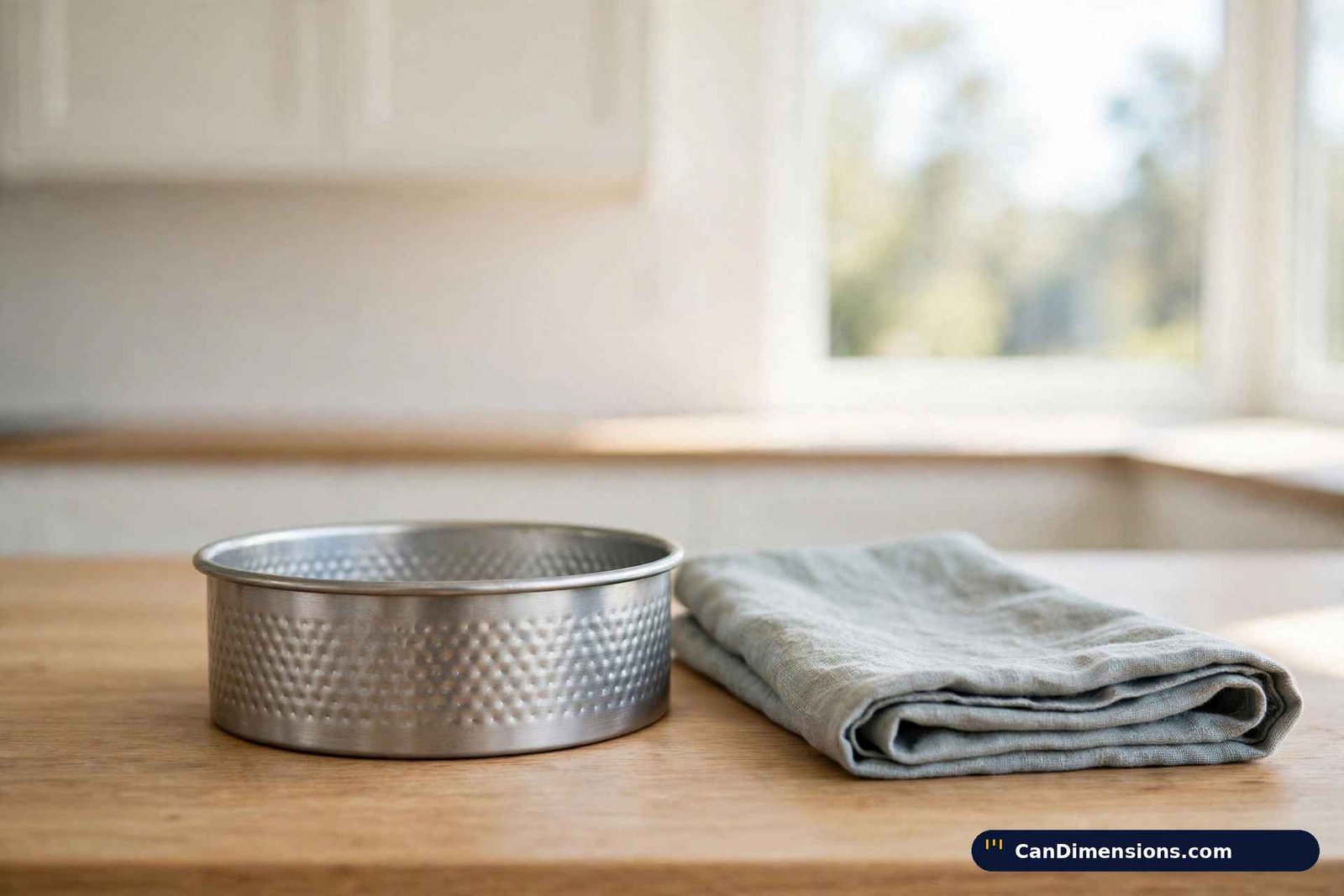
Counted: — Wilton’s small round, made at exactly this size. Bakers meet this length as the small layer pan. Wilton’s catalogue carries the 6-inch round in two depths, 6 × 2 and 6 × 3 — the pan used for smash cakes and the base tier of stacked cakes — and retailer specification tables give its diameter as 6 inches.
Cake pans are measured inside, across the top: the figure a recipe is written against. And because the pan is stamped metal, every copy of the model matches. Find one in the cupboard and the search is finished.
A 4 × 6 Photo Print
Counted: — the long edge of the standard print, exact by definition. Every photo lab, kiosk and online printer in the country cuts to the same default: 4 inches by 6 inches, or 101.6 by 152.4 millimetres. That long edge is this page’s length with nothing left over.
A print also happens to be an ideal measuring tool — flat, stiff, straight-edged, and already somewhere in the house. Press the long edge to the object in question and the comparison is exact, not approximate.

A 4 × 6 Index Card
Counted: — the middle card of the standard family, its long edge exact. Index cards are sold in three familiar sizes — 3 × 5, 4 × 6 and 5 × 8 inches — and the middle one’s long edge is 6 inches. The dimension is not approximate: it is the product’s name, its specification, and the size of every card in the pack.
Where the original page mentioned the card only in passing, this page promotes it. A rigid, right-angled, pennies-cheap rectangle of exactly 6 inches outperforms every soft or baked reference going.
A Maximum-Size USPS Postcard
Counted: — exact at the maximum the Postal Service allows. Start with the card in the rack: the everyday postcard measures 4 × 6 inches, just inside the legal limits. Those limits come from the Postal Service’s mailing standards: the postcard rate tops out at 6 inches long by 4.25 inches high, and starts at 5 inches long by 3.5 inches high.
A card built to that maximum is exactly 6 inches along its long edge — a figure the Domestic Mail Manual fixes, not any manufacturer. Few household lengths come with a rulebook; this one does.
A 6-Inch Terracotta Plant Pot
Counted: — the rim diameter the trade sells it by. Garden centres sell flower pots by the width across the rim, in whole-inch steps, and 6 inches is the step that holds the kitchen herb garden, a young houseplant or a tray of seedlings. A pot ticketed at 6 inches spans that across its top rim, inside edge to inside edge — the opening a grower actually plants into.
One caveat, because this page prints its caveats: fired clay can wander a fraction from its ticketed size in a way stamped steel never does. The ticket remains the standard: measure a 6-inch pot at its rim and you will read 6 inches, for any purpose short of machining.
A 6-Inch Embroidery Hoop
Counted: — a standard diameter in every maker’s range. Embroidery hoops are sized by the diameter of the circle that grips the fabric, and the sizes climb in whole inches from 3-inch miniatures to 14 inches and beyond. Six inches is a standard step on that ladder — the size beginners and small hoop-art projects usually start from.
A hoop’s stated diameter is a manufactured dimension, repeated identically across a production run — as a measuring circle it beats most round things in the house.
A Small Banana
Counted: — where the small class begins, on the USDA’s own grading. Bananas are not sold by the each-and-whatever; the USDA grades them in length bands. The medium fruit most shoppers picture measures seven inches to just under eight and weighs 118 grams. Below it sits the small band, which runs from exactly 6 inches up to just under 7, at 101 grams.
So the defensible statement is a narrow one — a banana is 6 inches at the floor of the small band, and only there — and the fruit that proves it sits within a gram of what weighs 100 grams.
A 6-Inch Adjustable Wrench
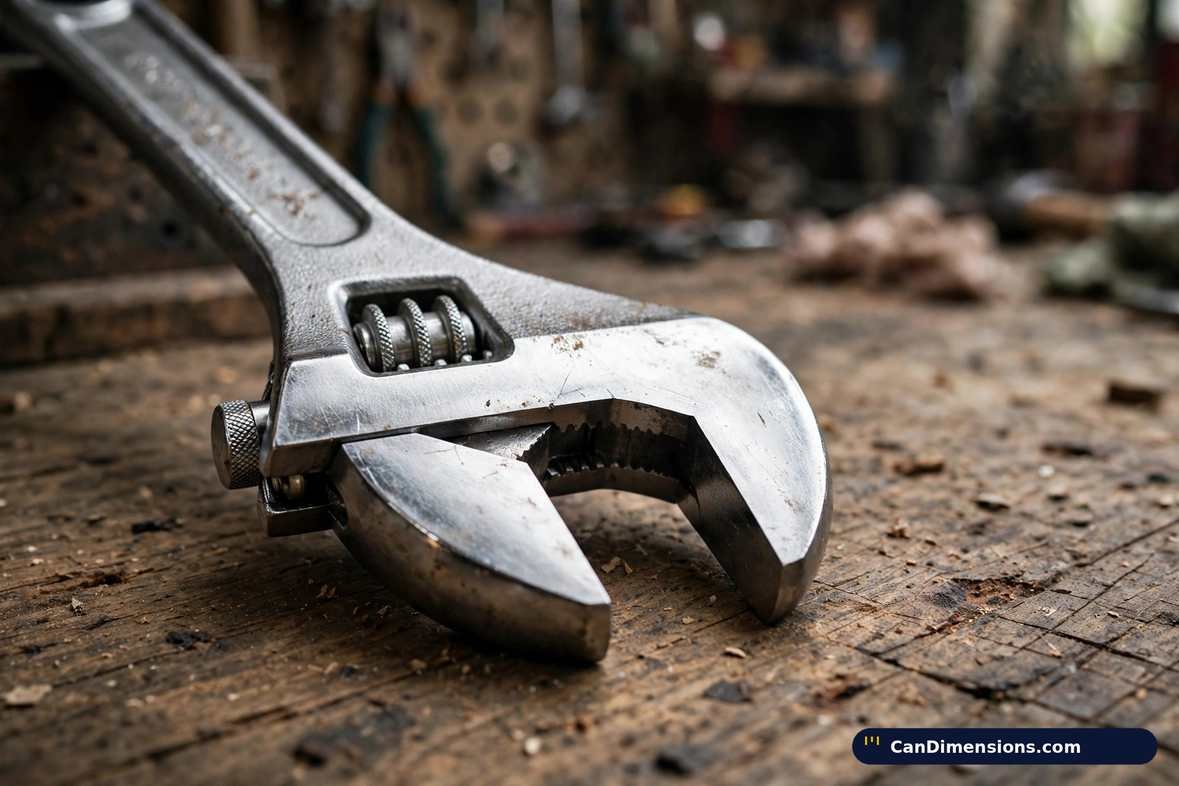
Counted: — Crescent’s small adjustable, forged at exactly this length. Crescent’s AC16 adjustable wrench is listed in the maker’s product data at 6 inches (150 mm) long, with a jaw opening of 15/16 inch (24 mm). The 6-inch wrench is the small member of the adjustable family — the one that lives in kitchen drawers and glove boxes rather than on workshop pegboards.
A wrench is a forged, machined object, made to its stated length the way a ruler is. No tool in the house is likelier to be exactly 6 inches long.
A 6-Inch Caliper
Counted: — on the span its jaws are built to open. Mitutoyo’s 500-196-30, the standard digital caliper, has a measuring range of 0 to 6 inches (0–150 mm): its jaws open to exactly 6.00 inches, and the instrument is built and certified around that span. The tool’s own body runs longer, as it must to house the scale — the 6 inches is the jaw capacity, stated here as plainly as the tool states it.
The check is pleasantly circular: the tool a workshop trusts to verify everything else carries this exact span in its own jaws.
A 6-Inch Utility Knife
Counted: — Wüsthof grinds this blade to exactly 6.0 inches. Wüsthof’s Classic utility knife carries a blade the maker specifies at 6.0 inches — the mid-size kitchen knife, longer than a paring knife and shorter than a chef’s knife, sold for slicing and trimming work. The blade length is the stated dimension, bolster to tip.
Knife steel is ground to specification, so a 6.0-inch blade is a production figure, not an estimate. Between the wrench, the caliper and this knife, the toolbox and the knife block turn out to be stocked with certified versions of this page’s length.
A 6 × 6 Inch Tile
Counted: — on the module the trade lays by, with the clay size confessed. Tiles are sold by their nominal size — the module they lay into, grout joint included — and 6 × 6 inches is a standard module across ceramic and handmade ranges. The tile body itself measures a fraction under: handmade specifications put a nominal 6 × 6 tile at about 5.5 × 5.5 inches of clay, the grout joint completing the 6-inch module on the wall.
Counted because the entire building trade buys, lays and names this tile at 6 inches, and because the distinction between the module and the clay is stated here rather than hidden. On a finished wall, the repeating unit you see is 6 inches.
A 6-Inch Corn Tortilla
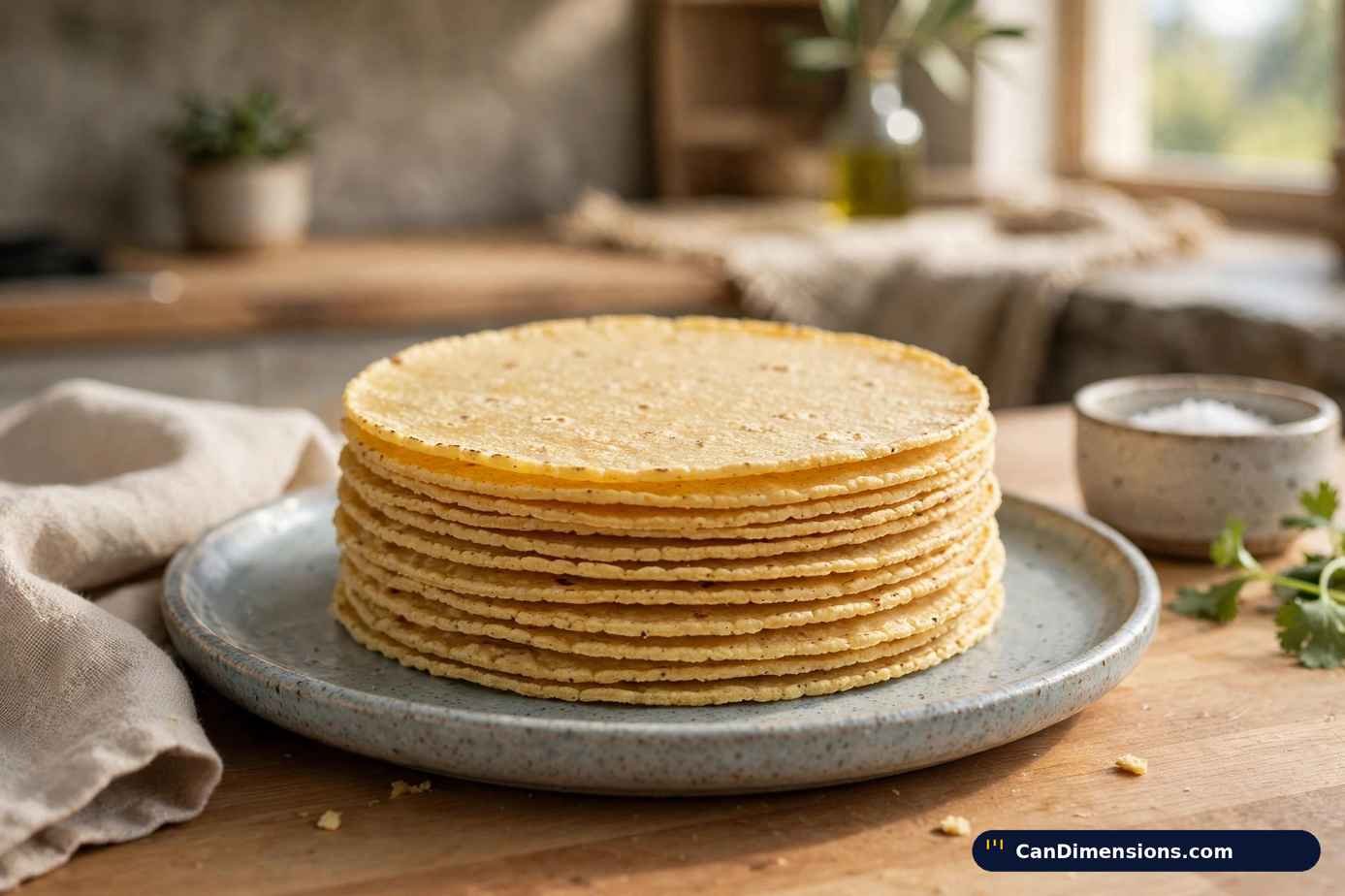
Counted: — a production figure with tolerances, not a nickname. Mission Foods’ foodservice specification for its 6-inch corn tortillas gives the product dimension as 6.000 inches, with a permitted diameter range of 5.75 to 6.25 inches. The standard corn tortilla — the taco-size one — is a 6-inch food by specification sheet, not by nickname.
That sets it apart from the famous sandwich above: here the number is a controlled production figure with tolerances printed beside it. A tortilla is soft and will not rule a straight line, but as a circle of known diameter it earns its place.
How to Visualize 6 Inches Without a Ruler
Four methods, ranked by how far they can be trusted — and note what is missing: the original page’s two favourite methods, the new pencil and the hand, are both disqualified by their own sections above, one at 7.5 inches and the other at 7-plus:
| Method | Accuracy | How To |
|---|---|---|
| 4 × 6 Photo or Index Card | ★★★★★ | The long edge of any standard print or card |
| US Dollar Bill Length | ★★★★★ | Any bill in your wallet — 6.14 in, a hair over |
| Half of a 12-Inch Ruler | ★★★★★ | The common ruler, halved in your mind |
| 6-Inch Wrench or Tortilla | ★★★★☆ | Any wrench or tortilla sold at the 6-inch size |
The card and the print sit at the top because they are exact and rigid. The bill follows, a seventh of an inch long. Leave the pencil in its box — 7.5 inches, unsharpened — and leave your hand out of it: adult hands run from 7.1 inches (the women’s median) to 7.6 (the men’s), so a hand-based estimate inflates everything it touches.
Where Does 6 Inches Appear in Daily Life?
Kitchen & Food: The tortilla is the headline here — a food whose 6.000-inch diameter is a controlled production figure — backed by the small Wilton pan and the 6.0-inch utility knife blade. The section above explains why the kitchen’s most famous claimant, the six-inch sandwich, does not make the list: its name is a menu entry, not a measurement.
Wallet & Pocket: Cash is the carrier: at 6.14 inches a dollar bill puts an approximate measure in most wallets, and the 4 × 6 card family — prints and postcards — travels with it. The two items usually named as exact, the glasses case and the pocket comb, measure about 6.5 and 5 inches respectively; both are corrected in their sections.
Tech & Gadgets: Phones cluster just short of this length — the mainstream flagships stand around 5.8 inches, and the Pixel 9, at 6.02, is the exception that reaches the line. The other gadget that owns the size is an instrument: the standard caliper, whose jaws open to exactly 6 inches, lives on every lab bench.
School & Office: In the classroom the exact 6 inches belongs to the 4 × 6 index card; the 6 × 6 tile module covers the corridor walls outside it. The pencil in the same classroom is the cautionary tale: at 7.5 inches unsharpened, it is the most misquoted object on this page.
6 Inches in Centimetres, Millimetres and Feet: The Full Table
One multiplication converts the length — inches × 2.54 for centimetres — and the table below spells out the result in the units readers actually ask for.
| Unit | 6 inches equals |
|---|---|
| Centimetres | 15.24 cm |
| Millimetres | 152.4 mm |
| Metres | 0.1524 m |
| Feet | 0.5 ft |
| Yards | 0.1667 yd |
The millimetre line is the one to remember if you work with instruments: 152.4 mm is the full jaw span of the standard caliper, which is why the 6-inch and 150 mm classes are treated as one size across workshops.
How Big Does 6 Inches Feel in the Hand?
It feels like one hand’s worth of object. Six inches is the size of things made to be gripped, pocketed or lifted to reading distance: a phone’s height, a wrench’s length, a small pan’s width. Much longer and a thing needs two hands or a surface; much shorter and it becomes a finger tool. This length is the border between the two.
A stacking test shows its substance: lay two 2.5 inches measures end to end and they reach 5 inches, with a whole inch still missing. Half a ruler is not a small thing.
6 Inches vs 4, 5 and 7 Inches: Neighbouring Sizes Compared
Four inches (10.16 cm) is the short edge of the same 4 × 6 print. Five inches (12.7 cm) is where the pocket comb truly lives. Seven inches, at 17.78 centimetres, is hand territory — the median adult hand, roughly. Six sits between the pocket sizes and the body sizes, borrowed by both.
| Length | Centimetres | Everyday anchor |
|---|---|---|
| 4 inches | 10.16 cm | The short edge of a 4 × 6 print |
| 5 inches | 12.7 cm | The standard pocket comb |
| 6 inches | 15.24 cm | A 6-inch wrench, a corn tortilla |
| 7 inches | 17.78 cm | About an adult hand’s length |
The smallest neighbour is covered in full in our guide to measuring 4 inches. The step to memorise runs the other way: double 6 inches and you arrive at the foot.
6 Inches at Work: Toolbox, Kitchen and Lab Bench
Three trades keep this length in daily employment. The toolbox holds two of its standards side by side — the small adjustable wrench, and the caliper whose jaw span certifies the size for everyone else. The kitchen counters with the utility knife’s blade, the small cake pan and the tortilla: slicing, baking and wrapping, all at 6 inches.
The lab bench runs on the same figure, because the 6-inch/150 mm pairing is the default size for measuring tools worldwide. Spec sheets from Mitutoyo to Mission print the two systems side by side, and 6 inches — 152.4 mm — is where they meet. Few lengths are this thoroughly employed.
Question’s
What is an example of 6 inches?
Any 4 × 6 print — photograph or index card — measured along its long side comes to exactly 6 inches, no caveats. The 6-inch wrench, the small Wilton pan and a postcard built to the postal maximum are exact as well. The dollar bill is the pocket stand-in, at 6.14 inches.
How big is 6 inches compared to an object?
Half a foot is the short answer — 15.24 centimetres in metric. In objects: the small cake pan measures this across, the small adjustable wrench measures it end to end, and Google’s Pixel 9 stands within two hundredths of an inch of it.
How long is 6 inches without a ruler?
Reach for the exact objects first: a 4 × 6 print or card, or a wrench sold at 6 inches. A dollar bill will serve at 6.14 inches. Two things to avoid: the new pencil, which is 7.5 inches long, and your own hand, which the Army’s survey puts closer to 7 inches than to 6 for most adults.
Is 6 inches a foot long?
No — it is half of one. The foot runs to 12 inches; 6 inches is 50 percent of that, 15.24 centimetres in metric terms.
Final Thoughts
The length stops being abstract once it is tied to objects that actually measure it — and the tying is only half the job, because the famous false friends have to be untied too. The pencil runs to 7.5 inches; the comb stops at 5. The glasses case overshoots to about 6.5, the sandwich is a name rather than a number, and the average hand belongs to the 7-inch class. What remains is a dependable set: the print, the card, the tortilla, the small pan.
Leave one where you can find it — a print in a drawer, a tortilla in the fridge, or the adjustable wrench in the toolbox — and 6 inches is never a guess again: each holds the length in the dimension it works by, exactly as its maker or regulator specifies.