Jerry Can Buying Guide: Which Size for Which Job?
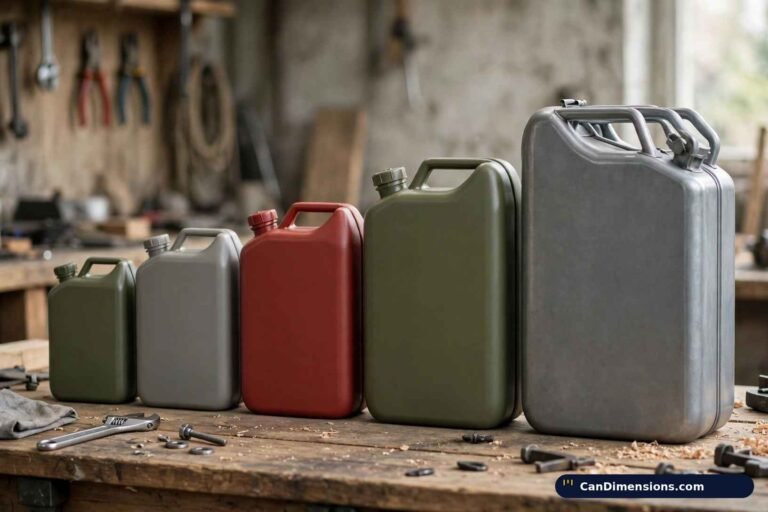
Choosing between jerry can sizes is really choosing between jobs. A can that lives happily in a car boot all winter is the wrong can for a generator in a storm outage, and the can a farm reaches for every morning would be miserable to haul onto a small boat.
This guide therefore starts with the work, not the warehouse shelf. Each common size is matched to the task it suits — boot, boat, mower shed, generator, farmyard — and only then are the full verified dimensions set out.
One warning shapes everything that follows: a litre figure alone tells you almost nothing. Makers build the same capacity into unrelated shapes, so every size below is tied to a named maker’s specification, and any capacity no maker specifies is flagged as a gap.
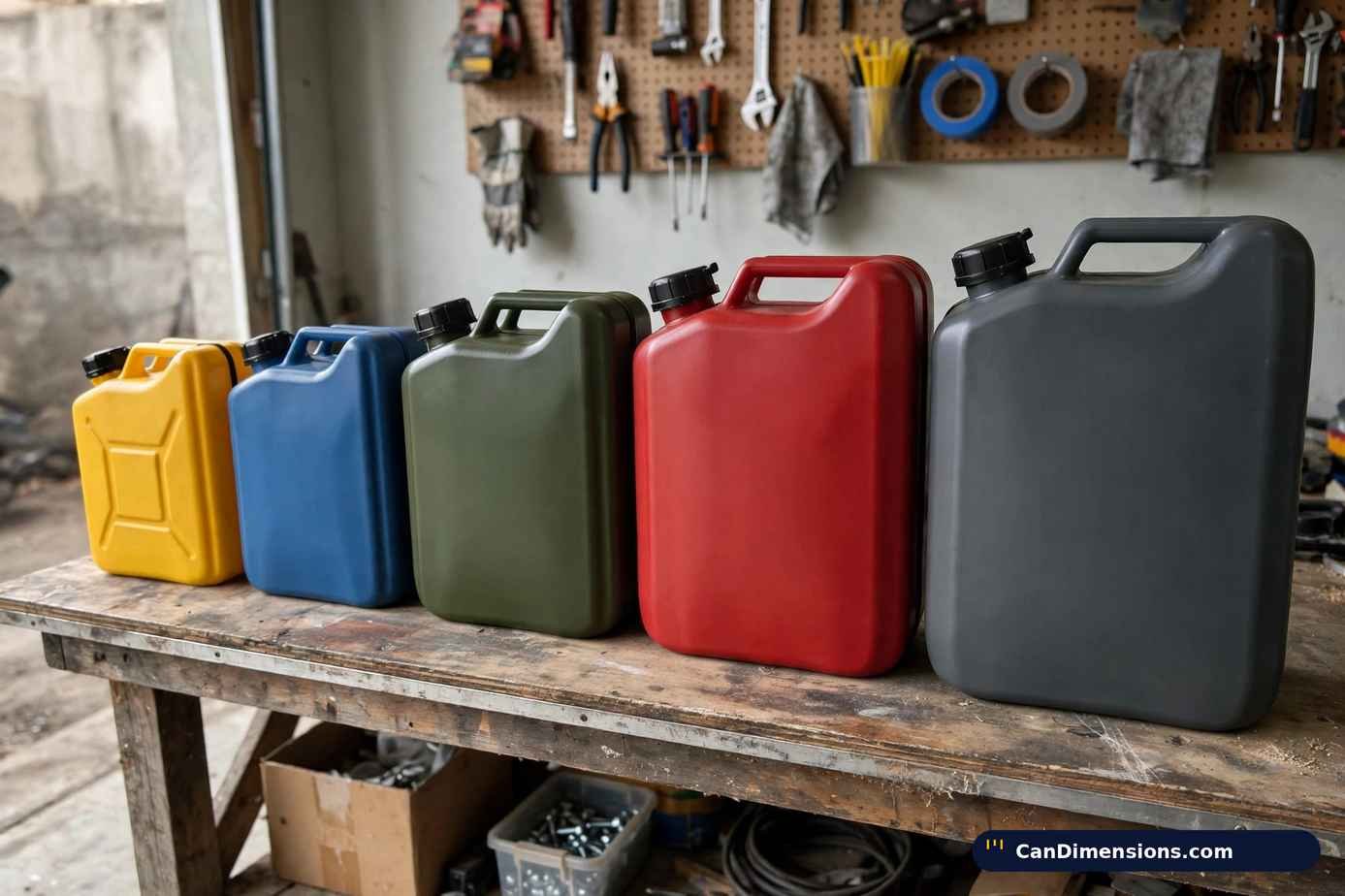
Which Jerry Can for Which Job? Matching Size to the Task
Start with the heaviest question: how much will the full load weigh in your hands? Fuel adds roughly three quarters of a kilogram per litre for petrol, a little more for diesel, and a full kilogram per litre for water. That arithmetic sorts most jobs before shape enters the discussion.
| Job | Size to buy | Why that size wins |
|---|---|---|
| Car boot emergency reserve | 5L steel or 5L HDPE | 12.20 in (steel) or 11.22 in (HDPE) tall; a one-handed lift that straps into a corner |
| Small boat or dinghy | 10L, horizontal steel or HDPE pattern | The horizontal steel 10L is only 10.83 in tall on the full-size footprint, so it stays low and stable |
| Lawn and garden kit | 5L or 10L HDPE | Short carries, frequent pouring; HDPE keeps the empty weight near or under 1.32 lb at 10L |
| Home generator reserve | 20L HDPE fuel can | A useful reserve whose empty can weighs only 2.43 lb; about 35.1 lb full of petrol |
| Farm and site work | 20L steel NATO pattern | The repairable, rack-friendly benchmark at 18.43 in tall; about 42.1 lb full of petrol |
| Bulk stationary storage | 25L or 30L HDPE stacker | Shorter than the 20L steel can and built to interlock; store-and-decant, not a carry can |
Boats punish height, which is why the horizontal 10-litre steel pattern — the full 345 by 165 mm footprint at only 275 mm tall — earns its place afloat, and why any deck can should be lashed rather than merely placed. For drinking-water duty, pick a food-grade HDPE water can and keep it for water alone; the household water bottle dimensions in our water bottle guide show how much smaller everyday drinking vessels are, which is why a dedicated can, kept apart from fuel cans, matters.
Jerry Can Dimensions Comparison Chart
Quick reference, rebuilt for buying: each row below traces to a single named maker and a can that can genuinely be ordered — never to an average blended across brands — because a rack, a boot or a locker must fit a physical object, not a range. Dimensions run height by length by width.
S Small Capacity (1-5 Liters)
| Capacity | Height (“) | Length (“) | Width (“) | Empty Weight (lbs) |
|---|---|---|---|---|
| 5L steel, NATO pattern | 12.20 | 9.45 | 4.72 | 2.87 |
| 5L HDPE (Cosmoplast) | 11.22 | 7.48 | 5.12 | — |
| 5L HDPE stacker (BariTainer) | 9.25 | 7.48 | 5.51 | 0.62 |
Two gaps are printed on purpose. For neither the 1-litre nor the 2-litre size could a datasheet from any major maker be located; vessels that small circulate as little plastic jugs, outside the specified can family altogether.
M Medium Capacity (10-15 Liters)
| Capacity | Height (“) | Length (“) | Width (“) | Empty Weight (lbs) |
|---|---|---|---|---|
| 10L steel, vertical NATO pattern | 15.94 | 11.81 | 5.12 | 5.07 |
| 10L steel, horizontal NATO pattern | 10.83 | 13.58 | 6.50 | 5.51 |
| 10L HDPE water can (ESCO) | 12.56 | 13.70 | 6.85 | 1.32 |
| 10L HDPE stacker (Greif JCR) | 12.52 | 9.13 | 7.56 | 0.86 |
| 10L HDPE lab can (Nalgene) | 14.80 | 9.69 | 7.83 | — |
The 15-litre row found on copied charts is missing here for the same reason: no maker documents a can of that capacity within this family, and the documented ranges step straight from 10 litres to 20.
L Large Capacity (20-25 Liters)
| Capacity | Height (“) | Length (“) | Width (“) | Empty Weight (lbs) |
|---|---|---|---|---|
| 20L steel, NATO standard (Wavian) | 18.43 | 13.58 | 6.50 | 9.48 |
| 20L HDPE fuel can (hünersdorff) | 17.13 | 14.37 | 7.01 | 2.43 |
| 20L HDPE, army pattern (Pressol) | 18.90 | 13.78 | 6.89 | 3.20 |
| 20L HDPE lab can (Nalgene, fluorinated) | 17.80 | 12.60 | 9.65 | — |
| 25L HDPE stacker (Chemline CNM-25) | 15.67 | 11.61 | 10.63 | 3.09 |
| 25L HDPE square (U-Pack) | 17.72 | 11.02 | 11.06 | 2.09–3.53 |
XL Extra-Large Capacity (30+ Liters)
| Capacity | Height (“) | Length (“) | Width (“) | Empty Weight (lbs) |
|---|---|---|---|---|
| 30L HDPE stacker (Wandel SK4) | 15.75 | 14.96 | 11.02 | — |
| 30L HDPE stacker (Mevatec) | 15.75 | 14.76 | 11.42 | 2.54 |
How Jerry Can Dimensions Are Measured
Height measurement starts with an empty can upright on level ground, cap fitted and any detachable spout taken off, and runs to whatever fixed point sits highest. On steel cans that point lies along the handle line — the bayonet cap tucks beneath it — so the published 468 mm really is the standing height. Clip a loose spout onto a plastic can and its longest reach can stretch by several inches: stored size and carried size are two different numbers.
Length and width describe the outline at ground level, taken at the broadest points: the long face plus the front-to-back depth. Diameter talk has no useful meaning for a rectangular vessel, so treat any listing quoting a base diameter for this shape with suspicion. Moulded plastic bodies taper as well, so a base footprint can sit a few millimetres inside the shoulder width — and the shoulder is where a tight locker binds.
Capacity versus dimensions trips up more buyers than any other idea on this page. Volume grows sideways just as readily as upward: the chart’s 25-litre stacker carries a quarter more than the steel 20-litre can yet stands some 70 mm lower, its extra litres living in its width.
Standard Jerry Can Dimensions by Capacity
Small Capacity Jerry Cans (1-5 Liters)
5-liter jerry can dimensions split by family from the very first size. The steel NATO-pattern version is listed by its maker at 120 mm wide, 240 mm long and 310 mm tall, with an empty weight of 1.3 kg; Meclube, an Italian steel maker, puts its own 5-litre steel can at 1.6 kg. In plastic, Cosmoplast’s datasheet reads 285 by 190 by 130 mm, while the lightest stacker shape verified here weighs 280 g and stands 235 mm tall.
That record corrects the weight most listings repeat. Quoting a pound to a pound and a half for an empty can of this size understates every steel example — steel starts around 2.9 lb — and holds true only for the very lightest plastic stacker. In daily use these are the additive, chainsaw and get-home cans.
For scale, set one beside a familiar drink can. Our beer can guide records the beer can dimensions of the standard shell most breweries fill; stack roughly two-and-a-half such shells and you reach the height of a steel 5-litre can.
Medium Capacity Jerry Cans (10-15 Liters)
10-liter jerry can dimensions refuse to settle into a single answer, even within steel alone. One steel pattern rises 405 mm from a 300 by 130 mm base and weighs 2.3 kg; its sibling keeps the big can’s 345 by 165 mm outline, halves the height instead — 275 mm — and weighs 2.5 kg. Same capacity, two silhouettes: choose by whether your space is tall and narrow or low and wide.
Plastic widens the field further. From ESCO comes a 10-litre water can 319 mm tall, based at 348 by 174 mm and weighing 0.6 kg; from Greif, a JCR stacker weighing 390 g and measuring 318 by 232 by 192 mm; from Nalgene, a laboratory can reaching 376 mm in height.
Large Capacity Jerry Cans (20-25 Liters)
20-liter jerry can dimensions stand apart in this guide, because a genuine standard sits underneath them. For its JC0020KV, Wavian publishes a NATO-pattern steel can 165 mm wide, 345 mm long and 468 mm tall, weighing 4.3 kg empty, made and tested to DIN 7274 and holding UN dangerous-goods approval.
In plastic, those same 20 litres wear unrelated shapes. hünersdorff’s fuel can, which holds UN approval, weighs 1.1 kg and measures 435 by 365 by 178 mm; Pressol’s army-pattern can weighs 1.45 kg and stands 480 mm tall; ESCO’s water can weighs 0.97 kg and stands 431 mm; Nalgene’s fluorinated laboratory can measures 452 by 320 by 245 mm. Notice what that does to the claim that a metal 20-litre can stands exactly 17.75 inches: steel, verified, stands 468 mm — 18.43 inches — and within this guide the 450 mm height belongs to plastic cans alone.
25-liter jerry can dimensions belong wholly to the stacker family. Chemline documents its CNM-25 at 1.4 kg and 398 by 295 by 270 mm, its walls running 2.0 mm across the top, 2.6 mm around the body and 2.8 mm under the base. U-Pack’s square container at this capacity measures 450 by 280 by 281 mm and weighs between 950 g and 1.6 kg. Neither resembles the tall, narrow 18-to-20-inch row that copied charts print for this capacity.
Extra-Large Jerry Cans (30+ Liters)
30-liter jerry can dimensions carry the stacker logic onward. On Wandel’s SK4 sheet the figures read: length 380 mm, width 280 mm, total height 400 mm, brimful volume 34 litres — and, worth underlining for buyers, a stacking ceiling of 2 layers set by the maker itself. Mevatec documents its 30-litre can at 1.15 kg and 375 by 290 by 400 mm.
So the largest common can in this guide stands 15.75 inches tall — lower than the steel 20-litre can it out-holds. Mass, not height, sets the ceiling here: full of water a 30-litre stacker totals roughly 68.7 lb; full of petrol, roughly 51.5 lb. Buy it as stationary storage you decant from.
Spouts, Venting and Pouring Without the Glug
A can can measure perfectly and still pour badly. The glugging pour that soaks a mower deck has a simple cause: air must travel back into the can along the same path the fuel is leaving, and every mouthful of returning air interrupts the stream. Designs that give air its own route pour in a smooth ribbon; designs that do not, pulse.

Three designs manage that air in different ways. The steel pattern’s wide bayonet mouth accepts a separate flexible spout and pours fast once tilted decisively — a virtue at a tractor, a hazard over a small mower tank. Modern consumer fuel cans in the United States instead carry self-closing caps, flame-arresting screens and stored spouts, hardware that arrived with two legal changes applying from 10 January 2009: emissions rules at federal level, following California’s lead, and child-resistant closure requirements. Industrial plastic cans sit between the two: a plain screw cap, often with an optional tap.
Technique covers what hardware leaves over. Set the receiving machine on level ground, start slowly so the vent path can establish itself, and stop short of brimful. Fill any portable can on the ground, never while it sits in a vehicle, and leave a little headspace, because fuel expands as it warms — standard items in United States safety guidance for petrol handling.
Jerry Can Dimensions by Material Type

HDPE (High-Density Polyethylene) Jerry Can Dimensions
HDPE jerry cans are each moulded to their own maker’s shape, so cross-brand consistency is the one thing this material never offers: within this guide alone, verified plastic heights at 20 litres span 431 to 480 mm. Weight class and wall thickness are steadier: Chemline specifies its stacker walls at about 2.0 to 2.8 mm, and an empty 20-litre plastic can weighs 0.97 to 1.45 kg across the makers verified here.
Set against steel’s 4.3 kg, that amounts to a saving somewhere between two thirds and three quarters — a far larger gap than the 40 percent usually quoted: hünersdorff’s 1.1 kg fuel can undercuts Wavian’s steel can by about 74 percent, Pressol’s 1.45 kg can by about 66 percent. Food-grade versions alter the resin certification rather than the mould: ESCO certifies its water cans as foodstuff-compatible under EU Regulation 10/2011 and FDA 21 CFR 177.1520, yet they share their shapes with fuel equivalents — so one maker’s water and fuel cans can measure identically and must never be swapped in service.
Metal Jerry Can Dimensions
Steel jerry cans keep faith with the NATO pattern, whose precision is genuine — it is simply attached to a different number than the one usually printed. Verified, the can measures 165 mm wide, 345 mm long and 468 mm tall, rather than exactly 17.75 by 13.5 by 6.5 inches: that familiar quote gets length and width right but falls 18 mm short on height, because 17.75 inches converts to 450.85 mm — a height published by no steel maker. Wavian’s version is seam-welded from 0.9 mm cold-rolled steel to EN 10130, closed by a bayonet cap, lined against fuel and tested to DIN 7274.
Empty weight corrects alongside height. At 4.3 kg — 9.48 lb — the steel 20-litre can sits well above the circulating 6-to-8-pound band, which matches no verified steel can at this size. Smaller steel cans sit at 2.3 to 2.5 kg (10 litres) and 1.3 to 1.6 kg (5 litres) across the makers verified here. Owners of steel storage will recognise the same trade from the ammo can dimensions in our ammo can guide: a modest weight penalty, repaid in decades of service.
Aluminum jerry cans get a flag here instead of figures. Aluminium versions of the pattern turn up in marine and aviation niches, yet this guide could locate no dimension sheet from any aluminium maker, and the claim that such cans copy steel’s outside measurements at 4 to 5 lb empty appears nowhere that can be checked. That row is therefore left empty, openly.
Buying Checks: Approvals, Closures and What to Inspect Before You Pay
Shop with a short checklist and most bad purchases disqualify themselves. First, the approval marks: a fuel can should carry a recognisable dangerous-goods pedigree. The steel benchmark pairs UN approval with testing to DIN 7274; hünersdorff’s datasheet prints the approval code UN 3H1/Y/150 against its plastic fuel can. A can with no approval story at all is a water can at best, whatever its colour suggests.
Second, the closure. On steel, work the bayonet cap: it should seat firmly and its seal should be present, uncut and springy. On plastic, run the screw cap down its thread and back; a cap that binds or rocks is telling you about the moulding. On a modern consumer fuel can, confirm the self-closing action still snaps shut and the flame-arresting screen is present.
Third, the honest measurements. Take height, length and width from the maker’s sheet — not from a listing’s rounded summary — and set them against the space you measured at home, with room to lift the can clear. Then do the filled-weight sum before the can is in your hands: empty weight, plus capacity multiplied by about 0.74 for petrol, 0.84 for diesel, 0.80 for kerosene or 1.00 for water, in kilograms per litre. If that total is a weight you would not happily carry across a yard, buy the smaller can.
Last, buy the system, not the silhouette. Confirm the spout fits, a spare seal is obtainable, and — for stackers — that the maker’s own stacking limit is printed somewhere you can reread later.
Different Types of Jerry Cans and Their Dimensions
Type 1 vs Type 2 Gas Can Dimensions
This comparison has to be corrected before it can be used, because the two labels were never jerry can types in the first place. Their home ground is OSHA and UL practice in the United States, where metal safety cans are classed as Type I when one opening handles filling and pouring alike, and as Type II when the jobs are split — filling through one opening, pouring from another. The EPA defines neither class, and no standard awards the Type II an extra 2 to 3 inches of height; what separates the classes is that second opening and its venting.
What genuinely changed in 2009 was hardware, not body size. From that year, portable fuel containers sold in the United States carried new federal duties: emissions rules following the CARB model from California, plus child-resistant closures under the federal burn-prevention law. The jerrycan’s own legal definition, at 49 CFR 171.8, speaks of a metal or plastic packaging whose cross-section is rectangular or polygonal — a statement about shape, not dimensions.
Specialty Jerry Can Dimensions
NATO military jerry cans preserve the classic pattern: height 468 mm, outline 345 by 165 mm — the benchmark against which every other can in this guide gets compared. America’s military line for the steel can ran through specification MIL-C-1283 F; its National Stock Number, 7240-00-222-3088, is now obsolete, superseded by A-A-59592 B, which covers versions moulded in high-density polyethylene.
Water storage jerry cans in plastic keep outlines of their own instead of copying the fuel pattern. ESCO bases its 20-litre water can at 383 by 203 mm and stands it 431 mm tall; Scepter lists its 5-gallon military-style water container at 2.65 lb and 18.88 by 13.38 by 7.5 inches — near the NATO class, without being identical to it. Square jerry cans built to stack differ deliberately again: the chart’s 25- and 30-litre stackers swap height for width, letting the interlock between cans do the holding.
Jerry Can Storage and Space Planning
Calculating Storage Space Based on Jerry Can Dimensions
Shelf height requirements belong to the maker’s stated height, never to a guess from the litre figure. A steel 5-litre can stands 310 mm, so a 12-inch clearance fails before any lifting-out allowance is added; the 20-litre steel can, at 468 mm, needs a clear 19 inches merely to stand; a 25-litre stacker, at 398 to 450 mm, fits shelving the tall steel can cannot — and the often-quoted claim that 25-litre containers demand 22 inches or more overshoots what is really needed by a good four inches.
Floor space calculations start from a simple product — length times width. Multiply 345 mm by 165 mm for a 20-litre NATO can and the footprint comes to roughly 0.61 square feet. The stackers run larger: around 0.86 square feet at 25 litres, around 1.15 at 30. For a household comparison, either stacker still stands on less floor than the kitchen trash can dimensions in our kitchen trash can guide describe for a standard kitchen bin.
Stacking height limitations come from each maker’s own testing, not from any general rule: no OSHA stacking count covering jerry cans could be found in any standard consulted, and tidy claims about three high or five high appear in none of them. Per-product data is what exists instead. Wandel caps its 30-litre SK4 at 2 layers maximum, under a stacking load of 38 kg at 20 degrees C. Use the figure printed for your can, and where none is printed, store single-layer.
Vehicle Storage Considerations
Truck bed dimensions swallow 20-litre cans easily: four NATO-pattern cans, each 13.58 inches long and 6.50 inches wide, stand together in a patch of bed roughly 27 by 13 inches. Strap every can down against movement in transit, and carry fuel outside the passenger compartment wherever the vehicle allows. A strapped row of cans along one wall costs a garage planned around the standard garage door dimensions in our garage door guide almost nothing in floor area.

SUV and car trunk fitting favours the 5- and 10-litre sizes, but choose by measured height rather than by capacity. At only 10.83 inches tall, a horizontal 10-litre steel can slips into low boots that shut out its 15.94-inch vertical sibling. Set any can low in the vehicle and strap it: a filled 20-litre steel can is a 42-to-54 lb object, and an unsecured one becomes a hazard in the first hard stop.
Safe Storage and Transport: The Rules That Actually Apply
Separate the rules with paperwork behind them from the folklore, and storage gets simpler. The firmest principle in United States guidance is also the shortest: only approved containers and portable tanks should be used for storing and handling flammable liquids — the OSHA formulation. CPSC consumer guidance points the same way for the home: keep petrol containers in well-ventilated, cool areas, outside living spaces and away from appliances, open flames, pilot lights and other ignition sources.

Within those two anchors, the working habits are plain. Keep closures fully shut whenever a can is not actively pouring. Store cans upright, out of direct sun, and check older cans for damaged seals and cracked necks before refilling. Never put fuel into a can reserved for drinking water — the shapes here can be identical, so the discipline has to come from labelling.
Transport adds movement to the same logic. A can that travels should be closed, upright, secured against sliding and tipping, and carried outside the passenger compartment wherever the vehicle allows it. Local fire codes, leases and insurers can impose stricter household limits than any general guidance, and where they speak, they govern — no universal federal gallon limit for the home exists to print.
Question’s
What are the standard dimensions of a jerry can?
One can sets the standard: Wavian’s 20-litre NATO-pattern steel can, listed at 4.3 kg empty and 165 mm wide by 345 mm long by 468 mm tall. Plastic cans at 20 litres follow no such pattern — verified heights among them span 431 to 480 mm, over wider bases.
How tall is a 20L jerry can?
Steel answers with a single number: 468 mm, or 18.43 inches. Plastic answers with a spread — 435 mm from hünersdorff, 480 mm from Pressol, 431 mm from ESCO — and the exactly-17.75-inches figure endlessly copied between charts fits not one of them.
How big is a 5 litre jerry can?
Family decides. Steel gives 310 by 240 by 120 mm and an empty weight of 1.3 kg; plastic gives, from Cosmoplast, 285 by 190 by 130 mm, and from the lightest verified stacker a height of 235 mm at just 280 g. Identify the family of the can before you before trusting any single figure.
How big is a 25l jerry can?
Expect a wide industrial stacker, never a stretched NATO can. Chemline lists the CNM-25 at 1.4 kg empty and 398 by 295 by 270 mm; U-Pack lists its square version at 450 by 280 by 281 mm. Fill one with water and the total reaches 26.4 kg; fill it with diesel and the total is 22.4 kg.
How big is a 25l container?
In jerry can style, the answer repeats the section above: roughly 400 to 450 mm tall, over a near-square base of about 280 to 295 mm. Other vessels at 25 litres — drums, kegs, pails — are cylinders, described by a diameter and a height, so match the shape before the capacity.
How many litres is a standard jerry can?
20 litres — 5.28 US gallons. A Wehrmacht requirement of 1936–37 fixed that size, and it has held the standard’s place ever since; the 5- and 10-litre cans scale the same patterns down, while the 25- and 30-litre sizes belong to the separate stacker family.
What are the different types of jerricans?
Count them by family: steel NATO-pattern cans at 5, 10 and 20 litres; NATO-class cans in plastic, for fuel and for water, from makers such as hünersdorff, Pressol, ESCO and Scepter; plastic industrial stackers; and plastic laboratory cans. The Type I and Type II labels sit outside that list entirely.
Are all fuel cans the same size?
No. Heights among the verified cans here start at 235 mm, for a 5-litre stacker, and end at 480 mm, for a 20-litre plastic fuel can; a single capacity can also wear unrelated shapes, the 10-litre steel can existing at both 405 mm and 275 mm tall. Three things move the measurements: capacity, family and maker.
What is the difference between Type 1 and Type 2 gas cans?
They are American safety-can classes, and openings are the whole distinction. One opening serves a Type I can for filling and pouring alike; a Type II can splits the work across two openings — filling at one, pouring from the other, each vented on its own. Dimensions play no part in the distinction, and height is never added to a Type II can by any standard.
Conclusion
Match the can to the job and most of this subject resolves itself. Five litres serves the boot and the mower shed, ten litres the boat and the garden, twenty litres the generator and the farm, and the wide stackers serve the store room — each in a shape its maker’s sheet should confirm before money changes hands.
Buy the approval marks, the closure and the spout as carefully as the capacity, store the can cool, closed and away from ignition, and secure it whenever it travels. Do that, and whichever size you settle on will serve long after cheaper guesswork has split, leaked or failed to fit — whether the load is water for a campsite or gasoline for the mower.