8 Inches: 12 Workshop and Job-Site Things That Are Exactly 8 Inches Long
Eight inches is the size a toolbox is organised around. The wrench that fits the whole hand, the brick module the wall is laid out in, and the tie that bundles the cable run all carry the same span — and that span is how long is 8 inches, stated in hardware instead of numbers.
The territory here is the workshop and the job site. Sixteen objects get checked against a maker’s specification sheet, a masonry standard or a tested-product comparison; a dozen come through, while four — a subwoofer, a caliper, a pencil and a flower pot — remain on the page carrying the figures that rule them out.
A short conversion table opens the account, followed by the dozen itself. Empty-hand judging tricks come next, and the questions a working size always draws close the page.
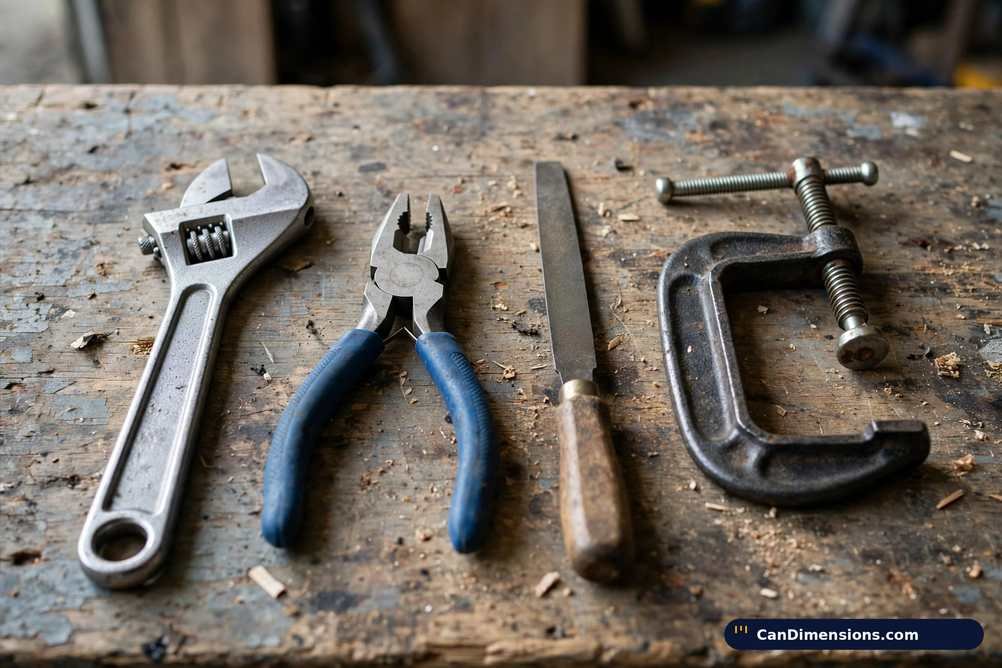
How Long Is 8 Inches?
Eight inches makes two thirds of a foot, and converts to 203.2 millimetres (20.32 centimetres, 0.2032 metres), or 0.2222 yards — just under a quarter yard. Get the feel of it from the span of a spread hand, and from the tools a hand closes around all shift long.
| Unit | 8 Inches Equals |
|---|---|
| Centimeters | 20.32 cm |
| Millimeters | 203.2 mm |
| Meters | 0.2032 m |
| Feet | 0.667 ft |
| Yards | 0.2222 yd |
12 Common Things That Are 8 Inches Long
| Thing | Verified size | Counted? |
|---|---|---|
| An 8-Inch Adjustable Wrench | 8 in overall length (Crescent AC18) | Yes |
| An 8-Inch Mill File | 8 in cutting length, excl. tang (Nicholson) | Yes |
| An 8-Inch C-Clamp | 8 in maximum opening (Bessey) | Yes |
| 8-Inch Tongue-and-Groove Pliers | 8.0 in overall (Channellock 428) | Yes |
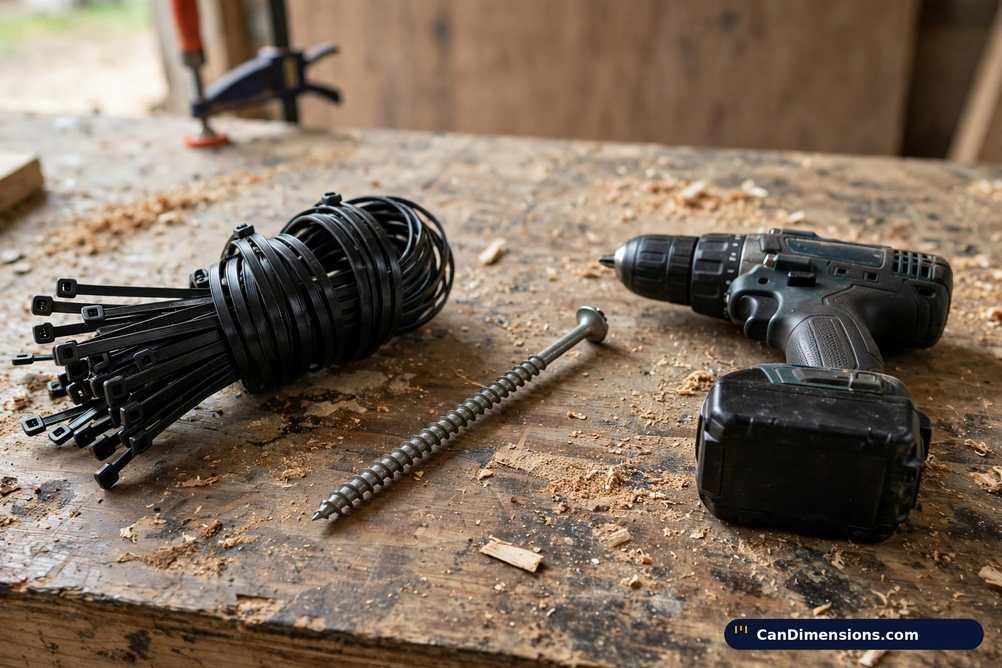
| 8-Inch Cable Ties | 8 in standard size (Gardner Bender) | Yes |
| A Modular Brick | Nominal 8 in; specified 7.625 in + ⅜ joint | Yes |
| A Concrete Block (CMU) | Nominal 8 × 8 × 16; actual 7.625 face | Yes |
| An 8-Inch Steel Tent Stake | 8 in (Snow Peak, tested table) | Yes |
| An 8-Inch Work Boot | 8-in shaft-height class (Timberland PRO) | Yes |
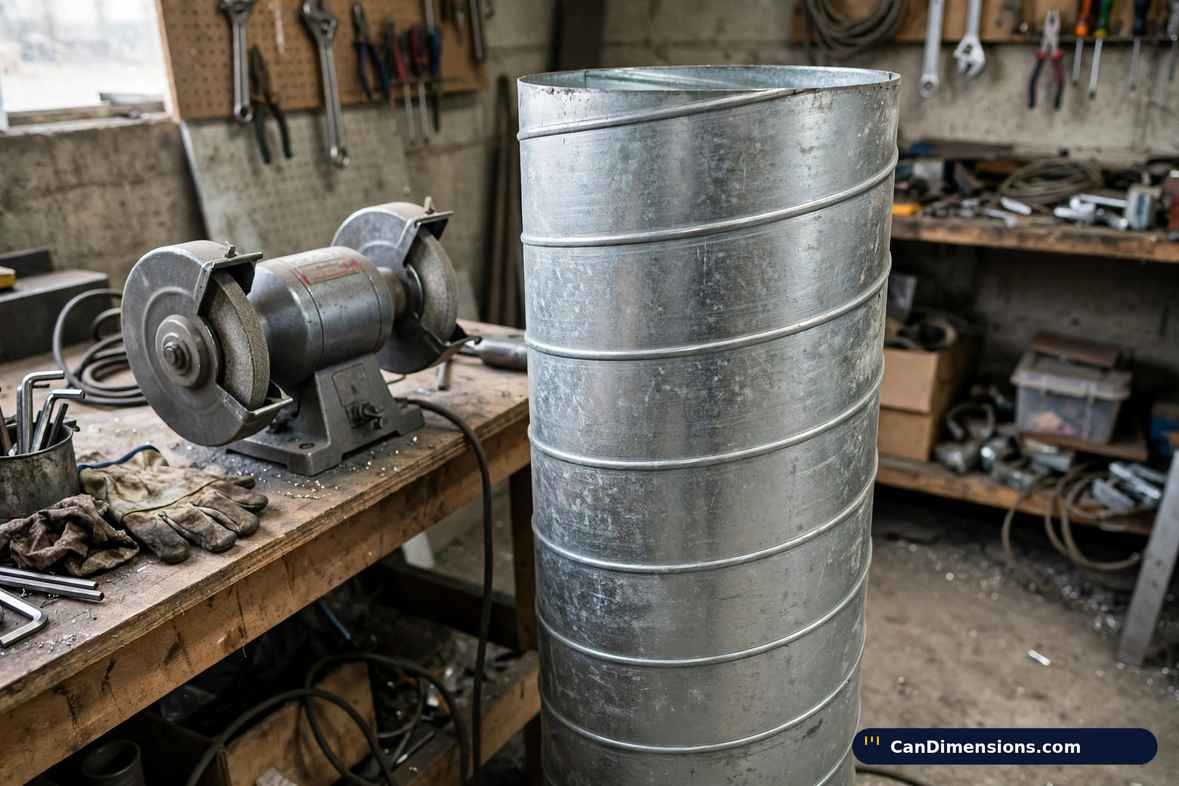
| 8-Inch Round Duct Pipe | 8 in diameter standard (Master Flow) | Yes |
| A 5/16 × 8-Inch Structural Screw | 8 in, head underside to tip (SPAX) | Yes |
| An 8-Inch Bench Grinding Wheel | 8 in wheel diameter (Norton) | Yes |
| An “8-Inch” Car Subwoofer | Frame measures 8.5 in across (Kicker) | No |
| An “8-Inch” Digital Caliper | 200 mm range = 7.87 in true (Mitutoyo) | No |
| A Standard #2 Pencil | 7.5 in (Dixon Ticonderoga) | No |
| An “8-Inch” Flower Pot | Trade size — actual tops 8.75 / 7.87 in | No |
An 8-Inch Adjustable Wrench
Counted: — on the maker’s own sizing, which for a wrench is its whole length. Crescent’s AC18 adjustable wrench is specified at exactly 8 inches overall: with adjustable wrenches, the size printed on the handle is the overall length, not the jaw opening, so the tool in the hand is this page’s figure end to end.
The 8-inch sits midway through the adjustable range — big enough for plumbing nuts, small enough for the top tray of the box. A size up or down changes the tool’s work; this one is the general-purpose standard.
An 8-Inch Mill File
Counted: — on the file maker’s measurement, which is the cutting length alone. Crescent Nicholson’s 8-inch mill file (21832NN) is specified at 8 inches of cut, measured exclusive of the tang — the pointed end that takes the handle is not counted in the figure at all.
Files are one of the few tools whose printed size understates the object: with a handle fitted, the whole thing runs longer than 8 inches. What the specification guarantees is 8 inches of working teeth, and that is the honest way to count it.
An 8-Inch C-Clamp
Counted: — on capacity, the dimension a clamp is bought for. Bessey’s 8-inch clamp (the CDF408CHV / CM80 class) is specified at a maximum opening of 8 inches between the pads: the gap it can grip is this page’s length, even though the frame that produces it is larger.
Clamps teach the same lesson as files from the other direction — the named size is the working dimension, not the object’s outline. An 8-inch clamp spans 8 inches of workpiece, and that span is the measurement that matters at the bench.
8-Inch Tongue-and-Groove Pliers
Counted: — exactly, on the maker’s specification table. Channellock lists its 428 tongue-and-groove pliers at 8.0 inches overall — not 8.1, not 7.9 — and the precision matters because the same catalogue is a minefield of near sizes: the 458 measures 8.31 inches, the 318CB 7.86, the 447 7.75.
That spread is printed here deliberately. “8-inch pliers” is a shelf description; the 428 is an 8.0-inch tool. The difference between the two statements is the whole discipline of this page.
8-Inch Cable Ties
Counted: — the electrician’s standard bundle size. Gardner Bender’s 8-inch cable ties (45-308SC / 46-308SC) are specified at 8 inches long with a 50-pound tensile rating — the middle size of the trade range, between the 4-inch panel tie and the 11- and 14-inch duct straps.
Ties are measured along the strap, head to tip, and the 8-inch wraps a wrist-thick bundle of cable with tail to spare. A pouch of them on the belt is a pocketful of gauges that fasten themselves to the work.
A Modular Brick
Counted: — as a module, with its fired size printed beside the claim. The Brick Industry Association’s Technical Note 10 fixes the modular brick at a nominal 8 inches: the specified brick itself measures 7.625 inches, and the remaining ⅜ inch is the standard mortar joint — brick plus joint equals the 8-inch module the wall is laid out in.
This is nominal sizing done honestly: the standard names both numbers, and masons plan openings, coursing and quantities in the 8-inch module. Count the brick as 8 inches the way the trade does — by its module — and know the clay itself is 7⅝.

A Concrete Block (CMU)
Counted: — the same module, in concrete. The standard concrete masonry unit is nominally 8 × 8 × 16 inches; the CMHA’s technical notes and ASTM C90 put its actual dimensions at 7.625 × 7.625 × 15.625 inches, the missing ⅜ inch on each axis being the mortar joint the unit is designed to sit in.
A block wall is therefore an 8-inch grid you can pace off: every course rises one nominal 8 inches, every two stretchers run 32. The block in the hand is 7⅝ tall; the wall it builds is measured in eights.
An 8-Inch Steel Tent Stake
Counted: — on a tested-product table rather than a catalogue claim. Greenbelly’s tested tent-stake comparison lists Snow Peak’s steel stake at 8 inches, a figure earned in a roundup that measured what it reviewed — worth trusting precisely because the same table exposes the neighbours: Coleman’s steel stakes run 10 inches, and Coghlan’s come in 7, 9 and 10, with no 8 among them.
Tent stakes are sold in a fog of approximate sizes, so the verified entry matters: an 8-inch stake exists, is steel, and is the mid-weight anchor of the set.
An 8-Inch Work Boot
Counted: — as the trade’s height class, labelled as such. Timberland PRO’s Boondock is sold in an 8 Inch version (style TB0A67B3W02): boot heights are a class system — 6-inch, 8-inch, 10-inch — describing the shaft’s rise above the sole, and the 8-inch class is the standard full-height work boot.
Boot sizing is a class rather than a caliper figure, and this page counts it the way it counts the brick: the industry’s named module, with the convention stated in the open. The 8-inch boot is the one that covers the ankle bone and laces to mid-shin.

8-Inch Round Duct Pipe
Counted: — a diameter this time, and a genuine one. Master Flow’s round duct pipe is manufactured in standard diameters and the 8-inch (BCP8X24 / CP8X60, in GAF’s sizing table) measures 8 inches across the bore’s outside — duct diameters are real dimensions, not nominal courtesies, because every elbow and register in the system must fit them.
Heating runs in older houses are a standing exhibit: the round pipe feeding a floor register is, more often than not, this page’s figure in galvanised steel.
A 5/16 × 8-Inch Structural Screw
Counted: — on the fastener maker’s specification sheet. SPAX’s PowerLag structural screw is listed at 5/16 × 8 inches (part 4581820802035, covered by evaluation report ESR-1782), and by the trade’s measuring rule — under the head to the very tip — the printed 8 inches describes the entire working fastener.
An 8-inch structural screw is a timber fastener — the lag replacement that pulls a ledger or a beam tight. It is also the longest single-object reference on this page that fits in a drill pouch.
An 8-Inch Bench Grinding Wheel
Counted: — on the abrasive maker’s specification tables. Norton’s bench grinding wheels are tabled with a Wheel Diameter column, and the 8-inch line (for example 07660788277) states the figure plainly: 8 inches across the wheel.
Bench grinders come in two household sizes, 6-inch and 8-inch, and the wheel is the machine’s defining dimension — guards, rests and flanges are all built around it. The 8-inch wheel is the workshop’s larger standard, spinning this page’s diameter at arm’s length.
An “8-Inch” Car Subwoofer
Not counted: — the cone class is not the object’s size. Kicker’s own manual for the CompR 8 gives the subwoofer’s outer frame diameter as 8.5 inches: the “8-inch” in the product name describes the nominal cone class, while the basket you must fit into an enclosure measures half an inch wider.
Audio sizing runs on nominal classes throughout, and enclosures are cut to the manual’s real figures for a reason. As a physical object, this subwoofer is an 8.5-inch one wearing an 8-inch badge.
An “8-Inch” Digital Caliper
Not counted: — a metric tool in imperial clothes. Mitutoyo’s 500-197-30 is marketed as a 0–8 in / 200 mm caliper, but the two halves of that label disagree: 200 mm converts to 7.87 inches, and 7.87 is the true measuring range. The “8-inch” is a rounding of the metric original.
Calipers measure to hundredths of a millimetre, which makes the rounded label faintly comic — and a perfect specimen of why this page verifies instead of repeating. The tool is excellent; its badge is approximate.
A Standard #2 Pencil
Not counted: — half an inch short, on the record. The Dixon Ticonderoga, the standard #2 pencil, measures 7.5 inches long (19.0 cm, per Unsharpen’s measured database of pencils) — a figure generations of listicles round up to 8 without checking.
A pencil also refuses to hold any size: it shortens from the first sharpening. Even a brand-new one starts at seven and a half, so the pencil belongs in the corrections column twice over — wrong when new, wronger every day after.
An “8-Inch” Flower Pot
Not counted: — a trade size that matches no two pots alike. Pots are sold by a nominal class, and the actual tops scatter around it: Bloem’s Ariana “8-inch” planter measures 8.75 inches across the top, while Southern Patio’s Cadiz “8 Inch” measures 7.87. The label is a shelf category, not a dimension.
Garden sizing is nominal in the loosest sense — closer to clothing sizes than to machining. A pot is a fine thing to measure with once you have measured the pot; as a printed reference for 8 inches, it fails in both directions at once.
How to Visualize 8 Inches Without a Ruler
On site, lengths get judged against the building itself, and this one is built into the walls:
| Method | Accuracy | How To |
|---|---|---|
| Concrete Block Course | ★★★★★ | One block course rises a nominal 8 in, joint included |
| Adjustable Wrench | ★★★★★ | The AC18 class is 8 in overall, handle end to jaw |
| Cable Tie | ★★★★☆ | The standard Gardner Bender tie is 8 in, head to tip |
| Brick Module | ★★★★☆ | Brick (7⅝) plus one mortar joint (⅜) = 8 in |
| Dollar Bills, End to End × 1.3 | ★★☆☆☆ | A bill is 6.14 in — pace one and a third, roughly |
Masonry does the ruling for free: every block wall is a grid of 8-inch courses waiting to be read. One step down, measuring 7 inches covers the size of the tools in the tray below.
Where Does 8 Inches Appear in Daily Life?
On site it appears as structure: the block course, the brick module, the duct run, the boot on the ladder. In the workshop the same figure sets the wrench’s length, the file’s cut, the clamp’s grip and the grinder’s wheel — dimensions tools are chosen by, repeated until nobody notices them.
Daily life borrows the figure more quietly: the tie bundling the cables behind the desk, the stake holding the tent line, the screw pinning the deck ledger. One step further and hand tools give way to layout tools: 13 inches is that length, with a guide of its own.
From Inches to Centimetres: 8 Inches in Every Unit
| Unit | 8 inches equals |
|---|---|
| Centimetres | 20.32 cm |
| Millimetres | 203.2 mm |
| Metres | 0.2032 m |
| Feet | 0.667 ft |
| Yards | 0.2222 yd |
| Hands (4 in each) | 2 hands |
The hand line is the satisfying one: at exactly two hands, 8 inches is one of the few modern tool sizes that lands cleanly on the old body-based unit. For the full stride beyond it, compare our guide to 20 inches, where the tape’s second foot begins to run out.
Nominal 8 Inches vs Actual 7⅝ Inches: The Masonry Lesson
Masonry runs on a polite fiction that works. The brick is fired at 7⅝ inches and the block is cast at 7⅝, yet every drawing, estimate and order on the job calls them 8 — because the wall, which is the thing actually being built, grows in true 8-inch steps once the ⅜-inch mortar joint takes its place.
The lesson generalises carefully. Nominal sizing is honest when the standard prints both numbers, as the masonry standards do; it misleads when only the round number survives, as with the subwoofer and the flower pot above. Our guide to 10 inches shows the same nominal-versus-actual split at the size where plywood and pizza both live.
8 Inches vs 6, 9 and 12 Inches: Neighbouring Sizes Compared
At six inches (15.24 cm) sit the short clamp and the ankle-height boot class. Nine inches (22.86 cm) brings the torpedo level. Twelve inches (30.48 cm) is the foot itself — the speed square’s long edge and the tile’s module.
| Length | Centimetres | Job-site anchor |
|---|---|---|
| 6 inches | 15.24 cm | The short clamp; the ankle boot |
| 8 inches | 20.32 cm | The block course; the mid wrench |
| 9 inches | 22.86 cm | The torpedo level |
| 12 inches | 30.48 cm | The foot — tile module, speed square |
From 8 to 12 the length grows by half again — the ratio worth keeping. The lower neighbour has its own page: 6 inches, the clamp you reach for first.
Close to 8 Inches but Not 8: Job-Site Near Misses
Four site regulars miss the mark, and no two miss it the same way. The Mitutoyo caliper’s range falls short at 7.87 inches — 200 mm wearing an 8-inch label. The #2 pencil falls shorter at 7.5 inches, then shrinks daily. The Channellock 458 pliers overshoot at 8.31 inches, a third of an inch of extra steel in an “8-inch-class” drawer. And the Kicker subwoofer overshoots widest at 8.5 inches of frame behind an 8-inch name.
Catalogues will go on calling everything from 7.5 to 8.5 inches “about eight”. The four objects above mark the boundary: two fall short, two run over, and none of them is exact.
Question’s
What does 8 inches long look like?
It looks like the mid-size adjustable wrench laid across your palm, one course of a block wall, and the standard cable tie stretched straight — a working length, longer than a hand is wide and shorter than a forearm.
How can I measure 8 inches without a ruler?
Read the building: one concrete-block course, joint included, is a nominal 8 inches, and brickwork modules match it. In the toolbox, an 8-inch wrench, file or cable tie is specified at the length — borrow the tool, not the tape.
How big is 8 inches?
Twenty point three two centimetres — two thirds of a foot, exactly two hands of 4 inches each, and the bore of the standard round duct pipe. Beyond it, tools stop being hand tools and start being layout tools.
How many centimetres is 8 inches?
20.32 cm, exactly — inches convert at 2.54 cm each, and 8 × 2.54 = 20.32. In millimetres the same length is 203.2 mm, which is why so many “8-inch” specifications drawn overseas are dimensioned at 203.
Final Thoughts
Read a job site by this one measurement and the place organises itself: courses rising eight at a time, duct bored to the figure, wrench, file and clamp all sized by it, boots classed by it. The trades did not adopt 8 inches once — they adopted it trade by trade, until it became the grid the work is laid out on.
Remember the building site, not the centimetre figure. And for bundling the cables behind the bench into a tidy run, the cable tie at 8 inches is the pouch’s most-stocked size.