9 Inches: 12 Real-Life Things That Are 9 Inches Long
Nine inches leads a double life. In inches it sounds arbitrary; in metric it is 22.86 centimetres, which the rest of the world rounds to a class of its own — the 23 cm class — and how big is 9 inches is easiest to see inside it: the grinder wheel sold as 230 mm, the chopsticks sized at 23 cm, the baseball whose rulebook circumference starts at 9.
Fifteen candidates are put through the check below — each against a rulebook, a maker’s specification or a published size — and twelve pass. The three failures are the same famous ones every 9-inch page inherits: a tablet’s diagonal, a row of dollar bills, and two phones end to end. Their corrections are printed where they fall.
The imperial sections come first, because the original page is an imperial page. The metric twin gets its own section after — it has earned one.

How Long Is 9 Inches?
Nine inches is 0.25 yards — 0.75 feet — and in metric, 22.86 centimetres exactly (0.2286 metres; 228.6 millimetres). Hold those numbers loosely and hold this one tightly: 22.86 cm is close enough to 23 cm that whole industries treat the two as one size, and most of this page’s verified examples are that class wearing different labels.
| Unit | 9 Inches Equals |
|---|---|
| Centimeters | 22.86 cm |
| Millimeters | 228.6 mm |
| Meters | 0.2286 m |
| Feet | 0.75 ft |
| Yards | 0.25 yd |
Common Things That Are 9 Inches Long
| Thing | Verified size | Counted? |
|---|---|---|
| Standard Dinner Plate | 9 in diameter (named maker size) | Yes |
| Large Tablet Device | 9.7 in is the screen diagonal; body 9.4 in | No |
| Three Dollar Bills Lined Up | 7.83 in by width; 18.42 in by length | No |
| Two Smartphones Stacked Vertically | ≈11.6 in (5.79 + 5.81) | No |
| Standard Butter Knife or Table Knife | 9.0 in (dinner knife, flatware spec) | Yes |
| Small to Medium Banana | 9 in is the extra-large class floor (USDA) | Yes |
| A Baseball’s Circumference | 9–9.25 in around (MLB Rule 3.01) | Yes |
| A 9-Inch Angle Grinder Wheel | 230 mm wheel = the 9-inch class | Yes |
| 9-Inch Drywall Sanding Discs | 225 mm class, sold as 9-inch | Yes |
| 9-Inch Lineman’s Pliers | 9-3/8 in overall (Klein D213-9NE) | Yes |
| Japanese Men’s Chopsticks | 23 cm ≈ 9.06 in | Yes |
| A Royal-Format Paperback | 234 mm tall ≈ 9.21 in | Yes |
| A 9-Inch Tambourine | 9 in (Toca Player’s Series) | Yes |
| An Adult Guinea Pig | 20–25 cm long; 9 in is mid-range | Yes |
| A 9-Inch Chef’s Knife | 9.0 in blade (Wüsthof Classic Ikon) | Yes |
Standard Dinner Plate
Counted: — because the size exists as a catalogue line, not because every cupboard holds one. Restaurant suppliers sell 9-inch dinner plates by the case — American Metalcraft’s Jane plate is a 9″ dinner plate — and the classic place setting was built around that diameter.
Most dinner plates in current home sets run 10–10.5 inches, so the counted claim is narrow and should stay narrow: a 9-inch dinner plate is a real, orderable object. Whether the plate in your cupboard is one is a question only a tape can settle.
Large Tablet Device
Not counted: — the body gives the game away. Apple’s specifications for the classic iPad put the body at 9.4 inches in height and 6.6 in width; the celebrated 9.7 inches measures the screen from corner to corner. A diagonal is a legitimate figure with a different job — it describes a display, not a span a ruler can check.
Counted honestly, the tablet is a 9.4-inch object with a 9.7-inch screen. Neither figure is 9 inches, and the gap between them is the whole lesson of this section.
Three Dollar Bills Lined Up
Not counted: — although the wallet nearly saves it. Every US bill is printed at one size — 6.14 by 2.61 inches (Bureau of Engraving and Printing figures). Three widths in a row make 7.83 inches; three lengths make 18.42. The tidy row fails at both orientations.
What almost works is a bill and a half: 1.5 lengths make 9.21 inches, and a length laid against a width makes 8.75. The truth about money and this page is a bracket — 8.75 below, 9.21 above — and brackets do not get counted as hits.
Two Smartphones Stacked Vertically
Not counted: — the sum runs away from the target. Samsung’s Galaxy S24 measures 5.79 inches tall and Apple’s iPhone 16 measures 5.81; set one on top of the other and the stack stands about 11.6 inches — within sight of a foot, nowhere near nine inches.
The example survives because two phones feel like they ought to make a medium-sized thing. They make a large one. A single phone is the 6-inch-class object; the pair belongs to the foot’s neighbourhood, not this page’s.
Standard Butter Knife or Table Knife
Counted: — for the dinner knife at the setting. Flatware specifications give the dinner knife an overall length of 9.0 inches — 23 cm in the metric listings, which is this page’s twin appearing at the table. The knife you eat with is a certified member of the 23 cm class.
The butter spreader is not: at 5 to 7 inches it belongs two size classes down. The original heading names both tools; only the table knife carries the count, and the spreader is corrected here rather than quietly included.
Small to Medium Banana
Counted: — as the ladder’s top rung, whatever the heading says. Banana sizing runs on USDA length grades, and 9 inches is a grade boundary: the extra-large class starts at 9 inches and 152 grams. Below it, the medium grade covers seven to just under eight inches (118 g) and the small grade 6 to just under 7.
So a 9-inch banana is not a small-to-medium banana at all — it is the first banana of the largest grade. The fruit counts; the heading’s sizing does not, and the correction is worth more than the example.
A Baseball’s Circumference
Counted: — around, not across, and on the rulebook’s word. Major League Baseball’s Rule 3.01 specifies the ball’s circumference: it “shall be not less than nine nor more than 9¼ inches.” A legal baseball is a 9-inch object measured the way tape measures a waist.
It is the only counted example on this page whose dimension is a circumference, which makes it the handiest of all: wrap a string around a baseball, mark it, and the string in your hand is 9 inches of string.

A 9-Inch Angle Grinder Wheel
Counted: — as the 9-inch class, with its metric passport shown. The big angle grinders take a 230 mm wheel — Makita’s GA9090N is specified for a wheel diameter of 230mm (9″) — and 230 mm converts to 9.06 inches. The industry sells the wheel as 9-inch in imperial markets and 230 mm in metric ones, because they are the same wheel.
This is the metric twin in work clothes: a size that exists because 22.86 cm and 23 cm were close enough for the world’s toolmakers to standardise on.

9-Inch Drywall Sanding Discs
Counted: — as a declared class size, the way the trade declares it. Drywall sanders take discs and pads of Ø 9″ (225mm) — the pairing is printed in the manuals (BN Products’ BNR1839 documentation lists the sanding pad at Ø 9″ / 225mm). In strict conversion 225 mm is 8.86 inches; the trade’s “9-inch” is a class name, and this page counts it on those terms, with the true figure beside the claim.
Class sizes are how the real world actually specifies things — lumber, pipe and pans all do it. The honest treatment is the one used here: print the class, print the conversion, let both stand.
9-Inch Lineman’s Pliers
Counted: — as a declared “about,” overage printed. Klein’s D213-9NE is the trade’s standard lineman’s plier, sold as the 9-inch model; Klein’s own specification gives its overall length as 9-3/8 inches (238 mm). The tool overruns its class name by three-eighths of an inch, and the overrun is printed rather than rounded away.
Linemen buy the tool by the class name and work it by the real length. Both numbers belong in the entry; the count goes to the class, with the confession attached.
Japanese Men’s Chopsticks
Counted: — as the 23 cm standard, converted openly. Japanese chopsticks are sized by sex and custom, and the standard men’s length is 23 cm — which converts to 9.06 inches. A pair of men’s chopsticks laid on the table is a 9-inch measure with a metric birth certificate.
Chopsticks make the twin’s point better than any tool: an object designed in centimetres, in a metric country, for a metric hand, lands within a sixteenth of an inch of this page’s imperial subject.
A Royal-Format Paperback
Counted: — as a declared “about,” on the printer’s trim table. Print-on-demand trim tables (Ingram/Lightning Source) list the Royal paperback format at 234 × 156 mm. The height — the dimension a spine shows on a shelf — converts to 9.21 inches: over by a fifth of an inch, confessed in the open.
Book formats are named in a pre-metric vocabulary — Royal, Crown, Demy — and sized in millimetres. The Royal is the format whose height parks closest to 9 inches, which is why it, and not the commoner 6 × 9 trim, represents books on this page.
A 9-Inch Tambourine
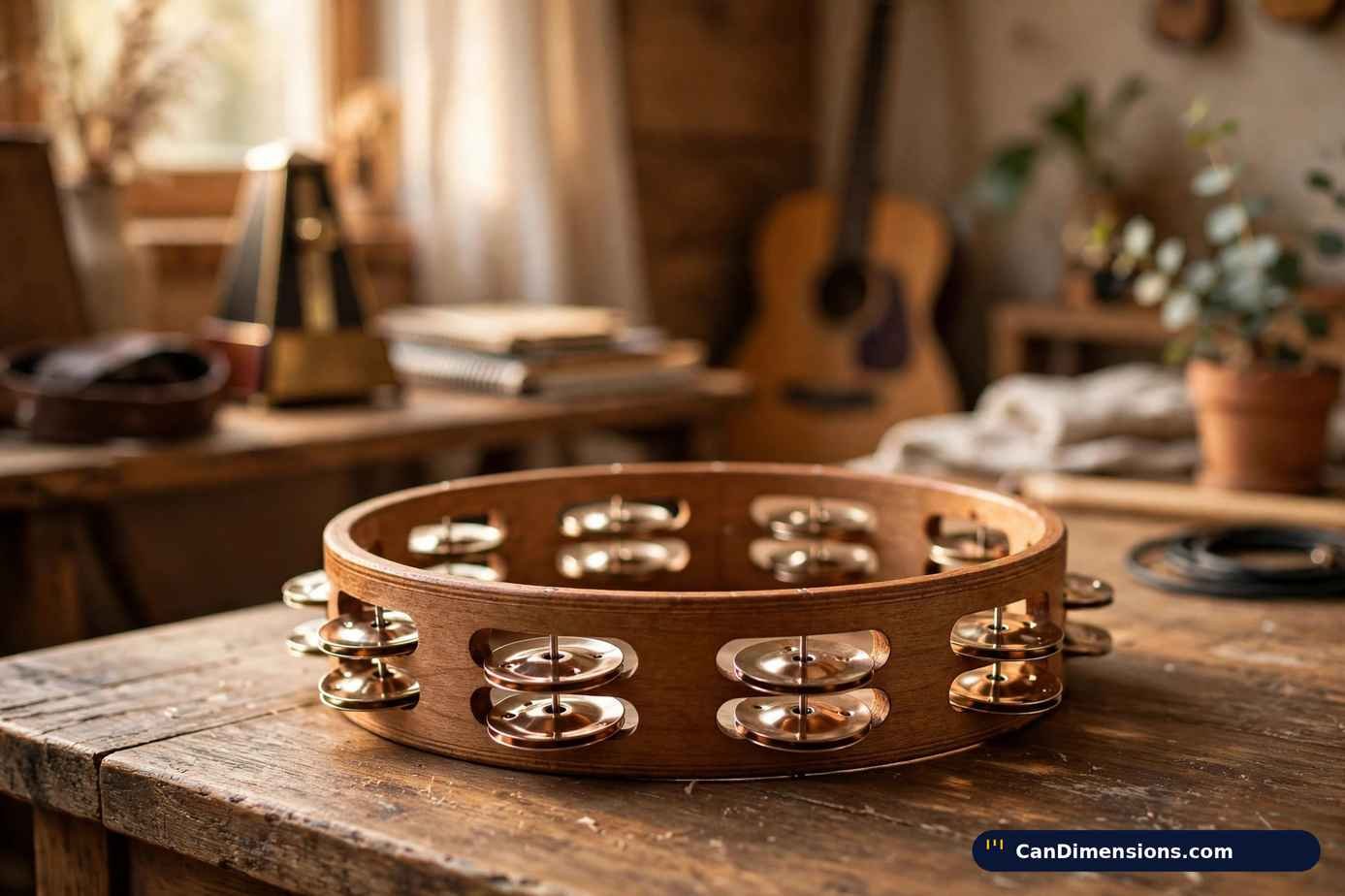
Counted: — on the maker’s size line. Toca’s Player’s Series single-row wooden tambourine is manufactured and sold at 9 inches — the middle of the line’s 6-to-10-inch ladder. A tambourine’s size is its shell diameter, so the instrument’s widest span is this page’s length exactly.
Percussion is sized in inches worldwide, metric countries included — drumheads, cymbals and tambourines all speak imperial natively. The 9-inch tambourine is the twin’s exception: an imperial native in a metric world.
An Adult Guinea Pig
Counted: — mid-range, on the reference figure. Adult guinea pigs measure 20 to 25 centimetres in body length (Wikipedia’s species account) — 8 to 10 inches — which puts 9 inches at the centre of the adult range. A typical adult guinea pig, nose to rump, is a 9-inch animal.
Animal sizes are ranges by nature, and range counts on this page always travel with their ranges printed. The guinea pig’s band is narrow and well documented, and 9 inches sits squarely inside it.

A 9-Inch Chef’s Knife
Counted: — to the tenth of an inch, on the maker’s product page. Wüsthof’s Classic Ikon chef’s knife in the 9-inch size carries a blade length of 9.0 in (23 cm) in the manufacturer’s own specification. No class rounding, no range: the blade is nine inches, and the same spec sheet says 23 cm in the next breath — the twin, printed by the maker himself.
Professional kitchens step up to this blade from the 8-inch; home kitchens step down to it from nothing, because there is no commoner size above it. It closes the list as the most exact object on the page.
How to Measure 9 Inches Without a Ruler
The metric twin makes ruler-free measuring easier, because 23 cm objects are everywhere once you know to look. Use one of these references:
| Method | Accuracy | How To |
|---|---|---|
| Baseball Circumference | ★★★★★ | String around a legal baseball = 9–9.25 in |
| Men’s Chopsticks | ★★★★☆ | The 23 cm standard pair = 9.06 in |
| Royal Paperback Height | ★★★★☆ | 234 mm tall = 9.21 in, a fifth over |
| Dinner Knife | ★★★★★ | 9.0 in on flatware specifications |
| Dollar Bill × 1.5 | ★★★★☆ | One and a half bill-lengths = 9.21 in |
The baseball and the dinner knife are the exact pair; the chopsticks and the paperback run a sixteenth to a fifth of an inch long, close enough for anything short of joinery. The wallet method brackets from above at 9.21 inches — pair it with a length-plus-width (8.75) and the truth is fenced in from both sides.
9 Inches: Quick conversion formula
The formula is one line long: inches × 2.54 = centimetres.
Worked example: nine inches × 2.54 gives 22.86 centimetres. Run the twin backwards and the class appears: 23 ÷ 2.54 = 9.06 inches, which is why a “23 cm” product — a pan, a pair of chopsticks, a knife — is a 9-inch product for every practical purpose, and why spec sheets print the two side by side.
9 Inches Is 23 Centimetres: The Metric Twin
Every imperial length has a metric shadow, but 9 inches’ shadow has a career of its own. Rounded to 23 cm, it became a manufacturing class: grinder wheels at 230 mm, sanding pads at 225–230 mm, chopsticks at 23 cm, knife blades at 23 cm, flatware at 23 cm. Makers on three continents tool up for this size without ever thinking in inches.
The relationship runs both ways. A product engineered at 23 cm enters imperial markets as “9 inch,” and a product engineered at 9 inches enters metric markets as “23 cm” — each wearing the other’s rounding. For the length’s bigger sibling in the same system, see our guide to 100 inches, where the metric figure (254 cm) is exact by definition.
Why 9 Inches Keeps Turning Up in Workshops and Sport
Workshops standardise on sizes that fit a hand and a workpiece at once, and 9 inches is the largest size that still does both: the big grinder is a two-handed tool, but its 230 mm wheel is the ceiling of the handheld class; the lineman’s plier at 9 inches is the largest plier a belt carries. Above this size, tools become machines; at it, they remain instruments.
Sport does the same thing by rule rather than by hand. The baseball’s circumference was fixed at 9 to 9¼ inches generations ago and has never moved, because the game is calibrated to it. Between the rulebook and the toolbox, the length is employed more than almost any other — our guide to 24 inches covers the workshop’s next standard size up.
9 Inches vs 8, 10 and 12 Inches: Neighbouring Sizes Compared
Eight inches (20.32 cm) is the home chef’s knife blade and the smaller layer-cake pan. Ten inches (25.4 cm) belongs to the modern dinner plate and to the standard skillet. Twelve inches is the foot (30.48 cm). Nine sits in the gap the others leave — the professional’s step up from 8, the classic’s step down from 10.
| Length | Centimetres | Everyday anchor |
|---|---|---|
| 8 inches | 20.32 cm | The home chef’s knife blade |
| 9 inches | 22.86 cm | The baseball’s circumference; the 230 mm wheel |
| 10 inches | 25.4 cm | The modern dinner plate |
| 12 inches | 30.48 cm | The foot itself |
The smallest neighbour in the table’s family is covered in our guide to 3 inches — a third of this length — and the measuring techniques for the foot are in our guide to measuring 12 inches.
Just Off 9 Inches: The 22 and 24 Centimetre Crowd
The twin has neighbours of its own. At 22 cm (8.66 in) sit the smaller grinder wheels and the women’s chopstick standard — close enough to be shelved beside the 23 cm class and far enough to matter on a workpiece. At 24 cm (9.45 in) sit the larger paperback trims and the next pan size up. Both get sold, somewhere on the internet, as “about 9 inches.”
About is doing heavy lifting in that sentence: 22 cm is a third of an inch short and 24 cm is nearly half an inch long. The class system survives because the classes are a centimetre apart and the rounding is confessed on spec sheets — as it is, line by line, in the list above.
Question’s
What can you compare 9 inches to?
A baseball, measured around. A dinner knife, measured along. A pair of men’s chopsticks, a 230 mm grinder wheel, a big banana wearing its extra-large grade — the length is the 23 cm class, and the class is everywhere once it has a name.
How to measure 9 inches without a ruler?
Wrap a string around a baseball and cut it at the overlap: the string is 9 to 9¼ inches. Or lay a pair of men’s chopsticks (23 cm) along the thing being measured, or stand a dinner knife beside it — both sit within a sixteenth of the mark.
What shoe size is 9 inches long?
Brand charts quarrel with each other, so treat any single answer cautiously: a foot 9 inches long lands in the small-adult range — women’s US six-and-a-half to seven-and-a-half on most charts, men’s nearer 5–6. The maker’s own chart, read after measuring the foot, outranks every general table.
What unit is 9 inches long?
In the old stable unit, 2¼ hands (a hand is 4 inches). In the modern imperial set it is 0.75 ft and 0.25 yd. In metric, strictly, 22.86 centimetres — the figure the 23 cm class rounds.
What size is a 9 inch?
In sport, a baseball’s waistline. In the workshop, the largest handheld grinder class. In books, no standard trim — the Royal’s 234 mm height is the nearest, at 9.21 inches, and in balls generally the size is fenced: bowling caps at 8.595 inches below it, and a size-7 basketball spans about 9.4 across above it.
How big is 9 inches in m?
0.2286 metres. On a metre rule it lands just before the 23 cm line — which is the entire biography of the length in one measurement: close enough to 23 cm for the world to build a class on it, exact enough at 22.86 to keep the classes honest.
Final Thoughts
Two numbers describe this length, and the second is the more useful. Nine inches is the imperial fact; 22.86 centimetres — the 23 cm class — is the working reality, stamped on wheels and chopsticks and knife blades across three continents. Learn the twin and the size stops being a trivia answer and becomes a recognition skill: you start seeing it on shelves, because the shelves were stocked by people who think in it.
The tool that teaches it fastest is the one in the garage with a 230 mm wheel fitted — the angle grinder — whose disc is this length’s diameter to within a sixteenth of an inch. Measure the wheel once, and 9 inches is calibrated for good.