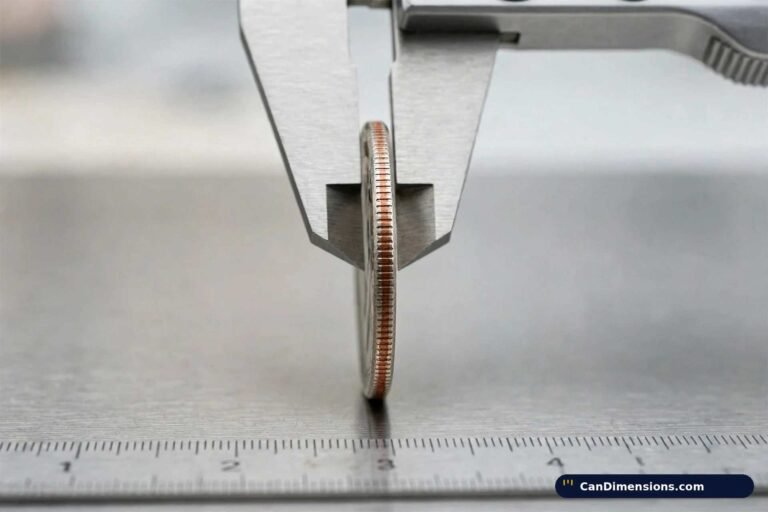
3.5 Inches: 11 Things with Pictures That Are 3.5 Inches Long
If you have ever wondered what does a 3.5 look like on a real object, the answer is already in your wallet: the long edge of a standard US business card is exactly 3.5 inches.
In numbers, 3.5 inches is 8.89 centimetres, 88.9 millimetres and 0.2917 feet — just under a third of a foot. It is a small size with an outsized paper trail, because card makers, lumber mills and hardware standards all settled on it independently.
Below are 11 things verified against maker specifications and official standards that genuinely measure 3.5 inches, the four famous examples that fail the check, and the ruler-free tricks that actually work.

How Long Is 3.5 Inches?
Three and a half inches is 8.89 cm exactly, because one inch is defined as exactly 2.54 cm. The full conversion set:
| Unit | 3.5 Inches Equals |
|---|---|
| Feet | 0.2917 ft |
| Yards | 0.0972 yd |
| Centimeters | 8.89 cm |
| Millimeters | 88.9 mm |
| Meters | 0.0889 m |
Picture it as a little less than a third of a standard ruler, or as half of 7 inches. What makes 3.5 inches unusually easy to find in the wild is that it sits where the inch world and the 90 mm metric world overlap: the business card is 88.9 mm long, the floppy disk’s short side is 90 mm, and the passport’s short side is 88 mm — three separate standards all landing within a millimetre or two of the same mark.
11 Common Things That Are 3.5 Inches Long
Standard US Business Card
Counted: The US and Canadian standard business card measures 3.5 × 2 inches (88.9 × 50.8 mm) — the long edge is exactly 3.5 inches. This is the size in VistaPrint’s own size guide and across the print industry, and it is the single most reliable 3.5-inch reference most people own.

Cards in much of the rest of the world run 85 × 55 mm, a touch shorter, so the exact reference is specifically the North American card. It shares its wallet with another inch-standard rectangle — the full official figures are set out in our dollar bill dimensions guide — which is why a wallet is a better measuring kit than most desk drawers.
Standard Household Matchbox
Not counted: There is no standard 3.5-inch household matchbox. The familiar small slide-open boxes are built around 2-inch match sticks, and the standardised small box measures about 2.0–2.1 inches long — the Indian matchbox standard IS 10373, for example, specifies an outer cover of 53 × 35 mm. A box only needs to clear its sticks, so a household matchbox lands near 2¼ inches, nowhere near 3.5. The heading stays because readers keep searching it; the claim does not survive a ruler.
Modern Smartphone Width
Not counted: Modern smartphones are not 3.5 inches wide. The iPhone 14 Pro measures 71.5 mm wide — 2.81 inches — and the Galaxy S23 measures 70.9 mm, or 2.79 inches, per the makers’ published specifications. Even the widest flagship class, the Pro Max models, reaches only about 3.06 inches. The competitor’s “2.75 to 3.5 inch range” invents its upper end: phone widths cluster tightly around 2.8 inches, a full 0.7 inch short of 3.5.
Standard Golf Tee
Not counted: 3.5 inches is not a standard golf tee length. The standard tee sizes are 1½, 2⅛, 2¾, 3¼ and 4 inches — the Rules of Golf cap a tee at 4 inches — and Pride’s Professional Tee System, the colour-coded range most golfers know, contains no 3.5-inch size at all. The modern driver standard is 3¼ inches and the classic all-rounder is 2¾. A tee sold as 3.5 inches would be a novelty, not the “most popular” standard.
Large Jumbo Paperclip
Not counted: No standard paperclip reaches 3.5 inches. Maker size charts put the jumbo clip at roughly 1⅞ to 2 inches long — the #1 standard clip is about 1¼ inches and the jumbo is the next step up, not a leap to three and a half. The competitor’s claim fails twice over: the “large jumbo” is not 3.5 inches, and the “3-inch jumbo” it is compared against does not exist either.
Small Pocket Knife (Folded)
Counted: Counted on a corrected basis. The models usually named for this size fail their own spec sheets — the Victorinox Cadet is an 84 mm knife, 3.31 inches closed, and the Kershaw Chive measures 2.9 inches closed per Kershaw. The honest match is Victorinox’s main 91 mm line, the Spartan and Tinker family: 91 mm closed is 3.58 inches, a hair over 3.5 and the closest standard folding knife made. A mid-size Swiss Army knife in your pocket is a 3.5-inch-class object; the smaller Cadet is not.
A Standard Playing Card
Counted: A poker-size playing card measures 2.5 × 3.5 inches (63.5 × 88.9 mm) — the long edge is exactly 3.5 inches. Bridge-size cards are narrower at 2.25 inches wide but stand the same 3.5 inches tall, and trading cards follow the same standard: the Pokémon card dimensions in our guide measure 63 × 88 mm, within a millimetre of the same height. Any deck in the house is a pocket ruler.

A Standard Crayon
Counted: Counted as about, with the disagreement printed. The standard crayon is commonly specified at 3.5 inches (89 mm) long in general references, and that is the figure the size is sold and taught by. Makers’ own paperwork clusters just above it — Crayola’s catalog size guide lists its Regular crayon at 3⅝ × 5/16 inches and retailer spec sheets list 3.6 inches — so treat a crayon as a 3.5-inch-class reference that may run a tenth of an inch long, not a precision gauge.
The Wide Face of a 2×4 Board
Counted: A dressed 2×4 does not measure 2 by 4 inches — it measures 1.5 × 3.5 inches, and the wide face is exactly 3.5 inches across. The finished sizes are fixed by the American Softwood Lumber Standard (NIST PS 20), which dresses a nominal 2×4 down to 1½ × 3½ inches. Every stud wall in North America is framed with a 3.5-inch reference.

A 4×4 Post
Counted: The same lumber standard dresses a nominal 4×4 post to 3.5 × 3.5 inches — a perfect square whose every face is exactly 3.5 inches wide. Fence posts, deck posts and mailbox posts across the continent are cut to this size, which makes the 4×4 the easiest 3.5 inches to find outdoors.
A 3.5-Inch Floppy Disk
Counted: Counted on its standard-name basis, with the real figures printed. The format’s own standard, ISO 8860, designates it “90 mm (3.5 in)” — 3.5 inches is the size’s official name. The physical cartridge measures 90 × 94 mm: its width, 90 mm, is 3.54 inches, and its depth of 94 mm is 3.70 inches. No object in history has been called 3.5 inches more often, and its short side earns the name honestly.

A Paring Knife’s Blade
Counted: The classic paring knife size is a 3.5-inch blade: Wüsthof lists its Classic 3½” Paring Knife with a blade length of exactly 3.5 inches in the maker’s own specification. Paring knives as a class run 3 to 4 inches, and 3½ is the standard middle size stocked by the major makers — the knife in the drawer you reach for to hull strawberries is the reference.
A Passport Book’s Short Side
Counted: Counted as about, with the shortfall printed. The international passport standard, ICAO Doc 9303 size TD3, fixes the booklet at 125.00 × 88.00 mm. The short side, 88 mm, is 3.465 inches — 0.035 inches, about a credit card’s thickness, short of 3.5. It is the closest thing in a travel wallet, and for any everyday estimate it reads as 3.5 inches; for precision work, use the business card instead.
An Interior Door Hinge
Counted: The standard residential interior door hinge measures 3.5 × 3.5 inches. Hinge sizing charts (ANSI/BHMA) assign the 3.5-inch butt hinge to interior doors of 1⅜-inch thickness up to 32 inches wide — which is to say, most bedroom and bathroom doors. Each leaf on the doors already hanging in your home is a 3.5-inch square.
A Golf Pencil
Counted: Counted as about, on a class basis. The short golf pencil — the half pencil stocked at golf courses, libraries and betting counters — is the standard short-pencil class at about 3.5 inches; bulk listings for the class run from 3⅜ to 3¾ inches depending on maker. Any single pencil may sit a quarter inch either side, so the class reads as 3.5 inches and no individual pencil should be trusted past that.
How to Visualize 3.5 Inches Without a Ruler
| Method | Accuracy | Why It Works |
|---|---|---|
| Business card long edge | ★★★★★ | Exactly 3.5 in by the print standard |
| Playing card long edge | ★★★★★ | Exactly 3.5 in, poker and bridge sizes both |
| Wide face of a 2×4 | ★★★★★ | Exactly 3.5 in by the lumber standard |
| Three adult fingers plus a small gap | ★★★★ | Roughly right; finger widths vary by hand |
| A 3¼-inch golf tee | ★★★ | A real standard size, but a quarter inch short |
| Smartphone width | ★★ | Phones are about 2.8 in wide, not 3.5 |
Two of the methods often rated five stars elsewhere drop down this table on the evidence. A smartphone’s width is a 2.8-inch measure wearing a 3.5-inch costume, and there is no standard 3.5-inch golf tee to hold — the 3¼-inch driver tee is the closest real object, and it reads a quarter inch short. The three exact references cost nothing: a card from your wallet, a card from a deck, and the stud behind the wall.
Where Does 3.5 Inches Appear in Daily Life?
Business and office settings. The business card is the headline, but the office is full of the size: playing-card-height card sleeves and trading cards at the same 3.5-inch standard, crayons in the supply cupboard at the 3.5-inch class, and golf pencils in the desk tidy. One correction belongs here — the jumbo paperclip on the same desk is a 2-inch object, not a 3.5-inch one.
Kitchen and dining areas. The paring knife’s 3.5-inch blade is the kitchen’s resident example, sized for in-hand work on fruit and garnishes. The matchbox by the stove, often listed at this size, is not: a household matchbox is built around 2-inch sticks and measures about 2 to 2¼ inches long.
Home improvement and gardening. This is 3.5 inches’ home turf. The wide face of every 2×4 stud and both faces of every 4×4 post are dressed to exactly 3.5 inches by the lumber standard, and the hinges on the interior doors between the rooms are 3.5-inch squares.
Sports and outdoor activities. Golf supplies the near-misses and one hit: tees top out at standard sizes of 3¼ inches for drivers — 3.5 is not a tee size — but the stubby scorecard pencil in the golf bag is a genuine 3.5-inch-class object, and the pocket knife on a hiking belt, in its mid-size 91 mm form, closes to the same measure.
Technology and gadgets. Computing named the size: the 3.5-inch floppy disk carried the number in its name for three decades. The gadget that replaced it is the cautionary tale — a modern phone is about 2.8 inches wide, and using its width as a 3.5-inch guide overstates every measurement by nearly three quarters of an inch.
Is 3.5 Inches Big?
No — 3.5 inches is a small, hand-scale size. It is just under a third of a foot, shorter than the width of most adults’ palms across the knuckles, and about the span of three fingers plus a gap. Its usefulness is not its size but its company: because card, lumber and hardware standards converged on it, 3.5 inches is one of the few small measures you can almost always find within arm’s reach, which no one can say of 3.4 or 3.6.
3.5 Inches vs 3 Inches and 4 Inches: Neighbouring Sizes Compared
| Size | Metric | A Reliable Anchor |
|---|---|---|
| 3 inches | 7.62 cm / 76.2 mm | A 3 × 3 sticky note |
| 3.5 inches | 8.89 cm / 88.9 mm | A business card’s long edge |
| 4 inches | 10.16 cm / 101.6 mm | A 4 × 6 photo print’s short edge |
The half inch on either side matters more than it sounds. Our guide to 3 inches covers the smaller neighbour, and measuring 4 inches shows the larger one against everyday objects — 4 inches is a full 14% longer than 3.5, easily visible side by side. The lumber yard holds the neatest illustration of the gap: a 4×4 post is named for 4 inches but measures 3.5, so the two sizes differ by exactly the half inch the sawmill and planer removed. For the next step up the scale, 6 inches is 3.5 inches plus 2.5 more.
Almost 3.5 Inches: The Near Misses
Three familiar objects circle 3.5 inches without landing on it, and all three are worth knowing so they are not mistaken for the real thing. A credit or debit card is 85.6 mm long under ISO/IEC 7810 — 3.375 inches, an eighth of an inch short. A standard modular house brick is 3⅝ inches wide in its actual dimensions, an eighth of an inch over. And the smaller Swiss Army knife, the 84 mm Cadet, closes to 3.31 inches — close enough to fool the eye, far enough to fail the count, which is why the 91 mm line carries the pocket-knife entry above.
Why So Many Standards Land on 3.5 Inches
Three forces converge on the same number. First, 3.5 is half of 7 and a clean fraction of the foot, so inch-based industries reach it naturally. Second, lumber economics fixed it in wood: dressing rough boards to consistent finished sizes made 3.5 inches the wide face of the continent’s most common board. Third, the metric world’s round 90 mm sits at 3.54 inches, close enough that card formats specified at 88–90 mm — business cards, floppy disks, passports — all read as the same 3.5-inch class from either system. The size is less a coincidence than a border crossing where two measurement systems meet.
Question’s
What household item is 3.5 inches?
The business card in your wallet — its long edge is exactly 3.5 inches. A paring knife’s blade, a dressed 2×4’s wide face and an interior door hinge are also exact.
What is comparable to 3.5 inches?
A poker or bridge playing card’s long edge, both faces of a 4×4 post, and a 3.5-inch paring knife blade all measure exactly 3.5 inches; three fingers plus a small gap approximates it.
How long is 3.5 in inches?
3.5 inches is three and a half inches: 8.89 cm, 88.9 mm, or 0.2917 feet.
Is 3 fingers 3 inches?
Roughly, yes — three adult fingers side by side span about 3 inches. Add a small gap, or a sliver of the fourth finger, to reach 3.5.
How many U is 3.5 inches?
Exactly 2U. One rack unit (1U) is 1.75 inches, so 3.5 inches of rack height is two units.
How big around is 3.5 cm?
3.5 cm is 1.38 inches — about the diameter of a D battery, which measures 34.2 mm across. It is not the width of an AA battery; an AA is only 14.5 mm in diameter.
Final Thoughts
Three and a half inches rewards a sceptical eye. Of the six examples usually listed for it, only two survive contact with a spec sheet — the business card exactly, and the pocket knife once the right model is named — while the matchbox, the smartphone’s width, the golf tee and the jumbo paperclip all turn out to be smaller objects wearing a bigger number. The verified eleven are better references anyway, because each one is fixed by a standard rather than by habit.
Keep a business card in your wallet and the size never needs guessing again. And if a dusty floppy disk turns up in a drawer, hold onto it — the object that put “3.5-inch” in its name still measures up, ninety millimetres at a time.