What Weighs 20 Grams? 14 Common Things That Weigh 20 Grams
Twenty grams is a small weight with a very precise definition: 20 grams is exactly 0.705 ounces, 0.0441 pounds and 0.02 kilograms — the combined weight of four U.S. nickels, no more and no less. It is light enough to sit on your palm almost unnoticed, yet recipes, coffee doses, parcels and jewellery scales ask for it every day.
Twenty grams also sits in the awkward middle of small weights: too heavy to ignore, too light to judge by feel alone. Most people who guess at it land anywhere between 10 and 40 grams, which is why checked reference objects matter far more than confidence at this size.
Below you will find 14 examples whose weights were checked against a mint specification, a manufacturer datasheet, a label or an official standard — plus eight popular claims, including the AAA battery and the tablespoon of peanut butter, that failed the same check and are corrected where they stand.
What Weighs 20 Grams? The Exact Conversions
Before the examples, here is 20 grams converted exactly into the units readers ask about most. Every figure in this table is calculated from the definition of the gram, not rounded from another website’s table.
| Unit | 20 Grams Equals |
|---|---|
| Kilograms | 0.02 kg |
| Milligrams | 20,000 mg |
| Ounces | 0.705 oz |
| Pounds | 0.0441 lb |
| Stones | 0.00315 st |
| Carats | 100 ct |
| Grains | 308.6 gr |
| Water volume | 20 ml |
Two of these are worth remembering. At exactly 100 carats, 20 grams is the weight jewellers work in when they price larger stones and gold, and the water line is the most useful of all: because one millilitre of water weighs one gram, 20 grams of water is always 20 millilitres, whatever container it is in.
What Does 20 Grams Mean?
In practical terms, 20 grams is the weight of four U.S. nickels — the single most reliable anchor on this page, because the U.S. Mint makes every nickel to exactly 5.000 grams. Held in an open palm, it registers as a definite but gentle pressure: clearly something, but nothing your hand has to work to hold.
It also helps to place it against its neighbours. Twenty grams is a little lighter than a standard AA battery (23.0 grams typical, on Energizer’s datasheet) and a little heavier than nothing at all — most everyday objects people reach for as comparisons, such as a AAA battery, turn out to be far lighter than they expect, which is exactly why the checked list below separates what is exact from what is folklore.
How Heavy Is 20 Grams?
The honest answer is: lighter than most people guess. Twenty grams is 0.705 of an ounce, so it is noticeably less than the smallest imperial unit most kitchens use. Set against familiar sports equipment, it is well under half a golf ball, which the rules of golf cap at 45.93 grams, and it is just 40 percent of a USDA large egg at 50 grams.
That is why feel is such a poor guide here and checked references are such a good one. If you remember only one anchor from this page, make it the nickel: one nickel is 5 grams, two are 10, four are 20, and twenty nickels make exactly 100 grams. With that single coin ladder you can picture, and physically build, almost any small weight in this series.
14 Most Common Things That Weigh About 20 Grams
The table below is the short answer: the 14 examples on this page that pass a real check, with the basis for each one stated openly. The sections under it explain every item in full, including the eight popular claims from lists like this one that did not pass — they are kept in place, in the original order, with the corrected figure printed where the claim used to be.
| Item | Weight | Basis |
|---|---|---|
| Four U.S. nickels | Exactly 20.000 g | U.S. Mint specification, 5.000 g each |
| Four British 20p coins | Exactly 20.0 g | Royal Mint specification, 5.0 g each |
| Eight US pennies (post-1982) | Exactly 20.000 g | U.S. Mint specification, 2.500 g each |
| Four Brazil nut kernels | 20 g | USDA portion data, 5 g per kernel |
| Two medium baby carrots | 20 g | USDA FoodData Central, 10 g each |
| 20 millilitres of water | Exactly 20 g | 1 ml of water weighs 1 g |
| A 20 g calibration weight | Exactly 20 g | Made and certified to that mass |
| A 20 g gold bar | Exactly 20 g | Minted to a 20 g specification |
| Twenty US dollar bills | About 20 g | About 1 g per bill (Bureau of Engraving and Printing) |
| Four sheets of A4 paper (80 gsm) | About 19.96 g | Rated paper weight, 4.99 g per sheet |
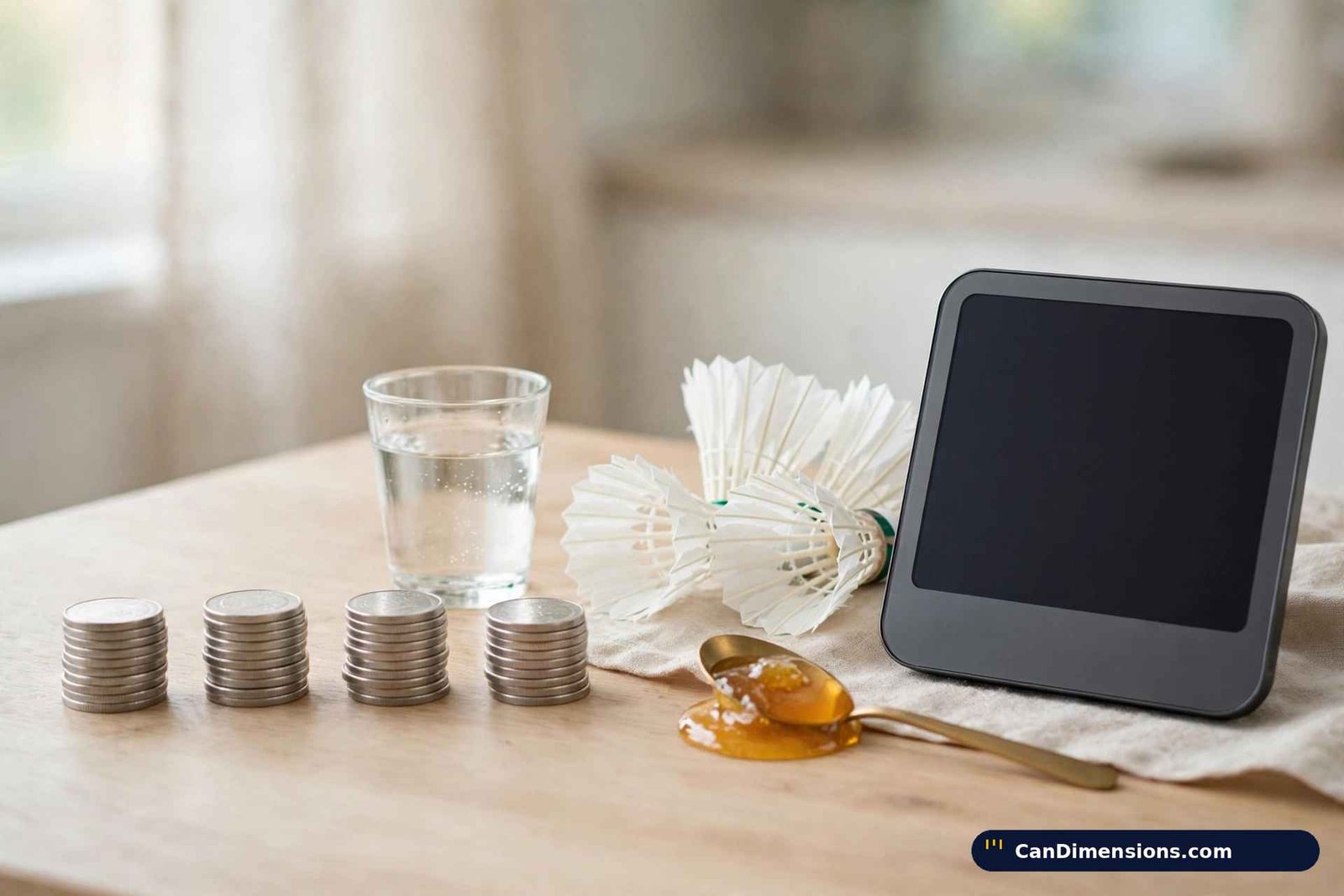
| Four badminton shuttlecocks | About 20 g | BWF legal range, 4.74–5.50 g each |
| Four credit or debit cards | About 20 g | About 5 g per standard card |
| One tablespoon of honey | About 20 g | USDA standard, 21 g per level tablespoon |
| Four grapes | About 19.6 g | USDA data, 4.9 g per grape |
Four U.S. Nickels
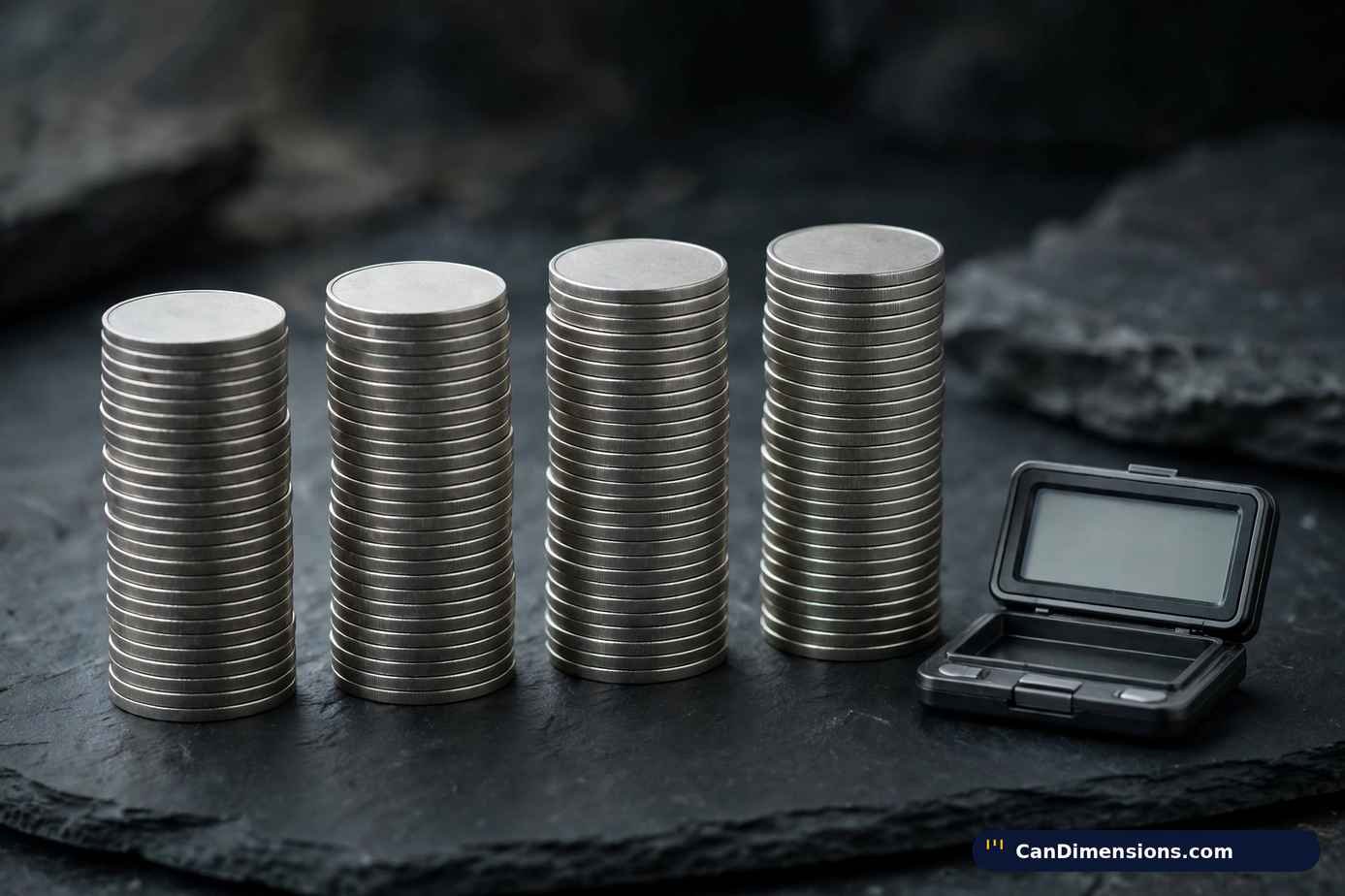
Counted: exactly 20 grams. The United States Mint specifies the nickel at exactly 5.000 grams, so four of them total exactly 20.000 grams — the cleanest household reference for this weight that exists. No other common object on this page can match a mint specification for accuracy.
That is also why nickels appear throughout this article wherever a known weight is needed: testing a kitchen or pocket scale, standing in for a calibration weight, or building the 10, 25 and 100 gram figures in the comparison sections below. If a scale reads four clean nickels as anything other than 20.0 grams, the scale is wrong, not the coins.
A Standard AAA Battery
Not counted — checked and corrected. Lists across the internet, including the one this article improves on, put a AAA battery at about 20 grams. The manufacturer’s own datasheet says otherwise: Energizer’s E92 specification gives the standard alkaline AAA a typical weight of 11.5 grams, and its lithium AAA is lighter still at 7.6 grams.
In other words, a AAA battery is a little over half of 20 grams, not an example of it. The confusion probably comes from the AA size further up the drawer, which really is close to this weight at 23.0 grams typical. The AAA figure is corrected here, and the battery is removed from the scale-free measuring method further down this page, where the same claim used to appear.
Twenty Paperclips
Not counted — no specification exists. The familiar claim runs that one paperclip weighs about one gram, so twenty of them weigh 20 grams. The problem is that no manufacturer publishes a paperclip’s weight at all, and measured clips vary so widely — roughly half a gram for a small clip up to about 1.4 grams for a large one — that a pile of twenty could honestly total anywhere from about 10 to about 28 grams.
A single clip can fairly be called “about a gram,” but at twenty times the scale that spread is far too wide to print as a weight. Twenty paperclips are a handful, not a reference, and they are not counted here.
A Compact Disc (CD)
Not counted — checked and corrected. A compact disc is often listed at around 20 grams, but the format’s own reference figures put a standard 120 mm disc at roughly 15 to 16 grams: it is a 1.2 mm sheet of polycarbonate, and Wikipedia’s technical summary of the format gives a range of 15 to 20 grams with typical discs sitting at the light end of it.
A disc at the very top of that range exists, but “about 20 grams” should describe the typical object, not the heaviest one ever pressed. As a rule of thumb, a bare CD is a 15-gram object; weigh it in its jewel case and the case, not the disc, supplies most of what the scale shows.
A Tablespoon of Peanut Butter
Not counted — checked and corrected. A level tablespoon of peanut butter is one of the most repeated “20 gram” examples in cooking content, and it is wrong on the standard reference: USDA data puts one level tablespoon of peanut butter at 16 grams. The 20 gram figure belongs to a heaped spoon, which is a serving style, not a measurement.
To actually take 20 grams of peanut butter, use a level tablespoon plus a level teaspoon — about one and a quarter tablespoons. The same correction applies to the spoon questions in the FAQ below, where the honest per-ingredient figures are printed in full.
Twenty Jelly Beans
Not counted — checked and corrected. This claim assumes each jelly bean weighs exactly one gram. Jelly Belly’s own label works out closer to 1.1 grams per bean — its standard serving of about 27 pieces is listed at 30 grams — so twenty beans total roughly 22 grams, not 20.
For a true 20 grams of jelly beans, count out about eighteen. The difference sounds small, but a 10 percent overshoot is exactly the kind of error this page exists to catch, and it is why candy arithmetic is always done from the maker’s label rather than from a round per-piece guess.
A Disposable Lighter (BIC Lighter)
Not counted — cannot be verified. BIC does not publish a weight for its classic pocket lighter, and the figures quoted by secondary sources scatter widely — anywhere from about 15 to about 24 grams depending on the model measured and, critically, on how much butane is left in it. A disposable lighter literally gets lighter every time it is used.
An object whose weight changes with use and has no manufacturer specification cannot be a reference for anything. It is kept here, corrected, because readers meet the claim so often — but it is not counted, and no exact figure is printed for it.
Twenty M&M’s Candies
Not counted — checked and corrected. The claim that twenty M&M’s weigh 20 grams rests on each candy weighing a full gram. Mars’s own label implies a lighter piece: the standard serving of about 32 pieces is listed at 28 grams, which is 0.875 grams per candy, so twenty of them total about 17.5 grams.
For 20 grams, you need roughly 23 plain M&M’s. As with the jelly beans above, the correction comes straight from the manufacturer’s nutrition label — the only honest source for a food that is sold by weight in the first place.
A Standard Highlighter Pen
Not counted — no standard exists. There is no such thing as a standard highlighter weight. Sharpie, the brand most often named in this claim, does not publish a weight for its highlighters at all, and the models that do appear on supplier datasheets scatter widely — one liquid-ink highlighter’s technical sheet lists about 12 grams, while chunky tank-style pens run heavier.
Depending on the pen in the drawer, a highlighter might weigh 12 grams or might approach 20, and a claim that only holds for some un-named model is not a measurement. It is corrected here rather than counted.
Four British 20p Coins
Counted: exactly 20 grams. The Royal Mint specifies the 20 pence piece at exactly 5.0 grams, so four of them total exactly 20.0 grams — the British twin of the nickel anchor above, and just as reliable for checking a scale.
British readers can build the same coin ladder used throughout this article: one 20p is 5 grams, two are 10, four are 20 and twenty are 100 grams. It is the same trick the Royal Mint’s own consistency makes possible, and it works because coin specifications are manufacturing law, not averages.
Eight US Pennies (Post-1982)
Counted: exactly 20 grams. The current United States cent — the zinc penny minted since late 1982 — is specified by the U.S. Mint at exactly 2.500 grams, so eight of them total exactly 20.000 grams.
The date matters: copper cents minted before 1982 weigh 3.11 grams each, and eight of those would overshoot to nearly 25 grams. Check for a mint year of 1983 or later and the arithmetic is exact.
Four Brazil Nut Kernels
Counted: 20 grams, on USDA portion data. The USDA’s standard portion for a single Brazil nut kernel is 5 grams, so four kernels make 20 grams. Brazil nuts are among the largest and densest of the common nuts, which is why so few of them reach a weight that takes seventeen almonds.
Natural foods vary from nut to nut, so treat this as the database’s standard kernel rather than a promise about every bag. As a portion guide, though, four kernels is a genuinely useful picture of 20 grams — and a rich one, at roughly 130 calories.
Two Medium Baby Carrots
Counted: 20 grams, on USDA data. USDA FoodData Central lists one medium baby carrot at 10 grams, so two of them make 20 grams — one of the few vegetable references that lands on this weight with a tidy piece count.
As with all produce, individual carrots vary, and the figure is the database’s standard medium piece. But as a visual anchor it is hard to beat: two baby carrots side by side on a plate is what 20 grams of vegetables looks like.
20 Millilitres of Water
Counted: exactly 20 grams. Water is the definition this whole system rests on: one millilitre of water weighs one gram, so 20 millilitres of water — four level teaspoons, or a tablespoon and a teaspoon — weighs exactly 20 grams in any kitchen on earth.
This is the one example on the page that needs no manufacturer, label or mint: it is true by the way the units were built. It is also the most practical measuring shortcut on the page, because a marked jug can stand in for a scale whenever water is the thing being portioned.

A 20 g Calibration Weight
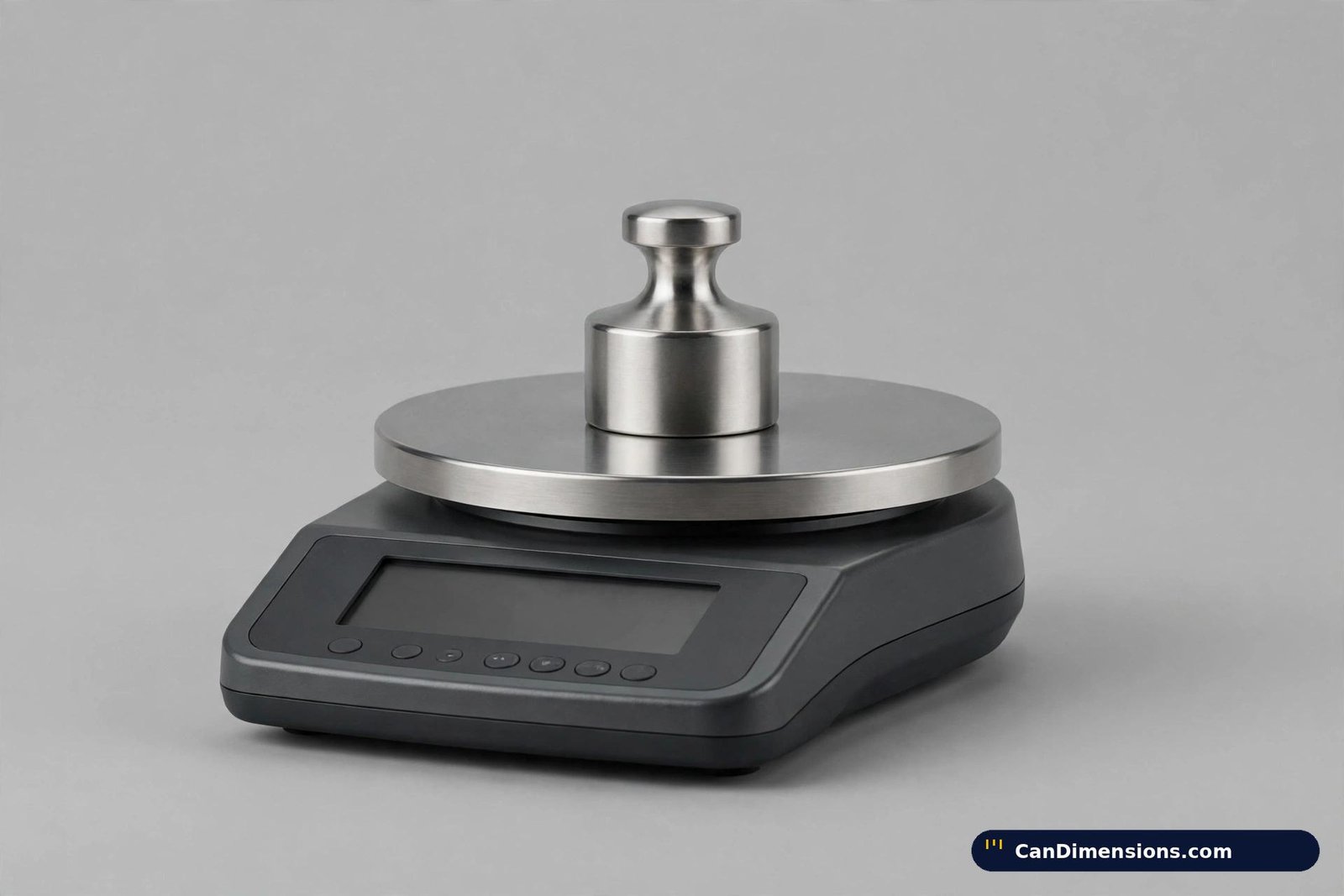
Counted: exactly 20 grams, by definition. A calibration weight is a piece of stainless steel manufactured and certified to a stated mass, and the 20 gram size exists precisely because 20 grams is a standard check point for pocket and kitchen scales. Under the ASTM and OIML classification systems, even the most forgiving tolerance class holds a 20 g weight within a few hundredths of a gram of its face value.
If you own any single object from this list, own this one: it turns every other example here from an estimate into a comparison. Four nickels should balance it — and on a good scale, they do, to the tenth of a gram.
A 20 g Gold Bar
Counted: exactly 20 grams. Small minted gold bars are sold in a standard ladder of weights — 1, 2.5, 5, 10, 20, 50 and 100 grams — and refiners such as PAMP mint a 20 gram bar to exactly that mass, sealed in its assay card. The 20 gram size is a popular middle rung: substantial enough to feel like wealth, small enough to gift.
It is also a neat illustration of density. Twenty grams of gold is a wafer barely larger than a postage stamp, because gold packs its mass into very little volume — the opposite end of the scale from the feather-light shuttlecocks further down this list.
Twenty US Dollar Bills
Counted: about 20 grams. The Bureau of Engraving and Printing’s figure for a United States banknote is about one gram per bill, whatever the denomination, so a stack of twenty bills totals about 20 grams. Twenty singles and twenty hundreds weigh the same — only their value changes.
“About” is the honest word here, because the Bureau’s figure is itself approximate and worn notes pick up traces of dirt and moisture. For a physical sense of this weight, though, a thin stack of twenty bills is one of the most recognisable handfuls on the page.
Four Sheets of A4 Paper (80 gsm)
Counted: about 19.96 grams. Paper is sold by its rated weight in grams per square metre — the “gsm” on the packet — and a sheet of standard 80 gsm A4 works out at 4.99 grams. Four sheets therefore total 19.96 grams, within a whisker of 20.
Five sheets, at about 25 grams, is the reference this series uses for the next step up. The rating makes paper one of the few household materials whose weight can be calculated from the packet instead of measured, provided the packet really is 80 gsm and the sheets really are A4.
Four Badminton Shuttlecocks
Counted: about 20 grams. The Laws of Badminton, set by the Badminton World Federation, require a shuttlecock to weigh between 4.74 and 5.50 grams — sixteen feathers (or a synthetic skirt) on a cork tip, built to a legal band rather than a single figure. Four shuttlecocks therefore total between about 19 and 22 grams, centred on 20.
It is the lightest-feeling entry on this page: a shuttlecock is mostly air and feather, so four of them spread across a palm feel like almost nothing while still being, genuinely, 20 grams of sports equipment.

Four Credit or Debit Cards
Counted: about 20 grams. A standard plastic payment card weighs about 5 grams — Chase, for example, specifies roughly 5 grams for its standard cards — so the four cards in a typical wallet total about 20 grams. The format is standardised worldwide, which is why cards from different banks cluster so tightly on the same figure.
Metal premium cards are the exception, running two or three times heavier, and are not what this reference means. Four ordinary plastic cards, though, are a wallet-sized 20 grams that most readers are carrying right now.
One Tablespoon of Honey
Counted: about 20 grams. Honey is the spoon exception that proves the spoon rule. USDA data puts a level tablespoon of honey at 21 grams — close enough to 20 that the competitor’s own FAQ figure was one of the few that survived checking — because honey is about 1.42 times as dense as water.
That density is the whole lesson of the spoon examples on this page: a tablespoon is a volume, and its weight is whatever the ingredient’s density makes it. Water gives about 15 grams per tablespoon, honey about 21, and peanut butter — corrected above — 16.
Four Grapes
Counted: about 19.6 grams. USDA data puts an average grape at 4.9 grams — its reference entry works out at ten grapes to 49 grams — so four grapes total about 19.6 grams, close enough to 20 to round out this list as its lightest-touch fruit reference.
Grapes vary by variety and season more than coins or cards do, so read this as a picture rather than a specification. Four average grapes in a row is still one of the quickest ways to show someone how small 20 grams really is.
How to Measure 20 Grams Without a Scale
Things to Use as Weights
The best scale-free reference for 20 grams is the one the U.S. Mint guarantees: four nickels, exactly 20.000 grams between them. Four British 20p coins do the same job to the same standard. If you own a 20 g calibration weight, that is the reference everything else is checked against.
Drop the AAA battery from this method, wherever you have seen it recommended: on Energizer’s datasheet it weighs 11.5 grams, so a balance “calibrated” against one is wrong by nearly half. Paperclips fail for the opposite reason — twenty of them could total anywhere from about 10 to about 28 grams, because nobody manufactures them to a weight.
Use Everyday Kitchen Tools
Volume measures work when the ingredient is known. Twenty grams of water is 20 millilitres — a tablespoon plus a teaspoon. Granulated sugar runs about 12.6 grams per level tablespoon (4.2 grams per teaspoon), so 20 grams is just under five level teaspoons; all-purpose flour is lighter still at about 8 grams per spooned tablespoon.
Liquids split by density: 20 millilitres of cooking oil weighs about 18 grams, because oil floats on water at roughly 0.91 of its density, while the same 20 millilitres of honey weighs about 28 grams. The jug measures volume faithfully every time — the conversion to grams is the part that changes with the ingredient.
Understand Volume Versus Weight
This is the distinction every section of this page keeps returning to: millilitres measure space, grams measure mass, and only water converts between them one-for-one. A recipe written in grams is asking for mass, and a spoon or jug can only estimate it through the ingredient’s density.
That is why the honest spoon figures on this page are given per ingredient rather than as one magic number. When a conversion matters — baking ratios, coffee extraction, medication-adjacent kitchen work — a basic kitchen scale settles in two seconds what no spoon chart can.
Comparing 20 Grams to Other Weights
20 Grams Versus 10 Grams
Ten grams is exactly half of this page’s weight: two nickels, two 20p coins, or ten millilitres of water. Our guide to how much is 10 grams works through that weight with the same checked method used here.
One correction travels between the two pages: an AA battery does not belong in a 10 gram discussion at all. Energizer’s typical figure for an AA is 23.0 grams — more than double 10 grams, and a little over this page’s 20.
20 Grams Versus 50 Grams
Fifty grams is two and a half times 20 grams, and its cleanest anchor is the USDA large egg at exactly 50 grams — so this page’s weight is 40 percent of a large egg. Ten nickels also make exactly 50 grams, keeping the ladder in a single coin.
Two popular comparisons need tightening: a golf ball is close to 50 grams only in the sense that the rules cap it at 45.93 grams, and a small apple is not a 50 gram object at all — USDA data puts even a medium apple at 182 grams. Egg and nickels are the references that hold.
Creating a Mental Weight Progression
The nickel ladder builds the whole small-weight range without a single guess. One gram is a single dollar bill, covered in our guide to things that weigh 1 gram. Five grams is one nickel. Ten grams is two. Twenty grams is four. One hundred grams is twenty nickels exactly, the weight explored in our guide to what weighs 100g.
The same ladder exposes a comparison that circulates widely: “a AAA battery plus two nickels is about 30 grams.” On the datasheet figures it is 11.5 plus 10.0 — 21.5 grams, barely over this page’s weight. Progressions are only worth memorising when every rung is checked.
How 20 Grams Relates to Other Metric Weights
Twenty grams is a crossroads weight in the metric small-weight family. It is double the 10 gram weight, twenty times the single gram, one fifth of 100 grams, and a fifteenth of the 300 grams weighed out in our what weighs 300 grams guide. Against the largest weight in this sequence, it is one twenty-fifth of the figure converted in our how many pounds is 500 g guide.
That is also why 20 grams appears so often in real life: it is the first metric weight that is big enough to portion with — a coffee dose, a spice blend, a serving of protein powder — while still being small enough to build exactly from coins, water and paper, the three reference families this page relies on.
Common 20-Gram Myths, Checked
- “A AAA battery weighs about 20 grams.” It weighs 11.5 grams typical on Energizer’s E92 datasheet. The AA is the close one, at 23.0 grams.
- “A tablespoon of peanut butter is 20 grams.” A level tablespoon is 16 grams on USDA data. Twenty grams is about one and a quarter level tablespoons.
- “A CD weighs 20 grams.” A typical disc weighs about 15 to 16 grams; the format’s stated range tops out at 20 only for the heaviest pressings.
- “Twenty paperclips are exactly 20 grams.” No manufacturer specifies a paperclip’s weight, and twenty real clips can total roughly 10 to 28 grams.
- “20 grams is exactly 0.70 ounces.” Close, but the exact figure is 0.705 ounces — the rounded 0.70 understates it.
- “20 grams is two-thirds of an ounce.” Two-thirds of an ounce is 18.9 grams. Twenty grams is just over seven-tenths of an ounce.
Question’s
How much does 20 grams weigh?
In imperial units, 20 grams is 0.705 ounces or 0.0441 pounds. In your hand, it is four U.S. nickels — the Mint makes each one to exactly 5.000 grams.
How to measure 20 grams at home?
Best is a kitchen scale. Without one, use four nickels (exactly 20.000 g), 20 millilitres of water, or a 20 g calibration weight. Do not use a AAA battery as a reference: it weighs 11.5 grams, not 20.
What items weigh 25g?
Five U.S. nickels weigh exactly 25.000 grams — the cleanest 25 g reference there is. An AA battery, at 23.0 grams typical, is close but not exact, six level teaspoons of sugar come to about 25 grams, and a single strawberry is too variable to use (a USDA medium strawberry is about 12 grams).
What is an example of 21 grams?
A level tablespoon of honey weighs 21 grams on USDA data — the simplest true 21 gram example. Twenty-one paperclips only reach about 21 grams if each happens to weigh a gram, which no specification guarantees.
What part of a human weighs 21 grams?
None, as a standard. The famous figure comes from Duncan MacDougall’s 1907 “21 grams” soul experiment, which was never replicated and is not accepted science. For scale, a human eyeball weighs only about 7 grams, and a tongue roughly 60 to 70 grams.
Is 1 tablespoon 20 grams?
Only for some ingredients. A level tablespoon is a volume: water gives about 14.8 grams, granulated sugar about 12.6 grams, peanut butter 16 grams, and honey about 21 grams. The spoon is constant; the density is not.
What is an example of 20 grams of protein?
About 65 grams of cooked chicken breast (USDA data puts it near 31 grams of protein per 100 grams), three large eggs at about 19 grams of protein, or roughly 200 grams of plain non-fat Greek yogurt. Eighty-five grams of chicken, often quoted for this, actually delivers about 26 grams.
Conclusion
Twenty grams turns out to be a weight with excellent exact references and terrible folklore. The exact side of the ledger is strong: four nickels, four 20p coins, eight post-1982 pennies, 20 millilitres of water, a 20 g calibration weight and a 20 g gold bar all hit the figure to mint or manufacturing precision, and the honest “abouts” — dollar bills, A4 sheets, shuttlecocks, cards, honey and grapes — each carry their basis in the open. The folklore side, from the 11.5-gram AAA battery to the 16-gram tablespoon of peanut butter, is corrected where it stands so it stops travelling.
Keep four nickels in a drawer and you will never have to guess this weight again. The same checked references work in the kitchen, at the post counter, and even at the sports hall — where the four shuttlecocks from this list, built to the laws of badminton, are quietly the lightest 20 grams you will ever hold.