How Much Is 2 Ounces? 12 Common Things That Weigh 2 Ounces
Two ounces is one of those weights that recipes, postage labels and product packaging use constantly, yet very few people can actually picture it. So how much is 2 ounces, really? It is exactly 56.699 grams — one eighth of a pound — and this page pins it down with exact conversions and real, checked objects.
The confusion starts with the word ounce itself, because a fluid ounce measures volume while an ounce measures weight, and the two only agree for water. Every figure below keeps the two apart, and every example object has been checked against a mint specification, a rulebook, a manufacturer datasheet or a food database before it was counted.
You will find the exact conversions first, then 12 everyday things that genuinely weigh 2 ounces — including three famous examples that fail the check and are corrected in place under their original headings. A no-scale measuring section, a short myth check and plain answers to the common questions follow.
What Is 2 Ounces?
An ounce is a unit of weight in the imperial and US customary systems. One ounce is defined as exactly 28.349523125 grams, so 2 ounces is exactly 56.699 grams — about 56.7 grams in everyday rounding. There are 16 ounces in a pound, which makes 2 ounces exactly one eighth of a pound, or 0.125 lb.
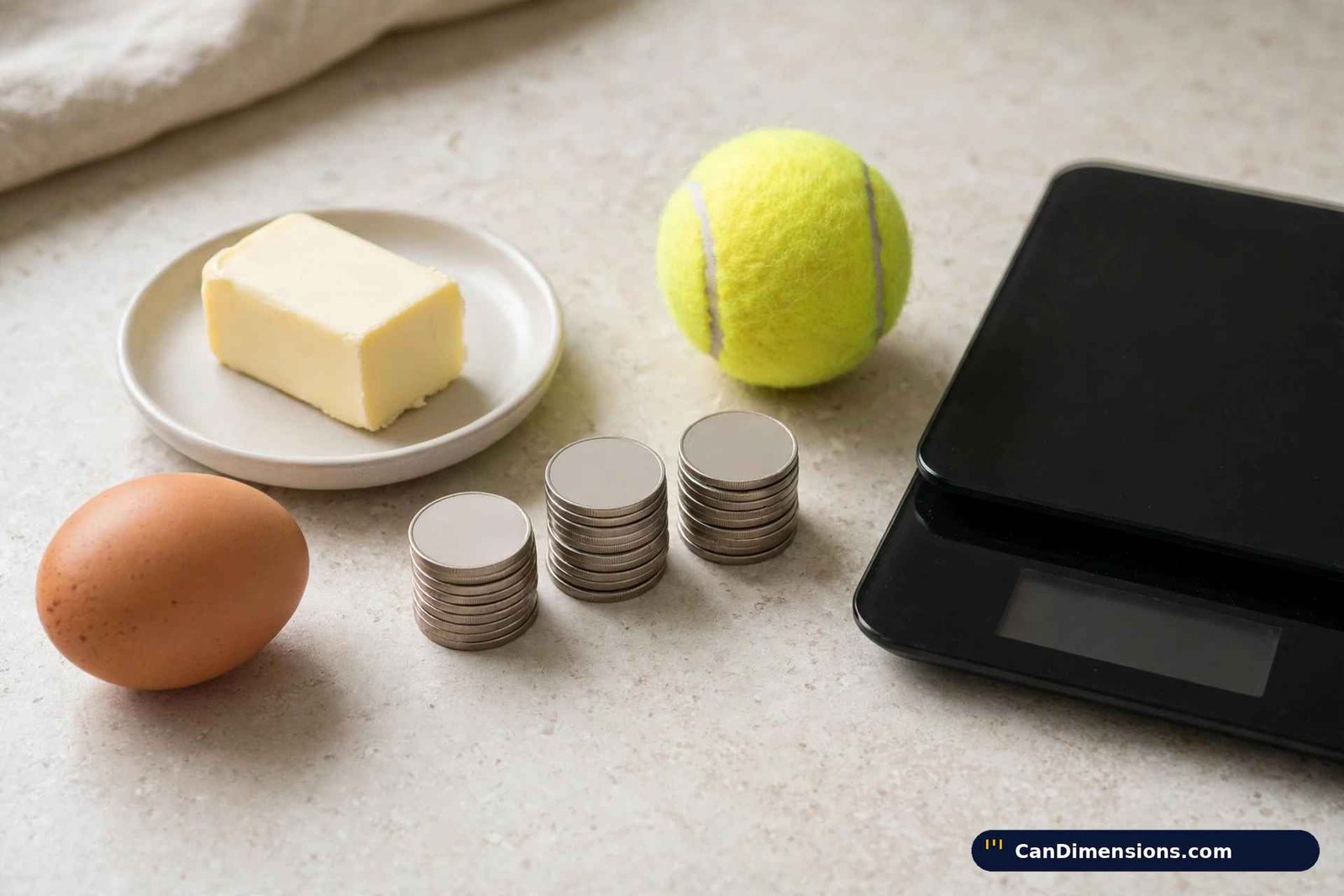
The quick picture: 2 ounces is roughly the weight of a large egg in its shell, a tennis ball, or half a stick of butter. It sits on the same ladder that starts with things that weigh 1 gram — fifty-six of those gram steps, gathered into one small handful.
One warning before the conversions. Precious metals are weighed in a different unit, the troy ounce of 31.1035 grams, so “2 ounces” of gold or silver is 62.2 grams, not 56.7. Everything else on this page uses the ordinary avoirdupois ounce — the one on kitchen scales, food labels and coin specifications.
How Much Is 2 Ounces in Cups, Grams, mL and More
Most of the confusion around 2 ounces comes from one habit: treating ounces and fluid ounces as the same thing. They are not. The four short sections below answer each version of the question separately, and the reference table keeps weight conversions and volume conversions clearly labelled.
How Much Is 2 Ounces in Cups?
As a volume, 2 fluid ounces is exactly 1/4 cup — that is the answer for liquids measured in a cup. As a weight, there is no single cup answer, because a cup is a space, not a weight: 2 ounces by weight is about half a cup of flour, a third of a cup of chocolate chips, and almost exactly a quarter cup of water. The ingredient decides.
How Much Is 2 oz in mL?
As a volume, 2 fluid ounces is 59.147 mL — call it 59 mL. By weight, 2 ounces is 56.699 grams, and since 1 mL of water weighs 1 gram, 2 ounces of water by weight occupies 56.7 mL. The two answers differ by about 2.5 mL, which is exactly the gap between the fluid ounce and the weight ounce showing up in metric.
How Much Is 2 Ounces in Grams?
56.699 grams, exactly. Round it to 56.7 g for the kitchen and 57 g for a rough label check, but 56.699 is the true figure: 2 × 28.349523125 g. It is also 0.0567 kilograms and 56,699 milligrams.
How Much Is 2 Ounces in Tablespoons?
As a volume, 2 fluid ounces is 4 tablespoons — or 12 teaspoons. By weight, tablespoons depend on the ingredient, with one famous coincidence: butter. Four tablespoons of butter weigh almost exactly 2 ounces, because a US stick of butter is 4 ounces and carries eight tablespoon marks. For most other ingredients the tablespoon is a volume tool only.
Quick 2 Ounces Conversion Reference Table
| Conversion | Value | Type |
|---|---|---|
| Grams | 56.699 g | Weight |
| Kilograms | 0.0567 kg | Weight |
| Milligrams | 56,699 mg | Weight |
| Pounds | 0.125 lb | Weight |
| Stones | 0.00893 st | Weight |
| Carats | 283.5 ct | Weight |
| Grains | 875 gr | Weight |
| Troy ounces | 1.823 troy oz | Weight |
| Millilitres | 59.147 mL | Volume (fluid ounces) |
| Cups | 1/4 cup | Volume (fluid ounces) |
| Tablespoons | 4 tbsp | Volume (fluid ounces) |
| Teaspoons | 12 tsp | Volume (fluid ounces) |
How Heavy Is 2 Ounces?
Two ounces is light but not trivial — about the heft of a tennis ball in the palm, or a large egg carried in its shell. It is far too heavy to be a sheet of paper and far too light to be a phone: a typical smartphone weighs three to four times as much. In the hand it feels like a small handful of coins, which is literally true, as the coin examples below show.
Set against its neighbours, 2 ounces is a little over half of what weighs 100 grams, about double a single ounce of cheese on a sandwich, and exactly half of a quarter-pound patty before cooking. Postal scales notice it, kitchen scales measure it easily, and a bathroom scale cannot see it at all.
12 Most Common Things That Weigh 2 Ounces
Every example under this heading was checked before it was counted. Twelve pass — some exactly, on a specification, and some as honest “about” matches on an official average. Three of the original examples fail, and they stay below as corrected warning sections, clearly marked, so nobody repeats them.
| Thing | Verified weight | Counted? |
|---|---|---|
| One large egg (in shell) | ≈56.7 g average (USDA class) | Yes — about |
| Ten US quarters | 56.70 g (Mint spec) | Yes — exact |
| Twenty-five US dimes | 56.70 g (Mint spec) | Yes — exact |
| Eleven US nickels | 55.0 g (Mint spec) | Yes — about |
| Twenty-two US pennies | 55.0 g (Mint spec) | Yes — about |
| Half a stick of butter | 56.7 g (label / USDA) | Yes — exact |
| A plain English muffin | 57 g (USDA) | Yes — about |
| A small lemon | 58 g (USDA) | Yes — about |
| A tennis ball | 56.0–59.4 g (ITF rules) | Yes — rulebook range |
| 56.7 mL of water | 56.7 g (by definition) | Yes — exact |
| A 2 oz calibration weight | 56.699 g (certified) | Yes — exact |
| Contents of a 2 oz spice jar | 56.7 g (label) | Yes — exact, contents only |
| Two AA batteries | ≈46 g (manufacturer) | No — corrected below |
| A standard deck of playing cards | ≈90–100 g | No — corrected below |
| A shot glass of liquid | A volume, not a weight | No — corrected below |
One Large Egg
Counted: a large egg in its shell averages almost exactly 2 ounces — with the basis stated. US egg sizes are set by minimum weight per dozen, and the USDA’s Large class is 24 ounces per dozen, which works out to an average of 2.0 ounces — about 56.7 grams — per egg, shell included. Individual eggs vary a little either side of that average, and once the shell comes off, the edible part of a large egg is about 50 grams. Counted honestly: right on the class the egg is sold by, shell on.
Two AA Batteries
Not counted: two AA batteries weigh about 46 grams, not 2 ounces. A standard AA alkaline cell from a major manufacturer has a typical weight of about 23 grams, so a pair comes to roughly 46 grams — about 1.6 ounces, a full 10 grams short. Four AA batteries would overshoot to about 92 grams. The claim survives because two AAs look like they should match a number as round as 2 ounces; on a datasheet, they do not.
A Standard Deck of Playing Cards
Not counted: a standard deck weighs about 90 to 100 grams — closer to 3.5 ounces than to 2. A paper poker-size deck of 52 cards runs roughly 1.7 to 2.0 grams per card once the box and jokers are included, which puts the full deck near double the 2-ounce mark. Decks are simply denser than they look. If a card reference is needed for the hand, about 30 loose cards is the honest 2-ounce stack.
A Small Lemon or Kiwi
Counted: on the lemon — a small-to-medium lemon is about 58 grams by USDA data. The USDA reference weight for a medium lemon is 58 grams, a whisker over 2 ounces, and a genuinely small lemon lands right on it. The kiwi half of the pairing fails and is corrected here: one kiwifruit is listed at 69 grams, about 2.4 ounces — nearly half an ounce too heavy. Keep the lemon, drop the kiwi.
Twenty-Two US Pennies
Counted: twenty-two modern US pennies weigh 55.0 grams — “about 2 ounces,” with the small gap stated. Every US cent minted since 1982 weighs exactly 2.500 grams by Mint specification, so 22 of them make 55.0 grams and 23 make 57.5 grams. The true 2-ounce point, 56.7 grams, sits between the two handfuls. This method works, and the pennies section below keeps it — but the exact coin stacks are the quarters and dimes a few sections down.
A Standard Shot Glass of Liquid
Not counted: a shot glass measures volume, and volume is not weight. There is no US federal standard for a shot — glasses run from 1 to 2 fluid ounces — and 2 fluid ounces of liquid is 59.15 mL whatever it weighs. Poured with water, that volume weighs about 59.1 grams, already over 2 ounces by weight; poured with spirits it weighs less, because alcohol is lighter than water. The glass itself is not part of the liquid at all, and it has no standard weight either: real glass shot glasses commonly weigh more than the drink inside them. A shot glass is a fair measuring tool for volume. It is not a 2-ounce weight.
Ten US Quarters
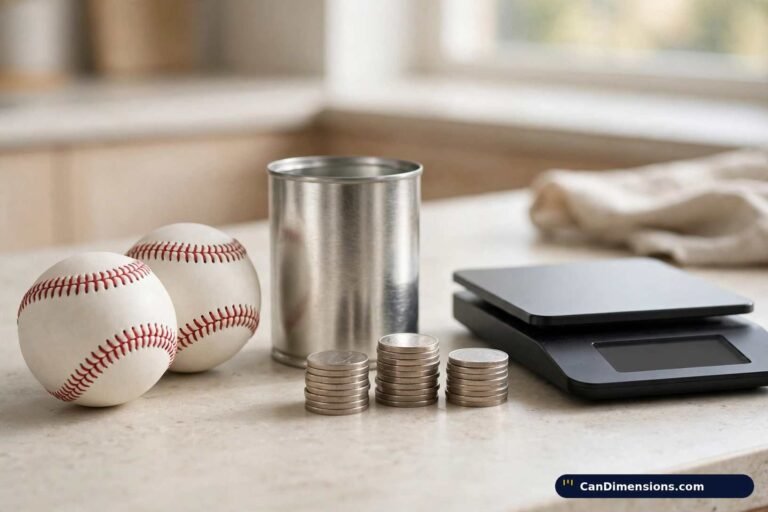
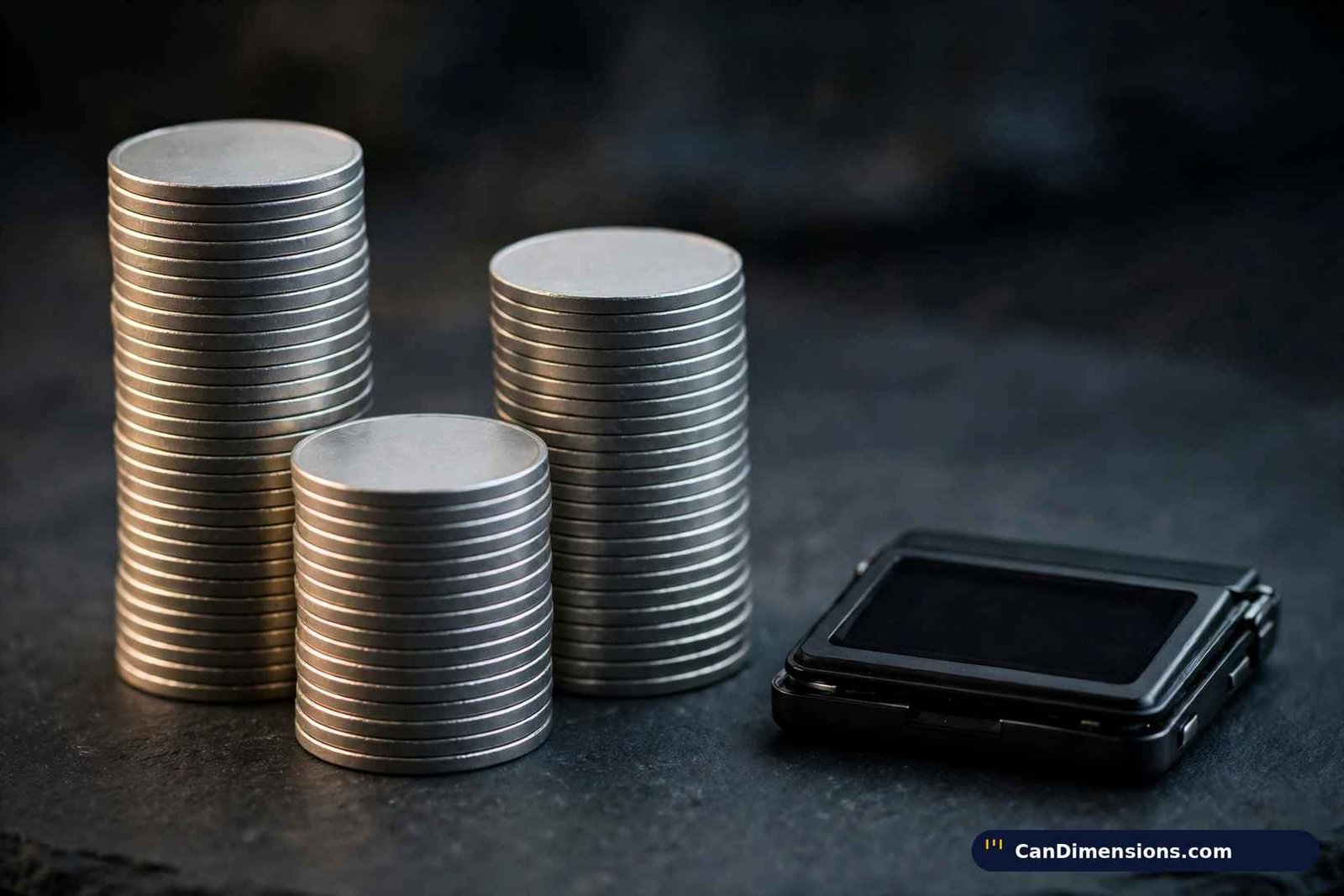
Counted — exact: ten US quarters weigh 56.70 grams, which is 2 ounces to the hundredth. The US Mint specification for a quarter is 5.670 grams, and 31 U.S. Code § 5112 writes that figure into law. Ten quarters therefore make 56.70 g against a target of 56.699 g — the closest everyday match on this page, and the best pocket reference for what 2 ounces feels like.
Twenty-Five US Dimes
Counted — exact: twenty-five dimes also land on 56.70 grams. A dime’s Mint specification is 2.268 grams, and 25 × 2.268 g = 56.70 g. A full standard roll of dimes is 50 coins, so half a roll is a certified-feeling 2 ounces — a second exact route, useful when quarters are scarce.
Eleven US Nickels
Counted: eleven nickels weigh 55.0 grams — about 2 ounces. The nickel is the friendliest US coin for weight work because its specification is a round 5.000 grams. Eleven nickels make 55.0 g, about 3% light; twelve make 60.0 g, about 6% heavy. For a quick hand-check, eleven is the closer handful.
Half a Stick of Butter
Counted — exact: half a US stick of butter is 2 ounces by the label itself. A stick is sold and printed as 4 ounces — 113 grams, matching the USDA record of 113 g per stick — and it carries eight tablespoon marks. Half a stick is therefore exactly 2 ounces, and it is also exactly 4 tablespoons, which is why butter is the one ingredient where the volume and weight answers agree.
A Plain English Muffin
Counted: one plain English muffin is 57 grams in USDA data — about 2 ounces. The USDA reference entry for a plain English muffin gives one muffin at 57 g, within half a gram of the 56.699 g target. Bakery muffins run larger, so the counted item is the standard packaged muffin the database describes.
A Tennis Ball
Counted: a regulation tennis ball must weigh between 56.0 and 59.4 grams — 2 ounces sits inside the rulebook range. The International Tennis Federation’s rules set that mass range for every approved ball type, so any real tennis ball is within about 5% of 2 ounces, and a ball at the light end is nearly exact. It is one of the easiest 2-ounce references to find.

56.7 Millilitres of Water
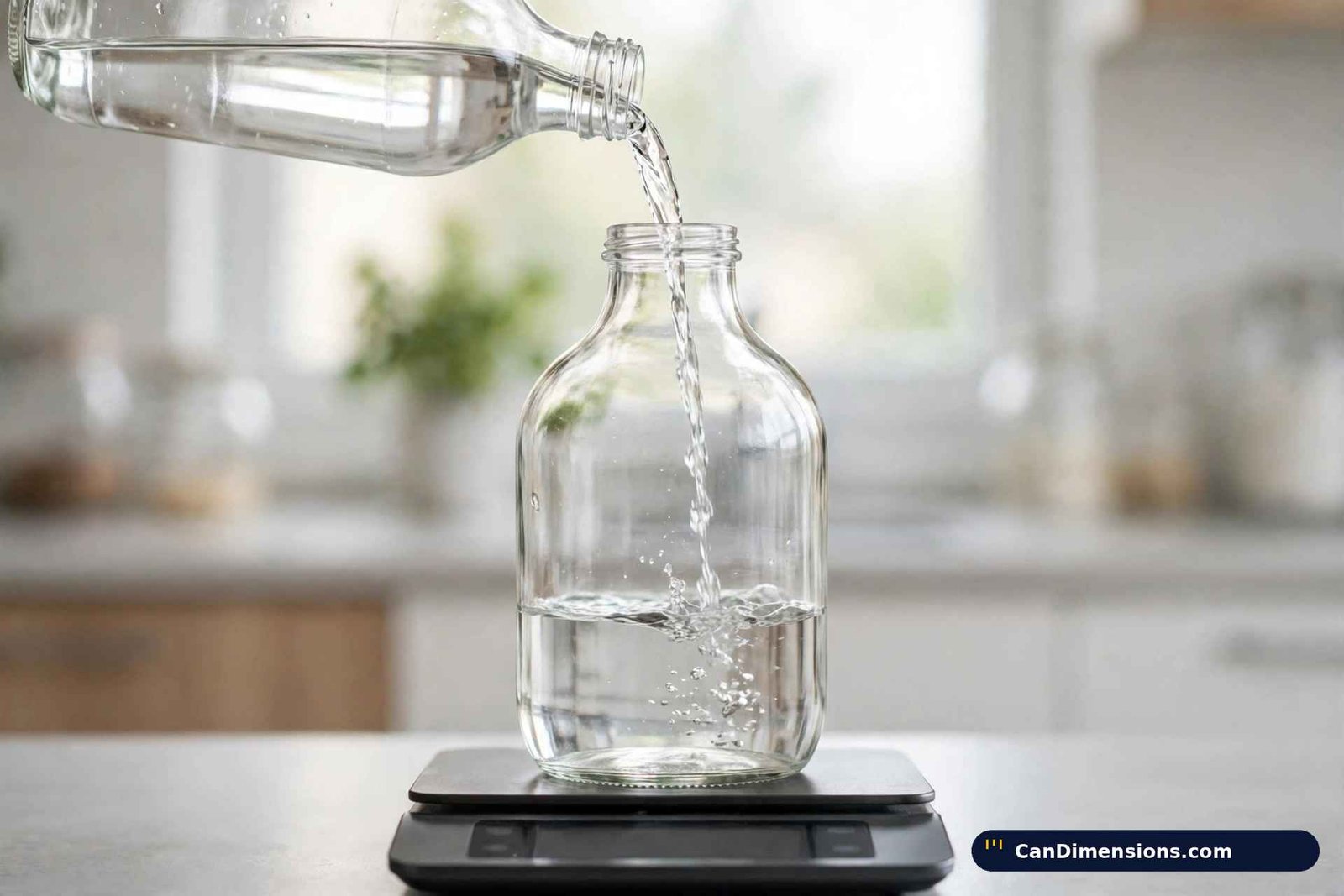
Counted — exact: 56.7 mL of water weighs 56.7 grams, because 1 mL of water weighs 1 gram. This is the definitional match, and it is why the mL answer matters: if a small bottle, syringe or measuring jug shows 56.7 mL of water, the scale will show 2 ounces. Note the contrast with the volume figure — 2 fluid ounces of water is 59.15 mL and weighs slightly more than 2 ounces.
A 2 oz Calibration Weight
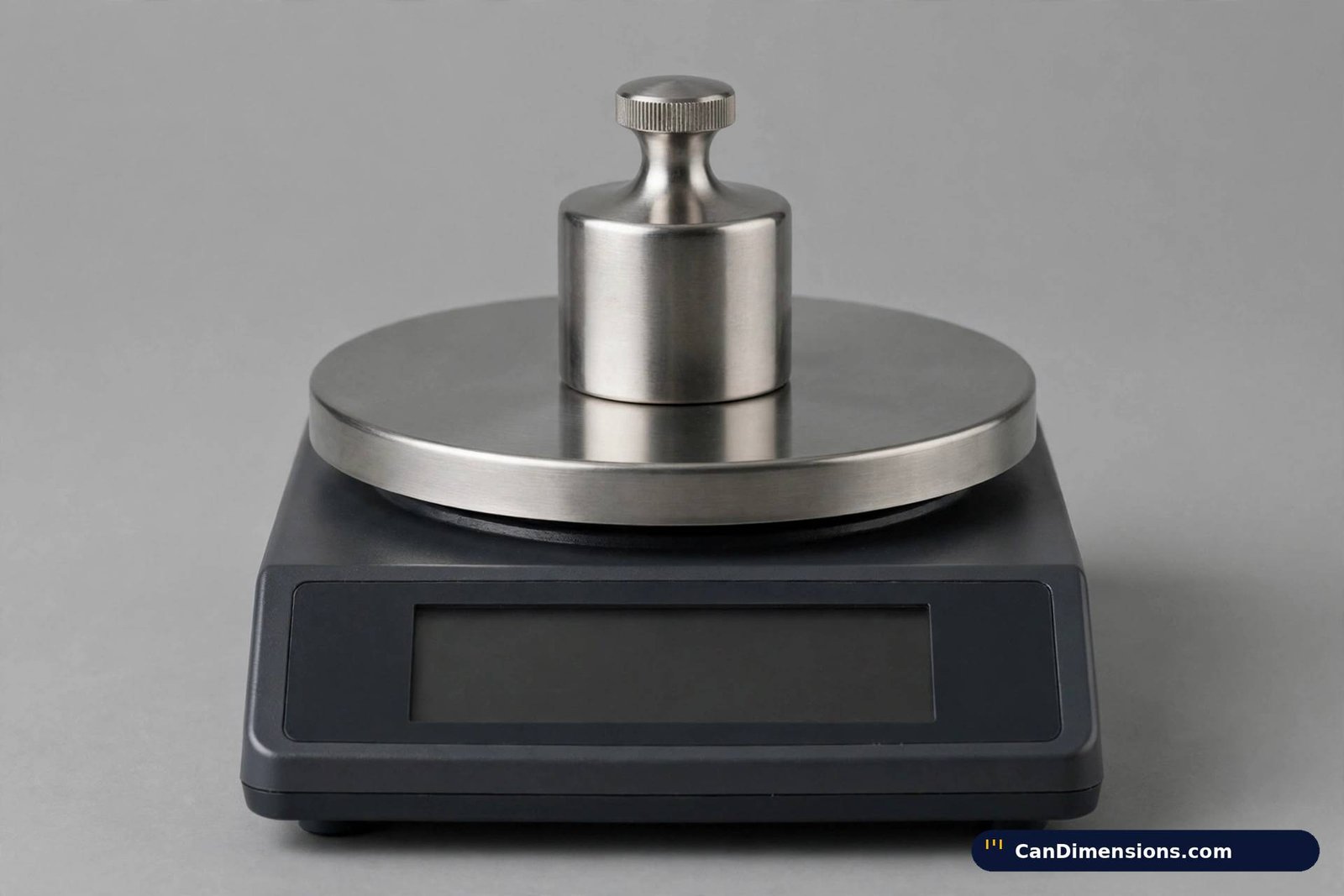
Counted — exact: a certified 2 oz calibration weight is 2 ounces by definition. These small stainless-steel weights are manufactured and certified to their stamped value within a tight tolerance, and they are sold precisely so a scale can be checked against a known mass. It is the least surprising item on the list, and the most exact.
The Contents of a 2 oz Spice Jar
Counted — exact, contents only: the spice inside a jar labelled “NET WT 2 OZ (56.7 g)” weighs exactly 2 ounces. Major spice brands sell whole ranges in this size — ground black pepper, allspice and curry powder jars are all labelled 2 oz (56.7 g), and the net weight on a US label is a legal statement about the contents. The jar and lid are packaging and are not counted; what is in the pantry is the spice.
2 Ounces of Liquid vs Dry — What Is the Real Difference?
The difference is not between two kinds of ounce. There is one ounce of weight and one fluid ounce of volume, and “dry ounce” is not an official unit at all — dry ingredients are simply weighed in ordinary ounces or measured by volume in cups and spoons. Everything below follows from that single fact.
| Ingredient | 2 fl oz by volume weighs | 2 oz by weight measures |
|---|---|---|
| Water | 59.1 g | 56.7 mL (about 1/4 cup) |
| Milk | About 61 g | About 55 mL |
| Vegetable oil | About 54 g | About 62 mL |
| Honey | About 84 g | About 40 mL |
| All-purpose flour | About 30 g | About 1/2 cup |
| Granulated sugar | About 50 g | About 1/4 cup, heaped |
| Cocoa powder | About 21 g | About 2/3 cup |
| Chocolate chips | About 42.5 g | 1/3 cup |
Read the flour row carefully, because it reverses a common claim: flour is less dense than water, not more. A quarter cup of flour — which is what 2 fluid ounces means — weighs only about 30 grams, while 2 full ounces of flour by weight fill about half a cup. Liquids denser than water, like honey, run the other way. This is why baking by weight is reliable and baking by “ounces” without saying which kind is not.
How to Measure 2 Ounces Without a Scale
Using Measuring Cups
For liquids, fill a 1/4-cup measure to the brim: that is 2 fluid ounces exactly. For dry ingredients, use the ingredient rows in the table above rather than the cup alone — a quarter cup of flour is only about half of 2 ounces by weight, while a quarter cup of water is slightly more.
Using Tablespoons
Four level tablespoons make 2 fluid ounces of any liquid. Count them into a small glass and you have the volume with no special equipment. For butter alone, the same 4 tablespoons are also 2 ounces by weight.
How to Measure 2 Ounces of Chocolate Chips
Use 1/3 cup. Standard semi-sweet chips weigh 6 ounces per cup — the figure printed on the common 12 oz bag, which holds 2 cups — so 2 ounces is one third of a cup, not one quarter. A quarter cup of chips is only about 1.5 ounces, and using it quietly under-measures a recipe by a quarter.
Using a Shot Glass
A shot glass works for volume if you know its size. Two fills of a standard 1-ounce pony glass, or one fill of a true 2-ounce jigger, give you 2 fluid ounces. A common 1.5-ounce shot glass gives 3 fluid ounces in two fills — over the mark — so check the glass before trusting it.
The 22-Penny Method
The classic trick works, with its small error understood: 22 modern pennies weigh 55.0 grams, close to but not exactly 56.7. Balance a light container against 22 pennies and you are within about 3%. For an exact hand reference, use the ten quarters instead — same pocket, no error worth naming.
Comparing 2 Ounces to Other Weights
Against 1 ounce, 2 ounces is simply double — two slices of sandwich cheese instead of one. Against a quarter pound, it is exactly half: a quarter-pounder patty is 4 ounces before cooking. Against 100 grams, it is a little over half, and against a full pound it is one eighth — the fraction worth remembering, because it converts in both directions without a calculator.
The metric neighbours put it in context: 2 ounces is nearly six times how much is 10 grams, about a fifth of what weighs 300 grams, and just over a ninth of how many pounds is 500 g. Small weights, same ladder — once 56.7 grams is fixed in the mind, the whole range around it becomes easier to judge.
How 2 Ounces Relates to Other Weights
Two ounces is built from the system’s own bricks: 2 × 1 ounce, 1/8 of a pound, 875 grains, and 283.5 carats. In metric it is 56.699 grams, 0.0567 kilograms and 56,699 milligrams — every one of those is the same single step, multiplying or dividing the exact 28.349523125-gram ounce.
The one relative that does not belong is the troy ounce. Gold, silver and platinum are weighed in troy ounces of 31.1035 grams, so 2 troy ounces is 62.2 grams — nearly 10% heavier than the 2 ounces everywhere else on this page. Jewellery listings that say “2 oz” mean the troy figure; kitchen and postal listings mean this one.
Common 2-Ounce Myths, Checked
“A deck of cards weighs 2 ounces.” Checked above: a standard deck is about 90–100 grams, nearer 3.5 ounces. False.
“Two AA batteries are exactly 2 ounces.” About 46 grams on the manufacturer’s typical figure — roughly 1.6 ounces. False.
“2 ounces is always a quarter cup.” Only as a volume. By weight, a quarter cup is 2 ounces for water and almost nothing else. Half true, and the half that matters is the label.
“There is a separate dry ounce.” No standards body defines one. Dry goods are weighed in the same ounce as everything else, or measured by volume. False.
“2 ounces of silver weighs 56.7 grams.” Silver is weighed in troy ounces: 2 troy ounces is 62.2 grams. False — and the most expensive mistake on this list.
“A shot is a standard 2 ounces.” No US federal standard exists; shots run 1 to 2 fluid ounces by glass and by state custom. False as a standard, true only for a true 2-ounce jigger.
Question’s
How much is 2 ounces in cups?
As a volume, 2 fluid ounces is exactly 1/4 cup. As a weight, the ingredient decides: about 1/2 cup of flour, 1/3 cup of chocolate chips, or about 1/4 cup of water.
How many ounces is 2 tablespoons?
One fluid ounce by volume — 2 tablespoons = 1 fl oz. By weight it depends on the ingredient; 2 tablespoons of butter weigh 1 ounce.
How much is 2 ounces in ml?
59.15 mL as a volume (2 fluid ounces). By weight, 2 ounces of water is 56.7 mL.
Is 2 oz half a 1/4 cup?
No. 2 fluid ounces is a full 1/4 cup. Half of a 1/4 cup is 1 fluid ounce.
Does 1 cup equal 2 oz?
No. One cup is 8 fluid ounces by volume, and by weight a cup of water is about 8.35 ounces while a cup of flour is about 4.25 ounces.
How many tablespoons of butter is 2 oz?
4 tablespoons — exactly half a stick. A stick is 4 ounces and 8 tablespoons, so the halfway cut is 2 ounces. (The “quarter stick” version of this claim is wrong.)
What is 2 oz of liquid?
A volume of 59.15 mL: a quarter cup, or 4 tablespoons. Its weight depends on the liquid — about 59.1 g for water, less for spirits, more for honey.
How can I measure 2 oz without a scale?
Use ten quarters for an exact weight reference, a 1/4-cup measure for liquid volume, or 4 tablespoons. The 22-penny handful works too, at 55.0 g.
How do I measure 2 oz of chocolate chips?
Use 1/3 cup. Standard chips weigh 6 ounces per cup, so 2 ounces is a third of a cup — not the quarter cup often quoted.
Is 2 ounces 2 tablespoons?
No. 2 tablespoons is 1 fluid ounce; 2 fluid ounces is 4 tablespoons.
How much water is 2 ounces?
By volume, 59.15 mL (2 fl oz). By weight, 56.7 mL — 56.7 grams of water. The two answers differ because the fluid ounce and the weight ounce are different units.
How many ounces is 100ml?
3.381 fluid ounces by volume. By weight, 100 mL of water is 100 grams, which is 3.527 ounces.
How to measure 2 oz of liquid?
Fill a 1/4-cup measure, count 4 tablespoons, or use a 2-ounce jigger. A standard 1.5-ounce shot glass needs one full fill plus a third of another.
How many ounces is 30 ml?
1.014 fluid ounces — for kitchen purposes, 1 fluid ounce. By weight in water, 30 mL is 30 grams, about 1.06 ounces.
Conclusion
Two ounces is exactly 56.699 grams — an eighth of a pound — and once the fluid ounce is kept in its own column, every version of the question has a clean answer: 59.15 mL of volume, a quarter cup, 4 tablespoons. The verified objects make it tangible: an egg in its shell, half a stick of butter, an English muffin, a small lemon, and three piles of US coins that hit the figure exactly or nearly so. The three famous failures — the batteries, the card deck and the shot glass — are worth remembering too, because they are the claims most likely to be repeated.
Keep one reference within reach and the weight stops being abstract. Ten quarters in a pocket, or the tennis ball in the sports bag, will tell your hand what 2 ounces is more honestly than any chart — the chart above is just there to prove they were telling the truth.