20 Feet: 12 Things with Pictures That Are 20 Feet Long or Tall
Ask a sports-hall manager how far is 20 feet visually and you will be pointed at a court, not a tape measure: the width of the pickleball court being lined that morning, the outer sidelines of the badminton court beside it, and the roped square waiting for the evening’s boxing all measure this one length.
The same number also collects confident mistakes. The celebrated 20-foot shipping container’s steel measures 19 feet 10½ inches, no giraffe on record reaches it, and the standard school bus overshoots it by half again — all three claims are tested below and stay on the page with their verdicts attached.
So this guide puts 14 candidates to the documents that govern them — federation rulebooks, class rules, makers’ specification sheets and published species records — and 12 pass. Each section opens by declaring its basis: exact rule, class name, ceiling or threshold, so no figure borrows more certainty than its source gives it.

How Long Is 20 Feet?
In other units the length reads: 240 inches, 6.667 yards, 609.6 centimetres, 6,096 millimetres and 6.096 metres. It is longer than any room in an ordinary house and wider than most halls are tall, which is why the reliable picture references are courts, vehicles and harbour steel rather than furniture.
| Unit | 20 Feet Equals |
|---|---|
| Inches | 240 in |
| Yards | 6.667 yd |
| Centimeters | 609.6 cm |
| Millimeters | 6,096 mm |
| Meters | 6.096 m |
Two anchors do most of the work. A basketball rim is fixed 10 feet above the floor, so set one rim atop another and the pair reaches the figure exactly. Against a person it works out at roughly three and a half: lay an average adult — about 5 feet 8 inches — end to end three times, add half of a fourth, and the line is covered.
12 Common Things That Are 20 Feet Long or Tall
| # | Thing | Counted? | Basis |
|---|---|---|---|
| 1 | Standard 20-Foot Shipping Container | Yes | Nominal class — ISO external length 6,058 mm (19 ft 10½ in) |
| 2 | Standard School Bus | No | A standard Type C bus runs about 25–40 ft; typical ≈36 ft |
| 3 | Full-Grown Giraffe | No | Males typically 15–18 ft; tallest ever recorded 19.3 ft |
| 4 | Standard Passenger Van or Minibus | Yes | About — long-wheelbase Ford Transit measures 237.6 in (19 ft 10 in) |
| 5 | Small Motorboat or Fishing Boat | Yes | The 20-foot class — Sportsman 20 Island Bay: maker’s length 20 ft 1 in |
| 6 | Standard Parking Space Length | Yes | Top of the standard range — US stalls run 18–20 ft; many codes specify 20 |
| 7 | A Pickleball Court’s Width | Yes | Exact — USA Pickleball Rulebook: court 20 ft wide × 44 ft long |
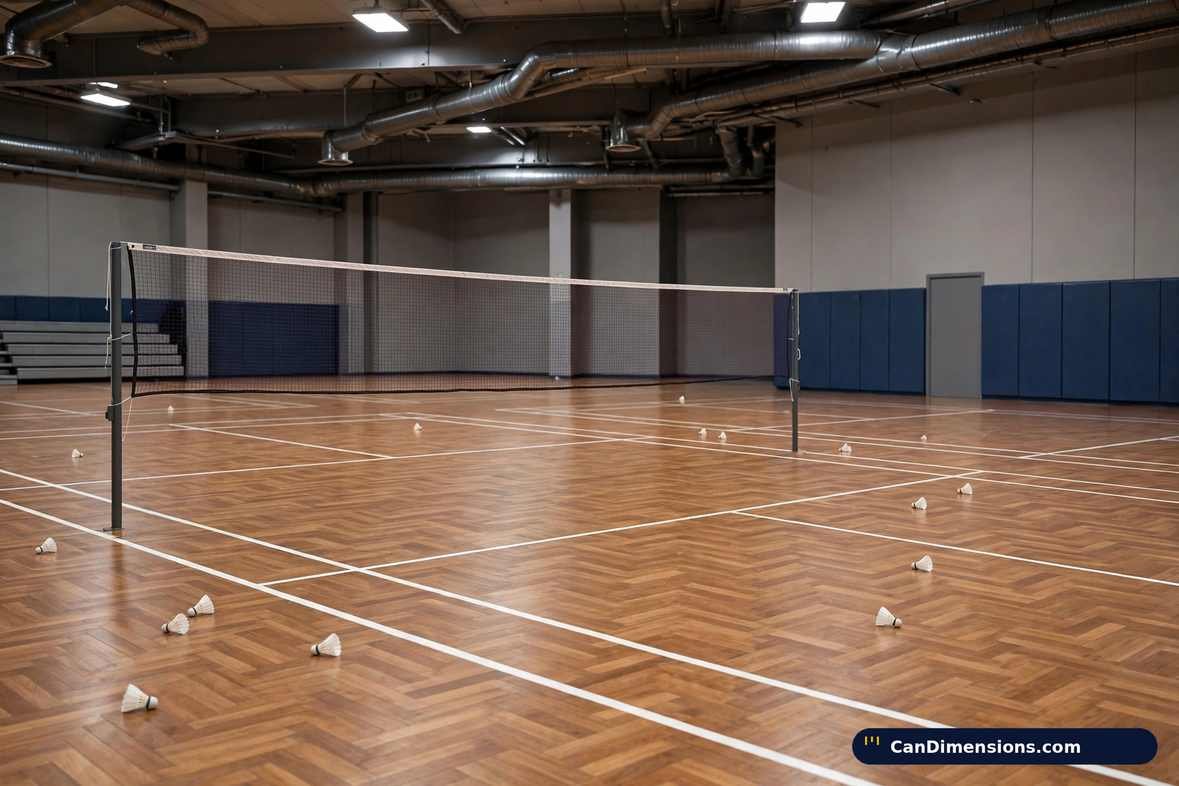
| 8 | A Badminton Court’s Doubles Width | Yes | Exact — BWF Laws: 6.10 m wide for doubles (13.40 m long) |
| 9 | A Racquetball Court | Yes | Exact — official rules: 20 ft wide, 40 ft long, 20 ft high |
| 10 | A Championship Boxing Ring | Yes | Standard top size — 20 ft square inside the ropes for major title fights |
| 11 | A Hockey End-Zone Faceoff Spot | Yes | Exact — NHL Rule 1.9: spots on a line 20 ft from each goal line |
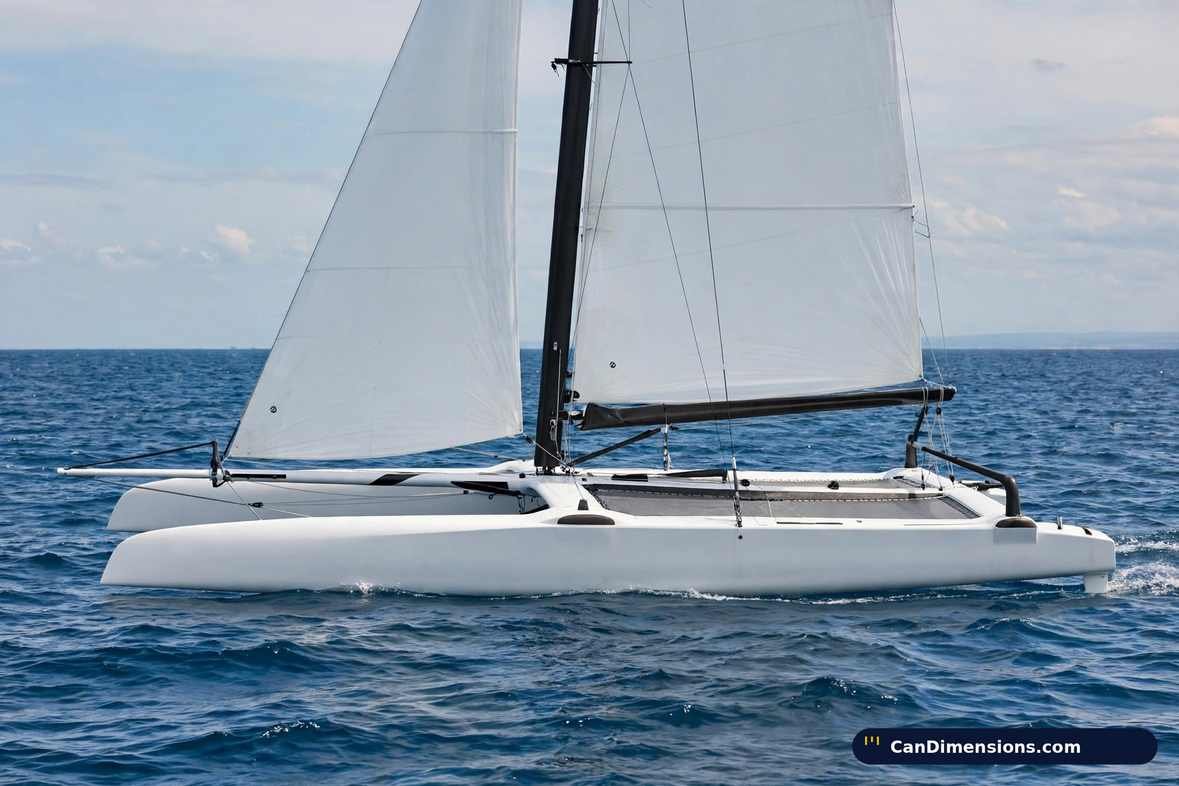
| 12 | A Tornado Racing Catamaran | Yes | One-design class — hulls 6.10 m (20 ft), the former Olympic class |
| 13 | A Great White Shark | Yes | Ceiling basis — biggest females reach 20 ft (6.1 m); most are smaller |
| 14 | A Big Wave | Yes | Threshold basis — big-wave surfing begins at 20 ft; scales disputed |
1. Standard 20-Foot Shipping Container
Counted: Nominal class basis — the name sponsors the figure rather than reporting it. World trade counts itself in TEUs, twenty-foot equivalent units, and the box that lends the unit its name is the most standardised object in freight. Yet ISO 668, the document that standardises it, fixes the outside length at 6,058 millimetres — 19 feet 10½ inches, tolerance included. Ports do not stack a 20-foot box; they stack a 6,058 mm box that the paperwork calls twenty feet.
None of that makes the example a cheat. Ships’ bays, crane spreaders, rail wagons and chassis are all laid out around the TEU grid, so the class governs real steel everywhere — the honest version is simply that the governing figure is a name, and the name runs an inch and a half ahead of the metal.
2. Standard School Bus
Not counted: The standard bus is roughly twice this size. Blue Bird’s owner’s manual for the conventional school bus — the Type C, the hooded yellow bus of the morning route — gives its length as 25 to 40 feet, and a typical example works out near 36 feet. The flat-fronted design the claim describes belongs to the Type D transit-style bus, which is built just as long.
What does exist near 20 feet is the Type A cutaway, a small bus body mounted on a van chassis for a dozen or so pupils. It is a niche vehicle for special routes, not the standard the claim needs, and it cannot carry the full classroom the original text promises. The heading stays because the correction is the useful part.
3. Full-Grown Giraffe
Not counted: The species fails by a margin that flatters it. Guinness World Records gives a grown male’s usual height as 4.6 to 5.5 metres — 15 to 18 feet. The record books’ tallest individual, a Masai bull called George who arrived at Chester Zoo in 1960, measured 5.8 metres, roughly 19 feet, and the biggest bull researchers have measured reached 5.88 metres (19.3 feet). Twenty feet is beyond every giraffe ever put against a measure.
Picture instead a bull at the top of the usual range: 18 feet of giraffe, with a tall man’s height still to add before this article’s figure is reached. The animals below that genuinely attain 20 feet do it horizontally, in water.
4. Standard Passenger Van or Minibus
Counted: Approximately — the class huddles just beneath the figure. Ford’s specification sheet for the long-wheelbase Transit gives an overall length of 237.6 inches, which is 19 feet 10 inches; the standard-body Mercedes-Benz Sprinter is shorter again at 233.5 inches. Order either van in extended form and it clears the mark altogether — the long Transit stretches to 263.9 inches, nearly 22 feet.
So the shuttle that collects you from an airport is an honest about: two inches shy in its longest regular body, sold and timetabled in the size class this page is about. Treat 20 feet as the class label and 19 feet 10 as the tape’s answer.
5. Small Motorboat or Fishing Boat
Counted: Labelled-class basis, re-based on two documented hulls. Twenty feet is the busiest class in American leisure boating, and the paperwork shows why the label needs care: Sportsman’s owner’s manual for the 20 Island Bay lists a hull length of 20 feet 1 inch, while Bayliner’s sheet for the Trophy T20 puts length overall at 20 feet 6 inches. Grady-White, Mako and Boston Whaler all catalogue rival models under the same class banner.
Boat figures are class figures. The badge number is nominal; a hull’s measured length overall lands a few inches to one side of it, and engines and swim platforms are excluded from the number altogether. Within those rules the class is genuine — these are the boats towed behind ordinary pickups to ordinary ramps — provided nobody reads the badge as a promise of exactly 240 inches.
6. Standard Parking Space Length
Counted: Top of the standard range — the basis matters, so here it is first. America has no national stall size: each town’s zoning code sets its own, and the usual perpendicular stall is drawn 18 to 20 feet long. Eighteen is the figure most codes and guides settle on; twenty is written into plenty of municipal codes word for word, and parallel bays are normally longer still, at 20 to 24 feet.
Two parts of the original claim do not survive checking. The Institute of Transportation Engineers issues guidance, not a national minimum, and it never fixed 20 feet as a “minimum comfortable length”. And the stall outside your supermarket is likelier to be an 18-foot one. What survives is narrower and true: a 20-foot stall is a standard, code-printed size at the generous end of the normal band, poured in concrete by the million.
7. A Pickleball Court’s Width
Counted: Exactly, on the governing body’s own rule. The USA Pickleball Official Rulebook (Rule 3.A.1) fixes the court as a rectangle measuring 20 feet (6.10 m) wide and 44 feet (13.41 m) long, for singles and doubles alike, with measurements taken to the outside edge of the lines. The non-volley zone — the kitchen — takes the first 7 feet on each side of the net, and the centreline splits the 20-foot width into two 10-foot service courts.
This is the most repeatable 20 feet in American recreation right now: the same rectangle is taped onto gym floors, painted onto converted tennis courts and poured as dedicated courts in every state, always to the same rule. Stand on one baseline corner and look across the short dimension — sideline to sideline is this article’s length, to the inch.
8. A Badminton Court’s Doubles Width
Counted: Exactly, on the world federation’s own laws. Law 1 of the BWF Laws of Badminton draws the court at 13.40 metres long and 6.10 metres wide for doubles, the outer sidelines governing; singles narrows the playing width to 5.18 metres using inner lines on the same court. The metric figure converts to a hair over 20 feet (6.10 m ≈ 20.01 ft) and is printed as 20 feet in the imperial editions — the two systems meet at this size almost exactly.
The family resemblance to the previous entry is not a coincidence: pickleball was invented in 1965 on Bainbridge Island, Washington, on a badminton court, and its rulebook kept the older game’s footprint. Two sports, one governing rectangle — stand at a badminton net post and the far post is 20 feet away.
9. A Racquetball Court
Counted: Exactly — and this entry earns the length twice. The Official Rules of Racquetball (Rule 2.1, court specifications) set the standard four-wall court at 20 feet wide, 40 feet long and 20 feet high, with a back wall at least 12 feet high and every surface in play. The width across the floor and the height of the front wall are the same 20 feet, so the room is a ruled box built out of this article’s subject.
The length gives the scale a second anchor: the court’s 40 feet from front wall to back wall is exactly two of its widths end to end. A player standing at the back wall is two 20-foot spans from the wall every shot must reach — a distance the game’s geometry makes you feel on every rally.
10. A Championship Boxing Ring
Counted: On the championship-standard basis — the top of a regulated range, disclosed. Professional rings are measured inside the ropes, and commissions and sanctioning bodies allow a square of 16 to 20 feet a side; major title fights are standardly held at the top of that range, 20 feet by 20 feet (6.1 m), and amateur and Olympic boxing’s major events use the same 6.1-metre square.
The disclosure is the apron: the canvas platform extends beyond the ropes on every side, so a “20-foot ring” stands on a platform of roughly 24 feet square. The fighting area is the 20 feet; the furniture around it is not. Ring size is negotiated precisely because a foot or two changes how much room a mover has — at 20 feet, a boxer crossing from rope to rope covers this article’s length in a few steps.

11. A Hockey End-Zone Faceoff Spot
Counted: Exactly, on the league’s own rink rule. NHL Rule 1.9 fixes the end-zone faceoff spots this way: along a line twenty feet (20′) from each goal line and parallel to it, mark two points twenty-two feet on either side of the rink’s centre line — each point the centre of a faceoff spot, ringed by a circle of 15-foot radius. Hockey Canada’s rink guidelines print the same mark as 6.1 metres from the back of the goal line.
So every restart near a goal begins at a governed 20 feet: the spot a centre takes for a defensive-zone draw sits exactly this article’s length in front of the goal line, on every NHL rink, with no local variation. No other entry here is re-iced into place before every game.
12. A Tornado Racing Catamaran
Counted: On the one-design class basis. The Tornado — designed in 1966, adopted as an international class in 1967 and the Olympic catamaran from 1976 to 2008 — is measurement-controlled by its class rules, and its hulls measure 6.10 metres (20 feet) long; class literature describes the boat outright as a 20 ft / 6.1 m catamaran. Every Tornado racing anywhere is built to that same length, because the class allows no other.
It is a different kind of boat from the fishing class at entry 5: not a size band a buyer shops in, but a single fixed dimension a rulebook defends. Two sailors race a hull that is this article’s length from bow to stern — and at speed, on one hull, it feels considerably longer.
13. A Great White Shark
Counted: At the documented ceiling of the species — read the basis carefully. The Smithsonian Ocean Portal puts it plainly: the biggest great white sharks can reach up to 20 feet long, while most are smaller — an average female runs 15 to 16 feet and males 11 to 13. NOAA Fisheries gives the species at about 6.1 metres (20 feet), with an upper figure of 6.4 metres (21 feet) that the Florida Museum describes as contentious and model-based.
The count rests on the verified end of that record, not the folklore: a female taken off Prince Edward Island in 1988 was verified at 6.1 metres — 20 feet — by the Canadian Shark Research Center. Bigger figures circulate (a 21-foot Cuban fish from a 1973 paper is still quoted), but 20 feet is the size the careful sources will sign — a mature female at the top of her species, not a typical shark.
14. A Big Wave
Counted: As a threshold — the floor of a category, not the size of an object. Big-wave surfing is categorised by wave height, and the category starts at 20 feet: surfing references define the discipline as riding waves of at least 20 feet (about 6.2 m), towed or paddled into on long “gun” boards at breaks like Mavericks and Jaws (Pe’ahi).
The disclosure is that wave height has two scales and the sport argues about them: the traditional Hawaiian scale reads the back of the wave at roughly half the face height, so a 20-foot Hawaiian wave shows a face of 30 feet or more, and the World Surf League waits for minimum 25-foot faces before running its professional big-wave events. On the face scale used by most references, though, the doorway to the category is this article’s length standing upright in water — with the record, Sebastian Steudtner’s 93.73-foot wave at Nazaré in February 2024, showing how far past the doorway the category runs.
The Rulebook Length: Why Sport Keeps Fixing 20 Feet
Lay the counted entries side by side and a pattern emerges that no single sport planned. Three racket sports governed from three different continents — pickleball in the United States, badminton internationally, racquetball in North America — all fix a playing width at 20 feet or its metric twin, 6.10 metres. Boxing’s championship square lands on the same figure, and hockey paints it onto the ice as a distance rather than a width.
Part of the explanation is arithmetic luck: 20 feet converts to 6.096 metres, so close to a round 6.10 that imperial and metric rulebooks could each adopt the size without either side conceding anything. A dimension that survives metrication unchanged gets kept, and kept dimensions get built — into hall floors, court lines and rink ice — until the number starts to look inevitable.
The rest is human scale. Twenty feet across is about the widest ground two players facing a net, or one player defending a wall, can honestly cover: wide enough that angles exist, narrow enough that reach and footwork still answer them. That is a reading of the pattern rather than a quote from any federation — the rulebooks simply print the number — but the number’s survival across a century of rewrites is its own evidence.
How to Visualize 20 Feet Without a Measuring Tape
Four references worth borrowing, all of them findable on an ordinary day:
| Method | How It Works | Accuracy |
|---|---|---|
| Pickleball Court Width | Sideline to sideline on any regulation court — the rulebook fixes it at exactly 20 ft | ★★★★★ |
| Badminton Doubles Width | Outer sideline to outer sideline — 6.10 m under the BWF Laws | ★★★★★ |
| Parking Stall, Long End | A stall poured to the 20-ft end of the standard 18–20 ft band — look for the lot’s longer stalls | ★★★★★ |
| 3½ Adults Lying Head to Toe | 3.5 average adults end to end (four overshoot to ≈22.7 ft) | ★★★★☆ |
Two popular shortcuts fail their own arithmetic. The two-compact-cars trick needs each car to be 10 feet long; a real compact runs about 14 feet, so the pair spans roughly 28 feet. The short-bus trick fails with entry 2 above: standard buses measure 25 to 40 feet, and only the little van-based Type A cutaways come anywhere near this length.
20 Feet at Games Speed: How Long the Distance Lasts
Judged standing still, 20 feet is a court width. Judged at the speeds sport moves, it nearly vanishes: a baseball thrown at 90 miles per hour travels at 132 feet per second, so it crosses the whole distance in about 0.15 seconds. The figures are arithmetic, printed as arithmetic: divide 20 by the speed in feet per second and the crossing time is what remains.
Slower traffic gives the number back its size. On foot at an ordinary 3 miles per hour (4.4 feet per second) the same ground takes about 4 to 5 seconds to cross — long enough to look both ways. In a car at 60 miles per hour (88 feet per second) it lasts under a quarter of a second, which is why the 50 feet of a following gap at highway pace is measured by driving instructors in seconds rather than in feet.
Where Does 20 Feet Appear in Daily Life?
Shipping & Commerce: World trade is organised around the 20-foot TEU shipping container — ports, ships and rail networks are all dimensioned for the class. (The box itself is 19 feet 10½ inches long; the class name is the dimension the system obeys.)
Transportation: The road fleet clusters around the same figure from just beneath it: long-body passenger vans tape at 19 feet 10, and the 20-foot rental truck’s cargo box measures 19 feet 5 inside — the class is a working ceiling for vehicles that still use ordinary roads and car parks.
Recreation & Nature: Above all, the length now lives where people play: regulation courts repeat it in paint and tape — pickleball, badminton and racquetball — and a title-fight ring matches it, while in the wild a great white shark reaches it only at her ceiling and a wave only at the big-wave category’s floor.
Urban Infrastructure: The 20-foot parking stall, the long end of the standard 18-to-20-foot band, is poured into lots and street plans across the country, and the same figure reappears indoors wherever a sports hall is lined for court games.
The Near Marks: 18 Feet, 19 Feet 9 and 21 Feet
Sport also keeps three famous marks just off this length, and knowing them keeps the real one honest. Soccer’s goal area — the six-yard box — reaches 6 yards (18 feet) in front of the goal line under IFAB Law 1, which now prints the depth as 5.5 metres: two feet short. The American high-school three-point arc sits at 19 feet 9 inches from the centre of the basket under the NFHS court diagram: three inches short, the closest miss in this article.
Overshooting by a foot, the tennis service line stands 21 feet (6.40 m) from the net on each side under ITF Rule 1 — and squash, racquetball’s neighbour, builds its court 21 feet wide where racquetball chose 20. A foot either way is a different game: the near marks are how you know the 20-foot standards were chosen, not rounded.
Exact, Ceiling or Threshold: Three Ways a Thing Earns 20 Feet
The 12 counted entries earn their place three different ways, and the way matters more than the number. Some are exact by rule: a pickleball court’s width, a badminton court’s doubles width, a racquetball room’s width and height, a faceoff spot’s distance from the goal line — figures a federation prints and a builder must hit. Some are class names: the container, the fishing boat and the Tornado, where the round number names a category and the tape reads a few inches either side. And some are edges: the parking stall’s generous end, the boxing range’s championship top, the shark’s documented ceiling, the wave category’s floor.
Confusing the three is how bad lists happen — a class name quoted as a measurement, a ceiling quoted as an average. By 30 feet the references change character entirely, to buses and building heights; at 20 the number still belongs to rulebooks, playing halls and one very large shark, provided each claim carries its basis with it.
Question’s
How long is 20 feet visually?
Picture the short side of a pickleball court — sideline to sideline is exactly 20 feet under the rulebook — or the doubles width of a badminton court. The shipping container makes a useful third picture once you know its steel stops at 19 feet 10½ inches.
What is 20 feet compared to a human?
Three and a half adults, give or take: at an average height of 5 feet 8 inches, 20 ÷ 5.67 ≈ 3.5, so three adults end to end plus half of a fourth cover it. Four whole adults run long — roughly 22 feet 8 inches of people.
What animals are 20 feet tall?
None. Standing height is where the land record stops short: the giraffe, tallest of all land animals, tops out at a measured 19.3 feet. The 20-foot animal in this guide is built long, not tall — a mature female great white shark, at the ceiling of her species.
What is 20 feet tall in perspective?
20 feet is exactly the height of a racquetball court’s front wall — the official rules build the room 20 feet high as well as 20 feet wide. A second gauge hangs in every gym — two basketball rims, each 10 feet up, one stacked on the other.
How far is 20 feet to walk?
Roughly 8 ordinary strides. Reckon a stride at about 2.5 feet and eight of them land on the number; at a steady 3 mph — 4.4 feet per second — the walk takes around four and a half seconds, not the under-three-seconds of the copied answers.
Final Thoughts
By the end of the list the figure has an address: it lives on the courts being lined in gyms and parks across the country, inside the ropes of a championship ring, on the front wall of a racquetball room and in the paint of every hockey rink’s end zone. Rulebooks that never met each other keep assigning the same span.
Keep the readiest reference where the games are played: a game of pickleball is contested across exactly this width, sideline to sideline, on every court in the country. Three and a half adults, a doubled rim, eight easy strides — pick whichever is nearest, and the estimate will hold.