What Weighs 300 Grams? 13 Kitchen-Tested Things That Weigh 300 Grams
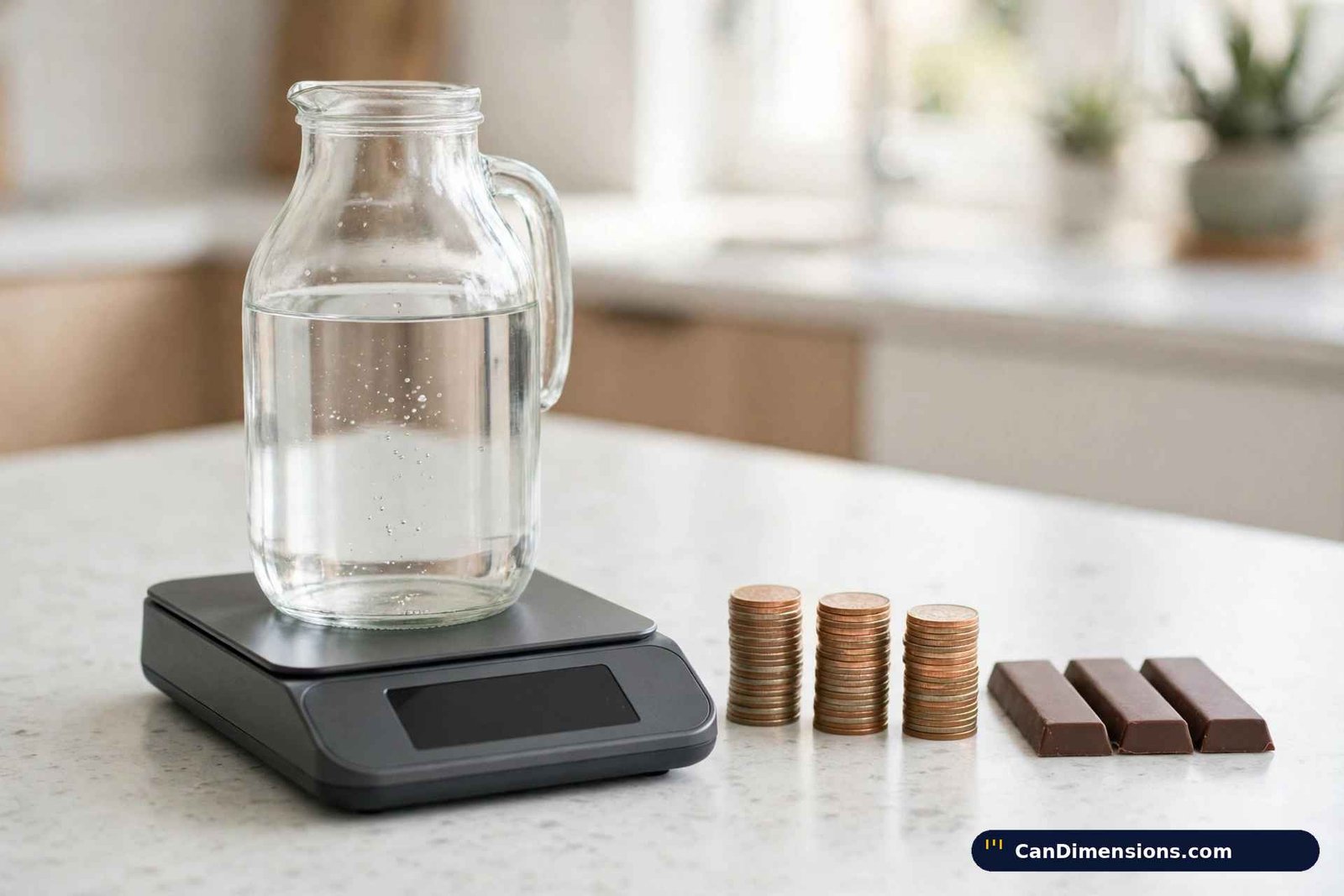
Most home cooks meet this weight at the counter, mid-recipe, with flour on their hands and a phone propped against the backsplash. The question behind the search — what weighs 300 grams — has its fastest honest answer in your own kitchen: it is the reading a scale settles on for a jug holding 300 millilitres of water, for three chocolate tablets from the baking cupboard, or for a modest stack of coins borrowed from the change jar.
This guide treats 300 grams as a cook’s weight rather than a classroom one. Every example below was chosen because it can be found, poured, stacked or bought near a kitchen, and every one earned its place through a check against whoever sets its weight: a mint, a rulebook, a food database, the firm that manufactures the item.
Five familiar names fail that check, and they remain in this guide labelled as failures: butter sticks, apples, the paperback, the cased phone and the portion of beef that only exists once a scale creates it. A list meant to help you trust your scale has to begin by retiring the references that would mislead it.
300 Grams on the Kitchen Scale: The Conversions Cooks Actually Use
A recipe that prints grams expects one fixed weight, and the conversions underneath it never change. In the units American recipes use, the weight reads 10.582 ounces, or 0.66139 pounds. The pound figure tempts a shortcut — call it two-thirds — but that fraction actually equals 302.4 grams, overshooting by a couple of grams: invisible in a stew, unwelcome in a bake weighed to the gram.
| Unit | 300 Grams Equals | Notes |
|---|---|---|
| Kilograms | 0.3 kg | The decimal form scales and apps display |
| Milligrams | 300,000 mg | 1 g = 1,000 mg |
| Pounds | 0.66139 lb | 1 lb = 453.592 g |
| Ounces | 10.582 oz | 1 oz = 28.3495 g |
| Stones | 0.0472 st | 1 st = 14 lb |
| Carats | 1,500 ct | 1 ct = 0.2 g |
| Grains | 4,630 gr | 1 gr ≈ 0.0648 g |
| Water volume | 300 ml | Water: one gram per millilitre |
Anyone converting a whole recipe back and forth will find the full grams to ounces table useful, because it runs the same fixed arithmetic across the weights cooks meet most. The neighbouring weights behave the same way: what weighs 100g covers the third-of-this-weight that nutrition labels favour, and how many pounds is 500 g applies the identical mint-and-label checking at the next size up.
How Heavy is 300 Grams?
On the counter, this weight feels like a filled ingredient bowl: present in the hand, never a strain. It falls in the gap whose lower edge, 227 grams, is half a pound, and whose upper edge, 340 grams, is the three-quarter-pound mark — nearer the top of that gap. Pick up a small tablet, a filled soup bowl or three chocolate tablets together and your hand already knows the territory.
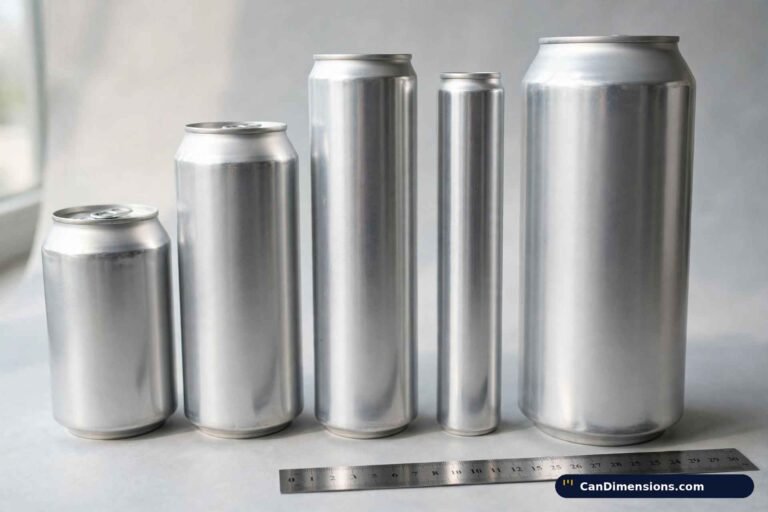
One comparison doing the rounds deserves to be dropped. A full 12-ounce soda can is sometimes described as lighter than this weight, and the direction is wrong: the drink inside alone runs to roughly 365 grams, with the aluminium still to add, putting a sealed can near 380 grams altogether. Three hundred grams is better pictured as that can after a long drink has been taken from it — or, staying in the kitchen, as a generous mug of soup with the mug itself left out of the reckoning.
Common Things That Weigh 300 Grams
Thirteen references survive checking, and the table below gathers them before the detail. Three come from the familiar household list this page rebuilds; ten more were added because each can be assembled on or near a kitchen counter and used to test a scale. The five failures keep their own sections further down, marked as misses, so nobody calibrates anything with them by accident.
| Example | Weight | Checked Against |
|---|---|---|
| Two standard baseballs | About 284–298 g | MLB Rule 3.01 (5–5.25 oz each) |
| A can of soup (condensed) | About 300 g | Labelled net weight (305 g / 298 g cans) |
| A standard tablet device (iPad mini) | About 293–297 g | Apple technical specifications |
| Sixty US nickels | Exactly 300 g | US Mint (5.000 g each) |
| One hundred twenty US pennies (post-1982) | Exactly 300 g | US Mint (2.500 g each) |
| Sixty British 20p coins | Exactly 300.0 g | The Royal Mint (5.0 g each) |
| Three hundred millilitres of water | Exactly 300 g | Water at one gram per millilitre |
| Three hundred US dollar bills | About 300 g | Bureau of Engraving and Printing (~1 g each) |
| A 300 g calibration weight | Exactly 300 g | Certified test weight (ASTM/OIML) |
| Sixty sheets of A4 paper (80 gsm) | About 299 g | ISO 216 size × rated grammage |
| A Nintendo Switch console | About 297 g | Nintendo official specifications |
| Thirteen AA alkaline batteries | About 299 g | Energizer E91 datasheet (23.0 g each) |
| Three 100 g chocolate bars | Exactly 300 g | Labelled net weight (100 g bars) |
Two Standard Baseballs
This one counts as an “about”, and its ceiling is stated openly. Rule 3.01 in the Major League Baseball rulebook confines an official ball to a band between 5 and 5.25 ounces, meaning 141.7 to 148.8 grams apiece. Double the heaviest legal ball and the pair reaches 297.7 grams; double the lightest and it falls to roughly 284. No lawful pairing crosses the target.
For a cook, the value here is calibration by hand rather than by kitchen. Two game balls cupped together give your grip a reference a few grams shy of the mark, close enough to judge a dough portion or a bag of rice at the market — provided you remember the shortfall instead of rounding it away.
A Can of Soup
The tin’s own label is the evidence here. Campbell’s condensed range carries its contents as a net weight: the long-standing 10.75-ounce size declares 305 grams, while the 10.5-ounce tins now common declare 298 grams. Either declaration lands close to the target, which is why a pantry shelf doubles as a rough reference library.
Read the declaration correctly, though. Net weight describes the soup and nothing else. Set the sealed tin on a scale and the steel wall adds its own grams above the printed number, so any list folding the container into the 305-to-310 range has merged two different measurements. The counted item here is the contents, exactly as labelled.
Three Sticks of Butter
A miss, and not a narrow one. American butter comes in quarter-pound sticks, 113 grams apiece, so a row of three totals close to 340 grams — overshooting by some forty grams. Bakers reaching for this shortcut would overweight every ingredient measured against it.
The useful figure runs the other way: 300 grams of butter means two complete sticks plus roughly two-thirds of another. Keep the single stick in mind as a 113-gram anchor for baking maths, and let the triple go.
Two Medium-Sized Apples
The same story, by a similar margin. FoodData Central at the USDA records a medium apple, three inches across, at 182 grams. A pair therefore lands near 364 grams — overshoot of more than a fifth. The often-quoted 150-gram apple belongs to the USDA’s small class at 149 grams, and a small apple cannot be renamed medium to rescue the arithmetic.
The weight takes roughly one and two-thirds of them. A lone medium apple remains a handy 180-gram guide for fruit bowls and lunchboxes; the pair does not belong on a list of 300-gram references.
A Standard Tablet Device
The count here rests on a named model, because tablet weights as a class scatter too widely to quote. Apple’s published specifications list the iPad mini in its sixth generation at 293 grams (Wi-Fi) and 297 grams (Wi-Fi + Cellular). The first mini, from 2012, weighed 308 grams in its Wi-Fi version, so the compact line has hovered near this weight for over a decade.
Full-sized tablets spoil the comparison, running roughly half as heavy again. The reference holds only at the small end of the range — happily, the size most likely to be propped beside a recipe. If a mini-format tablet lives in your kitchen, its specification page probably certifies it as a reference already sitting beside your recipes.
300 Grams of Ground Beef
The verdict is no count, for a reason worth understanding. Minced beef portioned to this weight is accurate by construction: the butcher, the packet or your own scale created the portion by weighing it. An object that cannot be recognised until it has been weighed cannot teach your hand, or check a scale, or settle an argument about any other food.
The amount itself still deserves a picture. It is 10.58 ounces of mince — enough for three modest patties or two thick ones, and a hearty single serving by ordinary guidance. It belongs to the cooking sections below, where portions are the subject, rather than to a list of references.
A Standard Paperback Book
Not counted, because no standard exists to check against. Nothing in publishing fixes the weight of a novel: page count, trim dimensions, paper stock and cover board each move the total, and books telling the same story can land anywhere from below 250 grams to beyond 350.
Individual copies near the target certainly sit on shelves everywhere. Until one named edition is weighed and quoted, though, “a paperback” names a category, not a reference — the cookbook on the counter earns its place by being read, not by being weighed against.
A Large Smartphone with Case
The verdict is no count — the second half of the object is unspecified. The handset half checks out readily enough: Apple quotes 221 grams for the iPhone 15 Pro Max, and the largest mainstream phones bunch between roughly 220 and 240 grams. Everything then depends on a case nobody named — slim shells add around 20 grams, armoured designs several times that, and no maker publishes a standard case weight to complete the sum.
A flagship wearing a heavy case can pass the target; the same phone in a slim shell stops near 245 grams. A total that changes with an accessory choice is not a reference, so the recipe-stand phone stays off the counted list.
Sixty US Nickels From the Change Jar
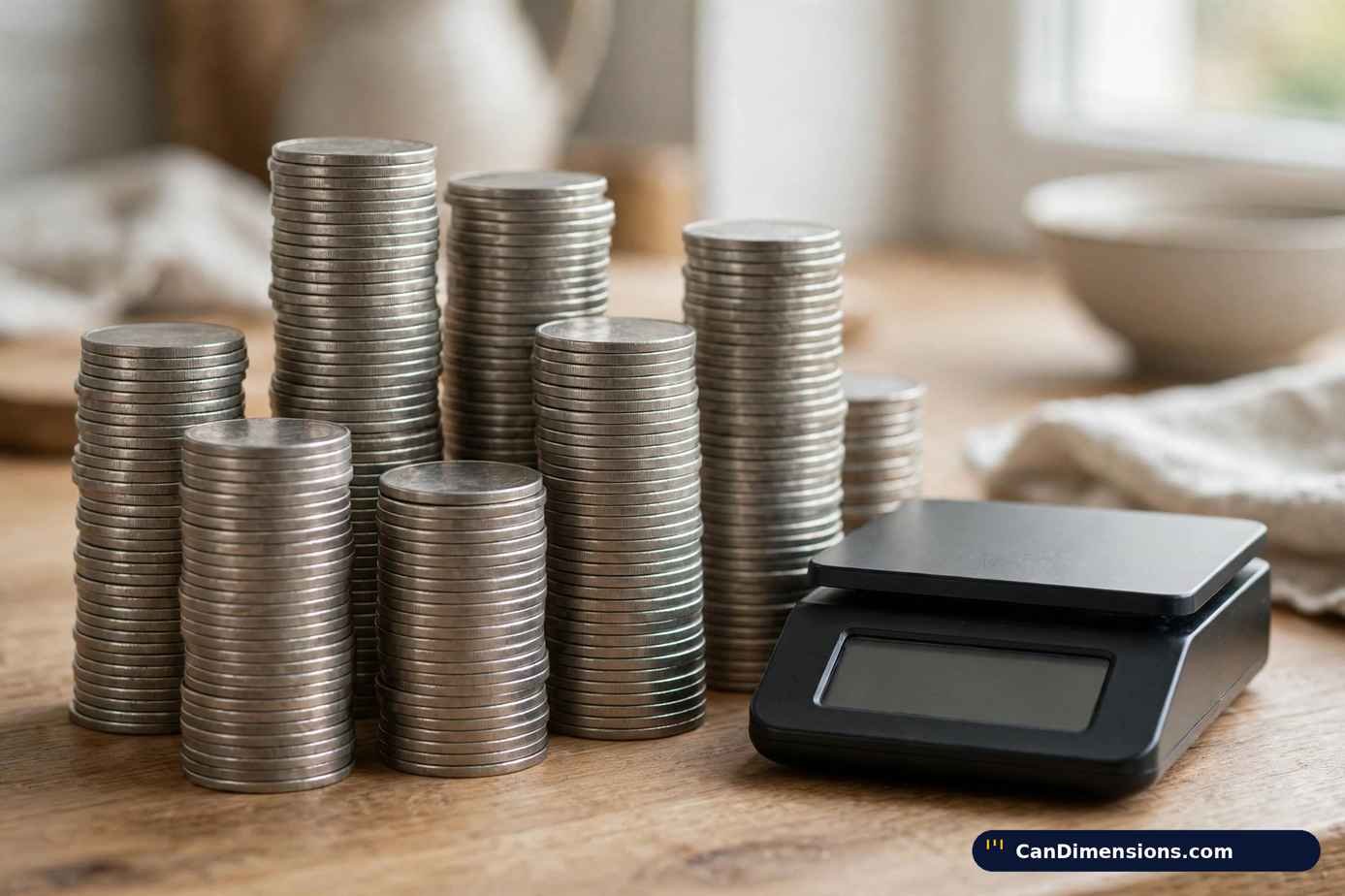
The cheapest precision instrument in the house costs three dollars in change. Every nickel leaves the United States Mint weighing 5.000 grams by specification — 75% copper, 25% nickel, a standard held since the denomination appeared in 1866 — so sixty stacked together total exactly 300 grams.
Mint figures are tolerances for manufacture, not estimates gathered afterwards, which is what makes coin stacks the classic home test. Count sixty nickels onto a kitchen scale: a healthy display reads 300, and a display reading anything else has just told you something worth knowing before the flour comes out.
One Hundred Twenty Pennies Dated After 1982
Cents work as well, provided the dates cooperate. Pennies struck from 1982 onward are zinc wearing a copper coat, specified by the Mint at 2.500 grams each; multiply by 120 and the pile is exactly 300 grams. Earlier cents are mostly copper at 3.11 grams apiece, and 120 of those would total roughly 373 grams instead.
Sort by date first, then count. A mixed jar is a small history of American coinage and a poor calibration tool; a sorted stack of modern cents is an exact one.
Sixty British 20p Coins
The seven-sided 20p piece is Britain’s counterpart to the nickel. Its Royal Mint specification: 5.0 grams, cupro-nickel, 21.4 millimetres across, issued in 1982. Sixty of them therefore weigh exactly 300.0 grams — twelve pounds in face value, assembled into a test weight.
Between the American sixty and the British sixty, most households on either side of the ocean can build a precise 300 grams from loose change alone, no purchase required.
Three Hundred Millilitres of Water From the Tap
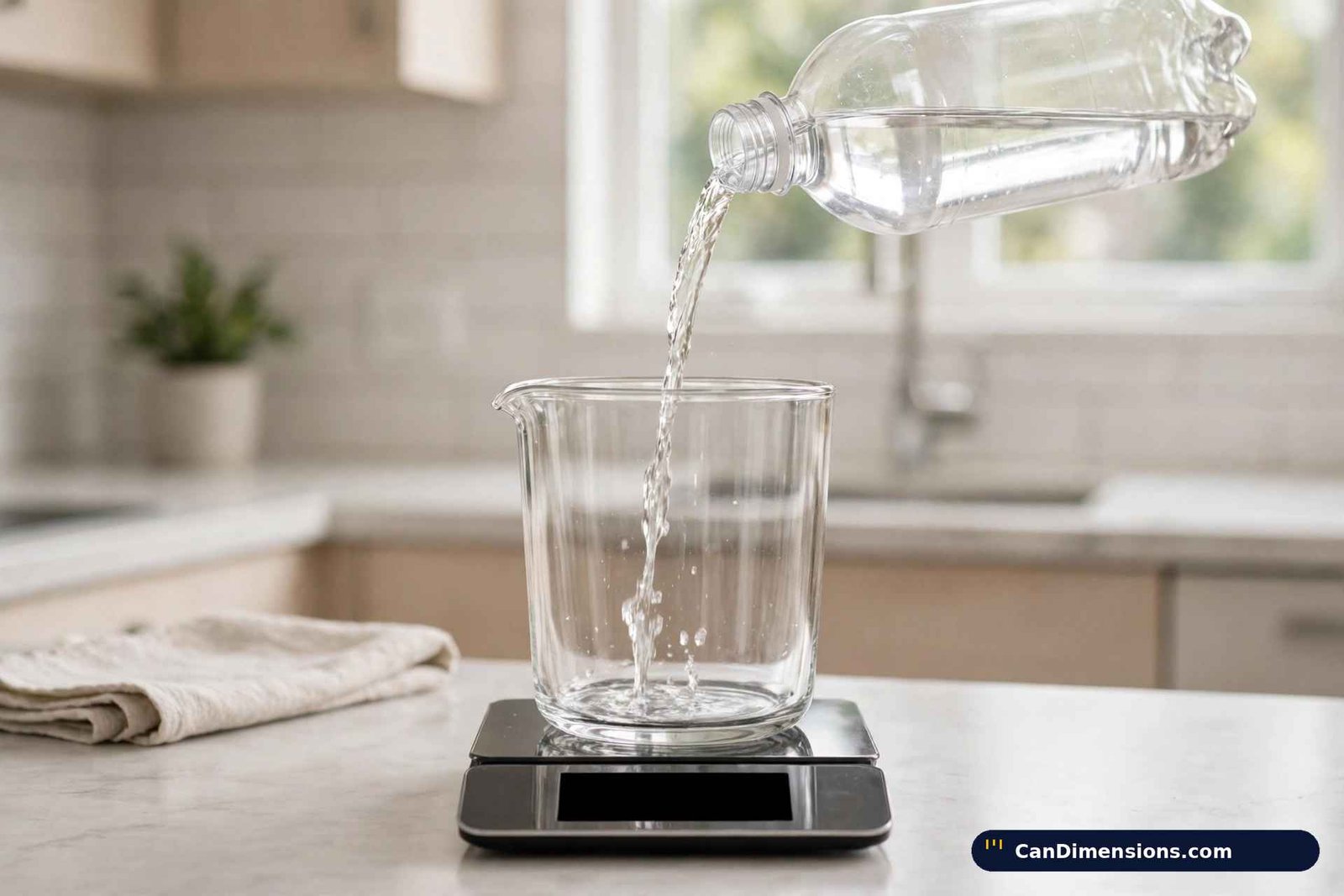
The reference every kitchen can produce on demand. Each millilitre of water weighs one gram, so a measured 300 millilitres is 300 grams outright — no brand, no batch variation, no tolerance band. Fill a jug to the 300 mark, set it in a tared bowl or straight on the pan, and the scale is being tested against a definition rather than a product.
Mind the container, as with any bottled reference. The water carries the weight; the jug, bottle or bowl adds grams of its own above that. Zero the empty vessel first and the tap becomes the most accurate supplier in the building.
Three Hundred US Dollar Bills
Banknotes join the list on an official “approximately”. The Bureau of Engraving and Printing (BEP) puts each note — one dollar or one hundred — at roughly a gram, since every denomination shares one cotton-linen stock (75% cotton, 25% linen). A bundle of 300 notes therefore weighs about 300 grams.
Treat it as a strong estimate rather than a specification. Worn notes pick up grime and lose fibres across their lives, so a circulated stack drifts a little; a fresh bundle sits close enough to expose a scale that is badly out.
A Test Weight Made for 300 g
The literal answer, made for exactly this job. Mettler Toledo, Ohaus and their peers manufacture certified test weights under ASTM and OIML classes, and the denomination ladder they sell from — 100, 200, 300, 500 grams — includes this size as a stock line.
For anyone who weighs coffee, dough or portions daily, one of these is the grown-up solution: inexpensive, effectively permanent, and able to settle any dispute with a drifting scale in the time it takes to set it on the pan.
Sixty Sheets of A4 Paper (80 gsm)
Printer paper hides its arithmetic in its name. The 80 gsm grade weighs 80 grams for each square metre; one A4 sheet covers 210 × 297 mm — 0.0624 square metres of area — so a single sheet works out near 4.99 grams, and sixty of them near 299 grams.
Since a ream packs 500 sheets, the reference is just the top sixty from a fresh packet — useful beside a desk, and close enough for any practical purpose away from laboratory work.
A Handheld Games Console With Its Controllers Off
Counted as an “about”, on the maker’s own numbers. Nintendo publishes the figure itself: approximately 297 grams for the Switch console — the screen unit — on its own. That solo unit is the object players hold on trains and sofas, and it sits three grams from the target.
Attach the two Joy-Con controllers and Nintendo’s figure climbs to approximately 398 grams, a third heavier again. The counted object is strictly the bare console; with controllers clicked in, it belongs to a different weight class entirely.
Thirteen AA Alkaline Batteries
The count rests on a datasheet here. Energizer’s E91 documentation puts one alkaline AA at typically 23.0 grams; thirteen of them come to about 299 grams. A remote-control drawer, in other words, quietly stores a near-perfect reference.
Chemistry decides whether the trick works. Lithium AAs weigh only around 15 grams each, and rechargeable nickel-metal hydride cells run heavier than alkalines, so a mixed drawer defeats the count. Thirteen alkaline cells from a major maker are the reference; check the labels before trusting the handful.
Three 100 g Chocolate Bars
Sweetest entry on the list, and an exact one. Europe’s standard chocolate tablet carries 100 grams on its label — the size Lindt, Ghirardelli and most rival makers all sell — and a label declaration is a legal claim, not an estimate. Three tablets therefore deliver exactly 300 grams of chocolate, with wrappers contributing a gram or two beyond it.
Check the label before counting, since American bars often run smaller. Where the 100-gram size is stocked, the test can be eaten afterwards, which no calibration weight has ever offered.
300 Grams for Quick Reference
Household Items Between 250 and 350 Grams
Neighbouring weights help when the target itself is not on the shelf. Below it, two builds are exact: fifty nickels make 250 grams on Mint figures, and a quarter litre of water makes the same. Above it, butter marks the line — three sticks, at 113 grams each, total roughly 340 grams. One comparison should leave the band entirely: a sealed soda can, all 12 fluid ounces plus its metal, comes to roughly 380 grams, beyond the band’s ceiling rather than inside it.
Checking a Kitchen Scale at Exactly 300 Grams
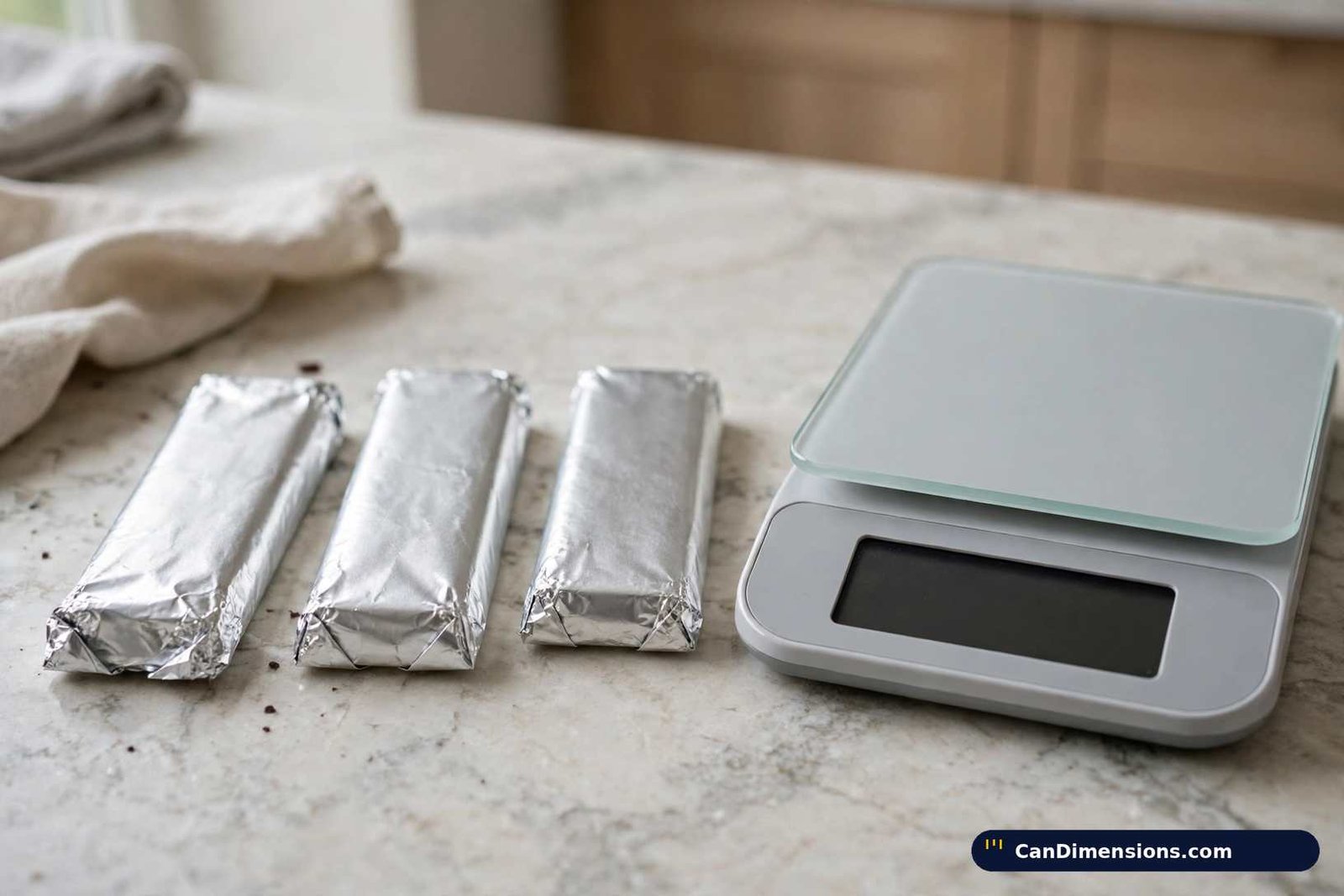
A scale earns trust by surviving known weights, and this target is unusually easy to stage. Begin with water: place an empty jug on the pan, zero it, pour to the 300-millilitre line, and read. Follow with metal: sixty nickels, or 120 modern pennies, counted slowly. Finish, if one is available, with a certified test weight. Three unrelated routes agreeing on one number leave little room for doubt.
Disagreement has a diagnosis order. Re-zero with nothing on the pan, move the scale to a flat and level stretch of counter away from a running appliance, then repeat the water test, since pouring is the easiest stage to repeat exactly. A display that misses by the same amount every time can be allowed for; one that wanders between repeats is asking to be replaced.
The same staging works at the bottom of the range: the guide to how much is 10 grams builds that weight from two nickels, and thirty such builds return you to 300 grams exactly; the guide to things that weigh 1 gram reaches it from the other end, three hundred items at a time.
300 Grams in Different Contexts
300 Grams of Food Portions
In portion terms, this is one large chicken breast. It also covers mince for two in a sauce, or raw meat for about three eaters at the usual 3-to-4-ounce serving size. Dry pasta: at the USDA serving of 2 ounces (56 grams), you get a little over five servings. Rice: roughly 1.6 cups before cooking, swelling to around 4.5–5 cups, enough as a side for four to six.
300 Grams in Shipping and Postage
At 10.582 ounces, a parcel of this weight stays in the cheapest domestic band, well short of the one-pound threshold. Names have changed around it — Ground Advantage took over from First-Class Package Service during 2023, the switch coming in July — while the band logic stayed put. Overseas, tariff steps often fall at a quarter kilo, half a kilo and one kilo, placing 300 grams in the second step; shaving fifty grams can move it down a step.
300 Grams in Fitness and Nutrition
Athletes weigh portions this size because estimation fails here first. Protein shows why: USDA data credits raw chicken with protein at 22.5 grams per hundred grams of meat, so a breast at this weight delivers roughly 68 grams — a training-day centrepiece, sized on purpose.
What 300 Grams Looks Like in a Recipe
Cups hide this weight differently in every ingredient, which is the whole argument for the scale. Granulated sugar is the heavyweight: about 200 grams fill one cup, so the target is a cup and a half. Flour is the lightweight: about 120 grams fill a cup, so the target stretches to two and a half cups — a difference no cook can judge by eye from across the counter. Rice sits between the two, at roughly 1.6 cups uncooked.
Dough work shows the practical payoff. A 300-gram flour base at 65% hydration calls for 195 grams of water, a figure a scale hits in seconds and a jug approximates badly. Weigh the bowl, zero it, add each ingredient in turn, and a recipe becomes repeatable — the second batch matching the first because both were built on numbers instead of impressions.
Kitchen Myths About 300 Grams, Checked
- “Two-thirds of a pound, exactly.” Not quite: the exact figure, 0.66139 lb, sits about two grams below that fraction’s 302.4 g.
- “Three sticks of butter make 300 grams.” At 113 g apiece the trio reaches roughly 340 g.
- “Two medium apples make 300 grams.” The USDA medium weighs 182 g, so the pair is nearer 364 g.
- “It is a touch heavier than a full soda can.” In truth the sealed can, drink plus metal, is the heavier object at roughly 380 g.
- “A paperback is a reliable stand-in.” None is standard: copies range widely, from below 250 g to beyond 350 g.
- “A full 300 ml bottle weighs exactly 300 grams.” Only the water does; the bottle’s own grams push the sealed total past the mark.
- “Two baseballs make exactly 300 grams.” Rule 3.01 caps a ball at 148.8 g, so even the heaviest pair stops at 297.7 g.
Question’s
What weighs 300 grams?
Water and coins give the exact routes: 300 ml of water; sixty nickels (Mint specification, 5.000 g apiece); three chocolate bars of 100 g each. Close behind: thirteen alkaline AAs at about 299 g, a Switch console at 297 g, two baseballs topping out near 298 g.
Which animal weighs 300kg?
Kilograms are a different world: 300 kg is 661 lb. Animals up there include a big male grizzly, a large Siberian tiger, or a pony.
What household items weigh 200 grams?
Two exact builds: forty nickels, or 200 ml of water in a tared jug. At 7.05 ounces it runs about a third below the 300-gram mark, a gap your hand notices at once.
How much is 300 grams of food?
Volume answers change with the ingredient. Flour: roughly two and a half cups. Sugar: one and a half. Rice, uncooked: about 1.6 cups. As meat, think one large breast, or three ordinary portions.
Is 300 grams of chicken a lot?
For a single diner, yes. It is 10.58 ounces — close to triple the usual 3-to-4-ounce serving — and raw, skinless, it brings roughly 68 grams of protein, since the USDA credits 22.5 grams in each 100 grams raw. Split it, and it suits two moderate appetites.
What do 300 grams of sugar look like?
Picture a measuring cup filled, then filled halfway once more: granulated sugar runs about 200 grams per cup, so the heap totals one and a half cups — a modest pile in a mixing bowl.
What is an example of a 300 GSM?
GSM is short for grams per square metre, a way of grading paper and cloth by area rather than objects by weight. At 300 gsm you are holding stiff card — the sort used for premium postcards, wedding invitations and business cards.
What household item weighs exactly 500 grams?
Go exact with coins or water: a hundred nickels, or half a litre of water weighed in a jug you zeroed first. A sealed 500 ml bottle overshoots slightly, because the plastic weighs something too.
Is 300g of meat a lot?
By restaurant standards, yes: steaks there usually run six to eight ounces, and this is 10.58. One hungry eater can manage it; two can share it comfortably.
Conclusion
A kitchen scale stops being a gadget and becomes an instrument the day its readings can be checked, and this weight is the easiest check on its whole range: water poured to a line, coins counted from a jar, chocolate weighed before it is eaten. Each route was verified against the authority that sets the figure — a mint, a manufacturer, a rulebook, a food database — rather than repeated from another list.
Keep the failures in mind alongside the references: butter sticks that overshoot, apples that outweigh their reputation, a bottle whose plastic quietly joins the reading. And when the last ingredient has been weighed and the bowl lifted away, remember that every one of those readings began with a cook setting a measuring cup aside and trusting the scale instead — the habit that makes 300 grams, and every other weight in a recipe, come out the same way twice.