17 Things That Weigh 1 Gram: Kitchen, Pharmacy and Jewellery Measures
Most lists of things that weigh 1 gram stop at whatever happens to be lying on a desk. This page starts where a gram is actually earned: the baker’s bench, the pharmacist’s counter and the jeweller’s scale, the three workplaces where a single gram is measured on purpose, every working day, and where getting it wrong has a taste, a dose or a price attached.
That professional lens changes which examples deserve trust. A gram here is a sixth of a teaspoon of salt, twenty drops from a medicine dropper, a stone of five carats – quantities with a specification, a label or a maker’s chart behind them, not folklore repeated from list to list.
Seventeen examples below pass that test, each one traced to a mint, a manufacturer, a food database or a standards body. Nine famous candidates fail it, and their sections remain, corrected in place – because in precision work, knowing that a grape is five grams is worth as much as knowing what one gram is.
How Heavy is 1 Gram?
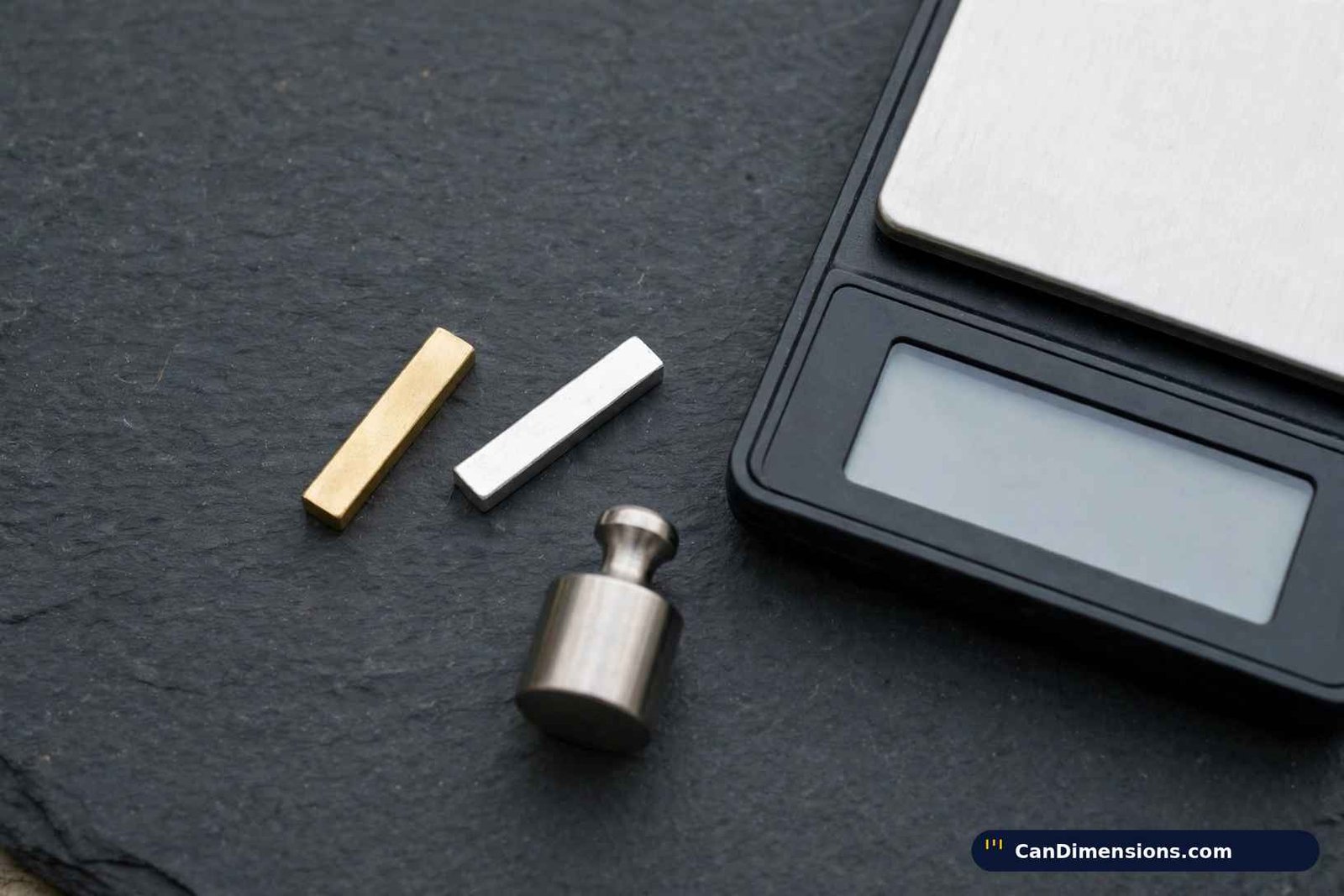
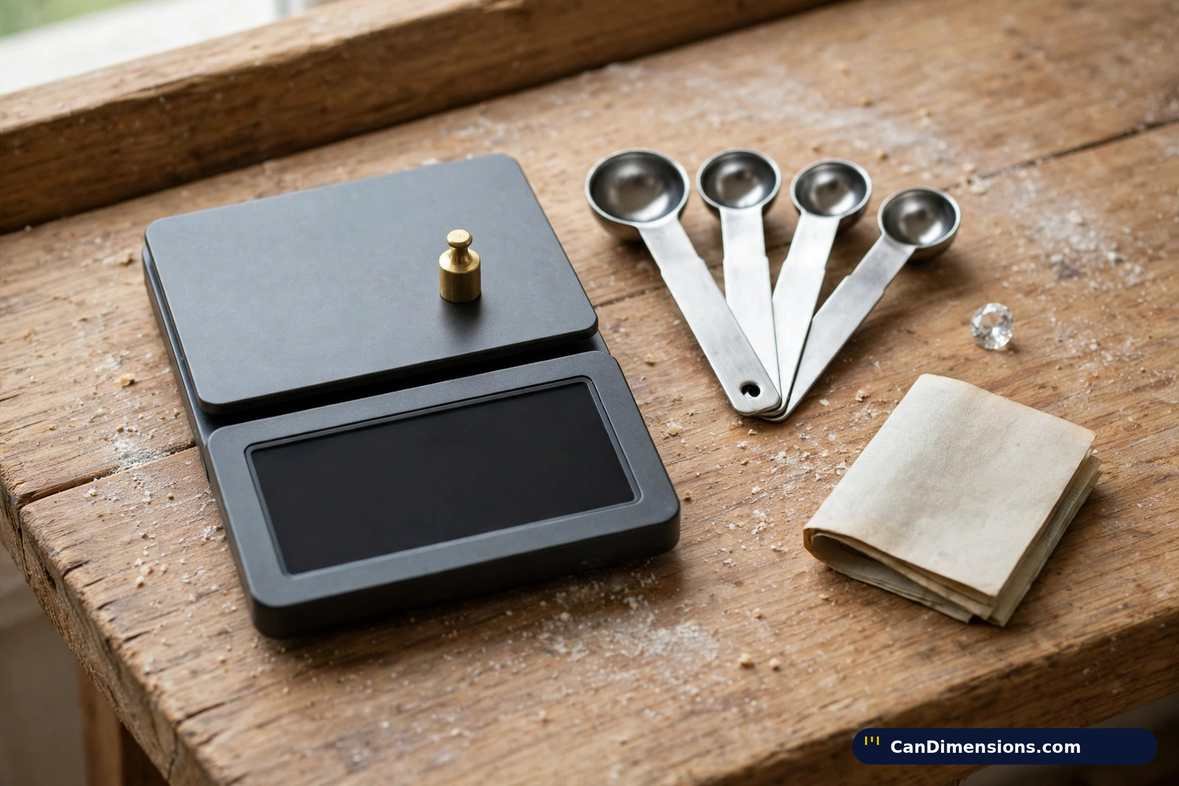
Picture the smallest brass weight in a calibration kit, the little knobbed cylinder that sits at the far end of the row. That is the weight under discussion: one-thousandth of a kilogram, 0.0353 ounces, roughly one twenty-eighth of a single ounce. On an open palm it registers as presence rather than pressure — you sense that something is there, and that is nearly all you sense.
Hands are poor instruments at this scale, which is why the trades that live here never rely on them. Bakers weigh yeast to the gram because a spoon can miss by half; pharmacists count in milligrams because a dose error is measured in them; jewellers certify their scales against test weights because money follows the decimal point. The gram is the largest unit all three still treat as small.
Stepping up helps calibrate the sense of scale. Stack ten of them together and you reach the subject of how much is 10 grams, and a hundred of them fill a small kitchen bowl — but the single gram remains the unit where estimation ends and measurement begins.
1 Gram is Equal to:
- 1 gram = 1,000 milligrams (the pharmacist’s working unit)
- 1 gram = 0.0353 ounces (the baker’s conversion)
- 1 gram = 0.0022 pounds (general weight)
- 1 gram = 1 millilitre of water (exact, by the metric system’s design)
- 1 gram = 5 carats (the jeweller’s conversion)
Each line serves a different counter. Milligrams rule the pharmacy, where doses are prescribed in them. Carats rule the gem trade, where one carat is fixed at exactly 0.2 grams. The ounce line is the one home cooks reach for, and our full grams to ounces converter carries the ladder far beyond this single rung.
A Gram in Teaspoons: The Baker’s Micro-Measures
A teaspoon holds volume, not weight, so a gram looks different in every ingredient jar. United States Department of Agriculture figures give a level teaspoon of granulated sugar as 4.2 grams and a level teaspoon of fine table salt as 6 grams. Divide each by its own total and the gram emerges as kitchen fractions: a quarter-teaspoon of sugar, a sixth of a teaspoon of salt.
Yeast runs lighter still. The standard packet sold by Red Star and Fleischmann’s holds 7 grams in two and a quarter teaspoons, putting one level teaspoon at about 3.1 grams — so a third of a teaspoon lands on a gram, the quantity that leavens a small slow-rise loaf. Flour sits at the far end: spooned all-purpose flour weighs about 120 grams per cup, which makes a gram of flour a scant half-teaspoon, little more than a dusting across the spoon.
These fractions explain the baker’s loyalty to the scale. A heaped spoon of salt can carry twice the salt of a level one, and at the one-gram end of a recipe that error is the whole measurement. The counted examples further down include the three spoon measures that survive scrutiny — sugar, yeast and salt — each printed with its source figure.
Common Items That Weigh 1 Gram
The table collects the seventeen verified examples argued in the sections that follow it. Read the basis column before trusting any row: exact entries rest on a specification or a definition, label entries on a manufacturer’s printed serving, and derived entries on arithmetic from a published figure, stated openly where it is used.
| Example | Weight | Basis |
|---|---|---|
| A US dollar bill | About 1 g | Bureau of Engraving and Printing |
| A standard paperclip | About 1 g | Reference value; no maker specification exists |
| A Japanese 1 yen coin | Exactly 1.0 g | Japan Mint specification |
| A sweetener packet | Exactly 1 g | USDA data / maker specification sheet |
| 1 millilitre of water | Exactly 1 g | Definition of the metric system |
| A 1 gram gold bar | Exactly 1 g | Refiner’s minted specification |
| A 1 gram silver bar | Exactly 1 g | Refiner’s minted specification |
| A five-carat gemstone | Exactly 1 g | Metric carat fixed at 0.2 g (GIA) |
| A 1 gram calibration weight | Exactly 1 g | Certified test weight, ASTM/OIML classes |
| One-fifth of a sheet of A4 paper | 0.998 g | ISO 216 area x 80 gsm grammage |
| A quarter-teaspoon of granulated sugar | About 1.05 g | USDA: 1 tsp sugar = 4.2 g |
| A third of a teaspoon of instant yeast | About 1.03 g | Maker packet: 7 g per 2 1/4 tsp |
| A sixth of a teaspoon of table salt | About 1.0 g | USDA: 1 tsp table salt = 6 g |
| Twenty drops of water | About 1 g | Pharmacy standard drop, 0.05 ml |
| Two raisins | About 1 g | USDA: one raisin about 0.5 g |
| A single shelled peanut | About 1 g | USDA FoodData Central portions |
| Two Tic Tac mints | 0.98 g | Ferrero label: 0.49 g per mint |
A US Dollar Bill
Counted: — as an approximate gram, on the issuing authority’s own wording. The Bureau of Engraving and Printing states that a United States banknote weighs about one gram, and the bureau prints every denomination on identical cotton-linen stock, at an identical size, so a five and a fifty make identical references. Humidity and wear nudge an old note slightly, which is why the honest word is “about.”
For a bench worker the bill has a second use: it is also a ruler. The note’s official footprint is set out in our dollar bill dimensions — one pocket object that anchors both a gram and six inches.
A Standard Paperclip
Counted: — as an approximate gram, with the caveat printed rather than buried. No clip manufacturer publishes a weight for a single clip; reference works settle on roughly a gram for the standard Gem pattern, the size about an inch and three-eighths long that fills office drawers. That consensus, repeated across textbooks, is the entire evidence base.
Size discipline matters here. The jumbo pattern runs to one and a half or two grams, and the miniature pattern drops to about half a gram, so the reference only holds for the middle size — check the clip against a known gram once before trusting it as a bench standard.
A Single Raisin
Not counted: — the fruit is a half-gram wearing a gram’s reputation. United States Department of Agriculture portion data values one raisin at roughly half a gram, so the single fruit misses the mark by a factor of two. The myth survives on serving arithmetic: an ounce of raisins holds dozens of fruits, and dividing loosely makes each one look heavier than it is.
The correction has a useful edge, though. Double the fruit and the gram arrives — the pair is counted as its own entry further down this list.
A Thumbtack or Push Pin
Not counted: — lighter than its legend by more than half. No maker publishes a weight for these, and the one careful weighing in print, from a school science text, put forty metal drawing pins at 17.55 grams in total. Divided out, each pin carries about 0.44 grams. Plastic-headed pins scatter around that figure rather than above it.
File the thumbtack beside the raisin: a half-gram reference, handy for halves, useless for wholes.
A Piece of Chewing Gum
Not counted: — a stick of gum overshoots the gram nearly threefold. Wrigley’s printed label for its Extra brand gives one stick at 2.7 grams, and the pellet formats come in around 1.4 grams apiece. Neither format supports the one-stick-one-gram slogan, however often it is repeated.
Gum feels weightless in the hand, and that feeling is the whole source of the error. The hand is exactly the instrument this page keeps warning against.
A Pen Cap from a Ball Pen
Not counted: — unverifiable, which in precision work means unusable. No pen manufacturer publishes the weight of a cap on its own, and caps differ enough between models that no single figure could stand for the class. A claim without a source is a guess, and guesses do not get counted here.
One true fact does attach to the object: the vent hole in a ballpoint cap is a safety feature, required so that a swallowed cap cannot seal the airway completely. It is a good story about design. It is not a weight.
A Pinch of Salt
Not counted: — a pinch is a defined measure, and its definition convicts it. Cooks’ references fix a pinch at one-sixteenth of a teaspoon; fine table salt weighs six grams to the level teaspoon on USDA figures, so a pinch delivers about 0.36 grams — barely a third of the claimed gram. Nearly three pinches are needed to build one.
Seasoning forgives that error, which is why the pinch survives in kitchens. Measurement does not forgive it, and the salt entry that does count — the sixth of a teaspoon — appears further down.
A Small Birthday Candle
Not counted: — the closest miss on the page, and still a miss. Wilton’s standard pack of twenty-four slim candles, two and a half inches long, carries a listed total weight of 1.12 ounces including its packaging. Strip the packaging away and each candle lands somewhere near 1 to 1.3 grams — near the gram, probably over it, and impossible to certify from the published figures.
A reference that cannot be certified is a decoration. The candle stays a celebration item, not a standard.
A Single Grape
Not counted: — the largest error in the standard lists. United States Department of Agriculture FoodData Central entry 174683 records ten seedless grapes at 49 grams, which is about 4.9 grams for each fruit — five times the weight claimed for it. Even the smallest table grapes run near three grams.
The confusion probably starts with the grape’s dried form. A raisin is roughly a tenth of its parent fruit’s weight, and somewhere in the retelling the fresh grape inherited the dried one’s numbers.
A Japanese 1 Yen Coin
Counted: — an exact gram, struck on purpose. The Japan Mint’s published specification gives this coin at exactly 1.0 gram: pure aluminium, twenty millimetres across, in production since 1955, and deliberately the lightest coin in regular circulation anywhere.
Its party trick follows from the physics. Set the coin down gently on still water and surface tension can hold it afloat, a demonstration no heavier coin can copy. Among everyday objects, nothing else matches it as a portable, exact, pocketable gram.
A Sugar Packet
Not counted: — the white packet fails, and the failure is a matter of record. Domino’s foodservice specification lists its sugar packet at 2.83 grams, and the same company’s retail packets hold 3.5 grams. A quarter of either packet therefore delivers between 0.7 and 0.9 grams — close to the target, never exactly on it, and not the tidy four-gram packet of the usual telling.
The coffee station does hold an exact gram, one packet over. It is the sweetener packet, counted next among the added examples.
A Plastic Bottle Cap
Not counted: — roughly double the claimed weight across the whole industry. Packaging figures for the standard 28 millimetre closure put it between about 1.75 and 2.45 grams; the lightest mainstream design, developed by a Coca-Cola bottler with SCGC, reaches only 1.75 grams, and Closure Systems International markets its ultra-light version as merely under two grams.
Hollowness misleads the hand here. A cap feels like nothing because it is mostly air, but the plastic in its walls adds up to two paperclips, not one.
A Sweetener Packet
Counted: — exactly one gram, twice sourced. United States Department of Agriculture data, entry SR 19868, lists a packet of saccharin-based sweetener at exactly one gram, and Splenda’s foodservice specification sheet prints the same figure for its own packets. Sweet’N Low packets match the weight as well.
This is the packet the sugar myth was always reaching for. The pink, blue and yellow packets at the coffee station are manufactured gram standards hiding in plain sight.
One Millilitre of Water
Counted: — exactly one gram: a truth of definition, not of manufacturing. The metric system was constructed around water: a millilitre of it weighs one gram at its densest, and 0.998 grams at room temperature, a gap no kitchen or bench will ever register.
The practical consequence deserves emphasis. Any syringe, dropper or dosing cup marked in millilitres is a gram scale for water — fill it to the one-millilitre line and the contents weigh a gram, no balance required.
A 1 Gram Gold Bar
Counted: — exactly one gram of .9999 fine gold, minted to order. Refiners such as PAMP Suisse strike a bar at this weight measuring 22.1 by 13.5 millimetres — barely larger than a postage stamp, since gold is nearly twenty times as dense as water.
It is the costliest gram on this page by an enormous margin, and the clearest demonstration available that mass and volume are strangers. The same weight of water would fill a thimble; the gold barely covers a fingernail.
A 1 Gram Silver Bar
Counted: — exactly one gram, the base rung of a second minted ladder. The same refiners who strike one-gram gold bars strike one-gram silver bars to the same certified nominal weight, sold in assay cards that guarantee the figure; PAMP’s silver range begins at this size, the smallest the house offers.
Silver’s lower density makes the comparison instructive: a gram of silver spreads noticeably larger than a gram of gold while weighing precisely the same. Two bars, one weight, two sizes — the density lesson in metal form.
A Five-Carat Gemstone
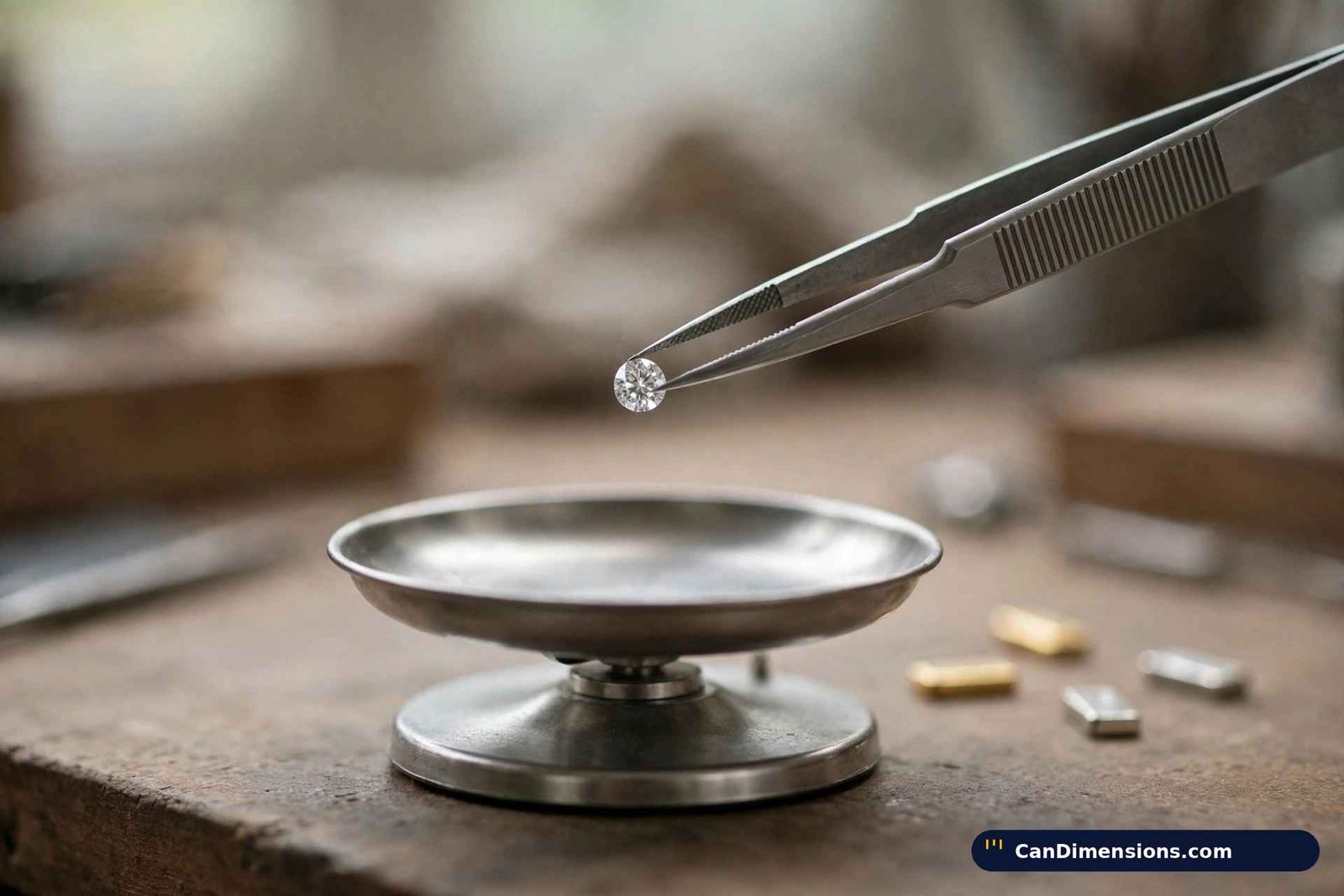
Counted: — exactly one gram, by an international definition. The Gemological Institute of America states the metric carat as 200 milligrams, a standard fixed in the early twentieth century and now identical worldwide. Five carats multiplied by 0.2 grams gives one gram with no rounding anywhere in the chain.
Jewellers weigh stones to the hundredth of a carat, so this is the most precisely knowable gram outside a laboratory. A five-carat stone is also where the arithmetic turns elegant: the gem trade’s unit and the metric system meet at a whole number.
A 1 Gram Calibration Weight
Counted: — exactly one gram, and the referee for every other entry here. Certified test weights are manufactured at a nominal one gram and graded under the ASTM and OIML class systems, then used to prove that jewellers’ and laboratories’ scales are reading honestly.
Every approximate example on this page is, in the end, an attempt to stand in for this object. If a scale and a certified gram disagree, the scale is the one that gets adjusted — that asymmetry is what makes the little cylinder a standard rather than a sample.
One-Fifth of a Sheet of A4 Paper
Counted: — 0.998 grams, derived from two published figures. The ISO 216 standard fixes A4 at 0.06237 square metres; standard office stock is rated at 80 grams per square metre; multiply the two and a full sheet weighs 4.99 grams, so a fifth of the sheet weighs a hair under a gram.
American Letter stock at the common twenty-pound bond weight lands in the same place, at about four and a half grams a sheet. Paper is the cheapest gram in the building — one tear and it is in your hand.
A Quarter-Teaspoon of Granulated Sugar
Counted: — about 1.05 grams, the friendliest spoon measure in baking. The USDA figure behind it is a level teaspoon of granulated sugar at 4.2 grams; a quarter of that spoon is a gram and a twentieth more, close enough that no recipe on earth could taste the difference.
Level is the operative word. A heaped quarter-teaspoon can hold close to double, which is why bakers scrape the spoon flat with a knife back — a two-second habit that protects every small measure on this page.
A Third of a Teaspoon of Instant Yeast
Counted: — about 1.03 grams, the new entry the baker’s angle earns. Red Star and Fleischmann’s both sell the standard yeast packet as 7 grams occupying two and a quarter teaspoons; dividing gives about 3.1 grams per level teaspoon, and a third of a teaspoon therefore sits a whisker over one gram.
Slow-rise and small-batch recipes genuinely call for quantities this size, which makes the fraction more than a curiosity. It is also the entry that most punishes guessing: a whole extra gram of yeast in a small dough is a third more leavening than the recipe asked for.
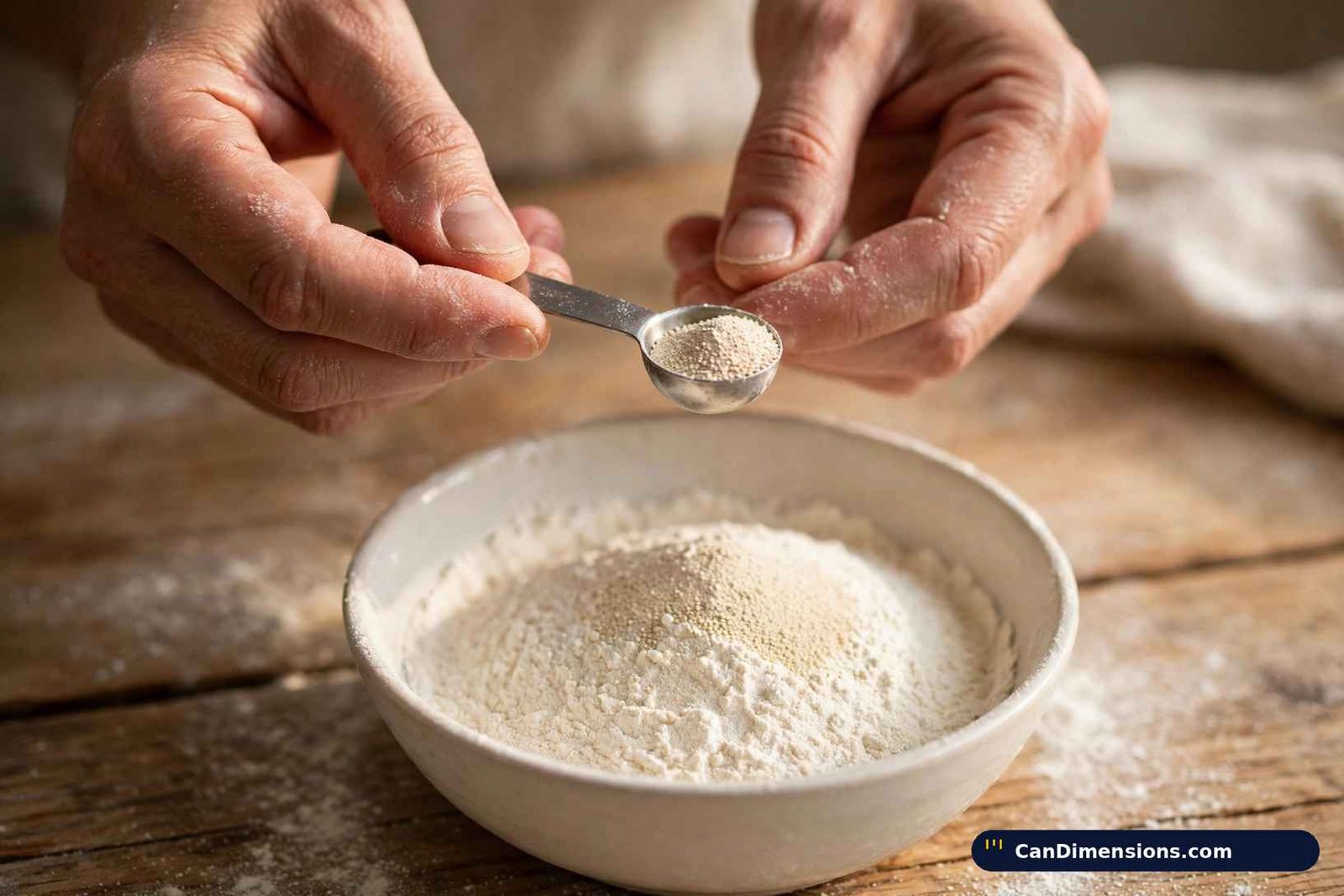
A Sixth of a Teaspoon of Table Salt
Counted: — about 1.0 gram, from the USDA’s own spoon weighing. FoodData Central entry 173468 records a level teaspoon of table salt at 6 grams, so one-sixth of the spoon is one gram almost exactly. Fractional spoon sets are sold down to a sixteenth of a teaspoon precisely because measures like this one recur in baking.
Crystal size is the trap. Flaky kosher salts pack far more loosely than fine table salt and can halve the weight in the same spoon, so this entry belongs to fine table salt alone — the form the USDA weighed.
Twenty Drops of Water
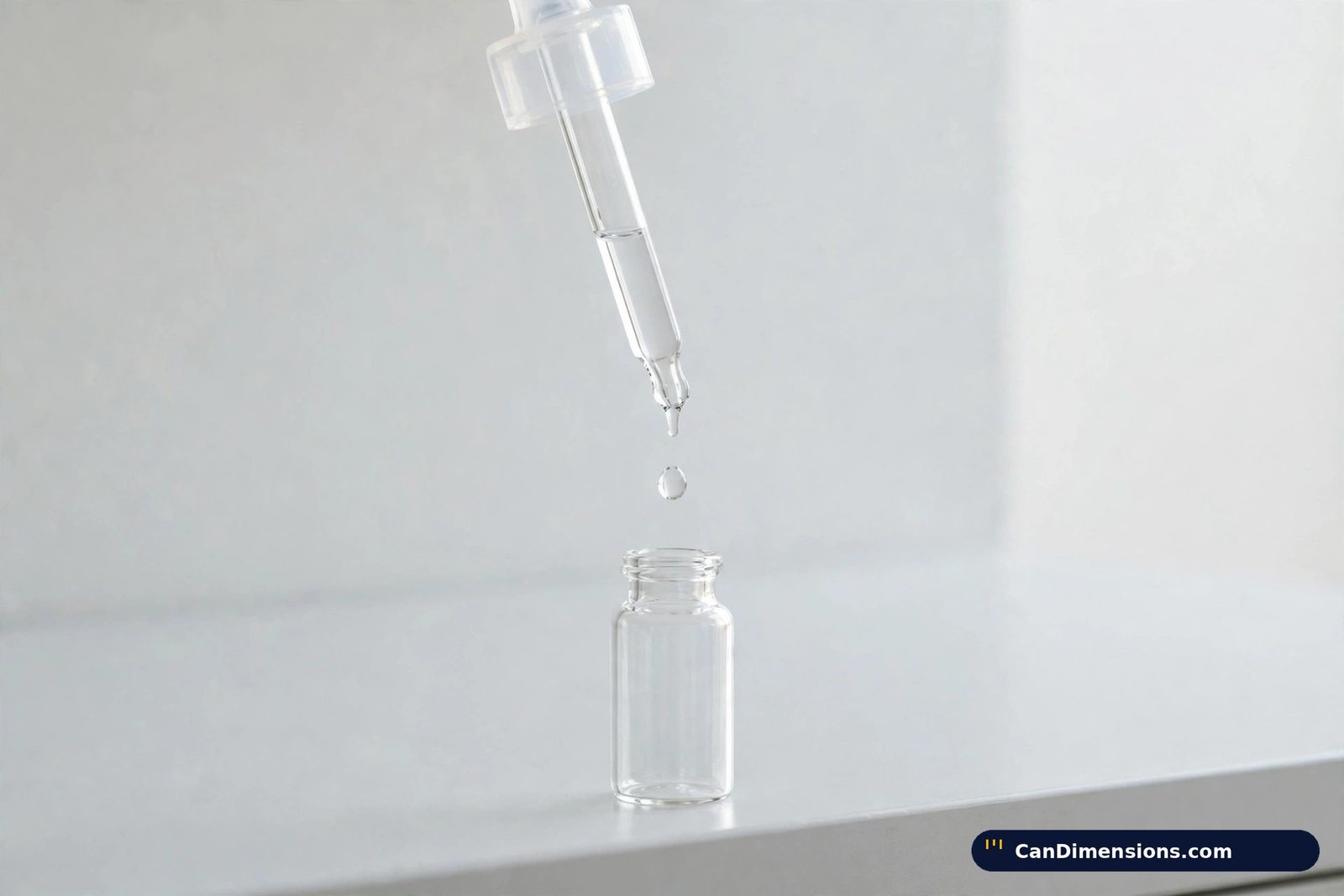
Counted: — about one gram, on the pharmacy’s standard drop. Dispensing practice fixes a standard drop at 0.05 millilitres from a calibrated medicine dropper, which makes twenty drops one millilitre — and one millilitre of water is one gram. Pharmacists still abbreviate drops as gtt, from the Latin gutta, when they write the measure.
Honesty about the convention matters: drop size follows the dropper and the liquid, real counts range roughly from fifteen to twenty-five drops per millilitre, and European pharmacopoeia droppers are standardised smaller still. Counted as the standard-drop figure it is — an approximation with a published basis, not a law of nature.
Two Raisins
Counted: — about one gram, built from the correction printed earlier. If a single raisin carries roughly half a gram on USDA portion data, then two average raisins carry a gram between them. The pair is the honest form of the internet’s favourite false example.
Raisins vary by variety and by drying, so treat the pair the way you would treat the paperclip: a serviceable pocket reference, checked once against a real scale if the work matters.
A Single Shelled Peanut
Counted: — about one gram per nut on USDA FoodData Central portion data for shelled peanuts. Ten nuts from the bag make a rough ten grams, which turns a handful into a surprisingly decent scale check for a home bench.
The shell changes everything, roughly doubling the weight, so the reference only works on the nut itself. Salted, roasted or raw makes no measurable difference at this size; the shell is the variable that counts.
Two Tic Tac Mints
Counted: — 0.98 grams, from the maker’s own label arithmetic. Ferrero prints one mint as a 0.49-gram serving, so a pair of mints falls two-hundredths of a gram short of the target — inside any tolerance a pocket reference could ask for.
A single mint doubles as a half-gram standard, and the whole flip-top box is a pocket set of matched weights. Of every candy on the usual lists, this is the one whose label actually supports the claim made for it.
The Jeweller’s Gram: Carats, Grains and Minted Metal
The gem trade runs on a unit older than the metric system and now welded to it. The metric carat was fixed at exactly 200 milligrams in the early twentieth century, which is why the five-carat stone above lands on the gram without a remainder. Before that standard, a carat’s weight drifted from city to city, and a stone could gain or lose value by crossing a border.
Reloaders and pharmacists keep the older unit alive: the grain, fixed at 64.79891 milligrams, making one gram equal to roughly 15.43 grains. Gunpowder charges and some medicine doses are still written in grains, and the conversion is exact even though the unit is ancient. Both trades check their balances against the same certified weights the baker uses.
Minted metal closes the section. A refiner’s ladder runs from the one-gram bars counted above up through five, ten and a hundred grams, each step certified on an assay card. Hold the whole ladder in mind and the scale of the subject snaps into focus — our guide to what weighs 100 grams takes up the story at the ladder’s upper end.
How to Estimate 1 Gram Without a Scale
The Paperclip Method
Keep one standard clip taped inside the scale’s lid, or loose in the drawer where small weighing happens. Rest it on your palm until its faint pressure is familiar, then set the unknown item beside the memory of it. The method sharpens quickly with practice and is honest to about half a gram — plenty for portions and postage, not enough for yeast.
Guard the reference’s identity. The clip only works while it stays the standard Gem size; a jumbo clip swapped into the drawer silently raises your standard by half again.
Currency Comparison
For American readers the wallet is the kit. Every denomination of banknote weighs about a gram on the Bureau of Engraving and Printing’s figure, so the reference is already carried. Abroad, the Japanese one-yen piece improves on it: an exact gram, struck to specification, small enough to live in a coin pocket permanently.
Match the reference to the object’s shape. Flat, papery items compare well against a bill; dense, small items compare better against coin multiples — two post-1982 pennies make five grams exactly, by mint specification.
The Water Volume Method
The laboratory method, and the most accurate of the three. Fill an oral syringe to its one-millilitre mark and the contents weigh a gram; a sealed millilitre in a small vial becomes a permanent pocket standard that no drawer accident can recalibrate.
Scale owners get a bonus: the same trick audits the instrument. Ten millilitres of water on the pan must read ten grams. If it does not, the scale — not the water — is wrong, and the calibration weight counted above is the tool that settles the argument.
Drops and Doses: The Pharmacy Gram
Pharmacy is where the gram stops being a curiosity and becomes a safety margin. Doses are prescribed in milligrams — a thousand of them to the gram — and for potent medicines a tenth of a gram can separate a proper dose from a dangerous one. That is why the profession thinks downward from the gram rather than upward from the milligram.
The drop standard counted earlier belongs to this world. A calibrated dropper’s 0.05-millilitre drop lets a pharmacist turn a gram of a water-based liquid into twenty countable units, and the same convention sizes the droppers packed with liquid medicines. Where the dose truly matters, the profession abandons drops for the oral syringe — millilitre markings, gram equivalents, no convention in between.
Sweeteners close the loop between pharmacy and kitchen. The one-gram packet counted above exists because a dose of intense sweetener is tiny; the packet is a pharmaceutical idea wearing a café costume, a pre-measured gram portion designed to be opened, not weighed.
Checking a Pocket Scale: The One-Gram Ritual
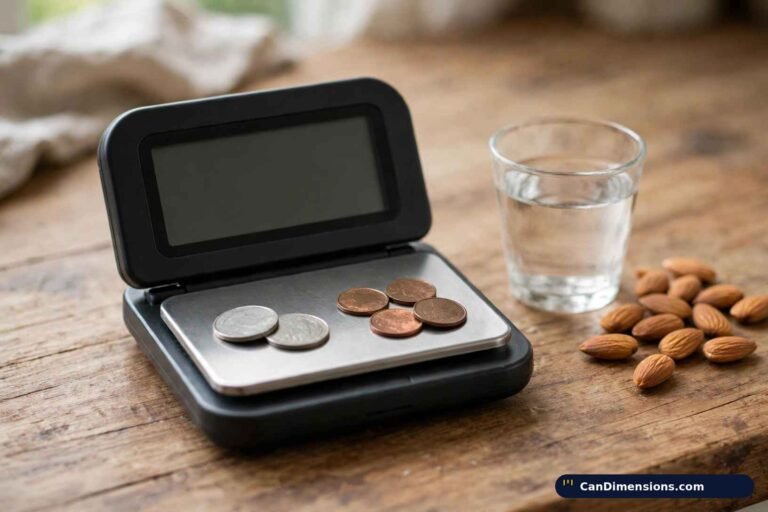
Precision workers share a morning habit: before trusting a small scale, they prove it. A certified one-gram weight goes on the pan first. Then the ladder climbs — five, ten, twenty grams — because a scale can be honest at one point of its range and lazy at another, and only a ladder of known weights exposes the lazy stretch.
Coins serve as the field version of the same ritual. Mint specifications are public and exact — the post-1982 cent at 2.500 grams, the nickel at 5.000, the quarter at 5.670 — so two cents plus a nickel will audit the ten-gram point of any scale in the house.
The ladder’s top end matters to bakers and reloaders alike, who work in the hundreds of grams as readily as in single ones. Our guide to how many pounds is 500 grams covers that far anchor — the weight a full calibration set is ultimately checked against.
Question’s
What weighs exactly 1 gram?
By specification: the Japanese 1 yen coin, a certified 1 g calibration weight, minted 1 g gold and silver bars, and a five-carat gemstone. The sweetener packet matches them, at exactly a gram on its maker’s label.
What is an example of a gram?
The desk-drawer standard is the paperclip, at about a gram; a banknote, a millilitre of water or a pair of Tic Tacs do the same job.
How much does 1 gram look like?
Density decides the look. One gram is a five-carat stone, a 22 mm gold bar, a sixth of a teaspoon of salt or a fifth of a sheet of paper — a single weight wearing very different sizes.
Does a paperclip weigh 1 gram?
About, yes, in the standard Gem size. Jumbo clips run 1.5-2 grams and mini clips 0.5-0.7 grams, so only the middle size is a reference.
How many grams is a normal paper?
One sheet of A4 or Letter stock runs to roughly four and a half to five grams. For a single gram, tear away about a fifth of it.
Can a metal detector detect a paper clip?
Yes — the detector reacts to steel, and weight plays no part in the response.
Can I use my phone as a gram scale?
No — a touchscreen is not a balance, and apps that claim otherwise are guessing. A basic pocket scale with a 0.01 g readout costs less than a takeaway lunch and settles the question properly.
Does a dollar bill weigh 1 gram?
About, yes — the issuing bureau values every denomination at roughly a gram, close enough to use as a reference, never exact.
Is 1 gram equal to 1 spoon?
No — weight and volume are different measures. Water fills a teaspoon at five grams; sugar reaches one gram in a quarter-teaspoon; salt needs only a sixth of one.
Conclusion
Approached through the workplaces that measure it deliberately, one gram resolves into a set of certified shapes: a yen piece struck to the milligram, a stone of five carats, twenty drops from a calibrated dropper, a sixth of a spoon of salt. Each survives because a specification, a label or a standards body stands behind it — and each famous failure on this page, from the five-gram grape to the pinch holding barely a third of one, fails for the same reason: nobody ever stood behind it.
Keep one trustworthy reference where you measure. A certified gram weight is best; a yen coin or a sweetener packet will serve. And when a jeweller quotes a stone’s weight in carat units, remember the meeting point this page is built on: five of those units are the gram itself, the same gram the baker spoons and the pharmacist drops.