Jerry Can Dimensions: Standard Sizes, Height and Weight Explained
The jerry can sizes that matter start with one benchmark: the standard 20-liter NATO-pattern steel can measures 468 mm tall × 345 mm long × 165 mm wide (18.43 × 13.58 × 6.50 inches) and weighs 4.3 kg (9.48 lb) empty, on the maker’s own specification sheet. Almost every other jerry can is either a scaled copy of that footprint or a plastic stacker shape that shares nothing with it but the name.
That is why capacity alone never tells you the size. A 20-liter can exists in at least three verified shapes — the steel NATO pattern at 468 mm tall, a German HDPE fuel can at 435 mm tall on a wider 365 × 178 mm footprint, and an industrial HDPE can at 452 mm tall and 245 mm wide — and the ranges quoted on most charts match none of them exactly.
Below are the verified dimensions of every common size from 5 to 30 liters, each traced to a manufacturer’s specification sheet or a standards approval, with the copied-around errors corrected as they come up: the invented “exact” NATO figure, the wrong empty weights, and the 25- and 30-liter rows that describe cans nobody makes.

Jerry Can Dimensions Comparison Chart
Quick reference: verified jerry can dimensions by capacity. Every row below is one maker’s published specification for a real can — not a range averaged across brands — because on this topic the ranges are where the errors live. Dimensions are given height × length × width, in inches with millimetres in the source notes that follow the chart.
S Small Capacity (1-5 Liters)
| Capacity | Height (“) | Length (“) | Width (“) | Empty Weight (lbs) |
|---|---|---|---|---|
| 5L steel, NATO pattern | 12.20 | 9.45 | 4.72 | 2.87 |
| 5L HDPE (Cosmoplast) | 11.22 | 7.48 | 5.12 | — |
| 5L HDPE stacker (BariTainer) | 9.25 | 7.48 | 5.51 | 0.62 |
Two honest gaps belong in this table. No major maker publishes a specification sheet for a 1-liter or 2-liter jerry can — those sizes exist as small plastic jugs, not as specified jerry cans — so the 1L and 2L rows that circulate in copied charts (7–9 inches tall, 0.5–0.8 lb) are flagged here as not verified rather than printed as dimensions.
M Medium Capacity (10-15 Liters)
| Capacity | Height (“) | Length (“) | Width (“) | Empty Weight (lbs) |
|---|---|---|---|---|
| 10L steel, vertical NATO pattern | 15.94 | 11.81 | 5.12 | 5.07 |
| 10L steel, horizontal NATO pattern | 10.83 | 13.58 | 6.50 | 5.51 |
| 10L HDPE water can (ESCO) | 12.56 | 13.70 | 6.85 | 1.32 |
| 10L HDPE stacker (Greif JCR) | 12.52 | 9.13 | 7.56 | 0.86 |
| 10L HDPE lab can (Nalgene) | 14.80 | 9.69 | 7.83 | — |
The 15-liter row in copied charts has the same problem as the 1L row: no maker specification for a 15L jerry can could be found in this family’s published sheets — the verified ranges jump from 10L straight to 20L — so no 15L dimensions are printed. If a maker’s 15L sheet surfaces, the row can be added then.
L Large Capacity (20-25 Liters)
| Capacity | Height (“) | Length (“) | Width (“) | Empty Weight (lbs) |
|---|---|---|---|---|
| 20L steel, NATO standard (Wavian) | 18.43 | 13.58 | 6.50 | 9.48 |
| 20L HDPE fuel can (hünersdorff) | 17.13 | 14.37 | 7.01 | 2.43 |
| 20L HDPE, army pattern (Pressol) | 18.90 | 13.78 | 6.89 | 3.20 |
| 20L HDPE lab can (Nalgene, fluorinated) | 17.80 | 12.60 | 9.65 | — |
| 25L HDPE stacker (Chemline CNM-25) | 15.67 | 11.61 | 10.63 | 3.09 |
| 25L HDPE square (U-Pack) | 17.72 | 11.02 | 11.06 | 2.09–3.53 |
Read the 25L rows carefully, because they break the pattern the copied charts assume. A real 25-liter jerry can is not a stretched 20-liter can: it is an industrial stacker, shorter than the 20L steel can and nearly twice as wide, built to interlock on a pallet rather than to stand in a vehicle rack.
XL Extra-Large Capacity (30+ Liters)
| Capacity | Height (“) | Length (“) | Width (“) | Empty Weight (lbs) |
|---|---|---|---|---|
| 30L HDPE stacker (Wandel SK4) | 15.75 | 14.96 | 11.02 | — |
| 30L HDPE stacker (Mevatec) | 15.75 | 14.76 | 11.42 | 2.54 |
Note: Dimensions vary by family first and by brand second. The steel NATO pattern holds its 345 × 165 mm footprint across 10L and 20L and changes only its height; HDPE stackers change every dimension with capacity. Always check the manufacturer spec for the exact can you are buying — the sections below name the maker behind every figure in this chart.
How Jerry Can Dimensions Are Measured
Height measurement runs from the base to the top of the closure, and the closure type matters: on the steel NATO pattern the bayonet cap sits inside the handle line, so the maker’s 468 mm is the full standing height, handles included. On HDPE cans with a separate spout, makers measure the can body with the cap on and the spout removed — a stored spout adds nothing, an attached one can add several inches in one direction.
Length and width measure the container’s footprint at its widest points. For a jerry can the length is the long face (345 mm on the NATO pattern) and the width is the depth front-to-back (165 mm). There is no meaningful base “diameter” on a rectangular can — that word belongs to round containers, and unlike the beverage can dimensions in our beverage can guide, which are fixed by a short list of maker shells, a jerry can’s footprint is whatever its own maker’s drawing says it is.
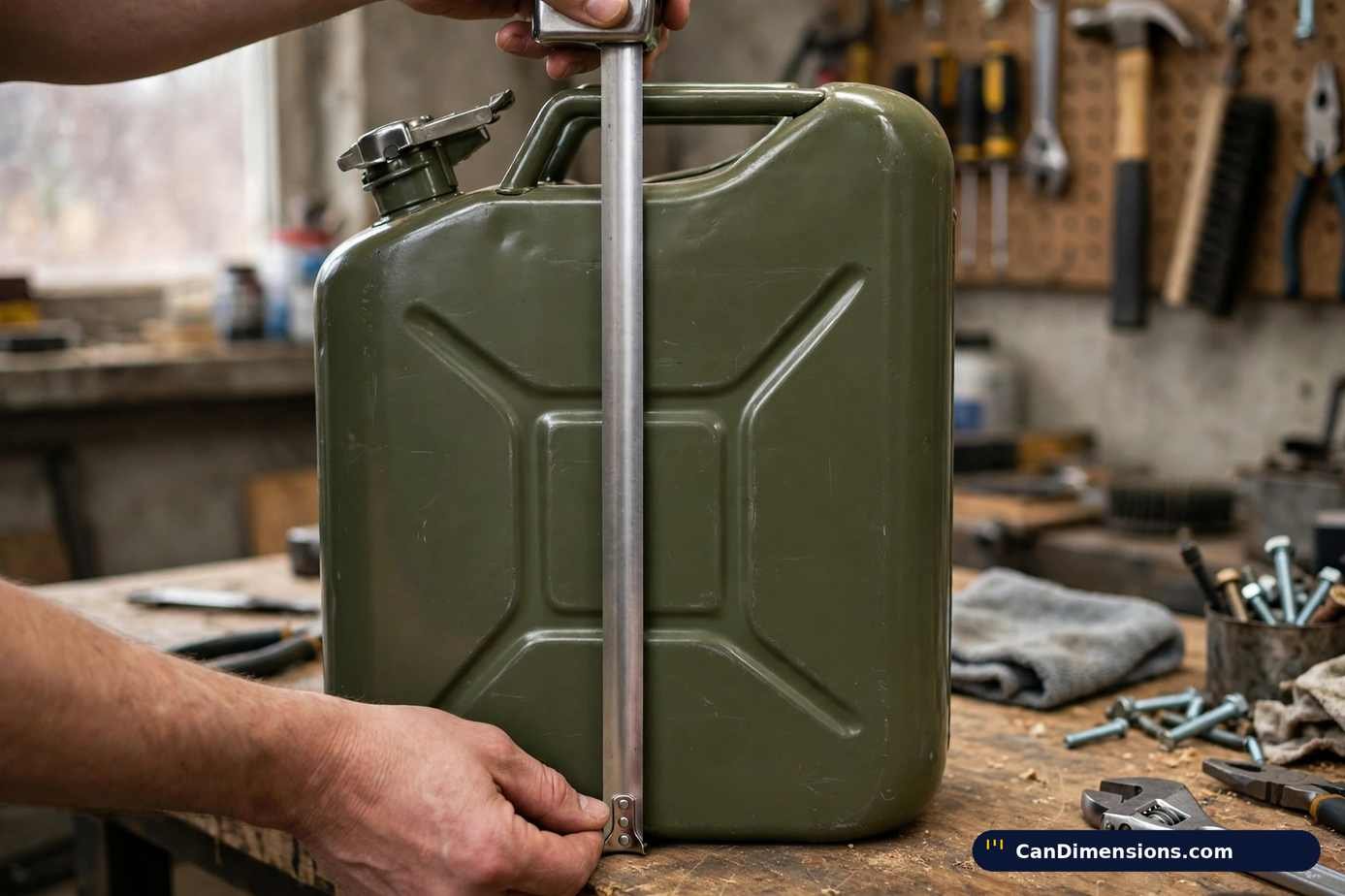
Capacity versus dimensions often confuses buyers, and the verified figures show why. A 25-liter stacker holds 25% more than a 20-liter NATO can yet stands 70 mm shorter (398 mm against 468 mm), because it gains its volume in width — 270 mm against 165 mm. Wall thickness and design shape affect internal volume without dramatically changing external size, but family changes — steel pattern versus stacker — change everything at once.
Standard Jerry Can Dimensions by Capacity
Small Capacity Jerry Cans (1-5 Liters)
5-liter jerry can dimensions depend on which family the can belongs to. In steel, the NATO-pattern 5L can from a military-pattern maker measures 310 mm tall × 240 mm long × 120 mm wide (12.20 × 9.45 × 4.72 inches) and weighs 1.3 kg (2.87 lb) empty; an Italian steel maker, Meclube, lists its 5L at 1.6 kg (3.53 lb). In HDPE, Cosmoplast’s datasheet gives 285 × 190 × 130 mm (11.22 × 7.48 × 5.12 inches), and the BariTainer stacker family gives a 235 mm (9.25 in) height at just 280 g (0.62 lb).
That spread corrects the figure usually quoted for this size. An empty weight of “1–1.5 pounds” is too light for any steel 5L can — steel starts at about 2.9 lb — and only the lightest HDPE stackers come in under it. What the small cans share is the use case: automotive additives, camping trips, and emergency fuel reserves, in a size that fits a car trunk or under a seat.
For scale, the standard US 12 fl oz can stands 4.83 inches tall with a 2.6-inch body — the can measured shell by shell in our coke can dimensions guide. A steel 5-liter jerry can at 12.20 inches is about two and a half of those cans tall.
Medium Capacity Jerry Cans (10-15 Liters)
10-liter jerry can dimensions split two ways even inside the steel family. The vertical pattern stands 405 mm tall × 300 mm long × 130 mm wide (15.94 × 11.81 × 5.12 inches) at 2.3 kg (5.07 lb); the horizontal pattern keeps the full 20L footprint — 345 × 165 mm — and halves the height instead, at 275 mm tall (10.83 in) and 2.5 kg (5.51 lb). Same capacity, same footprint family, two different shapes: this is the size where “the dimensions of a 10L can” stops being a single answer.
In HDPE the spread widens further. ESCO’s 10L water can measures 319 mm tall on a 348 × 174 mm base (12.56 in; 13.70 × 6.85 in) at 0.6 kg (1.32 lb); Greif’s JCR stacker is 318 × 232 × 192 mm (12.52 × 9.13 × 7.56 in) at 390 g (0.86 lb); Nalgene’s lab jerry can is 376 × 246 × 199 mm (14.80 × 9.69 × 7.83 in). Against that record, a single quoted range of “14–16 inches tall, 2–2.5 lb empty” fails in both directions: the verified heights run from 10.83 to 15.94 inches, and the verified empty weights run from 0.86 lb in HDPE to 5.51 lb in steel — the copied figure understates a steel can’s weight by more than half.
Large Capacity Jerry Cans (20-25 Liters)
20-liter jerry can dimensions are the one set on this page with a true standard behind them. The NATO-pattern steel can measures 468 × 345 × 165 mm (18.43 × 13.58 × 6.50 in) and 4.3 kg (9.48 lb) empty on Wavian’s specification sheet for its JC0020KV — a can manufactured and tested to DIN 7274, with UN dangerous-goods approval. The design it descends from, the 1937 Wehrmacht-Einheitskanister, was specified at 470 mm tall on the same 345 × 165 mm footprint; the Imperial War Museum’s measured specimen of an original can reads 472 × 350 × 160 mm, which is what hand-era production variance looks like. The full history is in the dedicated section below.
In HDPE, the same 20 liters come in unrelated shapes: hünersdorff’s UN-approved fuel can (approval UN 3H1/Y/150) at 435 × 365 × 178 mm (17.13 × 14.37 × 7.01 in) and 1.1 kg (2.43 lb); Pressol’s army-pattern HDPE fuel can at 480 mm tall on a 350 × 175 mm base (18.90 in; 13.78 × 6.89 in) and 1.45 kg (3.20 lb); ESCO’s water can at 431 mm tall on a 383 × 203 mm base (16.97 in; 15.08 × 7.99 in) and 0.97 kg (2.14 lb); and Nalgene’s fluorinated lab can at 452 × 320 × 245 mm (17.80 × 12.60 × 9.65 in). Note what that does to the usual claim that metal 20L cans measure “exactly 17.75 inches (450 mm)”: the verified steel figure is 468 mm — 18.43 inches — and 450 mm appears on this page only as the height of two plastic cans.
25-liter jerry can dimensions belong to the stacker family, not the NATO family. Chemline’s CNM-25 technical specification gives 398 mm tall × 295 mm long × 270 mm wide (15.67 × 11.61 × 10.63 in), 1.4 kg (3.09 lb), with wall thicknesses of 2.0 mm at the top, 2.6 mm at the body and 2.8 mm at the base. U-Pack’s 25L square container gives 450 × 280 × 281 mm (17.72 × 11.02 × 11.06 in) at 950 g to 1.6 kg depending on the duty rating. Neither resembles the “18–20 inches tall, 14–16 inches long, 7–8 inches wide” row in copied charts — that row describes a taller, narrower can that no maker’s sheet in this size shows.
Extra-Large Jerry Cans (30+ Liters)
30-liter jerry can dimensions continue the stacker pattern. Wandel’s SK4 specification gives 380 mm length × 280 mm width × 400 mm total height (14.96 × 11.02 × 15.75 in), a brimful volume of 34 liters, and a maximum stacking height of 2 layers — the maker’s own limit, stated on the sheet. Mevatec’s 30L technical sheet gives 375 × 290 × 400 mm (14.76 × 11.42 × 15.75 in) at 1.15 kg (2.54 lb).
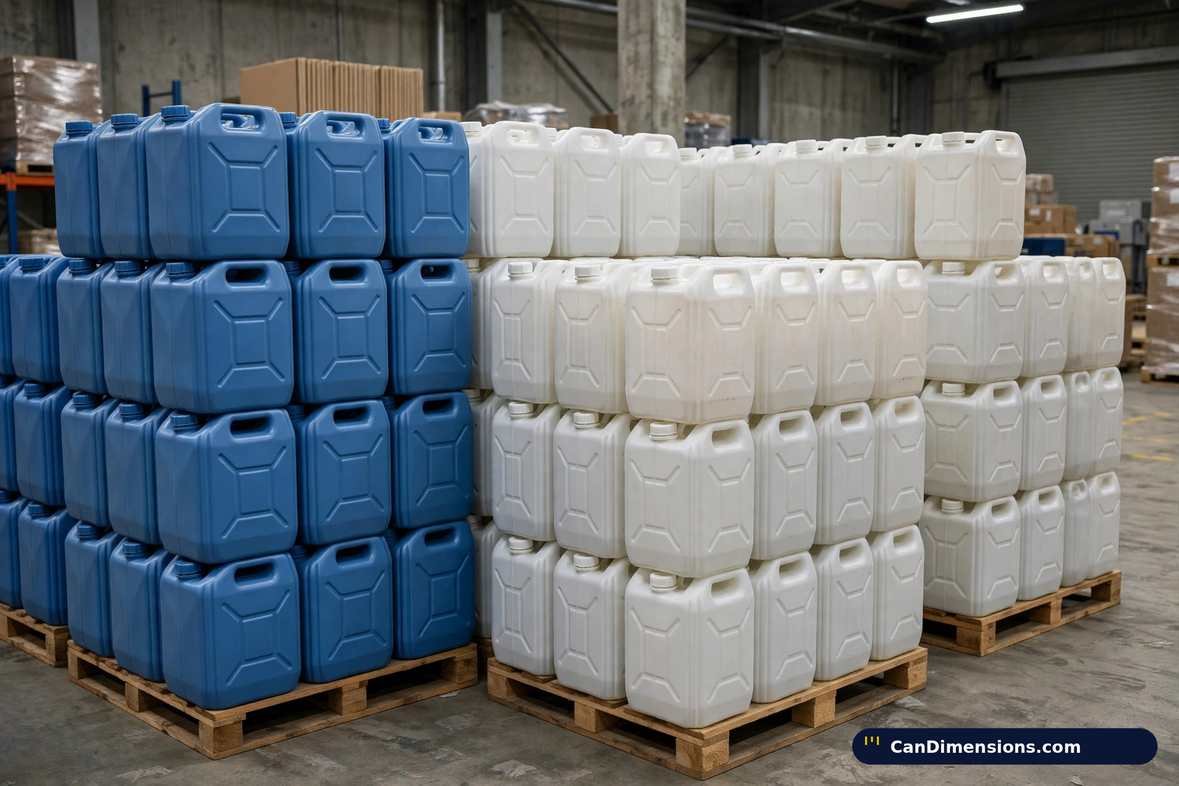
So the largest common jerry can stands 15.75 inches tall — shorter than the 20L steel can — and the “19–21 inches tall, 15–17 inches long, 8–9 inches wide” figures quoted for 30L describe no verified can. Filled weight is the real limit at this size, and it is computed in the filled-weight section below: a 30L stacker full of water totals about 68.7 lb, and full of gasoline only about 51.5 lb.
Jerry Can Dimensions in CM and MM
Most makers outside the United States publish in millimetres, so here is every verified can in this guide in metric, exactly as its specification sheet states it. Centimetres are the millimetre figure divided by ten.
| Can | Height (mm) | Length (mm) | Width (mm) | Empty Weight |
|---|---|---|---|---|
| 5L steel, NATO pattern | 310 | 240 | 120 | 1.3 kg |
| 5L HDPE (Cosmoplast) | 285 | 190 | 130 | — |
| 10L steel, vertical | 405 | 300 | 130 | 2.3 kg |
| 10L steel, horizontal | 275 | 345 | 165 | 2.5 kg |
| 10L HDPE water (ESCO) | 319 | 348 | 174 | 0.6 kg |
| 10L HDPE stacker (Greif JCR) | 318 | 232 | 192 | 390 g |
| 20L steel, NATO (Wavian) | 468 | 345 | 165 | 4.3 kg |
| 20L HDPE fuel (hünersdorff) | 435 | 365 | 178 | 1.1 kg |
| 20L HDPE army pattern (Pressol) | 480 | 350 | 175 | 1.45 kg |
| 20L HDPE water (ESCO) | 431 | 383 | 203 | 0.97 kg |
| 25L HDPE stacker (Chemline) | 398 | 295 | 270 | 1.4 kg |
| 30L HDPE stacker (Wandel SK4) | 400 | 380 | 280 | — |
When you convert a maker’s figure yourself, divide millimetres by 25.4 for inches — and convert the maker’s number, not a copied chart’s rounding of it. The NATO can shows why: 468 mm converts to 18.43 inches, but the figure that circulates, “17.75 inches,” converts back to 450.85 mm — a different can by 17 mm, introduced by rounding a rounding.
Jerry Can Dimensions by Material Type
HDPE (High-Density Polyethylene) Jerry Can Dimensions
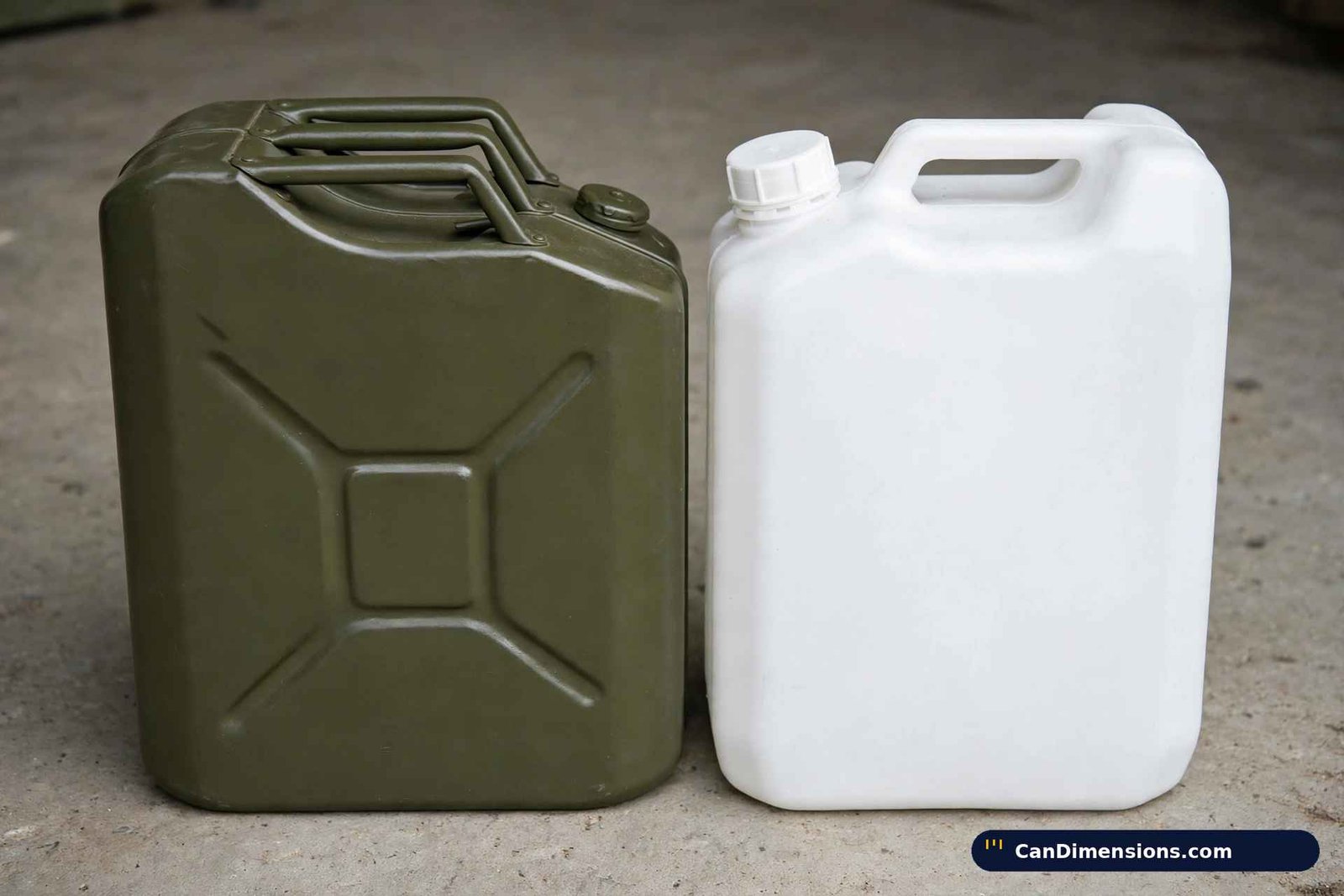
HDPE jerry cans do not maintain consistent dimensions across production batches the way the steel pattern does — each maker moulds its own shape, and the verified 20L HDPE heights in this guide alone run from 431 mm to 480 mm. What the material does fix is the weight class and the wall: industrial stacker walls run about 2.0–2.8 mm (Chemline’s 25L sheet: 2.0 mm top, 2.6 mm body, 2.8 mm base), and a 20L HDPE can weighs between 0.97 kg and 1.45 kg empty across the four makers verified here.
Against steel’s 4.3 kg, that is a saving of roughly two-thirds to three-quarters — not the “40% less” usually quoted. hünersdorff’s 1.1 kg fuel can is 74% lighter than the Wavian steel can; Pressol’s 1.45 kg army-pattern can is 66% lighter. Food-grade versions (ESCO’s water cans are certified foodstuff-compatible under EU Regulation 10/2011 and FDA 21 CFR 177.1520) use the same moulds as their fuel equivalents, so the certification changes the resin grade, not the dimensions.
Metal Jerry Can Dimensions
Steel jerry cans follow the NATO pattern with genuinely precise 20-liter dimensions — but the precise figure is the maker’s, and it is 468 × 345 × 165 mm (18.43 × 13.58 × 6.50 in), not the “exactly 17.75 × 13.5 × 6.5 inches (450 × 345 × 165 mm)” that copied charts print. The length and width in that quote are right; the height is 18 mm short, and its own millimetre pairing gives it away, since 17.75 inches is 450.85 mm, not a figure any steel maker publishes. Wavian builds the can from 0.9 mm cold-rolled steel (DC04 to EN 10130), seam-welded, with a bayonet closure and a fuel-resistant enamel lining, tested to DIN 7274.
Empty weight for the steel 20L is 4.3 kg — 9.48 lb — which also corrects the “6–8 pounds empty for steel” range: that range fits no verified steel 20L can, sitting below the lightest maker’s figure by a pound and a half. Smaller steel cans scale by the same pattern: 2.3–2.5 kg (5.07–5.51 lb) at 10L and 1.3–1.6 kg (2.87–3.53 lb) at 5L across the makers verified here.
Aluminum jerry cans need an honest flag instead of figures: aluminum versions of the pattern exist in marine and aviation niches, but no aluminum maker’s dimension sheet could be found for this guide, and the claim that they use “identical external dimensions” at “4–5 pounds empty” is printed nowhere verifiable. Rather than repeat it, this guide leaves the aluminum row blank — see the gaps note in the SEO block. (Aluminum in the drinks world is a different subject entirely: the aluminum can dimensions of beverage cans are set by can makers’ shells, not by container patterns.)
Filled Weight by Fuel Type: Gasoline, Diesel, Water and Kerosene
Empty weight is the number on the spec sheet; filled weight is the number your back meets. Filled weight is arithmetic, not a specification: take the maker’s empty weight and add the liquid’s density times the capacity. Gasoline runs about 0.74 kg per liter, diesel about 0.84, kerosene about 0.80, and water exactly 1.00.
| Can (empty weight) | Gasoline | Diesel | Kerosene | Water |
|---|---|---|---|---|
| 20L steel NATO (4.3 kg) | 19.1 kg / 42.1 lb | 21.1 kg / 46.5 lb | 20.3 kg / 44.8 lb | 24.3 kg / 53.6 lb |
| 20L HDPE (1.1 kg) | 15.9 kg / 35.1 lb | 17.9 kg / 39.5 lb | 17.1 kg / 37.7 lb | 21.1 kg / 46.5 lb |
| 25L HDPE stacker (1.4 kg) | 19.9 kg / 43.9 lb | 22.4 kg / 49.4 lb | 21.4 kg / 47.2 lb | 26.4 kg / 58.2 lb |
| 30L HDPE stacker (1.15 kg) | 23.4 kg / 51.5 lb | 26.4 kg / 58.2 lb | 25.2 kg / 55.4 lb | 31.2 kg / 68.7 lb |
Checked against the claims in circulation: a filled 20L can at “44–48 pounds” is right only for diesel and kerosene — gasoline comes in at 42.1 lb and water at 53.6 lb. A 25L can’s filled weight “exceeds 55 pounds” only when it is full of water; with diesel it is 49.4 lb. And a 30L can “exceeds 70 pounds” full of nothing in this table — water, the densest load, totals 68.7 lb.
Different Types of Jerry Cans and Their Dimensions
Type 1 vs Type 2 Gas Can Dimensions
This comparison needs correcting before it needs dimensions, because Type I and Type II are not jerry can types at all. They are the US safety-can classes used in OSHA and UL practice for metal safety cans: a Type I safety can has a single opening used for both filling and pouring, and a Type II has two openings — one for filling, one for pouring. Neither class is a jerry can, neither is defined by the EPA, and no standard gives Type II cans “2–3 inches” of extra height over Type I; the difference is the second opening and its venting, not the can’s height.
What actually changed in 2009 was not can dimensions. From 10 January 2009, US portable fuel containers had to meet the federal emissions rules modelled on California’s CARB system and the child-resistant closure requirements of the Children’s Gasoline Burn Prevention Act — the rules a jerrycan, defined in 49 CFR 171.8 as “a metal or plastic packaging of rectangular or polygonal cross-section,” meets through its closure and spout design. Makers answered with self-closing caps, flame arresters and stored spouts, which is why a modern US gas can’s hardware looks different from a NATO can’s bayonet cap while its body dimensions stay in the same class.
Specialty Jerry Can Dimensions
NATO military jerry cans hold the classic 20-liter pattern at 468 mm tall (18.43 in) on the 345 × 165 mm footprint — the benchmark every maker above is compared against, and the subject of the history section below. The US military’s own line runs through specification MIL-C-1283 F for the steel can; its National Stock Number, 7240-00-222-3088, is now considered obsolete, superseded by specification A-A-59592 B, which covers the high-density polyethylene versions — the steel-to-plastic handover, written into the standards themselves.
Water storage jerry cans in HDPE keep their own footprints rather than copying the fuel pattern: ESCO’s 20L water can stands 431 mm on a 383 × 203 mm base, and Scepter’s 5-gallon military-style water container is listed at 18.88 inches tall × 13.38 inches long × 7.5 inches wide (2.65 lb) — close to the NATO class, measurably not identical to it. Stackable square jerry cans measure differently again, by design: the 25L and 30L stackers in the chart trade height for width so the interlock, not the rack, does the holding.
The Original 1937 Wehrmacht Can and the US 5-Gallon Copy
Every dimension on this page descends from one drawing. The Wehrmacht-Einheitskanister — “armed forces standard canister” — was developed in 1937 by the Müller engineering firm of Schwelm, to a design by its chief engineer Vinzenz Grünvogel, after a 1936 Wehrmacht competition for a 20-liter container one soldier could manage alone. Its specified size: 470 mm tall, on a horizontal section of 345 × 165 mm, at an empty weight of about 4 kg (the German introduction notice gives 3.85 kg). The triple handle exists because the requirement said a soldier must carry two full cans or four empty ones; the recessed welded seam and the cross indentations exist so a dropped, full can survives. The Imperial War Museum holds an original and catalogues it at 472 mm high × 350 mm wide × 160 mm deep — a few millimetres off the drawing in every direction, which is normal for wartime production across dozens of makers, and a useful warning against any chart that prints one “exact” figure for a 1930s design.
The American copy kept the size and shape and simplified the making: the recessed welded seam became rolled seams (which leaked more), the stiffening became a simple X, and the lining was dropped on fuel cans, so a spanner and funnel were needed again. Wartime US Army history puts the American can at 10 lb against the German can’s 11.5 lb — notably heavier than the German drawing’s 4 kg, because period figures bundle production variance the modern maker sheet (4.3 kg) has engineered out. Britain copied the German design outright through firms including Briggs Motor Bodies, Vauxhall Motors and the Pressed Steel Company, and the design remains, in Wikipedia’s summary, “a standard container for fuel and other liquids in the armies of the NATO countries” — which is why “NATO can” and the 345 × 165 mm footprint still mean the same thing today.
Jerry Can Storage and Space Planning
Calculating Storage Space Based on Jerry Can Dimensions
Shelf height requirements should be read off the maker’s height, not the capacity. A steel 5L can stands 310 mm (12.20 in), so a 12-inch shelf clearance is already too tight before any removal allowance; the 20L steel can at 468 mm (18.43 in) needs a clear 19 inches to stand and more to lift out; and a 25L stacker at 398–450 mm (15.67–17.72 in) fits shelves the 20L steel can cannot — the often-quoted “25-liter containers require 22+ inches” overstates the real need by four inches or more. Floor space calculations multiply length by width. A 20L NATO can occupies 345 × 165 mm = 0.057 m² — approximately 0.61 square feet — a figure that checks out exactly. A 25L stacker occupies 295 × 270 mm = 0.86 square feet, and a 30L stacker 380 × 280 mm = 1.15 square feet: the stackers trade floor area for height, which is the whole point of their shape.
Stacking height limitations come from the maker’s own test data, not from a general rule: there is no OSHA stacking count for jerry cans, and claims like “maximum three high” or “five high for small cans” appear in no standard this guide could find. What exists is per-product data — Wandel rates its 30L SK4 stacker at a maximum of 2 layers with a 38 kg stacking load at 20 °C, and UN-approved cans carry the stack load they were actually tested to in their approval. Use the figure on the can’s own sheet.
Vehicle Storage Considerations
Truck bed dimensions accommodate multiple 20L containers in standard pickup trucks — at 13.58 inches long and 6.50 inches wide, four NATO cans stand in a 27 × 13 inch patch of bed. Secure containers with tie-downs preventing movement during transport, and keep fuel cans away from the passenger compartment, as transport regulations require.
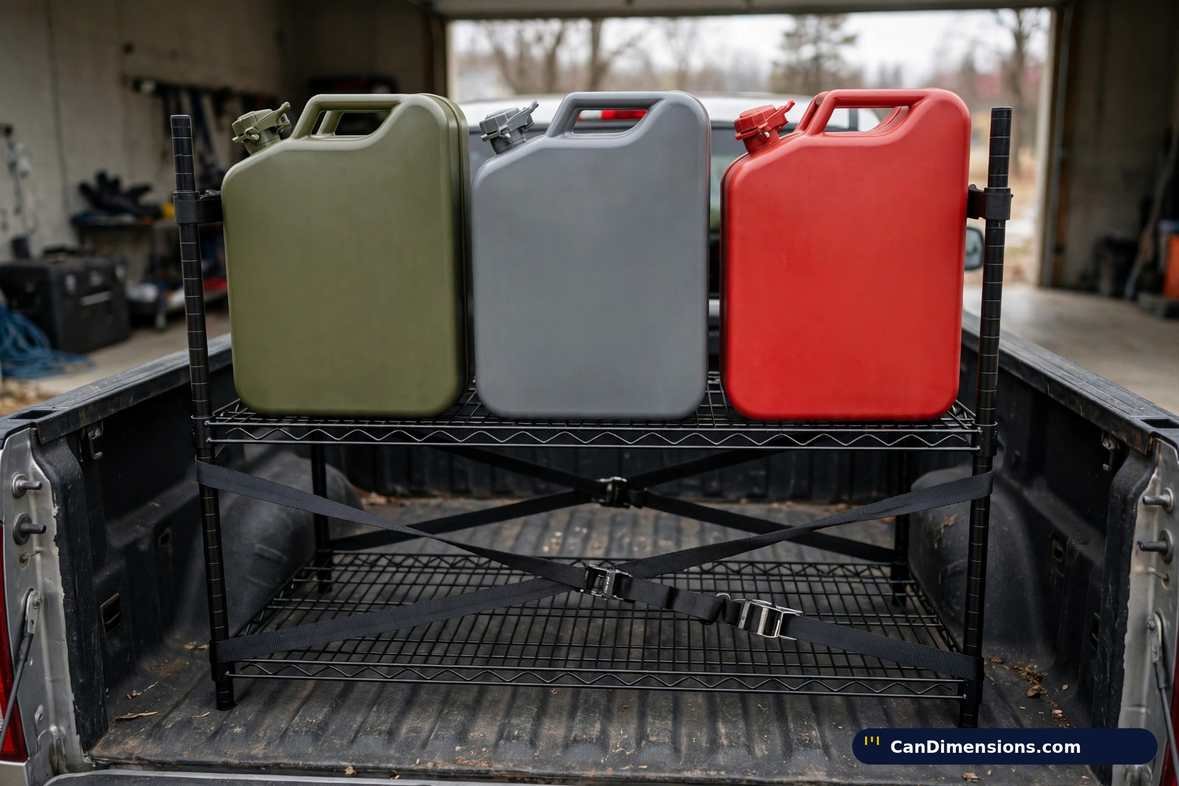
SUV and car trunk fitting works best with the 5–10L sizes — but measure against the real heights: a horizontal 10L steel can is only 10.83 inches tall on the full NATO footprint, which fits low trunks the 15.94-inch vertical 10L cannot. Position containers low in vehicles for stability and a lower center of gravity, and strap them: a filled 20L steel can is a 42–54 lb object (see the filled-weight table) long before it is a container.
How to Measure a Jerry Can Yourself
Measure height with the can standing empty on a flat floor, cap on, spout removed, from the floor to the highest fixed point — on a NATO-pattern can that is the handle line, on a stacker it is the cap. Measure length and width across the body’s widest points, not at the base: moulded HDPE cans taper, and ESCO’s published base dimensions (348 × 174 mm on its 10L water can) are footprints, which can differ from the shoulder width by several millimetres.
If you are checking a can against a rack or holder, measure the holder too and compare both against the maker’s sheet rather than a chart: the verified 20L heights in this guide span 431–480 mm across materials, so a rack welded to one maker’s “20 liter” can bind on another’s. And weigh the can empty if the filled weight matters — the steel-to-HDPE difference at 20L is 3.2 kg (about 7 lb), the single largest handling difference between the families.
Question’s
What are the standard dimensions of a jerry can?
The standard is the 20-liter NATO-pattern steel can: 468 mm tall × 345 mm long × 165 mm wide (18.43 × 13.58 × 6.50 inches), 4.3 kg (9.48 lb) empty, on Wavian’s specification sheet — the modern descendant of the 1937 Wehrmacht design specified at 470 × 345 × 165 mm. Plastic 20L cans are not built to it: verified HDPE versions run from 431 to 480 mm tall on wider footprints.
How tall is a 20L jerry can?
In steel, 468 mm — 18.43 inches — on the maker’s sheet. In HDPE it depends on the maker: 435 mm (17.13 in) for hünersdorff’s fuel can, 480 mm (18.90 in) for Pressol’s army-pattern can, 431 mm (16.97 in) for ESCO’s water can. The “exactly 17.75 inches” figure in copied charts matches none of them; 17.75 inches is 450.85 mm, a height published for two plastic cans, not for the steel standard.
How big is a 5 litre jerry can?
By family: in steel, 310 mm tall × 240 mm long × 120 mm wide (12.20 × 9.45 × 4.72 in) at 1.3 kg (2.87 lb) empty. In HDPE, Cosmoplast’s datasheet gives 285 × 190 × 130 mm (11.22 × 7.48 × 5.12 in), and the lightest stacker family starts at 235 mm (9.25 in) tall and 280 g (0.62 lb). There is no single 5L size — check which family the can in front of you belongs to.
How big is a 25l jerry can?
A 25-liter jerry can is an industrial stacker, not a stretched NATO can. Chemline’s CNM-25 specification: 398 mm tall × 295 mm long × 270 mm wide (15.67 × 11.61 × 10.63 in), 1.4 kg (3.09 lb) empty. U-Pack’s square 25L: 450 × 280 × 281 mm (17.72 × 11.02 × 11.06 in). Filled with water it weighs 26.4 kg (58.2 lb); with diesel, 22.4 kg (49.4 lb).
How big is a 25l container?
In jerry can style, as above: roughly 400–450 mm tall on a near-square footprint of about 280–295 mm. Other 25L container types differ completely — a 25L drum, keg or pail is a cylinder with a diameter and a height instead of a footprint — so the shape, not the capacity, is what to match when planning space.
How many litres is a standard jerry can?
20 liters — 5.28 US gallons. The size was fixed by the 1936–37 Wehrmacht requirement and has been the standard ever since; 5L and 10L cans are the same patterns scaled down, and 25L and 30L belong to the separate industrial stacker family.
What are the different types of jerricans?
By family: the steel NATO pattern (5L, 10L vertical and horizontal, 20L); HDPE fuel and water cans in the NATO class (hünersdorff, Pressol, ESCO, Scepter); HDPE industrial stackers (Greif, Chemline, Wandel, BariTainer); and HDPE laboratory cans (Nalgene). Type I and Type II are a separate US classification for metal safety cans — single-opening versus two-opening — not jerry can types.
Are all fuel cans the same size?
No. Verified cans in this guide run from a 235 mm-tall 5L stacker to a 480 mm-tall 20L HDPE fuel can, and the same capacity comes in unrelated shapes — a 10L steel can exists at both 405 mm and 275 mm tall. Capacity, family and maker each change the dimensions; only the steel NATO pattern holds one footprint across sizes.
What is the difference between Type 1 and Type 2 gas cans?
Type I and Type II are US safety-can classes: Type I has one opening for filling and pouring; Type II has two, a fill opening and a separate pour opening with its own venting. The difference is the openings, not the dimensions — no standard adds height to a Type II can. The 2009 changes often credited to these classes were actually the federal EPA emissions rules and the Children’s Gasoline Burn Prevention Act’s child-resistant closures, which apply to portable fuel containers generally.
Conclusion
Jerry can dimensions resolve into two families and one benchmark. The benchmark is the steel 20-liter NATO can — 468 × 345 × 165 mm, 4.3 kg, DIN 7274-tested — holding the footprint drawn in Schwelm in 1937, when the jerry can sizes in this guide began. Around it, the steel pattern scales down to 10L and 5L on the same footprint logic, while HDPE splits into NATO-class cans that stay near the benchmark and industrial stackers that abandon it entirely, trading height for width at 25 and 30 liters.
If you take one habit from this page, make it this: never size a rack, a shelf or a trunk from a capacity figure or a copied range — size it from the maker’s sheet for the exact can, the way every figure here was taken. The material decides the rest of the ownership experience: steel for the pattern’s durability and repairability, and high-density polyethylene for a can that weighs a third as much and never rusts — two answers to the same 20 liters, separated by 18 millimetres of height and 3.2 kilograms of empty weight.