Kitchen Trash Can Dimensions: Standard Sizes, Height and Bag Fit Explained
A trash can sizes chart is only useful if its numbers come from real cans, so this one starts with the benchmark: the standard 13-gallon kitchen can. Kohler’s own specification sheet for its 13-gallon step can gives 26-7/16 inches tall × 16-13/16 inches wide × 13 inches deep, Rubbermaid’s Classic 13G step-on measures 24.8 tall × 14.7 wide × 17.6 deep, and Glad’s 13-gallon step can measures 25 tall × 18 wide × 14.7 deep — three makers, three different footprints, one capacity.
That spread is the honest headline. Capacity is a volume, not a shape: two cans that both hold 13 gallons can differ by more than 3 inches in height and 4 inches in depth, and the “standard ranges” copied from chart to chart match no maker’s can exactly. The ranges on the page this guide replaces are wrong in both directions at once — its chart and its own text disagree about how deep a rectangular kitchen can even is.
Below, every size is traced to a manufacturer’s specification sheet or a retailer’s published specification for a named model: the 13-gallon class from Kohler, Rubbermaid, Glad and simplehuman, slim cans, in-cabinet pull-outs from Rev-A-Shelf, and the bag sizes Glad actually prints on its boxes — with the copied-around errors corrected as they come up.

Standard Kitchen Trash Can Dimensions Chart
Quick reference: kitchen trash can dimensions by capacity. Each row below is the range spanned by the named makers’ models verified for this guide — not an average and not a guess — and the models behind each row are named in the sections that follow. Dimensions are height × width × depth in inches.
| Capacity | Height (“) | Diameter/Width (“) | Depth/Length (“) | Best For |
|---|---|---|---|---|
| 8–9.3 gallons (in-cabinet) | 19.0–19.1 | 9.8–11.0 | 17.7–22.1 | 1–2 people, hidden in a base cabinet |
| 10.6–11.9 gallons | 24.3–25.2 | 10.2–15.9 | 13.8–20.1 | Small kitchens, slim spaces |
| 13 gallons (standard) | 24.8–28.3 | 11.5–18.0 | 13.0–18.0 | Most households |
| 15.3 gallons (dual compartment) | 25.8 | 22.0 | 14.2 | Trash plus recycling in one can |
| 20 gallons | 22.9 | 19.5 (diameter) | — | Large households, utility use |
Two things in this chart correct the version it replaces. First, the 13-gallon row is wider and taller than the copied chart claims: verified 13-gallon cans run from 11.5 to a full 18 inches wide — Glad’s 13-gallon step can is 18 inches wide, outside the old chart’s 14–16 inch band — and up to 28.3 inches tall in Rubbermaid’s Slim Jim front-step model, above the old chart’s 26-inch ceiling. Second, the 20-gallon row is shorter, not taller: Rubbermaid’s BRUTE 20-gallon container stands 22.9 inches tall on a 19.5-inch diameter, because big cans grow in width and footprint, not in height. A chart that puts 20-gallon cans at “28–35 inches tall” is describing cans no maker in this guide sells.
The Glad model the older page cites is real, and its figures check out: the Glad 13 Gallon step can does measure 14.7″ D x 18″ W x 25″ H, confirmed on retailer specification listings for the model. It sits at the wide, shallow end of the 13-gallon class — which is exactly why a single “standard” footprint for this class does not exist.
Quick Size Guide
Short on time? Match the household, not the marketing label. One or two people, or a can hidden in a cabinet: an 8–9.3 gallon in-cabinet unit (about 19 inches tall) is enough. A small kitchen with a narrow gap: a 10.6–11.9 gallon slim can, only about 10 inches wide. Most households: a 13-gallon can, roughly 25–26.5 inches tall. Sorting at the source: a 15.3-gallon dual-compartment can, 22 inches wide. A big household that hates taking bags out: 20 gallons — but measure the footprint, because that class is wide, not tall.
Key Measurements You Need to Know
Four numbers decide whether a can fits, and listings do not all print them in the same order — Amazon’s own listing for its 50-litre can gives length × width × height, Kohler’s sheet gives height first, and simplehuman prints width × depth × height. Read the axis labels, not the order. Height is the floor-to-lid-top measurement with the lid closed. Width is the side-to-side measurement across the front. Depth (also printed as length) is front-to-back, pedal included on most step cans. The fourth number, the one almost nobody prints in the headline, is height with the lid open: simplehuman’s spec table for its 58-litre recycler gives 91.5 cm — 36 inches — with the lid open, against 25.8 inches closed, and EKO’s 50-litre Madison is listed at 36.6 inches open against 25.4 closed. A step can parked under a counter overhang or inside a tall niche needs that open figure, not the closed one.
Capacity needs the same care. Makers rate cans in US gallons or in litres, and the two labels are not interchangeable: 13 US gallons is 49.21 litres, so the cans sold as “50 litre / 13.2 gallon” (Amazon Basics, EKO and others) are the same standard class wearing the metric label. The conversion used throughout this guide is exact: 1 US gallon = 3.78541 litres.
Kitchen Trash Can Dimensions in CM and Litres
For metric listings — most European-market cans are sold by the litre — the verified models from the chart convert as follows. Where the maker publishes centimetres itself (simplehuman, Kohler), the maker’s own metric figure is used; the rest are computed at 1 inch = 2.54 cm exactly.
| Model | Capacity | W × D × H (cm) |
|---|---|---|
| simplehuman 40L slim step can (CW1390) | 40 L / 10.6 gal | 26 × 51 × 62.6 |
| simplehuman 45L rectangular step can (CW1371) | 45 L / 11.9 gal | 40.5 × 35 × 64 |
| Glad 13-gallon step can | 49.2 L / 13 gal | 45.7 × 37.3 × 63.5 |
| Kohler 13-gallon step can (K-20940) | 49 L / 13 gal | 42.7 × 33 × 67.2 |
| Amazon Basics 50L step can | 50 L / 13.2 gal | 37.2 × 42.5 × 65.7 |
| simplehuman 58L dual recycler (CW2209) | 58 L / 15.3 gal | 56 × 36 × 65.5 |
| Rev-A-Shelf double 35 qt pull-out (53WC) | 66.2 L / 17.5 gal total | 36.6 × 56.1 × 48.3 |
| Rubbermaid BRUTE 20-gallon (FG262000) | 75.7 L / 20 gal | 49.2 diameter × 58.2 high |
Read the litre label as the primary size whenever both are printed: a “13.2 gallon” can is a 50-litre can converted (50 ÷ 3.78541 = 13.21), and a “15.3 gallon” can is a 58-litre can converted. Nothing is gained or lost in the conversion — but a can shopped as “13 gallon” in one store and “50 litre” in another is the same can.
Standard Kitchen Trash Can Dimensions by Capacity
Small Kitchen Trash Cans (8-10 Gallons)
Verified cans in this class are mostly in-cabinet units, and that is not a coincidence: an 8–10 gallon freestanding can is small for a main kitchen, so makers build this capacity into cabinets instead. simplehuman’s 35-litre (9.3-gallon) dual-compartment under-counter pull-out measures 17.7 long × 9.8 wide × 19.1 high, and Rev-A-Shelf’s single 35-quart (8.75-gallon) pull-out unit measures 11.01 wide × 22.09 deep × 19.01 high on the maker’s own engineering drawing. Expect about 19 inches of height and a footprint set by the cabinet, not by the room.
One example on the older page does not belong in this class at all. The “BETHEBEST 15 Liter” can it cites as a compact 8–10 gallon model is a 15-litre can — 15 ÷ 3.78541 = 3.96 gallons, a roughly 4-gallon bathroom-class bin. Its quoted figures (17.61 inches tall, 7.87 inches wide) are centimetre conversions — 44.7 cm and 20 cm — from an unverifiable marketplace brand, and no maker specification sheet stands behind them. They are not repeated here as dimensions.
Medium Kitchen Trash Cans (13 Gallons – Standard Size)
This is the standard kitchen class, and five verified models show its real spread:
| Model | W × D × H (“) |
|---|---|
| Rubbermaid Classic 13G Premium Step-On | 14.7 × 17.6 × 24.8 |
| Glad 13-gallon step can | 18 × 14.7 × 25 |
| Amazon Basics 50L / 13.2 gal step can | 14.7 × 16.7 × 25.9 |
| Kohler 13-gallon step can (K-20940) | 16.8 × 13 × 26.4 |
| Rubbermaid Slim Jim 13G front step | 11.5 × 18 × 28.3 |
The Glad 13 Gallon model the older page cites measures exactly 14.7″ D x 18″ W x 25″ H — verified. So does its second citation, with one repair: the Amazon Basics 13.2 Gallon can is listed by Amazon at 16.73″ long × 14.65″ wide × 25.87″ high, so the figures “14.7″ x 16.7″ x 25.9″” are the same can with the length and width unlabelled — 16.7 is the front-to-back length, 14.7 the width. Note also what the class does to rules of thumb: the tallest verified 13-gallon can (the Slim Jim front step, 28.3 inches) is a narrow commercial-style step can, and the widest (Glad, 18 inches) is among the shallowest. Pick the axis your kitchen is short of first, then shop inside the class.

Large Kitchen Trash Cans (16-20+ Gallons)
Above 13 gallons the verified picture changes shape. The commonest genuine step up is not a taller single can but a wider dual: simplehuman’s 58-litre (15.3-gallon) recycler at 22 wide × 14.2 deep × 25.8 high, covered in the Dual Compartment section below. True 20-gallon cans exist — Glad sells a 20-gallon stainless step can at retail — but the fetched retail listing publishes no specification dimensions for it, so none are printed here. The 20-gallon can whose dimensions a maker does publish is a utility container: Rubbermaid’s BRUTE 20-gallon measures 19.5 inches in diameter × 22.9 inches tall on Rubbermaid Commercial’s own catalogue (a second maker brochure gives 19.25 × 23.12 for its 20-gallon round can — the same class, the same proportions).
So the older page’s claim that 15+ gallon cans “measure 26 to 35 inches tall and 16 to 24 inches wide,” with rectangular large cans reaching “24 W x 20 D x 32 H,” is not verified against any maker in this guide. Verified large cans cluster at 23–26 inches tall; the growth is in width and diameter. A 32-inch-tall, 24-inch-wide kitchen can would be a remarkable object, and no specification sheet for one could be found.
Kitchen Trash Can Height
Standard Height Ranges
Across the verified models, kitchen can heights sort by type, not by capacity alone. In-cabinet pull-outs: 19.0–19.1 inches (both Rev-A-Shelf units and simplehuman’s pull-out measure within a tenth of an inch of 19). Standard freestanding 13-gallon step cans: 24.8–26.4 inches. Narrow commercial-style step cans: up to 28.3 inches (Slim Jim 13G front step). Large round utility cans: 22.9 inches (BRUTE 20-gallon) — shorter than the standard class despite holding half again as much. The older page’s citation of a “BETHEBEST 15 Liter” can standing 17.61 inches in this section is the same unverifiable 4-gallon marketplace can described above; it is not a kitchen height benchmark and is not used as one.
Under a standard counter the binding figure is the open-lid height: roughly 36–36.6 inches on the verified simplehuman and EKO step cans, against a standard countertop height of 36 inches. A step can that lives under an overhanging counter edge will strike it; freestanding cans belong in open floor or in a niche measured with the lid up.
Height Considerations for Different Placements
Under the sink is the tightest placement, and the constraint is plumbing, not the cabinet shell: the bowl and trap cut into both height and depth, which is why freestanding under-sink cans are kept short — the older page’s “16 to 20 inches” ceiling is a fair rule of thumb for a loose can under a sink, and the verified in-cabinet kits below show why: even in a full base cabinet with no plumbing, pull-out makers ask for 19.25–20.25 inches of clear opening height. In a base cabinet (not under the sink), height is set by the kit: Rev-A-Shelf’s single 35-quart unit is 19.01 inches tall and needs a 20.25-inch minimum opening height; its double needs 19.25. The Home Zone Living Pull Out dual bin the older page cites at “19.72″ x 15.20″ x 19.25″” could not be verified in that form — Home Zone Living’s published figure for its 15-gallon dual pull-out is a minimum cabinet size of 21.78 × 16.20 × 24.80 inches, which does not match the cited numbers in any axis order, so the cited figures are flagged here as not verified and the Rev-A-Shelf figures above are used instead.
Kitchen Trash Can Length and Width
Circular vs. Rectangular Trash Can Dimensions
Round cans are sized by diameter, and the verified anchor is again the BRUTE: 19.5 inches across at 20 gallons. The older page’s “round cans run 14 to 18 inches in diameter” may describe mid-size round bins, but it fails at the top of the kitchen range — the one round can a major maker specifies in full is wider than 19 inches. Rectangular cans dominate kitchens because they sit flush to a wall or cabinet run. Their verified widths run 11.5–18 inches in the 13-gallon class and their verified depths 13–18 inches.
That last figure corrects an internal contradiction on the older page: its introduction and chart put rectangular depth at 10–20 inches, while this section of the same page claims “19 to 26 inches deep.” No verified kitchen can in this guide is 19–26 inches deep in the ordinary sense. Depths of 20.1–21.5 inches exist only as the long axis of slim cans (below), and 22.09 inches is the depth of an in-cabinet pull-out unit — cabinet territory, not a freestanding footprint. A 26-inch-deep freestanding kitchen can would project past a standard 24-inch-deep base cabinet run; treat any listing that claims one as a mislabelled axis until proven otherwise.
Measuring Your Available Space
Measure the space, then the can — in that order. Width: the clear gap, minus an inch of working room. Depth: from the wall or cabinet face to the front edge of the space, remembering the pedal adds its travel at the front on step cans. Height: floor to the lowest obstruction, and for a step can, check the open-lid height (about 36 inches on verified models) against anything overhead. The older page advises adding 2–4 inches of clearance around the can and about 6 inches behind for the lid; as advice that is harmless, but note the verified lids open upward, not backward — the clearance that actually binds is vertical. Keep the 2–4 inches as finger and cleaning room if you have it; do not let a “6 inches behind” rule talk you out of a can whose lid never travels there.
Slim and Space-Saving Dimensions
A slim can trades width for depth: the footprint rotates, the volume stays. simplehuman’s two verified slim step cans are both just 10.2 inches wide — the 40-litre (10.6-gallon) at 10.2 wide × 20.1 deep × 24.3 high, and the 45-litre (11.9-gallon) at 10.2 wide × 21.5 deep × 24.4 high. So the older page’s “slim cans are 8 to 10 inches wide and 28 to 32 inches tall” is wrong on both axes for freestanding step cans: verified slim step cans are 10.2 inches wide and about 24.5 inches tall. Widths under 10 inches do exist, but on in-cabinet pull-out bins (simplehuman’s 35-litre pull-out is 9.8 inches wide) — a different product. Its BETHEBEST citation, “only 7.87 inches wide,” is the same unverifiable 20 cm marketplace figure flagged above; no maker sheet supports a freestanding kitchen step can that narrow.
How to Measure a Kitchen Trash Can Yourself
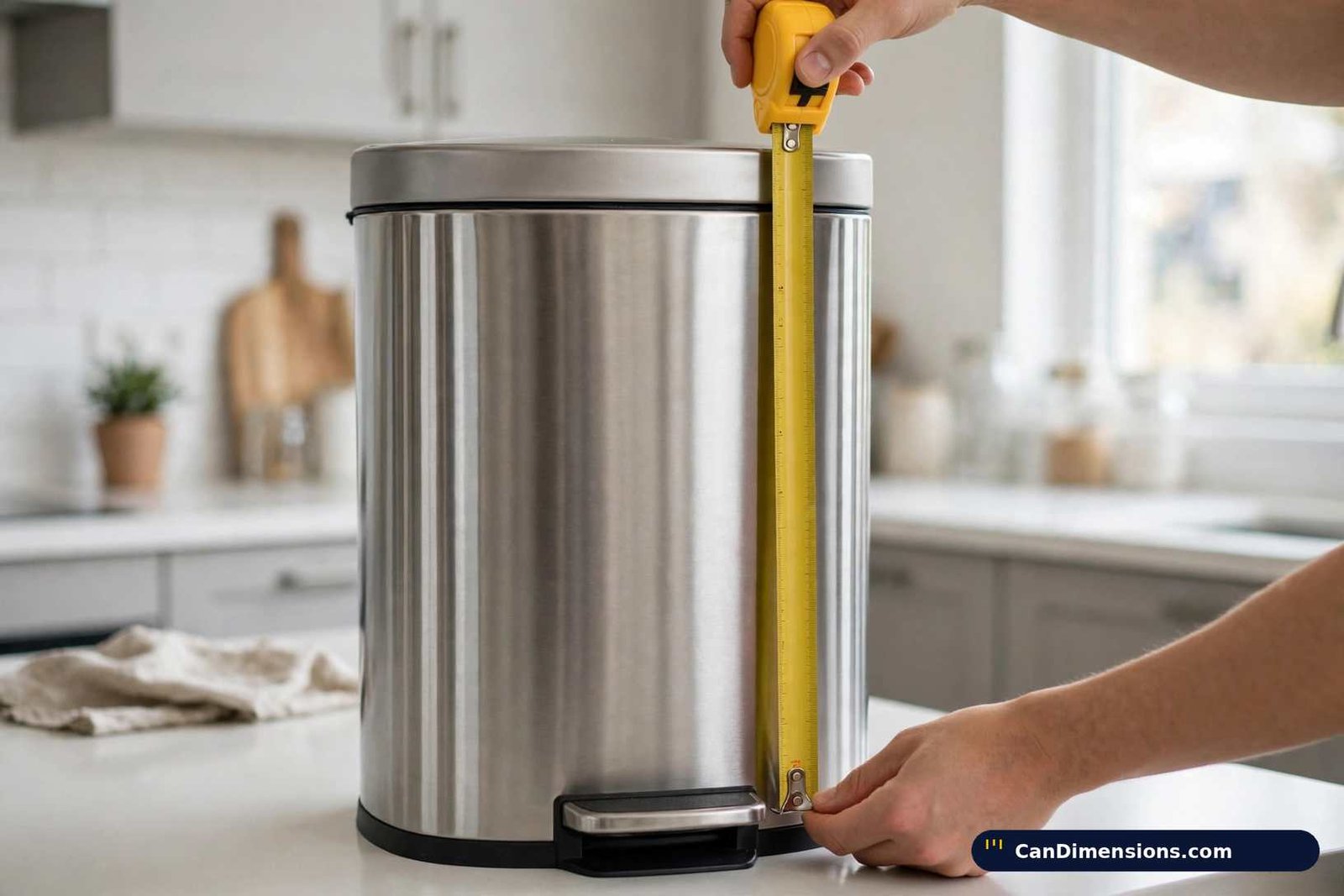
Specifications disagree between listings often enough that measuring the can in hand is worth two minutes. Height: stand the tape on the floor against the can’s tallest side, lid closed, and read at the lid’s highest point — then open the lid fully and measure again; the second number is the one your counter overhang cares about. Width: across the front at the widest point, which on step cans is often the lid hinge or the pedal housing, not the body. Depth: from the wall-facing back to the pedal’s front edge, pedal at rest. Diameter (round cans): measure across the top rim in two directions and average them — moulded rims are rarely perfectly round. Capacity: if the label is gone, fill the can with a measured bucket of water to the brim line; litres ÷ 3.78541 = US gallons. Compare your numbers against the maker’s sheet for the model, not against a chart of ranges: as the 13-gallon table above shows, two honest cans of the same capacity can differ by inches.
Kitchen Trash Can Type
Freestanding Kitchen Trash Can Dimensions
The freestanding step can is the default kitchen form, and its verified envelope is the 13-gallon table above: roughly 24.8–26.4 inches tall, 13–18 inches in each footprint axis, with the narrow Slim Jim front-step as the tall outlier at 28.3. Sensor cans sit in the same bodies with a lid motor instead of a pedal and add nothing to the footprint. Whatever the mechanism, a freestanding can is the only type whose dimensions are wholly the maker’s choice — every other type in this section is sized by the cabinet it must fit.
Under-Sink Trash Can Dimensions
Under-sink space is a standard sink-base cabinet — commonly 30, 33 or 36 inches wide — minus a sink bowl, a trap and often a disposal unit. What survives is a low, shallow pocket, which is why loose under-sink cans stay at or under about 20 inches tall and why full-depth pull-outs (22.09 inches of unit depth, 22.125 minimum opening) generally cannot go there at all: the plumbing occupies the back of the cabinet where the slides need to run. Door-mounted and short pull-out bins exist for sink bases precisely because the standard kits do not fit. If a listing promises a standard pull-out “for under the sink” without asking about your plumbing, it has not measured your cabinet.
Pull-Out/Slide-Out Trash Can Dimensions
Pull-outs are the one type where the maker’s engineering drawing, not the marketing page, carries the numbers that matter — the minimum cabinet opening. Rev-A-Shelf’s 53WC series, from the maker’s own drawing and listing:
| Kit | Bin capacity | Unit W × D × H (“) | Minimum cabinet opening (“) |
|---|---|---|---|
| Single 35 qt (53WC-1535SCDM) | 8.75 gal | 11.01 × 22.09 × 19.01 | 11.125 W × 22.125 D × 20.25 H |
| Double 35 qt (53WC-1835SCDM-213) | 2 × 8.75 gal | 14.41 × 22.09 × 19.01 | 14.5 W × 22.09 D × 19.25 H |
Three corrections follow from those figures. First, depth: the kits are 22.09 inches deep and need a 22.125-inch opening — they are built for the standard 24-inch-deep base cabinet, full stop; “20 to 24 inches of drawer depth” is right only at its top end. Second, width: the older page’s rule of “bin width plus 2 inches for mounting hardware on each side” overstates the hardware allowance by an order of magnitude — the verified minimum openings are 0.1–0.9 inches wider than the units, because the slides mount inside the opening the drawing specifies. The real width decision is the nominal cabinet: a 15-inch base cabinet takes the single, an 18-inch base takes the double — the standard cabinet-retail rule, and it matches the drawings (an 18-inch cabinet’s inside opening clears the double’s 14.5-inch minimum). Third, height: plan on 19.25–20.25 inches of clear opening, and remember a standard base cabinet also carries a top drawer unless it is a full-height-door model — the taller 50-quart (12.5-gallon) kits, at 22.9–23.2 inches tall, exist only for those full-height-door cabinets.

Dual Compartment Trash Can Dimensions
The verified freestanding dual is simplehuman’s 58-litre recycler (CW2209): 22 wide × 14.2 deep × 25.8 high overall, split 34 litres (9.0 gallons) for trash and 24 litres (6.3 gallons) for recycling, with a 36-inch height with the lid open. Against the older page’s “18 to 24 wide, 14 to 18 deep, 20 to 26 tall, each compartment 6–10 gallons”: width and compartment sizes check out, depth is at his floor, and height is at his ceiling — a real dual is as tall as a standard 13-gallon can, not shorter. The recycling side is where can sizes stop being abstract: bottles and cans go in uncrushed, so knowing the standard aluminum can dimensions tells you how fast that 24-litre side fills. In-cabinet duals follow the pull-out table above — two 8.75-gallon bins in an 18-inch cabinet — and the Home Zone Living figure the older page quotes for this section (“19.72 inches wide total”) is the same unverifiable citation flagged in the Height section.
Standard Cabinet Sizes for In-Cabinet Trash Cans
In-cabinet cans are bought by the cabinet, so the cabinet standards come first. Base cabinets are 24 inches deep and 34.5 inches tall (36 with a standard countertop), and they are sold in 3-inch width steps — 12, 15, 18, 21, 24 inches and up. The inside opening is always smaller than the nominal width, by roughly 1.5–3 inches across makers once the frame and hinges are counted, which is why kit makers publish minimum openings instead of cabinet sizes. Matched against the verified kits: a 15-inch base cabinet is the single-bin cabinet (minimum opening 11.125 wide); an 18-inch base cabinet is the double-bin standard (minimum opening 14.5 wide, two 35-quart bins = 17.5 gallons total); a 21–24 inch cabinet is where double 50-quart kits live. Sink bases break the pattern — same nominal sizes, but the bowl and trap take the depth the slides need (see Under-Sink, above). Measure the opening itself — the tightest width between frame and hinge, the depth to the back panel, and the height to the underside of the drawer or countertop — and shop against the kit’s minimum-opening line, never against the cabinet’s nominal width.
Trash Bag Sizes and How They Correspond to Can Dimensions
Standard Trash Bag Size Guide
Bags are sold flat, width × length, and the verified anchor is Glad’s own printing. Glad’s tall kitchen bags (13-gallon) measure 23-15/32 inches wide × 25-3/8 inches long on the box (59.6 × 64.5 cm); a Glad ForceFlex specification sheet for the same class lists 24 inches wide × 27.38 inches long. So the standard tall kitchen bag is about 23.5–24 inches wide and 25.4–27.4 inches long, varying by variant. Against the older page’s guide: its “tall kitchen bags: 24 inches by 30 inches” is not Glad’s standard size — 24 × 30 exists only as an extra-tall variant class sold for the tallest cans; its “small bags for 8–10 gallon bins: 24 by 27 inches” mislabels that same tall kitchen size as a small-bag size (8-gallon “medium” bags are a smaller product, and no verified figure for them is printed here rather than a copied one); and its “large bags: 30 by 33 inches or larger” does match a real size — Rubbermaid Commercial’s liner chart pairs 30 × 33 bags with its 20-gallon BRUTE — a utility-can liner, not the standard partner for a 16–20 gallon kitchen step can.
Ensuring Proper Bag Fit
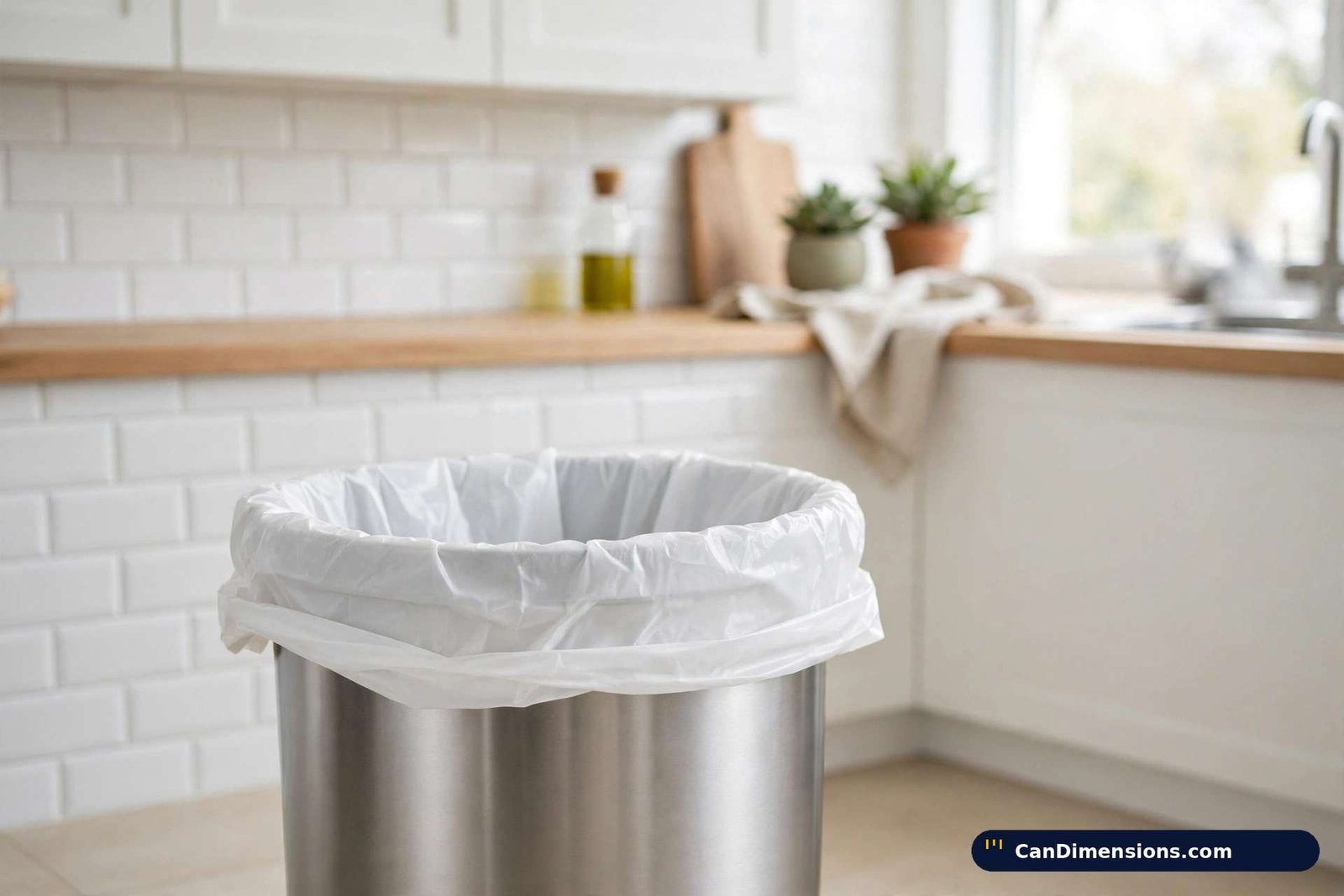
The fit check that binds is width, and it is arithmetic, not a formula with the circumference added to the length. A flat bag of width W opens into a tube of circumference 2 × W. For a round can, the bag’s width must be at least half the rim’s circumference: a 15-inch-diameter can has a rim circumference of 15 × 3.14 = 47.1 inches, so it needs a flat width of at least 23.6 inches — the standard 24-inch-wide tall kitchen bag fits, with little to spare. The older page’s worked example — “25 + (15 × 3.14) + 6 = approximately 78 inches” — adds the can’s whole circumference into the bag’s required length, which double-counts it: the circumference constrains the width, as above, while length is governed by the can’s height plus the fold-over you want at the rim (4–6 inches is the usual allowance). The same page’s claim that a 24 × 30 bag has a “108-inch perimeter” fails the same check: opened, a 24-inch-wide bag is a 48-inch-circumference tube; 108 is 2 × (24 + 30), the perimeter of the flat rectangle, which is not a fit measurement for anything. For a rectangular can, work from the rim: the older page’s 18 wide × 14 deep example has a rim perimeter of 2 × (18 + 14) = 64 inches — that number is right — and the practical check is the maker’s pairing: Kohler designs its 13-gallon can, rim and all, “to fit any brand of 13-gallon (49-litre) trash bag,” because the bag grips the rim’s long sides and folds at the corners rather than wrapping the full perimeter as a tube.
Kitchen Trash Can Fit Mistakes to Avoid
Four mistakes account for most bad fits, and each is visible in the verified figures above. Buying by gallons alone: the 13-gallon class spans 11.5–18 inches of width and 24.8–28.3 inches of height — the label cannot tell you whether the can fits your gap. Measuring the can closed: a step can’s working height is its open-lid height, about 36 inches on verified models; a can that “fits” under an overhang at 25.8 inches closed will hit it on the first pedal press. Reading the axes in the wrong order: listings print L × W × H, W × D × H and H-first in roughly equal numbers (the Amazon Basics can above is 16.7 long and 14.7 wide, not the reverse) — check the labels before concluding a can is too wide. Shopping pull-outs by nominal cabinet width: the binding numbers are the kit’s minimum opening dimensions — 11.125 or 14.5 inches wide, 22.125 deep, 19.25–20.25 high on the verified Rev-A-Shelf kits — and a nominal 18-inch cabinet is only a promise that such an opening probably exists.
Question’s
What is the standard size for a kitchen trash can?
13 gallons (49.2 litres). Verified standard cans stand 24.8–26.4 inches tall with footprints from 14.7 × 17.6 inches (Rubbermaid) to 18 × 14.7 (Glad).
What is the size of a standard kitchen bin?
The same 13-gallon tall kitchen class: about 25–26.5 inches tall, 14–18 inches wide, 13–18 inches deep, sized for tall kitchen bags.
What is the size of a 13 gallon trash can?
It depends on the maker — that is the point of the chart above. Verified range: 24.8–28.3 inches tall, 11.5–18 inches wide, 13–18 inches deep.
How big is a 12″ L trash can?
The “L” is the length — the front-to-back axis on most listings — so a 12-inch-long can has a shallow 12-inch footprint on that axis; capacity cannot be read from one axis. For a feel of the unit itself, see how 12 inches looks against everyday objects.
Is 50 liter 13 gallons?
Yes, effectively: 50 litres = 13.21 US gallons, so 50-litre cans are sold as the 13-gallon class (13 gallons exactly is 49.21 litres).
Is an 8 gallon trash can big enough for a kitchen?
For one or two people, or as a second can, yes — most 8-gallon units are in-cabinet pull-outs of about 19 inches tall. Most households fill one too fast and use 13 gallons.
Is a 10 gallon trash can big enough for a kitchen?
For a small household, yes — verified 10.6-gallon slim cans stand about 24.3 inches tall and only 10.2 inches wide. Families usually step up to 13 gallons.
Conclusion
The standard kitchen trash can is a 13-gallon can, and its real dimensions are a range with names attached: 24.8–28.3 inches tall, 11.5–18 inches wide, 13–18 inches deep across the verified Kohler, Rubbermaid, Glad, Amazon Basics and simplehuman models. Around it, the verified map is just as concrete — slim cans 10.2 inches wide and about 24.5 tall, in-cabinet pull-outs 19 inches tall inside 15- or 18-inch base cabinets, a dual recycler 22 inches wide, a 20-gallon round can 19.5 inches across and only 22.9 tall, and a tall kitchen bag that Glad prints at roughly 24 by 25.4–27.4 inches flat.
Measure your space on all four numbers — width, depth, closed height and open-lid height — match the bag to the rim, and treat any chart whose ranges no maker will sign as decoration. Every bag that leaves a well-fitted can is one the landfill receives a little later and a little fuller; the right size is the one that fits the kitchen first and the bin bag second, and now you have the makers’ own figures to check it against.