300 Feet: 11 Things with Pictures That Are 300 Feet Long or Tall
Three hundred feet is about where judging distance by eye gives up: too far to pace out casually, too tall to size against a doorway. The honest way to get 300 feet visualized is to borrow the length from things that genuinely measure it — a football field between its goal lines, a grove of old-growth redwoods, the dish of a great radio telescope.
Plenty of pages will also sell you a rounder version of it. The ferry fleets of America do not run to a neat 300-foot class, three ordinary blue whales laid in a line do not reach it, and the three celebrated towers most often listed for this height stand 390, 574 and 590 feet in reality. All of that is put to the test further down, and whatever fails the test remains visible here with its true size attached.
First come the conversions into the units people actually quote. Then come 11 things that genuinely measure 300 feet long or tall. Every entry was verified before it was admitted — against a rulebook, a maker’s published specification or an official body’s own figures — and where the number behind an entry is a floor-height convention, a catalogue option or a rulebook’s old imperial dimension instead of a tape-exact size, the entry says so in plain words.

How Long Is 300 Feet?
Three hundred feet is exactly 100 yards — the identity this whole topic hangs on. In the other units people quote it in:
| Unit | 300 Feet Equals |
|---|---|
| Inches | 3,600 in |
| Yards | 100 yd |
| Centimeters | 9,144 cm |
| Millimeters | 91,440 mm |
| Meters | 91.44 m |
Take the 25 feet you might pace out for a driveway or a garden bed and lay twelve of them in a row: that is the span this page is about. Stood upright, it clears a thirty-storey roofline; laid flat, it swallows a city block. Almost nothing in a house or on a residential street is built anywhere near it, which is why the honest references live on playing fields, in forests and on working water.
300 Feet Compared to a Human
The CDC’s measured data puts the average American man at 68.9 inches tall. Divide 300 feet by that height and you get about 52 — so the span equals roughly fifty-two grown adults piled one atop another, or the same fifty-two stretched heel-to-crown in a line along a kerbside.
Keep the number fifty-two in mind, not the “roughly fifty-four” that circulates with this topic. That figure pairs a shorter 5-foot-8 adult with a mis-division: even at 5 feet 8 inches the honest quotient is 53, and at the CDC’s measured average it is 52. Two phantom people may sound harmless, but they are eleven feet of invented height.
11 Common Things That Are 300 Feet Long or Tall
Every example under this heading was admitted only after verification against a primary source — a rulebook, a specification sheet, an operator’s published figures. Eleven pass: several to the exact foot, the rest on named bases — a floor-height rule, a catalogue tower option, a species’ documented size, a rulebook’s imperial original — that are stated inside their sections rather than hidden. Two of his six originals fail outright, and they remain in the list below, clearly marked, with their real sizes printed.
| # | Thing | Verified size | Counted? |
|---|---|---|---|
| 1 | NFL Football Field | Playing field exactly 100 yd (300 ft), goal line to goal line | Yes |
| 2 | 28 to 30-Story Building | About 10 ft floor-to-floor across 28–30 storeys | Yes — rule-of-thumb basis |
| 3 | Large Wind Turbine Tower | A listed 91.5 m hub-height option = 300.2 ft (Vestas V117-4.3 MW) | Yes — catalogue basis |
| 4 | Medium-Size Cargo Ship or Passenger Ferry | Named ferries bracket it instead: 296 ft and 302 ft | No |
| 5 | Three Blue Whales End to End | Typical adults run about 72–92 ft each; three make roughly 240–270 ft | No |
| 6 | Coastal Redwood Tree | The species passes 300 ft throughout old-growth stands; the record tree is 380 ft 9.7 in | Yes — species basis |
| 7 | The Green Bank 300-Foot Telescope | Reflecting dish exactly 300 ft in diameter | Yes |
| 8 | Millennium Force’s First Drop | First drop exactly 300 ft (park figures) | Yes |
| 9 | Orion’s First Drop | First drop exactly 300 ft (park figures) | Yes |
| 10 | Power Tower at Cedar Point | Combined structure 300 ft tall; rider travel 240 ft | Yes |
| 11 | A Field Hockey Pitch | FIH rulebook length 91.40 m — the metric form of 100 yd | Yes — spec basis |
| 12 | An Erie Canal Lock | Usable length for vessels exactly 300 ft (operator’s figure) | Yes |
| 13 | Bristol Cathedral | Published external length exactly 300 ft | Yes |
1. NFL Football Field
Counted: Exactly — by rule, and it is the cleanest reference on this page. The playing field in American football measures 100 yards from goal line to goal line under NFL and NCAA rules alike, and 100 yards is 300 feet. High school fields are built to the same playing length, so the rectangle most Americans have stood on, played on or watched is a true 300-foot span.
One boundary is worth stating, because broadcasts blur it: the two 10-yard end zones are not part of the 300. Goal line to goal line is the playing field; with both end zones included, the full striped rectangle runs 120 yards, or 360 feet. The counted figure here is the playing field itself.
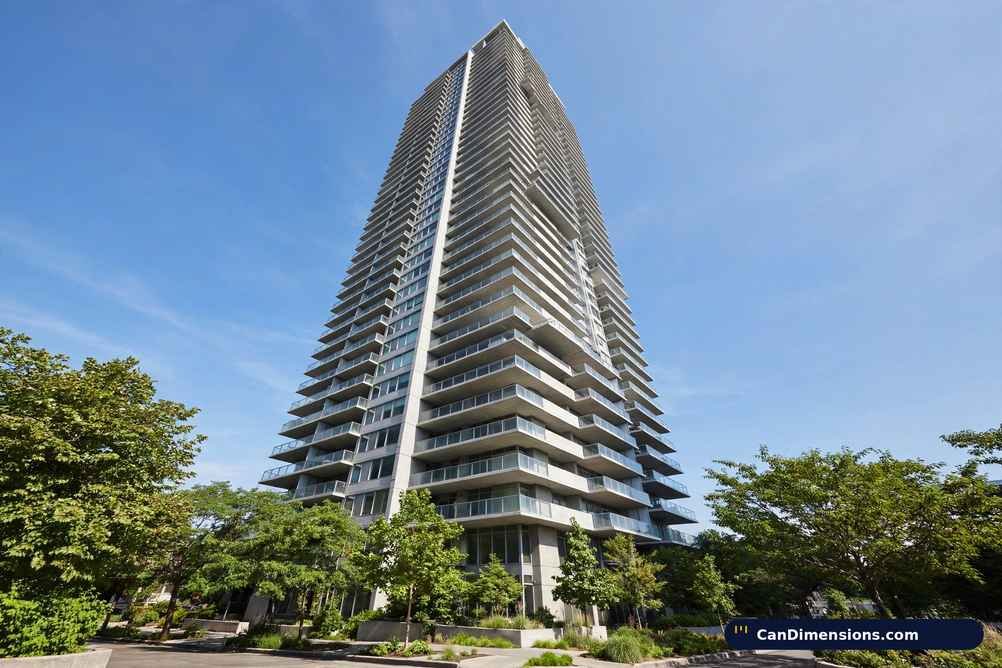
2. 28 to 30-Story Building
Counted: On the floor-height basis, flagged as the rule of thumb it is. Commercial construction works to roughly 10 feet from one floor to the next — ceiling height plus the structure carrying it — so a tower of 28 to 30 storeys lands in the 280-to-300-foot band, and plenty of American mid-rise towers in that band measure out at about this height. As a way of picturing 300 feet vertically, the class is honest.
What is not honest is naming towers that were never in the class. The three buildings usually listed with this example miss it by entire skylines: One Financial Center in Boston is a 46-storey tower standing 590 feet; the Carew Tower in Cincinnati is 49 storeys and 574 feet; and Birmingham’s Regions Center has the right storey count — 30 — but stands 390 feet, because its floors are not 10-foot floors. Storeys alone never fix a height; the floor-to-floor figure and the tape do.
3. Large Wind Turbine Tower
Counted: On a named catalogue basis, flagged — and the popular version of this claim is corrected below. Turbine towers are ordered in set heights, and at least one documented option lands on this mark: Vestas lists its V117-4.3 MW onshore turbine with a hub height of 91.5 metres in Ireland’s Triple E product register, and 91.5 metres is 300.2 feet. Put that turbine on that tower and the hub — the point the blades turn around — sits 300 feet above the field.
The claim that “the U.S. Department of Energy reports 300-foot towers are now the standard hub height” is not what the DOE reports. Its Land-Based Wind Market Report (2024 edition) puts the average hub height of turbines installed in the United States in 2023 at 103.4 metres — 339 feet — and the 2021 average was already about 308 feet. The fleet’s centre of gravity passed 300 feet years ago on its way up; today a 300-foot tower is the modest end of a new wind farm, not its standard.
4. Medium-Size Cargo Ship or Passenger Ferry
Not counted: The vessel class is real and the neat figure is not. “Medium-size cargo ship” covers hulls from under 300 feet to several times it, and the ferry fleets usually named with this example bracket the mark instead of landing on it. Alaska’s MV Tustumena, a working veteran of the Alaska Marine Highway since 1964, measures 296 feet on the state transportation department’s own vessel table — four feet short. The newest car ferry on Long Island Sound, MV Long Island, was built by Eastern Shipbuilding at 302 feet — two feet over.
So the honest summary is that 300 feet sits inside the ferry size range, between named ships that miss it by a few feet on either side. A bracket is a useful thing to know; it is not a measurement, and it does not get counted as one.
5. Three Blue Whales End to End
Not counted: The multiplication only works with three record-breakers. The longest blue whales ever measured scientifically run about 29.9 to 30.5 metres — 98 to 100 feet — and those animals are the extreme edge of the species, not its adults generally. Typical mature females measure roughly 72 to 92 feet depending on the population, so three ordinary adults laid nose to tail span about 240 to 270 feet. (NOAA’s rounded “up to 110 feet” figure is itself disputed in the scientific literature.)
The claim survives by quietly promoting every whale to the all-time maximum and then multiplying. Kept here corrected, it is still a striking comparison — just strike it at its true size: even the largest animal that has ever lived needs help from two record-class companions to reach a football field.
6. Coastal Redwood Tree
Counted: On the species basis, flagged. The coast redwood is the tallest tree species on earth, and old-growth stands hold large numbers of individuals past 300 feet — the tallest known trees of the species stand between about 360 and 381 feet. A mature old-growth redwood at 300 feet is not the species’ ceiling; it is the ordinary upper company of the protected groves in Redwood National and State Parks, which is exactly what a visualisation reference should be.
Two flourishes printed with this example need correcting. The record tree, Hyperion, was measured at 380 feet 9.7 inches in 2019 — recognised through Guinness World Records and the National Park Service, not “the U.S. Forest Service” — and at 380 feet it overshoots this article’s length by 80 feet, which is why the section counts the species and not that tree. Hyperion is also a reference to know rather than to visit: the Park Service closed its area in 2022, and going off-trail to find it risks a fine of up to $5,000 and six months in jail.

7. The Green Bank 300-Foot Telescope
Counted: Exactly — a diameter, stated plainly. The 300 Foot Telescope at Green Bank, West Virginia, was named for the single dimension that defined it: a reflecting dish 300 feet across, with a surface of about 78,000 square feet — roughly 1.8 acres of steel held in a paraboloid. The structure weighed some 600 tons and its highest point stood about 240 feet up (Green Bank Observatory’s and NRAO’s records).
It worked from October 1962 until 15 November 1988, when it collapsed without warning at 9:43 in the evening — no one was hurt, and the failure made it the most famous 300 feet in American radio astronomy. A diameter is not a length you can pace out, but it earns its place the same way the great telescope mirror does in our guide to 100 inches: one specified dimension, exact to the foot, that changed what its science could see.
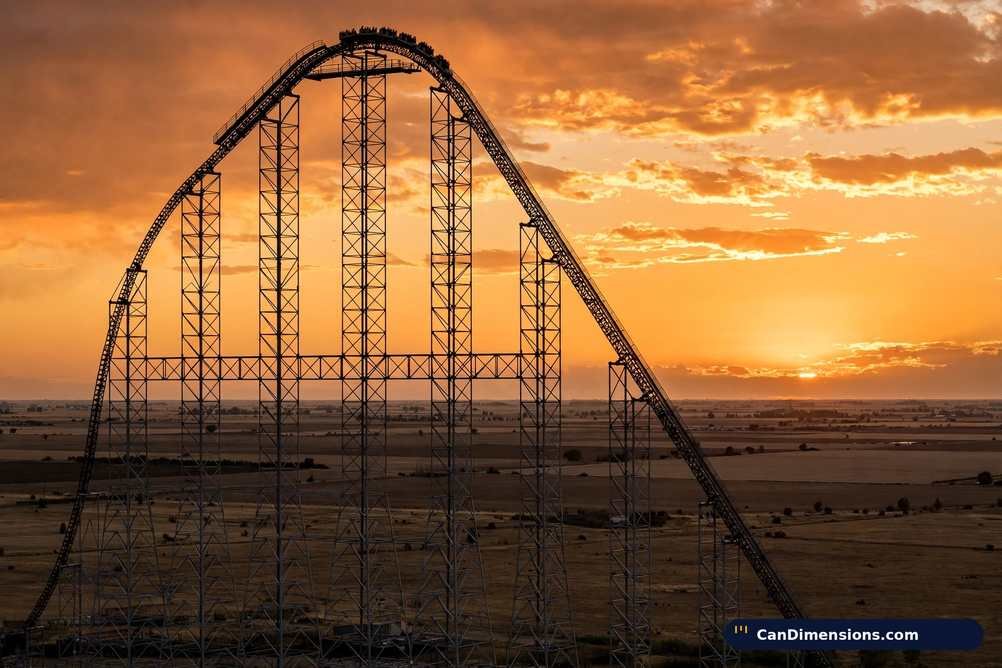
8. Millennium Force’s First Drop
Counted: Exactly, on the park’s own figures. Millennium Force at Cedar Point (Intamin; opened 13 May 2000) stands 310 feet tall, and its first drop is exactly 300 feet, falling at 80 degrees and reaching 93 mph. Cedar Point’s 1999 announcement of the ride coined a whole category for it — the “giga coaster”, a coaster whose height or drop falls between 300 and 399 feet — and Millennium Force was the first of them.
The number to hold onto is the drop, not the tower. Riders climb 310 feet of lift hill and then fall this article’s entire length in a few seconds, which makes the drop the most visceral 300 feet most people will ever experience.
9. Orion’s First Drop
Counted: Exactly — and it teaches the difference between a structure and a fall. Orion at Kings Island (Bolliger & Mabillard; opened 2 July 2020) climbs a lift hill only 287 feet tall, yet its first drop measures exactly 300 feet at 85 degrees, reaching 91 mph on the park’s figures. The drop outmeasures the hill because the track dives into ground excavated below the level the train started from.
A 300-foot fall out of a 287-foot tower sounds like a misprint until you stand in the low ground it falls into. It is also why this list counts drops as drops and heights as heights, and says which is which every time.
10. Power Tower at Cedar Point
Counted: Exactly, as a structure — with the rider’s number disclosed. Power Tower (S&S; opened 1998) is four towers, each 240 feet tall, joined at the top by arches and a crown, and the combined structure stands exactly 300 feet (Cedar Point’s specifications; the park’s 1999 Guinness citation lists the ride at 300 feet with a travel length of 240 feet). It is the only four-towered drop ride of its kind.
The disclosure is in that citation: riders themselves travel 240 of the 300 feet, launched up or dropped down the individual towers. The 300 is the tower’s true architectural height, crown included — the dimension you see from across the park — and that is the dimension counted here.
11. A Field Hockey Pitch
Counted: On the governing body’s specification, flagged on its rounding. The FIH’s Rules of Hockey fix the field of play at 91.40 metres long by 55.00 metres wide. Those metric figures are the converted descendants of the game’s imperial originals — a pitch 100 yards by 60 yards — and 100 yards is exactly 300 feet. One of the world’s oldest team sports still draws its rectangle at this article’s length.
The honest asterisk: a pitch marked precisely to the modern metric line measures 299.87 feet, about an inch and a half inside the old imperial line. The count rests on the rulebook’s own 100-yard basis, and the rounding is printed rather than hidden — the same treatment this guide gives every spec that arrives wearing two unit systems.
12. An Erie Canal Lock
Counted: Exactly, on the operator’s own stated figure. The New York State Canal Corporation answers the size question in its canal FAQ: all Canal System locks are built 328 feet long and 45 feet wide — but “the area available for vessels within a lock is 300 feet long, 43.5 feet wide”. The masonry chamber runs 328 feet; the working length a boat can actually occupy inside it is exactly 300 feet.
Both numbers are printed here because the honest 300 is the usable one. A captain planning a passage through the Erie Canal plans by the 300 — it decides what fits through the lock, which makes it a measurement in daily working use, not a rounding of the chamber behind it.

13. Bristol Cathedral
Counted: Exactly, on its published dimensions. Bristol Cathedral’s dimensions, as tabled in the standard architectural references, give a total external length of 300 feet (the internal length is 284 feet, and the nave alone 125 feet). The building — an abbey church raised between the 12th and 16th centuries and a cathedral since 1542 — runs this article’s full length along a city street in the middle of Bristol.
Cathedral lengths are normally quoted to the foot, and Bristol’s happens to be the round one: 300 feet from the west front to the far end of the eastern Lady Chapel. Stood on end it would match the towers in section 2; laid out as built, it has been a walkable 300-foot reference for about five centuries.
300 Feet Next to Other Lengths
| Length | How 300 Feet Compares |
|---|---|
| 10 feet | 300 feet is thirty of them |
| 20 feet | 300 feet is fifteen of them |
| 25 feet | 300 feet is twelve of them |
| 30 feet | 300 feet is ten of them |
| 40 feet | 300 feet is seven and a half of them |
| 50 feet | 300 feet is six of them |
| 80 feet | 300 feet is three and three-quarters of them |
| 100 feet | 300 feet is three of them |
| 500 feet | 300 feet is three-fifths of it |
The ladder does the memorising. Three hundred feet is thirty 10-foot spans end to end, fifteen times the 20-foot container-and-van length, ten times the 30-foot bus-and-boat class, seven and a half times the 40-foot container length, six times the 50-foot court-width length, and three and three-quarters of the 80-foot waterfall-and-flagpole length. Every rung below it is a length daily life actually hands you; 300 feet is where those rungs stack into architecture and landscape.
How to Visualize 300 Feet Without a Measuring Tape
Four tape-free ways to judge the distance, rated by how far you can trust them:
| Method | Accuracy | How To |
|---|---|---|
| NFL Football Field, Goal to Goal | ★★★★★ | Exactly 100 yards — the field itself, no arithmetic |
| 28 to 30-Storey Building | ★★★★★ | The 10-foot floor rule × 28–30 storeys (a rule of thumb, not a tape) |
| 20 Car Lengths | ★★★★☆ | An average car at about 15 feet × 20 |
| One Manhattan Block, North–South | ★★★★☆ | The short blocks run about 264 feet — twenty to the mile, so a shade under 300 |
One row in the version of this table that circulates needs removing: “5 city blocks” built on a “standard ~60-foot block”. No standard 60-foot block exists — city blocks run far longer almost everywhere, and the figure even contradicts the block answer in the FAQs below it. Five parade-route fragments are not a measuring method; one real block, honestly sized, is.
Measuring 300 Feet with Your Own Body
Your stride is the tape you always carry. A comfortable walking step covers about 2.5 feet, so roughly 120 easy paces walk out the full 300 feet — a span that takes a little over a minute to cover on foot at a normal 3 mph stroll, about 68 seconds.
For a floor-level check, the length is also 300 standard 12-inch ruler lengths end to end — which is precisely why nobody measures it that way twice. Pacing is the practical method: calibrate your own step once against a football field’s 10-yard lines (30 feet apart), and you own a 300-foot measure for life.
Where Does 300 Feet Appear in Daily Life?
Sports & Culture: Two of the world’s rulebook rectangles are drawn at exactly this length — the American football field between its goal lines, and the hockey pitch the FIH still specifies from its 100-yard original. No other large measurement is watched, paced and argued over by so many people every week.
Energy & Infrastructure: Wind towers reach 300 feet as a catalogue option and have passed it as an average — the American fleet installed in 2023 averaged 339 feet at the hub — so the 300-foot tower now marks the modest end of new wind farms rather than their frontier.
Maritime & Transportation: Working water brackets the figure — a 296-foot Alaska ferry below it, a 302-foot Long Island Sound ferry above it — while the Erie Canal’s locks hold exactly 300 feet of usable chamber. The measurement is lived daily at docks and lock gates even where the hulls themselves miss it.
Nature & Conservation: Old-growth redwood groves remain the only place this length stands alive and rooted: tree after tree past 300 feet, in forests that were old before the measurement had a name, protected in Redwood National and State Parks for anyone to stand inside.
Is 300 Feet Big?
Yes — it sits at the top of the human scale and the bottom of the monumental one. It is about fifty-two adults tall, three times the length of the largest animal ever reliably measured, and just under one-eighteenth of a mile. A person can walk it in about a minute, which makes it feel small on a map; standing at the foot of a 300-foot tower or beneath a 300-foot redwood corrects that impression instantly.
Its everyday invisibility is the point. Houses, streets and shops are all built far below it, so the length only appears where life gets organised at scale — sport, shipping, energy, worship and old forest. When a number keeps turning up exactly where human activity outgrows the household, that number is a genuine landmark, and 300 feet is one.
300 Feet Conversion Chart (Inches, Yards, Metres and Miles)
The short table under the first heading covered the everyday units. This fuller chart adds the rest, so a figure quoted in any system — including a sailor’s fathoms — can be checked against the same 300 feet.
| Unit | 300 feet equals |
|---|---|
| Inches | 3,600 in |
| Feet | 300 ft |
| Yards | 100 yd |
| Metres | 91.44 m |
| Centimetres | 9,144 cm |
| Millimetres | 91,440 mm |
| Kilometres | 0.09144 km |
| Miles | 0.0568 mi |
| Fathoms | 50 fathoms |
Worked from the exact definitions — 1 foot = 12 inches, 1 yard = 3 feet, 1 foot = 30.48 cm exactly, 1 mile = 5,280 feet, 1 fathom = 6 feet — so every row converts back to exactly 300 feet. The fathom row is the sailor’s version of the same span: the Erie Canal boat in section 12 floats in a lock holding 50 fathoms of usable length.
Almost 300 Feet: Familiar Things That Miss the Mark
Near misses earn their keep: every size below is documented, sits close to the mark, and misses it. Two of the five are the real dimensions standing behind this page’s failed ferry claim.
- The Statue of Liberty: 305 feet 1 inch. Ground to the tip of the torch, on the National Park Service’s Statue Statistics — five feet over, and the most photographed near miss in the country. (The statue alone, base to torch, is 151 feet 1 inch.)
- The Texas State Capitol: 302.64 feet. From the south front ground level to the tip of the star on the Goddess of Liberty, on the Texas State Preservation Board’s figures — under three feet over. The United States Capitol, at 288 feet, misses in the other direction.
- MV Long Island: 302 feet. The newest Long Island Sound car ferry, delivered by Eastern Shipbuilding — two feet over (see the ferry section above).
- MV Tustumena: 296 feet. The Alaska Marine Highway’s 1964 veteran, on the state’s vessel table — four feet under, and the closest working ship found to the mark.
- Hyperion, the record redwood: 380 feet 9.7 inches. Eighty feet over — the record tree overshoots the very class its own species fills so reliably (see the redwood section above).
FAQs About 300 Feet
What does 300 feet look like visually?
Stand at one end of an American football field and look down its length: the far goal line sits exactly 300 feet away. No picture of this measurement is easier to call to mind.
How many stories tall is 300 feet?
About 28 to 30 storeys, at the standard allowance of roughly 10 feet from floor to floor. It is a rule of thumb, not a definition: Birmingham’s 30-storey Regions Center stands 390 feet, because its floors are taller.
What portion of a mile is 300 feet?
0.0568 of a mile — 300 divided by 5,280 — which works out to just under one-eighteenth of a full mile.
How many feet is 300?
Three hundred feet is 3,600 inches, exactly 100 yards, or 91.44 metres — one complete football field measured from goal line to goal line.
How far is 300 feet in blocks?
About one short Manhattan block plus a little change: the north–south blocks run roughly 264 feet (twenty to the mile), so 300 feet is one of those blocks plus about 36 feet more. The long avenue blocks are several times longer.
How tall is 300 feet?
As tall as a 28-to-30-storey building or a mature old-growth redwood — and about twice the Statue of Liberty’s statue alone, though the whole monument, ground to torch, overshoots the mark at 305 feet.
How much is 300 feet visually?
The Green Bank dish gives the vertical version: 300 feet of white reflector stood on edge. Horizontally, it is the view from one goal line to the other on any football field in the country.
How tall is 300 feet compared to a human?
About 52 average adults. The CDC’s measured average for American men is 68.9 inches, and 300 feet divided by that height comes to roughly 52. The “roughly 54” printed elsewhere pairs a shorter 5-foot-8 adult with a mis-division — at 5 foot 8 the answer is 53.
Final Thoughts
Three hundred feet earns its drama honestly when it is measured rather than rounded: a football field’s playing length, a cathedral’s footprint, a canal lock’s working chamber, a telescope’s dish, and the drops that two American roller coasters fall through in seconds. That verified set is stranger and better than the rounded one — it has an excavated valley hiding inside a coaster’s statistics and a medieval church keeping company with a radio telescope.
Keep the honest references and retire the rounded ones: the ship class that brackets the mark, the whales that need three record-breakers, the towers that were never this height. And if you want the length at ground level instead of in the sky, find a field hockey pitch near you — the rulebook still draws it 100 yards long, which is 300 feet exactly, waiting on the grass.