Soup Can Dimensions: Size, Height and Can Numbers Explained
Ask how tall is a can of soup in a grocery aisle and the honest answer is “which soup?” A condensed can stands about 4 inches tall, a ready-to-serve can stands roughly 4½ to 4⅞ inches, and the big food-service can towers at exactly 7 inches.
Those figures surprise people because a widely copied chart assigns the wrong can to the condensed soup most homes actually buy. Shelf records for the real cans tell a different story, and this page follows the records: every size below is tied to an industry can standard, a maker’s case data or a commissary shelf listing.
You will find the corrected size chart first, then the can-number system decoded, the leading brands checked against their own packaging data, metric conversions, serving maths, circumference, and the storage numbers that decide whether a can fits your shelf at all.
Complete Soup Can Size Chart
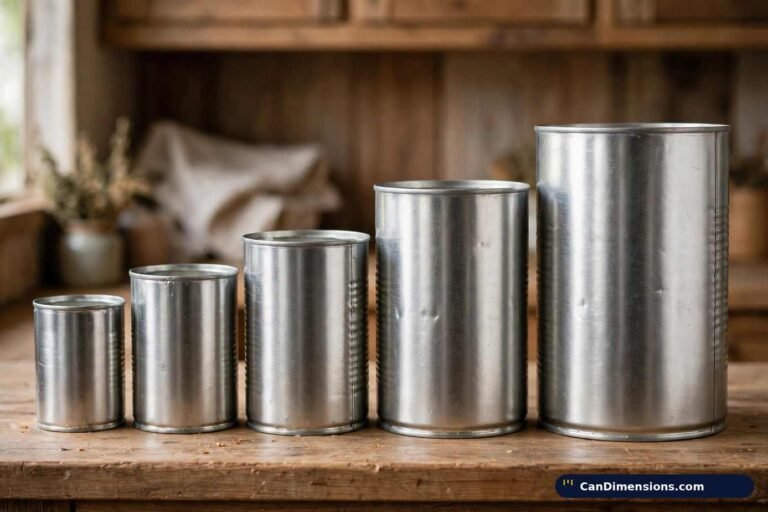
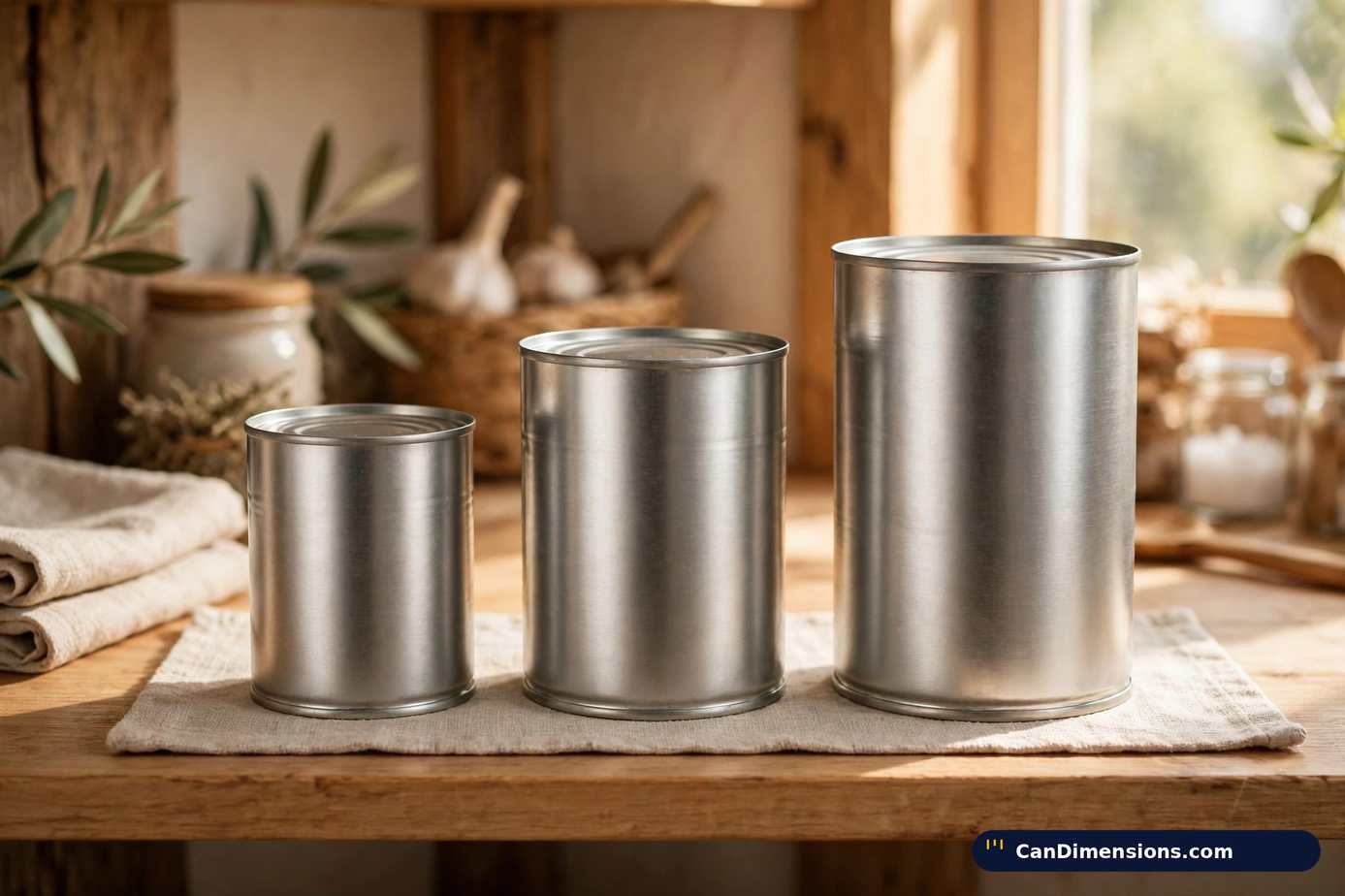
The chart below keeps the five rows shoppers ask about most, with each row rebuilt from its industry code rather than copied from earlier guides. A code such as 307×409 is not a decimal measurement: the first group gives the diameter and the second gives the height, each written as whole inches plus sixteenths of an inch.
| Can Size | Can Name | Diameter | Height | Capacity | Common Use |
|---|---|---|---|---|---|
| 211×400 | #1 (Picnic) | 2 11/16 inches | 4 inches | About 10½ to 12 oz | Condensed soup, fruit |
| 300×407 | 300 | 3 inches | 4 7/16 inches | About 14 to 16 oz | Beans, vegetables, some soups |
| 307×409 | #2 Can | 3 7/16 inches | 4 9/16 inches | About 19 to 20 oz | Ready-to-serve soup, vegetables |
| 401×411 | #2.5 Can | 4 1/16 inches | 4 11/16 inches | About 26 to 30 oz | Family-size portions |
| 502×510 | #5 Can | 5 1/8 inches | 5 5/8 inches | About 56 oz | Institutional soup, chili |
| 603×700 | #10 Can | 6 3/16 inches | 7 inches | About 102 to 117 oz | Food service, commercial |
Two cautions belong with any chart of this kind. First, the ounces in the capacity column are typical net weights for foods packed in that shell, not a property of the empty can: a dense soup and a light vegetable pack differently into identical metal. Second, the code describes the nominal shell, while a finished retail can may sit a few hundredths of an inch inside it once seams and retailer rounding enter the record — the brand section below shows exactly that gap.
Standard Soup Can Dimensions and Sizes
How to Read a Can Size Code
Read each three-digit group as a whole number of inches followed by a count of sixteenths. The group 211 therefore means 2 and 11/16 inches, the group 407 means 4 and 7/16 inches, and the group 700 means a plain 7 inches. Diameter always comes first and height second, the same diameter-times-height order used for the beverage can dimensions elsewhere on this site.
Once the code is decoded, the familiar names fall into place. The #1, #2, #2.5 and #10 labels are traditional trade names rather than measurements, which is why a #10 can holds roughly a hundred ounces instead of ten of anything. When a recipe, a shelf plan or a case listing gives only the code, the decoding rule above recovers the physical size without any guesswork.
Condensed Soup Can Dimensions
Condensed soup is the small can of American cooking, and its real shell is the #1 Picnic can, coded 211×400: a nominal 2 11/16 inches across by 4 inches tall. The finished retail can measures slightly inside the nominal code. Commissary shelf records for the leading condensed lines list the cans at 2.65 to 2.66 inches wide and 3.91 to 3.95 inches tall, and the maker’s own twelve-can case stands 4.125 inches high overall, cardboard included, which only works over a can of about 4 inches.
The net weight printed on that can is 10.75 ounces. Note the wording, because it matters later on this page: soup labels declare a weight, not a fluid volume, even though shoppers habitually read the figure as fluid ounces. The concentrate inside is meant to be diluted, usually with one can of water or milk, before it becomes soup.

Ready-to-Serve (Chunky) Soup Can Dimensions
Ready-to-serve soup skips the dilution step, so it ships in a larger shell — but not the shell most guides describe. The category splits by brand. One leading ready-to-serve line is built on the #2 shell, coded 307×409 at a nominal 3 7/16 by 4 9/16 inches, and commissary shelf records list those cans at 3.35 inches wide by 4.45 inches tall. The other leading line runs taller and narrower: shelf records put it at 3.15 inches wide by 4.95 inches tall, and its maker’s twelve-can case, at 12.875 by 9.5 by 5 inches, backs the taller figure, since four cans across a 12.875-inch case cannot be much wider than 3.2 inches each.
Net weights in this class run from about 18.5 to 19 ounces per can. Either way, the can you are holding is roughly half an inch to a full inch taller than the condensed can beside it, which is the difference that matters when a shelf was spaced for one and stocked with the other.
Small Soup Can Sizes
The genuinely small documented soup format sits one step below the condensed can: the 211×300 shell, sometimes listed as the 8Z short, at 2 11/16 inches across by just 3 inches tall, holding roughly 7 to 8 ounces. It keeps the condensed can’s diameter and gives up a full inch of height, which is why small cans stack so neatly in lunch bags and shallow drawers.
Claims about a 7.25-ounce soup can standing 4 inches tall on a narrower body could not be tied to any maker’s listing or shelf record during checking, so no such size is charted here. Single-serve soup today is also widely sold in microwavable cups and cartons rather than cans, and those packages follow no can standard at all.
Popular Soup Can Dimensions by Brand
Campbell’s Soup Can Dimensions
The condensed line from this maker is the reference can of the category, and its dimensions are the ones corrected at the top of this page: a #1 Picnic shell, nominally 2 11/16 by 4 inches, measuring about 2.66 inches across and just under 4 inches tall on the shelf, with a net weight of 10.75 ounces. The maker’s food-service listing for a twelve-can case of its condensed chicken noodle soup gives case dimensions of 10.75 by 8.25 by 4.125 inches — four cans by three, over a can roughly 2.7 inches wide and 4 inches tall.
The ready-to-serve line from the same maker is the tall, narrower can described above: about 3.15 inches across by about 4.95 inches tall in shelf records, at net weights of 18.6 to 19 ounces depending on variety. Shoppers comparing the two lines side by side are looking at a trade of width for height — the bigger can is barely half an inch wider, but nearly a full inch taller.
Other Major Brand Dimensions
The other national ready-to-serve brand packs its 18.5 to 19 ounce soups in the #2 shell class: a nominal 3 7/16 by 4 9/16 inches, listed on commissary shelves at 3.35 inches wide by 4.45 inches tall, with large retailers recording the same can at 3.45 by 4.45 inches once ship packaging is included. Organic and store brands overwhelmingly buy the same industry shells, because canning lines, case packers and shelf systems are all built around them.
That shared hardware is the useful takeaway. A brand may change its label, its recipe or its net weight by a fraction of an ounce, yet the can underneath stays one of the standard shells in the chart, and the standard shell is what decides your storage maths.
Why Brand Cans Measure Smaller Than the Chart
Read the brand figures above against the chart and a pattern appears: the shelf-measured can is consistently a few hundredths of an inch smaller than the nominal shell it belongs to. The condensed can belongs to a 2 11/16-inch shell yet shelves at 2.65 to 2.66 inches; the #2-shell brands belong to a 3 7/16-inch shell yet shelf at 3.35 inches.
Neither figure is wrong. The code names the shell as the can maker specifies it, while the shelf record captures the finished, seamed, labelled can as the retailer stocks it — and retailer records round to the nearest twentieth of an inch on top of that. For storage planning, use the shelf figure; for identifying which shell a can belongs to, use the code. Confusing the two bases is the single most common source of wrong soup can dimensions online.
Large Format Soup Can Dimensions
Above the retail sizes sit the cans that feed institutions. The #2.5 can, coded 401×411, measures 4 1/16 inches across by 4 11/16 inches tall and carries roughly 26 to 30 ounces — the family and small-restaurant size. The #3 can, coded 404×414, measures 4¼ by 4⅞ inches at about 32 ounces, and its tall sibling stretches the same diameter to a full 7 inches for juice and bulk packing.
The #5 can, coded 502×510, measures 5 1/8 by 5 5/8 inches and holds about 56 ounces, or seven cups. The giant of the system is the #10 can, coded 603×700: 6 3/16 inches across by exactly 7 inches tall, holding roughly 102 to 117 ounces depending on the food packed — twelve to thirteen cups from a single can. A #10 can is a catering tool, not a pantry item, and its 7-inch height is the figure to check before assuming it will stand on a home shelf.

Soup Can Dimensions in Metric (Centimeters)
Converting Soup Can Measurements
Metric figures on this page are exact conversions, worked at 2.54 centimetres to the inch and rounded once at the end. That discipline matters because the most common metric error in soup guides is converting a rounded inch figure instead of the real one: converting a rounded 4.5-inch height produces 11.43 centimetres, while the condensed can’s true height of about 4 inches converts to about 10.2 centimetres — a difference of more than a centimetre from a single early rounding.
Standard Sizes in Centimeters
| Can Size | Diameter (cm) | Height (cm) | Capacity (ml) |
|---|---|---|---|
| Condensed (#1, shelf-measured) | About 6.8 cm | About 10.2 cm | 305 g net (10.75 oz) |
| 300 | 7.62 cm | 11.27 cm | About 414 to 473 ml |
| Ready-to-serve (#2) | 8.73 cm | 11.59 cm | About 532 to 562 ml |
| #2.5 | 10.32 cm | 11.91 cm | About 828 ml |
| #10 | 15.72 cm | 17.78 cm | About 3,025 to 3,460 ml |
Read the condensed row carefully: its diameter and height are the shelf-measured retail figures converted, while the other rows convert the nominal industry codes. The two bases are labelled rather than blended, because mixing them silently is how the wrong numbers travelled from guide to guide in the first place.
Soup Can Capacity and Serving Sizes
Understanding Fluid Ounces vs Servings
Three different quantities share the word “ounce” on a soup shelf. Net weight is what the label declares, in ounces by weight. Fluid ounces measure volume, and the two agree only for water-like liquids. Servings are a labelling construct: United States rules set the reference amount for soup at 245 grams in 21 CFR 101.12, and makers express the label serving as roughly one cup derived from that reference.
A condensed can at 10.75 ounces net therefore contains a little over one reference amount of concentrate — before the water goes in. After preparation it yields about two and a half cups, which is why its label lists roughly two and a half servings even though the sealed can looks like a single portion.
Is One Can of Soup Equal to One Cup?
No. One cup is 8 fluid ounces, about 237 millilitres, and every standard soup can on this page holds more than that. The condensed can holds about 1.3 cups of concentrate and makes about 2.5 cups once prepared as directed. The ready-to-serve cans hold roughly 2.3 cups straight from the can.
The confusion is understandable: a single serving and a single can are marketed as near-synonyms, and for ready-to-serve soup many people do eat the whole can. Eating it is one decision; measuring it is another, and for recipes the cup figures above are the ones to cook with.
Standard Soup Serving Sizes
For label purposes the working serving is about one cup, anchored to the 245-gram federal reference amount. A prepared condensed can, at roughly two and a half cups, covers two generous bowls or two label servings with a little left over. A ready-to-serve can, at roughly 2.3 cups, is labelled at about two servings and eaten as one hearty portion by many adults.
Restaurant practice runs larger still, with bowls commonly poured at 12 ounces or more. None of this changes the can: plan a family meal by counting cups per can from the chart, then round up, because appetites treat the second serving as the point of the exercise.
Length and Circumference of Soup Cans
How Long is a Soup Can?
For a soup can, length means height — how far the can rises from the surface it stands on to the top of its rim, which is the dimension the sheet keyword asks about. Across the standard shells that distance runs from 3 inches for the small format, through about 4 inches for condensed and 4.45 to 4.95 inches for ready-to-serve, up to exactly 7 inches for the #10 food-service can.
Height is also the dimension that decides stacking and shelf fit, so it is the one to measure first. A can that fits a shelf lying down may still fail standing up, and the tallest common retail can needs a clear five inches of vertical space once a finger’s worth of lifting room is added.
Calculating Soup Can Circumference
Circumference is pi times diameter, and it governs label length, grip and how cans pack against each other. Worked on the nominal diameters: the #1 condensed shell gives about 8.44 inches around, the #2 ready-to-serve shell about 10.80 inches, the #2.5 about 12.76 inches, and the #10 about 19.44 inches. On the shelf-measured retail cans the figures shrink slightly — about 8.36 inches around the condensed can and about 9.90 inches around the tall ready-to-serve can.
If you are cutting a replacement sleeve or checking a holder, measure the can itself rather than trusting any chart, this one included: a tenth of an inch of diameter becomes nearly a third of an inch of circumference, and holders are unforgiving of thirds.
How to Measure a Soup Can Yourself
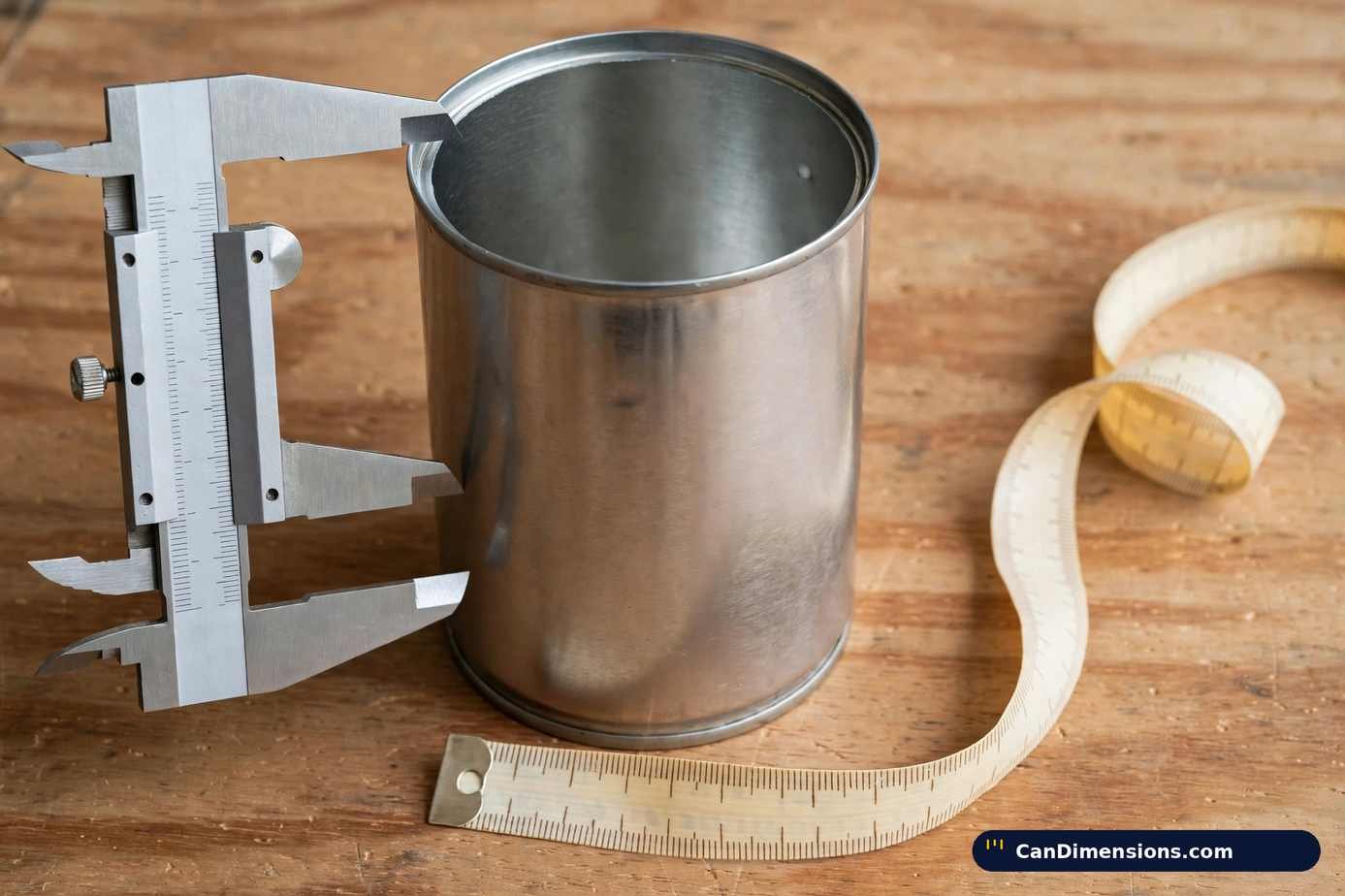
Stand the can on a flat counter and measure height first, from the counter surface to the highest point of the rim, with the ruler held vertically against the body. For diameter, measure straight across the widest part of the body rather than across the lid inset, and take the reading twice at right angles, because a dented can reads differently in different directions.
For circumference, wind a length of plain paper once around the can, pinch the point where the end meets the strip, then flatten it out and read the distance between the pinch marks. The same three readings, taken the same way, are how the aluminum can dimensions on this site were checked, and they take under a minute with a ruler and a paper strip — no caliper required, though a caliper makes the diameter quicker.
Soup Can Dimensions for Storage
Cabinet Space Planning
Depth rarely causes trouble: standard wall cabinets are built about 12 inches deep, several times any soup can’s diameter. Height is the binding constraint. A shelf spaced under 4 inches of clear height takes no standard can standing up; about 4.5 inches of clearance covers condensed cans; a clear 5 inches covers every common retail soup can, including the tall ready-to-serve format; and the #10 can needs its full 7 inches plus lifting room, which most home cabinets cannot offer between shelves.
Stacking deserves a cooler assessment than it usually gets. Sealed steel cans are strong, and a second layer over a flat, fully supported first layer is ordinary pantry practice. Tall stacks of mixed sizes are not: the tall ready-to-serve can rocks on the narrower condensed can beneath it, and three-high towers of mixed shells belong in a commercial storeroom with shelf lips, not over a home worktop.
How Many Cans Fit Across a Shelf?
The honest count comes from the diameter, not from optimism. Across a clear 12 inches: condensed cans at about 2.66 inches fit four across with room to spare; #2-shell cans at a nominal 3.44 inches fit three across; #2.5 cans at 4.06 inches fit two across with space left for a smaller can beside them. The same diameter decides whether a sleeve or holder fits, which is why the can koozie dimensions guide on this site also starts from the can’s outside width.
Refrigerator Storage After Opening
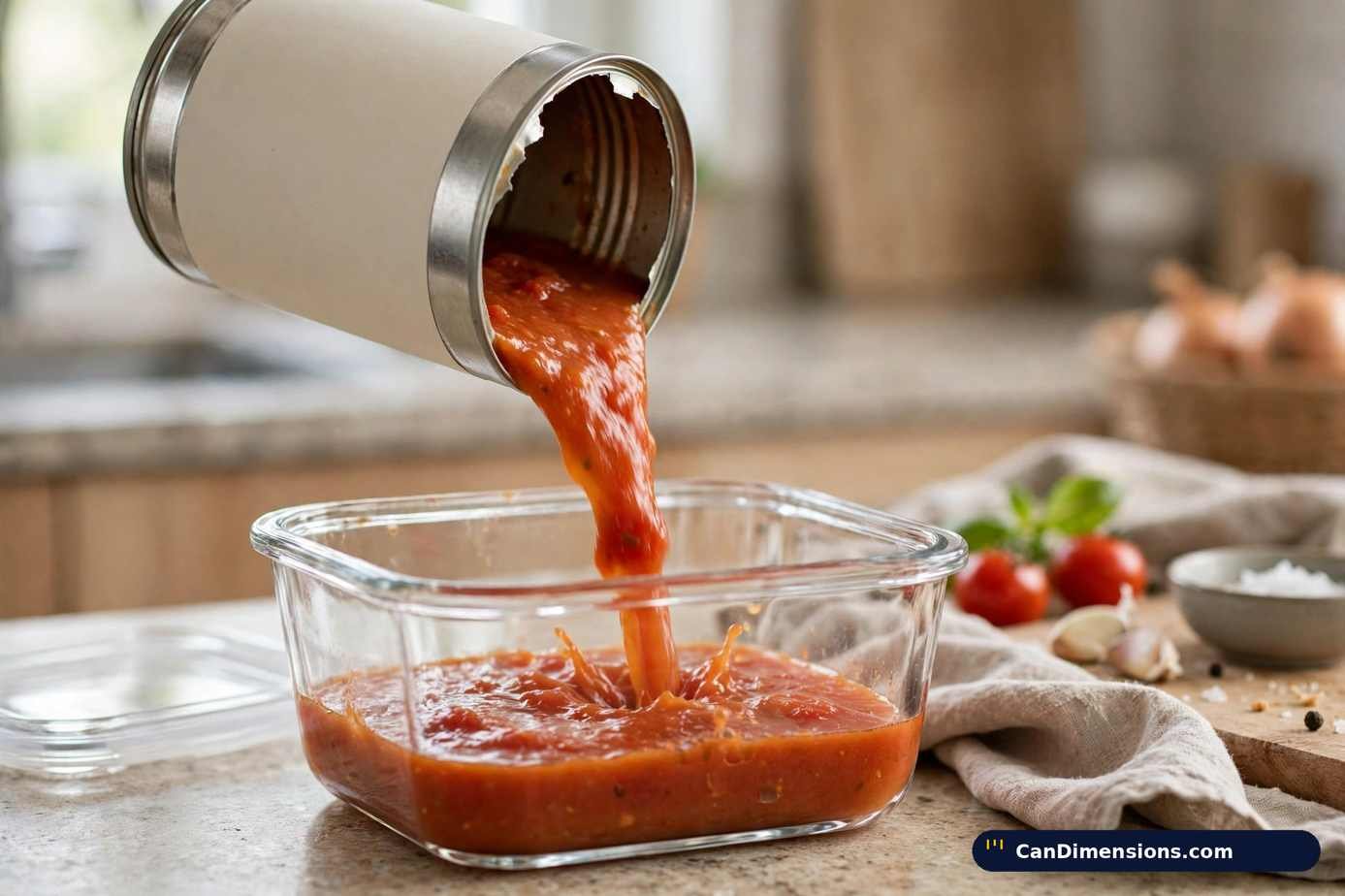
Once a can is opened, the storage rules change completely. Federal food-safety guidance allows an unused portion to stay in its can in the refrigerator, but recommends moving it to a food-grade glass or plastic container for the best flavour and quality, and using it within four days. Soup is a low-acid food, so treat four days as the outer limit rather than a target, and label the container with the opening date.
Choose the container by prepared volume, not by the can’s looks: leftovers from a ready-to-serve can need a container of at least two and a half cups, while a partly used condensed can, once diluted, can need more room than the concentrate it came from. When in doubt, size up — headspace is cheap, and a lid that will not close is a spill waiting for the drive to work.
Question’s
What are the dimensions of a soup can?
They depend on the format. The condensed can measures about 2.66 inches across by about 4 inches tall on the shelf, on a nominal #1 shell of 2 11/16 by 4 inches. Ready-to-serve cans run larger: about 3.35 by 4.45 inches for the #2-shell brand, and about 3.15 by 4.95 inches for the tall rival format.
How many centimeters is a can of soup?
The condensed can converts to about 6.8 centimetres across by about 10.2 centimetres tall. The #2 ready-to-serve shell converts to 8.73 by 11.59 centimetres, and the #10 food-service can to 15.72 by 17.78 centimetres.
How long is canned soup?
Length, for a can, is height. Standard cans run from 3 inches for the small format and about 4 inches for condensed, through 4.45 to 4.95 inches for ready-to-serve, to exactly 7 inches for the #10 can.
What is a standard serving size of soup?
About one cup. United States labelling rules set the reference amount for soup at 245 grams under 21 CFR 101.12, and label servings are expressed as roughly one cup derived from that figure — regardless of how much of the can one person actually eats.
What size is a Campbell’s soup can?
The condensed can is the #1 Picnic shell: about 2.66 inches across by about 4 inches tall on the shelf, holding a net weight of 10.75 ounces. The same maker’s ready-to-serve cans are taller and narrower, at about 3.15 by about 4.95 inches and 18.6 to 19 ounces.
Is 1 can of soup 1 cup?
No. One cup is 8 fluid ounces. A condensed can holds about 1.3 cups of concentrate and makes about 2.5 cups prepared; a ready-to-serve can holds roughly 2.3 cups as it stands.
Conclusion
Soup can dimensions turn out to be two stories told at once. The industry story is orderly: a ladder of numbered shells, each with a code that decodes to an exact nominal diameter and height, from the 211×400 Picnic can to the 603×700 #10. The shelf story is messier and more useful: the condensed can most homes buy measures about 2.66 by 4 inches rather than the widely copied 3 by 4.5, and the two big ready-to-serve formats differ from each other by half an inch of height.
Hold on to the handful of figures that do the daily work — about 4 inches tall for condensed, up to about 5 for ready-to-serve, 7 for food service — and measure any can that has to fit a shelf, a holder or a recipe before trusting a chart. Every can in the pantry, after all, is just a tin can whose size was standardised long before it reached your kitchen, and standardised sizes reward the cook who bothers to learn them.