Wheelchair Dimensions: Verified Size Chart, Height and Weight Guide
Start with a wheelchair size chart height and weight figures you can trust: a standard adult manual chair carries an 18-inch seat, measures roughly 25½ to 27 inches wide overall by model, stands about 36 inches tall, and is commonly rated to 300 pounds.
Two different widths hide inside every listing. Seat width names the chair size and drives the fit, while overall width counts the wheels and handrims as well — and that second figure alone decides whether a doorway works.
This guide separates those two widths class by class, sets product weight apart from weight capacity, checks the doorway and turning figures against the accessibility standards, and names the maker specification behind each headline number.
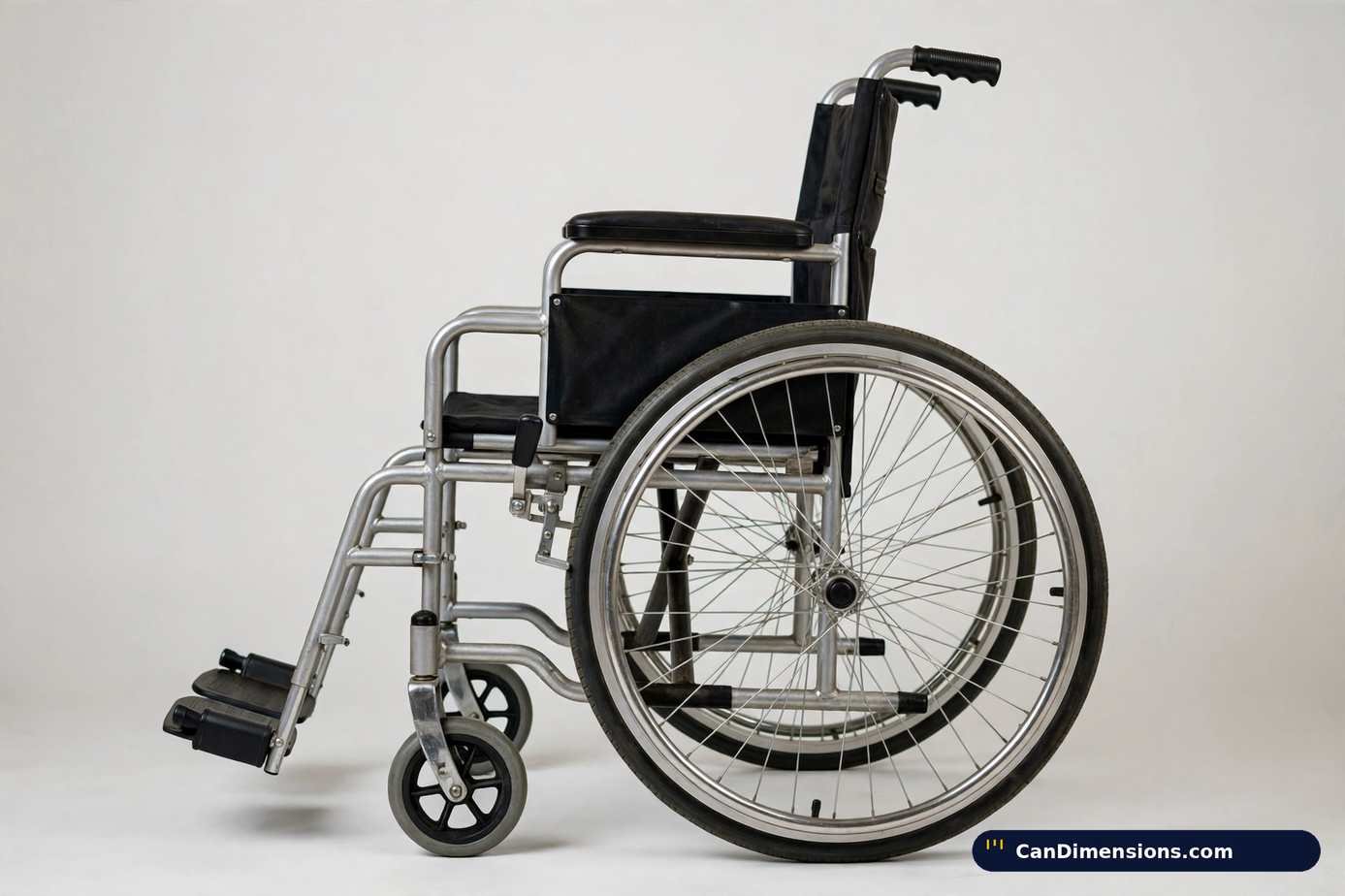
Standard Wheelchair Dimensions and Measurements
No single standard wheelchair exists on a maker’s shelf. What exists is a cluster of stock adult sizes that most product lines share, and the honest way to state the standard is as the spread those lines actually publish.
Overall height is the simplest figure: the bariatric line checked for this page lists its chairs at 36 inches tall, and mainstream adult manuals sit in that same neighbourhood, push handles included. Overall length needs more care, because sellers quote it two ways. Drive Medical lists a typical adult chair at 42 inches long with its front riggings fitted; shorter figures near 36 to 38 inches describe a frame measured without those riggings, so a length is meaningless until its basis is stated.
Seat height shows the same split. A stock dual-axle chair offers a standard seat-to-floor setting of 19.5 inches and a lower hemi setting of 17.5 inches on the same frame. The 19 to 19.5 inch band is therefore the standard setting, not the only one, and a buyer who needs the lower setting for foot propulsion should confirm the frame offers both axle positions.
Seat Width vs Overall Width: The Difference That Decides Doorway Fit
An 18-inch wheelchair is almost never 18 inches wide in a doorway. The seat figure is taken between the armrests, where the sitter’s hips rest. Overall width adds the frame, the rear wheels and the handrims on both sides, and on named models that addition runs to roughly 7½ to 9 inches.
The named examples make the point better than any rule. A Medline adult chair with an 18-inch seat is listed at 25.5 inches overall, a Drive Medical chair in the same seat size at 26 inches, and listings for another Drive line in that seat size run to 27 inches. Same seat, three overall widths, three different doorway margins — which is why this page prints a model spread wherever a summary chart prints one tidy figure.
Folded width answers a separate question again. A folding adult chair that opens to about 26 inches commonly folds to about 12 inches, and a transport chair can fold to about 9 inches. Folded figures belong to storage and car boots, never to doorway checks, because nobody travels through a door in a folded chair. The 12 inches a folded frame occupies is a boot measurement, not a passage measurement.
Wheelchair Sizing Chart
The chart below rebuilds the size classes from named makers’ published specifications. Read each row as a class anchored to real models, not as a promise about every chair sold under that label, because two makers can build the same seat size to different overall widths and ratings.
| Class | Seat width | Overall width (open) | Weight capacity | Product weight |
|---|---|---|---|---|
| Narrow adult | 16 inches | About 24.5 to 25 inches | 250 to 300 lb by model | Varies by frame |
| Standard adult | 18 inches | About 25.5 to 27 inches | 300 lb on the lightweight line; 250 to 350 lb by seat size on one standard line | About 34 to 36 lb on the lightweight line |
| Wide adult | 20 inches | About 28 to 29 inches | 350 lb on the checked standard line | Varies by frame |
| Bariatric (heavy duty) | 20 to 24 inches | 28 to 32 inches | 450 lb on the checked Drive line | About 55 to 60 lb |
| Extra-extra-wide bariatric | 26 to 30 inches | 34.5 inches at 26-inch seat; 36.5 inches at 28-inch seat | 700 lb on the checked Drive line | About 62 lb and up at 26-inch seat |
| Transport | 17 or 19 inches | About 22 inches on the checked aluminium model | 300 lb on the checked aluminium model | 19 lb on the checked aluminium model |
| Pediatric | 12 or 14 inches on the checked kids’ model | 21.5 inches on that model | As printed for the exact model | 17 lb total on that model |
Narrow Wheelchairs
A narrow adult chair means a 16-inch seat, and its overall width is wider than many listings imply. One checked lightweight line puts its 16-inch-seat chair at about 25 inches overall, and another maker’s 16-inch version sits near 24.5 inches. Capacity follows the model, not the label: the lightweight line rates its 16-inch chair to 300 pounds, while a standard line rates its 16-inch chair to 250 pounds.
Overall widths of 21 to 23 inches do exist in this topic, but they belong to other classes. The checked transport chair reaches about 22 inches overall because its small wheels add less at the sides, and the checked pediatric chair measures 21.5 inches overall around a much smaller seat. Calling either figure the width of a narrow adult manual mixes three products into one row.
Standard Wheelchairs
The standard adult size is the 18-inch seat. Its checked overall widths run from 25.5 inches on the Medline example to 26 inches on a Drive example, with some listings for a comparable Drive line reaching 27 inches. Capacity depends on which line is speaking: one standard Drive line rates its seat sizes separately, at 250 pounds for 16 inches, 300 pounds for 18 inches and 350 pounds for 20 inches, while the checked lightweight line rates its 18-inch chair to 300 pounds.
Medicare’s coding language draws the class more narrowly than retail language does. Under the federal policy article for manual wheelchair bases, the standard code describes a chair weighing more than 36 pounds, with a seat height of 19 inches or more and a capacity of 250 pounds or less. A retail chair sold as standard can therefore sit outside the coding definition, and the code on a maker’s page is that maker’s coding, not a payment promise.
Wide Wheelchairs
A wide adult chair carries a 20-inch seat, rated to 350 pounds on the checked standard line — that part of the usual chart story is sound. The overall width is where the tidy version breaks down: the checked bariatric line already measures 28 inches overall at a 20-inch seat, and listings for a 20-inch lightweight chair run to about 29 inches overall. A buyer working from a 27-inch figure for this class can be two inches wrong at the exact doorway that matters.
Extra Wide Wheelchairs
Extra wide, in the checked Drive bariatric line, covers 20, 22 and 24-inch seats under one reinforced design. The three sizes measure 28, 30 and 32 inches overall respectively, share an 18-inch seat depth, stand 36 inches tall and 42 inches long with riggings, and carry a single 450-pound rating across the line. Their product weights climb with size, at about 55, 57 and 60 pounds. Capacity therefore does not climb seat by seat inside this line, and the overall widths run whole sizes larger than a standard chair’s pattern, because the reinforced frame and wider wheels spend real room at the sides.
Bariatric Wheelchairs
Bariatric is not one band but at least two distinct families in the checked range. The heavy-duty line above tops out at 450 pounds on seats to 24 inches. A separate extra-extra-wide line takes over at 26, 28 and 30-inch seats with a 20-inch seat depth, a 700-pound rating, overall widths of 34.5 inches at the 26-inch seat and 36.5 inches at the 28-inch seat, and product weights starting near 62 pounds. A single band of 500 to 700 pounds misses both families: it overstates the first and describes only the second. Seat depth separates them as cleanly as capacity — 18 inches against 20 inches — and seat-to-floor height on the heavy-duty line adjusts between 17.5 and 19.5 inches.
Lightweight and Pediatric Sizes
Lightweight is a weight class before it is a size class. The checked lightweight adult line weighs about 34 to 36 pounds across its 16 to 20-inch seats while rating each chair to 300 pounds, showing how frame design separates product weight from capacity. Below the adult range sit the pediatric sizes. One checked kids’ model offers 12 and 14-inch seat widths with a 13-inch seat depth, a 16-inch seat-to-floor height, a 21.5-inch overall width and a total weight of 17 pounds, falling to 12 pounds without its rear wheels. Pediatric seat widths across makers run roughly from 10 to 16 inches, so a child’s chair is chosen from its own size ladder, never as a shrunken adult chair.
Additional Measurements
Seat depth on stock adult chairs is most often 16 inches, not 18. The checked lightweight line builds its seats at 16 inches deep, transport chairs commonly sit at 16 inches deep, and the deeper figures belong to the bariatric lines at 18 and 20 inches. A chart that calls 18 inches the common depth has mistaken the heavy-duty figure for the standard one.
Back height on the checked bariatric line is 18 inches, and adjustable and reclining backs move beyond any single stock figure, so back height belongs to the exact model’s sheet. Rear wheel size varies the same way: a self-propelled adult chair commonly carries 24-inch rear wheels, while a transport chair runs on small wheels at both ends, typically 8-inch rears on the checked aluminium model.
How to Measure for the Right Wheelchair Fit
Published fitting guidance works from the seated body, and the four core measurements below follow that method. They are general sizing guidance only; a clinician or seating specialist should confirm the final fit, particularly where posture or pressure care is involved.
Seat width starts at the widest point across the hips or thighs while sitting, with a flat object held against each side so the tape reads a straight line. Guidance then adds 1 to 2 inches of clearance, matched to the nearest stock seat size. That clearance is the whole method — body weight alone does not select a seat width, whatever a summary chart claims.
Seat depth is taken from the back of the buttocks to the crease behind the knee, minus about 2 inches. The gap left behind the knee is deliberate: a seat that reaches the crease can press there through a long sit.
Seat height works from the lower leg: heel to back of knee, in the shoes normally worn, checked against the chair’s seat-to-floor figure and footrest adjustment — a dual-axle frame may offer both a 19.5-inch standard setting and a 17.5-inch hemi setting. Back height runs from the seat surface toward the shoulder blades, commonly minus about 4 inches, so the backrest supports the trunk without crowding the shoulders during propulsion.
Wheelchair Doorway and Space Requirements
Doorway fit compares two numbers: the chair’s overall width when open, and the doorway’s clear opening. Clear opening is not the size printed on the door slab; it is the unobstructed width left when the door stands open, after the slab, hinges and stop have taken their share, which is why the tape belongs across the open doorway.
The standards set the reference figures. Doors on an accessible route must provide a clear width of 32 inches minimum under the 2010 ADA Standards, and a route itself keeps at least 36 inches of continuous clear width, the same span as 3 feet. A standard chair at about 26 inches overall passes a genuine 32-inch clear opening with room for hands on the handrims. Older interior doors are harder: a nominal 30 inches door delivers a clear opening narrower than 30 inches once its slab sits open in the frame, so the standard chair’s margin shrinks to an inch or two, and a wide or bariatric chair at 30 to 32 inches overall may not pass at all.
Turning and parking space come from the same standards. A turning space is a circle 60 inches in diameter at minimum, or a T-shaped space inside a 60 by 60 inch square; clear floor space for one stationary chair and its occupant is 30 by 48 inches minimum. A hallway figure of 36 inches describes straight passage, never turning, and a room can offer the passage width while offering nowhere to turn. The average living room dimensions give a sense of how much turning room ordinary layouts leave, and a standard garage door opening, by contrast, is never the constraint — the interior doors on the way to it are.

Ramps follow their own published limits on an accessible route: a maximum running slope of 1 in 12, a clear width of at least 36 inches between handrails, and a level landing after no more than 30 inches of rise. Those figures govern public and commercial routes; a private home is not held to them, but they remain the reference a builder will quote, and a portable ramp should still be checked for its slope at the actual step height it has to climb.
Folded width and transport in a car. A chair that fits its user and its doorways still has to fit a vehicle. Folding adult manuals commonly close to about 12 inches wide, the checked transport chair folds to about 9 inches, and the checked pediatric model folds to 12 inches. Length with riggings matters in a boot as much as width does: footrests that swing away or lift off shorten the package, and makers who quote a weight without riggings say so on the sheet. Read any folded figure alongside its basis, just as a 300 pounds rating must always be separated from a load.
Wheelchair Weight Guide
Product weight and weight capacity answer different questions, and this guide keeps them apart throughout. Product weight is what a caregiver lifts into a car; capacity is the maker’s rated ceiling for the occupant, and exceeding it is a specification breach, not a comfort preference. A chair can be light and strongly rated, or heavy and modestly rated, because frame design pulls the two numbers in different directions.
Standard Manual Wheelchairs
The familiar statement that a standard manual weighs 25 to 40 pounds spans several classes at once and satisfies none of them precisely. The coding definition of a standard chair expects a weight above 36 pounds; the checked lightweight line weighs about 34 to 36 pounds; and genuinely light transport and pediatric products weigh under 20 pounds, but they are different products with different jobs.
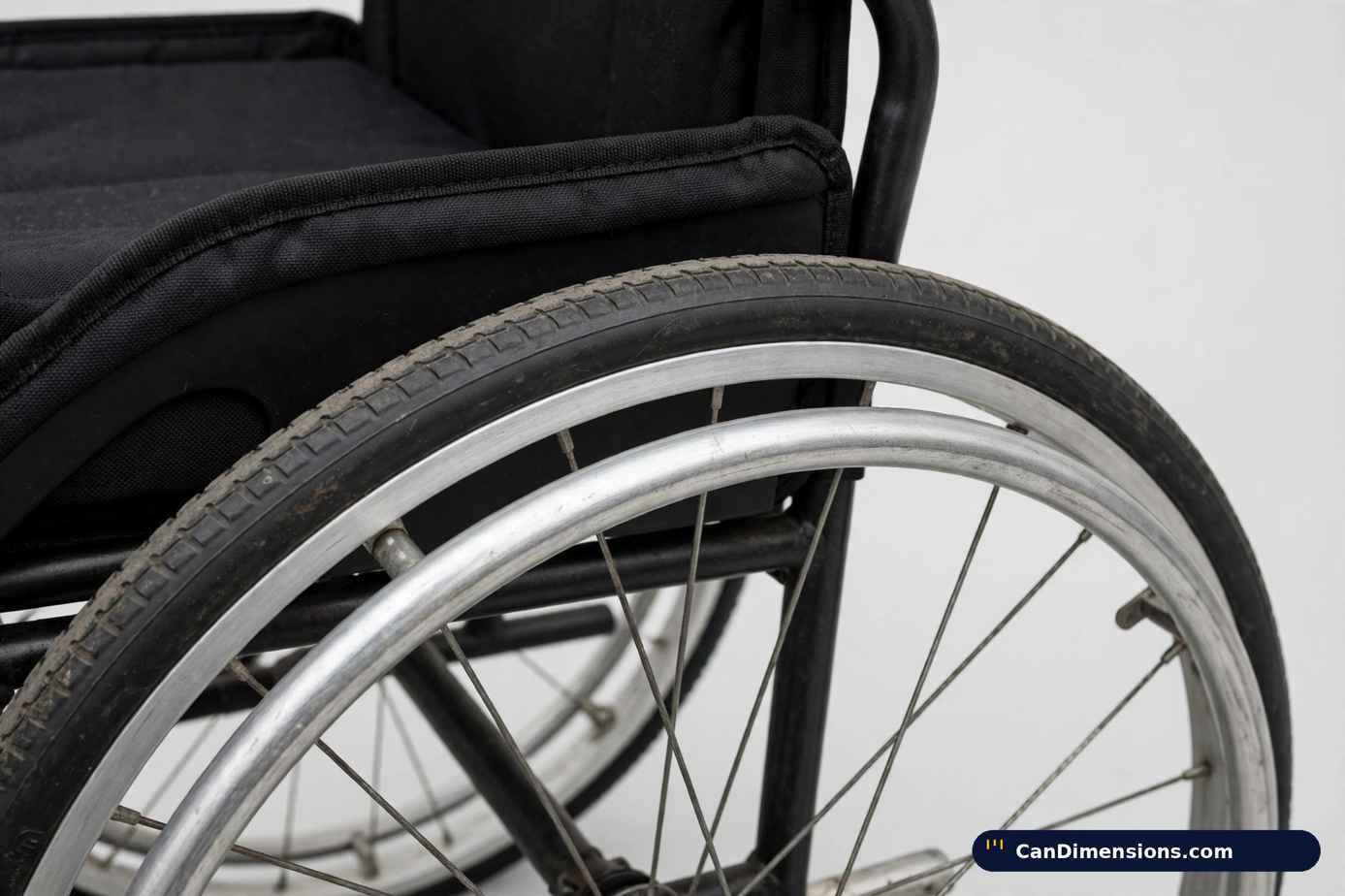
Frame material explains much of the spread. Carbon steel carries the heavier stock chairs and the reinforced bariatric lines, at about 55 to 60 pounds on the heavy-duty line and more on the extra-extra-wide line. Aluminium carries the lightweight adult lines and the lightest transport chairs. Neither material is a quality verdict: the steel bariatric frame is heavy because its rating demands it.
Weight Capacity
Capacity is printed per model and sometimes per seat size, and the only safe reading is the figure attached to the exact configuration being bought. The sections below keep the two capacity families apart, because merging them into one band was the largest error in the summary charts this page replaces.
Standard
On the checked standard Drive line, capacity climbs with seat width: 250 pounds at 16 inches, 300 pounds at 18 inches and 350 pounds at 20 inches. On the checked lightweight line, the rating holds at 300 pounds across all three seat sizes. Both patterns are real, which is why no universal capacity can be attached to a seat width alone. Compare the occupant’s weight with the chosen model’s rating and leave a margin; anything carried on the chair counts toward the load in use, so a supplier should confirm how the maker treats added equipment.
Bariatric
The checked heavy-duty line rates every seat size, 20 through 24 inches, to 450 pounds; the extra-extra-wide line rates its 26 through 30-inch seats to 700 pounds. No checked model in this research sits at 500 or 600 pounds, so a band of 500 to 700 pounds describes a range with a hole in its middle. A buyer above 450 pounds is shopping in the second line only, and a buyer below it gains nothing from that line’s extra width, weight and doorway demands.
Transport Wheelchairs
A transport chair is pushed by a companion. Its four small wheels carry no handrims, so its occupant cannot propel it, and that single fact — not its weight — is what separates it from a manual wheelchair. The checked Drive aluminium transport chair weighs 19 pounds, offers 17 and 19-inch seat widths, folds to about 9 inches, measures about 22 inches wide overall and is rated to 300 pounds. A flyweight model from the same maker weighs 16.2 pounds without its footrests and 18.9 pounds with them, also rated to 300 pounds, and an ultralight competitor model is listed at 15 pounds with the same rating.
Those figures correct the usual summary in both directions. Capacity on a mainstream transport chair is a specific 250 to 300 pounds by model, not an unknown, and weight is not capped at 25 pounds across the class: bariatric transport models rated to 450 pounds weigh about 45 to 49 pounds. A transport chair suits appointments, travel and outings where a pusher is always present; the limit is the pushing arrangement and the small-wheel ride, not a rule that the chair may only be used briefly.

Power Wheelchair Dimensions at a Glance
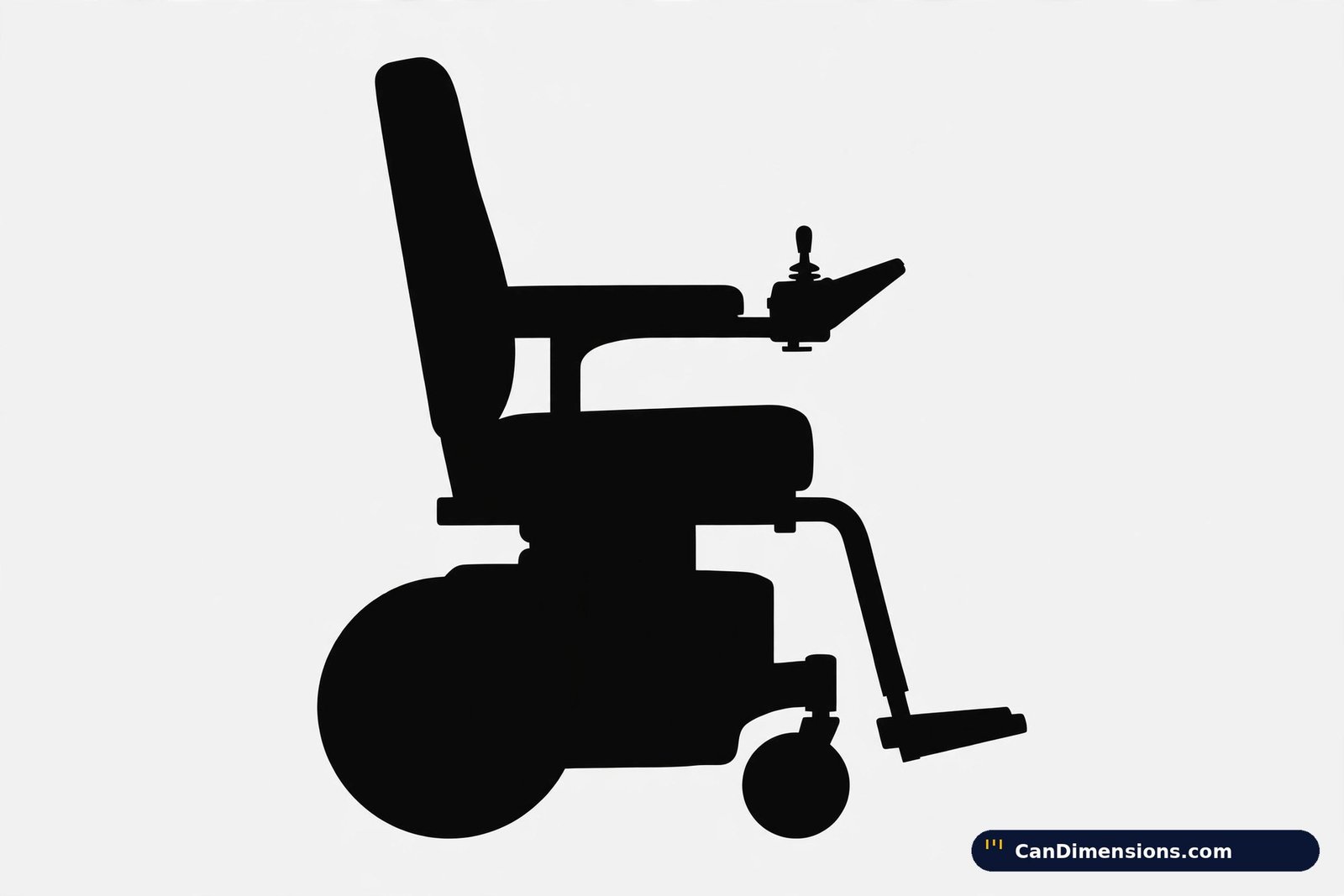
Power chairs follow the same two-width discipline, with a base width quoted separately from the width over the seating. One checked model, the Permobil M3 Corpus, lists a 24-inch-wide base, an overall width of 25.5 to 31 inches by configuration, an overall length of 40 inches, seat widths from 17 to 23 inches, seat depths from 14 to 22 inches and a maximum user weight of 330 pounds. Its manual also publishes the space the chair needs — a corridor width of 28 inches for a side opening and 33 inches for an angled corridor — and those maker figures outrank any general turning circle where both exist.
Quick Comparison
The table below is the weight half of this page in one view, rebuilt from the named models above. Use it to separate the families, then return to the exact model’s sheet for the governing figure.
| Type | Product weight | Weight capacity | Best for |
|---|---|---|---|
| Standard manual (checked lines) | Above 36 lb under the standard coding definition; about 34 to 36 lb on the checked lightweight line | 250 to 350 lb by seat size on one line; 300 lb across the lightweight line | Daily use, self-propelled or pushed |
| Bariatric heavy duty (checked line) | About 55 to 60 lb | 450 lb | Higher weight needs, seats to 24 inches |
| Bariatric extra-extra-wide (checked line) | About 62 lb and up | 700 lb | Higher weight needs, seats from 26 inches |
| Transport (checked models) | 15 to 19 lb mainstream; about 45 to 49 lb bariatric | 250 to 300 lb mainstream; 450 lb bariatric | Short trips and travel with a companion pushing |
Wheelchair Dimensions in Centimeters and Kilograms
Metric equivalents follow from the inch figures already verified, converted at 2.54 centimetres per inch and 2.20462 pounds per kilogram with a single rounding step. An 18-inch seat is 45.72 centimetres wide, a 26-inch overall width is 66.04 centimetres, and the 42-inch length with riggings is 106.68 centimetres. The 32-inch clear door opening is 81.28 centimetres, the 36-inch route width is 91.44 centimetres, the 60-inch turning circle is 152.4 centimetres, and clear floor space of 30 by 48 inches becomes 76.2 by 121.92 centimetres.
For weight, a 300-pound capacity is 136.08 kilograms, the 450-pound rating is 204.12 kilograms and the 700-pound rating is 317.52 kilograms, while a 19-pound transport chair weighs 8.62 kilograms and a 57-pound bariatric chair weighs 25.85 kilograms. Where a maker publishes its own metric sheet, that sheet governs; these conversions simply let an inch-based sheet be compared with a metric doorway or lift limit.
Question’s
What size is a standard size wheelchair?
The 18-inch seat is the standard adult size. Checked overall widths for that seat run from 25.5 to 27 inches by model, height sits near 36 inches, and length is 42 inches with riggings fitted on a typical Drive sheet — shorter figures are measured without riggings.
Will a wheelchair fit through a 30 inch door?
Usually, for a standard chair, with less margin than the headline suggests. A nominal 30-inch door leaves a clear opening narrower than 30 inches once the open slab is counted, and a standard chair at about 26 inches overall passes with an inch or two to spare. A wide or bariatric chair may not pass. Measure the clear opening and compare it with the chair’s overall width.
What is the difference between 16 inch and 18 inch wheelchairs?
Seat width, and the fit that follows from it. The 16-inch seat suits a narrower seated hip measurement under the published method of hip width plus 1 to 2 inches of clearance; the 18-inch seat suits a wider one. Body-weight bands do not set the choice, and capacity can be identical across both sizes on one model — the checked lightweight line rates both to 300 pounds.
How wide does a space need to be for a wheelchair?
For straight passage along an accessible route, 36 inches of continuous clear width under the 2010 ADA Standards. For turning, a 60-inch-diameter circle or a T-shaped space inside a 60 by 60 inch square. The two figures answer different questions, and a space can satisfy the first while failing the second.
What is the narrowest wheelchair width?
Among adult self-propelled chairs, about 24.5 to 25 inches overall at a 16-inch seat on the checked lines. Narrower overall figures belong to other classes: about 22 inches for the checked transport chair and 21.5 inches for the checked pediatric model, neither of which substitutes for an adult manual chair.
What is a clear floor space for a wheelchair?
Thirty by 48 inches minimum under the 2010 ADA Standards — the level, unobstructed area in which one stationary chair and its occupant can be positioned for a forward or a parallel approach to a fixture or surface.
What are the four basic measurements for a wheelchair?
Seat width, seat depth, seat height and back height. Published guidance takes them from the seated body: hip width plus clearance for width, buttock to behind-knee minus about 2 inches for depth, heel to behind-knee for height, and seat to below the shoulder blades, commonly minus about 4 inches, for back height. A clinician should confirm the final fit.
What kind of wheelchair will Medicare pay for?
Medicare Part B can cover manual and power wheelchairs as durable medical equipment when they are medically necessary for use inside the home. Coverage generally requires a face-to-face examination, a written order, documentation that daily activities in the home are significantly limited even with a cane or walker, and a Medicare-enrolled supplier. The person must be able to operate the chair safely or have a caregiver who can help. Rules change, so confirm the current position with Medicare or the supplier.
Is 32 inches wide enough for a wheelchair?
Yes, where 32 inches is the clear opening — the minimum clear width for doors on an accessible route under the 2010 ADA Standards, which a standard chair passes comfortably. A nominal 32-inch door delivers slightly less clear opening, and a bariatric chair at 32 inches overall or more still will not pass, so the measurement basis matters as much as the number.
Conclusion
Wheelchair sizing resolves into a handful of disciplined comparisons. Seat width, taken from the seated body with 1 to 2 inches of clearance, selects the chair size. Overall width, read from the exact model’s sheet, decides the doorways. Product weight decides who can lift the chair, and weight capacity, read per model and never as a class band, decides who it can safely carry. The standards figures — a 32-inch clear door opening, a 36-inch route, a 30 by 48 inch clear floor space and a 60-inch turning circle — then test the building against the chair.
Measure the body, the chair and the building as three separate jobs, write each figure down with its basis, and let a seating professional check the final fit before money changes hands. The last detail worth planning is the route out of the building itself, where a well-sized wheelchair ramp turns a doorway that fits into a home that works.