Koozie Size Fit Guide: Which Koozie Fits Which Drink?
The wrong koozie size fails in one of two ways at the cooler: it refuses to pull over the can at all, or it hangs loose around a narrower drink and insulates mostly air. Both failures happen before the first sip, and both trace back to the same habit — choosing sleeves by the name of the drink instead of by the drink’s measurements.
This guide works in the opposite order. It begins by fit-testing every common sleeve against the drinks people actually load into a party cooler — the everyday can, the tall seltzer, the pint can, the taproom crowler and the glass bottles — and only then sets out the complete size and printing reference, so the buying decision can rest on the test results.
One caution runs through everything below: sleeves have no governing standard of their own, so each figure here is anchored to the can or bottle it must fit and to the patterns suppliers actually cut. Where suppliers scatter by a few tenths of an inch, the page prints the figure they converge on and marks it as approximate.
Koozie Fit Test: Which Sleeve for Which Drink?
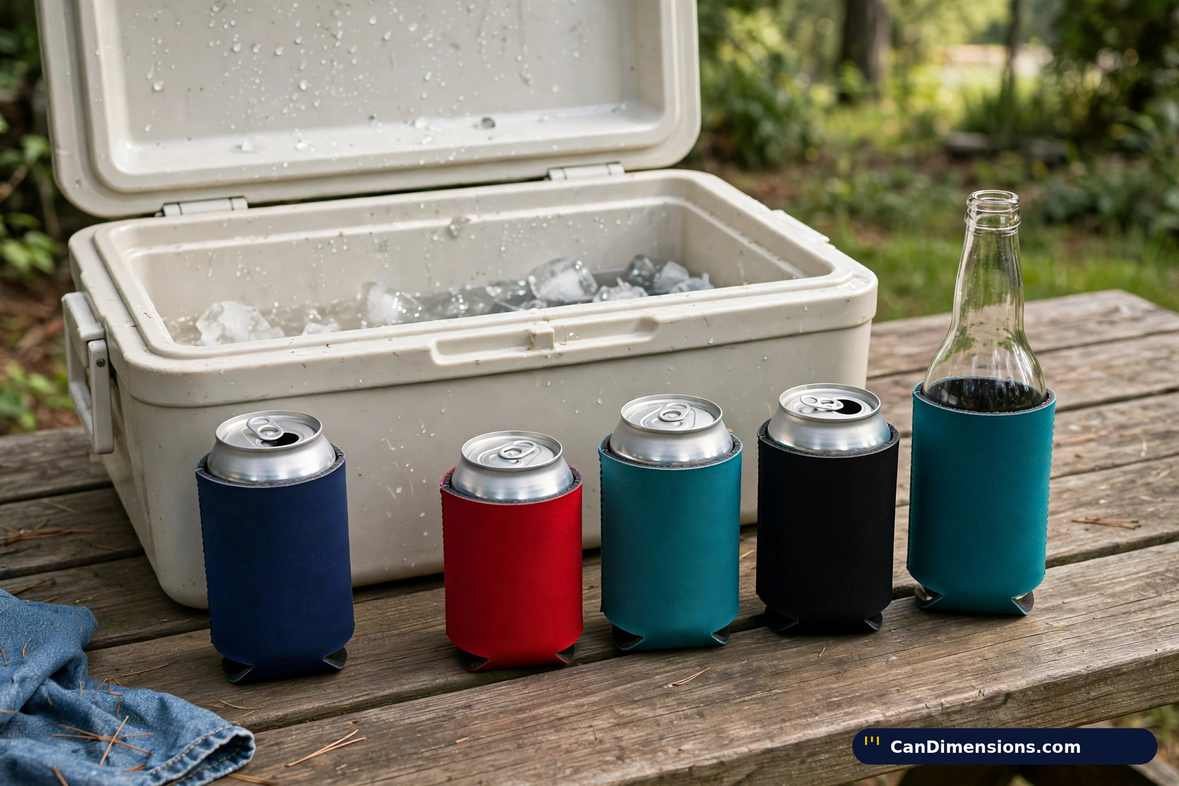
A sleeve passes or fails on a single measurement: the drink’s circumference, pi multiplied by its body diameter. Height decides how much of the wall gets covered; circumference decides whether the sleeve grips at all. Tested drink by drink, the cooler shakes out like this.
| Drink | Drink size (height × diameter) | Sleeve that fits | What the wrong sleeve does |
|---|---|---|---|
| Regular 12 oz can | 4.83 × 2.6 in | Standard (4 × 4 in foam; 3.75 × 5.13 in neoprene) | A slim sleeve cannot stretch over its 8.17 in circumference |
| Sleek seltzer can | 6.13 × 2.26 in | Slim (4.875 × 3.375 in flat) | Inside a standard sleeve it rattles — about 1.1 in of spare circumference |
| Slim 250 ml can | 5.28 × 2.1 in | Slim (one neoprene cut bridges both narrow shells) | Inside a standard sleeve the spare grows to about 1.6 in |
| 16 oz pint can | 6.19 × 2.6 in | Tall boy (about 4 × 6 in flat) | A standard sleeve grips correctly but leaves about 2.2 in of can bare |
| 500 ml can | 6.61 × 2.6 in | 500 ml (about 5 × 4 in flat) | A tall boy sleeve is the workable stand-in — same body, taller cut |
| 7.5 oz mini can | About 4.11 × 2.28 in | Mini (about 3.5 × 3.5 in flat) | Inside a standard sleeve it swims, tilts and spills |
| 32 oz crowler | 7.60 × 3.29 in body | None in the regular chart | Its 10.34 in circumference defeats every standard sleeve |
| Longneck bottle | About 9 in tall, body about 2.4 in | Zipper bottle koozie (about 7.25 in tall) | A slide-on can sleeve jams against the bottle’s shoulder |
| Stubby bottle | Short, wide craft bottle | Stubby bottle koozie (about 5 in tall) | A longneck jacket stands too tall and bunches at the neck |
Three patterns explain the whole table. First, the wide-body family shares one grip: the regular can, the pint can and the 500 ml can all stand on one shared body, 2.6 inches through, so their sleeves are interchangeable at the hand and differ only in how much wall they cover — which is why our beverage can dimensions chart groups those shells together. Second, the narrow family never swaps upward: a slim sleeve is cut for a circumference of 6.60 to 7.10 inches and no amount of pulling makes it a standard sleeve. Third, bottles are not cans with necks — the shoulder defeats any slide-on design, which is why bottle koozies zip shut instead.
The crowler deserves its own sentence because it is the one cooler regular with no answer. Its body measures 3.29 inches across — wider than any can in the regular chart — giving a circumference of about 10.34 inches against the 8.17 inches a standard sleeve is built around. Serve crowlers bare, hand them over in the taproom bag, or look for an adjustable wrap; do not budget standard sleeves for them.
Standard Can Koozie Dimensions
What Are the Dimensions of a 12 Oz Can Koozie?
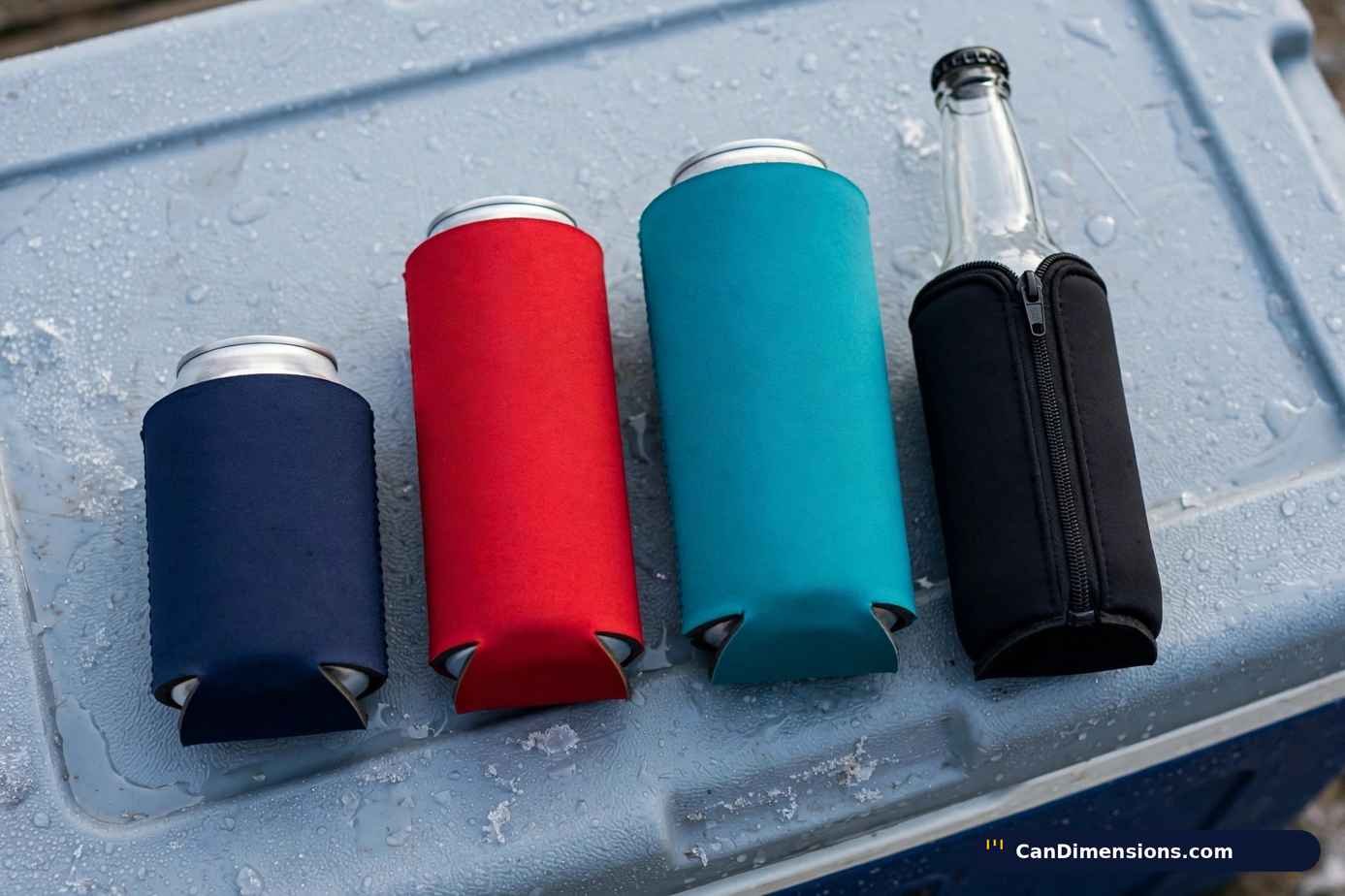
Ask for a standard koozie and the parcel may hold either of two published patterns, both correctly labelled. One is the square cut: polyurethane foam, 4 mm thick, 4 inches by 4 inches when the sleeve is flattened. The other is the tall cut in neoprene, roughly 3.75 inches across and 5.13 inches high on the same flat basis. Confusion starts when a shop quotes one number and names neither pattern.
On the can, the foam version stands about 4 inches high and measures roughly 2.75 inches across the outside of the tube. Multiply that outside diameter by pi and you get about 8.6 inches — a figure many charts present as the size that matters. It is not. Fit is governed by the can’s own girth — 8.17 inches — and the inner wall is sized to pull over that and no more. Nor is the shortfall in height an error: at 4 inches the sleeve stops below the rim, leaving the opening and the lip clear while it wraps the part of the can a hand actually holds.
Artwork gets one number from this section, developed fully later: allow roughly 3 inches square per side. The full panel is 4 inches square, and designs drawn to the panel edge come back with their borders lost around the curve.
How Big Are Standard Cans?
Under the sleeve sits a can 4.83 inches high with a body diameter of 2.6 inches. That shell is the industry’s default — beer, soda and sparkling water are all filled into it — so a single koozie pattern serves the whole fridge door; our coke can dimensions guide checks the shell across brands. The lid invites one misunderstanding worth clearing up. It is a 202 end, and 2.13 inches is simply what the code works out to on paper; measured from the makers’ drawings, the end itself is nearer 52.4 mm, about 2.06 inches. A koozie never touches either figure, because it holds the body.
Charts often decorate this can with a precise market share credited to an industry institute. No publication from that quarter supports the number, so it is left out here. The shell’s importance is plain without it: supplier templates start from this can, and every range stocks its size first.
Slim Can Koozie Dimensions
How Wide Are Slim Koozies?
Around the can, a slim koozie forms a tube somewhere between 2.25 and 2.4 inches across. Flattened, it measures about 3.375 inches from edge to edge and 4.875 inches from top to bottom — the width a full 0.625 inches inside the standard pattern’s. The word on the label, though, covers two cans that are not the same shape, and telling them apart is the point of this section.
Start with the narrower of the pair. The 250 ml energy can — the genuinely slim shell — stands 5.28 inches and measures 2.1 inches through the body, a girth of 6.60 inches; our red bull can dimensions guide sets out that shell in full. The seltzer can is the sleek shell, taller at 6.13 inches and broader at 2.26 inches, with a girth of 7.10 inches, verified in our white claw can dimensions guide. Neoprene’s give spans the half inch separating the two girths, so one slim pattern in that material dresses both; rigid foam is less accommodating.
Against that record, the often-repeated claim that slim cans stand somewhere between 5.5 and 6 inches describes neither can — the pair stand at 5.28 and 6.13. A second circulating error files two well-known 16 oz energy drinks as slim-can products. Their cans ride a standard-body shell, 2.6 inches through, at 6.19 inches high; they take tall boy sleeves, and a box of slim koozies bought for them fits nothing in the crate.
Slim vs Standard: Size Comparison
| Measurement | Standard Koozie | Slim Koozie | Difference |
|---|---|---|---|
| Height | 4 inches | 4.875 inches | 0.875 in taller |
| Width | 4 inches | 3.375 inches | 0.625 in narrower |
| Diameter | About 2.75 inches | About 2.25 to 2.4 inches | Variable |
| Can it fits | 4.83 × 2.6 in, circumference 8.17 in | 6.13 × 2.26 in or 5.28 × 2.1 in, circumference 7.10 or 6.60 in | Different shells entirely |
Treat the pair as patterns for unrelated cans, not as neighbouring sizes of a single product. A shoe shop can swap a size up; a koozie drawer cannot.
Specialty Can Koozie Sizes
500 mL Can Koozie Measurements
Begin with the can: the international 500 ml format stands 6.61 inches high, and its body is the familiar 2.6 inches — the standard can’s body, stretched upward. The sleeve cut for it is sold in metric as 127 by 102 mm, which is about 5 inches by 4 inches flattened. Only the second of those numbers should surprise nobody: the width repeats the standard koozie’s 4 inches because the body never changed, and the extra inch of height answers the taller can.
Do not let the near-identical volumes merge this can with the American tall boy in your ordering. One holds 500 ml, the other 473 ml, yet they stand 6.61 and 6.19 inches apart in height, and each one’s sleeve visibly under-covers the other can. On American shelves the 500 ml can belongs mostly to import beers and overseas energy brands, not to domestic soda.
Other Common Sizes
Tall boy koozies, for 16 oz cans. The pint can stands 6.19 inches on the standard body — the shell our monster can dimensions guide records for the large energy cans — and its koozie flattens to about 4 inches by 6 inches. Some charts widen it to 4.5 inches; supplier templates do not, holding the width at roughly 4 inches with a few at 4.25. Since its girth equals the standard can’s, at 8.17 inches, think of this sleeve as the standard pattern with length added, nothing more.
Mini can koozies. Here the correction comes before the size. Listings call the little square sleeve, about 3.5 inches by 3.5 inches flattened, an “8 oz” koozie, yet can makers list no 8 oz shell. The small soda can actually in production measures about 4.11 inches high and 2.28 inches through — the 7.5 oz mini — and the arithmetic vindicates the sleeve: half of that can’s 7.16-inch girth is 3.58 inches, matching the flat width. The 8.4 oz energy can, by contrast, is tall and slim-bodied, and its cooler is a different shape altogether at roughly 2.25 by 5.13 inches.
Bottle koozies. Glass changes the design problem, because a bottle narrows at the shoulder and no sleeve can be pulled past it. The answer is a jacket about 7.25 inches high that opens flat and zips closed around the bottle. The longneck inside it stands about 9 inches, its body measuring about 2.4 inches across. Ignore the 4-inch width quoted for this size in some charts — measured on the bottle, finished jackets list at about 2.3 inches by 7.3 inches. Shorter craft bottles, the stubbies, take a shorter jacket of roughly 5 inches.
What Size Should a Koozie Design Be?
Work backwards from what a printer will guarantee. The stock templates behind most custom koozies promise an imprint of roughly 3 inches square on each face; within that family of templates, one supplier allows 2.75 by 2.75 inches for screen print and 3 by 3 for full-colour work, and another allows a rectangle of 3 inches by 2.5. Centre the artwork in a 3-inch square and every one of those templates accepts it.
Resist the larger “maximum printable area” of 3.75 by 4 inches quoted in roundups. That rectangle covers almost the entire panel, stitching and curve included, and no template in the set above backs it; art drawn to it returns clipped or stitched through. Whole-panel art has its own route — a repeating wrap pattern, sized by the sublimation method below — and the two faces of a sleeve may carry different designs provided each stays in its square. A few makers also print the base, a disc of about 2.5 inches across that shows only when the drinker lifts the can.
Design Margins and Bleed
Bleed first, because it is added before anything is cut: full-coverage art extends 0.125 inches past the trim line on all four sides, a quarter inch of oversize in total, and the surplus is sliced away. Omit it and any slight wander in the cut exposes a pale sliver at the edge. Margins then pull the important content inward: hold key elements between 0.25 and 0.5 inches inside the edges, and keep lettering at least 0.375 inches clear, so that cutting tolerance, seams and stretch cannot reach them. Apply both rules to a 4-inch panel and the roughly 3-inch working square of the previous section is what remains — the two numbers are one fact stated twice.
Lettering has its own floor on a curved, textured surface. Shops that print koozies commonly advise nothing smaller than about 12-point for ordinary text and 18-point or more for headings, since fine type thickens and breaks apart on foam and neoprene alike. File that as trade advice, not a standard: if your printer demands larger, your printer is right.
What Size DTF for Can Koozie?
On slim sleeves the transfer stretches upward: about 3 inches by 4.25 at the largest, with 2.75 by 4 the size working printers favour for a bond that lasts. On a standard sleeve the ceiling is lower and wider — about 3.5 by 3.75 inches — the advised working size is 3.25 by 3.5, and a 3-inch square fits every sleeve in this guide, which is why it is quoted as the universal choice.
All of those numbers come from transfer vendors, not from any standards document, because none exists for DTF sizing. Check them against the chart of the supplier filling your order before committing to a run. Pressing conditions and wash life are dealt with under the printing methods and in the answers below.
Stocking a Cooler: Which Koozie Sizes to Buy and How Many
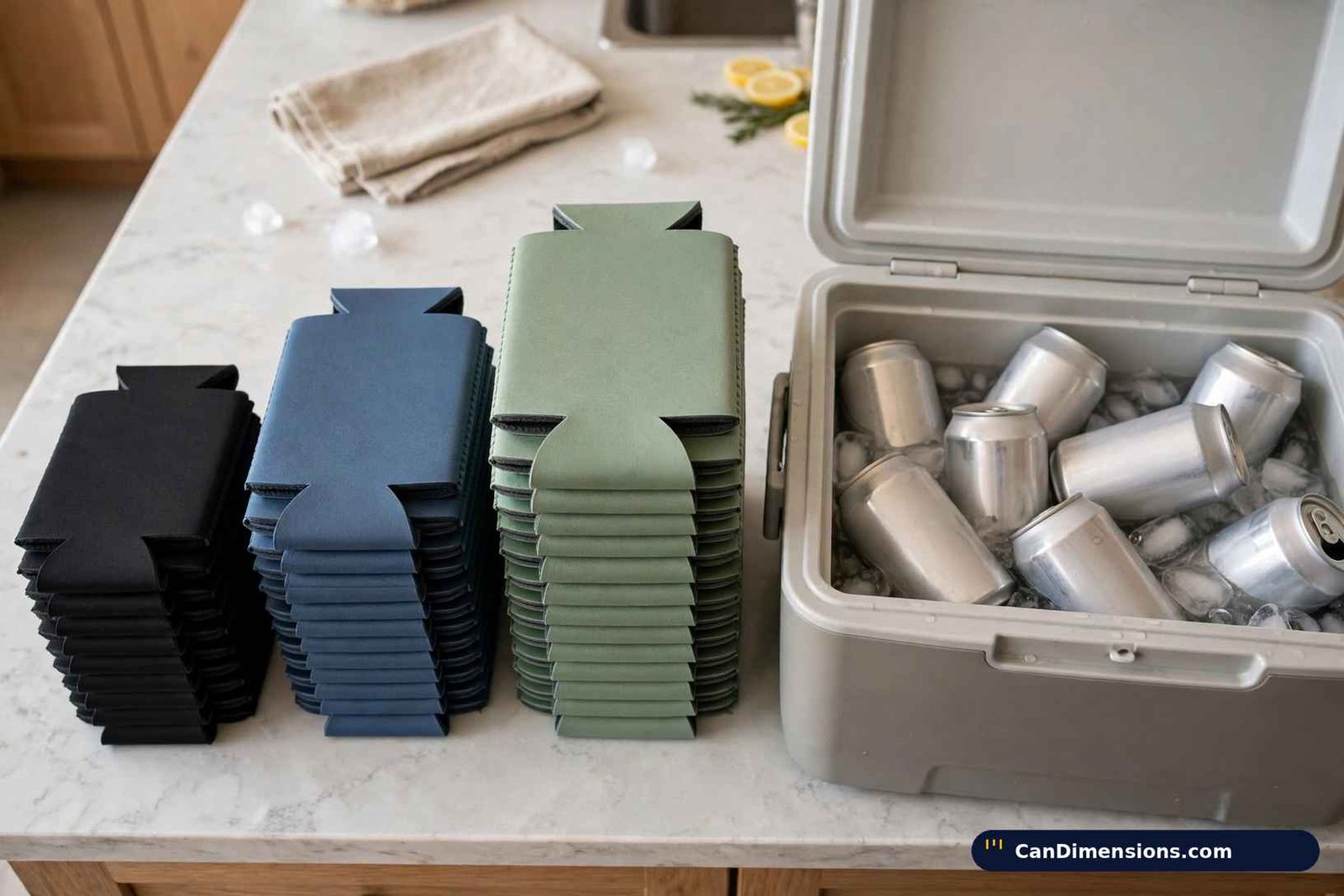
The fit test converts directly into a shopping list, because a mixed cooler is never mixed evenly. As a practical starting mix — guidance from the fit test, not a survey figure — two dozen sleeves for a general party divide sensibly as twelve standard, six slim, three tall boy, two zipper bottle jackets and one spare standard for the guest who arrives holding something unexpected. Adjust the proportions to your own drinks list before you adjust anything else: the drinks decide, and the sleeves follow.
The reasoning is the table above, read as quantities. Standard cans dominate most coolers, so the standard sleeve earns half the stock. Seltzers and energy drinks guarantee the slim sleeve a real share, but a quarter, not a half. Tall boys appear in handfuls, and because a standard sleeve grips their body in a pinch, three tall cuts cover the gap without stranding stock. Bottles need their own garment entirely, so two zipper jackets protect the longneck drinkers without pretending a can sleeve can substitute. Mini and 500 ml sleeves earn a place only when those cans are actually on the list — both are single-drink sizes, and stock bought “just in case” for them is the stock that never leaves the drawer.
Material splits the order the same practical way. For a crowd — a wedding, a reunion, a company picnic — collapsible foam is the bulk buy: it folds flat for transport, costs the least per sleeve and tolerates being lost. For a household set that will be washed and reused for years, buy fewer sleeves in neoprene, whose stretch forgives the sleek-versus-slim gap and whose surface takes print better. Either way, order against the drinks list, count heads second, and let the fit test — not the colour chart — choose the sizes.
Can Koozie Dimensions for Printing Methods
Screen Printing Dimensions
Volume is this method’s home ground: screens must be made before the first sleeve prints, setup is charged, and orders commonly start somewhere between 50 and 100 pieces. What the screens can hold is the familiar square — roughly 3 inches by 3 inches a side on the major templates. Figures beyond that, reaching 3.5 by 4 inches, sit outside the templates’ guarantee; a shop quoting them is either printing a larger blank or letting the image distort around the curve, and the buyer should know which.
Fine lines set the second limit. A leading maker’s artwork template fixes the thinnest positive line at 1.25 points — near enough 0.45 mm — and the thinnest reversed line at 1.5 points, the same floor most printing guides round to 0.5 mm. Colours laid in separate passes register against each other only to about half a millimetre either way, so bold shapes in one or two colours, kept inside a 2 to 3 inch square, are what this method rewards.
Sublimation Printing Dimensions
Start with the file requirements, because they reverse ordinary print habits: at least 300 DPI, and RGB rather than CMYK, since the heat stage works from the RGB original. The stock must cooperate too — polyester, or a polyester-coated blank — and light colours give the strongest result.
Only then does size change its meaning. The image is printed while the panel is still flat and unsewn, so a design meant to run all the way around is drawn as one wide file: roughly 8.5 to 9.25 inches across, allowing for the seam on top of an 8.17-inch girth, and about 4.25 inches high with bleed included. The 4.125-inch square sometimes published as the sublimation size describes a single face of the panel; build a wrap to it and the design stops halfway round. With no screens to make and no per-colour charge, the method suits photographs and short runs.
Vinyl and HTV Dimensions
Heat settings come first in practice, because they are the part buyers get wrong: common vinyls go onto neoprene and foam at about 305 degrees F, held for 10 to 15 seconds under medium-firm pressure. Sizes then follow the placed-art rules already set out — a 3-inch square serves most jobs, and about 3.5 by 3.75 inches is the largest a standard sleeve should carry.
Two working cautions complete the method. Nothing in the design should be smaller than about a quarter inch, because pieces below that size tear during weeding or lift after washing. And stacked colours build thickness layer on layer, which can mean easing or raising the press pressure as the design grows. With no minimum order and low material cost, vinyl remains the natural choice for a single personalised sleeve or a name on a team set.
Koozie Care: Washing, Storing and Making a Sleeve Last
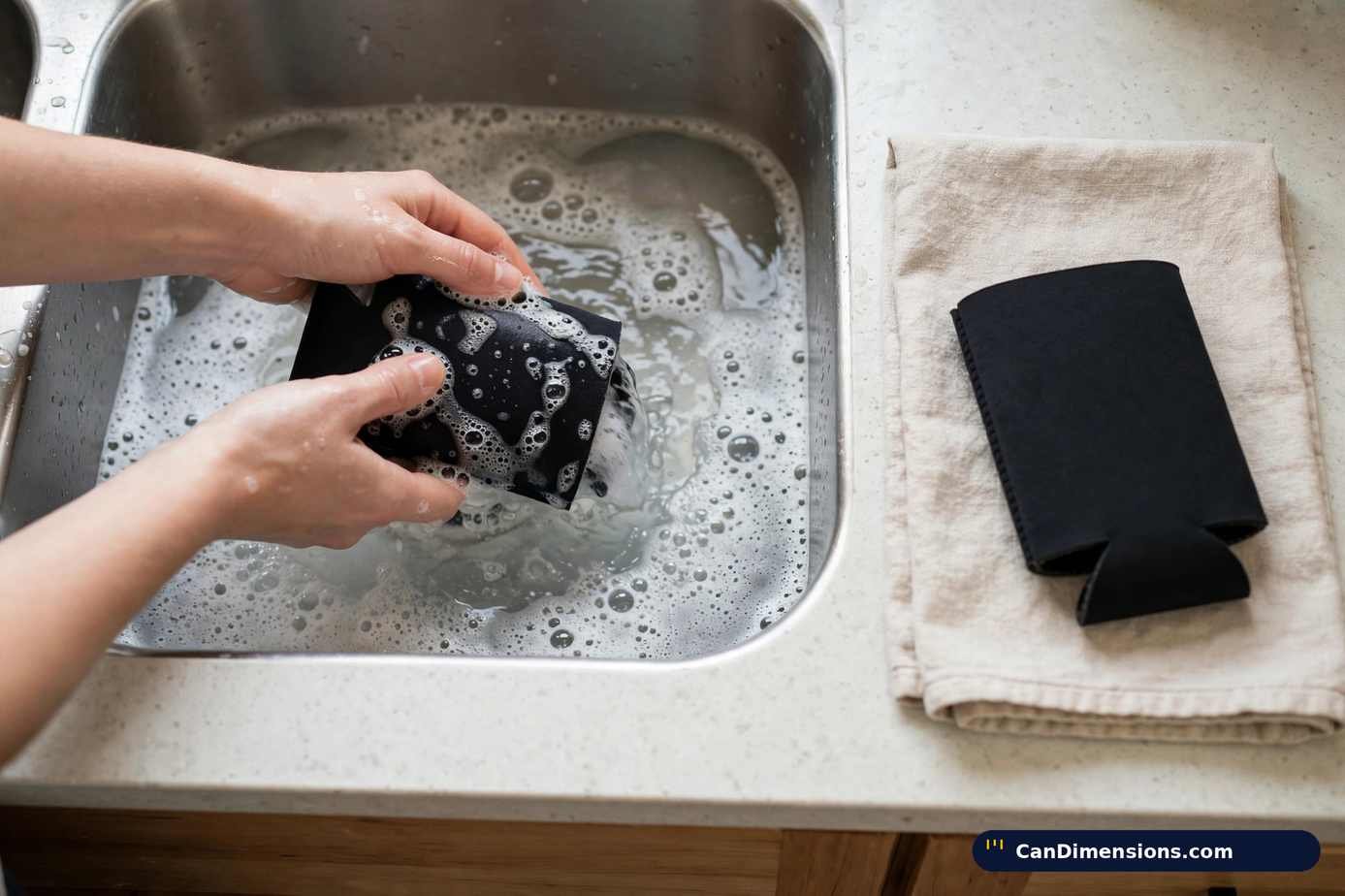
Care guidance differs by material, and the vendors who sell these sleeves give broadly consistent advice — framed here as guidance, because no maker publishes a tested lifespan for a koozie. Neoprene sleeves wipe down with a damp cloth, or hand wash in cold water with a mild detergent. Foam sleeves spot clean, or hand wash as needed, and should not be left soaking in water. Fabric sleeves are often machine washable, but the care label governs, as it does for any garment.
Drying is where sleeves are usually ruined, so treat the vendor cautions as the rule: rinse soap out thoroughly, squeeze water out gently rather than wringing or twisting — wringing distorts the shape the fit depends on — and air dry flat on a clean towel, away from tumble dryers, radiators and strong direct sun, which can warp the material and fade the print. A sugary spill rinsed off the same day is a wipe; left a week, it is a scrub.
Storage is simple and is the one step the sellers state plainly: keep sleeves in a cool, dry place, and let collapsible foam do what it was designed to do — fold flat into a drawer or a bag. A household neoprene set keeps its shape best stored flat and uncreased rather than balled up, though that is workshop practice rather than a published specification. And since no honest lifespan figure exists, judge a sleeve by the fit test instead: foam that has cracked, a sleeve that no longer needs a gentle stretch to seat, or print that peels at the edges are the retirement signs, whenever they arrive.
Stubby Holders and Other Names: Koozie Sizes Around the World
The same sleeve answers to different names in different countries, and the name on a listing carries a size implication worth knowing before you order across borders. In Australia the sleeve is a stubby holder, named for the bottle it was built around: Australian beer was traditionally sold in 375 ml bottles nicknamed “stubbies” for their short, squat shape, set against 750 ml bottles, and the holder took the bottle’s name. A stubby holder is therefore a bottle-first design in its home market — many are cut at bottle height — so check the flat dimensions on an Australian listing before assuming it is a can sleeve.
In the United States, “koozie” began as a trademark: the name was registered in 1980 and the product introduced as a can cooler in 1982, before the word slid into generic everyday use for any sleeve of the type. The descriptive names travel better than the brand name does — can cooler, beer hugger and huggie all describe the object plainly — and New Zealand shares Australia’s stubby holder. None of those names, on any listing anywhere, states a size. The only words on a product page that commit the seller to a fit are the flat width and height, which is why this guide has printed those two numbers for every size.
Question’s
What is the size of a can koozie?
For the regular can, allow a 4-inch square in foam, or the taller neoprene cut at about 3.75 by 5.13 inches. Slim cans take a sleeve of 4.875 by 3.375 inches. All figures are for the sleeve lying flat.
What are the dimensions of a 12 oz can koozie?
Flattened, 4 inches high and 4 inches across in the foam pattern. Fitted, it stands about 4 inches and spans roughly 2.75 inches outside, while the can within measures 4.83 by 2.6 inches.
What size should a koozie design be?
Plan on a square of about 3 inches a side, and hold anything important at least 0.375 inches in from the edges. The larger areas quoted as printable maxima run almost to the panel’s edge, and the templates do not support them.
What size DTF for can koozie?
Standard sleeves accept up to about 3.5 by 3.75 inches, work best at 3.25 by 3.5, and take a 3-inch square without exception. Slim sleeves stretch the shape to about 3 by 4.25 inches at the most.
What is a good size for DTF transfers?
The 3-inch square. Templates are drawn around it, the border it leaves gives the transfer room to bond, and it stays clear of the curved edges where oversize transfers begin to peel.
Can you use DTF on koozies?
On neoprene, polyester blends and scuba foam, yes. Press with a pillow inside, at medium pressure and about 305 to 315 degrees F for 10 to 15 seconds, and careful washing should give the print some 25 to 50 washes. Keep it away from plain foam and silicone.
How big are standard cans?
Height 4.83 inches, body diameter 2.6 inches. The 202 end on top is nominally 2.13 inches by its code, and about 2.06 inches — 52.4 mm — when the end itself is measured.
How to make a DIY koozie?
Either sew two neoprene squares of about 4.25 inches, seam allowance included, or cut a single strip roughly 8.5 inches long — the 8.17-inch girth of the can plus allowance — to your pattern’s height. Centre any design in a 3-inch square, join the edges with a seam of 0.25 inch, sewn or glued, and for a wrap that opens, add hook-and-loop strips of 1 by 4 inches at the ends, overlapping by half an inch.
How wide are slim koozies?
Flattened, they measure 3.375 inches across and 4.875 inches high — the width 0.625 inches less than a standard sleeve’s — and they close around the can at a diameter of roughly 2.25 to 2.4 inches.
Conclusion
Fit is the whole subject, and it reduces to one habit: read the drink’s circumference before the sleeve’s label. The standard sleeve is built around the 2.6-inch body family, and only the height changes across the regular, pint and 500 ml cans; the slim sleeve owns the narrow shells and substitutes for nothing else; bottles zip, crowlers go bare, and every buying, stocking and care decision in this guide follows from those four facts.
Buy against a drinks list, wash gently, dry flat, and a small set of sleeves will cover years of coolers. Most are cut from foam or from the same foamed neoprene as a wetsuit — a material that insulates in the water exactly as it does around a can, which is why the right size, snugly fitted, keeps a drink cold long after a loose one has given up.