Ammo Can Dimensions: Verified Size Chart for Every Standard Can
Use this ammo can size chart before you trust any single number: the two cans almost everyone means are the M19A1, sold as the .30 cal size, and the M2A1/M2A2, sold as the .50 cal size, and even those two are published at different sizes by different sellers.
The reason is built into the topic. The military specification behind both cans, MIL-DTL-3060, rates each model by volume — 0.18 cubic feet for the M19A1 and 0.32 cubic feet for the M2A1 and M2A2 — rather than by one fixed set of outside measurements, so honest spec sheets disagree by fractions of an inch.
Below, every figure is tied to a named source: the military specification, a current retailer’s published spec sheet, or a container maker’s own brochure. Where no source publishes a size at all, this page says so instead of filling the gap, and the chart marks those rows openly.

Ammo Can Dimensions Comparison Chart
Read each row as one source’s figures, not as a universal truth. The first two rows come from a current retailer’s published specifications for its steel cans in the two military sizes; the PA108 row comes from the container maker’s own brochure; the last row pairs a retail listing with a maker’s brochure, and the two disagree in a way the Large Format section explains.
| Ammo Can Type | Exterior (L × W × H inches) | Interior (L × W × H inches) | Weight (lbs) |
|---|---|---|---|
| M19A1 (.30 Cal) | 11 × 3-13/16 × 7-1/8 | 9 × 3-1/2 × 6-1/2 | 3.9 |
| M2A1/M2A2 (.50 Cal) | 12-1/8 × 5-5/8 × 7-3/8 (width as listed; see note) | 11-1/8 × 5-1/2 × 6-7/8 | 5.62 |
| .50 Cal Fat (PA108) | Up to 12.906 × 7.297 × 8.906 (maker maximum) | At least 11.875 × 6.75 × 8.175 (maker minimum) | About 7.05 |
| .50 Cal Tall | No manufacturer specification verified — see the Specialty section | — | — |
| M548 (20mm) | No manufacturer specification verified — see the Large Format section | — | — |
| M116A2 / PA120 class (40mm) | 18.25 × 6 × 9.75 (retail listing) | Maker brochure and retail figures conflict — see the Large Format section | 14.1 (retail listing) |
One note on the .50 cal width: the retailer puts the outside width at 5-5/8 inches, barely wider than its own 5-1/2-inch interior, which leaves almost no room for the steel walls. Other sellers put the same can nearer 6.1 inches wide, and the military volume rating supports the larger figure, as the M2A1 section shows. Treat width as the least settled number on this page and measure any can you plan to fit into a tight space.
M19A1 (.30 Cal)
Exterior: 11 × 3-13/16 × 7-1/8 inches on the retailer’s spec sheet. Interior: 9 × 3-1/2 × 6-1/2 inches. Weight: 3.9 lb. Specification volume: 0.18 cubic feet under MIL-DTL-3060. The narrowest can in the chart, and the lightest steel one with a full published spec.
M2A1/M2A2 (.50 Cal)
Exterior: 12-1/8 long × 7-3/8 high, width as discussed above. Interior: 11-1/8 × 5-1/2 × 6-7/8 inches. Weight: 5.62 lb. Specification volume: 0.32 cubic feet — close to double the smaller can’s, which is the single most useful comparison on this page.
.50 Cal Fat
The Fat .50 is the PA108 container, and a maker’s brochure specifies it properly: a minimum interior of 11.875 × 6.75 × 8.175 inches inside a maximum exterior of 12.906 × 7.297 × 8.906 inches, weighing 3.2 kilograms, roughly 7 pounds. It exceeds the standard .50 cal in every direction, width and height alike.
.50 Cal Tall
Tall .50 cal cans are sold by surplus and retail sellers, but this research found no manufacturer’s specification sheet for a steel tall can, so no dimensions are printed for it. The honest measurement is the one you take yourself, and the measuring section below explains how.
M548 (20mm)
The M548 name appears in military packaging manuals as a shipping and storage container, but this research found no maker’s dimension sheet for it either. Its chart row is left unverified rather than repeated from other charts, which is where unverified figures usually come from.
M116A2 (40mm)
Retail listings for the PA120, the container in this long, narrow class, give an exterior of 18.25 × 6 × 9.75 inches and a weight of 14.1 lb. A maker’s brochure for the same PA120 designation publishes an internal size that does not match the interior figures circulating online, and the Large Format section sets both records side by side.
M19A1 .30 Caliber Ammo Can Dimensions
The smaller of the two military standards began as a shipping and storage box under the same specification that still governs it. MIL-DTL-3060 covers the M19A1 alongside the two .50 cal models, describes it as a 0.18-cubic-foot airtight steel box, and ties its construction to Army drawing 7553315 — which is why surplus and new-made cans in this size stay so close to each other.
30 Cal Ammo Can Size Specifications
On the current retailer’s published sheet, the steel .30 cal can measures 11 inches long, 3-13/16 inches wide and 7-1/8 inches high outside, with an inside space of 9 inches long, 3-1/2 inches wide and 6-1/2 inches high, and a product weight of 3.9 lb.
Two checks are worth doing on those numbers. First, multiply the outside measurements together and you get roughly 299 cubic inches — about 0.17 cubic feet, matching the specification’s 0.18-cubic-foot rating once the lid, latch and handle are counted. The rating describes the whole box as an object, not the space inside it. Second, the usable inside space multiplies out to about 205 cubic inches, roughly 3.4 litres. Anyone quoting a much larger capacity for this can is quoting the outside of the box.
The gap between the 11-inch outside length and the 9-inch inside length also deserves a word, because it is larger than the steel is thick. The lid’s recessed well, the latch hardware at the front and the rolled edges at both ends all spend length that a simple wall-thickness calculation would not predict.
What Fits Inside a .30 Cal Ammo Can
Fit, on a dimensions page, is a question about the inside measurements: 9 inches of length, 3-1/2 inches of width and 6-1/2 inches of height, with the longest straight line inside the base running diagonally at about 9.7 inches.
That makes the can a narrow container rather than a small one. Flat objects up to about 9 inches long stand upright in it; anything wider than 3-1/2 inches does not go in at all, however short it is; and the 6-1/2-inch interior height runs up to the closed lid’s underside, where the lid well can add a little headroom at the centre. The same three numbers, applied to the jerry can dimensions of fuel containers, are what decide whether a can fits a rack — the container changes, the measuring habit does not.
M2A1 and M2A2 .50 Caliber Ammo Can Dimensions
The .50 cal size is the reference point for the whole family: the can other cans are described as wider, taller or longer than. Under MIL-DTL-3060 it is a 0.32-cubic-foot airtight steel box, built to Army drawing 7553296 in its M2A1 form.
Standard .50 Cal Ammo Can Size
The retailer’s sheet for its steel .50 cal can lists a product length of 12-1/8 inches and a height of 7-3/8 inches, an inside space of 11-1/8 × 5-1/2 × 6-7/8 inches, and a weight of 5.62 lb. The inside space multiplies to about 421 cubic inches — roughly 6.9 litres, and just over double the .30 cal can’s usable volume, exactly as the two specification ratings (0.32 against 0.18 cubic feet) predict.
The width is the one figure to handle with care. As the chart notes, the same sheet lists the outside width at 5-5/8 inches, which sits oddly against its own 5-1/2-inch interior and against the roughly 6.1-inch width other sources give the military can. The volume check sides with the larger figure: at 6.1 inches wide, the outside measurements multiply to about 0.32 cubic feet, matching the specification rating almost exactly. If a shelf or box must fit this can’s width precisely, measure the actual can.
M2A2 Ammo Can Dimensions and Differences
The M2A2 is covered by the same specification and the same 0.32-cubic-foot rating as the M2A1, under its own assembly drawing (13032542). No separate dimension set is published for it in the specification, and the retailer sheets for this size do not split the two models either — so the defensible statement is that the M2A2 shares the .50 cal size class, and any claim of a size difference between the two models needs a source this research could not locate.
What the specification does separate is construction detail rather than size: the two models are distinct assemblies under distinct drawings. A buyer choosing between them on dimensions alone is comparing two cans of the same rated volume.
.50 Cal Ammo Can Capacity Guide
Capacity, stated dimensionally, is the interior volume: about 421 cubic inches (roughly 6.9 litres) of usable space inside an 11-1/8-inch length, a 5-1/2-inch width and a 6-7/8-inch height.
Set against the smaller can, the gain is mostly width. The .50 cal is only about 2-1/8 inches longer inside than the .30 cal, but it is a full 2 inches wider, and width is what lets bulkier, less uniform objects sit flat instead of being threaded in one at a time. Objects longer than about 11 inches fit only diagonally — the base diagonal is about 12.4 inches — and anything taller than 6-7/8 inches holds the lid open.
Specialty Ammo Can Dimensions and Sizes
Beyond the two standards, the specialty sizes divide into two kinds: containers with real manufacturer documentation, and names that circulate in listings without a spec sheet behind them. The Fat .50 belongs firmly to the first kind. The Tall .50, for now, belongs to the second.
.50 Cal Fat Ammo Can Dimensions
The Fat .50 is the PA108, and its maker’s brochure is the best-documented page in this topic. The brochure gives a minimum internal size of 301.63 mm long × 171.45 mm wide × 207.65 mm high — 11.875 × 6.75 × 8.175 inches — and a maximum external size of 327.81 × 185.34 × 226.21 mm, which converts to 12.906 × 7.297 × 8.906 inches. The approximate weight is 3.2 kg, about 7.05 lb.
Note the form of those figures: a minimum inside and a maximum outside. That is how a manufacturer actually guarantees a container — everything it ships holds at least that much and takes up no more room than that — and it is more trustworthy than any single tidy measurement. Set beside the standard .50 cal, the PA108 gains roughly 1-1/4 inches of inside width and a similar amount of inside height, which is where its extra room comes from.
PA108 and PA120: What the PA Numbers Mean
PA numbers are container designations from military packaging practice: the PA108 is the wide .50 cal-class container above, and the PA120 is the long 40mm-class container in the Large Format section. Knowing the designation matters because sellers use the caliber nicknames loosely — a can listed as a Fat .50 with a PA108 behind it can be checked against the brochure figures, while a nickname on its own cannot be checked against anything.
.50 Cal Tall Ammo Can Dimensions
For a steel Tall .50 cal can, this guide located no manufacturer specification at all: sellers list the style, dimensions differ between listings, and none of the listings traces back to a maker’s sheet. Plastic cans in a tall .30 cal style do carry published sizes from their maker — one lists an inside space of 3.4 × 8.9 × 6.1 inches — but a plastic replica’s sheet cannot stand in for the steel can’s dimensions.
The section stays in this article because the question is real; the answer, honestly, is that a Tall .50’s dimensions are whatever the individual can measures. The measuring section below is the reliable route, and any chart printing exact tall-can figures without naming a maker is printing a guess.
Large Format Ammo Can Dimensions
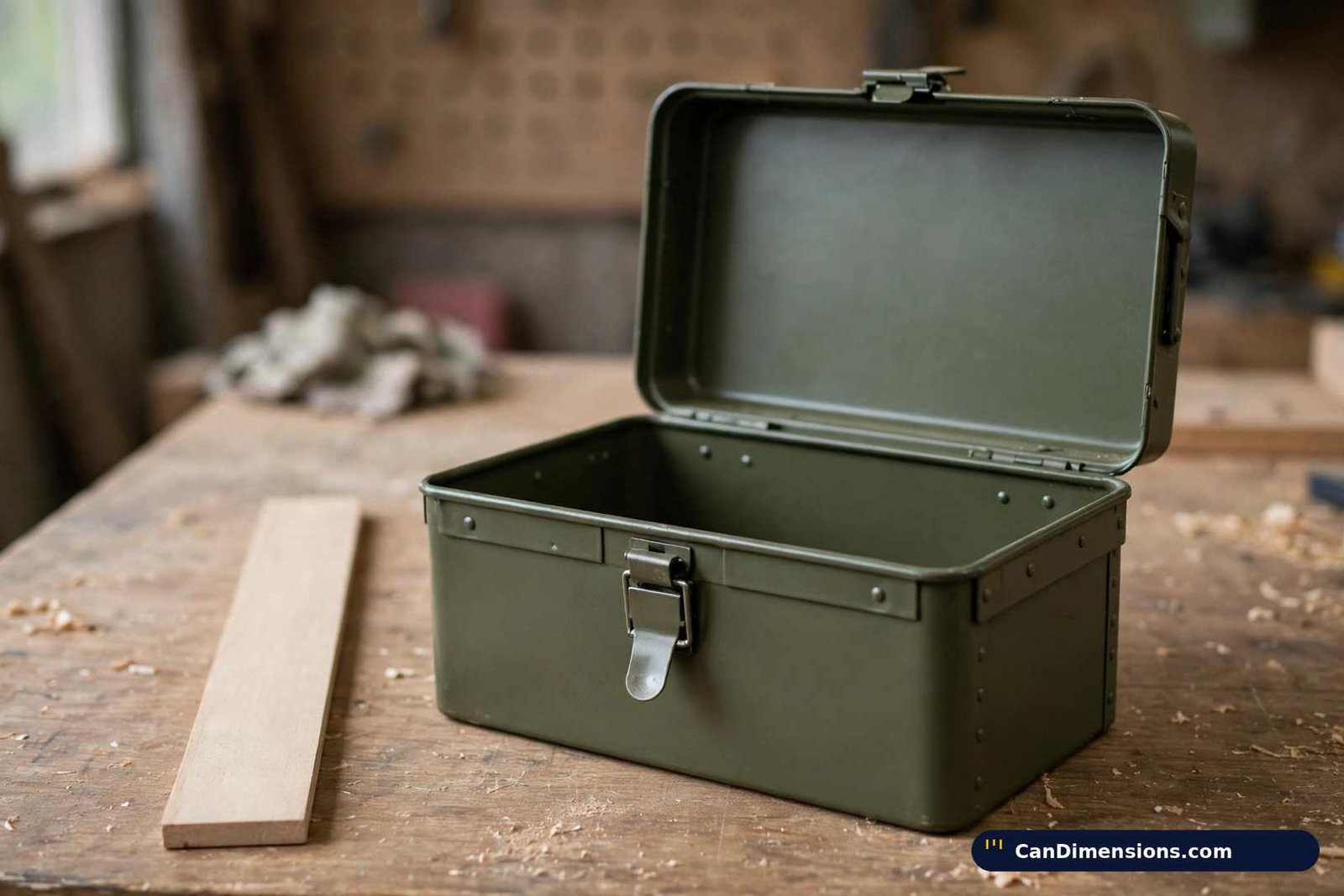
The large formats are long rather than merely big: both containers in this section run past 18 inches in length while staying near the .50 cal’s width, which is what makes them awkward on standard shelving and useful for long objects.
M548 20mm Ammo Can Size
The M548 appears in the Army’s ammunition packaging manual, TM 9-1305-201-34, as a shipping and storage container — the manual carries a full page of its packaging markings. Yet neither that manual nor any maker’s sheet located during this research publishes a dimension set for the container itself.
That absence is worth stating plainly, because figures for a 20mm-class can circulate widely online with no source attached. Until a manufacturer or specification sheet surfaces, these pages print no M548 dimensions rather than repeat numbers that cannot be traced. A related record does exist for a neighbouring size: a defence maker’s brochure for the PA125, the 25mm container, rates that can’s packing at 0.7 cubic feet — a volume rating in the same style as the MIL-DTL-3060 figures, again with no outside dimensions published alongside it.
M116A2 40mm Ammo Can Dimensions
The 40mm class is where the PA120 designation belongs, and it is the one place in this guide where two real sources disagree. A current retail listing for the PA120 gives an exterior of 18.25 × 6 × 9.75 inches and an item weight of 14.1 lb — the same outside figures most often quoted for the M116A2 name. A container maker’s brochure for the PA120, a can it states meets the MIL-B-3060 specification family, publishes an internal size of 441 mm long × 141 mm wide × 204 mm deep — about 17.36 × 5.55 × 8.03 inches.
The conflict sits in the depth. An interior depth of about 8 inches cannot live inside a 9.75-inch-tall can alongside a lid and base structure in quite the way the commonly repeated interior figures suggest, and the brochure’s 204 mm depth is the more conservative, maker-published number. This guide therefore prints the retail exterior and the brochure interior side by side, flags the disagreement, and does not merge them into a single tidy row. If the exact interior depth decides a purchase, it has to be measured on the can itself.

Ammo Can Dimensions in Centimeters and Millimeters
Every metric figure below is an exact conversion of a verified inch or millimetre figure above, at 2.54 centimetres per inch, rounded once at the end.
| Can | Exterior (cm) | Interior (cm) |
|---|---|---|
| M19A1 (.30 Cal) | 27.94 × 9.68 × 18.10 | 22.86 × 8.89 × 16.51 |
| M2A1/M2A2 (.50 Cal) | 30.80 long × 18.73 high; width unsettled (see text) | 28.26 × 13.97 × 17.46 |
| PA108 (Fat .50) | Up to 32.78 × 18.53 × 22.62 | At least 30.16 × 17.15 × 20.76 |
| PA120 class (40mm) | 46.36 × 15.24 × 24.77 (retail) | 44.1 × 14.1 × 20.4 (maker brochure, from mm) |
The PA108 and PA120 rows started life in millimetres on their makers’ brochures, so for those two cans the metric figures are the originals and the inches are the conversions — the reverse of the two military standards, whose documentation runs in inches and cubic feet.
How to Measure an Ammo Can Yourself
Start with the outside, taken at the widest points: length along the long face including the latch, width across the short face, and height from the floor the can stands on up to the shut lid’s top edge, handle folded flat. Then measure the inside with the lid open — length and width at the top rim and again at the base, because pressed-steel walls taper slightly, and depth from the rim down to the floor of the can.
Three habits keep the numbers honest. Measure an empty can, since a liner or tray spends space invisibly. Record which basis each figure uses — outside, inside at the rim, or inside at the base — because most online disagreements about these cans are really two correct measurements of different things arguing with each other. And compare like with like when you check a can against a chart: the beverage can dimensions covered elsewhere on this site come from a handful of standard shells, while these steel boxes vary by maker and era, so a quarter-inch of disagreement is normal and a full inch means a different can.

Steel vs Plastic Ammo Can Dimensions
The military standards are steel, but the same size classes are widely sold in plastic, and the plastic makers publish their own dimensions — which are not copies of the steel figures. One maker’s plastic .50 cal-style can lists an inside space of 5.8 × 11.0 × 7.2 inches within an outside of 7.4 × 13.5 × 8.5 inches: a noticeably larger footprint than the steel M2A1 class, bought with much thicker walls. Its .30 cal-style tall can lists an inside of 3.4 × 8.9 × 6.1 inches.
Weight is where the materials separate most. The steel retail cans above weigh 3.9 and 5.62 lb empty; a plastic can in the .50 cal class from the same maker family weighs about 1.76 lb. For pure storage the difference rarely matters; for a can that gets carried, it is the largest single difference between the two materials — larger than any dimension on this page. Aluminium, by contrast, plays no part here: unlike the aluminum can dimensions of drinks cans, which follow drinks-can makers’ standard shells, these storage boxes are a steel-and-plastic subject.

Questions
What size is an ammo can?
There is no single size, but there are two standards. The M19A1 (.30 cal class) is a 0.18-cubic-foot steel box measuring 11 × 3-13/16 × 7-1/8 inches outside on a current retailer’s sheet; the M2A1/M2A2 (.50 cal class) is a 0.32-cubic-foot box at 12-1/8 inches long and 7-3/8 inches high outside on the same seller’s sheet. Larger and wider containers — the PA108 and the PA120 class — sit beyond those two.
Are all ammo cans the same size?
No. The sizes verified here stretch from the narrow 3-13/16-inch-wide M19A1 to the PA120 class at 18.25 inches long, and the same nickname can hide different measurements from different makers and eras. The designation — M19A1, M2A1, PA108, PA120 — is a more reliable guide to size than the caliber nickname printed in a listing title.
What are the inside dimensions of a 50 Cal ammo can?
On the retailer’s published sheet for the steel .50 cal can: 11-1/8 inches long × 5-1/2 inches wide × 6-7/8 inches high, giving about 421 cubic inches (roughly 6.9 litres) of usable space. Individual cans vary by maker, so treat the figures as the class reference and measure a specific can when the fit is tight.
What are the dimensions of a 556 ammo can?
The specification this guide is built on designates no container under that name: MIL-DTL-3060 covers the M19A1, M2A1 and M2A2 boxes only. Cans sold or used under a 5.56 description are one of those standard sizes — most often the M19A1 class at 11 × 3-13/16 × 7-1/8 inches outside and 9 × 3-1/2 × 6-1/2 inches inside — so the dimensions to check are the standard can’s, under its own designation.
What size is a 20mm ammo can?
For the M548, the 20mm-class shipping and storage container named in the Army packaging manual, this research located no manufacturer dimension sheet, so no verified size can be printed. Figures circulating online for this class carry no source; the can has to be measured directly, using the steps in the measuring section above.
What size is a 40MM ammo can?
The PA120 class: a retail listing gives 18.25 × 6 × 9.75 inches outside at 14.1 lb, while a maker’s brochure for the PA120 publishes an internal size of 441 × 141 × 204 mm (about 17.36 × 5.55 × 8.03 inches). The two records are printed together in the Large Format section because their interior figures do not reconcile — check both before relying on either.
Conclusion
An ammo can size chart is only as good as its sources, and this topic shows why. The two military standards are specified by volume — 0.18 and 0.32 cubic feet under MIL-DTL-3060 — so their honest dimensions come as named sellers’ sheets that agree closely but never perfectly: an M19A1 at 11 inches long outside and 9 inches inside, an M2A1 class at 12-1/8 inches long outside and 11-1/8 inside. Beyond them, the PA108 carries a proper maker’s brochure with guaranteed minimum and maximum figures, the PA120’s two records disagree in print, and the Tall .50 and the M548 carry no publishable dimensions at all.
Buy by designation, check the basis of every figure — outside, inside, minimum or maximum — and measure any can whose fit really matters. Kept dry and wiped down with a pad of steel wool when surface rust starts, a steel can will hold its dimensions, and its usefulness, for decades.