Beer Can Label Dimensions: Standard Wrap Sizes, Heights and Templates Explained
The can label dimensions most brewers actually order for a standard 12 oz beer can are 8.125 inches wide by 3.5 inches tall (20.6 × 8.9 cm) — a near-full wrap cut just short of the can’s true circumference so the ends meet with a small clean gap. The 16 oz pint can keeps the same 8.125-inch width and grows to 5 inches tall, and every other format — sleek, slim, crowler — is sized from its own body’s circumference the same way.
One warning before the chart: a label’s width comes from the can’s measured body, not from its size code. The standard body is coded “211”, and charts that convert that code literally get a circumference of 8.44 inches — a quarter-inch too long, because the finished can measures 66 mm (2.6 in) across, not the 68.3 mm the code converts to. Every width below is built from the measured body.
Below are the verified label width and height for every common beer can — 12 oz, 16 oz, 19.2 oz, sleek, slim, mini and crowler — in inches, centimetres and millimetres, each traced to a label printer’s published die line or template, or worked from a can maker’s body specification, with the copied-around mistakes corrected as they come up.

The Anatomy of a Beer Can Label
Every beer label has two critical measurements: width and height. The width wraps around your can’s circumference, while the height covers the vertical space from bottom to top. Wrap styles determine how much of your can gets covered. You’ll choose between partial wraps, optimal wraps, or full wraps depending on your design needs and budget constraints.
Bleed areas and safety zones protect your design elements. Bleed extends 0.125 inches beyond your final cut line, while safety zones keep important text and logos at least 0.25 inches from any edge.
Two clarifications belong at the top, because they decide everything after. First, the “label” on most beer cans sold in America is not a sticker at all: large breweries buy cans pre-printed by the can maker. The dimensions in this guide are for the applied labels small and mid-size brewers actually buy — pressure-sensitive wraps — with shrink sleeves covered separately in their own section below. Second, a wrap label never covers the can top to bottom: it sits on the straight body wall, clear of the neck curve at the top and the base curve at the bottom, which is why a 4.83-inch can wears a 3.5-inch label.
Standard Beer Can Label Dimensions
The standard sizes below are the dies label printers keep in stock. The figures are stated width × height, in the order printers list them.
Standard 12 oz — 8.125″ × 3.5″. The full-wrap die for the standard can, listed at exactly this size by working label printers; the same printers’ “optimal” die is 8″ × 3.5″ and their half wrap is 6.25″ × 3.5″. A taller 8″ × 3.625″ die also exists in printers’ template libraries, which is where the 3.625-inch height in circulation comes from — it is a real die, but the stocked standard is 3.5 inches.
16 oz pint — 8.125″ × 5″. Same width, because the tallboy shares the standard 66 mm body; only the height grows. Printers’ optimal die for the 16 oz is 7.25″ × 5″ and the half wrap 6.25″ × 5″. The height gain over the 12 oz label is 1.5 inches (5 − 3.5), the extra design space that makes the pint can the craft format.
Specialty Sizes
Crowler — 9.5″ × 6″ or 10″ × 6″. The 32 oz crowler body measures 83.6 mm (3.29 in) across, so its circumference is about 10.34 inches; printers’ crowler dies at 9.5 and 10 inches wide by 6 inches tall sit just short of it, exactly as the 12 oz die sits short of its can.
Sleek and slim cans take narrower, taller labels — the full verified set is in the Sleek, Slim and Mini section below. And the standing rule for any custom format: measure your can. Always verify exact size against the can in hand before ordering, because a label is cut to a body, not to a volume.
Quick Size Comparison
| Can | Label size (W × H) | Can body | Circumference |
|---|---|---|---|
| 12 oz standard | 8.125 × 3.5 in | 66 mm / 2.6 in | 8.16 in / 207 mm |
| 16 oz tallboy | 8.125 × 5 in | 66 mm / 2.6 in | 8.16 in / 207 mm |
| 19.2 oz stovepipe | 8.125 × 5 in class (measure height) | 66 mm / 2.6 in | 8.16 in / 207 mm |
| 12 oz sleek | 7 × 5.31–5.4 in | 57.4 mm / 2.26 in | 7.10 in / 180 mm |
| Slim (250 mL class) | 7.2 × 5 in | 53.4 mm / 2.1 in | 6.60 in / 168 mm |
| 7.5 oz mini | ≈7 × ≈3.5 in class (measure) | 58 mm / 2.28 in | 7.17 in / 182 mm |
| 32 oz crowler | 9.5–10 × 6 in | 83.6 mm / 3.29 in | 10.34 in / 263 mm |
12 oz Beer Can Label Dimensions
The 12 oz can is America’s most popular beer container size. Standard label dimensions for these cans measure 8.125 inches wide by 3.5 inches tall in most professional settings. You have three main wrapping options for 12 oz beer cans. The half wrap measures 6.25″ wide × 3.5″ tall and covers just the front portion. The optimal wrap at 8″ × 3.5″ gives you balanced coverage. The full wrap at 8.125″ × 3.5″ nearly encircles the entire can with minimal gap. Most craft breweries choose the 8.125″ full wrap because it provides excellent coverage without excessive overlap. This standard beer can label size works with virtually all automated applicators and hand-labeling processes — and it is cut for the same standard shell whose body is measured in our beer can dimensions guide.
16 oz Beer Can Label Size and Height
Sixteen-ounce cans require taller labels to maintain visual proportion. The industry standard measures 8.125 inches wide by 5 inches tall for these popular pint cans. Your wrapping choices mirror the 12 oz options but with increased height. Half wrap labels measure 6.25″ × 5″, while optimal wraps come in at 7.25″ × 5″. Full wrap configurations use 8.125″ × 5″ dimensions for maximum can coverage. The extra 1.5 inches of height compared to 12 oz labels gives you more design space. This additional real estate works perfectly for detailed artwork, longer ingredient lists, or compelling brand storytelling that captures consumer attention.
Specialty Beer Can Label Dimensions
Eight-ounce cans use much smaller labels at 2.25″ × 8″. These slim cans work great for session beers, samplers, or premium offerings where portion control matters to your customers. Crowler labels measure either 9.5″ × 6″ for optimal coverage or 10″ × 6″ for full wraps. These large-format cans have become increasingly popular at taprooms offering fresh beer to-go. Sleek cans and other specialty formats require custom measurements. Always measure your specific cans before ordering labels, as even small variations affect the final appearance and application quality.
One figure in this section cannot stand, and it is corrected here rather than repeated: there is no 2.25″ × 8″ label for a small can. A label 8 inches wide cannot wrap a can whose whole circumference is about 7.2 inches, and no small beer can is 8 inches tall — the figure appears to be a can diameter and a label width welded together. The real small can is the 7.5 oz mini on a 58 mm sleek-family body, about 4.11 inches tall with a circumference of about 7.17 inches (182 mm), so its wrap label is roughly 7 inches wide and roughly 3.5 inches tall at most — and because no major printer publishes a stock mini die, that size is printed here as a measured class, not a die: cut it from your own paper template. True 8 oz beer cans are not a standard US shell at all; the “pony” 7 oz and 8 oz formats are bottles.
Beer Can Label Dimensions in CM and MM
For metric listings, printer templates quoted in millimetres, and wrap checks against the can makers’ own drawings, here is the verified set converted exactly (1 inch = 25.4 mm).
| Can | Label (in) | Label (cm) | Label (mm) | Body circumference (mm) |
|---|---|---|---|---|
| 12 oz standard | 8.125 × 3.5 | 20.6 × 8.9 | 206 × 89 | 207 |
| 16 oz tallboy | 8.125 × 5 | 20.6 × 12.7 | 206 × 127 | 207 |
| 12 oz sleek | 7 × 5.31 | 17.8 × 13.5 | 178 × 135 | 180 |
| Slim | 7.2 × 5 | 18.3 × 12.7 | 183 × 127 | 168* |
| 32 oz crowler | 9.5 × 6 | 24.1 × 15.2 | 241 × 152 | 263 |
| 32 oz crowler (full) | 10 × 6 | 25.4 × 15.2 | 254 × 152 | 263 |
*The stocked slim die at 7.2 inches (183 mm) is wider than the slim body’s 168 mm circumference — it is an overlap die, designed so the trailing edge laps over the leading edge rather than meeting it with a gap. That is the one format where the label is deliberately longer than the wrap; on every standard-body can the die is shorter than the circumference. Work from the millimetre column for a precise fit — those are the specification and die values; centimetres are rounded to one decimal.
Sleek, Slim and Mini Can Label Sizes
The narrow cans are where copied label charts fail hardest, because each narrow body has its own circumference and its own dies.
12 oz sleek — about 7″ wide × 5.31–5.4″ tall. The sleek body measures 57.4 mm (2.26 in), a circumference of about 180 mm (7.10 in). One can supplier’s template for the format is 7 inches wide by 5.31 inches tall; a die-cut printer’s sleek templates run 6.875″ × 5.375″, 7″ × 5.4″ and 7.125″ × 5.375″. All sit just under the 7.10-inch circumference, as a gap die should. This is the shell whose can sizes are set out in our aluminum can dimensions guide.
Slim — 7.2″ × 5″ (overlap die). The slim body is 53.4 mm (2.1 in), circumference about 168 mm (6.60 in). The stocked slim label is wider than that on purpose — an overlap wrap — which is why slim labels must be designed with the overlap zone kept free of critical text: whatever sits in the last half-inch can end up underneath the trailing edge.
7.5 oz mini — measured class, no stock die. Body 58 mm, height about 104 mm (4.11 in), circumference about 182 mm (7.17 in). A wrap label is roughly 7 inches wide; height cannot exceed the straight wall, so roughly 3.5 inches is the practical ceiling. Treat any chart that prints an exact mini label size without naming a printer’s die as unverified — none was found at draft time.
19.2 oz stovepipe — standard width, measure the height. The stovepipe keeps the 66 mm body, so the 8.125-inch width family applies; the can stands 188.1 mm (7.41 in) tall, and label height is set by how much of that wall you want covered — printers do not list a separate stock stovepipe die, so the height is a template measurement, not a catalogue figure.
Label Sizes for 330 ml, 440 ml and 500 ml Cans
The metric cans sold in Europe and Britain wear labels from the same width family, because every one of them stands on the standard 66 mm body: the 330 mL can (115.2 mm tall), the 440 mL can (149.9 mm) and the 500 mL can (168.0 mm) all measure about 207 mm (8.16 in) around, so the 8.125-inch full-wrap width and its 8-inch optimal variant fit them exactly as they fit the US 12 oz. What changes is only the height budget: the short 330 mL can’s straight wall takes a label of roughly 3.5 inches at most, the 440 mL can sits between the 12 oz and the tallboy, and the 500 mL can’s wall accepts the 5-inch pint height. No separate metric die set exists — printers cut these from the standard dies — so order by width from this chart and set the height from a paper template on the actual can.
The Science Behind Beer Can Label Measurements
Understanding Can Diameter and Circumference
The 211 can represents the industry standard for most beer cans. This number means 2 and 11/16 inches in diameter, which equals exactly 2.6875 inches when converted to decimal format. Circumference calculations use the mathematical formula π × diameter. For a 211 can, multiply 2.6875 by 3.1416 to get 8.443 inches total circumference around the entire can. Most labels use 8.125 inches instead of the full 8.443 inches. This smaller width prevents overlap issues and leaves a clean gap where label ends meet, creating a more professional finished appearance.
The arithmetic is flawless and the premise is wrong — this is the single most repeated error in can label sizing, and it is corrected here in full. “211” is a nominal code written in inches and sixteenths; it names the shell, it does not measure it. The finished standard body measures 66 mm — 2.6 inches — across (the can makers’ drawings allow 66.3 mm maximum), so the true circumference is π × 66 mm ≈ 207 mm, about 8.16 inches. The stocked 8.125-inch die therefore leaves a gap of only about 0.04 inches (roughly 1 mm) — a hairline, not the generous third-of-an-inch the code-based math suggests. Anyone who cuts a label to the 8.44-inch figure will overlap by more than a quarter-inch and bury their own back-panel text. Measure the body, never convert the code — the same code-versus-measurement trap is untangled across the whole can family in our beverage can dimensions guide.
The 207 vs 211 Can Dilemma
Supply chain disruptions changed the beer can landscape dramatically after 2020. Many breweries now receive 207 cans instead of the traditional 211 size, especially for 16-ounce formats. 207 cans measure narrower in diameter but taller in height to hold the same liquid volume. This means your standard 8.125″ × 5″ label may look stretched or leave excessive margin space on top and bottom. Always verify which can diameter your supplier provides before finalizing label dimensions. A label designed for 211 cans won’t look right on 207 cans, potentially requiring a complete redesign and additional production costs.
The advice at the end — verify your supplier’s can before finalizing — is sound, and it is kept. The “207 can” itself cannot be verified: no body called 207 appears in the current Ball, Ardagh or Crown beverage catalogues this guide is built from, and no maker drawing for a narrower-but-taller 16 oz beer shell was found. Read as a code, 207 would name 2 7/16 inches (61.9 mm) nominal — a diameter no standard beer shell measures. The real narrow bodies a brewery can actually be switched to are the sleek (57.4 mm) and the slim (53.4 mm), and a switch to either does exactly what this section warns about: the 8.125-inch label no longer fits, and the sleek or slim dies in this guide are the replacement. If a supplier quotes a “207”, ask for the drawing and work from its measured body diameter — do not design from the number alone.
Label Height Considerations for Different Beer Cans
Top and bottom margins prevent your label from touching the can’s rim or base. Leave at least 0.25 inches of space on both ends for clean visual boundaries and easier application. Can seams require careful planning in your label height calculations. Position your design elements to avoid the vertical seam where can edges meet, as this area can cause label distortion or poor adhesion. TTB compliance zones dictate where mandatory information must appear. Federal regulations require specific placement for government warnings, alcohol content, and producer information within your beer can label dimensions.
Two corrections. A drawn aluminum beverage can has no vertical seam: the body is drawn and ironed from a single disc, so there is no side join for a label to distort over — the only seam is the double seam that closes the lid at the top, which the label never reaches. (Three-piece steel food cans do have a side seam; beer cans are not built that way.) And the margin rule of thumb checks out arithmetically on the standard can: 4.83 inches of can minus a 3.5-inch label leaves 1.33 inches total, split between the neck curve, the base curve and clearance — far more than the minimum 0.25-inch clearances, because the label must stay on the straight wall, not merely off the rim.
How to Calculate Beer Can Label Size for Your Specific Cans
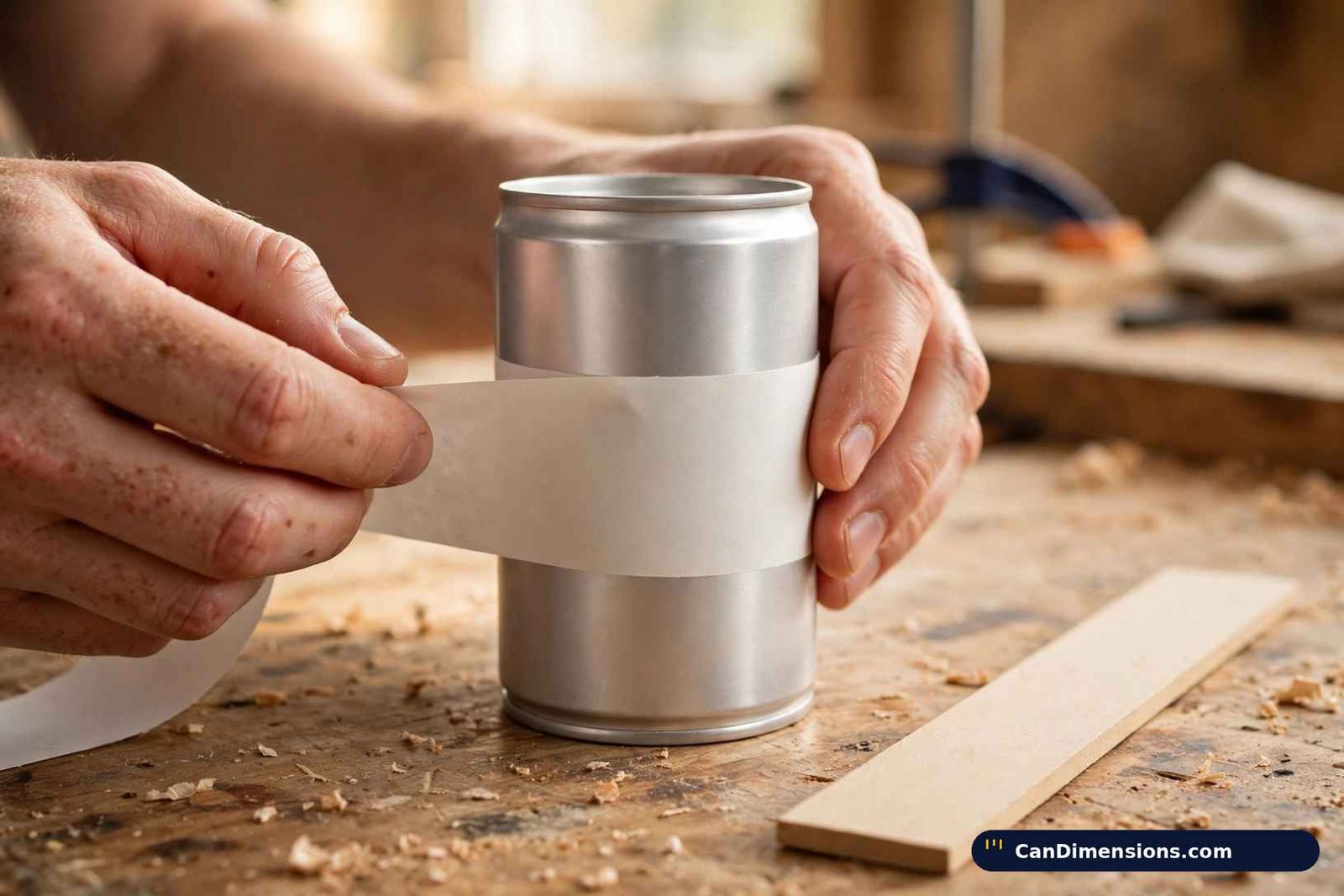
The Paper Template Method
Cut a rectangular piece of paper that wraps completely around your can. This simple DIY measurement technique costs nothing and gives you immediate visual feedback on how different sizes will look. Trim the paper to match your desired label height and width. Wrap it around your can and adjust until you achieve the coverage you want, then measure the final paper dimensions with a ruler. This hands-on approach reveals issues you might miss on a computer screen. You’ll see exactly how text placement works, where your logo sits, and whether your design proportions match the can’s physical dimensions.
Professional Measurement Techniques
Digital calipers provide precision down to 0.01 inches for can diameter measurements. Measure at multiple points around the can, as slight manufacturing variations can affect your final label width calculations. Work directly with your label printer for exact specifications. Professional manufacturers maintain databases of common can sizes and can provide template files that guarantee proper beer can label dimensions for your specific containers. Account for label material thickness in your calculations. Thicker materials like vinyl add bulk that affects how labels wrap and overlap, potentially requiring width adjustments of 0.0625 to 0.125 inches.
One precision note: calipers read a diameter, and the wrap figure follows from it — circumference = π × measured diameter. On the standard body, calipers should read about 2.6 inches (66 mm); if they read 2.69 inches, you are measuring something other than a standard beer can body, and the label should be cut to what you measured, not to this chart.
Beer Can Label Dimensions Calculator Formula
Calculate label width using this formula: (Can Diameter × 3.1416) − Gap Allowance. Most breweries use a 0.25 to 0.375-inch gap for clean label separation where ends meet. Measure label height directly on your can from the lowest point you want covered to the highest. Subtract 0.5 inches total (0.25 inches top and bottom) to ensure margins away from can edges. Convert between inches and millimeters by multiplying inches by 25.4. International suppliers often quote can dimensions in millimeters, so accurate conversion prevents costly ordering mistakes that delay your production schedule.
The formula is right; the gap range belongs to the code-based circumference, not the real one. Run it with the measured body: 2.6 in × 3.1416 = 8.17 in, minus the stocked die’s actual gap of about 0.04 in, gives the 8.125-inch label. A 0.25–0.375-inch gap is a legitimate design choice — it produces the “optimal” 8-inch and shorter dies printers also stock — but it is a choice about back-panel coverage, not the standard full wrap. State which you are ordering: full wrap (8.125″), optimal (8″), or half wrap (6.25″).
Designing Within Your Beer Can Label Dimensions

How to Design a Beer Can Label That Fits Perfectly
Set up your design file with exact label dimensions plus bleed area. A standard 8.125″ × 3.625″ label needs a 8.375″ × 3.875″ canvas to accommodate the required 0.125-inch bleed on all sides. Maintain 300 DPI resolution minimum for professional print quality. Lower resolutions create blurry text and pixelated images that look unprofessional on finished cans and damage your brand perception. Save files in PDF, AI, or EPS formats with fonts converted to outlines. This prevents font substitution issues and ensures your design prints exactly as intended, regardless of what fonts your printer has installed.
The canvas arithmetic is correct — 0.125 inches of bleed on all four sides adds 0.25 inches to each dimension — and it is kept, applied to the stocked die: an 8.125″ × 3.5″ label is built on an 8.375″ × 3.75″ canvas. On the safe zone, printers’ own art guidelines put the hard limit much tighter than the conservative 0.25 inches quoted in the Anatomy section: one major die printer keeps critical content just 1/16 inch (0.0625″) inside the die line, the band where cutting tolerance lives. Design to 0.25 inches if your layout allows it — it is safer — but know that 1/16 inch is the production minimum, not a quarter-inch.
Design Elements and Beer Label Size Optimization
Position your logo in the upper third of your label for maximum visibility. This placement catches consumer eyes at typical shelf height and works whether cans face forward or angle slightly in coolers. Typography sizing requires careful consideration within limited label dimensions. Use minimum 8-point fonts for compliance text and 14-point or larger for brand names to ensure readability from typical shopping distances. Color choices impact how your label appears on different can sizes. Metallic silver cans show through lighter label colors, while gold cans affect warm color palettes differently than expected on screen mockups.
One sizing figure in this section is superseded by the compliance section below: federal law does not measure the government warning in points. Its floor is a character height of 2 mm with a maximum of 25 characters per inch for cans of this size — a rule a nominal “8-point” setting can still fail if the face is condensed. Set compliance text by measured height, not by the point number in the layout program.
Compliance Requirements Within Standard Label Dimensions
TTB regulations mandate specific text sizes for government warnings. The “GOVERNMENT WARNING” statement must appear in at least 2mm lettering, which translates to roughly 6-point font depending on typeface choice. Alcohol content declarations need prominent placement within your beer can label design. Most breweries position this information on the front lower third or back upper third for easy consumer visibility and regulatory compliance. State-specific requirements vary across the USA. California, Texas, and Florida each have unique labeling rules that may affect your label dimensions or require additional text.
The 2 mm floor is correct for beer cans — the TTB rule (27 CFR 16.22) sets a 2 mm minimum character height for containers larger than 237 mL (8 fl oz) and up to 3 liters, which covers every can in this guide — but it is only half the rule: the same regulation caps the warning at 25 characters per inch, requires “GOVERNMENT WARNING” in bold capitals with the rest of the statement not in bold, and requires the statement to appear as one continuous block, separate from other information, legible on a contrasting background. Two softer claims are corrected: for malt beverages, a federal alcohol-content statement is generally optional (many states require one, which is why most labels carry it), so its placement is a design and state-law question, not a federal placement mandate; and the warning’s position — front, back or side — is the brewer’s choice under the rule, provided it is conspicuous. This is general information from the published regulation, not legal advice for a specific label, which needs a COLA review.
Material Considerations for Beer Can Label Dimensions
How Thick Are Labels?
Standard label thickness ranges from 2 to 4 mil depending on material choice. One mil equals 0.001 inches, so a 3-mil label measures just 0.003 inches thick but affects how it wraps around cans. Vinyl labels typically measure 3.5 to 4 mil thick. This extra thickness provides durability for ice buckets and outdoor events but requires slightly narrower width dimensions to prevent overlap when wrapped. Paper labels run thinner at 2 to 3 mil. These work well for retail shelf environments but may deteriorate faster in wet cooler conditions, affecting both appearance and label adhesion over time.
The range survives checking, with the units now anchored: 1 mil = 0.001 in = 25.4 µm exactly. The film most can labels are printed on, BOPP, is commonly supplied as a 50 µm facestock — 1.97 mil, the bottom of the quoted range — and shrink-sleeve films run 40–50 µm (about 1.6–2 mil). Paper facestocks with adhesive sit higher. So “2 to 4 mil” is a fair span across materials, provided it is read as the whole label construction, not the print film alone.
Adhesive Types and Dimensional Stability
Permanent adhesive creates strong bonds that won’t peel or lift during cold storage. This adhesive type works best for beer can labels that face temperature fluctuations from brewery to consumer refrigerator. Cold storage below 40°F can affect label dimensions through material contraction. Quality label materials resist shrinkage, but cheaper options may pull away from can edges or create wrinkles after extended refrigeration periods. Moisture resistance protects your labels in ice-filled coolers and condensation-heavy environments. Laminated labels or synthetic materials maintain their size and appearance better than uncoated paper in wet conditions.
The practical core — synthetic film outlasts uncoated paper in ice and condensation — is standard printer guidance and is kept. The specific contraction claim (measurable label shrinkage below 40 °F) is not stated by the film or printer sources checked for this guide, so it is not repeated as a measured fact: what cold and wet demonstrably do is attack adhesion and paper fibres, which is why wet-strength and film stocks exist. If a dimension has to survive the cooler, the verified route is the material choice, not a temperature threshold.
Label, Sleeve or Printed Can: Three Different Products

Most confusion in this topic comes from three different products sharing the word “label”. A pressure-sensitive label — everything charted above — is a printed sticker on a liner, applied to a blank (“brite”) can; it covers the straight wall only, leaves a hairline gap or a small overlap at the back, and is the small-batch default. A shrink sleeve is a tube of printed film (typically PETG, 40–50 µm) slipped over the can and shrunk in a heat tunnel; it follows the can over the shoulder, covers nearly the full height, and is sized by lay-flat width and cut length from the can’s circumference — not by the wrap dies in this guide. A printed can carries the design printed directly on the aluminum by the can maker before filling; it has no label dimensions at all, and it is how most national beer is packaged.
The sizing consequence is the point: order a wrap die for a sleeve job, or sleeve film to a wrap measurement, and the job fails. Tell your printer which of the three you are buying before anyone talks inches — and if the can will wear a sleeve in a fridge or cooler, the sleeve sizing for the same body is worked from the same circumferences charted here. A sleeve or wrap that fits the body also has to clear the same rims and curves a can koozie dimensions sleeve is cut around.
Printing Your Beer Can Labels
Can I Print My Own Labels at Home?
Desktop printers handle sheets up to 8.5″ × 11″ or 8.5″ × 14″ maximum. This limits you to label dimensions under 8 inches wide, which barely accommodates standard beer can labels with proper bleed area. Home printing quality rarely matches professional output. Consumer inkjet and laser printers typically max out at 1200 DPI, while commercial presses run 2400 DPI or higher for sharper text and images. Cost per label often runs higher for DIY production once you factor in premium label sheets, ink cartridges, and your time. Professional printing becomes more economical beyond 500-1000 labels, especially for multiple can sizes.
The sheet-size claim is backwards, and it is corrected: an 8.125-inch label fits across an 8.5-inch-wide sheet with room to spare — width is not what stops home printing. What stops it is stock and durability: desktop machines need pre-cut or sheet label stock in the right size, home inks are not waterproof, and an unlaminated home label in an ice bucket fails fast. The DPI comparison is also not how label quality is specified — printers ask for artwork at 300 DPI (PPI) at final size, and judge output by the press and stock, not by a headline DPI race. The cost conclusion (professional printing wins beyond a few hundred labels) is the section’s own estimate and is kept as guidance, not as a verified figure.
Professional Printing Considerations for Beer Label Dimensions
Digital printing accommodates any custom dimensions without plate costs or setup fees. This flexibility benefits small breweries testing new products or running limited seasonal batches with unique label sizes. Minimum order quantities vary by printer and label dimensions. Standard sizes like 8.125″ × 3.625″ often have no minimums, while custom beer can label dimensions may require 1000-2500 piece minimums to justify die creation. Roll configuration affects how labels feed through applicators. Standard unwind direction position #3 means the right edge comes off the roll first, with label face up and adhesive backing down on a 3-inch core.
Kept as printer-practice guidance, with the standard size corrected to the stocked 8.125″ × 3.5″ die (the 3.625-inch variant exists, as noted above, but is not the default). Minimums and unwind conventions genuinely vary by printer — both figures here are plausible shop practice, printed as guidance to confirm on the quote, not as industry constants.
What Is the Standard Label Size for Commercial Production?
The 8.125″ × 3.625″ dimension for 12 oz cans and 8.125″ × 5″ for 16 oz cans represent the most economical standard sizes. Printers stock dies for these measurements, eliminating custom tooling charges. Common die sizes kept in inventory reduce lead times by 3-5 business days. Popular beer can label dimensions ship faster because printers maintain these cutting tools ready for immediate production. Premium pricing applies to unusual label sizes outside industry standards. Expect 10-30% higher costs for custom dimensions due to die creation, material waste, and setup time that standard sizes avoid.
The 16 oz figure is verified; the 12 oz height is corrected to the stocked standard, 8.125″ × 3.5″, with the 8″ × 3.625″ die noted as a stocked variant at die printers. The cost and lead-time percentages in this section (10–30% custom premiums, 3–5 business days) could not be verified against a published printer price list — they are plausible shop experience, and they are printed here as estimates to test against quotes, not as established figures.
Beer Can Label Dimensions for Different Application Methods
Hand Application Sizing Considerations
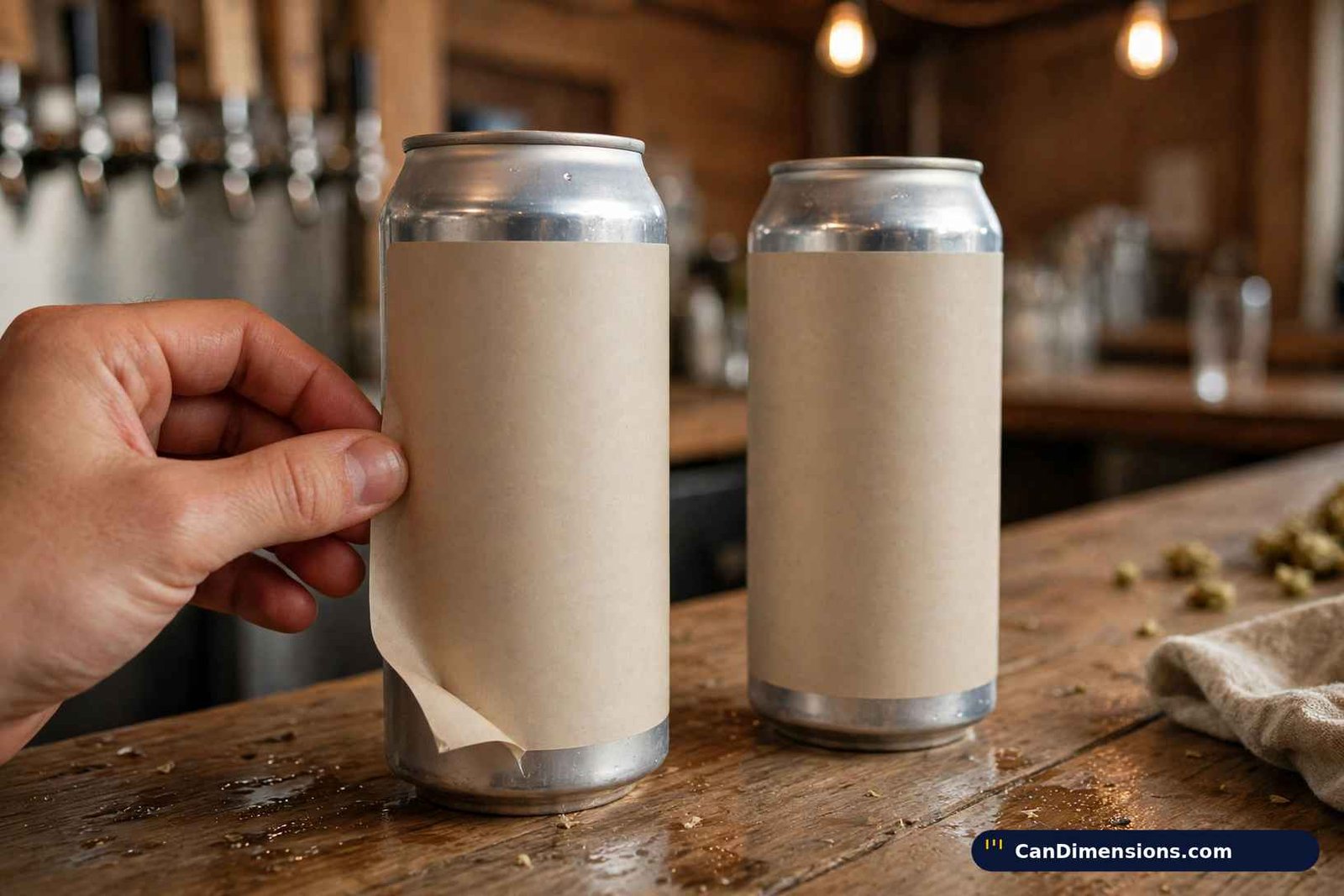
Manual labeling works best with label dimensions under 4 inches in width. Wider labels become difficult to align properly without wrinkles, especially on curved beer can surfaces at production speeds. Alignment challenges increase with larger label sizes. The 8.125-inch width requires careful technique to prevent diagonal placement or bubbles that detract from professional appearance and brand image. Small batch tips include using label placement guides marked on work surfaces. Consistent positioning ensures every can in your limited release maintains the same visual presentation customers expect from quality craft breweries.
The “under 4 inches” limit contradicts the rest of this page and the printers who sell 8.125-inch full wraps precisely for small-batch hand application — it is corrected here: there is no 4-inch width ceiling for hand labeling. Wide wraps are slower and less forgiving — the alignment and bubble warnings are real, and a placement jig or a marked guide line is the standard fix — but the full wrap is routinely applied by hand at taproom scale, which is the entire market for the crowler dies above.
Automatic Applicator Requirements
Machine-compatible dimensions depend on your specific equipment model. Most entry-level applicators handle labels up to 8.5 inches wide and 10 inches tall, accommodating standard beer can label sizes perfectly. Production speed affects which label dimensions work best. Narrower labels apply faster with fewer jams, while wider full wrap labels may require slower speeds to prevent misalignment and material waste. Gap requirements between labels on rolls typically measure 0.125 to 0.25 inches. This spacing lets sensors detect individual labels, triggering precise application timing that prevents doubles or misses during production runs.
The first sentence is the verified part: compatibility is model-specific, so the 8.5 × 10-inch envelope is printed as a typical class figure to check against your machine’s manual, not as a standard. The roll gap (0.125–0.25 in between labels on the liner) is standard converting practice and is kept.
Question’s
What is the size of a beer can label?
The most common beer can label size measures 8.125 inches wide by 3.5 inches tall for standard 12 oz cans. For 16 oz pint cans, the standard dimensions increase to 8.125 inches wide by 5 inches tall to maintain proper visual proportions.
What are the dimensions of a can of beer?
Standard beer cans in the USA use the 211 body code, which names — but does not measure — the body: the finished can is 2.6 inches (66 mm) across, with a circumference of approximately 8.16 inches around, and heights of 4.83 inches for 12 oz cans and 6.19 inches for 16 oz cans on the can makers’ specifications. (The 2.6875-inch and 8.443-inch figures come from converting the 211 code literally; no finished can measures them.) The can itself, format by format, is the subject of our coke can dimensions guide’s standard shell as well.
What is the standard label size?
The industry standard label size for 12 oz beer cans is 8.125″ × 3.5″, while 16 oz cans use 8.125″ × 5″ dimensions. These measurements provide optimal coverage, work with most application equipment, and avoid custom die fees that increase production costs.
How to design a beer can label?
Start by setting up your file with correct label dimensions plus 0.125-inch bleed on all sides. Maintain 300 DPI resolution, keep critical elements 0.25 inches from edges, and save as PDF with outlined fonts to ensure your design prints exactly as intended.
What is the 75-85-95 rule for wine?
It is not a serving-temperature rule, and no such temperature rule exists in wine service — wine is never served at 95 °F. The numbers 75, 85 and 95 are the U.S. wine-label content thresholds in federal regulation: a wine named for a grape variety must be at least 75% that variety; a wine named for an American Viticultural Area (AVA) must be at least 85% from that area; and a wine carrying a vintage date with an AVA appellation, or naming a specific vineyard, must be at least 95% from that year or vineyard. The rule has nothing to do with beer can labels; it survives in this FAQ because readers keep asking, and the temperature version in circulation is simply wrong.
Can I print my own labels at home?
Home printing works for small test batches under 100 labels, but professional printing becomes more cost-effective and higher quality beyond that quantity. Desktop printers also struggle with the 8.125-inch width needed for standard beer can labels due to maximum sheet size limitations.
Correction to the last sentence: the 8.125-inch width fits an 8.5-inch sheet — the real home-printing limits are waterproof stock, pre-cut sizes and durability in ice, as covered in the Printing section above.
How to calculate label size?
Multiply your can’s measured diameter by 3.1416 (pi) to get circumference, then subtract your chosen gap — about 0.04 inches for the stocked full-wrap die, or 0.25–0.375 inches for a shorter “optimal” wrap. Measure height directly on the can’s straight wall, leaving clearances top and bottom, to calculate your final beer can label dimensions accurately. Work from the measured diameter (2.6 in on a standard can), never from the size code.
What are standard beer sizes?
Standard beer can sizes in the USA include 12 oz (355 ml), 16 oz (473 ml), 19.2 oz (568 ml), 24 oz (710 ml), and 32 oz (946 ml) crowlers. The 8 oz (237 ml) size in circulation belongs to bottles and mini formats, not to a standard beer can shell — the small can is the 7.5 oz sleek-family mini. No verified market-share figure for the 12 oz is published by the can makers, so the “roughly 60% of volume” claim sometimes attached to this list is not repeated here.
How thick are labels?
Beer can labels typically measure 2-4 mil thick depending on material. Paper labels run 2-3 mil, while vinyl labels measure 3.5-4 mil. One mil equals 0.001 inches, so even thick labels remain under 0.004 inches total thickness for smooth application.
Conclusion
Perfect beer can label dimensions require careful measurement, proper calculations, and understanding of industry standards. The most common sizes — 8.125″ × 3.5″ for 12 oz cans and 8.125″ × 5″ for 16 oz cans — work for the great majority of craft breweries labelling standard-body cans. Always verify your specific can dimensions before ordering labels, as variations between manufacturers can affect fit and appearance. Test with paper templates first, work closely with experienced label printers, and request physical proofs to catch issues before expensive production runs.
If you take one habit from this page, make it this: size the label from the measured body — 66 mm across, about 207 mm around — and never from the code printed in a chart. The code is a name; the circumference is a measurement, and the label only ever meets the measurement.